Daily Current Affairs for UPSC 9th Dec 2025


| Index |
| S.No | Topic | Page No |
| Daily Hindu Analysis (YouTube) |
| 1. | Democracy’s paradox, the chosen people of the state |
|
| 2. | A new step in the dragon-elephant tango |
|
| 3. | Shekhawat inaugurates 3-day Hornbill fest in Nagaland |
|
| 4. | ‘China must give assurance Indians won’t be targeted’ |
|
| 5. | What is the India Post’s DHRUVA framework? |
|
| 6. | How new DGCA rules put human limits at centre of air safety |
|
| 7. | 7 states contribute more to total taxes than their share from devolutions |
|
| |
| Daily Current Affairs (App) |
| 8. | Sanctuary Wildlife Service Award 2025 | |
9. | Border Roads Organisation (BRO) |
|
| 10. | 200th Anniversary of Dadabhai Naoroji |
|
| 11. | Diwali inscribed on UNESCO’s Intangible Cultural Heritage list |
|
Democracy’s paradox, the chosen people of the state
CONTEXT
The article examines India’s citizenship governance paradox: although Indian passports and electoral rolls are meant only for citizens, neither document is definitive proof of citizenship.
This debate resurfaced due to the Election Commission’s Special Intensive Revision (SIR) of electoral rolls, prompting legal, procedural, and philosophical questions about who determines citizenship, what constitutes proof, and how the state defines its people in a democracy.
DETAILED ANALYSIS
Citizenship documents: evidence vs proof
- A passport and voter roll entry indicate citizenship but do not prove it.
- People can forge or manipulate documents; hence their evidentiary value is limited.
- This tension — between status of evidence and evidence of status — lies at the heart of current debates.
The legal challenge to SIR
The challenge to the Election Commission’s SIR rests on three arguments:
1. ECI cannot determine citizenship — only the Home Ministry and bodies under the Foreigners Act/Tribunals can.
2. The law does not permit a mass citizenship verification; electoral roll corrections must be individualised.
3. Determining whether someone is a foreigner is a quasi-judicial function, not a field-level administrative task.
The ECI argues that it must ensure purity of electoral rolls, which requires verifying citizenship. Critics say this crosses legal boundaries.
The deeper philosophical problem: who is presumed to be a citizen?
The core issue is not just procedural — it is philosophical:
- Should residents be presumed citizens unless proved otherwise?
OR - Should individuals prove citizenship before being recognised?
This goes to the heart of India’s democratic norms.
No single document proves citizenship
- The Citizenship Act defines who is a citizen, but no document conclusively establishes it.
- The Home Minister, when asked in Parliament, could not cite any one document that proves citizenship.
- India has NPR (National Population Register), but NRC (National Register of Citizens) is the only legal citizen register — and it has never been fully implemented.
Thus, legal status and documentary evidence remain mismatched.
NPR, NRC and the rules underlying identity verification
- NPR records basic demographic data.
- NRC is derived from NPR by flagging “doubtful” individuals.
- Citizenship Rules describe how National Identity Cards will eventually be issued.
- The SIR resembles NRC-like verification, raising concerns about constitutional overreach.
Burden of proof on individuals, not on the state
- Indian law places the burden of proving citizenship on the individual when challenged.
- This was embedded in the NPR exercises of 2010 and 2015.
- BJP has dropped the promise of nationwide NRC from its 2024 manifesto, though NPR may still be updated.
India’s shift from Jus Soli to Jus Sanguinis
- Founding leaders supported jus soli — citizenship by birth.
- Over decades, especially since the 1980s, India moved toward jus sanguinis — citizenship based on descent and parental citizenship.
- This shift reflects concerns over illegal immigration and changes in political attitudes.
Increasing restrictiveness of citizenship by birth
Laws changed as follows:
- Up to 1987: Born in India = citizen.
- 1987–2004: One parent must be Indian.
- After 2004: One parent Indian + other parent not an illegal migrant.
The 2003 amendment introduced the idea of “illegal immigrants,” tightening birth-based citizenship further.
Lessons from the Assam NRC
- NRC in Assam involved massive document verification.
- Many residents were marked D-voters (doubtful voters).
- Their voting rights were suspended unless citizenship was proved.
- Post-process cuts in legal support and procedural complexities caused long-term disenfranchisement fears.
- The example shows how documentation-heavy processes can affect vulnerable populations.
The democracy paradox: Who creates whom?
- In theory, the state derives power from the people.
- But in citizenship verification, the state decides who the people are.
- Bureaucratic and police agencies end up exercising the authority to recognize identity.
- Thus, the democratic logic gets reversed:
The people constitute the state, but the state determines the people.
Conclusion:
- Citizenship determination is not merely administrative — it is deeply political and philosophical.
- SIR rekindles anxieties associated with NRC-like exercises.
- In a democracy, the burden of proving one’s belonging should not fall disproportionately on individuals.
The state claims sovereignty from the people, yet demands proof of belonging from the people it claims to serve.
UPSC MAINS QUESTION
“The determination of citizenship in India raises constitutional, administrative, and philosophical challenges. Discuss in the context of the ongoing debates around electoral roll verification and the paradox between democratic sovereignty and state authority.”
A new step in the dragon-elephant tango
1. CONTEXT
At the Fourth Plenary Session of the 20th Central Committee of the Communist Party of China (CPC), the proposal for China’s 15th Five-Year Plan was approved.
The article, written by the Chinese Consul General in Kolkata, argues that China’s new development strategy presents opportunities for India–China cooperation, highlighting historical ties, economic complementarities, and shared development aspirations.
The piece stresses that China and India—two ancient civilisations—are partners in shaping the future and must strengthen collaboration across various sectors.
2. DETAILED ANALYSIS
China’s new vision and significance of the 15th Five-Year Plan
- The new plan charts China’s development direction for the next five years while opening broad opportunities globally.
- China and India are neighbours and partners, both at a critical stage of national development.
- China is undergoing major modernisation, while India is working toward its “Viksit Bharat 2047” vision.
- Development is seen as the most important common interest between the two countries and a priority for both.
China’s economic progress under the 14th Five-Year Plan (2021–2025)
- China reached historic milestones and maintained average annual GDP growth of 5.5%, with its economy expected to hit RMB 140 trillion this year.
- Per capita GDP has been above $13,000 for two consecutive years.
- China became the leading upper-middle-income country and now ranks in the top 10 of the Global Innovation Index.
- China leads the world in installed renewable energy capacity and remains one of the world’s top three trading partners for 157 countries, including India.
- Contributing around 30% to global GDP growth, China is a major engine for global economic recovery.
- The article attributes China’s success to:
- Centralised leadership of the CPC
- Unified adherence to mid- and long-term strategies
- Stable and efficient governance
Evolution of China’s Five-Year Plans
From the 1st to the 14th Five-Year Plan, China has consistently worked toward building a modern socialist country.
It has:
- Combined a strong government with public consultation,
- Maintained policy stability and continuity,
- Focused on people-centric aspirations.
The upcoming 15th Five-Year Plan signals China’s intent to pursue:
- High-quality development
- High-level opening-up
- Expanded opportunities for cooperation with other economies, including India.
3. Potential Areas for India–China Cooperation
1. Economic and trade cooperation
- Trade is a major foundation of ties:
- Bilateral trade in 2024 reached $138.46 billion.
- India’s exports to China are increasing, and more Indian firms are tapping Chinese platforms such as:
- Canton Fair
- China International Import Expo
- China International Fair for Trade in Services
- China International Consumer Products Fair
These platforms can help India introduce more high-quality goods and services into Chinese markets.
2. Industrial and supply chain cooperation
- China and India complement each other:
- China: world’s largest manufacturing economy with strong supply chains.
- India: skilled IT, new-energy potential, infrastructure growth, innovation, and biopharma strength.
- Cooperation in these areas can drive mutual economic benefit.
3. People-to-people exchanges & cultural affinity
- Deep cultural connections go back thousands of years.
- Indian culture — yoga, Bollywood, Darjeeling tea — is extremely popular in China.
- China recently resumed Indian pilgrimages to Mount Kailash and Mansarovar.
- India restored 19 direct flights from different Chinese cities, boosting tourism, academics, and business exchanges.
4. Multilateral cooperation
- In a world facing economic headwinds, instability, and protectionism, platforms such as:
- BRICS
- SCO
- G20
provide opportunities for India and China to: - Strengthen coordination
- Address global issues (climate change, food security, public health)
- Promote a just, equitable, and orderly multipolar world
- Support inclusive globalisation
5. Historical goodwill and diplomatic trust
- Tagore described China as one of India’s “intimate friends.”
- 2025 marks 75 years of diplomatic ties between India and China.
- The article stresses “time-honoured brotherhood” and hopes for further improvement amid challenges.
- Under leadership guidance, China–India relations have “continued to improve and develop.”
- Stability between China and India is important for global stability.
UPSC MAINS QUESTION
“Discuss the opportunities and challenges for India–China cooperation in light of China’s proposed 15th Five-Year Plan. How can both countries strengthen bilateral ties while managing strategic differences?”
Shekhawat inaugurates 3-day Hornbill fest in Nagaland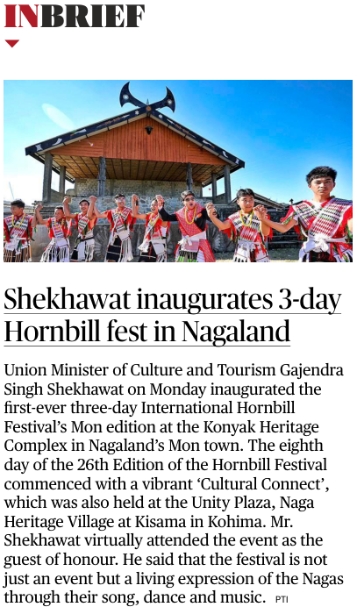
CONTEXT
- Union Minister of Culture & Tourism Gajendra Singh Shekhawat inaugurated the first-ever three-day International Hornbill Festival’s Mon edition at the Konyak Heritage Complex in Mon town, Nagaland.
- This Mon edition is part of the broader 26th Hornbill Festival, whose eighth day featured a ‘Cultural Connect’ event at Unity Plaza, Naga Heritage Village, Kisama (Kohima).
- The Minister attended the event virtually as Guest of Honour.
- He emphasised that the Hornbill Festival is not merely an event, but a living expression of Naga identity—showcasing their song, dance, culture, and music.
- The Mon edition marks a step towards taking the festival closer to different Naga tribes, especially the Konyaks, enhancing cultural visibility and tourism potential.
UPSC PRELIMS
Q. Consider the following statements about the Hornbill Festival:
1. It is an annual cultural festival organised by the Government of Nagaland.
2. The 2025 edition included, for the first time, a Mon edition held at the Konyak Heritage Complex.
3. The festival primarily celebrates the cultural heritage of all Naga tribes.
Which of the statements given above is/are correct?
(a) 1 and 2 only
(b) 2 and 3 only
(c) 1 and 3 only
(d) 1, 2 and 3
Answer: (d)
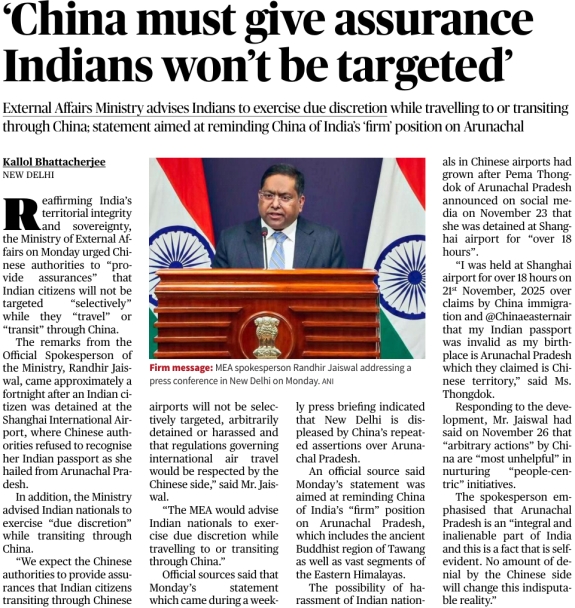
‘China must give assurance Indians won’t be targeted’
CONTEXT
- The Ministry of External Affairs (MEA) has urged China to provide assurances that Indian citizens will not be selectively targeted, detained, or harassed while they travel to or transit through China.
- This follows the incident where an Indian citizen from Arunachal Pradesh was detained for over 18 hours at Shanghai International Airport after Chinese authorities refused to accept her passport, claiming Arunachal Pradesh as “Chinese territory.”
- MEA spokesperson Randhir Jaiswal reaffirmed:
- India’s territorial integrity and sovereignty, especially regarding Arunachal Pradesh.
- That Arunachal Pradesh is an integral and inalienable part of India.
- The MEA also issued an advisory asking Indians to exercise “due discretion” while travelling through China.
- India noted that China has repeatedly made unfounded territorial claims over Arunachal Pradesh, and the latest statement serves as a reminder of India’s firm position.
- India emphasized that international travel regulations must be respected and Indians must not face arbitrary measures at Chinese airports.
UPSC PRELIMS PRACTICE QUESTION
Q. Consider the following statements regarding India–China relations:
1. The Government of India maintains that Arunachal Pradesh is an integral and inalienable part of India.
2. China issues stapled visas to Indian citizens from some regions as part of its territorial claims.
3. India has issued an advisory asking its nationals to exercise due discretion while travelling to or transiting through China.
Which of the statements given above are correct?
(a) 1 and 2 only
(b) 1 and 3 only
(c) 2 and 3 only
(d) 1, 2 and 3
Answer: (d) 1, 2 and 3
What is the India Post’s DHRUVA framework?

CONTEXT
The Department of Posts has proposed a framework called DHRUVA (Digital Hub for Reference and Unique Virtual Address) to standardise and digitally share physical addresses in India.
KEY POINTS
What is DHRUVA?
- A proposed Digital Public Infrastructure for reference and sharing of addresses.
- Converts physical addresses into unique digital “labels”.
- Works in combination with DIGIPIN, India Post’s geo-coded pin system.
DIGIPIN
- A 10-digit alphanumeric code tied to precise geolocation (12 sq. metre blocks).
- Helps in mail delivery, especially where descriptive addresses are unclear.
- Open-sourced and developed in-house by India Post.
Ecosystem under DHRUVA
- Address Service Providers (ASPs): generate proxy addresses/labels.
- Address Validation Agencies (AVAs): authenticate addresses.
- Address Information Agents: manage user consent for data sharing.
- A governance entity (similar to NPCI) to oversee the framework.
Potential Use Cases
- Consent-based address tokenisation (like UPI handles for bank accounts).
- Seamless updating of addresses when users move houses.
- Platforms (Amazon, Uber, logistics firms, govt. portals) can use labels instead of full physical addresses.
- Faster, secure service delivery through verified, standardised addresses.
Concerns Raised
- Effectiveness for urban governance is unclear because the system links addresses to people rather than physical infrastructure surveys.
- Incomplete datasets if users choose not to share addresses.
- Heavy reliance on collecting personal information → need for strong consent framework.
UPSC PRELIMS PRACTICE QUESTION
Q. With reference to DHRUVA (Digital Hub for Reference and Unique Virtual Address), consider the following statements:
1. DHRUVA aims to standardise and share physical addresses through digital labels.
2. DIGIPIN, associated with DHRUVA, is a 10-digit geocoded alphanumeric pin developed by India Post.
3. DHRUVA functions as a Digital Public Infrastructure similar to Aadhaar and UPI.
4. Under DHRUVA, address sharing will occur without any user consent to improve service efficiency.
Which of the statements given above are correct?
(a) 1, 2 and 3 only
(b) 1 and 2 only
(c) 2, 3 and 4 only
(d) 1, 2, 3 and 4
Answer: (a) 1, 2 and 3 only
How new DGCA rules put human limits at centre of air safety
CONTEXT
Recent flight disruptions, especially IndiGo cancellations, have brought attention to the new fatigue and rest norms introduced by the Directorate General of Civil Aviation (DGCA).
- The cancellations were caused by crew scheduling lapses, not by the new DGCA norms themselves.
- The article argues that the new rules are scientifically grounded in human physiology and must not be diluted.
- Aviation safety depends heavily on managing pilot fatigue, as fatigue has consistently contributed to global aviation incidents.
- The DGCA’s revised norms align India with international best practices adopted in the U.S. and Europe to reduce fatigue-related errors.
KEY FACTS
What the New DGCA Framework Changes
1. Weekly rest increased from 36 to 48 hours.
2. Night landings reduced from six to two per week.
3. Definition of “night duty” expanded → restricting flying during biologically unsuitable hours.
4. Mandatory fatigue risk reporting introduced.
5. Greater scrutiny of crew rosters.
Why These Rules Matter
- Fatigue affects reaction time, judgment, vigilance, attention, and increases emotional irritability.
- Pilots face unique stressors:
- time-zone shifts,
- twilight-hour flights,
- disrupted circadian rhythms,
- dry cabin air, vibration, noise, reduced oxygen pressure.
- These disrupt melatonin secretion and cause sleep debt.
Medical Evidence Supporting Tighter Norms
- Chronic circadian misalignment linked to:
- high blood pressure,
- metabolic disturbances,
- impaired immunity,
- cardiovascular risk,
- depression,
- menstrual irregularities.
- Long-haul operations worsen jet lag and disrupt metabolism.
- Confined postures → musculoskeletal strain.
Wider Relevance Beyond Aviation
- Fatigue risk also affects: hospital workers, railways, trucking, police forces, BPOs, journalists.
- Many sectors lack strong regulations compared to aviation.
Central Argument of the Article
The DGCA norms are essential, scientifically justified, and place human physiology at the centre of air safety.
Any attempt to dilute the rules due to operational inconvenience must be resisted.
UPSC PRELIMS PRACTICE QUESTION
Q. With reference to the new DGCA flight duty norms, consider the following statements:
1. The weekly rest period for pilots has been increased as part of the new framework.
2. The number of permitted night landings has been reduced to address fatigue risks.
3. The DGCA now mandates fatigue risk reporting by airlines.
4. The new rules are primarily aimed at addressing mechanical failures in aircraft.
Which of the above statements are correct?
(a) 1, 2 and 3 only
(b) 1 and 3 only
(c) 2 and 4 only
(d) 1, 2, 3 and 4
Answer: (a) 1, 2 and 3 only
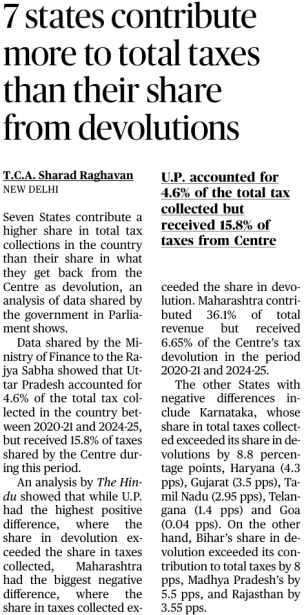
7 states contribute more to total taxes than their share from devolutions
CONTEXT
- Ministry of Finance data shared in Parliament shows seven States contribute a higher share of total taxes collected in India than the share they receive back from the Centre as tax devolution.
- Uttar Pradesh:
- Contributed 4.6% of total taxes (2020-21 to 2024-25)
- But received 15.8% of the total devolved taxes — the highest positive gap.
- States contributing more than what they receive include:
- Maharashtra (largest negative gap: contributed 36.1% of taxes but received only 6.65%)
- Karnataka, Haryana, Gujarat, Tamil Nadu, Telangana, and Goa.
- On the contrary, States like Bihar, Madhya Pradesh, and Rajasthan receive a higher share of devolutions than their contribution.
- This reflects the redistributive nature of India’s federal fiscal structure, where richer states subsidise poorer states through the Finance Commission’s formula.
ABOUT DEVOLUTION OF FUNDS
What is Tax Devolution?
- The Centre transfers a share of its divisible tax pool to States, as recommended by the Finance Commission.
- These transfers are unconditional and form a major source of revenue for many States.
Purpose
- Fiscal equalisation among states.
- Ensuring poorer states receive more support for development.
RELEVANT CONSTITUTIONAL PROVISIONS
Article 280
- Establishes the Finance Commission, which recommends:
- Division of taxes between Centre and States
- Principles governing grants-in-aid
- Measures to improve fiscal stability
Article 270
- Provides for levy and distribution of taxes between the Centre and States (divisible pool).
Article 275
- Grants-in-aid to states (statutory grants).
Article 266
- Consolidated Fund of India & Consolidated Fund of States — where devolved taxes are credited.
Article 268–269A
- Deal with the assignment of certain taxes to states (e.g., stamp duty, GST on inter-state supplies).
KEY FACTS
15th Finance Commission fixed 41% of the divisible pool as the share for states (excluding J&K).
- Devolution formula uses factors like:
UPSC PRELIMS PRACTICE QUESTION
Q. With reference to tax devolution in India, consider the following statements:
1. The share of States in the divisible pool of central taxes is recommended by the Finance Commission under Article 280.
2. Tax devolution is a constitutional obligation and not discretionary for the Union Government.
3. The Finance Commission may recommend grants-in-aid to States under Article 275.
Which of the statements given above are correct?
(a) 1 and 2 only
(b) 2 and 3 only
(c) 1 and 3 only
(d) 1, 2 and 3
Answer: (d) 1, 2 and 3
Sanctuary Wildlife Service Award 2025
Syllabus: GS-III — Environment: Biodiversity Conservation; Species Protection; Community-led Conservation.
Context
BNHS scientist Parveen Shaikh has been awarded the Sanctuary Wildlife Service Award 2025 for her innovative, community-driven conservation of the endangered Indian Skimmer in the National Chambal Sanctuary.
Key points
- About the Award: A national honour recognising exceptional contributions to wildlife conservation, focusing on individuals safeguarding threatened species and ecosystems.
- Instituted by: Sanctuary Nature Foundation.
- 2025 Awardee: Parveen Shaikh, scientist at the Bombay Natural History Society (BNHS).
- Scientific research: Conducted long-term monitoring of Indian Skimmer populations since 2016; documented nesting behaviour, threats, and survival constraints.
- Community-led model: Developed the ‘Nest Guardian’ programme, where locals protect sandbar nests through fencing, monitoring and predator deterrence.
- Impact: Increased nest survival from near zero to approximately 60%.
- Habitat assessment: Analysed impacts of dams, water-flow changes, accessibility of sandbars, and recommended adaptive conservation strategies aligned with river dynamics.
Source: The Hindu
Border Roads Organisation (BRO)
Syllabus: GS-III — Defence: Strategic Infrastructure; Border Management; Disaster Response.
Context
The Defence Minister inaugurated 125 BRO infrastructure projects worth ₹5,000 crore, marking the largest single-day project launch in the organisation’s history.
Key points
- About BRO: A premier road construction force under the Ministry of Defence, responsible for building and maintaining strategic border infrastructure in India and select foreign nations.
- Established: 7 May 1960; functions under the Border Roads Development Board (BRDB); HQ: New Delhi.
- Aim: To meet strategic needs of the Armed Forces through timely, high-quality infrastructure and support socio-economic growth in remote border regions.
- Peace-time role:
- Develop and maintain operational road networks in border areas.
- Execute infrastructure projects in friendly countries (Bhutan, Afghanistan, Myanmar, Tajikistan, Sri Lanka).
- Support remote-area development through connectivity.
- War-time role:
- Construct and maintain roads for troop mobility and logistics.
- Keep supply routes functional by clearing snow, landslides, avalanches.
- Undertake additional duties assigned during conflicts.
- Other functions:
- Build roads, bridges, tunnels, and airfields in high-altitude/extreme climates.
- Use indigenous tech such as Class-70 modular bridges.
- Employ large numbers of local workers, aiding livelihoods.
- Provide disaster relief during earthquakes, floods, landslides, and tsunamis.
- Significance:
- Strategic: Enhances military mobility along borders with China & Pakistan and in the Himalayas.
- Economic: Boosts connectivity, trade, tourism, and regional development.
- Geopolitical: Supports India’s neighbourhood outreach via infrastructure diplomacy.
- Humanitarian: Key contributor to rescue and relief operations.
Source: DD News
200th Anniversary of Dadabhai Naoroji
Syllabus: GS-I — Modern Indian History: Freedom Movement, Economic Nationalism, Reformers.
Context
India celebrated the 200th birth anniversary of Dadabhai Naoroji in 2025, recognising his foundational role in nationalism, economic thought, and early political mobilisation against British rule.
Key points
- Who he was: Indian nationalist leader, economic theorist, social reformer, scholar, and the first Indian Member of British Parliament.
- Birth: Born 4 September 1825 in Bombay/Navsari; educated at Elphinstone Institute; later became its first Indian Professor.
- Drain of Wealth Theory: Demonstrated the economic drain under British rule through unequal trade, remittances, pensions, and administrative expenses.
- Major works: Poverty and Un-British Rule in India, Poverty of India.
- Welby Commission: His analysis led to the 1895 Welby Commission on Indian expenditure, where he served as a member.
- Role in INC:
- Founding member of the Indian National Congress.
- President of INC in 1886, 1893, 1906.
- The 1906 Calcutta Session under him formally adopted Swaraj as the national goal.
- First Indian MP: Elected to the British Parliament in 1892 (Central Finsbury, Liberal Party); advocated self-government and constitutional rights for Indians.
- Mentor to national leaders: Influenced Tilak, Gokhale, and Mahatma Gandhi, shaping early nationalist ideology.
- Social reforms:
- Promoted women’s education and conducted classes at Elphinstone.
- Founded Rast Goftar (Gujarati newspaper).
- Co-founded Rahnumai Mazdayasan Sabha (1851) for Parsi reform.
- Made submissions to the Hunter Commission (1882) advocating compulsory primary education.
- Organisational building:
- Founded London Indian Society (1865) and East India Association (1866) to represent Indian interests abroad.
- Unique recognitions:
- Known as the Grand Old Man of India.
- Called the Unofficial Ambassador of India for raising India’s cause in Britain.
- Taught Gujarati at University College London, breaking academic barriers.
Source: Free Press Journal (FPJ)
Diwali inscribed on UNESCO’s Intangible Cultural Heritage list
Syllabus: GS-I — Indian Culture: Festivals, Cultural Heritage; International Recognition of Cultural Practices.
Context
Diwali has been officially added to UNESCO’s Intangible Cultural Heritage (ICH) List, marking global recognition of one of India’s most celebrated cultural traditions during UNESCO’s ongoing session in New Delhi.
Key points
- UNESCO recognition: Diwali is now part of the Intangible Cultural Heritage list, highlighting its cultural depth, symbolism of light, and universal message of harmony.
- Purpose of listing: Aims to safeguard living cultural traditions, promote global awareness, and ensure continuity for future generations.
- Selection factors: Recognised for its historical continuity, vibrant rituals, community participation, and its widespread celebration across India and the world.
- UNESCO session: The cultural agency reviewed nominations from 70+ countries to support diverse traditional practices globally.
- Symbolism: Five-day festival representing the victory of good over evil; associated with the return of Lord Rama to Ayodhya in the Ramayana.
- Nationwide celebrations: India hosted events including mass lamp-lighting ceremonies, city-wide illuminations, and public festivities marking the honour.
- Cultural reach: Celebrated by millions worldwide across religious and cultural backgrounds, reinforcing social bonds and community cohesion.
- Exam-oriented facts:
- UNESCO ICH list protects living cultural expressions, not monuments.
- Diwali is one of India’s most widely celebrated festivals with strong cultural and religious significance.

 Launch your Graphy