Daily Current Affairs for UPSC 8th Dec 2025



| Index |
| S.No | Topic | Page No |
| Daily Hindu Analysis (YouTube) |
| 1. | Rupee at 90: a market meltdown or a calculated policy pivot by RBI? |
|
| 2. | The evolution of pension reforms in India | |
3. | Surveillance apps in welfare, snake oil for accountability |
|
| 4. | Rajnath unveils border infrastructure projects | |
5. | National intelligence grid gains traction as Central agencies, police scour for information | |
6. | Top court warns of penalties for abuse of disabled prisoners | |
7. | Local body elections too complex to be a referendum on State government in Kerala | |
8. | Assam tribal body protests against ST tag for six groups | |
9. | Cheetah cub dies less than a day after release into the wild |
|
| |
| Daily Current Affairs (App) |
| 10. | Organization for Security and Cooperation in Europe (OSCE) | |
11. | Zambezi River | |
12. | Directorate General of Civil Aviation (DGCA) |
|
| 13. | Shingles Disease |
|
| 14. | Barcelona Convention |
|
| 15. | Niger Becomes 1st African Country to Eliminate Onchocerciasis | |
16. | India Hosts 20th UNESCO’s Inter-Governmental Committee | |
Rupee at 90: a market meltdown or a calculated policy pivot by RBI?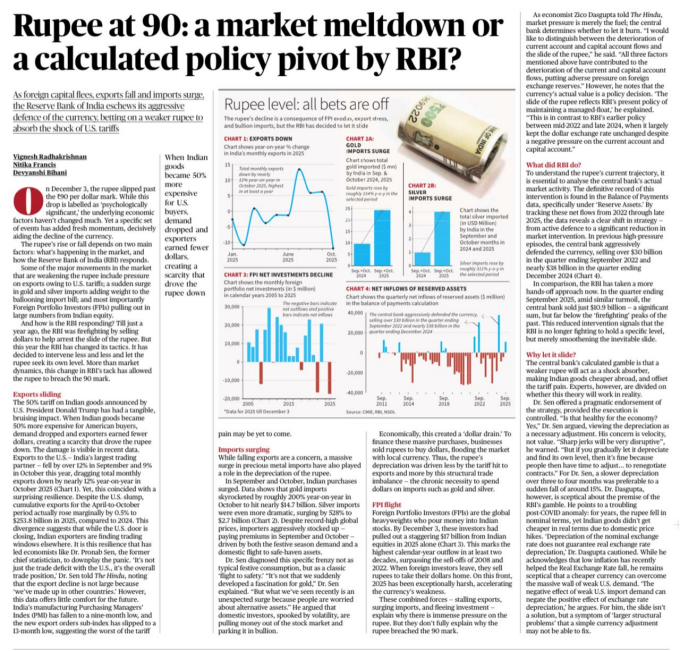
Context
The rupee has slipped past ₹90 per US dollar, its weakest level ever. The article analyses whether this is
- a panicky market-driven crash, or
- a deliberate RBI strategy to let the rupee weaken so that India can absorb the impact of US tariffs and weak exports without burning too many forex reserves.
Detailed Analysis
1. Immediate triggers behind the slide
- US tariffs on Indian goods have made Indian exports more expensive, sharply lowering demand from India’s biggest trade partner.
- As exports dropped and import demand for essentials (oil, gold, silver, inputs) stayed high, the trade deficit widened, adding pressure on the rupee.
- Markets also reacted to sentiment and expectations – once the rupee crossed key levels, stop-losses and speculative positions amplified the fall.
2. Export slowdown and tariff shock
- US tariffs meant that many Indian goods suddenly became 50% more expensive for American buyers.
- Export orders fell in sectors such as manufacturing, pharmaceuticals, garments and engineering goods, reducing dollar inflows.
- This created a scarcity of dollars relative to demand, putting downward pressure on the rupee.
3. Import dynamics: gold, silver and other commodities
- While exports were weakening, imports surged:
- Gold and silver imports rose sharply as households and investors treated them as a hedge against uncertainty.
- Higher oil prices and festive-season demand added to the import bill.
- This combination – weak exports + strong imports – worsened the current account deficit (CAD) and deepened structural pressure on the currency.
4. Capital flows: FPI outflows and “dollar drain”
- Foreign Portfolio Investors (FPIs) pulled out money from Indian equities and bonds amid global risk aversion and better yields elsewhere.
- Businesses needing dollars for import bills, external debt repayment and bullion purchases rushed to buy dollars in advance (“front-loading”), intensifying demand.
- Together, this resulted in a ‘dollar drain’ – fewer dollars coming in, more going out – accelerating the rupee’s decline.
5. RBI’s changing exchange-rate strategy
Earlier approach (e.g. 2022 episode)
- When volatility spiked earlier, RBI aggressively defended the rupee, selling tens of billions of dollars from its reserves to hold specific levels.
- The exchange-rate regime was effectively a tightly managed float, with RBI leaning strongly against depreciation.
Current approach (rupee at 90)
- This time, RBI has taken a more hands-off, “tolerant” stance:
- It is intervening to smooth volatility, but not to protect any particular level.
- Forex reserves remain comfortable; RBI prefers to preserve reserves rather than burn them defending 89 or 90.
- Economists quoted in the article argue that the rupee’s current level reflects a policy decision, not just pure market panic – a calculated pivot within a managed-float framework.
6. Why might RBI allow a weaker rupee?
- Tariff shock absorber:
- US tariffs have eroded price competitiveness of Indian exports.
- A somewhat weaker rupee offsets part of this shock, making exports cheaper in dollar terms and helping firms stay in overseas markets.
- Support for domestic demand & growth:
- Over-tight defence of the rupee could require sharp rate hikes and liquidity tightening, hurting growth.
- By allowing gradual depreciation, RBI avoids a sudden squeeze on credit and supports the domestic recovery.
- Reserve management:
- With global uncertainty and potential capital-flow swings, burning reserves to defend a “prestige level” may be risky.
- A flexible rupee plus adequate reserves gives RBI more room if conditions worsen later.
7. Risks of a weaker rupee
- Imported inflation:
- Costlier oil, fertilisers, electronics, edible oils, gold and machinery can push up inflation.
- Poor households face higher fuel and food prices; government may have to absorb part of the pain through subsidies.
- External debt servicing:
- Corporates and public entities with foreign-currency debt see rupee-denominated repayment burdens rise.
- Investor confidence:
- A rapid slide can spook financial markets, trigger more FPI outflows, and create a self-fulfilling pessimism about the Indian macro story.
The article therefore stresses that how RBI communicates its strategy is critical – markets must see a coherent policy choice, not policy drift.
8. Is it a market meltdown or policy pivot? – Author’s view
- The article leans towards the view that the present episode is not just a meltdown but reflects a deliberate shift in RBI’s reaction function:
- From defending a particular rupee level, to prioritising external competitiveness and reserve conservation, while tolerating a weaker currency.
- However, the author cautions that if underlying fundamentals – export weakness, high commodity imports, and FPI outflows – are not corrected, a policy of tolerance could easily slide into loss of control over the exchange rate.
Suggestions / Way Forward :
1. Strengthen the real economy, not just defend the rupee
o Diversify exports, move up the value chain, use trade diplomacy to address tariff barriers.
2. Curb non-essential imports
o Discourage excessive gold and silver imports through calibrated duties and financial-savings alternatives.
3. Deepen domestic capital markets & attract stable flows
o Focus on FDI and long-term investors rather than hot-money portfolio flows.
4. Transparent RBI communication
o Clearly articulate that India follows a flexible, managed-float regime where intervention is for volatility, not prestige; this can stabilise expectations.
5. Protect vulnerable groups from imported inflation
o Use targeted subsidies, tax tweaks and social safety nets to cushion poor households from fuel and food price spikes that follow depreciation.
UPSC Mains Question
Q. “The recent depreciation of the rupee beyond ₹90 per US dollar reflects both external shocks and a conscious recalibration of RBI’s exchange-rate policy.”
Discuss the major factors behind the rupee’s fall and critically examine the merits and risks of allowing the currency to weaken as a policy response.
The evolution of pension reforms in India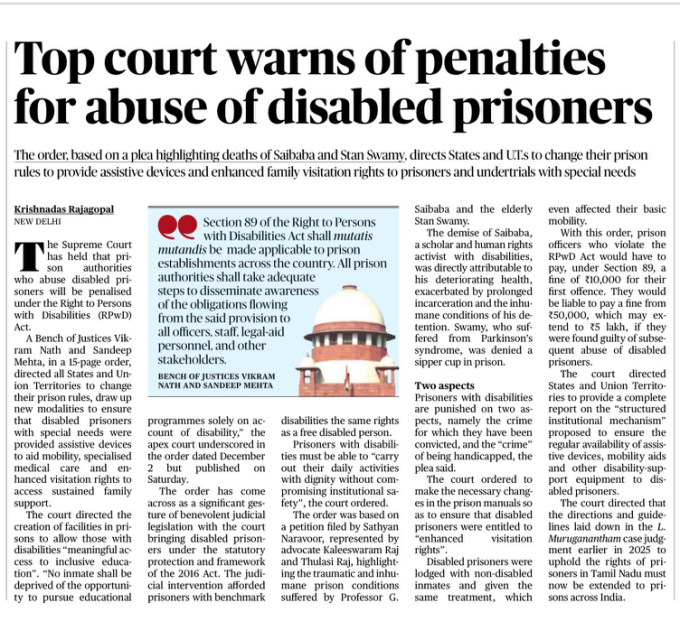
Context
India is witnessing a rapid rise in its ageing population, creating an urgent need to strengthen pension systems. The article discusses how India’s pension framework has gradually shifted from welfare-based support to a more participatory and contributory system, especially for informal sector workers.
Detailed Analysis
1. Rising Ageing Population and the Pension Challenge
- Over 153 million Indians are above 60, projected to reach 347 million by 2050.
- Most senior citizens lack formal pensions; over 88% of workers are in the informal sector, with limited access to secure retirement income.
2. Evolution of Welfare-Based Pension Schemes
- IGNOAPS (National Old Age Pension Scheme):
- Launched in 1995 for BPL elderly.
- Expanded in coverage and benefits over time.
- Provides a minimum assured pension but remains modest.
- State-level top-ups supplement central pensions, but benefits remain too small to ensure dignified ageing.
3. Shift to Contributory Pension Framework
a. New Pension Scheme (NPS)
- Replaced most formal sector pension systems in 2004.
- Expanded later to include corporate employees and voluntary contributors.
- NPS Lite and NPS-Swavalamban targeted low-income informal workers.
- Offers flexibility, market-linked returns, and portability.
b. APY (Atal Pension Yojana)
- Launched in 2015, focuses on low-income groups.
- Government co-contribution for early joiners.
- Works as a guaranteed pension scheme but limited awareness persists.
4. Labour Codes and Old-Age Protection
- Labour codes revised definitions of "wages" and enhanced employer contributions to retirement funds.
- Aimed to widen social security coverage for formal sector employees.
5. Inclusion of Informal Sector Workers
a. e-SHRAM Portal (2021)
- Largest national database for informal workers.
- Enables workers to access welfare schemes by registering their occupation & demographic details.
b. Gaps Identified
- LASI data shows 42% of those above 55 are unaware of NPS eligibility.
- Many elderly remain excluded due to digital literacy barriers, documentation issues, and fragmented welfare delivery.
6. Persistent Weaknesses
- Fragmented pension landscape: central schemes + state schemes + contributory systems → confusion for beneficiaries.
- Low female participation in pension savings due to unpaid/irregular work patterns.
- Registration hurdles in APY/NPS and Aadhaar-linked verification issues for elderly.
7. Towards a Participatory and Inclusive Future
The authors argue that India needs:
- Better integration of databases (e-SHRAM + NPS + welfare pensions).
- Awareness campaigns targeting vulnerable groups.
- Simplified, phone-based registration to reduce exclusion.
- Linking pensions with savings promotion and digital literacy efforts.
Conclusion
India’s pension reforms show a clear transition:
- From welfare-based minimum assistance
- To participation-based contributory pensions
However, without addressing awareness gaps, digital barriers, and informal-sector vulnerabilities, millions of elderly Indians will remain outside secure retirement systems. Sustainable old-age security will require coordination, simplification, and targeted inclusion measures.
UPSC Mains Question
Q. Critically examine the evolution of India’s pension reforms from welfare-based schemes to contributory participation-based models. What challenges persist in ensuring old-age security for informal sector workers?
Surveillance apps in welfare, snake oil for accountability
Context
The author critiques the growing reliance on surveillance-style digital tools (biometric systems, photo-based attendance/apps, facial recognition) in welfare programmes, arguing that these “tech-fixes” often fail to produce real accountability and can cause exclusion, fraud and demotivation among frontline workers and beneficiaries.
Detailed analysis
1. The biometric / tech era and its promise
- Governments adopted biometric attendance and photo evidence to ensure punctuality and verify delivery (examples: biometric attendance for government staff; NMMS / NREGA photo uploads).
- Promise: reduce ghost workers, improve punctuality, strengthen monitoring.
2. Evidence of perverse outcomes
- Fudged evidence: masters/uploaders posting irrelevant or repeated photos to satisfy app requirements (MNREGA/NMMS cases).
- ABBA/Poshan/THR examples: Aadhaar-based Biometric Authentication (ABBA) and Poshan Tracker intended to prevent fraud excluded elderly/immobile persons and led to ration denial.
- Facial Recognition Technology (FRT) for THR raised accessibility and privacy problems; Anganwadi workers bypassing tech due to connectivity/operational constraints.
- Attendance paradox: RCTs (Rajasthan) showed biometric monitoring reduced absenteeism short-term but sometimes worsened staff morale or shifted behavior without improving service quality.
3. Why tech-fixes fail as accountability tools
- Focus on compliance, not outcomes: Apps incentivise ticking boxes (photos, geotags) rather than quality of service.
- Gaming the system: Monetary/administrative pressure leads to forging or superficial compliance.
- Exclusion risk: elderly, disabled, poor connectivity areas get left out — welfare becomes conditional on tech access.
- Demotivation of frontline workers: surveillance undermines trust, reduces intrinsic motivation and discretion necessary for complex social work.
- Privacy & legal gaps: weak safeguards for sensitive personal data and facial recognition use.
4. Broader conceptual critique (author’s perspective)
- Accountability ≠ surveillance: True accountability involves responsibility, legitimacy, public interest—not merely forcing behaviour by monitoring.
- Agnotology: the term used for deliberate ignorance—policy makers may ignore negative effects and push tech because it appears modern and measurable.
Suggestions:
1. Prioritise outcome-based metrics over photo/attendance inputs — measure service quality, beneficiary outcomes.
2. Human-centred design: involve frontline workers and beneficiaries when designing digital tools; ensure apps work offline and in low-bandwidth settings.
3. Pilot & evaluate: run RCTs and independent evaluations before scale; monitor for adverse incentives.
4. Safeguards & oversight: strong data-protection rules, limits on FRT, transparency of algorithms and appeals/ redress mechanisms.
5. Complement with institutional accountability: strengthen local grievance redress, social audits, citizen monitoring and supervisory systems rather than replacing them with tech.
6. Capacity building & incentives: train staff, provide adequate resources and incentivise intrinsic professional norms, not only compliance.
7. Design for inclusion: alternative modes for those unable to use tech (home verification, proxy mechanisms).
.
UPSC Mains Question
Discuss the advantages and limitations of using surveillance-based digital tools (biometric systems, facial recognition, photo-verification apps) in public welfare programmes in India. In your answer, suggest policy measures that can ensure accountability while protecting beneficiaries’ rights and frontline workers’ dignity.
Rajnath unveils border infrastructure projects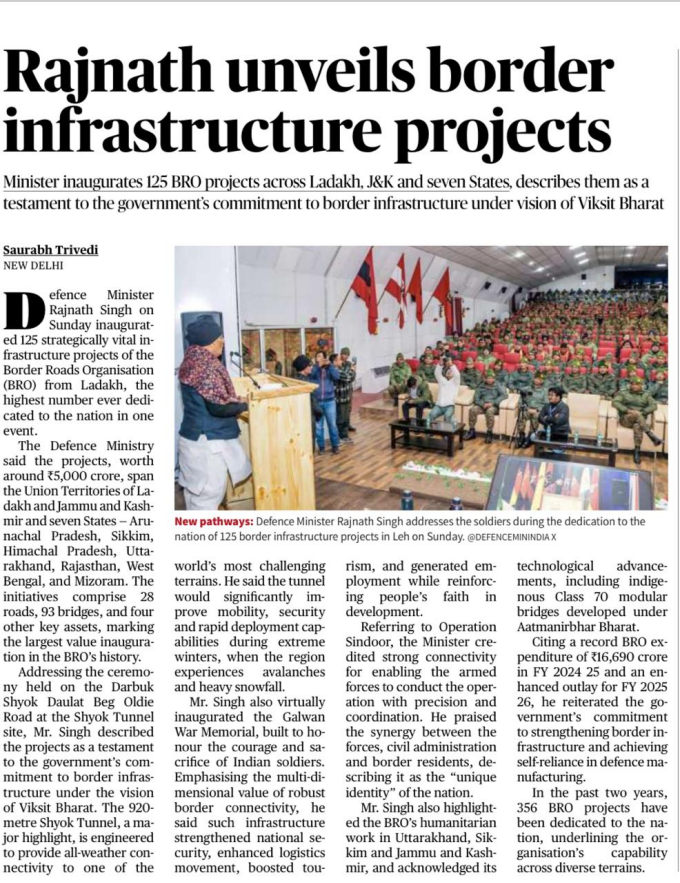
Context
The Defence Minister inaugurated 125 strategic BRO projects across Ladakh, Jammu & Kashmir, and seven States, marking the largest-ever single-day project launch in BRO’s history to strengthen border connectivity and security.
Key Points
1. Scale and Spread of New Projects
- 125 projects worth ₹5,000 crore inaugurated.
- Spread across Ladakh, J&K, Arunachal Pradesh, Sikkim, Himachal Pradesh, Uttarakhand, Rajasthan, West Bengal, Mizoram.
- Infrastructure includes 28 roads, 93 bridges, and 4 major tunnels.
2. Importance for Border Security
- Enhances mobility, rapid troop deployment, and logistics in high-altitude terrains.
- Critical in areas prone to avalanches, heavy snowfall, and hostile conditions.
3. Major Highlight – Shyok Tunnel
- Darbuk–Shyok–Daulat Beg Oldie Road tunnel inaugurated.
- A key asset for all-weather connectivity to forward areas.
4. Support to Armed Forces & Civilian Development
- Strengthens operational readiness along sensitive borders.
- Also boosts local livelihoods, faith in development, and regional connectivity.
5. Synergy with Atmanirbhar Bharat
- Deployment of indigenous modular Class 70 bridges.
- Focus on self-reliance in defence infrastructure.
6. Increasing BRO Capacity
- BRO expenditure touched ₹16,690 crore in FY 2024–25.
- 356 projects completed in the past two years.
About Border Roads Organisation :
BRO, under Ministry of Defence, was formed in 1960 for infrastructure development in border areas.
- Works in 19 states, 3 UTs, and countries like Bhutan, Myanmar, Afghanistan, Sri Lanka, Tajikistan.
- Staffed by GREF and deputed Army engineers.
- Operational role during hostilities and relief operations.
- Major achievement: Atal Tunnel (9.02 km) – world’s longest highway tunnel at high altitude.
- Motto: Shramena Sarvam Sadhyam (Everything is achievable through hard work).
UPSC Prelims Practice Question
Q. Consider the following statements about the Border Roads Organisation (BRO):
1. BRO is an organization under the Ministry of Defence responsible for developing road networks in India’s border areas.
2. BRO personnel consist only of Army engineers and does not include any civilian cadre.
Which of the statements given above is/are correct?
(a) 1 only
(b) 2 only
(c) Both 1 and 2
(d) Neither 1 nor 2
Answer: (a) 1 only
Explanation:
- Statement 1 is correct – BRO functions under the Ministry of Defence.
- Statement 2 is incorrect – BRO’s parent cadre is the General Reserve Engineer Force (GREF), which is civilian; Army engineers join on deputation.
National intelligence grid gains traction as Central agencies, police scour for information
Context
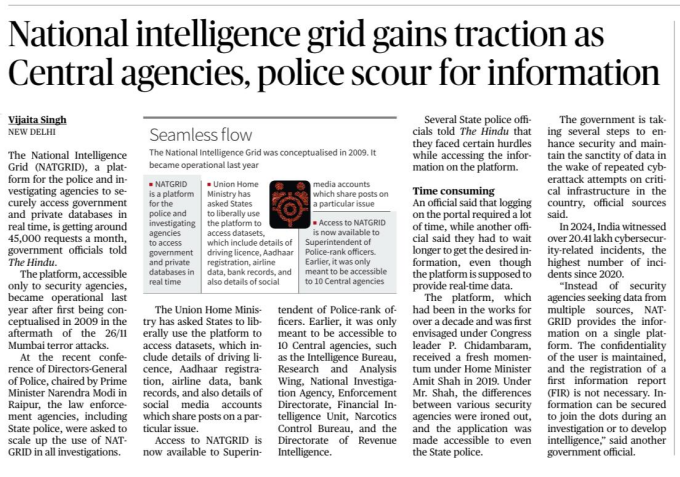
NATGRID, India’s integrated intelligence and information-sharing platform, is now receiving nearly 45,000 requests per month as Central and State police agencies increasingly rely on it for real-time data access in criminal and terrorism-related investigations.
Key Points
1. What is NATGRID?
- A real-time intelligence platform enabling security and investigative agencies to access government and private databases securely.
- Conceptualised post 26/11 Mumbai attacks (2009) and became operational in 2023.
- Accessible only to security agencies, not the public.
2. Expanded Access
- Initially available only to 10 Central agencies (IB, RAW, NIA, ED, FIU, DRI, etc.).
- Now extended to Superintendent of Police (SP)-rank officers across States for improved investigation capabilities.
3. Types of Data Available
- Driving licence details, Aadhaar registration, airline passenger data, bank transactions, and
- Social media activity related to specific issues or suspects.
4. Directions from the Union Home Ministry
- States asked to scale up the use of NATGRID in all investigations.
- Encouraged to liberally use datasets to ensure faster intelligence processing.
5. Challenges Reported by State Police
- Time-consuming login process.
- Delays in retrieving real-time data due to system load or connectivity issues.
- Need for more efficient interface and operational training.
6. Importance for National Security
- India faced 20.41 lakh cybersecurity incidents in 2024, the highest since 2020.
- NATGRID helps reduce dependency on multiple agencies for data.
- Enhances data sanctity, confidentiality, and supports quicker detection of terror and criminal networks.
- FIR registration is not required to access data.
7. Governance and Evolution
- Received renewed priority under Home Minister Amit Shah (2019).
- Issues of interoperability between agencies were resolved to make the platform functional.
Additional Information — NATGRID
- Provides 360-degree intelligence by integrating data from several sources such as immigration, banking, telecom, PAN databases.
- Aimed at creating a unified counter-terror architecture.
- Ensures access only on a need-to-know basis for authorised officers.
Top court warns of penalties for abuse of disabled prisoners
Context
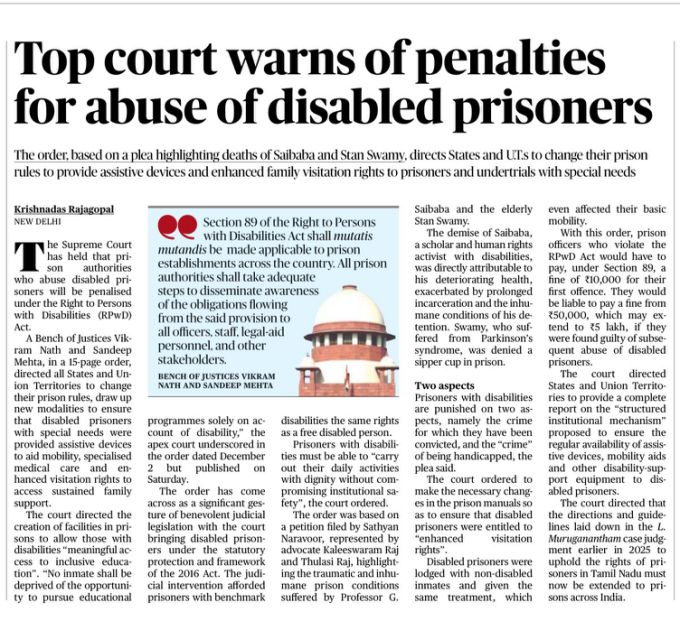
The Supreme Court has directed all States and Union Territories to amend their prison manuals so that prisoners with disabilities are treated in accordance with the Rights of Persons with Disabilities (RPwD) Act, 2016, and warned that prison officials will face penalties for abusing or neglecting such prisoners.
Key Points
Supreme Court’s main directions
- Application of RPwD Act to prisons:
Section 89 of the RPwD Act will apply mutatis mutandis to all prison establishments across India.
- Duty to sensitise staff:
Prison authorities must disseminate awareness of obligations under the RPwD Act to all officers, staff, legal-aid personnel and stakeholders.
- No discrimination in prison programmes:
Disabled prisoners cannot be excluded from educational, vocational or other programmes solely on account of disability.
- Assistive devices and facilities:
States/UTs must ensure access to assistive devices, mobility aids and other disability-support equipment for prisoners with special needs.
- Enhanced visitation rights:
Disabled prisoners are entitled to “enhanced visitation rights” so that family support is not curtailed by their disability.
- Parity of treatment:
Disabled prisoners lodged with non-disabled inmates must receive the same treatment, with reasonable accommodation for their special needs.
Basis of the petition
- The order arose from a plea citing the cases of Professor G.N. Saibaba and Father Stan Swamy, whose deteriorating health and lack of basic aids in jail highlighted inhuman conditions for prisoners with disabilities.
Penalties under Section 89 RPwD Act (as applied to prisons)
- First offence: Fine of up to ₹10,000 on officers who violate provisions relating to abuse/neglect of persons with disabilities.
- Subsequent offences: Fine from ₹50,000 up to ₹5 lakh if found guilty again of abusing or neglecting disabled prisoners.
Implementation requirements for States and UTs
- Prepare a report to the Court on the “structural institutional mechanisms” adopted to:
- Regularise availability of assistive devices and mobility aids in prisons.
- Ensure accessibility of prison infrastructure and services.
- Prevent abuse, inhuman treatment and neglect of prisoners with disabilities.
Rights of Persons with Disabilities Act, 2016
- Purpose: Gives effect to UNCRPD, ensuring persons with disabilities live with dignity, equality and without discrimination.
- Definition: PwD is a person with long-term physical, mental, intellectual or sensory impairment that, in interaction with barriers, restricts full participation in society.
- Coverage: Recognises 21 specified disabilities, including intellectual disability, mental illness and acid-attack victims.
- Rights guaranteed:
- Equality, life with dignity, respect for integrity.
- Protection from abuse, cruelty, inhuman treatment and exploitation.
- Right to home and family, reproductive rights, accessibility in voting, and property rights.
- Benchmark disability: At least 40% of a specified disability as certified by a competent authority.
- Guardianship:
- Provides for limited guardianship, a joint decision-making arrangement respecting the PwD’s will and preferences.
- District Court or designated authority can grant total support where repeated limited guardianship is required.
- Social security: Mandates governments to frame schemes so PwDs can live independently and attain an adequate standard of living.
UPSC Prelims Question
With reference to the Rights of Persons with Disabilities (RPwD) Act, 2016, consider the following statements:
1. It was enacted, among other things, to give effect to India’s obligations under the UN Convention on the Rights of Persons with Disabilities.
2. The Act provides only for full (plenary) guardianship, where the guardian takes all decisions on behalf of the person with disability.
3. A “person with benchmark disability” is defined as one having at least 40% of a specified disability, as certified by a competent authority.
Which of the statements given above is/are correct?
a) 1 only
b) 1 and 3 only
c) 2 and 3 only
d) 1, 2 and 3
Answer: b) 1 and 3 only
Explanation:
- Statement 1 is correct: The RPwD Act, 2016 explicitly aims to implement the UNCRPD.
- Statement 2 is incorrect: The Act emphasises limited guardianship, a joint decision-making model; plenary guardianship is not the only option.
- Statement 3 is correct: Benchmark disability is defined as at least 40% of a specified disability, certified by the appropriate authority.
Local body elections too complex to be a referendum on State government in Kerala.
 Context
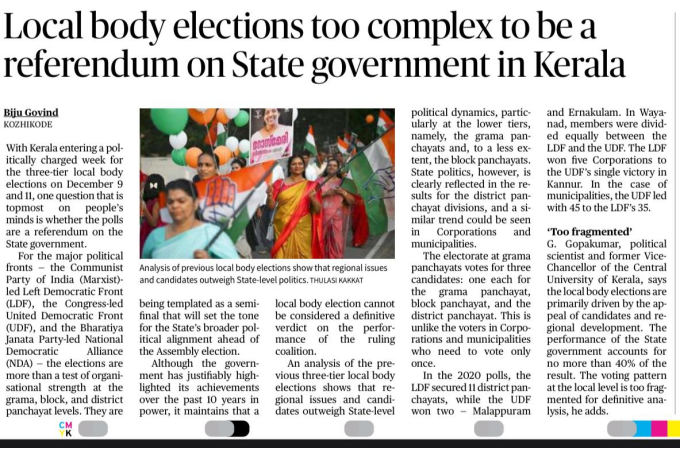
Kerala is holding its three-tier local body elections, raising questions on whether these polls act as a referendum on the performance of the State government.
Key Points
Local Body Elections in Kerala
- Elections are being conducted at grama, block, and district panchayat levels.
- Major political fronts involved: LDF, UDF and NDA.
Complex Electoral Dynamics
- Analysts note that regional issues and candidate-specific factors outweigh State-level political trends.
- Local elections cannot serve as a clear verdict on the State government’s performance.
Voting Behaviour
- Voters at grama panchayat level vote thrice (for grama, block, district panchayats).
- Municipal and corporation voters vote only once, showing different patterns.
Previous Trends
- In 2020, outcomes differed at various levels:
- LDF won 11 district panchayats.
- UDF performed better in municipalities.
Expert Analysis
- Local body outcomes are driven by candidate appeal and local development, not State politics.
- State government performance influences less than 40% of the result.
- Voting is “too fragmented” for definitive political conclusions.
Additional Information
State Election Commissions (SECs)
- Constitutional body responsible for free, fair and impartial elections to local bodies.
- Article 243K(1): Superintendence, direction and control of Panchayat elections vest in SEC.
- Article 243K(2):
- SEC appointed by Governor.
- Removal only as per procedure applicable to a High Court Judge, ensuring independence.
UPSC Prelims Question
Consider the following statements regarding the State Election Commission (SEC):
1. The State Election Commissioner is appointed by the Governor.
2. The State Election Commissioner can be removed only in the same manner as a Judge of the High Court.
Select the correct answer:
a) 1 only
b) 2 only
c) Both 1 and 2
d) Neither 1 nor 2
Answer: c) Both 1 and 2
Explanation:
Article 243K clearly states that the State Election Commissioner is appointed by the Governor and enjoys protection similar to a High Court Judge, ensuring autonomy.
Assam tribal body protests against ST tag for six groups
Context
The All Assam Tribal Students’ Union (AATSU) has petitioned the President opposing the proposal to grant Scheduled Tribe (ST) status to six major ethnic communities in Assam.
Key Points
Groups proposed for ST status
- The Group of Ministers has suggested ST status for Adivasi/Tea Tribes, Chutia, Koch-Rajbongshi, Matak, Moran, and Tai Ahom.
Reason for Opposition
- Tribal organisations argue that adding these socio-economically stronger communities will dilute Constitutional protections meant for existing STs.
Concerns of existing tribes
- Smaller tribes such as Bodos, Rabhas and Misings fear loss of benefits in reservation, political representation, and welfare allocations.
AATSU’s stand
- Calls the proposal “anti-tribal” and demands a proper socio-economic assessment before altering the ST list.
Cheetah cub dies less than a day after release into the wild
Context
A cheetah cub released into the wild at Kuno National Park, Madhya Pradesh, died within 24 hours, marking the 20th death since the launch of Project Cheetah in 2022.
Key Points
Recent Incident
- A 10-month-old cheetah cub died shortly after being released into the free-ranging area of Kuno National Park (KNP).
- The cub became separated from its mother and sibling and was found dead around 1.5 km from the release point.
Project Cheetah
- Launched in 2022 to reintroduce cheetahs extinct in India since 1952.
- First intercontinental translocation project for a large carnivore, implemented under Project Tiger.
Objectives
- Establish breeding populations in secure habitats across historical range.
- Restore open forest and savanna ecosystems using cheetahs as a flagship species.
- Promote ecotourism and eco-development for local livelihoods.
- Reduce human-wildlife conflict through awareness and community participation.
Implementation Structure
- Implemented by National Tiger Conservation Authority (NTCA) under MoEFCC.
- Supported by Madhya Pradesh Forest Department and Wildlife Institute of India (WII).
- NTCA created the Cheetah Project Steering Committee (2023) to supervise and evaluate project progress.
Additional Information
National Tiger Conservation Authority (NTCA)
- A statutory body under the Wildlife Protection Act, 1972.
- Responsible for tiger conservation, oversight of tiger reserves, and now the implementation of Project Cheetah.
UPSC Prelims Question
Consider the following statements regarding Project Cheetah:
1. Project Cheetah is implemented by the National Tiger Conservation Authority (NTCA).
2. It is the world’s first intercontinental translocation project for a large wild carnivore.
Select the correct answer:
a) 1 only
b) 2 only
c) Both 1 and 2
d) Neither 1 nor 2
Answer: c) Both 1 and 2
Explanation:
- NTCA is the nodal implementing agency — Statement 1 is correct.
- No other country has attempted intercontinental large carnivore reintroduction — Statement 2 is correct.
Organization for Security and Cooperation in Europe (OSCE)
Syllabus: GS Paper 2 – International Organizations & Global Governance
Context
At the OSCE meeting, the Ukrainian Foreign Minister stated that Ukraine seeks “real peace, not appeasement” with Russia, bringing global attention to the role of OSCE in regional security dialogue.
Key Points
1. Nature & Role of OSCE
- World’s largest regional security organization, covering Europe, Central Asia, and North America.
- Works to promote peace, stability, democracy and security through political dialogue and practical cooperation.
2. Historical Background
- Originates from the Helsinki Final Act (1975) and the Conference on Security and Co-operation in Europe (CSCE).
- Renamed as OSCE in 1994 to reflect its expanded post–Cold War mandate.
3. Membership
- Comprises 57 participating States across Europe, North America and Asia.
- India is NOT a member.
4. Objectives
- Strengthens stability, peace and democracy.
- Facilitates dialogue on shared values and security concerns.
5. Decision-Making Bodies
- Summits: Highest decision-making authority.
- Ministerial Council: Central governing and decision-making body.
- Permanent Council: Handles daily administrative and political work.
- Forum for Security Co-operation: Deals with the politico-military dimension.
6. Leadership Structure
- Includes the Chairperson-in-Office, the Secretary-General, and heads of institutions and field missions.
7. Headquarters
- Located in Vienna, Austria.
Source: Reuters
Zambezi River
Syllabus: GS Paper 1 – World Physical Geography
Context
A new study has revised the origin and total length of the Zambezi River, showing that it actually begins in Angola’s southern highlands at the source of the Lungwebungu River, making it 342 km longer than previously thought.
Key Points
- Revised Length & Source
- New total length: 3,421 km, earlier estimate shorter by 342 km.
- Fresh study identifies the Lungwebungu River in southern Angola as the true headwater.
- Rank & Direction
- 4th longest river in Africa.
- Longest east-flowing river on the African continent.
- Course & Countries Traversed
- Flows through Angola, Zambia, Namibia, Botswana, Zimbabwe and Mozambique.
- Empties into the Indian Ocean after its eastward journey.
- Major Waterfalls
- Notable for Victoria Falls, among the world’s largest waterfalls.
- Also includes Chavuma Falls on the Zambia–Angola border.
- Hydropower Dams
- Hosts major hydroelectric projects: Kariba Dam and Cahora Bassa Dam.
- These are key power sources for the region.
- Drainage Basin
- Zambia contributes the largest share of basin area, around 41.6% of the drainage.
- Main Tributaries
- Important tributaries: Shire, Kafue, Luangwa, Kabompo and Cuando (Kwando) rivers.
Source: The Hindu
Directorate General of Civil Aviation (DGCA)
Syllabus: GS Paper 2 – Governance, Regulatory Bodies, Transport Sector
Context
The Directorate General of Civil Aviation (DGCA) has granted IndiGo a one-time temporary exemption from certain Flight Duty Time Limitation (FDTL) norms for pilots, bringing renewed attention to DGCA’s regulatory role in civil aviation safety.
Key Points
1. Nature and Status
- DGCA is India’s civil aviation regulatory authority, primarily concerned with safety oversight.
- Functions as an attached office under the Ministry of Civil Aviation.
2. Core Responsibilities
- Regulates air transport services to, from and within India.
- Enforces civil air regulations, airworthiness, and safety standards.
3. Coordination with International Bodies
- Works closely with the International Civil Aviation Organisation (ICAO) for regulatory harmonisation.
4. Headquarters
Functions of DGCA
1. Ensuring Aviation Safety
- Conducts routine inspections of airlines and aircraft.
- Ensures compliance with mandatory safety standards.
2. Accident and Incident Investigation
- Investigates aviation accidents and near-miss incidents in Indian airspace.
3. Infrastructure & Modernisation Role
- Participates in planning and development of new airports.
- Supports modernisation of existing civil aviation infrastructure.
4. Air Traffic Regulation Support
- Works with Airports Authority of India (AAI) to ensure safe and efficient air traffic management.
5. Licensing and Certification
- Issues licences for pilots, aircraft maintenance engineers, and other aviation personnel.
- Grants certificates for aircraft and organisations involved in aviation operations.
Source: Indian Express
Shingles Disease
Syllabus: GS Paper 3 – Health, Diseases & Immunization
Context
Shingles, a viral disease caused by reactivation of the varicella-zoster virus, is being reported increasingly among older adults and immunocompromised individuals.
Key Points
1. Cause
- Caused by the varicella-zoster virus (VZV) — the same virus responsible for chickenpox.
- After chickenpox recovery, the virus stays dormant in nerve cells and can reactivate later.
2. Trigger for Reactivation
- Occurs when immunity weakens due to:
- Ageing (common after 50 years)
- Illness
- Immunosuppressive medications
- Chronic stress or weakened immune system
3. Symptoms
- Painful rash, typically in a single stripe or band on one side of the torso, face or neck.
- Other symptoms: itching, tingling, burning pain, fever, headache, light sensitivity.
4. Transmission
- Shingles itself is not contagious, but VZV can spread from a shingles patient to someone who has never had chickenpox, causing chickenpox (not shingles).
5. High-Risk Groups
- Individuals above 50 years.
- People with weakened immunity or chronic illnesses.
6. Treatment & Prevention
- Antiviral medicines can reduce severity if taken early.
- Shingrix vaccine is recommended to prevent shingles and its complications (e.g., post-herpetic neuralgia).
Source: DD News
Barcelona Convention
Syllabus: GS Paper 3 – Environment, Conservation Agreements, Pollution Control
Context
At COP24 of the Barcelona Convention held in Cairo, EU countries and Mediterranean partners adopted strengthened commitments to protect the Mediterranean Sea from pollution and support sustainable coastal management.
Key Points
1. Nature of the Convention
- A legally binding regional environmental agreement under UNEP.
- Focused on protecting the Mediterranean Sea and its coastal environment.
2. Adoption & Evolution
- Adopted: 16 February 1976 (as “Convention for the Protection of the Mediterranean Sea Against Pollution”).
- Entered into force: 1978.
- Amended/Renamed: 1995 — now called “Convention for the Protection of the Marine Environment and the Coastal Region of the Mediterranean.”
3. Core Objectives
- Prevent, reduce, combat and eliminate pollution from:
- Land-based sources
- Marine activities
- Atmospheric sources
- Promote sustainable development across the Mediterranean basin.
4. Key Functional Areas
- Supports member states in implementing specialised protocols on:
- Dumping of wastes
- Emergency pollution response
- Land-based pollution sources
- Protected areas & biodiversity
- Hazardous waste movement
- Offshore activities
- Integrated coastal zone management
Source: UNEP
Niger Becomes 1st African Country to Eliminate Onchocerciasis
Syllabus: GS Paper 3 – Science & Technology; Public Health; Disease Eradication
Context
Niger has officially become the first African country to eliminate onchocerciasis (river blindness), as verified by the World Health Organization (WHO).
Key Points
1. What is Onchocerciasis?
- A neglected tropical parasitic disease caused by Onchocerca volvulus.
- Transmitted through bites of infected Simulium blackflies breeding in fast-flowing rivers.
- Globally, 99% cases occur in sub-Saharan Africa.
2. Disease Burden & Significance
- Second leading infectious cause of blindness after trachoma.
- Causes long-term community-level disability, reduced productivity, and poverty.
3. Disease Characteristics
- Chronic disease — adult worms live 10–15 years.
- Microfilariae cause intense inflammation in skin and eyes.
- Requires long-term mass drug administration.
4. Treatment
- Main drug: Ivermectin (Mectizan) — administered once or twice yearly for 10–15 years.
- Interrupts transmission by killing microfilariae.
Source: News on Air
India Hosts 20th UNESCO’s Inter-Governmental Committee
Syllabus: GS Paper 2 – International Organisations; Cultural Diplomacy
Context
India is hosting the 20th Session of UNESCO’s Intergovernmental Committee for the Safeguarding of Intangible Cultural Heritage (ICH) at the Red Fort, New Delhi.
Key Points
1. What is this Committee?
- A 24-member UNESCO body established under the 2003 Convention for the Safeguarding of Intangible Cultural Heritage.
- Mandated to promote, supervise and operationalise global safeguarding of Intangible Cultural Heritage (ICH).
2. Host Venue
- Red Fort (Lal Qila), New Delhi, a UNESCO World Heritage Site.
3. Composition & Structure
- 24 Member States, elected by the General Assembly of States Parties.
- Seats distributed across six UNESCO regional groups for balanced representation.
- Member States nominate experts in ICH fields.
4. Term & Membership Rules
- Four-year term for each elected member.
- Staggered renewal: Every two years, half the committee is replaced to preserve institutional continuity.
- No consecutive terms, ensuring wider global participation.
5. Key Functions of the Committee
- Promotes objectives of the 2003 ICH Convention.
- Provides guidance on safeguarding best practices.
- Prepares operational directives and plans for the ICH Fund.
- Examines nominations for:
- Representative List of ICH of Humanity
- List of Intangible Cultural Heritage in Need of Urgent Safeguarding
- Supports States in preserving traditions, rituals, crafts and social practices.
6. What is Intangible Cultural Heritage?
- Living traditions passed across generations.
- Includes:
- Performing arts
- Rituals & festivals
- Crafts & skills
- Oral traditions
- Social practices & knowledge systems
Source: PIB

 Launch your Graphy