Daily Current Affairs for UPSC 7th Nov 2025



| Index |
| S.No | Topic | Page No |
| Daily Hindu Analysis (YouTube) |
| 1. | Why the nomination process needs reform |
|
| 2. | Redraw welfare architecture, place a UBI in the centre |
|
| 3. | Accused should get grounds of arrest in known language: SC |
|
| 4. | First PSLV made by private firms to be unveiled in 2026, says ISRO Chairman |
|
| 5. | Airlines report ‘severe’ GPS spoofing over Delhi for 7 days |
|
| 6. | Indian Navy commissions survey vessel INS Ikshak |
|
| Daily Current Affairs (App) |
| 7. | Baliyatra Festival |
|
| 8. | Vande Mataram 150 Years Celebration |
|
| 9. | UN Water Convention |
|
| 10. | Second World Summit for Social Development 2025 |
|
| 11. | Operation White Cauldron |
|
Why the nomination process needs reform

Context The article discusses the need to reform India’s electoral nomination process under the Representation of the People Act (RPA), 1951, which governs how candidates contest elections. It highlights how procedural rigidity, arbitrary rejections, and lack of transparency in verifying nominations have made the process prone to misuse — undermining the principle of free and fair elections as envisaged under Article 324 of the Constitution, which empowers the Election Commission of India (ECI) to supervise elections.
What It Is About
A recent incident from Dadra and Nagar Haveli — where a candidate’s nomination was rejected without proper hearing — sparked debate on how Returning Officers (ROs) wield disproportionate discretion in accepting or rejecting nominations.
The author argues that the current system overemphasizes technical compliance over democratic substance, risking arbitrary exclusions and weakening citizens’ right to contest elections under Article 326 of the Constitution.
Detailed Analysis Legal Framework: RPA, 1951
| Representation of People Act (RPA) 1951 Highlights |
| Section | Highlight |
| Section 8 | Lists disqualification grounds based on criminal convictions, promoting ethical public office. |
| Section 29A | Allows political parties to register with the Election Commission, essential for electoral participation. |
| Section 123 | Defines corrupt practices, including bribery and undue influence, to maintain election integrity. |
| Section 33 | Discusses candidate nomination procedures and associated eligibility criteria. |
| Section 62 | Ensures voting rights for individuals listed on the electoral roll, strengthening voter inclusion. |
| Section 100 | Specifies conditions for voiding elections due to malpractice or eligibility issues. |
| Section 126 | - 48 hours before the polling ends or concludes, displaying of any election matter by television or similar apparatus in a constituency is prohibited.
- Section 126 is not applicable to the print media, news portals and social media
- Section 126A prohibits the conduct of exit poll and dissemination of its results during the period mentioned.
|
| Section 77 | Regulates election expenses to prevent financial misuse and maintain fairness. |
Discretion and the Problem of Subjectivity - The RO’s scrutiny is final and binding before polling begins; courts cannot interfere under Article 329(b) once elections are notified.
- Hence, an arbitrary rejection — even if later proven wrongful — cannot be corrected until after elections.
- In practice, this gives ROs extraordinary power to determine who appears on the ballot, especially in politically sensitive or competitive constituencies.
Judicial Interpretation: Substantial vs Procedural Defects The Supreme Court in Resurgence India vs Election Commission (2014) clarified that: - False declarations by candidates make nominations incomplete but not invalid.
- Only substantial defects (that affect fairness or legality) can justify rejection.
- Mere clerical or technical errors should not disqualify candidates.
Despite this, ambiguity in what constitutes
“substantial” continues to cause misuse and confusion during scrutiny.
Bureaucratic Complexity and Digital Gap
- The process requires filing multiple affidavits, income and asset declarations, and statutory oaths within strict deadlines.
- Any error, even a missed page or signature, can trigger rejection.
- In an age of digital governance, the system still operates largely manually, creating avoidable errors and delays.
The author argues for digital submission and automated verification, allowing candidates to track errors and correct them within a set period (as done in Australia or the UK).
Institutional Concerns
- The current framework prioritizes technical compliance over democratic intent.
- Minor mistakes by genuine candidates can be punished, while well-resourced parties navigate the process easily.
- Such procedural barriers risk entrenching political inequality, favoring established elites over grassroots candidates.
Democratic Implications - The right to contest elections is intrinsic to the right to equality and political participation under Articles 14 and 326.
- Over-reliance on form over substance undermines citizens’ faith in the Election Commission’s neutrality.
- Transparent, inclusive, and tech-driven nomination reforms are essential for preserving electoral integrity.
UPSC Mains “The current nomination process under the Representation of the People Act, 1951 prioritizes procedural compliance over democratic participation. Critically examine.”
Redraw welfare architecture, place a UBI in the centre
Context
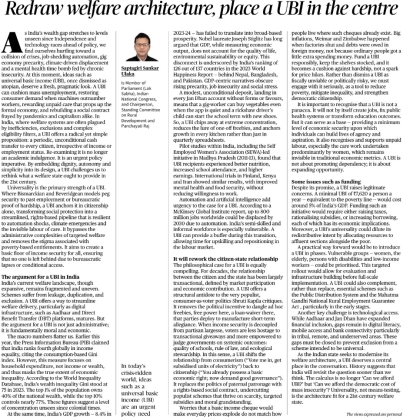
Amid growing income inequality, job insecurity, and automation-induced unemployment, the idea of Universal Basic Income (UBI) — once dismissed as utopian — is regaining policy attention.
The article by
Saptagiri Sankar Ulaka (MP, Lok Sabha) argues that India must
rethink its welfare architecture and place
UBI at the centre to ensure dignity, equity, and social security in the 21st century.
Detailed Analysis Why UBI Is Back in Debate - India’s wealth gap has widened despite economic growth.
- Rising automation, AI, gig work, and climate-induced displacement threaten employment stability.
- UBI is emerging as a pragmatic social contract, protecting citizens against economic precarity and rebuilding trust in the state.
What Makes UBI Unique UBI differs from traditional welfare schemes by being
universal, unconditional, and rights-based. Key Strengths: - Universality: Reaches all citizens without means-testing.
- Simplicity: Eliminates bureaucratic discretion and corruption.
- Dignity: Anchors welfare in citizenship, not charity.
- Resilience: Works even in crises like pandemics or automation waves.
“UBI represents a streamlined, inclusive model of social protection fit for 21st-century challenges.”
Lessons from India’s Welfare Landscape India’s welfare delivery suffers from
leakages, duplication, and exclusion errors, weakening its impact on poverty alleviation. To understand this, key committees have shaped India’s welfare discourse:
| Committee / Report | Focus Area | Relevance to UBI |
| Suresh Tendulkar Committee (2009) | Revised poverty line based on consumption expenditure and cost of living. | Highlighted the extent of hidden poverty, showing the need for universal social protection. |
| C. Rangarajan Committee (2014) | Reviewed poverty estimates post-Tendulkar. | Recommended higher poverty thresholds, reaffirming that targeted welfare leaves many poor excluded. |
| Economic Survey 2016–17 (Arvind Subramanian) | Introduced UBI as a “radical but feasible” idea. | Suggested replacing inefficient subsidies with direct cash transfers ensuring economic freedom and dignity. |
Global and Indian Evidence Supporting UBI
- India’s SEWA (Self-Employed Women’s Association) pilot in Madhya Pradesh (2011–13) showed improved nutrition, education, and health outcomes.
- Finland, Kenya, and Namibia saw reduced stress, improved well-being, and stable work participation under UBI pilots.
- Automation threats: A McKinsey Global Institute Report warns that up to 800 million jobs could vanish by 2030, making UBI a timely buffer.
Economic Feasibility and Funding - Estimated minimum UBI: ₹7,620 per person per year (~5% of GDP).
- Fund through rationalising subsidies, improving tax compliance, and reducing inefficiencies.
- Not a “free dole” — a redistributive investment in human dignity and economic stability.
Redefining the State–Citizen Relationship - Shifts welfare from patronage-based entitlements to rights-based empowerment.
- Removes bureaucratic discretion, giving citizens agency and economic freedom.
- Particularly beneficial for women, informal workers, and the disabled.
“UBI transforms the welfare state into a partnership between citizen and nation.”
Key benefits of Universal Basic Income (UBI):
- UBI provides a direct cash transfer to all citizens, ensuring a minimum income floor. This can lift people out of poverty, particularly in regions with high poverty rates, by providing basic financial security.
- Universal transfers ensure fewer intermediaries, reducing administrative costs and minimizing exclusion errors.
- With basic income support, individuals, especially in lower-income groups, will have more purchasing power. This can stimulate aggregate demand, boosting consumption and potentially driving economic growth, especially in times of economic downturn.
- UBI can provide essential financial support to vulnerable populations like the elderly, disabled, and unemployed, who may not benefit from work-based welfare programs like MGNREGS.
- With guaranteed financial support, families are more likely to invest in better healthcare and education for their children, improving overall human development indicators in the long run.
- A guaranteed basic income can reduce the stress and mental health issues associated with financial insecurity. It can also reduce crime rates, as people with stable income are less likely to resort to criminal activities out of desperation.
Concerns and challenges associated with implementing a Universal Basic Income (UBI)
- One of the primary concerns about UBI is the significant financial burden it places on the government.
- If UBI is implemented by replacing current welfare schemes, there’s a risk that targeted programs that are crucial for vulnerable populations (such as food distribution via the Public Distribution System or MGNREGS) might be eliminated, leaving certain groups worse off.
- Providing a universal cash transfer could potentially lead to inflation, particularly in rural or underdeveloped areas where an increase in demand for basic goods might outpace supply.
- There is concern that UBI could create a disincentive to work, as individuals receiving guaranteed income may opt out of the labor force.
- Biometric failures and network issues have already plagued existing welfare schemes in India, such as PM-KISAN, leading to exclusion errors.
- While UBI may provide short-term financial relief, it does not address the structural issues related to unemployment, education, healthcare, or inequality in the long run.
Way Forward: - Implementing a full-scale UBI may not be feasible in India due to financial constraints. Therefore, a modified UBI, starting with specific vulnerable groups (such as women, the elderly, the disabled, and landless laborers), could be an effective compromise.
- UBI can be integrated into existing frameworks like MGNREGS (Mahatma Gandhi National Rural Employment Guarantee Scheme) and Public Distribution System (PDS) to ensure comprehensive coverage.
- The JAM (Jan-Dhan, Aadhaar, Mobile) infrastructure is crucial for the smooth rollout of UBI. The government must continue improving banking access in remote areas, addressing issues with Aadhaar-based verification, and ensuring stable internet and mobile connectivity.
- UBI is not a solution to structural unemployment; hence, it must be paired with policies that promote job creation and boost economic growth.
UPSC Mains “Universal Basic Income (UBI) represents a shift from conditional welfare to citizenship-based justice. Discuss its feasibility and implications for India’s welfare architecture.”
Accused should get grounds of arrest in known language: SC
Context
The Supreme Court of India has ruled that an arrested person must be informed of the grounds of arrest in a language they understand, reinforcing the constitutional safeguard of personal liberty under Article 22(1).
The verdict, delivered by Justices B.R. Gavai and A.G. Masih, arose from the 2024 Mumbai hit-and-run case.
Constitutional and Legal Basis This article forms part of the Fundamental Rights under Part III and is designed to protect individuals from arbitrary arrest and detention. Judicial Interpretation The Supreme Court observed that: Hence, the communication must be both meaningful and comprehensible to ensure that the accused can exercise their legal rights effectively. Significance of the Judgment Reinforcement of Personal Liberty
- The ruling strengthens procedural fairness and rule of law, ensuring that arrests are not arbitrary.
- It reaffirms that liberty cannot be curtailed by mere procedural formalities; the accused must understand why they are being arrested.
Language as a Component of Justice - The Court acknowledged linguistic diversity and the possibility that an accused might not understand the language of arresting officers or official documents.
- Therefore, translation or interpretation must be provided in a language known to the accused — whether regional or vernacular.
Accountability and Transparency in Police Procedure - This judgment compels law enforcement agencies to ensure written documentation of arrest grounds and proof of comprehension.
- It can prevent abuse of power, particularly in cases involving minorities, migrants, or illiterate citizens.
Broader Implications - The decision aligns with international human rights principles, including Article 9 of the International Covenant on Civil and Political Rights (ICCPR), which India is a signatory to.
- It harmonizes domestic law with global due process standards.
UPSC Prelims Q. With reference to Article 22(1) of the Constitution of India, consider the following statements: 1. It guarantees that an arrested person must be informed of the grounds of arrest “as soon as may be.” 2. The Supreme Court has held that these grounds must be communicated in a language the accused understands. 3. Non-compliance with this requirement renders the arrest and remand proceedings invalid. Which of the statements given above are correct? (a) 1 and 2 only
(b) 2 and 3 only
(c) 1 and 3 only
(d) 1, 2 and 3
Answer: (d) 1, 2 and 3
First PSLV made by private firms to be unveiled in 2026, says ISRO Chairman
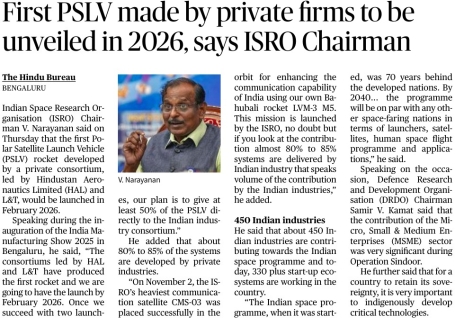
Context · The Indian Space Research Organisation (ISRO) announced that the first Polar Satellite Launch Vehicle (PSLV) developed entirely by private industry will be launched in February 2026. · This historic milestone marks the transition of India’s space programme from a government-driven initiative to a public-private collaborative model. · The consortium developing the rocket is led by Hindustan Aeronautics Limited (HAL) and Larsen & Toubro (L&T) — a major step toward space sector indigenisation and privatisation under the government’s
Atmanirbhar Bharat vision.
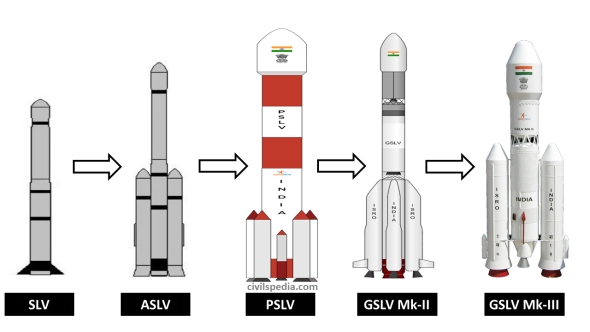
What It Is About - The PSLV (Polar Satellite Launch Vehicle) is India’s most reliable and versatile launch vehicle, used for launching satellites into Sun-synchronous orbits (SSO) and low-Earth orbits (LEO).
Key Highlights Expanding Role of Private Sector
- About 80–85% of ISRO’s systems are already developed by private industries.
- Around 450 Indian industries and 330 start-ups are actively contributing to India’s space ecosystem.
- The HAL–L&T consortium represents a new model of industrial participation, where private companies undertake end-to-end production of launch vehicles.
Shift Towards Industrial Manufacturing in Space
- The project aligns with ISRO’s plan to transfer at least 50% of PSLV production to the Indian private sector.
- This move is part of India’s space sector reforms launched in 2020, aimed at expanding the role of industry, start-ups, and academia in space missions.
- The Indian National Space Promotion and Authorization Centre (IN-SPACe) and NewSpace India Limited (NSIL) facilitate this collaboration.
India’s Growing Space Industry Ecosystem - India’s space programme now includes start-ups working on small satellite launches, propulsion systems, and communication technologies.
- Private players like Skyroot Aerospace, Agnikul Cosmos, and Dhruva Space are already partnering with ISRO for missions.
- This ecosystem supports job creation, technological innovation, and export potential, turning India into a global space manufacturing hub.
Broader Implications for India’s Space Programme - ISRO’s collaboration with industry mirrors models used by NASA (U.S.) and ESA (Europe), where space agencies focus on R&D while industries handle production and operations.
- It helps reduce costs, accelerate production timelines, and free up ISRO’s resources for advanced missions like Gaganyaan (human spaceflight) and Aditya L1 (solar study).
- ISRO Chairman noted that by 2040, India’s programme would be on par with leading spacefaring nations in terms of launchers, satellites, and human spaceflight.
Strategic and Economic Significance - The Indian space programme, once 70 years behind developed nations, is now catching up rapidly.
- A robust domestic industrial base ensures strategic sovereignty and technological self-reliance, reducing dependence on foreign imports.
- Defence and space integration also benefits from MSME participation — especially highlighted by DRDO Chairman Samir V. Kamat, who praised MSMEs’ contribution during Operation Sindoor (defence manufacturing).
UPSC Prelims Q. With reference to India's satellite launch vehicles, consider the following statements: (UPSC Prelims 2018) 1. PSLVs launch satellites useful for Earth resources monitoring whereas GSLVs are designed mainly to launch communication satellites. 2. Satellites launched by PSLV appear to remain permanently fixed in the same position in the sky, as viewed from a particular location on Earth. 3. GSLV Mk III is a four-stage launch vehicle with the first and third stages using solid rocket motors; and the second and fourth stages using liquid rocket engines. Which of the statements given above is/are correct? (a) 1 only (b) 2 and 3 (c) 1 and 2 (d) 3 only Answer: (a)
Airlines report ‘severe’ GPS spoofing over Delhi for 7 days 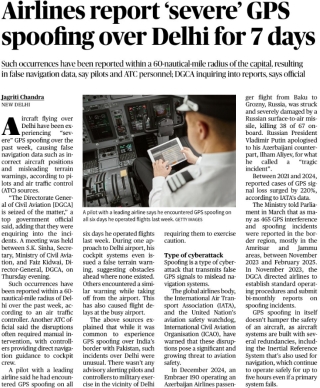
Syllabus Mapping
- GS3: Science and Technology — Awareness in the fields of IT, Computers, Cybersecurity, and Aviation Technology.
Context Over the past week, several aircraft flying over Delhi have reported incidents of “severe GPS spoofing”, resulting in false navigation data, incorrect aircraft positioning, and misleading terrain warnings.
These disruptions occurred within a 60-nautical-mile radius of Delhi and caused flight delays and manual intervention by air traffic controllers (ATC). The Directorate General of Civil Aviation (DGCA) has initiated an inquiry into the incidents. The issue has drawn attention due to the growing cyber vulnerability of aviation systems worldwide.
What Is GPS Spoofing? GPS Spoofing is a cyberattack in which a transmitter sends fake GPS signals to deceive a receiver into showing false location or timing data.
How It Works
- Modern aircraft rely on Global Navigation Satellite Systems (GNSS) such as GPS for positioning and navigation.
- Spoofers mimic these signals, tricking aircraft systems into believing they are somewhere else.
- This leads to erroneous altitude or terrain warnings, posing a risk to flight safety.
Global Concerns and Trends - Between 2021 and 2024, reported cases of GPS signal interference increased by 220%, according to the International Air Transport Association (IATA).
- Many incidents have been recorded in conflict zones such as Ukraine, the Middle East, and parts of Eastern Europe, often linked to military-grade electronic warfare systems.
- India’s recent experience indicates that such cyber threats are no longer geographically confined.
Analysis and Implications Aviation Safety Risks - Although commercial aircraft have redundant navigation systems (like the Inertial Reference System), spoofing can create confusion in cockpit automation.
- False warnings may cause unnecessary evasive actions or operational delays.
National Security Concerns - The proximity of spoofing to India’s national capital region (NCR) raises the possibility of intentional interference.
- Cyberattacks on critical aviation infrastructure could potentially be part of hostile electronic warfare or espionage attempts.
Cybersecurity and Technological Preparedness - India’s aviation cybersecurity framework needs constant upgradation to match new-generation threats.
- The DGCA and Airlines have been asked by the International Civil Aviation Organization (ICAO) to maintain and submit bi-monthly reports on GPS interference incidents.
- Development of anti-spoofing algorithms, signal authentication systems, and pilot training in manual navigation is essential.
UPSC Prelims Q. Consider the following statements regarding GPS spoofing: 1. GPS spoofing involves transmitting false signals to deceive navigation systems. 2. The International Civil Aviation Organization (ICAO) is responsible for setting global standards to address such threats. 3. The Inertial Reference System (IRS) used in aircraft serves as a backup when GPS signals are unavailable. Which of the statements given above are correct? (a) 1 and 2 only
(b) 2 and 3 only
(c) 1 and 3 only
(d) 1, 2 and 3
Answer: (d) 1, 2 and 3
Indian Navy commissions survey vessel INS Ikshak
Context The Indian Navy has commissioned its third Survey Vessel (Large) class ship, INS Ikshak, at the Naval Base in Kochi.
The ceremony was presided over by Admiral Dinesh K. Tripathi, Chief of the Naval Staff.
What It Is About
- INS Ikshak is part of India’s Survey Vessel (Large) class, designed to strengthen hydrographic survey and maritime operational capabilities.
- The ship will assist in:
- Hydrographic surveys for navigational charting,
- Humanitarian assistance,
- Disaster relief, and
- Medical support operations.
- Notably, INS Ikshak is the first SVL to have dedicated women’s accommodation, reflecting the Navy’s push toward gender inclusivity.
UPSC Prelims Q. With reference to
INS Ikshak, recently in the news, consider the following statements: 1. It is the third vessel of the Survey Vessel (Large) class. 2. It is designed for hydrographic surveys, disaster relief, and medical support operations. 3. It is the first Indian naval vessel with dedicated women’s accommodation. Which of the statements given above are correct? (a) 1 and 2 only
(b) 2 and 3 only
(c) 1 and 3 only
(d) 1, 2, and 3
Answer: (d) 1, 2, and 3
Baliyatra Festival
Syllabus: GS Paper I - Indian Culture
The Baliyatra Festival, celebrated annually in Cuttack, Odisha, commemorates the ancient maritime and cultural connections between Kalinga (modern-day Odisha) and various regions of Southeast Asia. It also highlights India’s rich seafaring history.
Key Points:
- Celebration Date: Held every year on Kartika Purnima, marking the day seafaring traders sailed for Indonesian islands.
- Historical Significance: Commemorates the 2,000-year-old maritime links between ancient Kalinga and Southeast Asia, including Bali, Java, Sumatra, and Ceylon.
- Cultural Importance: Recognizes the skills of ancient sailors who contributed to the prosperity of the Kalinga Empire.
- Boita Bandana Ritual: Women float paper or banana leaf boats with lighted lamps in the Mahanadi river, symbolizing the maritime voyage.
- Festivities: The festival features grand fairs, rides, food, dance, and vibrant cultural performances.
Source: News On Air
Vande Mataram 150 Years Celebration
Syllabus: GS Paper I - Indian Culture
The celebration of 150 years of "Vande Mataram" marks the historical significance of India’s National Song, which has deep cultural and political relevance, especially in the context of India's freedom struggle.
Key Points:
- National Song: "Vande Mataram," written by Bankim Chandra Chatterjee in 1882, is a blend of Sanskrit and Bengali.
- Historical Context: Featured first in the novel Anand Math, it became a symbol of patriotism during the Indian freedom struggle.
- First Performance: Rabindranath Tagore first sang it at the 1896 Congress Session in Calcutta.
- Political Significance: "Vande Mataram" was used as a political slogan during the Swadeshi Movement, beginning 7 August 1905.
- Global Recognition: In 1907, Madam Bhikaji Cama raised the tricolour flag with "Vande Mataram" written on it in Stuttgart, Germany.
- National Song: On 24 January 1950, the Constituent Assembly officially adopted "Vande Mataram" as India’s National Song, holding it in equal reverence to the National Anthem.
- Singing Protocol: It is not mandatory to sing "Vande Mataram" at any occasion, although it is revered as the National Song.
Source: News On Air
UN Water Convention
Syllabus:
GS Paper II -
International Relations
The United Nations Water Convention addresses the sustainable management of transboundary water resources, fostering international cooperation to prevent water-related conflicts and promoting regional integration. Bangladesh’s accession marks a significant milestone in South Asia.
Key Points: - UN Water Convention: Also known as the Convention on the Protection and Use of Transboundary Watercourses and International Lakes, adopted in 1992 and effective from 1996.
- History: Initially a regional framework for Europe, it became open to all UN Member States in 2016 after an amendment.
- Legal Framework: A legally binding instrument that supports sustainable water management, conflict prevention, and peace-building through cooperation.
- Cooperation Mandate: Parties are required to prevent transboundary harm, use shared water resources equitably, and ensure sustainable management.
- Bilateral Agreements: The Convention encourages the establishment of bilateral or multilateral agreements for specific transboundary water bodies, rather than replacing them.
- UNECE Role: The United Nations Economic Commission for Europe (UNECE) provides support for the Convention’s implementation.
- Significance: Integral for achieving the 2030 Agenda for Sustainable Development and the Sustainable Development Goals (SDGs), particularly in water management.
Source: DTE
Second World Summit for Social Development 2025
Syllabus:
GS Paper II -
International Relations
The Second World Summit for Social Development in Doha, Qatar, aims to assess global progress on social development, focusing on poverty eradication, employment, and social inclusion, while reinforcing commitments to the 2030 Agenda for Sustainable Development.
Key Points: - UN Convened Summit: The summit reaffirms the commitment to eradicate poverty, promote full employment, decent work, and social inclusion.
- Alignment with Global Processes: It aligns with recent global initiatives, such as the 2023 SDG Summit Political Declaration and the Pact of the Future.
- First Summit: The first World Summit for Social Development was held in Copenhagen in March 1995.
- Location: The second summit is being held in Doha, Qatar, with India represented by the Minister for Labour & Employment.
- Main Objectives:
- Global Solidarity: Accelerate social development action by assessing progress and addressing gaps.
- 2030 Agenda Implementation: Strengthen the execution of the SDGs and the 2030 Agenda.
- Copenhagen Commitments: Reaffirm the 10 commitments made in the Copenhagen Declaration.
- Focus Areas: Promoting equality, inclusion, well-being, and strengthening global cooperation.
Source: DD News
Operation White Cauldron Syllabus:
GS Paper II -
Governance, Transparency, and Accountability
Operation White Cauldron is a significant law enforcement action targeting the illegal drug trade in India, particularly focusing on synthetic drugs. It aligns with India’s ongoing efforts to curb drug abuse and promote public health.
Key Points: - Operation Overview: Led by the Directorate of Revenue Intelligence (DRI), this nationwide operation focuses on dismantling clandestine drug manufacturing units involved in producing psychotropic substances, particularly Alprazolam.
- Aim: To disrupt inter-state synthetic drug networks, prevent illegal chemical precursor trade, and contribute to the Nasha Mukt Bharat Abhiyaan.
- Seizure Details: In Valsad, Gujarat, a major Alprazolam manufacturing unit was uncovered, with drugs worth ₹22 crore seized, and four individuals arrested.
- Significance:
- Curbing Synthetic Drug Trade: The operation disrupted the large-scale circulation of synthetic drugs like Alprazolam across multiple states.
- Strengthened Inter-State Cooperation: Enhanced coordination between law enforcement agencies to track and eliminate narcotic networks under the NDPS Act, 1985.
- Support for Anti-Drug Mission: Operation aligns with the government’s Nasha Mukt Bharat Abhiyaan, working to reduce drug abuse through proactive surveillance and intervention.
Source: DD News

 Launch your Graphy