Daily Current Affairs for UPSC 6th Dec 2025


| Index |
| S.No | Topic | Page No |
| Daily Hindu Analysis (YouTube) |
| 1. | A growing shadow over digital constitutionalism |
|
| 2. | India-Russia friendship like the pole star: PM |
|
| 3. | Cheaper loans likely as repo rate cut by 25 bps |
|
| 4. | Govt. to streamline its public communications framework | |
| 5. | Path paved to link India’s skill base with Russia’s demand for labourers | |
| 6. | Delhi, Moscow look to raise Arctic and nuclear cooperation | |
| 7. | RBI to conduct OMO purchases of ₹1 lakh crore: G-Secs for liquidity |
|
| Daily Current Affairs (App) |
| 8. | Hornbill Festival | |
| 9. | National Forensic Infrastructure Enhancement Scheme | |
| 10. | Government Initiatives Using AI in Agriculture | |
| 11. | India–Malaysia Joint Military Training Exercise HARIMAU SHAKTI Begins in Rajasthan | |
| 12. | India, Russia Finalise 2030 Economic Cooperation Programme | |
A growing shadow over digital constitutionalism
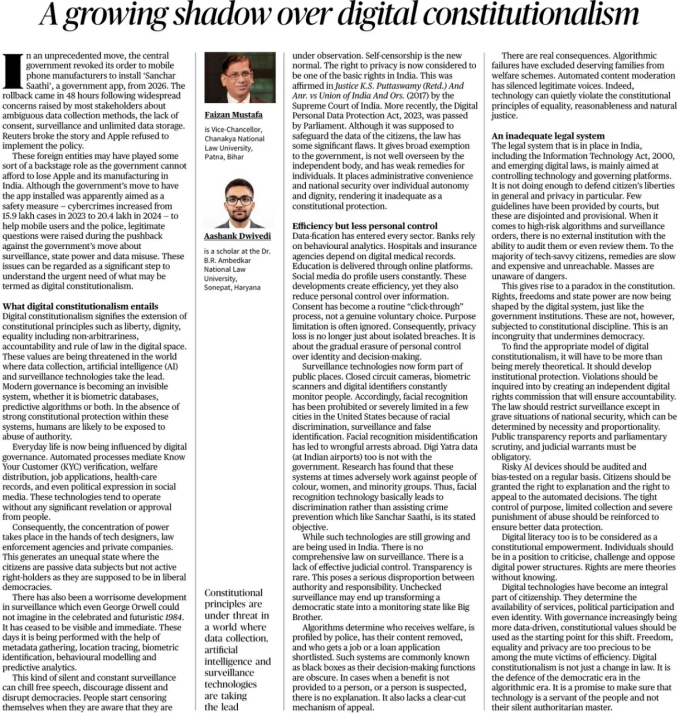
Context
The article analyses the Centre’s attempt to mandate pre-installation of the Sanchar Saathi app on all smartphones and the rapid rollback after public outcry. Using this episode, the authors argue that India is entering an era of “digital constitutionalism” where constitutional values are being tested by data collection, AI, and surveillance technologies. Detailed Analysis
1. What digital constitutionalism means
- Digital constitutionalism refers to application of core constitutional principles – liberty, dignity, privacy, equality, non-arbitrariness, accountability and rule of law – to the digital sphere.
- As governance becomes data-driven (KYC, welfare delivery, credit scoring, political profiling), citizens’ everyday life is increasingly mediated by algorithms and platforms, not just traditional state authorities.
- Without strong constitutional guardrails, humans risk being reduced to data points under opaque systems of control.
2. The Sanchar Saathi episode as a warning sign - Government order for mandatory pre-installation raised concerns on:
- absence of informed consent,
- unclear data retention and sharing,
- potential for surveillance and tracking.
- Strong backlash from civil society and telecom/device firms (including Apple) led to a 48-hour rollback, showing both the vulnerability of citizens’ rights and the power of public scrutiny.
- The issue is framed not as opposition to crime control, but as objection to unchecked executive power in digital policy.
3. Privacy as a constitutional right, but weak protection in practice - The Supreme Court’s K.S. Puttaswamy (2017) judgment recognised the right to privacy as a fundamental right.
- The Digital Personal Data Protection Act, 2023 was expected to operationalise this but, according to the authors, has serious problems:
- Broad exemptions for the State;
- Weak independence of the data protection board;
- Limited remedies for individuals;
- Over-emphasis on national security and administrative convenience.
- Thus, data protection remains a statutory concession rather than a robust constitutional shield.
4. Datafication and the erosion of meaningful consent - Every sector – banking, welfare, telecom, jobs, social media – now runs on continuous data extraction and profiling.
- Consent is often “click-through” and illusory, with users having no real choice if they want to access essential services.
- Platforms and state systems together create permanent digital trails, enabling monitoring and nudging of citizen behaviour.
5. Rise of surveillance technologies in public spaces - CCTV networks, biometric systems, facial recognition, DigiYatra-type apps and automated number-plate recognition systems are becoming routine in cities and transport hubs.
- Such tools can misidentify people, especially minorities and vulnerable groups, leading to false suspicion, exclusion or criminalisation.
- The article points to global examples where facial recognition has been restricted due to racial bias; similar concerns arise in India without any comprehensive law on surveillance.
6. Algorithmic governance and exclusion - Algorithms now influence welfare targeting, credit scoring, school admissions, policing, and platform visibility.
- When flawed or biased, they can:
- deny deserving families welfare benefits,
- amplify discrimination,
- silence certain voices in digital spaces.
- Because these systems are opaque and often proprietary, affected citizens find it hard to challenge decisions, diluting basic constitutional guarantees of equality and due process.
7. Democratic deficit and institutional gaps - India lacks a clear legal framework for:
- state surveillance thresholds,
- independent oversight of intelligence agencies,
- algorithmic audits and transparency obligations.
- Parliamentary oversight, public consultations, and judicial warrants often trail behind rapid deployment of new technologies.
- The authors warn that digital tools are being used in ways that reshape power relations without adequate democratic debate.
Suggestions / Way Forward 1. Stronger data and surveillance laws - Enact a comprehensive surveillance law with:
- clear legality, necessity, and proportionality tests;
- strict limits on bulk and un-targeted surveillance;
- independent authorisation and review (not just executive approval).
2. Make the DPDP Act rights-centric - Narrow State exemptions; ensure an independent, well-resourced data protection authority.
- Guarantee effective rights to notice, access, correction, portability and meaningful remedy for citizens.
3. Algorithmic accountability - Mandate impact assessments and audits for high-risk AI systems used in welfare, policing, and credit.
- Require transparency about data sources, logic and error rates, especially where decisions significantly affect rights.
4. Strengthen democratic oversight - Ensure parliamentary scrutiny of major digital policies and large surveillance projects.
- Public consultation, civil society participation, and periodic reviews should be mandatory.
5. Upholding constitutional values online - Treat digital governance as constitutional governance: any intrusion must satisfy tests of legality, legitimate aim, necessity, and proportionality.
- Courts should remain vigilant in reviewing digital measures that restrict liberty, dignity and equality.
Conclusion The authors argue that India is witnessing a
“growing shadow” over constitutionalism in the digital age. While digital tools can enhance efficiency and security, unchecked data extraction, surveillance and algorithmic control risk hollowing out fundamental rights. Safeguarding privacy, autonomy and equality online requires not just better technology, but
strong laws, independent oversight and a constitutional culture that treats citizens as rights-bearers, not mere data subjects. UPSC Mains Question “Digital technologies have transformed governance in India, but without adequate constitutional safeguards they risk creating an infrastructure of surveillance and exclusion.” Discuss with reference to recent debates on data protection, mandatory apps and facial recognition systems. India-Russia friendship like the pole star: PM Context During Russian President Vladimir Putin’s two-day visit to India, Prime Minister Narendra Modi described
India–Russia friendship as “steady like the pole star (dhruva tara)”. The visit saw reaffirmation of strategic ties, emphasis on energy and nuclear cooperation, and signing of new pacts on mobility of Indian workers and economic collaboration.
Detailed Analysis 1. Nature of the India–Russia Partnership - PM Modi highlighted that the relationship has remained stable over a quarter of a century, despite global crises and geopolitical churn.
- Foreign Secretary explained “dhruva tara” as symbolising sustained, predictable and long-term ties.
- Both leaders projected the partnership as crisis-resilient, withstanding Cold War legacies, post-Soviet transition, and current great-power rivalries.
2. Energy Security as a ‘Strong Pillar’ - PM Modi signalled that, despite Western criticism, India will continue energy ties with Russia, calling energy cooperation a “vital pillar” of the partnership.
- Joint statement underlined cooperation in:
- Oil and gas (upstream and downstream),
- Oil refining and petrochemicals,
- Oilfield services and technologies,
- Associated infrastructure.
- This aligns with India’s strategy of diversified energy sourcing and discounted crude imports amidst global price volatility.
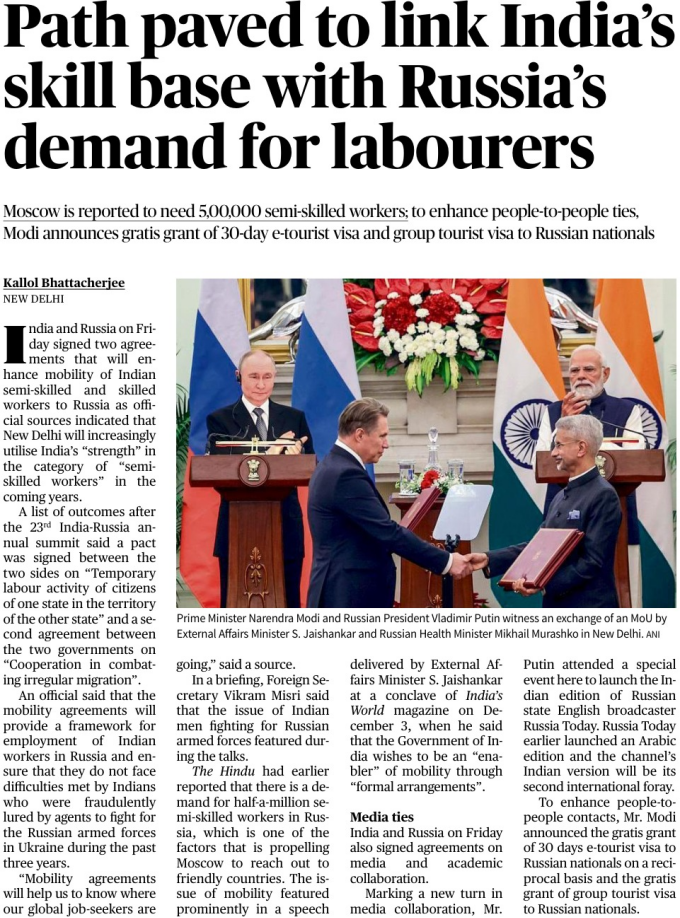
3. Pacts to Facilitate Indian Workers in Russia - India and Russia signed two agreements to enhance mobility of semi-skilled and skilled Indian workers to Russia.
- Russia will “increasingly utilise India’s strength” in this category, adding dynamism to economic ties and offering employment avenues for Indian youth.
- This also reflects India’s attempt to position itself as a global human-resource hub, not just a market.
4. Nuclear and High-Technology Collaboration - President Putin highlighted the Kudankulam plant as the “largest nuclear reactor of India” and reaffirmed long-term nuclear cooperation.
- Russia expressed willingness to collaborate on small modular nuclear reactors, supporting India’s clean energy transition.
- Nuclear cooperation reinforces Russia’s role as a technology partner, not merely a supplier of raw energy.
5. Strategic Autonomy and Independent Foreign Policy - Both sides projected themselves as countries following an “independent foreign policy” aimed at a more just and democratic world order.
- India maintained its balanced stance on Ukraine, reiterating the need for dialogue and peaceful resolution, while not rupturing ties with Russia.
- For India, deepening ties with Russia while engaging the West reflects multi-alignment and strategic autonomy.
6. Economic & Sectoral MoUs - Sixteen MoUs were signed covering:
- Mobility of semi-skilled workers,
- Fertilizer supply and cooperation,
- Media collaboration,
- Academic and research partnerships, and other economic linkages.
- These seek to broaden ties beyond defence to trade, agriculture inputs and knowledge sectors, partly compensating for reduced defence dependence and Western sanctions constraints.
UPSC Mains Question “India–Russia relations are often described as time-tested and resilient, yet they face new structural challenges in the emerging global order.” Critically examine this statement in the light of recent developments in energy cooperation, defence ties and labour mobility. Cheaper loans likely as repo rate cut by 25 bps.
Context
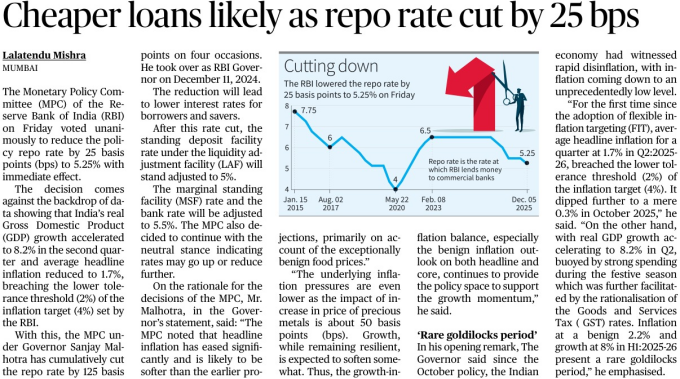
The Reserve Bank of India’s Monetary Policy Committee (MPC) has unanimously decided to cut the policy repo rate by 25 basis points to 5.25% with immediate effect. The move comes amid strong GDP growth and very low inflation, creating space for monetary easing and making bank loans likely to become cheaper.
Key Points
1. Decision of the MPC
- Repo rate cut: Policy repo rate reduced from 5.5% to 5.25%.
- Stance: MPC has retained a neutral stance, signalling that future rate moves will depend on incoming data.
- Cumulative cuts: Under Governor Sanjay Malhotra, repo has now been cut by 125 bps over four meetings.
2. Changes in Policy Corridor - Standing Deposit Facility (SDF): Adjusted to 5% (floor of corridor).
- Marginal Standing Facility (MSF) and Bank Rate: Adjusted to 5.5% (ceiling of corridor).
- This maintains the 0.25% corridor around the repo rate.
3. Macroeconomic Backdrop - Growth: Real GDP growth in Q2 is estimated at 8.2%, aided by festive demand and GST rationalisation.
- Inflation:
- Average headline inflation in Q2: 1.7%, below the lower tolerance band of 2% under the 4% ± 2% inflation-targeting framework.
- October inflation dipped further to 0.3%, indicating rapid disinflation.
- Underlying pressures: Core and food inflation are described as benign, helping ease headline inflation.
4. Rationale for Rate Cut - Headline inflation has softened significantly below earlier projections, mainly due to low food prices and moderated core inflation.
- With growth still resilient, the MPC judged that there is policy space to support momentum without breaching inflation targets.
- Governor described current conditions (strong growth + low inflation) as a “rare goldilocks period” for the Indian economy.
5. Likely Impact - Cheaper loans: Banks are expected to gradually reduce lending rates on housing, vehicle and MSME loans as their cost of funds falls.
- Lower deposit rates: Saving deposit and term deposit rates may also trend lower over time.
- Support to investment and consumption: Lower rates can stimulate credit demand, aiding growth, while RBI will monitor for any potential re-acceleration of inflation.
Source: The Hindu UPSC Prelims Practice Question Q. With reference to the recent decision of the Monetary Policy Committee (MPC) of the RBI, consider the following statements:
1. Repo rate is the rate at which the Reserve Bank of India lends short-term funds to commercial banks.
2. After the latest policy decision, the Standing Deposit Facility (SDF) rate is higher than the Marginal Standing Facility (MSF) rate.
Which of the statements given above is/are correct? a) 1 only
b) 2 only
c) 1 and 2
d) Neither 1 nor 2
Answer: a) 1 only
Govt. to streamline its public communications framework
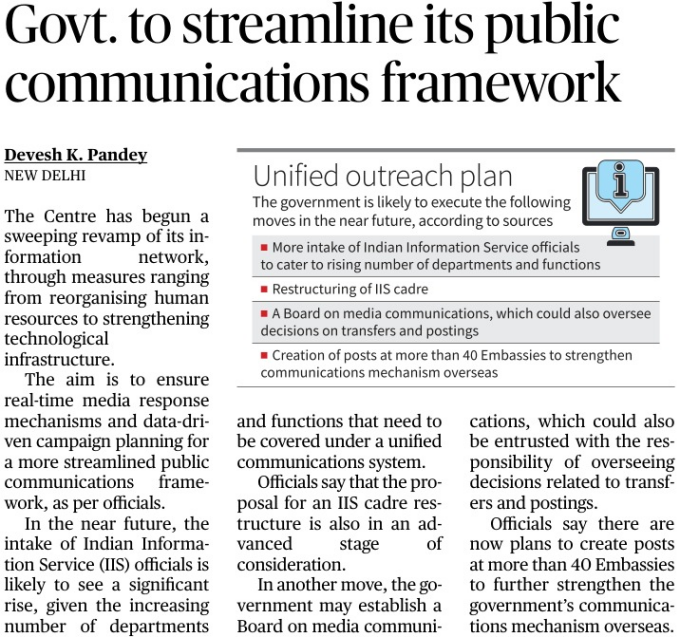
Context
The Union government has initiated a major revamp of its public information and media outreach system. The move aims to ensure real-time media response and data-driven campaign planning by restructuring the Indian Information Service (IIS) and strengthening communication capacity in India and abroad.
Key Points
1. Objectives of the revamp
- Real-time media response: Build capacity to respond quickly to news cycles and misinformation.
- Data-driven outreach: Use analytics for targeted public communication and campaign planning.
- Unified framework: Integrate scattered communication functions under one coherent system.
2. Changes in the Indian Information Service (IIS) - Higher intake of IIS officers to cater to the growing number of ministries, departments and programmes needing professional media handling.
- Restructuring of IIS cadre under consideration to better align ranks, postings and specialization with modern communication needs.
3. Proposed Board on Media Communications - Government considering a Board on media communications to:
- Coordinate communication strategy across ministries.
- Possibly oversee transfers and postings of IIS officers, bringing more coherence and transparency to cadre management.
4. Strengthening overseas communication - Plan to create new information & communication posts in more than 40 Indian embassies.
- Aim is to enhance India’s strategic communication and image-building abroad, and provide quicker responses in foreign media spaces.
5. Significance for governance - A streamlined framework can:
- Improve policy messaging and citizen awareness of schemes.
- Help tackle fake news and disinformation.
- Professionalise government communication as a specialised governance function.
Source: The Hindu UPSC Prelims Practice Question Q. With reference to the recent revamp of the Union government’s public communications framework, consider the following statements: 1. The restructuring proposal relates primarily to the Indian Information Service (IIS) cadre.
2. Creation of additional information posts in Indian embassies is meant to strengthen overseas communication mechanisms.
Which of the statements given above is/are correct? a) 1 only
b) 2 only
c) 1 and 2
d) Neither 1 nor 2
Answer: c) 1 and 2
Path paved to link India’s skill base with Russia’s demand for labourers
Context
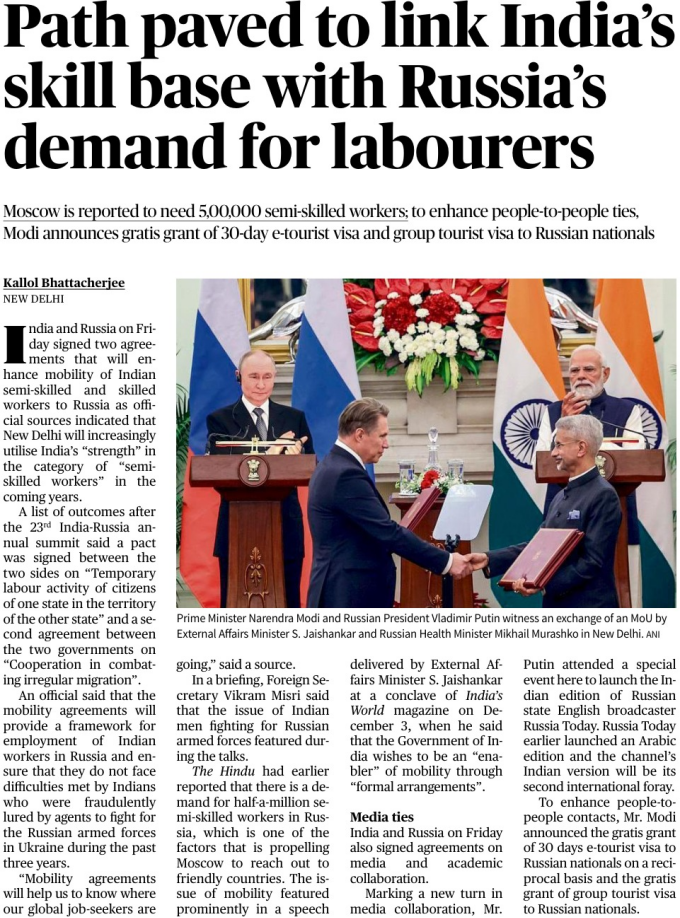
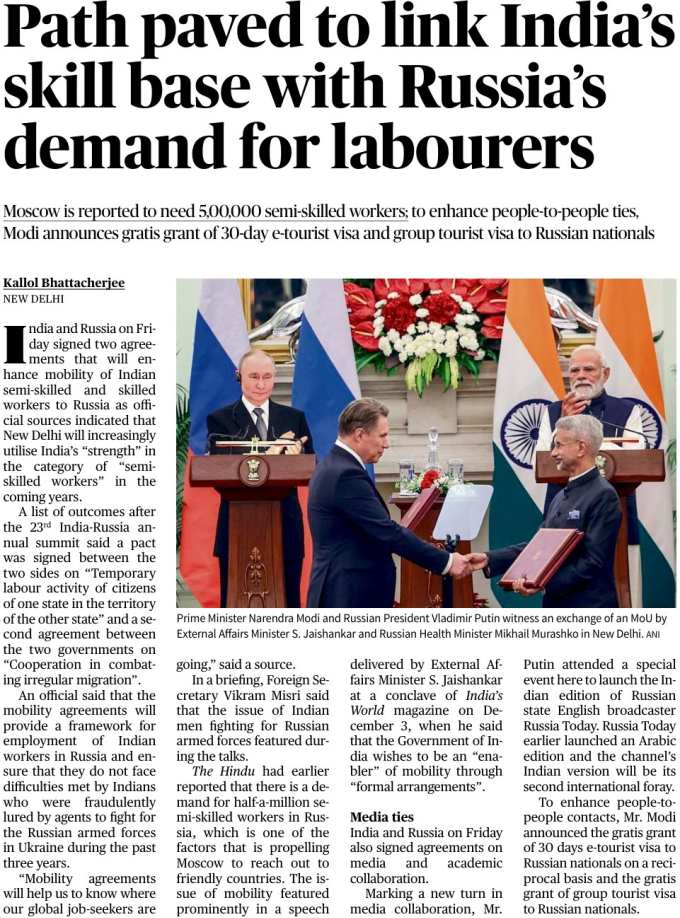
India and Russia have signed two mobility-related agreements enabling the movement of Indian semi-skilled and skilled workers to Russia. This comes amid Moscow’s requirement for nearly 5 lakh semi-skilled workers and aims to strengthen people-to-people ties and labour mobility.
Key Points
1. Labour Mobility Agreements Signed
- India and Russia signed a pact on temporary labour activity, allowing citizens of one country to work in the other.
- A second agreement covers cooperation in combating irregular migration, ensuring safe and legal employment pathways.
2. Russia’s Demand for Indian Workforce - Reports indicate Russia needs 500,000 semi-skilled workers, influenced by shortages arising from the Ukraine conflict and demographic challenges.
- India aims to leverage its large semi-skilled labour base to meet this demand.
3. Protection for Indian Workers - Agreements will create a framework ensuring that Indian workers do not face exploitation by fraudulent agents.
- Issue of Indians misled into joining Russian armed forces was highlighted during talks.
4. People-to-People Engagement Measures - Prime Minister Modi announced gratis 30-day e-tourist visas and group tourist visas for Russians on a reciprocal basis.
- These steps aim to enhance tourism and cultural linkages.
5. Media & Academic Cooperation - India and Russia signed MoUs on media collaboration and academic exchanges, including the launch of the Arabic edition of Russia Today with an Indian version to follow later.
6. Strategic Significance - Labour mobility helps strengthen the India–Russia strategic partnership, especially at a time of geopolitical shifts.
- Enhances India’s role as a global supplier of human capital and supports bilateral economic cooperation.
UPSC Prelims Practice Question Q. With reference to recent India–Russia agreements on labour mobility, consider the following statements:
1. India and Russia have signed a pact allowing temporary labour activity of each other’s citizens in the other country.
2. The agreements also include provisions to combat irregular migration.
3. The mobility framework includes a guaranteed minimum wage for all Indian workers employed in Russia.
Which of the statements given above is/are correct? a) 1 and 2 only
b) 2 and 3 only
c) 1 and 3 only
d) 1, 2 and 3
Answer: a) 1 and 2 only
Delhi, Moscow look to raise Arctic and nuclear cooperation
Context India and Russia have agreed to deepen cooperation in Arctic governance and nuclear energy, as highlighted during the recent India–Russia summit. The joint statement emphasises regular consultations on Arctic issues and expanding collaboration in nuclear technology.
Key Points
1. India–Russia Cooperation on Arctic Issues
- Both countries will hold regular bilateral consultations on Arctic-related matters.
- India acknowledged progress in cooperation on the Northern Sea Route (NSR), a key emerging maritime corridor.
2. India’s Long Scientific Engagement in the Arctic - India’s scientific presence dates back to the Svalbard Treaty, 1920, allowing non-military scientific activities.
- India conducts Arctic research on climate, fisheries, and mining under international legal frameworks.
3. Expansion of Nuclear Energy Partnership - Russia will support India across the fuel cycle and lifecycle of the Kudankulam Nuclear Power Project (KKNPP).
- Both sides will progress work on the construction of remaining reactors at Kudankulam and ensure timely equipment and fuel supply.
4. Nuclear Fuel Delivery for Kudankulam Unit-3 - Rosatom has delivered initial fuel assemblies for Unit-3 of KKNPP.
- The supply is under the 2024 pact, covering the lifetime fuel requirement for Units 3 and 4.
5. Future Nuclear Projects - India and Russia agreed to hold further discussions on another nuclear plant, with India expressing interest in selecting a second site.
6. Joint Development of Nuclear Technologies - Talks to continue on the VVER (Vodo-Vodyanoi Energetichesky Reaktor) design for research and commercial applications.
- The cooperation includes reactor development and advanced nuclear technologies.
7. Collaboration in Space Sector Both sides welcomed the enhanced partnership between
ISRO and Russia’s
Roscosmos for peaceful uses of outer space.
RBI to conduct OMO purchases of ₹1 lakh crore: G-Secs for liquidity
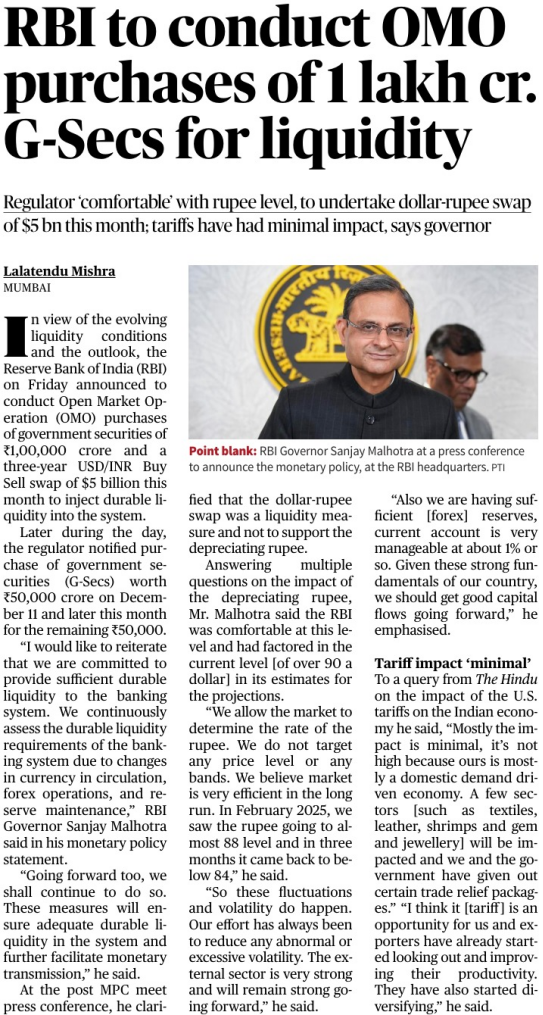
Context
The Reserve Bank of India (RBI) has announced Open Market Operation (OMO) purchases of government securities worth ₹1 lakh crore, along with a $5 billion USD/INR Buy–Sell swap, to inject durable liquidity into the financial system.
Key Points
1. OMO Purchases Announced
- RBI will purchase ₹1,00,000 crore worth of Government Securities (G-Secs).
- A tranche of ₹50,000 crore will be purchased on December 11, and the rest later this month.
2. Purpose of OMO - To ensure sufficient durable liquidity in the banking system.
- Supports economic activity and improves monetary policy transmission.
3. Dollar–Rupee Swap of $5 Billion - A three-year Buy–Sell swap announced for December.
- Clarified as a liquidity management tool, not a measure to support the rupee.
4. RBI Position on Rupee Volatility - RBI is comfortable with the rupee trading above ₹90 per USD.
- Rupee previously fluctuated between ₹88 to ₹84 in early 2025, showing natural volatility.
- RBI does not target a specific exchange rate or band.
5. Forex & External Sector Outlook - India’s forex reserves are adequate; the current account deficit remains around 1% of GDP.
- Strong fundamentals expected to attract capital inflows.
6. Impact of U.S. Tariffs Called Minimal - U.S. tariffs have limited impact as India is a domestic-demand driven economy.
- Some affected sectors (textiles, leather, shrimps, gems/jewellery) have been given support packages.
- Tariffs seen as an opportunity for exporters to innovate and diversify.
Open Market Operations (RBI): - OMO refers to RBI’s purchase or sale of government securities to regulate liquidity.
- OMO Purchase: Injects liquidity.
- OMO Sale: Absorbs liquidity.
- A key tool under liquidity management framework alongside CRR, SLR, MSF, LAF.
Source: The Hindu
UPSC Prelims Practice Question Q. With reference to Open Market Operations (OMO), consider the following statements:
1. OMO purchases by the RBI lead to an increase in liquidity in the banking system.
2. OMO operations involve buying or selling government securities in the secondary market.
3. OMO is used only for managing inflation and has no role in managing liquidity.
Which of the statements given above is/are correct? a) 1 only
b) 1 and 2 only
c) 2 and 3 only
d) 1, 2 and 3
Answer: b) 1 and 2 only
Hornbill Festival
Syllabus: GS I – Indian Art and Culture Context The 26th Hornbill Festival (2025) is being celebrated at Kisama Heritage Village, Nagaland, where 18 Naga tribal troupes are performing to showcase the State’s rich cultural diversity. Key Points What is the Hornbill Festival?
- Premier cultural festival of Nagaland, called the “Festival of Festivals.”
- Celebrates the heritage, traditions and artistic expressions of all major Naga tribes.
When and where is it held? - Organised annually from 1–10 December.
- Venue: Kisama Heritage Village, near Kohima, Nagaland.
Historical Background - Started in 2000 by the Government of Nagaland.
- Aims to promote inter-tribal unity, preserve indigenous culture and boost tourism.
- Named after the Hornbill bird, revered in Naga folklore for valour, beauty and tradition.
Major Cultural Features - Daily traditional dances, folk songs, war cries and indigenous games by Naga tribes.
- Showcases Naga arts and crafts: wood carving, textiles, paintings, sculptures, jewellery.
- Food festivals, herbal medicine stalls, flower shows and traditional archery & wrestling.
Special Events - Hornbill International Rock Festival and contemporary music shows.
- Morung (traditional house) exhibitions, fashion shows and craft bazaars.
- Participation from international partners and neighbouring Indian states.
Significance - Revives and preserves the cultural identity of Nagaland’s 17 major tribes.
- Acts as a platform for inter-generational cultural exchange between elders and youth.
- Strengthens tourism and local livelihoods and enhances global cultural linkages for Nagaland.
Source: DD News
National Forensic Infrastructure Enhancement
Scheme Syllabus: GS II – Government Policies and Interventions / Internal Security
Context The Government informed the Rajya Sabha about the National Forensic Infrastructure Enhancement Scheme (NFIES), launched to strengthen India's forensic capabilities in line with the requirements of the new criminal laws. Key Points About the Scheme
- Central Sector Scheme, launched in 2024.
- Aim: Create robust forensic laboratory infrastructure and develop world-class trained forensic professionals.
- Nodal Ministry: Ministry of Home Affairs (MHA).
- Implementation Period: 2024–25 to 2028–29.
Key Components - Setting up new campuses of the National Forensic Sciences University (NFSU) across India.
- Establishment of new Central Forensic Science Laboratories (CFSLs).
- Upgrading the existing NFSU Delhi campus with advanced infrastructure.
Why NFIES was Introduced? - New criminal laws mandate forensic investigation for offences punishable with 7 years or more, increasing workload.
- Existing forensic laboratories face manpower shortages and high pendency.
- The scheme aims to reduce case backlog, improve forensic quality, and support the goal of achieving 90%+ conviction rates.
Source: PIB
Government Initiatives Using AI in Agriculture
Syllabus: GS III – Agriculture, Science & Technology Context The Government of India is increasingly deploying Artificial Intelligence (AI) to improve crop productivity, enhance sustainability, and strengthen farmer livelihoods by addressing climate, pest, and information-related challenges.
Key Points
1. Kisan e-Mitra (AI Voice-Based Chatbot)
- A voice-enabled AI chatbot designed to assist farmers with queries related to PM-KISAN, PMFBY, and Kisan Credit Card.
- Supports 11 regional languages, ensuring wider accessibility.
- Handles 8,000+ queries daily; over 93 lakh queries resolved so far.
- Being upgraded to support more government schemes for farmer assistance.
2. National Pest Surveillance System (AI–ML Based) - Uses AI & Machine Learning to detect pest infestation early, enabling timely intervention.
- Farmers upload pest images via extension workers; the tool provides rapid diagnosis.
- Used by 10,000+ extension workers, covering 66 crops and 432 pest types.
- Helps reduce crop losses, especially in climate-change–induced pest outbreaks.
India–Malaysia Joint Military Training Exercise HARIMAU SHAKTI Begins in Rajasthan
Syllabus: GS III – Security; Defence Cooperation; International Relations
Context The 5th edition of
Exercise Harimau Shakti-2025 between India and Malaysia has commenced at the
Mahajan Field Firing Range, Rajasthan, from
5–18 December 2025, focusing on counter-terror operations under the UN mandate.
Key Points About Exercise Harimau Shakti-2025 - A bilateral military exercise held annually between India and Malaysia.
- The 2025 edition is being hosted by India in the deserts of Rajasthan.
Participating Troops - India: Troops primarily from the DOGRA Regiment.
- Malaysia: Personnel from the 25th Battalion, Royal Malaysian Army.
Aim of the Exercise - To rehearse sub-conventional operations under Chapter VII of the UN Mandate.
- Strengthen coordination, planning and execution in counter-terrorist operations.
Operational Scope - Joint response simulations during counter-terrorism missions.
- Tactical drills include:
- Search and destroy missions
- Heliborne operations
- Securing helipads
- Casualty evacuation (CASEVAC)
Interoperability & Cooperation - Enhances interoperability between Indian and Malaysian forces.
- Focus on learning best practices and improving joint combat effectiveness.
- Reinforces bilateral defence ties and supports cooperation in UN peacekeeping operations.
Source: PIB
India, Russia Finalise 2030 Economic Cooperation Programme
Syllabus: GS II – International Relations Context India and Russia have agreed on a 2030 Economic Cooperation Programme aimed at expanding bilateral trade, investment, and industrial collaboration after high-level talks between PM Narendra Modi and Russian President Vladimir Putin. Key Points 2030 Economic Cooperation Programme
- A long-term framework to diversify bilateral trade beyond traditional sectors like defence and energy.
- Seeks to provide predictability and direction to investors on both sides.
Focus on Trade & Investment Expansion - Both countries plan to expand trade volumes, promote joint ventures, and boost industrial partnerships across sectors.
- Emphasis on energy cooperation, including hydrocarbons, civil nuclear projects, and critical minerals.
Progress on Proposed Free Trade Agreement - India and Russia discussed the need to fast-track the FTA between India and the Eurasian Economic Union (EAEU) to improve market access.
Industrial & Technology Collaboration - India confirmed active participation in the India–Russia Business Forum, aimed at strengthening joint production, technology transfer, and innovation-led growth.
Connectivity & Financial Cooperation - Both sides reiterated commitment to connectivity projects such as the International North-South Transport Corridor (INSTC).
- Discussions included mechanisms for rupee–ruble trade, banking cooperation, and alternative payment systems to ease transactions.
Source: Indian Express

 Launch your Graphy