Daily Current Affairs for UPSC 5th Dec 2025


| Index |
| S.No | Topic | Page No |
| Daily Hindu Analysis (YouTube) |
| 1. | A day to pause and come down to earth |
|
| 2. | Do we need to change how cities are governed in India? |
|
| 3. | Parliament approves Bill to levy excise duty on tobacco | |
| 4. | Wildlife body BNHS to release 6 critically endangered vultures in Assam in 2026 |
|
| 5. | Postal department considers UPI-like ‘labels’ for addresses |
|
| 6. | State must not prosecute citizens without reasonable prospect of conviction: SC |
|
| 7. | U.S. deported 3,258 Indian nationals in 2025, highest since 2009: Jaishankar in Rajya Sabha |
|
| |
| Daily Current Affairs (App) |
| 8. | Caller Name Presentation (CNAP) | |
| 9. | National Commission for Backward Classes (NCBC) |
|
| 10. | Indian Statistical Institute (ISI) Act, 1959 |
|
| 11. | RBI Integrated Ombudsman Scheme |
|
A day to pause and come down to earth.
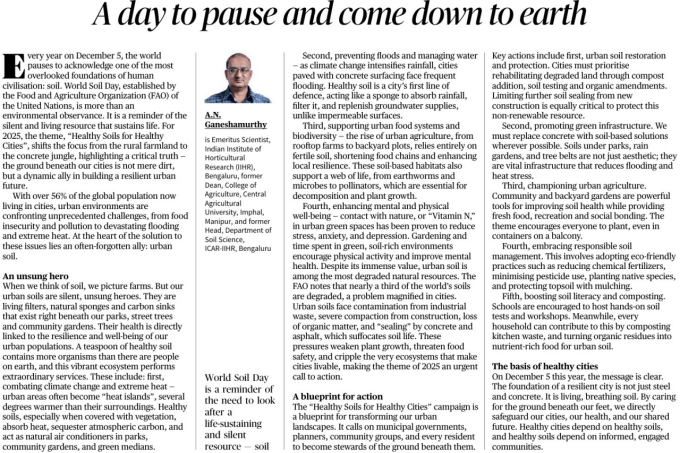
Context
The article highlights the importance of urban soil on World Soil Day (December 5), emphasising its crucial but overlooked role in ensuring food security, climate resilience and healthy urban living, especially under the 2025 theme, “Healthy Soils for Healthy Cities.”
Detailed Analysis
1. Urban Soil: The Silent Hero
- Urban soils act as natural sponges, absorbing heat, storing carbon and moderating temperatures.
- They help combat urban heat islands, reduce pollution and support microorganisms essential for ecosystem functioning.
- A teaspoon of healthy soil contains more organisms than people on Earth—showing its immense biological value.
2. Role in Climate Resilience and Water Management - Healthy soils help reduce flood risk by absorbing runoff, unlike concrete surfaces.
- They replenish groundwater and act as the first line of defence during extreme weather events.
- Soil sealing by asphalt and construction suffocates soil life, increasing flood vulnerability.
3. Supporting Urban Food Systems and Biodiversity - Urban agriculture—rooftop farms, backyard plots—depends on fertile soil.
- Soil supports food chains, beneficial insects and pollinators like earthworms and microbes.
- Shortened food chains enhance local resilience and community nutrition.
4. Enhancing Physical and Mental Well-being - Interaction with soil and green spaces, termed “Vitamin N”, reduces stress and improves mental health.
- Gardening, composting and outdoor activity in soil-rich areas improve physical well-being.
- Yet, urban soils are among the most degraded resources, facing pollutants, compaction, sealing and loss of organic matter.
Blueprint for Action Urban Soil Restoration - Prioritise rehabilitation of degraded lands through compost, organic amendments and soil testing.
- Limit new construction that seals soil surfaces.
Green Infrastructure - Replace concrete with soil-based solutions:
- parks
- rain gardens
- tree belts
These reduce flooding and heat stress.
Champion Urban Agriculture - Promote community gardens, kitchen gardens and balcony containers.
- Provide recreation, nutrition and social bonding.
Responsible Soil Management - Reduce chemical inputs, promote mulching, composting and eco-friendly farming practices.
- Encourage planting native species and minimising pesticide use.
Boost Soil Literacy - Schools to introduce soil workshops, testing and composting.
- Households should compost organic waste to create nutrient-rich soil.
Conclusion Urban soils are essential for building a resilient, healthy and sustainable future. Protecting them is not merely an environmental priority but a foundation for secure food systems, climate resilience, cleaner air, and community well-being. The 2025 theme serves as a reminder that the health of our cities depends directly on the health of the soil beneath them.
UPSC Mains Question
“Urban soils are the foundation of sustainable and climate-resilient cities.” Discuss the challenges affecting urban soils and suggest measures to restore their ecological functions.
Do we need to change how cities are governed in India?
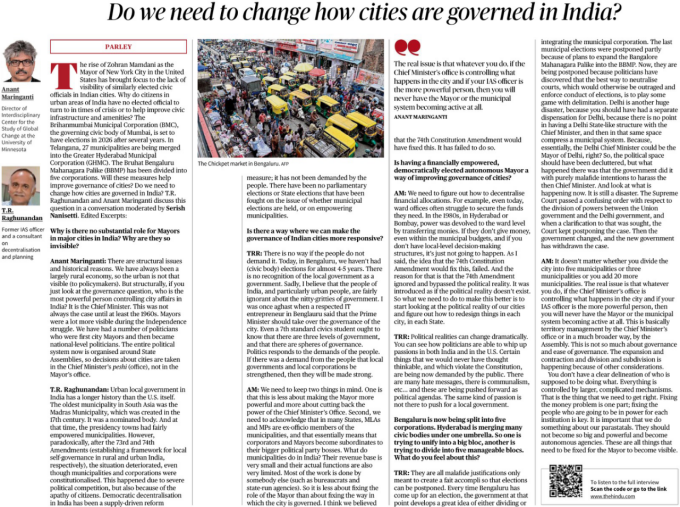
Context
The article is a Parley discussion between Anant Maringanti and T.R. Raghunandan on whether India needs to fundamentally change how its cities are governed. It examines the weak role of elected Mayors, the dominance of Chief Ministers and State bureaucracy, and the limited impact of the 74th Constitutional Amendment on urban self-government.
Detailed Analysis
1. Why are Mayors so weak and invisible?
- Chief Minister as the real power centre: Structurally, cities’ key decisions are controlled by the State government and not by elected Mayors or councils.
- During the freedom struggle, Mayors were visible public figures; now, they are overshadowed by State-level politicians whose careers are built in the Assembly, not in city halls.
- The political system is organised around State Assemblies and Chief Ministers; municipal politics is treated as secondary.
2. Historical evolution and missed opportunity of the 74th Amendment - India’s local government history predates many Western examples (e.g., local bodies in Madras Presidency in the 19th century).
- The 74th Constitutional Amendment was meant to provide a framework for urban self-government, but:
- States often did not devolve real powers, functions, or finances.
- Municipalities remain “creatures of the State”, dependent on grants and State approvals.
- Raghunandan notes that while the Amendment gave a constitutional space to cities, political will to use that space has been lacking.
3. Non-recognition of local governments as “real government” - In cities like Bengaluru, civic elections have been delayed for years, reflecting how little seriousness States attach to municipal democracy.
- People are familiar with the MLA–CM system, but often ignorant of the three tiers of government and what the municipal tier does.
- This leads to low demand from citizens for stronger city governments and enables parties to treat ULBs mainly as patronage channels.
4. Financial and functional dependence - Cities need own financial allocations and decision-making powers to respond to local needs.
- Example: In Hyderabad or Bombay earlier, municipal bodies had greater control over local finances; over time, more money and authority moved to State departments.
- Even where funds exist within municipal budgets, local decision-making is constrained by State-level controls and parastatals.
5. Structural problems: fragmentation and recent reorganisation - Bengaluru’s municipal body has been split into multiple corporations, while Hyderabad’s municipalities are being merged into a mega body; both are driven by political calculations rather than governance logic.
- The discussants argue that whether you divide or merge cities is secondary; the real issue is:
- Who controls planning, land, transport, and services?
- Is it the Mayor and council or the Chief Minister and State bureaucracy?
6. Democratic deficit and accountability - When the Chief Minister’s office controls city decisions, citizens cannot hold their local governments directly accountable.
- This also creates space for blame-shifting: State leaders can claim credit for city projects but distance themselves from municipal failures.
- The present arrangement weakens urban citizenship and reduces incentives for professional, city-focused leadership.
Suggestions emerging from the discussion 1. Strengthen directly elected, empowered Mayors o Provide clear, long, and stable tenures.
o Vest them with real control over key functions: planning, transport, utilities, and policing interface.
2. Implement the spirit of the 74th Amendment o Devolve the 12th Schedule functions, along with adequate staff and funds, to ULBs.
o Reduce the reliance on State-level parastatal agencies for core urban services.
3. Ensure predictable finances and autonomy o Provide cities with buoyant own-source revenues (property tax, user charges, cesses). o Mandate a fair share of State revenues for municipalities through State Finance Commissions and formula-based devolution.
4. Clarify vertical accountability o Citizens should know who is responsible for city outcomes; fix clear lines of authority between Mayor, council, bureaucracy, and CM.
o Strengthen Ward Committees and Area Sabhas for participatory local planning.
5. Reduce political control by State-level party structures
o Limit arbitrary dissolution/merger of ULBs. o Encourage city-based leadership rather than treating municipalities as training grounds for MLA/MP careers.
Conclusion
The discussion argues that India’s cities are governed by State capitals rather than city halls. Despite constitutional recognition, urban local bodies lack real power, finances, and visibility. Without politically empowered and financially autonomous city governments, initiatives on smart cities, infrastructure, and resilience will remain constrained. Reforming urban governance is thus not only about administrative efficiency but about strengthening local democracy and urban citizenship.
UPSC Mains Question
“Despite the 74th Constitutional Amendment, Indian cities remain governed from State capitals rather than city halls.” Discuss the structural, political and financial factors responsible for this situation and suggest reforms to create genuinely empowered urban local bodies.
Parliament approves Bill to levy excise duty on tobacco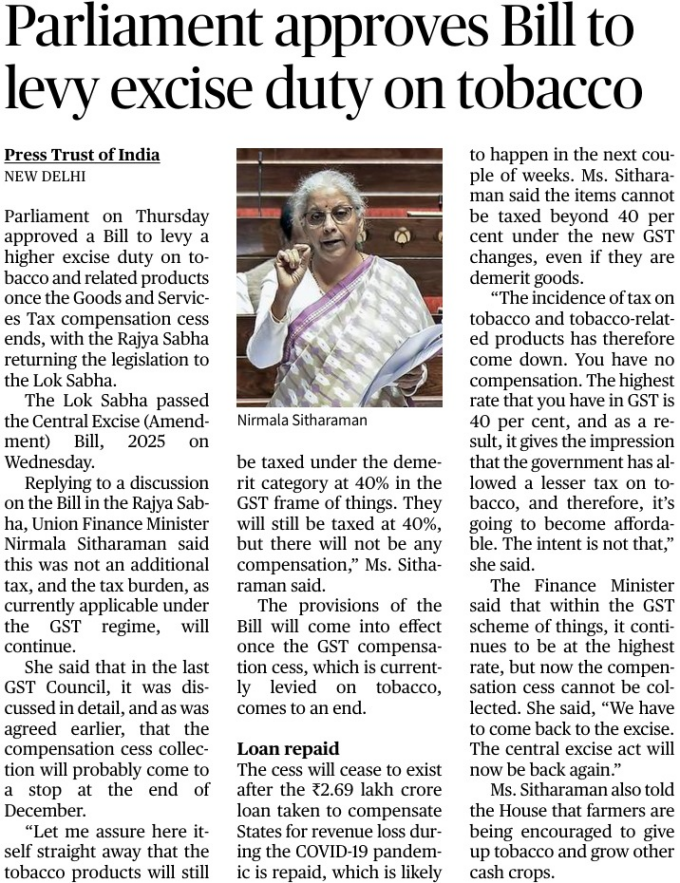
Context Parliament approved the Central Excise (Amendment) Bill, 2025 to allow the Centre to levy higher excise duty on tobacco and related products once the GST compensation cess (currently used to tax tobacco) comes to an end
. Key points What Parliament did
- Central Excise (Amendment) Bill, 2025 was approved by Parliament to restore/enable central excise on tobacco after the GST compensation cess ends.
- The Rajya Sabha returned the Bill to the Lok Sabha after passage.
Why this step - Tobacco products have been taxed under the GST compensation cess mechanism; that cess is likely to cease (compensation loan repaid).
- Once cess ends, the Centre needs a statutory route (excise law) to levy comparable duties.
Finance Minister’s clarifications - Not a new/additional tax: FM Nirmala Sitharaman said the move is not an extra tax beyond the GST regime—rather a shift in the legal instrument for levying the tax.
- GST rates remain relevant: Under GST, tobacco falls in the demerit category with tax incidence around 40%; the excise route will not necessarily increase that immediately.
GST compensation cess linkage - The compensation cess currently funds state revenue shortfalls arising from GST implementation and also covers specific levies on products such as tobacco.
- When the compensation cess collection ends, the cess cannot be collected further — prompting the return to excise.
Policy intent & signals - Government says purpose is to retain tax incidence on tobacco and continue discouraging consumption, not to make tobacco cheaper or to give relief.
- The move also signals the Centre’s intent to reclaim fiscal instruments once the GST transitional mechanisms (compensation cess) end.
Practical effect - Central excise will again be the statutory tool to levy duties on tobacco and related products — enabling the Centre to set excise rates and collect revenue directly under the Central Excise Act.
UPSC Prelims Practice Question Q. The Central Excise (Amendment) Bill, 2025 was introduced mainly because —
A. The GST Council decided to move tobacco products out of GST and into state VAT.
B. The GST compensation cess on tobacco is likely to end, requiring the Centre to use the excise route to levy duties.
C. The World Health Organization recommended excise duties for tobacco to be administered by central governments.
D. The Bill aims to transfer tobacco taxation powers from the Centre to the States.
Answer: B
Wildlife body BNHS to release 6 critically endangered vultures in Assam in 2026
Context
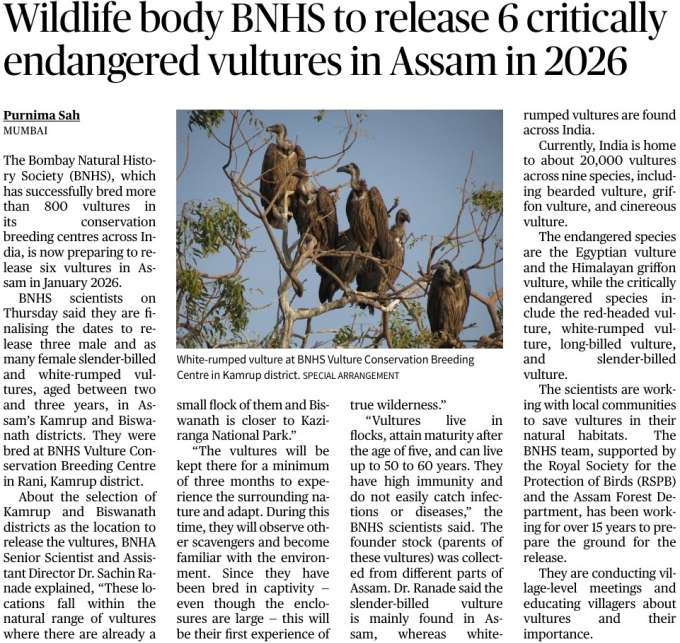
The Bombay Natural History Society (BNHS) will release six captive-bred critically endangered vultures in Assam in January 2026 as part of a long-running vulture conservation and re-wilding programme.
Key points Release plan and location
- BNHS has bred over 800 vultures in conservation breeding centres across India.
- In January 2026, it will release three male and three female vultures (slender-billed and white-rumped) aged 2–3 years.
- Release sites: Kamrup and Biswanath districts of Assam, near the natural range of these species and close to Kaziranga National Park.
Soft-release strategy - Birds were bred at the BNHS Vulture Conservation Breeding Centre, Rani (Kamrup).
- They will be kept in the release area for about three months to adapt to local conditions and learn to forage on natural carcasses.
- This will be their first experience of true wilderness after being raised in captivity.
Vulture ecology and status in India - Vultures live in flocks, mature at around five years, and can live up to 50–60 years with high immunity.
- India has about 20,000 vultures across nine species.
- Critically endangered species:
- Red-headed vulture
- White-rumped vulture
- Long-billed vulture
- Slender-billed vulture
- Endangered species:
- Egyptian vulture
- Himalayan griffon vulture
Community involvement and institutional support - BNHS, supported by the Royal Society for the Protection of Birds (RSPB) and the Assam Forest Department, has worked for over 15 years to prepare for such releases.
- Teams are holding village-level meetings, educating locals about vultures, their ecosystem role and the need to avoid harmful veterinary drugs.
Bombay Natural History Society (BNHS) - BNHS is one of India’s oldest and largest non-governmental organisations working on biodiversity research and conservation.
- Founded on 15 September 1883 in Bombay (now Mumbai).
- Works through action-based research, education and awareness campaigns, including nature trails and public outreach.
- Collaborates closely with the Ministry of Environment, Forest and Climate Change and various national and international conservation bodies.
UPSC Prelims Practice Question Q. With reference to the Bombay Natural History Society (BNHS), consider the following statements:
1. BNHS is an autonomous organisation under the Ministry of Environment, Forest and Climate Change.
2.
BNHS is one of India’s oldest and largest NGOs involved in biodiversity research and nature conservation.
3.
BNHS conducts nature trails, birding camps and public awareness programmes for conservation.
Which of the statements given above is/are correct? A. 1 and 2 only
B. 2 and 3 only
C. 1 and 3 only
D. 1, 2 and 3
Correct Answer: B. 2 and 3 only
Postal department considers UPI-like ‘labels’ for addresses
Context
The Department of Posts has proposed amendments to the Post Office Act, 2023 to introduce DHRUVA, a system enabling smart, interoperable, UPI-like digital address labels for citizens and businesses.
Key Points 1. What is DHRUVA?
- A Digital Hub for Reference and Unique Virtual Address.
- Provides UPI-like address labels such as “name@entity” acting as proxies for physical addresses.
2. Purpose of the New System - To standardise, digitise and simplify sharing of addresses across platforms.
- Reduces need to repeatedly fill physical address forms.
3. DIGIPIN as Core Layer - DHRUVA built on DIGIPIN, a 10-character alphanumeric code representing latitude–longitude.
- Offers precise geolocation, especially useful in rural areas where textual addresses are unclear.
4. Consent-Based Access - Users can authorise companies to view their address for a specified time.
- After expiry, the smart label must be re-authorised.
5. Address Information Agents (AIAs) - Proposed new entity similar to NPCI for UPI.
- Will manage consent architecture and enable interoperability.
6. Benefits Expected - Faster delivery and address verification.
- Boosts digital public infrastructure.
- Enables participation of private logistics and e-commerce entities.
7. Government Objectives - Encourage firms and users to adopt smart addressing.
- Improve accuracy and efficiency in postal and delivery services.
UPSC Prelims Practice Question Q. Consider the following pairs: | System/Term | Description |
| 1. DHRUVA | Smart address label framework proposed by Department of Posts |
| 2. DIGIPIN | 10-digit numeric code representing postal PIN zones |
| 3. Address Information Agents | Entities proposed to manage consent architecture for digital addresses |
Which of the pairs given above are correctly matched? A. 1 only
B. 1 and 3 only
C. 2 and 3 only
D. 1, 2 and 3
Answer: B. 1 and 3 only
State must not prosecute citizens without reasonable prospect of conviction: SC Context The Supreme Court has cautioned the State against initiating criminal prosecution
without a reasonable prospect of conviction, stating that such “half-baked prosecutions” violate citizens’ right to fair process.
Key Points SC’s Core Observation - The State must not prosecute citizens when reasonable prospect of conviction is absent.
- Such prosecutions undermine the right to fair process under Article 21.
Half-baked chargesheets harmful - Filing incomplete or weak chargesheets burdens an already stressed judiciary.
- Police and trial courts must act as initial filters to prevent baseless cases from entering full trial.
Case Background - The ruling came in a petition filed by a man accused of voyeurism and intimidation.
- The allegations were made by a woman who attempted to enter the accused’s property in 2020 claiming to be a tenant.
SC’s Findings on Facts - The woman had no right to enter the property without the owners’ consent.
- The FIR and chargesheet did not contain any allegation that the woman was watched or photographed during a “private act.”
- Therefore, the essential ingredient of voyeurism (under Section 354C IPC) was not met.
Outcome - Supreme Court discharged the accused brothers of all charges, including voyeurism and intimidation.
- Held that prosecution must not proceed where ingredients of the offence are not made out.
Prelims Practice Question Q. Consider the following statements regarding principles laid down by the Supreme Court on criminal prosecution:
1. The State should not prosecute citizens unless there is a reasonable prospect of conviction.
2. Filing incomplete or weak chargesheets violates the right to fair process under Article 21.
3. Police and trial courts act as initial filters to prevent baseless cases from entering the trial stage.
Which of the statements given above is/are correct?
A. 1 only
B. 1 and 2 only
C. 2 and 3 only
D. 1, 2 and 3
Answer: D. 1, 2 and 3
U.S. deported 3,258 Indian nationals in 2025, highest since 2009: Jaishankar in Rajya Sabha
Context
The Union External Affairs Minister informed Parliament that the U.S. deported 3,258 Indian nationals in 2025, the highest yearly number since 2009, raising concerns about mistreatment of deportees and visa-related scrutiny.
Key Points
1. Record Number of Deportations
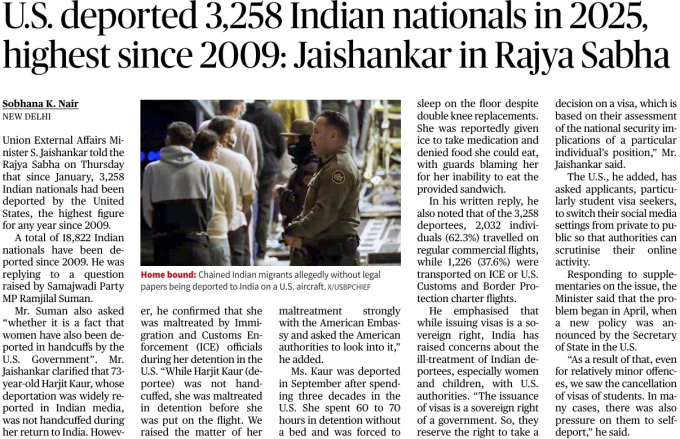
- Since January 2025, 3,258 Indians were deported by the U.S.
- This is the highest annual figure since 2009.
- Total deportations since 2009 stand at 18,822.
2. Mode of Deportation - 2,032 individuals (62.3%) deported on regular commercial flights.
- 1,226 individuals (37.6%) transported through ICE/US Customs and Border Protection charter flights.
3. Concerns of Ill-Treatment - Case highlighted: Harjit Kaur (age 73), deported after three decades in the U.S.
- She faced allegedly harsh conditions—no bed, limited food, denial of medicines.
- India lodged a protest with the U.S. Embassy.
4. Visa Scrutiny & New U.S. Policies - U.S. authorities now require visa applicants, especially students, to keep their social media settings “public.”
- New policy since April 2025 increases cancellations of visas even for minor violations.
- Many Indians face pressure to self-deport.
5. India’s Position - Issuing visas is a sovereign right of every nation.
- India raises concerns only about mistreatment, especially of women and children.
Additional Information: Indian Citizenship Framework Articles 5–11 of the Constitution - Article 5 – Citizenship at commencement of the Constitution.
- Article 6 – Citizenship rights of migrants from Pakistan.
- Article 7 – Rights of those who migrated to Pakistan.
- Article 8 – Persons of Indian origin residing outside India.
- Article 9 – Voluntary foreign citizenship ends Indian citizenship.
- Article 10 – Continuation of citizenship rights.
- Article 11 – Parliament to regulate citizenship by law.
Citizenship Act, 1955 – Ways to Acquire Citizenship - By Birth – Born in India with at least one citizen parent (not illegal migrant).
- By Descent – Born abroad; registered at Indian Mission within 1 year.
- By Registration – Persons of Indian origin, spouse of Indian, OCI holders.
- By Naturalisation – Based on qualifications under Third Schedule.
- By Incorporation of Territory – When territory becomes part of India.
- Special Provisions: Assam Accord (1985) – Citizenship rules for migrants before 1966 and between 1966–1971.
Caller Name Presentation (CNAP)
Syllabus: GS Paper 3 – Science & Technology, Cyber Security, Telecom Governance Context
- The Department of Telecommunications (DoT) will soon mandate telecom operators to display the KYC-registered name of all incoming callers using Indian numbers.
- This feature, known as Caller Name Presentation (CNAP), aims to improve user safety and reduce spam or fraudulent calls.
Key Points - Meaning: CNAP is a technology that shows the caller’s name on the recipient’s screen, similar to apps like Truecaller.
- Data Source: The displayed name comes from telecom operators’ KYC databases, based on details provided in the Customer Application Form (CAF) during SIM registration.
- Database System: Each telecom operator will maintain a subscriber name database linked to mobile numbers.
- Call Process: When a call is made, the system fetches the registered KYC name and displays it to the receiver.
- Initial Limitation: CNAP will initially work only within the same network (e.g., Airtel-to-Airtel).
- Cross-network display (e.g., Jio-to-Vodafone) will require regulatory approval for inter-operator data sharing.
- TRAI Recommendation: In February 2024, TRAI recommended implementation of CNAP for all smartphones and urged operators to adopt it.
- Purpose: Designed to reduce harassment, curb spam/fraud calls, and improve caller transparency for mobile users.
Source: The Hindu
National Commission for Backward Classes (NCBC)
Syllabus: GS Paper 2 – Polity, Constitutional Bodies & Social Justice Context
- The NCBC has recommended exclusion of 35 communities (mostly Muslim) from West Bengal’s Central OBC list after reviewing the inclusions made in 2014.
Key Points - Status: A constitutional body established under Article 338B to protect the rights and welfare of Socially and Educationally Backward Classes (SEBCs).
- Establishment:
- Initially set up under the NCBC Act, 1993.
- Received constitutional status through the 102nd Constitutional Amendment, 2018, which inserted Articles 338B and 342A.
- Aim: Advises, monitors, investigates and recommends on matters related to SEBC welfare, inclusion/exclusion, safeguards and rights violations.
- Composition:
- Five members – Chairperson, Vice-Chairperson and three Members.
- Appointed by the President of India.
- Members enjoy rank and pay equivalent to a Secretary, Government of India.
- Functions:
- Monitor implementation of constitutional safeguards for SEBCs.
- Inquire into complaints of rights violations or misuse of reservation benefits.
- Evaluate welfare programmes and socio-economic policies for backward classes.
- Mandatory consultation by Union and States on all major policy matters concerning SEBCs.
- Submit annual and special reports to the President for presentation in Parliament and State Legislatures.
- Powers:
- Possesses civil court powers—summoning witnesses, examining on oath, seeking documents and taking evidence.
Source: The Hindu
Indian Statistical Institute (ISI) Act, 1959
Syllabus: GS Paper 2 – Governance; Statutory and Regulatory Bodies Context The Central government’s reported plan to repeal the Indian Statistical Institute (ISI) Act, 1959 has triggered protests by over 1,500 academics in Kolkata, who fear loss of autonomy and dilution of the ISI’s status as an institution of national importance. Key Points
- Origin of ISI
- Founded by P.C. Mahalanobis in Kolkata on 17 December 1931 as a society devoted to statistics and quantitative research.
- ISI Act, 1959 – Purpose
- Enacted to recognise ISI’s national role, give it a statutory base, and provide autonomy with structured support for research and teaching.
- Institution of National Importance
- The Act declares ISI an “institution of national importance”, placing it in the same league as leading national institutes.
- Scope of the Act
- Applies to the Institute, its governing body, employees and students, governing their rights, duties, and institutional functioning.
- Academic Powers
- Authorises ISI to grant degrees and diplomas in statistics, mathematics, quantitative economics, computer science and allied fields.
- Financial Provisions
- Enables grants, loans and other financial assistance from the Central Government to support ISI’s activities.
- Mandates audit of accounts by qualified auditors to ensure financial accountability.
- Government Oversight & Approvals
- Certain actions—such as altering objectives, amending the memorandum, or disposing key properties—require prior Central Government approval.
- Committees & Programme Review
- Allows the Centre to constitute committees to frame ISI’s programme of work and review its performance.
- Power to Issue Directions
- The Central Government may issue directions to the Institute on specified matters in public interest.
- Assumption of Control
- In defined circumstances, the Act permits the Centre to assume control of the Institute, indicating a strong regulatory framework.
- Administrative Ministry
- The Act is administered by the Ministry of Statistics and Programme Implementation (MoSPI).
Source: The Hindu
RBI Integrated Ombudsman Scheme
Syllabus: GS Paper 3 – Indian Economy; Banking Sector & Financial Inclusion
Context The RBI Annual Report highlights that
complaints under the RBI Integrated Ombudsman Scheme (RB-IOS) rose by 13.55% in FY25, indicating rising consumer awareness and increased digital/financial transactions.
Key Points Launch & Purpose - Launched: 12 November 2021.
- Integrates three earlier schemes:
- Banking Ombudsman Scheme, 2006
- NBFC Ombudsman Scheme, 2018
- Digital Transactions Ombudsman Scheme, 2019
- Objective: Provide a speedy, cost-effective, and uniform grievance redress mechanism for customers of RBI-regulated entities.
- Follows “One Nation One Ombudsman” for jurisdiction-neutral redressal.
Deficiency in Service – Core Ground - Complaints are accepted on deficiency in service by banks/REs.
- A list of specific exclusions is notified by RBI.
Coverage - All commercial banks, NBFCs, RRBs, Payment System Participants,
most Urban Cooperative Banks with deposits ≥ ₹50 crore,
and Credit Information Companies.
Centralised Complaint Processing - A Centralised Receipt & Processing Centre (CRPC) is set up in RBI Chandigarh to receive and process complaints—physical or email—in any Indian language.
Compensation - Compensation up to ₹20 lakh for loss due to deficiency in service.
- Additional ₹1 lakh for harassment, mental anguish, expenses, and loss of time.
Source: Business Standard (BS)

 Launch your Graphy