Daily Current Affairs for UPSC 4th Dec 2025


| Index |
| S.No | Topic | Page No |
| Daily Hindu Analysis (YouTube) |
| 1. | A missing link in India’s mineral mi |
|
| 2. | A dismantling of the base of environmental regulation |
|
| 3. | ‘States will have to abide by terms of Samagra Shiksha to receive funds’ |
|
| 4. | Gyanesh Kumar takes charge at International IDEA council |
|
| 5. | Govt. Withdraws order to install Sanchar Saathi app |
|
| 6. | SC flags issues in payouts, free care for acid attack survivors |
|
| 7. | Proposal to divert Ganga water to Yamuna hits roadblock |
|
| |
| Daily Current Affairs (App) |
| 8. | New Geographical Indication Products from Tamil Nadu |
|
| 9. | National Centre for Polar and Ocean Research |
|
| 10. | Bonda Tribe |
|
| 11. | World Summit on Disaster Management (WSDM) 2025 |
|
| 12. | RBI reaffirms SBI, HDFC Bank and ICICI Bank as D-SIBs |
|
A missing link in India’s mineral mi
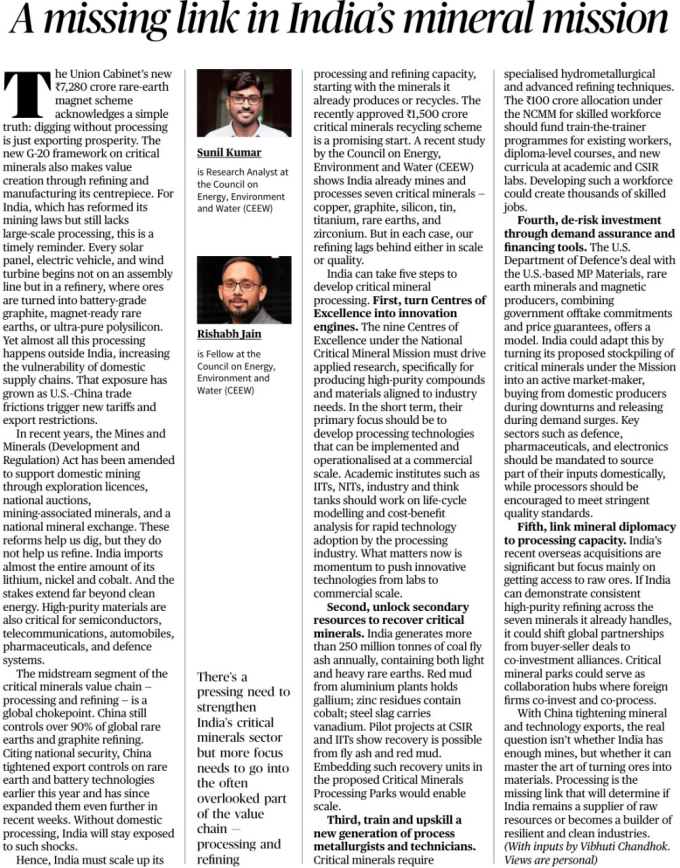
Context
The article examines India’s new ₹7,280-crore rare-earth magnet scheme and the broader critical minerals mission, arguing that India is still overly focused on mining and raw ore exports while neglecting the crucial “missing link” of domestic processing and refining that actually captures value and builds strategic resilience.
Detailed Analysis
1. Mining reforms, but processing vacuum
- Recent amendments to the Mines and Minerals (Development and Regulation) Act encourage:
- deep-seated mineral exploration,
- national auctions, and
- a national mineral policy.
- These reforms help “dig more,” but without domestic refining and processing, India continues to import high-value products such as lithium, nickel, cobalt and rare-earth magnets.
- Example: critical minerals underpinning EV batteries, wind turbines, semiconductors, telecom and defence – India often exports low-value ores and imports high-value processed materials.
2. Global chokepoints and China factor - The midstream segment – processing, separation, refining – is a global chokepoint, dominated by China, which:
- controls ~90% of global rare-earth processing and much of graphite refining;
- has tightened export controls on rare earths and battery materials.
- This poses supply-chain and geopolitical risk for India and other countries, especially in the context of the G-20 framework on critical minerals and ongoing US–China trade frictions.
3. India’s current capability: mining yes, processing weak - A CEEW study shows India already mines and processes seven critical minerals – copper, graphite, silicon, tin, titanium, rare earths, zirconium.
- But in each, India’s processing lags in either scale or quality; most value addition happens abroad.
- Without processing, India is effectively “exporting prosperity” while importing high-margin products.
4. Five-step pathway to build critical mineral processing a) Centres of Excellence for innovation
- Under the National Critical Mineral Mission, nine proposed Centres of Excellence should focus on:
- high-purity compounds,
- process innovation,
- techno-economic modelling for rapid industrial adoption.
- The aim is to move technologies from lab to commercial scale.
b) Unlock secondary resources - India generates >250 million tonnes of coal fly ash annually, rich in light and heavy rare earths.
- Other secondary sources:
- aluminium-plant residues (red mud) with gallium;
- zinc residues with cobalt;
- steel slag with vanadium.
- Embedding such recovery into proposed Critical Minerals Processing Parks can boost supply without fresh mining.
c) Skill and upgrade workforce - The midstream requires specialised hydrometallurgy, solvent extraction, advanced refining skills.
- The article backs using the ₹100-crore NCMIL skilling window for:
- train-the-trainer modules,
- diploma/degree programmes in CSIR labs and universities,
- re-skilling existing workers.
- A skilled workforce is key to running complex processing plants safely and competitively.
d) De-risk investment through demand assurance - Processing is capital-intensive and subject to commodity price swings.
- Suggests using models like the U.S. Department of Defense’s offtake and price-support contracts for critical minerals.
- India could:
- commit long-term purchases for defence, EVs, electronics etc.,
- build strategic processed-mineral stockpiles, buying more during downturns and releasing during supply shocks.
e) Link mineral diplomacy to processing capacity - India’s recent overseas acquisitions and MOUs focus on raw mineral access, not joint processing.
- If India can demonstrate high-purity refining of the seven minerals it already handles, it can:
- negotiate co-investment deals where partner countries send ores for processing in India;
- evolve as a processing hub, not just a buyer of foreign refined material.
Suggestions of the Author 1. Shift policy focus from just mining to the midstream – treat processing and refining as the real strategic lever for self-reliance. 2. Operationalise Centres of Excellence quickly with clear industry linkages and outcome-based targets.
3.
Mainstream secondary-resource recovery into national missions (fly ash, red mud, slag) to reduce import dependence and environmental burden.
4.
Design smart de-risking instruments – offtake guarantees, minimum price contracts, and strategic stockpiles – to crowd in private investment.
5.
Use international critical-mineral partnerships to bring technology and capital for processing inside India, rather than exporting ores for processing abroad.
Conclusion The article argues that processing is the “missing link” that will decide whether India becomes merely a supplier of raw ores or emerges as a global builder of clean-tech and advanced manufacturing value chains. Mining reforms and international partnerships are necessary but insufficient; without a robust domestic processing ecosystem, India will remain vulnerable to external chokepoints and continue exporting value. Building midstream capabilities is therefore central to India’s strategic autonomy, green transition and economic resilience.
UPSC Mains Question
Critically examine the challenges and opportunities for India in developing a domestic critical mineral processing ecosystem. How can India reduce its dependence on external processing hubs while aligning with its green industrial ambitions?
A dismantling of the base of environmental regulation
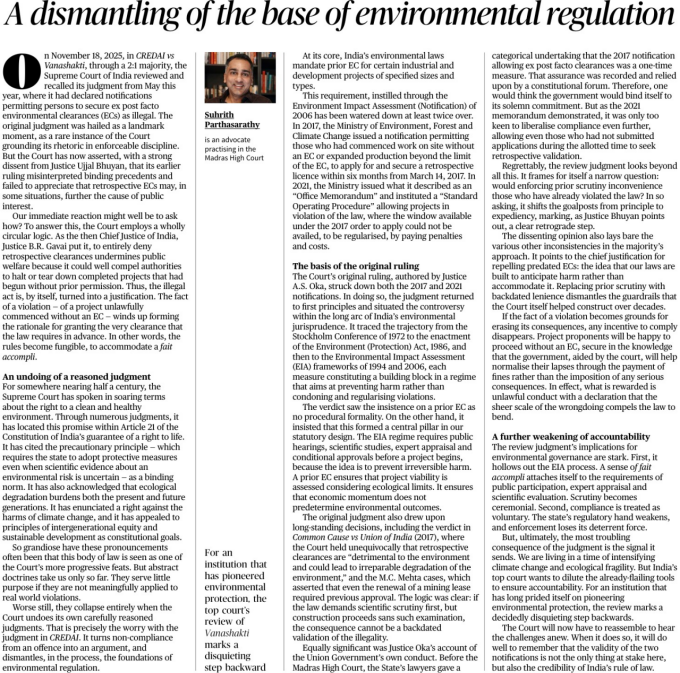
Context
The article analyses the Supreme Court’s recent judgment in CREDAI vs Vanashakti (Nov 18, 2025), where a 2:1 Bench reversed its own May 2025 decision that had held ex post facto Environmental Clearances (ECs) illegal. The author argues that this reversal weakens India’s environmental law framework and undermines the principle of prior environmental scrutiny.
Detailed Analysis
1. Background: Prior EC as the backbone of environmental law
- India’s environmental regime, especially under the EIA Notification 2006, requires prior EC for specified industrial and infrastructure projects.
- This embodies the precautionary principle – environmental impacts must be assessed before damage occurs.
- Despite this, the Environment Ministry issued:
- 2017 notification allowing violators a six-month window to seek retrospective EC, and
- 2021 “Standard Operating Procedure” regularising projects that had started without EC, on payment of penalties.
- These measures converted a preventive law into a curative/regularising mechanism.
2. The original (May 2025) ruling – why it mattered - A previous SC Bench, tracing EIA’s history and Stockholm-era principles, struck down the 2017 and 2021 relaxations.
- It held that:
- Allowing ex post facto clearances rewards illegality – the very fact that a project began unlawfully cannot become the basis for later approval.
- EIA is not mere formality; it integrates public hearings, scientific studies, expert appraisal and cumulative impact assessment before a project begins.
- A prior EC is central to protecting the right to life/clean environment (Art. 21) and preventing irreversible harm.
- This earlier judgment was hailed as a landmark, restoring discipline to environmental decision-making.
3. The new majority judgment – what changed - The November 2025 majority now:
- Holds that earlier precedents were misread and that retrospective ECs may be permissible in some circumstances.
- Accepts the 2017/2021 schemes as valid regulatory choices, so long as violators pay penalties and meet conditions later.
- Treats “fait accompli” projects (already built without EC) as something that can be accommodated, not necessarily dismantled.
- The author notes Justice L. Nageswara Rao’s type of approach (cited in earlier environmental cases) is replaced here by a far more forgiving stance towards non-compliance.
4. Why the author calls it “a dismantling” a) From prevention to post-facto regularisation
- Environmental law shifts from avoiding harm to managing damage already done.
- Instead of insisting on halting unlawful projects, the Court’s approach encourages violators to pay and proceed, reducing EC to a revenue-raising, not protective, tool.
b) Loss of deterrence and regulatory authority - If ex post facto clearance is available, illegal commencement is no longer risky; it becomes a rational business strategy.
- Administrative agencies lose their strongest tool – the ability to deny or halt projects that ignore environmental norms.
c) Weakening of constitutional environmentalism - For decades, the Court has:
- Read the right to a clean and healthy environment into Article 21.
- Affirmed precautionary and public-trust doctrines as binding.
- By normalising retrospective ECs, the judgment hollows out these doctrines, making them rhetorical rather than enforceable.
d) Accountability deficit - Violations now likely end in fines, not project cancellation or criminal liability.
- This dilutes accountability of both project proponents and regulators who tolerated or enabled illegal starts.
5. The dissent – a contrasting vision - The dissent (Justice L. Nageswara Jha, as noted) emphasises:
- Prior EC as a non-negotiable procedural safeguard.
- The need to protect future generations, not regularise present violations.
- It warns that allowing a backlog of illegal projects to be retrospectively blessed undermines the rule of law.
Suggestions of the Author 1. Re-centre the precautionary principle o Future Benches must restore the idea that no project can legally commence without EC, regardless of investment already made.
2.
Tighten EIA and remove amnesty windows o The executive should
withdraw/limit notifications that open periodic windows for retrospective approvals.
3.
Strengthen independent scrutiny o Re-empower appraisal committees and pollution control boards with
real veto powers and transparent decision-making.
4.
Rebuild accountability mechanisms o Make deliberate violation of EC requirements attract
serious civil and criminal penalties, including demolition/closure where warranted.
5.
Judicial consistency in environmental jurisprudence o The Court should avoid
oscillating precedents that confuse regulators and embolden violators, and instead build on its earlier pro-environment line of cases.
Conclusion The article argues that the Supreme Court’s new ruling marks a retreat from four decades of progressive environmental jurisprudence in India. By legitimising retrospective clearances, it transforms environmental regulation from a preventive shield into a post-hoc rubber stamp, weakening deterrence and undermining citizens’ right to a healthy environment. Reasserting the primacy of prior environmental scrutiny and constitutional environmentalism is essential if India is to confront its climate and ecological crises credibly.
UPSC Mains Question
“Ex post facto environmental clearances strike at the very foundation of India’s environmental rule of law.” Critically examine in the light of recent Supreme Court judgments and amendments to the EIA framework.
‘States will have to abide by terms of Samagra Shiksha to receive funds’
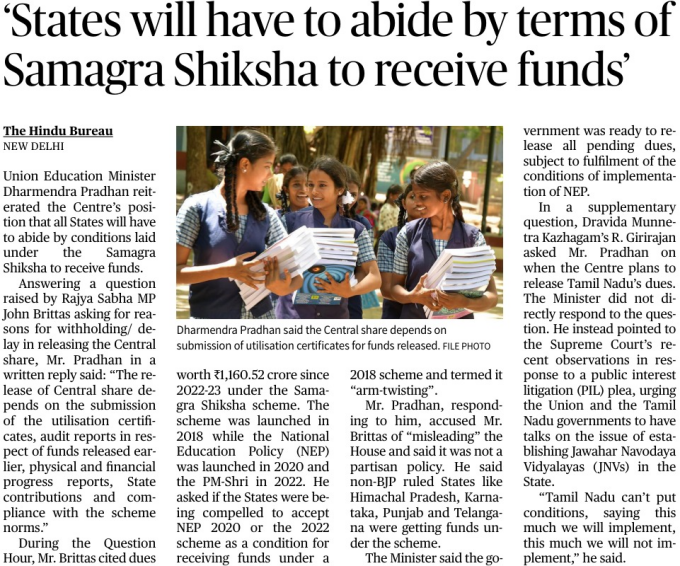
Context
Union Education Minister Dharmendra Pradhan told Parliament that States will receive the Centre’s share under the Samagra Shiksha scheme only if they comply with scheme conditions such as submission of utilisation certificates and implementation norms.
Key Points Centre’s position on fund release
- Release of the Central share depends on:
- submission of utilisation certificates,
- audit reports of earlier releases,
- physical and financial progress reports, and
- State contribution and compliance with scheme norms.
Quantum of pending dues - Around ₹1,160.52 crore of Central share under Samagra Shiksha has been pending since 2022–23 due to non-compliance/documentation gaps.
NEP and scheme conditionality debate - Question raised whether States are being compelled to accept NEP 2020/PM-SHRI as a condition for funds.
- Minister denied this, saying the scheme is not partisan and non-BJP States like Himachal Pradesh, Karnataka, Punjab and Telangana are receiving funds.
Tamil Nadu issue and JNV reference - On Tamil Nadu’s dues, Minister pointed to the Supreme Court’s observations in a PIL on establishing Jawahar Navodaya Vidyalayas (JNVs) and urged Centre–State talks.
- He said Centre is ready to release funds “subject to implementation of NEP provisions,” indicating continuing friction with Tamil Nadu’s stance.
Samagra Shiksha Scheme – Overview & Features - Launched in 2018 as an integrated scheme unifying Sarva Shiksha Abhiyan (SSA), Rashtriya Madhyamik Shiksha Abhiyan (RMSA) and Teacher Education (TE).
- Covers pre-primary to Class 12 under one umbrella for holistic school education.
- Gives States flexibility to plan interventions based on local needs.
- Focus on learning outcomes: better teacher training via SCERTs/DIETs, library grants, and tech-enabled pedagogy.
- Strong push for digital education through smart classrooms, ICT labs and platforms like DIKSHA.
- Supports school consolidation, transport, infrastructure, and sanitation facilities.
- Special thrust on girls’ education by upgrading KGBVs to cover Classes 6–12, stipends and self-defence training.
Samagra Shiksha – Funding Pattern - Centrally Sponsored Scheme with shared funding between Centre and States.
- UTs without legislature: 100% funding by the Central Government.
- General States/UTs with legislature: 60:40 Centre–State share.
- North-Eastern & Himalayan States: 90:10 Centre–State ratio to reflect their special needs.
UPSC Prelims Practice Question
Q. With reference to the Samagra Shiksha Scheme, consider the following statements:
1. It subsumes Sarva Shiksha Abhiyan, Rashtriya Madhyamik Shiksha Abhiyan and the Teacher Education scheme into a single integrated framework.
2. For all States in India, the Centre bears 90% of the cost and the States 10%. Which of the statements given above is/are correct?
A. 1 only
B. 2 only
C. Both 1 and 2
D. Neither 1 nor 2
Answer: A
Gyanesh Kumar takes charge at International IDEA council
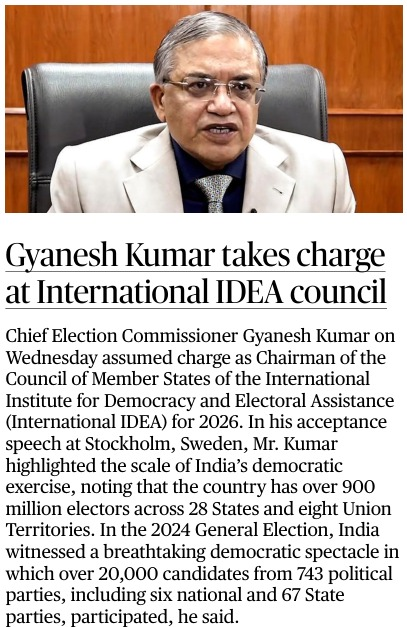
Context Chief Election Commissioner (CEC) Gyanesh Kumar has assumed charge as Chairman of the Council of Member States of the International IDEA for 2026, highlighting India’s democratic scale in his address at Stockholm, Sweden.
Key Points Role Taken by India
- The CEC of India will serve as Chairman of the Council of Member States of International IDEA for 2026.
- The position reflects India’s significant democratic credentials, with 900 million electors and participation across 28 States and 8 UTs.
India’s Democratic Scale - The 2024 General Election involved over 20,000 candidates from 743 political parties, underscoring India’s robust electoral participation.
- India is a founding member of International IDEA, reaffirming its global role in electoral governance and democracy promotion.
International Institute for Democracy and Electoral Assistance (International IDEA) Overview - Established: 1995
- Nature: Inter-governmental organization (IGO)
- UN Observer Status granted
- Headquarters: Stockholm, Sweden
Mission & Vision - Mission: Advance, promote, and protect sustainable democracy worldwide.
- Vision: A world where all people live in inclusive and resilient democracies.
Core Functions - Knowledge Production: Research and global comparative data on democracy.
- Capacity Development: Technical support to electoral bodies and governments.
- Advocacy: Promoting democratic norms and standards.
- Convening Dialogues: Platforms for political consensus-building.
Key Focus Areas 1. Elections
2. Constitutional Building Processes
3. Political Participation & Representation
4. Democracy Assessment & Analysis
5. Climate Change & Democracy
6. Digitalization & Democracy
Membership - 35 Member States
- Observers: United States and Japan
- India is a founding member and actively participates in shaping global democratic governance.
UPSC Prelims Practice Question Q. With reference to the International Institute for Democracy and Electoral Assistance (International IDEA), consider the following statements: 1. It is an inter-governmental organization headquartered in Geneva.
2. India is a founding member of International IDEA.
3. International IDEA has UN observer status. Which of the statements given above is/are correct?
A. 1 and 2 only
B. 2 and 3 only
C. 1 and 3 only
D. 1, 2 and 3
Answer: B Explanation:
- Statement 1 is incorrect: International IDEA is headquartered in Stockholm, not Geneva.
- Statements 2 and 3 are correct: India is a founding member, and the organization has been granted UN observer status.
Govt. Withdraws order to install Sanchar Saathi app
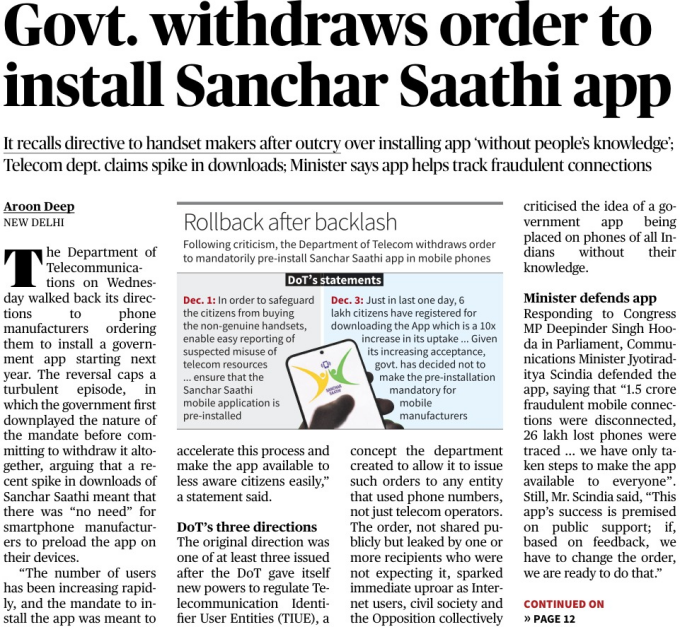
Context The Department of Telecommunications (DoT) has withdrawn its earlier order mandating smartphone manufacturers to pre-install the Sanchar Saathi app after public criticism over privacy and consent concerns. Key Points Reason for Rollback
- The DoT faced backlash for asking manufacturers to pre-install the app without users’ knowledge or consent.
- Critics argued that a government app on all phones raised privacy and transparency concerns.
DoT’s Clarification - DoT stated the withdrawal was due to a “miscommunication" regarding the mandate.
- The Ministry said increasing voluntary downloads made compulsory installation unnecessary.
Spike in App Downloads - On December 3, more than 6 lakh citizens registered on Sanchar Saathi, reflecting a 10x increase in uptake.
- The government claimed this demonstrates public support.
Minister’s Defence - Minister Jyotiraditya Scindia said the app has already helped detect 1.5 crore fraudulent mobile connections, disconnecting them, and traced 26 lakh lost phones.
- He stated the app remains useful and will be promoted, but only with public acceptance.
Original DoT Directions
- Earlier directions were issued under powers given to regulate Telecommunication Infrastructure Providers and User Equipment Entities (TUIE).
- It allowed ordering pre-installation of telecom-related apps, not just for handset makers.
Sanchar Saathi (Additional Information) Department of Telecommunications (DoT) - Sanchar Saathi is a citizen-focused telecom platform used to:
- Track lost/stolen phones
- Identify fraudulent SIMs
- Detect misuse of telecom resources
- Includes tools like CEIR (Central Equipment Identity Register) to block/trace devices.
UPSC Prelims Practice Question Q. With reference to the Sanchar Saathi platform, consider the following statements:
1. It enables users to block and track lost or stolen mobile phones.
2. It is implemented by the Ministry of Home Affairs.
3. It allows users to check mobile connections issued in their name.
Which of the statements given above is/are correct? A. 1 only
B. 1 and 3 only
C. 2 and 3 only
D. 1, 2 and 3
Answer: B Explanation:
- Statement 1 is correct – CEIR under Sanchar Saathi tracks/block phones.
- Statement 2 is incorrect – It is under the Department of Telecommunications (DoT), Ministry of Communications.
- Statement 3 is correct – The platform allows citizens to check all mobile connections issued in their name.
SC flags issues in payouts, free care for acid attack survivors
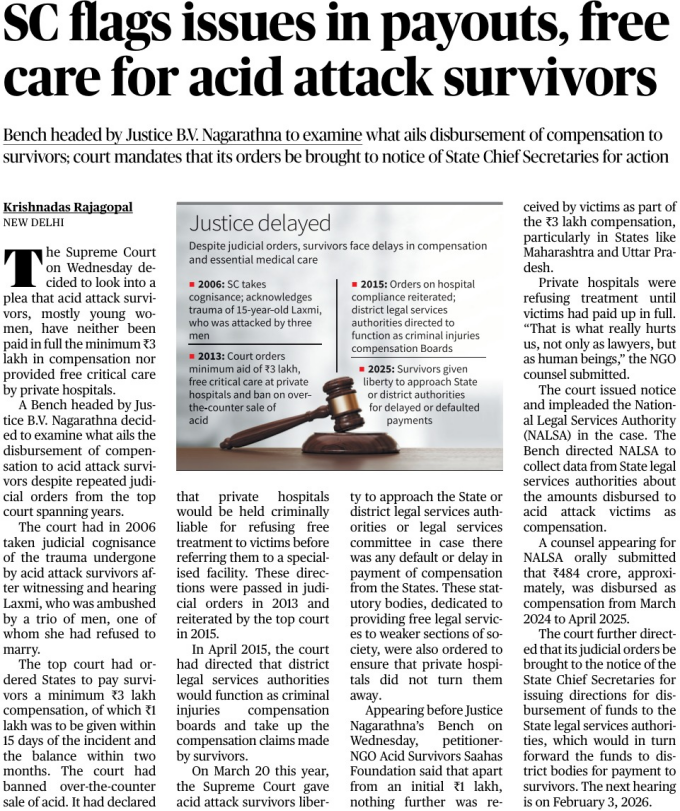
Context The Supreme Court has raised concerns over delays in compensation payouts and denial of free critical medical care to acid attack survivors, despite multiple earlier judicial orders mandating timely relief. Key Points SC’s Observations
- Survivors have not been paid the mandatory minimum ₹3 lakh compensation in many States.
- Private hospitals still refuse free treatment unless victims pay upfront, violating court orders.
Judicial History of the Case - 2006: SC took cognisance after hearing the testimony of acid attack survivor Laxmi.
- 2013 Order: Minimum ₹3 lakh compensation; free treatment at private hospitals; ban on over-the-counter sale of acid.
- 2015: SC reiterated that district legal services authorities must act as criminal injuries compensation boards.
Latest SC Directions (2025) - Bench led by Justice B.V. Nagarathna to examine systemic problems in compensation disbursement.
- Survivors given liberty to approach State/district legal services authorities for delays or denial by States.
- Court has directed that its orders be sent to all State Chief Secretaries for immediate action.
Role of NALSA - Supreme Court impleaded the National Legal Services Authority (NALSA) to collect data from States on compensation paid between March 2024–April 2025.
- NALSA reported that ₹484 crore was disbursed as compensation during this period.
Issue with Private Hospitals - Private facilities continue to refuse free critical care, contrary to SC orders.
- Court reiterated hospitals may be held criminally liable for refusal.
Concerns Raised - NGO counsel highlighted that victims in States like Maharashtra and Uttar Pradesh often received less than the mandated ₹3 lakh.
- Survivors face bureaucratic hurdles and delays even after court directives.
National Legal Services Authority (NALSA) - Established under the Legal Services Authorities Act, 1987.
- Provides free legal aid to weaker sections and oversees the functioning of State and District Legal Services Authorities.
- Plays a key role in implementing victim compensation schemes.
Source: The Hindu
UPSC Prelims Practice Question
Q. With reference to the National Legal Services Authority (NALSA), consider the following statements:
1. NALSA was established under a constitutional provision inserted through the 42nd Constitutional Amendment.
2. NALSA is mandated to provide free legal services to weaker sections of society and monitor the implementation of legal aid programmes across the country.
3. Victim compensation schemes under the Code of Criminal Procedure are overseen by NALSA.
Which of the statements given above is/are correct? A. 2 only
B. 2 and 3 only
C. 1 and 3 only
D. 1, 2 and 3
Answer: B
Proposal to divert Ganga water to Yamuna hits roadblock 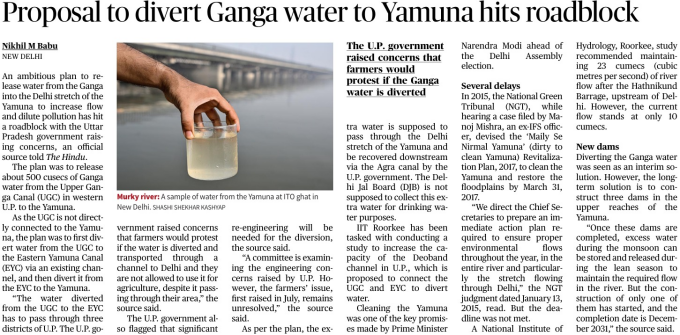
Context The Centre’s proposal to divert 500 cusecs of Ganga water to the Delhi stretch of the Yamuna to increase its flow and dilute pollution has stalled due to objections raised by the Uttar Pradesh government. Key Points
1. Plan for Water Diversion
- Proposal: Release 500 cusecs of Ganga water from the Upper Ganga Canal (UGC) into the Yamuna.
- Route planned:
- UGC → Eastern Yamuna Canal (EYC) → Delhi stretch of Yamuna.
- Purpose: Increase flow, dilute pollution, and improve water quality in Delhi.
2. Objections Raised by Uttar Pradesh - Farmer Protests: UP fears farmers will agitate if Ganga water is diverted without being allowed for agricultural use while passing through their region.
- Engineering Issues: UP flagged significant re-engineering needed for the diversion.
- The farmers’ concern, first raised in July, remains unresolved.
3. Recovery of Water Downstream - Extra water is intended to flow through Delhi and be recovered by UP via the Agra Canal.
- Delhi Jal Board will not use this diverted water for drinking purposes.
4. IIT Roorkee Study - Conducting a study to increase the capacity of the Deoband channel to link UGC and EYC.
- Aim: Ensure diversion feasibility.
5. Previous Efforts to Clean the Yamuna - NGT 2015 Judgment: Called for maintaining 23 cumecs of flow after the Hathnikund Barrage; actual flow is only ~10 cumecs.
- NGT’s “Maili Se Nirmal Yamuna, 2017” plan aimed to restore floodplains by 2017, but deadlines were missed.
6. Long-Term Solution: New Dams - Diversion considered only an interim measure.
- Final solution: Construction of three dams in the upper Yamuna basin.
- Status: Only one dam construction has begun; completion expected by December 2031.
New Geographical Indication Products from Tamil Nadu
Syllabus:
GS Paper 1 – Indian Culture (Handicrafts, Traditional Products)
GS Paper 3 – Economy (GI Tags, Intellectual Property Rights)
Context Five traditional products from Tamil Nadu have recently been awarded the
Geographical Indications (GI) tag, recognising their unique identity, origin, and traditional craftsmanship.
Key Points
1. Woraiyur Cotton Sari (Tiruchi District)
- Woven in Manamedu on the banks of River Cauvery.
- Known for its Korvai border, geometric motifs, and block colour palette.
- Devanga community has preserved this weaving tradition for generations.
2. Thooyamalli Rice - Traditional sambha-season variety with a duration of 135–140 days.
- Name means “pure jasmine”; also called pearl rice due to its shine.
- Highly valued for nutritional benefits.
3. Kavindapadi ‘Naatu Sakkarai’ (Erode District) - Kavindapadi is a major jaggery powder–producing region.
- Produced by mechanically crushing sugarcane and slowly evaporating the juice.
- Sugarcane sourced from fields nourished by the Lower Bhavani Project canal.
4. Namakkal ‘Kalchatti’ (Soapstone Cookware) - Traditional cookware made of soapstone (makkal pathirangal).
- A staple in South Indian kitchens for generations.
- Known for heat retention and non-toxic cooking.
5. Ambasamudram ‘Choppu Saman’ (Wooden Toys) - Over 200 years old craft tradition from Ambasamudram.
- Handmade miniature wooden toys representing everyday household items.
- Traditionally crafted from Manjal Kadamba, teak, and rosewood.
Source: The Hindu
National Centre for Polar and Ocean Research
Syllabus: GS Paper 3 – Science & Technology; Environment and Climate Change Context The National Centre for Polar and Ocean Research (NCPOR) has celebrated its Silver Jubilee and released commemorative postage stamps, highlighting 25 years of India’s leadership in polar and ocean research.
Key Points
- Establishment & Status
- Set up on 25 May 1998 as an autonomous R&D institution.
- Earlier known as the National Centre for Antarctic and Ocean Research (NCAOR).
- Nodal Ministry & Location
- Works under the Ministry of Earth Sciences, Government of India.
- Headquarters located at Vasco da Gama, Goa.
- Core Role
- Leads India’s scientific expeditions and research in Polar regions and the Southern Ocean.
- Mandate in Polar Programmes
- Nodal agency for Indian Antarctic Programme and polar expeditions to Antarctic, Arctic, Southern Ocean and Himalayas.
- Strategic Ocean Projects
- Involved in EEZ mapping, continental shelf surveys, and supports the Deep Ocean Mission.
- Indian Research Stations (Polar & Himalayas)
- Antarctica: Dakshin Gangotri, Maitri, Bharati.
- Arctic: Himadri.
- Himalayas: Himansh high-altitude research station.
Source: PIB
Bonda Tribe
Syllabus: GS Paper 1 – Indian Society; Tribes of India Context Members of the Bonda Tribe in Odisha’s Malkangiri district will shift from traditional thatched huts to pucca houses under the PM-Janman Scheme, aimed at improving living standards of PVTGs. Key Points
- Location & Distribution
- Found exclusively in Malkangiri district, Odisha, mostly in Khairaput block.
- Live in mountainous, forested terrain with around 7,000 population.
- Tribal Status & Identity
- Classified as a Particularly Vulnerable Tribal Group (PVTG).
- Among India’s oldest tribes, belonging to the Austroasiatic lineage.
- Also called Bondo, Bonda Paraja, Bhonda.
- Language
- Speak Remo, part of the Austroasiatic language family, distinct from mainstream Indian languages.
- Social Structure
- Community led by a council of elders.
- Villages organized around communal spaces for rituals and meetings.
- Sub-Groups
- Lower Bondas: Settled near Andhra Pradesh & Chhattisgarh borders.
- Upper Bondas: Live in more remote hilly areas.
- Housing & Architecture
- Traditional mud and thatched-roof houses suited to hilly climate.
- Culture & Art
- Known for decorative tools, utensils, colorful fabrics, jewellery.
- Women are semi-clad, wearing heavy jewellery; men wear minimal attire.
- Religion
- Follow animism, worship nature and ancestral spirits.
- Occupation & Economy
- Depend on subsistence agriculture, hunting, gathering.
- Socio-economic Indicators
- Only 6% literacy; very low life expectancy, considered nearly extinct.
Source: DC
World Summit on Disaster Management (WSDM) 2025
Syllabus:
GS Paper 3 – Disaster Management; Climate Change; Science & Technology Context The World Summit on Disaster Management (WSDM) 2025 was held in Dehradun, where major upgrades to Uttarakhand’s early-warning systems were announced, including six new weather radars, 33 observatories, and 142 automated weather stations (AWS).
Key Points
1. What is WSDM 2025?
- A global platform for disaster resilience.
- Brings together scientists, policymakers, disaster managers, and industry leaders.
- Focuses on future-ready disaster risk reduction strategies.
2. Venue and Theme - Held in Dehradun, Uttarakhand.
- Theme: “Strengthening International Cooperation for Building Resilient Communities.”
3. Aim of the Summit - Enhance international collaboration on disaster preparedness.
- Strengthen early-warning infrastructure in climate-vulnerable regions.
- Support resilience in fragile ecosystems like the Himalayas.
4. Key Features of the 2025 Summit - Announcement of expanded weather radar networks and warning systems
- Focus on agri-startups, CSIR technologies, and innovation for sustainable Himalayan livelihoods.
5. Significance - Strengthens Uttarakhand’s defence against cloudbursts, landslides, flash floods, and GLOFs.
- Enhances India’s status as a regional hub for disaster science & climate forecasting.
- Helps integrate scientific insights, community awareness, and technology into disaster management.
Source: PIB
RBI reaffirms SBI, HDFC Bank and ICICI Bank as D-SIBs
Syllabus:
GS Paper 3 – Indian Economy; Banking Sector; Financial Stability Context The Reserve Bank of India (RBI) has once again classified State Bank of India (SBI), HDFC Bank, and ICICI Bank as Domestic Systemically Important Banks (D-SIBs), reflecting their crucial role in ensuring stability of India’s financial system. Key Points 1. What are D-SIBs?
- Domestic Systemically Important Banks are institutions “too big to fail”.
- Their failure would significantly disrupt the financial system and broader economy.
- RBI identifies such banks based on size, interconnectedness, complexity, and substitutability.
2. Why these three banks? - SBI, HDFC Bank, and ICICI Bank dominate India’s banking landscape in terms of:
- Size of assets
- Nationwide reach
- Interconnected financial activities
- Their continued inclusion highlights their critical importance to India’s financial stability.
3. Implications of D-SIB Status - These banks face enhanced regulatory oversight.
- Required to maintain higher capital buffers to absorb losses during financial stress.
- The goal is to minimise contagion risk — preventing a crisis from spreading across the financial system.
4. Significance for India - Ensures stronger shock absorption capacity of major banks.
- Enhances financial system resilience against market volatility and economic downturns.
- Reinforces trust in the stability of India’s largest banks.

 Launch your Graphy