Daily Current Affairs for UPSC 3rd Nov 2025

| Index |
| S.No | Topic | Page No |
| Daily Hindu Analysis (YouTube) |
| 1. | Between Funds and Ideology: Kerala joins PM-SHRI Scheme |
|
| 2. | Bastar Rising Beyond Its Scars |
|
| 3. | The Vision of Model Youth Gram Sabhas |
|
| 4. | ISRO Launches Advanced GSAT-7R, India’s Heaviest Communication Satellite |
|
| 5. | Tri-Services Exercise ‘Trishul’ Begins to Strengthen Joint Combat Preparedness |
|
| 6. | Indian Women Script History, Win World Cup |
|
| 7. | Households Are Piling on Debt Faster Than Creating Assets: RBI Data |
|
| 8. | Kerala Becomes First State to Declare Itself Free of Extreme Poverty |
|
| 9. | Lucknow Declared UNESCO ‘Creative City of Gastronomy’ |
|
| Daily Current Affairs (App) |
| 10. | ‘Pink Saheli Smart Card’ Initiative |
|
| 11. | Russia Becomes India’s Largest Supplier of Sunflower Oil |
|
| 12. | Doctrine of Severability |
|
| 13. | UNESCO’s Creative Cities Network |
|
| 14. | Exercise MILAN |
|
| 15. | Leprosy |
|
| 16. | India Creates History at ICC Women’s World Cup 2025 |
|
| 17. | Grand Egyptian Museum Inaugurated |
|
Between Funds and Ideology: Kerala joins PM-SHRI Scheme
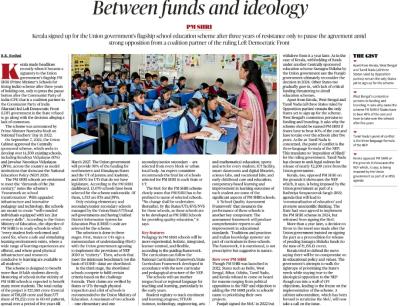
Context · Kerala recently became a signatory to the Union Government’s flagship PM SHRI (Prime Minister’s Schools for Rising India) scheme after resisting it for three years. · The decision came despite strong opposition from the CPI(M)-led LDF government’s coalition partner, CPI, which alleged ideological imposition linked to the National Education Policy (NEP) 2020. · This move has reignited the debate between educational federalism, funding control, and ideological influence in India’s school education system.
What is PM SHRI Scheme?
- Launched on National Teachers’ Day, September 5, 2022, PM SHRI aims to upgrade 14,500 existing schools into “model schools” aligned with NEP 2020.
- It is a Centrally Sponsored Scheme (CSS), implemented jointly by the Centre and State/UTs over five years (till March 2027).
- These schools will focus on 21st-century skills, integrated pedagogy, digital learning, environmental sustainability, and inclusive education.
- Funding ratio: 60:40 (Centre: State) for most States and 90:10 for Northeastern and Himalayan States.
Detailed Analysis 1. Federal Tensions in Education Education is a Concurrent List subject, yet the Centre’s increasing role through flagship schemes like PM SHRI and NEP has sparked concerns of central overreach.
Kerala, Tamil Nadu, and West Bengal initially refused to sign, citing erosion of state autonomy and ideological concerns regarding curriculum content and language policy.
2. Ideological Dimension Critics, especially from Left-ruled States, allege that PM SHRI and NEP 2020 reflect an RSS-influenced agenda, focusing on “Indian knowledge systems” and Hindi promotion, potentially marginalising regional identities and secular values in education.
Supporters, however, argue that NEP 2020 and PM SHRI modernise Indian education by integrating technology, skill-based learning, and flexibility across disciplines.
3. Fiscal and Administrative Issues Under PM SHRI, States must bear 40% of costs and take over school operations after five years — raising concerns about financial sustainability.
Some States view this as conditional funding, where refusal to comply with NEP-aligned reforms could risk withdrawal of Central funds for education schemes like Samagra Shiksha.
4. Cooperative Federalism vs Competitive Centralism The PM SHRI issue highlights a larger pattern — the Centre using fiscal instruments to push policy alignment in domains constitutionally shared with States.
It revives questions on the spirit of cooperative federalism, where consultation and consensus should ideally precede major national education reforms.
UPSC Mains Q. “Flagship schemes like PM SHRI reflect the growing centralisation of education policy in India. Discuss the implications of such centralised approaches on federal relations and educational diversity.” (10 Marks, 150 words)
Bastar Rising Beyond Its Scars Syllabus Mapping: - GS Paper 2: Governance, Government Policies and Interventions, Centre-State Relations, Welfare Schemes for Vulnerable Sections.
Context Bastar, once synonymous with Maoist insurgency and underdevelopment, is undergoing a remarkable transformation.
Located in Chhattisgarh’s tribal heartland, it long suffered from violence, isolation, and poverty. Today, through a combination of peacebuilding, welfare measures, and inclusive development, Bastar is transitioning into a region of stability, opportunity, and hope.
What is it about? The article, written by Chhattisgarh Chief Minister Vishnu Deo Sai, highlights how joint efforts between the Centre and the State are reviving Bastar — socially, economically, and psychologically.
Key changes include expansion of education, healthcare, women’s empowerment, livelihood generation, and digital and physical connectivity, reflecting a holistic model of post-conflict reconstruction.
Detailed Analysis
1. From Conflict to Confidence The first step in Bastar’s revival was restoring peace and mobility.
Once war-torn roads now carry school buses and market goods, symbolising trust between civilians and the state. Police camps have turned into community spaces hosting sports, health camps, and cultural events, reducing alienation and building confidence among locals
. 2. Education and Skill Development Education has become a cornerstone of Bastar’s transformation.
Ekalavya Model Schools, ITIs, and skill training centres are providing new opportunities for tribal youth.
Girls’ education and scholarships are promoting gender equity and long-term social mobility, while the focus on vocational skills prepares youth for dignified employment — ensuring the “right to learn” becomes a “right to earn”.
3. Women-led Transformation Women are driving Bastar’s grassroots economy through Self-Help Groups (SHGs) and small businesses in food processing, tailoring, and crafts.
Markets and
haats are reviving, connecting rural producers with urban demand — showcasing inclusive and sustainable local entrepreneurship.
4. Healthcare and Connectivity Access to healthcare has dramatically improved through Poshan Vatikas, mobile units, telemedicine, and sub-health centres.
Electricity, clean water (via Jal Jeevan Mission), and digital connectivity are reaching even remote villages — bridging the development gap and ensuring dignity through access.
5. Peace, Democracy, and Development The revival of Bastar proves that peace is not merely the absence of conflict, but the presence of opportunity and empowerment.
By combining security operations with social and economic inclusion, the region exemplifies how democracy can heal deep-rooted alienation and create ownership among local communities.
It also signals that development and governance must be locally rooted and participatory, not externally imposed.
SDGs Covered This article’s vision of Bastar’s transformation aligns with multiple Sustainable Development Goals (SDGs):
| Goal No. | SDG Objective | Relevance to Bastar |
| SDG 1 | No Poverty | Livelihood programs, SHGs, market access |
| SDG 2 | Zero Hunger | Nutrition initiatives, Poshan Vatikas |
| SDG 3 | Good Health and Well-being | Mobile health units, telemedicine |
| SDG 4 | Quality Education | Ekalavya Schools, ITIs, scholarships |
| SDG 5 | Gender Equality | Women-led entrepreneurship |
| SDG 6 | Clean Water and Sanitation | Jal Jeevan Mission access |
| SDG 8 | Decent Work and Economic Growth | Skill-based employment |
| SDG 9 | Industry, Innovation, Infrastructure | Road, electricity, digital connectivity |
| SDG 16 | Peace, Justice, and Strong Institutions | Reduction in Maoist violence, trust-building |
| SDG 17 | Partnerships for Goals | Centre-State coordination and local participation |
UPSC Mains Q.
“The transformation of Bastar demonstrates that peace and development must go hand in hand. Discuss the importance of inclusive governance in rebuilding post-conflict regions in India.”(10 Marks, 150 Words)
The Vision of Model Youth Gram Sabhas
Syllabus Mapping:
- GS Paper 2: Governance — Role of Civil Services, Local Self-Government, and Participatory Democracy
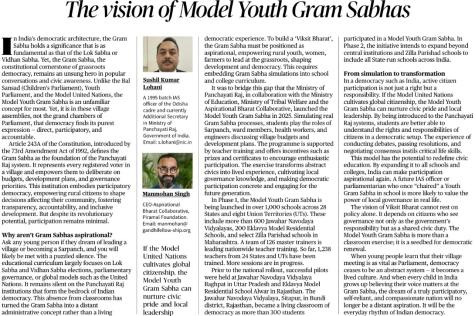
Context · India’s democratic foundation rests on grassroots institutions, particularly the Gram Sabha, which is enshrined under Article 243A of the Constitution (73rd Amendment Act, 1992). · While bodies like the Lok Sabha, Vidhan Sabha, and Youth Parliament receive national attention, the Gram Sabha — the real nerve centre of participatory democracy — often remains overlooked. · To bridge this gap and inspire civic participation among youth, the Ministry of Panchayati Raj, in collaboration with the Ministry of Education, Ministry of Tribal Affairs, and the Aspirational Bharat Collaborative, has launched the Model Youth Gram Sabha (MYGS) initiative in 2025.
What is it About? ·
The Model Youth Gram Sabha seeks to bring real-life democratic experiences into the classroom, simulating actual village-level deliberations. · Students play roles such as Sarpanch, ward members, engineers, and health workers, discussing budgets, local development, and governance issues. · The initiative aims to translate textbook civics into lived democracy, nurturing civic responsibility, inclusivity, and participatory governance among young citizens.
Detailed Analysis
1. Gram Sabha: The Soul of Grassroots Democracy · The Gram Sabha represents every voter in a village and empowers citizens to deliberate on local budgets, plans, and priorities. · It is the bedrock of participatory democracy, ensuring transparency, accountability, and decentralised decision-making. · Yet, its potential remains underutilised due to low participation and lack of civic awareness.
2. From Textbook Civics to Lived Experience While school civics focuses on national-level institutions (Lok Sabha, Vidhan Sabha, UN models), it rarely introduces students to local self-government where democracy begins.
The Model Youth Gram Sabha corrects this imbalance by turning civic education into an experiential learning process, allowing students to practice debate, resolution drafting, and consensus building.
It transforms the abstract idea of democracy into a lived experience that fosters empathy, leadership, and a sense of community.
3. Phase-wise Implementation
- Phase I (2025): Over 1,000 schools across 28 States and 8 UTs, including Jawahar Navodaya Vidyalayas, Eklavya Model Residential Schools, and Zilla Parishad schools.
- Training: 1,238 teachers from 24 States trained as master trainers.
- Phase II: Expansion to include all State-run and central schools, ensuring a nationwide civic awakening at the youth level.
4. Bridging the Civic Gap By engaging youth early in democratic dialogue, the initiative: - Instills civic pride and leadership.
- Enhances awareness of rights, responsibilities, and Panchayati Raj institutions.
- Encourages gender inclusivity and grassroots innovation in governance.
- Converts citizens from passive observers to active participants in shaping their communities.
It aligns with the vision of “Viksit Bharat” — a self-reliant and participatory democracy driven by empowered citizens, not just by government machinery.
5. Long-term Vision If the Model UN fosters global citizenship, the Model Youth Gram Sabha fosters local citizenship and civic ownership.
It prepares a generation that values participation, consensus, and ethical governance — crucial traits for India’s democratic resilience.
An IAS officer or MP who once “chaired” a school Gram Sabha may grow up valuing grassroots decision-making, completing the circle between education and governance.
UPSC Mains Q. “Grassroots democracy cannot thrive unless citizens are trained to participate from a young age.” Critically examine the significance of initiatives like the Model Youth Gram Sabha in strengthening India’s participatory democracy. (10 Marks, 150 Words)
ISRO Launches Advanced GSAT-7R, India’s Heaviest Communication Satellite
Syllabus Mapping
- GS Paper 3: Science & Technology (space technology), Internal Security (maritime security, force multipliers), Indigenization of technology & developing new technology.
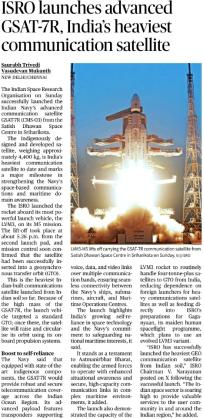
Context ISRO successfully launched GSAT-7R (CMS-03)—an advanced Indian Navy communication satellite—on LVM3 (M5 mission) from SDSC, Sriharikota. At ~4,400 kg, it is India’s heaviest communication satellite to be launched from Indian soil. The spacecraft was injected into Geosynchronous Transfer Orbit (GTO) and will circularise to its operational orbit using onboard propulsion.
What is it about?
- Purpose: Provide robust, secure, high-capacity SATCOM (voice, data, video) across multiple bands for ships, submarines, aircraft and Maritime Operations Centres, improving maritime domain awareness and mission coordination over the Indian Ocean Region.
- Platform: Indigenously designed and developed payloads and bus; part of the Navy’s space-based communications architecture.
- Launcher significance: Demonstrates LVM3’s routine ability to carry >4-tonne class satellites to GTO—reducing dependence on foreign launchers and strengthening Aatmanirbhar Bharat in space.
Analysis (don’t miss the crux) 1) Strategic & security gains - Assured Beyond-Line-of-Sight (BLOS) connectivity for blue-water operations, task-force coordination, and dispersed assets.
- Enhances network-centric operations, encrypted links, and resilient communications in congested/contested electromagnetic environments.
- Fortifies maritime domain awareness and responsiveness for HADR, anti-piracy, and sea-lane security.
2) Technology & industry - Validates heavy comsat manufacturing and integration capabilities in India.
- LVM3 consolidation creates an indigenous heavy-lift pipeline, opening export/mission opportunities and lowering launch risk/cost.
- Pushes the supply chain for high-power transponders, high-throughput antennas, thermal control and bus avionics.
3) Space programme trajectory - Strengthens India’s GEO comsat fleet while LVM3 evolves as a crew-rated workhorse for Gaganyaan variants.
- Demonstrates the transition from sporadic heavy missions to regular, high-mass launches, a prerequisite for complex national security and commercial constellations.
4) Governance & policy angles - Self-reliance: aligns with Make in India/Aatmanirbhar goals.
- Civil–military synergy: ISRO–Navy collaboration delivers dual benefits (security + maritime governance).
- Space traffic management: heavier assets mean tighter orbital slot coordination, end-of-life disposal, and debris-mitigation discipline.
5) Challenges / Way forward - Anti-jamming & cyber-hardening; redundancy via inter-satellite links and multi-orbit architectures (GEO + LEO).
- Rapid replenishment plan for GEO assets; greater private sector participation in payloads and buses.
- Integrate SATCOM with coastal radar, AIS, UAV/MPA sensors for real-time fused maritime picture.
UPSC Mains Q.
How does the launch of GSAT-7R advance India’s maritime security and strategic autonomy? Discuss its implications for network-centric operations, indigenous launch capability, and the road map for secure space-based communications.
Tri-Services Exercise ‘Trishul’ Begins to Strengthen Joint Combat Preparedness
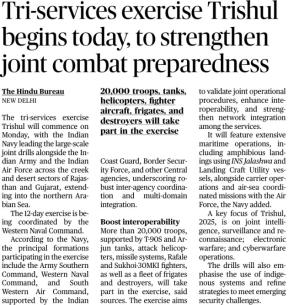
Context India has begun the Tri-services Exercise “Trishul”, a large-scale joint military drill led by the Indian Navy, in coordination with the Army and Air Force. The 12-day exercise is being conducted across the creek and desert sectors of Rajasthan and Gujarat, extending into the northern Arabian Sea.
What is it about?
- Participants: Over 20,000 troops, T-90 & Arjun tanks, Rafale and Sukhoi-30 MKI fighters, frigates, destroyers, and attack helicopters.
- Objective: Strengthen jointness, interoperability, and multi-domain coordination among the three services.
- Support: Includes participation from the Indian Coast Guard, Border Security Force, and other Central agencies.
Analysis - Enhancing Joint Combat Preparedness:
Exercise Trishul focuses on joint planning and execution in land, air, and maritime domains — reflecting India’s move toward integrated theatre commands. - Focus Areas:
- Joint Intelligence, Surveillance & Reconnaissance (ISR)
- Electronic and Cyber Warfare
- Amphibious operations using INS Jalashwa and Landing Craft Utility vessels.
- Air-sea coordination with the Air Force for carrier operations.
- Strategic Significance:
Strengthens multi-domain warfare capability, network integration, and indigenous system usage, aligning with the goal of Atmanirbhar Defence and national security preparedness in a volatile regional environment.
UPSC Prelims Q. The recently conducted
Exercise Trishul is associated with which of the following?
A) Coastal disaster management
B) Tri-services joint combat preparedness
C) Indo-US naval cooperation
D) Counter-terrorism in the Northeast
Answer: B) Tri-services joint combat preparedness
Indian Women Script History, Win World Cup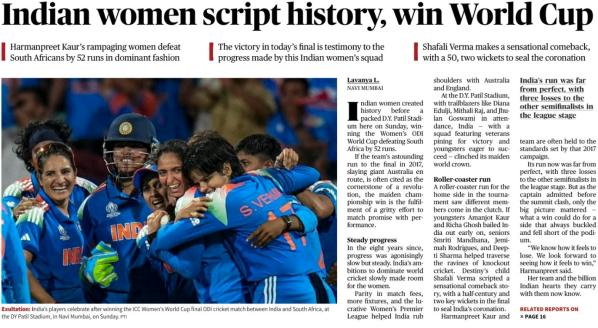
Context The Indian women’s cricket team created history by winning its maiden ICC Women’s ODI World Cup, defeating South Africa by 52 runs in the final held at DY Patil Stadium, Navi Mumbai.
Led by Harmanpreet Kaur, this triumph marks a defining moment in India’s sporting history — symbolising the rise of women’s sports and gender parity in athletics.
- Historic Win: India clinched its first-ever Women’s ODI World Cup, overcoming past heartbreaks such as the 2017 final loss to England.
- Key Performers:
- Harmanpreet Kaur led from the front with all-round brilliance.
- Shafali Verma made a sensational comeback with a half-century and two wickets.
- Collective team effort ensured dominance through all phases.
- Journey of Progress:
The victory reflects India’s long-term investment in women’s cricket—improved match fees, infrastructure, and exposure through the Women’s Premier League (WPL) have paved the way for global competitiveness. - Social Significance:
The win represents a milestone in women’s empowerment, showcasing how institutional support and equal opportunities can elevate women in sports traditionally dominated by men.
UPSC Prelims Q. Which of the following statements is correct regarding India’s recent ICC Women’s ODI World Cup victory?
A) India defeated England in the final.
B) This is India’s maiden ICC Women’s ODI World Cup title.
C) The final was held in Cape Town, South Africa.
D) Mithali Raj captained the Indian team.
Answer: B)
Households Are Piling on Debt Faster Than Creating Assets: RBI Data
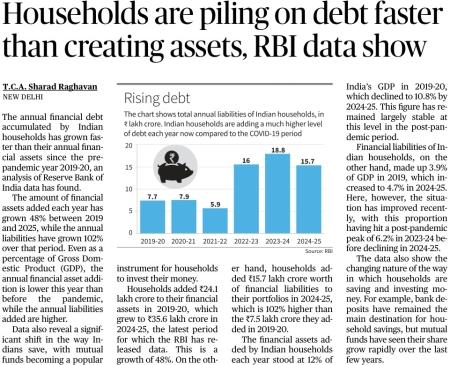
Context The Reserve Bank of India (RBI) data reveals that Indian households’ liabilities are growing faster than their financial assets since the pre-pandemic period (2019–20). While asset accumulation has increased by 48% over this period, liabilities have surged by 102%, raising concerns about the long-term financial health of households. What Is It About
- The report compares annual additions to financial assets and liabilities between FY2019–20 and FY2024–25.
- Financial assets added: ₹24.1 lakh crore in 2019–20 → ₹35.6 lakh crore in 2024–25 (↑48%).
- Financial liabilities added: ₹7.5 lakh crore in 2019–20 → ₹15.7 lakh crore in 2024–25 (↑102%).
- This indicates that households are borrowing and spending more than they are saving or investing.
Detailed Analysis Asset Creation vs Debt Growth - Asset growth slower: Even as the economy recovered post-pandemic, households’ savings and investments have not kept pace with borrowing.
- Liabilities up: Households’ financial liabilities as a share of GDP rose from 3.9% in FY2019 to 4.7% in FY2024–25, peaking at 6.2% in FY2023–24.
- Asset-to-GDP ratio fell from 12% in 2019–20 to 10.8% in 2024–25, suggesting weaker savings relative to output growth.
Changing Investment Patterns - Traditional bank deposits remain the dominant household savings channel.
- However, mutual funds and market-linked instruments have seen rapid growth, indicating a shift toward higher-risk, higher-return instruments.
Implications - The rise in debt relative to savings reflects:
- Consumption-driven borrowing post-pandemic.
- Stagnant real wages and inflation-led erosion of disposable income.
- A possible vulnerability in household balance sheets if economic shocks or interest rate rises occur.
Macroeconomic Angle - Rising household debt could boost short-term consumption but undermine long-term financial stability.
- Lower savings weaken the domestic pool of capital, increasing reliance on external financing for investment.
UPSC Prelims Q. According to recent RBI data (2024–25), which of the following trends has been observed in Indian households’ financial behavior? 1. Household liabilities have grown faster than financial assets. 2. Financial liabilities as a share of GDP have declined since 2019–20. 3. Mutual funds are emerging as a significant savings instrument. Select the correct answer using the code below:
A) 1 and 2 only
B) 2 and 3 only
C) 1 and 3 only
D) 1, 2 and 3
Answer: C) 1 and 3 only
Kerala Becomes First State to Declare Itself Free of Extreme Poverty
Syllabus Mapping
- GS Paper 2: Welfare schemes for vulnerable sections of the population, government policies and their implementation.
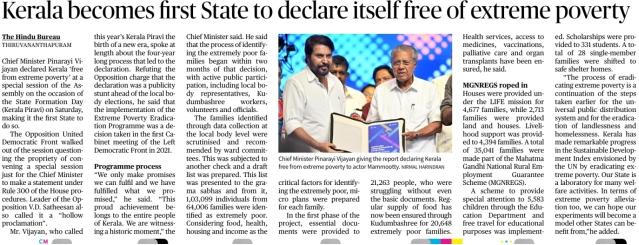
Context Kerala has become the first state in India to declare itself “free from extreme poverty”, marking a major milestone in inclusive welfare and poverty eradication.
The announcement was made by Chief Minister Pinarayi Vijayan during a special session of the Assembly on Kerala Piravi (State Formation Day), following a four-year-long implementation of the Extreme Poverty Eradication Programme launched in 2021.
What Is It About - Kerala identified and rehabilitated 1,03,099 individuals from 64,006 families living in extreme poverty.
- The programme was implemented through grassroots participation — involving local bodies, Kudumbashree units, volunteers, and officials.
- The initiative focused on food, health, housing, income, and education, ensuring that each family received tailored support for sustainable upliftment.
Detailed Analysis Implementation Process - The Extreme Poverty Eradication Programme (2021) was launched by the Left Democratic Front (LDF) government.
- Families were identified at the local body level, verified by ward committees, and finalized through gram sabhas.
- A comprehensive database helped tailor welfare packages based on specific needs like housing, healthcare, and education.
Schemes & Support Mechanisms Mentioned - Kudumbashree: Provided food and livelihood support to 20,648 extremely poor families, especially through women-led SHGs.
- LIFE Mission: Built houses for 4,677 families, ensuring shelter as a basic right.
- Mahatma Gandhi National Rural Employment Guarantee Scheme (MGNREGS): Offered livelihood support to 4,394 families, integrating rural employment with welfare outcomes.
- Education Department: Ensured free education and scholarships to 5,583 children, providing social mobility.
- Health Interventions: Included palliative care, vaccinations, access to medicines, and organ transplant assistance.
Broader Significance - Kerala’s declaration reflects its long tradition of social welfare — from land reforms and universal literacy to public distribution systems and universal healthcare.
- This initiative aligns with the UN Sustainable Development Goals (SDGs), particularly SDG 1: No Poverty and SDG 3: Good Health and Well-being.
- Kerala’s welfare model is now being seen as a replicable blueprint for other Indian states.
UPSC Prelims Q. Kerala recently became the first Indian state to declare itself “free from extreme poverty.” Which of the following schemes were part of this achievement? 1. LIFE Mission 2. Kudumbashree 3. MGNREGS 4. Pradhan Mantri Awas Yojana Select the correct answer using the code below:
A) 1, 2 and 3 only
B) 2 and 4 only
C) 1 and 3 only
D) 1, 2, 3 and 4 Answer: A) 1, 2 and 3 only
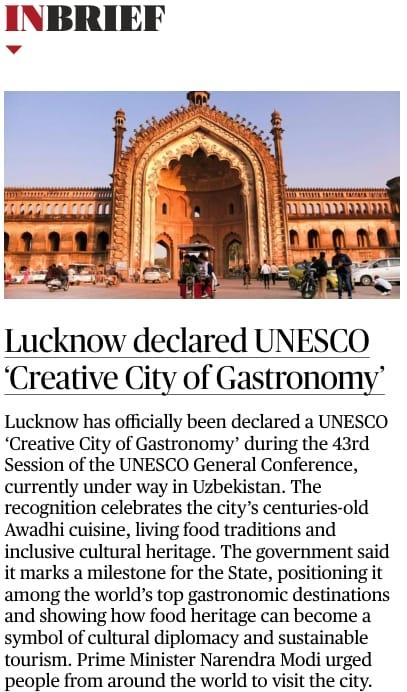
Lucknow Declared UNESCO ‘Creative City of Gastronomy’ Lucknow has been officially recognized as a UNESCO Creative City of Gastronomy during the 43rd Session of the UNESCO General Conference held in Uzbekistan.
This prestigious title celebrates the city’s centuries-old Awadhi cuisine, deep-rooted culinary traditions, and inclusive cultural heritage, making Lucknow a global hub for gastronomic tourism and cultural diplomacy.
About the UNESCO Creative Cities Network (UCCN)
- Established in 2004, the UCCN aims to promote cooperation among cities that recognize creativity as a strategic factor for sustainable urban development.
- Cities are designated under seven creative fields:
1. Crafts and Folk Arts 2. Design 3. Film 4. Gastronomy 5. Literature 6. Media Arts 7. Music
- Other Indian cities in the UCCN include:
- Jaipur – Crafts and Folk Art
- Varanasi – Music
- Chennai – Music
- Mumbai – Film
- Hyderabad – Gastronomy
- Lucknow – Gastronomy (new entrant, 2025)
UPSC Prelims Q. Match the following Indian cities with their respective UNESCO Creative City designations:
| City | Field |
| A. Jaipur | 1. Film |
| B. Varanasi | 2. Crafts and Folk Art |
| C. Chennai | 3. Music |
| D. Hyderabad | 4. Gastronomy |
Select the correct code:
A) A-2, B-3, C-1, D-4
B) A-2, B-3, C-3, D-4
C) A-2, B-3, C-3, D-1
D) A-1, B-2, C-3, D-4
Answer: B) A-2, B-3, C-3, D-4
‘Pink Saheli Smart Card’ Initiative
Syllabus: GS Paper 2 – Governance and Social Justice Context:
The
Delhi government has launched the
‘Pink Saheli Smart Card’, enabling
women and transgender commuters to travel
free of cost on
Delhi Transport Corporation (DTC) and
cluster buses, promoting safety, inclusivity, and accessibility in public transport.
Key Points - Objective: Aims to empower women and transgender individuals by ensuring safe, affordable, and inclusive mobility in Delhi.
- Eligibility: All women and transgender persons above 12 years of age are eligible for the smart card.
- Card Function: Acts as a digital pass providing seamless and free access to DTC and cluster bus services across the city.
- Economic Impact: Expected to reduce daily travel expenses for working women and students, enhancing economic participation and independence.
- Environmental Benefit: Encourages use of public transport, which may reduce traffic congestion and pollution levels in Delhi.
- Symbolism: CM Rekha Gupta stated that the initiative represents respect, empowerment, and equality for women in public spaces.
- Social Inclusion: Supports educational access and social participation, especially for economically disadvantaged groups.
Source: Indian Express
Russia Becomes India’s Largest Supplier of Sunflower Oil Syllabus: GS Paper 3 – Economy and International Trade
Context:
Russia has overtaken Ukraine to become
India’s largest supplier of sunflower oil, accounting for nearly
56% of India’s total imports in 2024, due to
stable supply routes and
competitive pricing. Key Points - Trade Shift: Prior to the Ukraine conflict, India imported most of its sunflower oil from Ukrainian Black Sea ports.
- Post-Conflict Impact: War disruptions forced Ukraine to reroute exports through Europe by rail and road, increasing costs and reducing reliability.
- Russian Advantage: Russia maintained uninterrupted maritime exports, offering lower prices and a stable supply chain, making it the preferred source for Indian buyers.
- Import Data:
- 2021: 1.75 lakh tonnes from Russia (10% share).
- 2024: 20.9 lakh tonnes (56% share), a twelvefold increase.
- Key Factors: Growth attributed to stable pricing, dependable logistics, and closer trade relations between India and Russia, as noted by the Solvent Extractors’ Association of India (SEA).
- Market Overview:
- Sunflower oil ranks third among India’s edible oils after palm oil and soybean oil.
- India imports 60% of its edible oil needs; palm oil forms about 50% of total imports.
- Price Trends:
- Sunflower oil prices fell below palm oil in 2023–24, boosting demand.
- A recent $150/tonne price rise may cause a 13% dip in imports, though Russia’s share is expected to remain 55–60%.
Source: The Hindu
Doctrine of Severability Syllabus: GS Paper 2 – Polity and Governance
Context:
The Supreme Court has clarified that the
Doctrine of Severability is applicable in
Suits for Specific Performance, but only in
exceptional cases. This doctrine plays a crucial role in determining whether a law partially inconsistent with the Constitution can still remain valid in part.
Key Points - Meaning: The Doctrine of Severability ensures that when a part of a law violates the Fundamental Rights, only the offending portion is struck down, not the entire law.
- Purpose: It helps maintain the valid parts of legislation that can stand independently after removing the unconstitutional sections.
- Principle: If the invalid provision can be separated without affecting the functioning of the valid part, only the invalid part will be void.
- Interlinked Provisions: When the valid and invalid provisions are inseparable or so intertwined that one cannot exist without the other, the whole law becomes void.
- Usage of ‘and/or’: If good and bad provisions are connected by words like ‘and’ or ‘or’, the court checks whether the valid part can be enforced independently.
- Dual-purpose provisions: A provision usable for both legal and illegal purposes is treated as invalid in entirety.
- Also Known As: The Doctrine of Separability.
Source: The Hindu
UNESCO’s Creative Cities Network
Syllabus: GS Paper 1 – Art and Culture Context:
Lucknow has officially joined the
UNESCO Creative Cities Network (UCCN) under the
Gastronomy category during the
43rd Session of the UNESCO General Conference, recognising its rich culinary heritage.
Key Points - Establishment: The UCCN was launched in 2004 to promote cooperation among cities that view creativity as a driver of sustainable urban development.
- Objective: It aims to leverage the creative, social, and economic potential of cultural industries for inclusive and sustainable growth.
- Focus Areas: The network covers seven creative fields — Crafts and Folk Arts, Media Arts, Film, Design, Gastronomy, Literature, and Music.
- UNESCO Goals: UCCN promotes cultural diversity and helps cities build resilience against global challenges such as climate change, inequality, and rapid urbanisation.
- Indian Cities in UCCN:
- Crafts & Folk Arts: Jaipur, Srinagar
- Music: Varanasi, Chennai, Gwalior
- Film: Mumbai
- Literature: Kozhikode
- Gastronomy: Hyderabad, Lucknow
- Objectives:
- Encourage public-private partnerships in cultural development.
- Foster innovation hubs and enhance opportunities for creators.
- Support cities in advancing the UN Sustainable Development Goals (SDGs).
Source: The Hindu
Exercise MILAN Syllabus: GS Paper 3 – Defence and Security
Context:
India will host
Exercise MILAN 2026, along with the
International Fleet Review (IFR) and the
Indian Ocean Naval Symposium (IONS) Conclave of Chiefs, in
February 2026 at Visakhapatnam.
Key Points - Nature: Exercise MILAN is a biennial multilateral naval exercise aimed at enhancing maritime cooperation and interoperability among friendly navies.
- Inception: Started in 1995 with participation from Indonesia, Singapore, Sri Lanka, and Thailand.
- Expansion: Over the years, it has become India’s largest naval exercise, growing in scale, complexity, and participation.
- Policy Link: Initially aligned with India’s ‘Look East Policy’, it now complements the ‘Act East Policy’ and the SAGAR (Security and Growth for All in the Region) vision.
- Host Location: Visakhapatnam, the headquarters of the Eastern Naval Command, will be the venue for MILAN 2026.
- Key Features of MILAN 2026:
- Dual Phase: Includes Sea and Harbour Phases focusing on interoperability, maritime domain awareness, anti-submarine warfare, air defence, and search-and-rescue operations.
- International City Parade: Naval contingents, along with the Indian Army and Air Force, will march along RK Beach, symbolising India’s maritime diplomacy and cooperation.
Source: PIB Syllabus: GS Paper 2 – Health and Social Welfare Context:
The
Maharashtra government has officially declared
leprosy a
“notifiable disease”, making it mandatory for healthcare providers to report diagnosed cases to authorities for effective monitoring and control.
Key Points - Causative Agent: Leprosy, also known as Hansen’s Disease, is caused by the bacterium Mycobacterium leprae.
- Affected Areas: It primarily impacts the skin, peripheral nerves, eyes, and other organs.
- Global Concern: Recognised as a Neglected Tropical Disease (NTD), it still occurs in over 120 countries with nearly 2 lakh new cases annually.
- India’s Effort: It was made notifiable nationwide in 2005 under the National Leprosy Eradication Programme (NLEP), overseen by the Union Ministry of Health and Family Welfare.
- Transmission:
- Spread through droplets from the nose and mouth of untreated patients during prolonged close contact.
- Not transmitted by casual contact like handshakes, hugging, or sharing food.
- Transmission ceases once treatment begins.
- Incubation & Symptoms:
- Symptoms appear 3–5 years after infection.
- Characterised by persistent skin sores, lumps, and loss of sensation leading to accidental injuries.
- Treatment:
- Curable through Multi-Drug Therapy (MDT) comprising dapsone, rifampicin, and clofazimine.
- Early diagnosis and treatment prevent disability and transmission.
Source: Indian Express
India Creates History at ICC Women’s World Cup 2025
Syllabus: GS Paper 2 – Sports and Achievements Context:
India clinched their
maiden ICC Women’s World Cup title by defeating
South Africa by
52 runs in the
2025 final, marking a historic milestone for Indian women’s cricket under
captain Harmanpreet Kaur’s leadership. Key Points - Historic Win: India won the ICC Women’s World Cup 2025, their first-ever world title in women’s cricket.
- Final Match: India defeated South Africa by 52 runs in a thrilling final encounter.
- Leadership: The triumph was led by Harmanpreet Kaur, whose captaincy was instrumental in guiding the team to victory.
- Significance: The win ended years of near-misses and heartbreaks, elevating India’s status among the global elite of women’s cricket.
- Impact: The victory is expected to boost women’s cricket in India, inspiring a new generation of players and strengthening the sport’s popularity nationwide.
Source: The Hindu
Grand Egyptian Museum Inaugurated
Syllabus: GS Paper 1 – Art and Culture
Context:
Egypt has officially inaugurated the
Grand Egyptian Museum (GEM) near the
Giza Pyramids, a
$1 billion project two decades in the making. The museum is the
largest in the world dedicated to a single civilisation, showcasing Egypt’s ancient legacy and its vision to rejuvenate global tourism.
Key Points - Historic Launch: Inaugurated by President Abdel-Fattah el-Sissi, the GEM represents a fusion of ancient heritage and modern architecture, celebrating Egypt’s enduring cultural influence.
- Architectural Design: Features a glass façade inspired by the pyramids, spanning 24,000 sq. metres of permanent exhibition space, with panoramic views of the Giza Plateau from its grand atrium.
- Exhibition Structure: A six-storey staircase lined with colossal statues leads to 12 thematic galleries, tracing Egypt’s history from prehistoric to Roman times.
- Cultural Significance: The museum symbolises a “bridge between ancient genius and modern creativity,” highlighting Egypt’s contribution to world civilisation.
- Infrastructure Development: Includes improved roads, a planned metro station, and proximity to the Sphinx International Airport, enhancing accessibility and promoting tourism.
- Tourism Impact: The GEM is expected to become a global cultural hub, strengthening Egypt’s position as a premier archaeological and heritage destination.
Source: Indian Express

 Launch your Graphy