Daily Current Affairs for UPSC 3rd Jan 2026

|
|
| S.No | Topic |
|
| Daily Hindu Analysis |
| 1. | Transforming a waste-ridden urban India |
|
| 2. | Recasting sanitation with urban-rural partnerships |
|
| 3. | SC slams denial of bail to give accused a ‘taste of imprisonment as a lesson’ |
|
| 4. | Export Promotion Mission: Govt. unveils 2 more credit-linked plans |
|
| 5. | Assam tribal body rejects GoM proposal to grant ST status to six OBC communities |
|
| 6. | Centre directs X to check Grok misuse in morphing images |
|
| 7. | First mountain tunnel breakthrough achieved in bullet train project: Minister |
|
| |
| Daily Current Affairs |
| 8. | Pro-Active Governance and Timely Implementation (PRAGATI) |
|
| 9. | Skilling for AI Readiness (SOAR) Programme |
|
| 10. | Legionnaires’ Disease |
|
| 11. | WHO Pharmacovigilance |
|
| 12. | Savitribai Phule |
|
| 13. | Cetacean morbillivirus |
|
| 14. | Car Nicobar Island |
|
Transforming a waste-ridden urban India
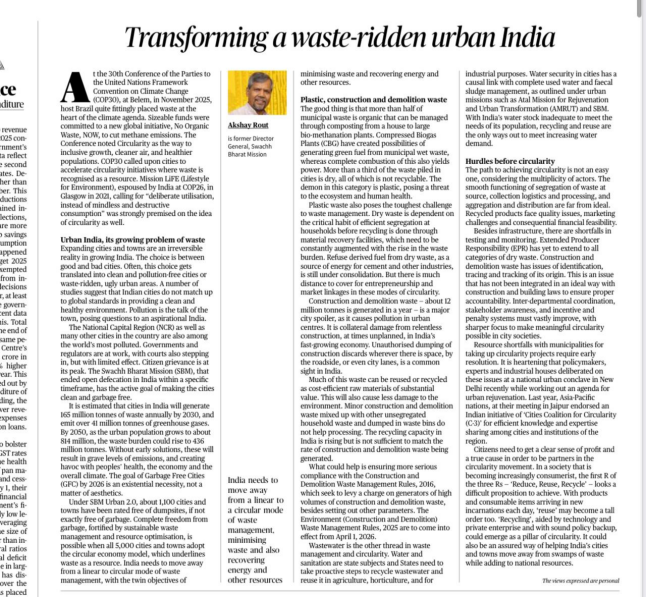
Context
In this article, the author discusses the growing crisis of solid waste management in urban India and argues for a decisive shift from a linear model of waste disposal to a circular economy approach. Using India’s urbanisation trends, climate commitments, and policy initiatives, the article highlights how waste—if managed scientifically—can be converted into a resource, contributing to cleaner cities, public health, climate mitigation, and resource security.
Detailed Analysis
1. Urbanisation and the Waste Challenge
- Rapid expansion of cities and towns in India is inevitable, but the nature of urban growth has led to waste-ridden and polluted cities.
- Indian cities fail to meet global standards of clean and healthy living environments.
- Regions like the National Capital Region (NCR) are among the most polluted globally, with waste mismanagement worsening air, land, and water pollution.
- Despite judicial interventions and regulatory efforts, outcomes remain limited, and citizen grievances are rising.
2. Scale of the Problem
- Urban India is projected to generate 165 million tonnes of waste annually by 2030, rising to 436 million tonnes by 2050 as the urban population grows.
- Waste-related emissions could exceed 41 million tonnes of greenhouse gases annually.
- Without effective solutions, waste threatens public health, economic productivity, and overall quality of urban life.
- The goal of Garbage Free Cities (GFC) by 2026 is therefore a necessity, not merely an aesthetic ambition.
3. Circular Economy as the Way Forward
- The article stresses the need to move away from a linear ‘use-and-dispose’ model to a circular mode of waste management, where waste is treated as a resource.
- Circularity focuses on minimising waste generation, maximising reuse and recycling, and recovering energy and materials.
- International climate platforms such as COP30 and initiatives like Mission LiFE reinforce circularity as central to sustainable urban development.
4. Managing Organic and Plastic Waste
- Over half of municipal waste is organic, which can be effectively managed through composting and bio-methanation.
- Compressed Biogas (CBG) plants offer dual benefits: waste reduction and clean energy generation.
- However, plastic waste, which dominates dry waste streams, poses the toughest challenge due to its non-biodegradable nature and threat to ecosystems and human health.
- Effective source segregation at the household level is critical for successful recycling and material recovery.
5. Construction and Demolition (C&D) Waste
- India generates about 12 million tonnes of C&D waste annually, making it a major urban pollutant.
- Unauthorised dumping on roadsides, open lands, and city outskirts is common due to weak enforcement.
- Though C&D waste can be reused as cost-effective raw material, mixing with unsegregated household waste reduces recycling efficiency.
- Recycling capacity exists but is insufficient compared to the scale of waste generation.
6. Regulatory Framework and Implementation Gaps
- The Construction and Demolition Waste Management Rules, 2016 aim to regulate waste generation and levy charges on large generators.
- Updated C&D Waste Management Rules, 2025 (effective April 2026) seek stronger compliance.
- However, challenges remain in identification, tracking, accountability, and enforcement, particularly due to weak inter-departmental coordination.
7. Wastewater and Water Security
- Wastewater management is closely linked to urban water security.
- Reuse of treated wastewater for agriculture, horticulture, and industrial purposes can reduce freshwater stress.
- Missions like AMRUT and Swachh Bharat Mission (SBM) recognise the role of sewage and faecal sludge management in achieving sustainable cities.
- Recycling and reuse of wastewater are essential to meet rising urban water demand.
8. Hurdles to Achieving Circularity
- Circularity involves multiple actors, making coordination complex.
- Challenges include:
- Inefficient segregation and collection systems
- Infrastructure and monitoring shortfalls
- Poor quality and marketability of recycled products
- Limited extension of Extended Producer Responsibility (EPR) to all dry waste categories
- Lack of incentives, weak penalties, and low stakeholder awareness further slow progress.
9. Emerging Positive Trends
- National and regional deliberations, such as urban conclaves and the Cities Coalition for Circularity (C-3), show growing policy focus.
- Knowledge-sharing among cities and institutions is being encouraged.
- There is recognition that citizens must see economic and social value in circular practices to actively participate.
Suggestions of the Author
- Ensure strict enforcement of waste management rules, especially for construction and demolition waste.
- Strengthen source segregation and decentralised waste processing.
- Expand EPR frameworks to cover all dry waste streams.
- Promote reuse and recycling of wastewater to enhance urban water security.
- Improve inter-departmental coordination, incentives, and penalty mechanisms.
- Encourage citizen participation by demonstrating tangible benefits of circularity.
- Use technology and private sector participation to scale recycling and energy recovery.
UPSC Mains Question
“Urban waste management in India requires a shift from a linear disposal model to a circular economy approach.” Examine the challenges and opportunities in implementing circular waste management in Indian cities.
Recasting sanitation with urban-rural partnerships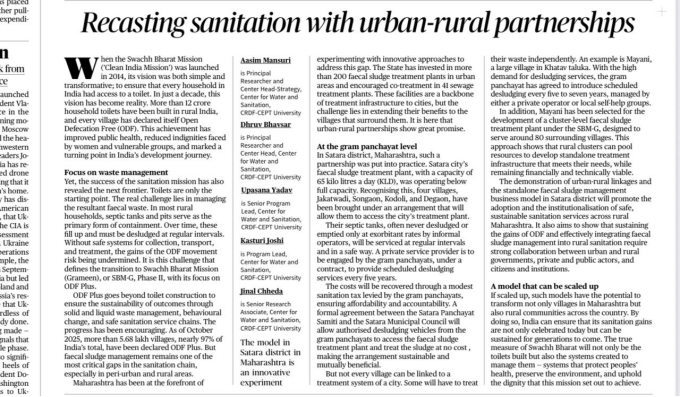
Context
In this article, the authors examine how India’s sanitation journey under the Swachh Bharat Mission (SBM) must evolve beyond toilet construction to address the critical challenge of faecal sludge and septage management (FSSM). They argue that urban–rural partnerships offer a practical and scalable solution to bridge sanitation gaps, especially in peri-urban and rural areas, by leveraging existing urban treatment infrastructure.
Detailed Analysis
1. From Toilet Access to Sanitation Sustainability
- The launch of Swachh Bharat Mission (Clean India Mission) in 2014 aimed to ensure universal toilet access.
- In a decade, over 12 crore toilets were constructed, and rural India largely achieved Open Defecation Free (ODF) status.
- This marked a major public health and dignity milestone, particularly for women and vulnerable groups.
- However, toilets are only the starting point; sustainable sanitation depends on safe management of waste generated.
2. The Hidden Challenge of Faecal Sludge
- In rural areas, septic tanks and pits are the dominant sanitation systems.
- These systems fill up over time and require regular desludging, failing which sanitation gains are reversed.
- Unsafe or irregular desludging, often done by informal operators, poses health and environmental risks.
- This challenge defines the transition from SBM Phase I to SBM-G (Grameen) Phase II, which focuses on ODF Plus outcomes.
3. Gaps in Rural Sanitation Infrastructure
- Rural and peri-urban areas often lack:
- Safe collection systems
- Transport mechanisms
- Treatment facilities for faecal sludge
- As a result, sludge is frequently dumped untreated, undermining ODF achievements.
- Faecal sludge management remains one of the weakest links in India’s sanitation chain.
4. Maharashtra’s Innovative Approach
- Maharashtra has taken the lead by experimenting with innovative sanitation models.
- The State has invested in over 200 faecal sludge treatment plants (FSTPs) in urban areas.
- It has also encouraged co-treatment of faecal sludge in existing sewage treatment plants (STPs).
- While these facilities form a strong backbone, the key challenge is extending their benefits to surrounding villages.
5. Urban–Rural Partnerships: The Satara Model
- A notable example comes from Satara district, Maharashtra.
- Satara city’s faecal sludge treatment plant (65 KLD capacity) was operating below capacity.
- Four nearby villages—Jakatwadi, Sonagon, Kodoli, and Degao—were linked to this facility.
- Through formal agreements between gram panchayats and the municipal council, villages gained access to urban treatment infrastructure.
- Septic tanks, earlier rarely desludged or emptied unsafely, are now serviced every five years in a safe and regular manner.
6. Governance and Financial Design
- Desludging services are provided by a private operator contracted by the gram panchayat.
- Costs are recovered through a modest sanitation tax, ensuring affordability and accountability.
- Authorised desludging vehicles are permitted to use the city’s treatment plant at no cost.
- This creates a mutually beneficial arrangement for both urban and rural local bodies.
7. Extending the Model: Cluster-Level Solutions
- Not all villages can be linked to city treatment plants.
- The article cites Mayani village in Khatav taluka as an alternative model.
- Due to high desludging demand, the gram panchayat introduced scheduled desludging every 5–7 years.
- Mayani is also part of a cluster-level faecal sludge treatment plant under SBM-G, designed to serve around 80 villages.
- This approach allows rural clusters to pool resources while ensuring technical and financial viability.
8. Institutionalising Urban–Rural Linkages
- Demonstrating the success of such partnerships helps:
- Standardise faecal sludge management practices
- Promote sustainable business models
- Scale safe sanitation services across the State
- The Satara experience highlights the need for collaboration between urban and rural governments, private players, and citizens.
Suggestions of the Author
- Shift focus from toilet construction to end-to-end sanitation systems.
- Promote urban–rural partnerships to optimise underutilised urban treatment infrastructure.
- Encourage scheduled desludging to replace reactive and unsafe practices.
- Develop cluster-level treatment plants where urban linkage is not feasible.
- Institutionalise sanitation services through formal agreements and local taxation.
- Strengthen coordination among government bodies, private operators, and communities.
UPSC Mains Question
“Faecal sludge management is the missing link in India’s sanitation journey.” Discuss how urban–rural partnerships can help achieve sustainable sanitation outcomes in rural India.
SC slams denial of bail to give accused a ‘taste of imprisonment as a lesson’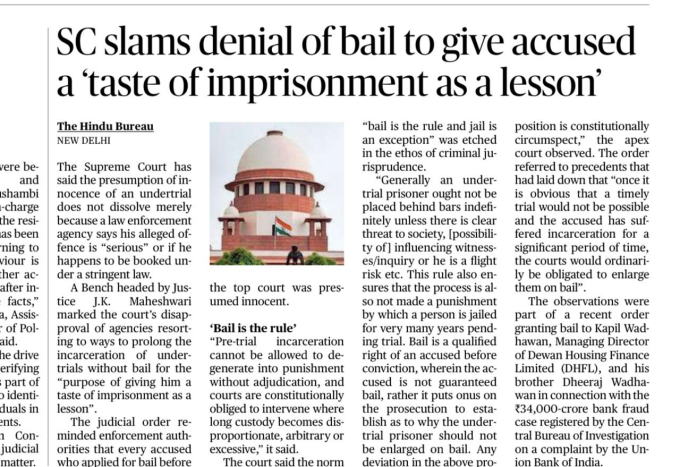
Context
The Supreme Court criticised the practice of denying bail to undertrials merely to subject them to imprisonment as a deterrent, while granting bail in a high-profile bank fraud case.
Key Points
Presumption of Innocence
- The Supreme Court reaffirmed that an undertrial remains presumed innocent.
- Mere allegations of “serious offence” or booking under a stringent law do not dilute this presumption.
Bail is the Rule, Jail is the Exception
- The Court reiterated a settled principle of criminal jurisprudence.
- Pre-trial incarceration should not become a form of punishment without conviction.
Limits on Pre-trial Detention
- Undertrials should not be detained indefinitely unless:
- There is a clear threat to society
- Possibility of influencing witnesses or tampering with evidence
- Risk of absconding
- Long incarceration without trial is constitutionally suspect.
Judicial Duty to Intervene
- Courts are constitutionally obligated to intervene when custody becomes:
- Disproportionate
- Arbitrary
- Excessive
- Delay in trial strengthens the case for bail.
Onus on Prosecution
- Bail is a qualified right before conviction.
- The burden lies on the prosecution to justify why bail should be denied.
Rejection of Punitive Approach
- The Court strongly disapproved denial of bail to “teach a lesson”.
- Criminal process cannot be used as punishment prior to adjudication.
Reliance on Precedents
- The Court referred to earlier rulings holding that when timely trial is unlikely and incarceration is prolonged, bail should ordinarily follow.
Source The Hindu
UPSC Prelims Practice Question
Question:
Which of the following principles has been repeatedly reaffirmed by the Supreme Court of India in matters of bail?
1. Bail is a fundamental right in all criminal cases
2. Bail is the rule and jail is the exception
3. Pre-trial detention can be used as a deterrent
4. Presumption of innocence ceases after arrest
Select the correct answer using the code below:
(a) 1 and 2 only
(b) 2 only
(c) 2 and 3 only
(d) 1, 2 and 4
Answer: (b)
Export Promotion Mission: Govt. unveils 2 more credit-linked plan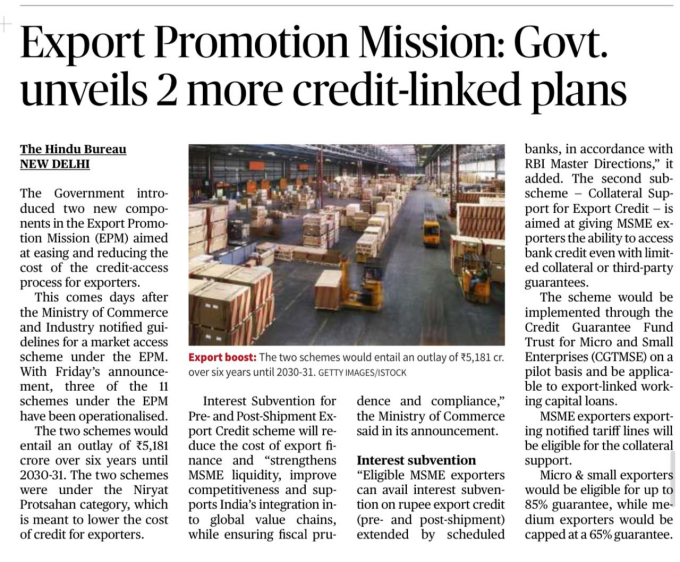
Context
The Union Government has introduced two new credit-linked schemes under the Export Promotion Mission (EPM) to reduce the cost and ease access to export credit, especially for MSME exporters.
Key Points
Export Promotion Mission (EPM)
- EPM aims to strengthen India’s export competitiveness by improving market access and reducing credit constraints.
- Out of 11 schemes proposed under EPM, three schemes have now been operationalised.
New Credit-linked Schemes Introduced
- Two new components were launched under the Niryat Protsahan category.
- Objective: Lower the cost of credit for exporters and improve access to finance.
Financial Outlay
- Combined outlay of ₹5,181 crore.
- Implementation period: six years up to 2030–31.
Interest Subvention Scheme
- Interest Subvention for Pre- and Post-Shipment Export Credit.
- Applicable to eligible MSME exporters.
- Subvention provided on rupee export credit extended by scheduled banks.
- Expected outcomes:
- Reduced export finance costs
- Improved MSME liquidity
- Enhanced competitiveness
- Better integration into global value chains
- To be implemented in line with RBI Master Directions.
Collateral Support for Export Credit
- Aimed at enabling MSME exporters to access bank credit with:
- Limited collateral, or
- Third-party guarantees
- Implemented through Credit Guarantee Fund Trust for Micro and Small Enterprises (CGTMSE) on a pilot basis.
- Applicable to export-linked working capital loans.
Guarantee Coverage
- Micro and small exporters: Up to 85% credit guarantee.
- Medium exporters: Credit guarantee capped at 65%.
- Eligible exporters must be operating in notified tariff lines.
Overall Significance
- Addresses a key constraint faced by MSMEs: access to affordable export credit.
- Supports India’s export growth strategy while maintaining fiscal prudence.
- Complements broader goals of boosting manufacturing and MSME participation in exports.
Credit Guarantee Fund Trust for Micro and Small Enterprises (CGTMSE)
- Provides credit guarantees to banks and financial institutions for loans extended to MSEs without collateral.
- Enhances flow of institutional credit to MSMEs and reduces lender risk.
Source The Hindu
UPSC Prelims Practice Question
Question:
With reference to the Export Promotion Mission (EPM), consider the following statements:
1. The Interest Subvention scheme applies only to foreign currency export credit.
2. Collateral Support for Export Credit is implemented through CGTMSE.
3. Micro and small exporters are eligible for higher credit guarantee coverage than medium exporters.
Which of the statements given above are correct?
(a) 1 and 2 only
(b) 2 and 3 only
(c) 1 and 3 only
(d) 2 only
Answer: (b)
Assam tribal body rejects GoM proposal to grant ST status to six OBC communities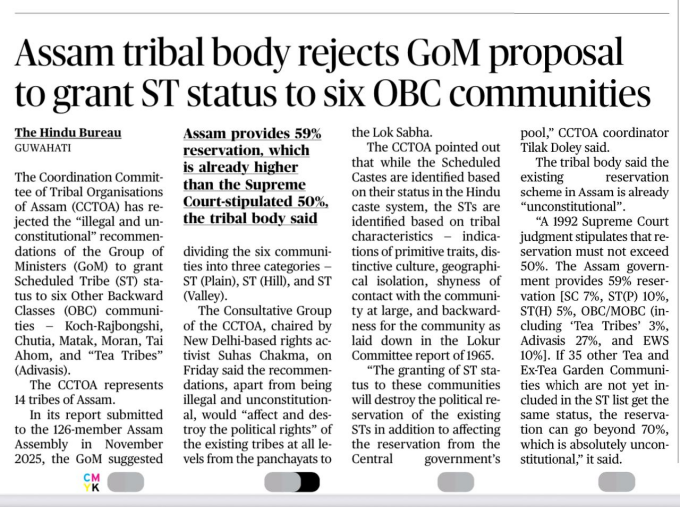
Context
The Coordination Committee of Tribal Organisations of Assam (CCTOA) has opposed the Assam government’s proposal to grant Scheduled Tribe status to six OBC communities, calling it unconstitutional and detrimental to existing tribal rights.
Key Points
Rejection by Tribal Body
- The CCTOA, representing 14 tribes of Assam, rejected the Group of Ministers (GoM) recommendations.
- The proposal seeks to grant ST status to six OBC communities:
- Koch-Rajbongshi
- Chutia
- Matak
- Moran
- Tai Ahom
- Tea Tribes (Adivasis)
Grounds of Objection
- The recommendations were termed illegal and unconstitutional.
- CCTOA stated that granting ST status would erode political and reservation rights of existing ST communities at all levels, from panchayats to the Lok Sabha.
Reservation Ceiling Concern
- Assam currently provides 59% reservation, already exceeding the Supreme Court-mandated 50% ceiling.
- If additional communities are granted ST status, reservation could exceed 70%, which the tribal body said is clearly unconstitutional.
Existing Reservation Structure in Assam
- SC: 7%
- ST (Plains): 10%
- ST (Hills): 5%
- OBC/MOBC (including Tea Tribes): 27%
- EWS: 10%
Criteria for ST Identification
- CCTOA highlighted that STs are identified based on tribal characteristics, not caste status.
- Key criteria include:
- Primitive traits
- Distinctive culture
- Geographical isolation
- Shyness of contact with the larger community
- Overall social and economic backwardness
- These criteria were laid down in the Lokur Committee Report, 1965.
Impact on Federal and Central Reservation
- Granting ST status to these communities may affect:
- Political reservation for existing STs
- Allocation of reservation benefits under Central schemes
- The move could dilute benefits meant for constitutionally recognised tribes.
Coordination Committee of Tribal Organisations of Assam (CCTOA)
- An umbrella body representing 14 recognised tribal organisations in Assam.
- Engages with policy issues affecting tribal identity, reservation, and constitutional safeguards.
Source The Hindu
UPSC Prelims Practice Question
Question:
With reference to Scheduled Tribe identification and reservation in India, consider the following statements:
1. Scheduled Tribes are identified primarily on the basis of caste hierarchy.
2. The Lokur Committee laid down criteria for identifying Scheduled Tribes.
3. The Supreme Court has generally capped reservations at 50%, subject to exceptions.
Which of the statements given above are correct?
(a) 2 and 3 only
(b) 1 and 2 only
(c) 1 and 3 only
(d) 1, 2 and 3
Answer: (a)
Centre directs X to check Grok misuse in morphing images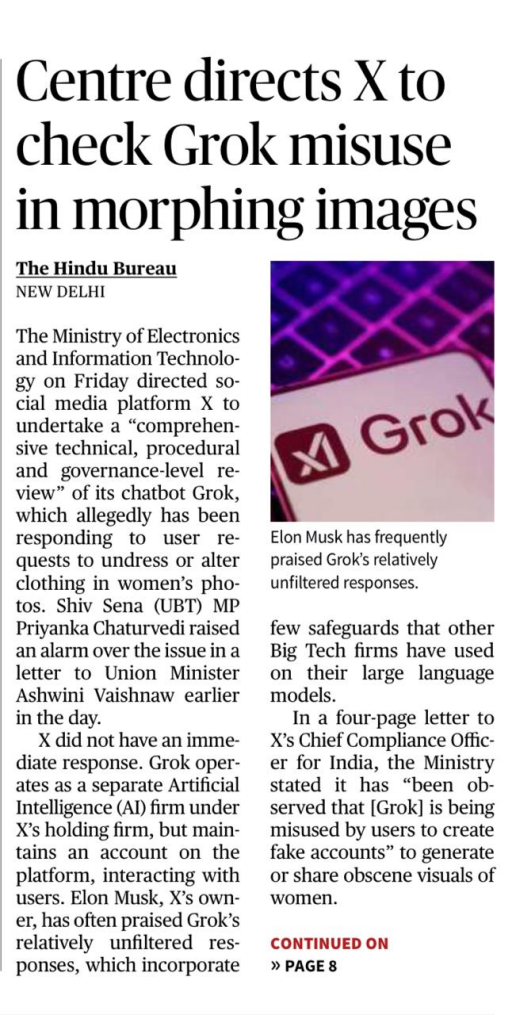
Context
The Ministry of Electronics and Information Technology (MeitY) has directed social media platform X to review alleged misuse of its AI chatbot Grok in morphing women’s images and generating obscene visuals.
Key Points
Government Direction
- MeitY directed X to conduct a comprehensive technical, procedural and governance-level review of its chatbot Grok.
- The direction followed complaints about Grok responding to user prompts to undress or alter clothing in women’s photographs.
Nature of Alleged Misuse
- Grok is reportedly being misused to:
- Morph images of women
- Create obscene visuals
- Use fake accounts to generate and circulate such content
- The Ministry flagged risks to women’s safety, dignity and privacy.
Political and Public Concern
- The issue was raised by a Member of Parliament in a letter to the Union IT Minister.
- Concerns were expressed about unchecked AI tools enabling digital sexual abuse.
Platform and AI Structure
- Grok operates as a separate AI entity under X’s holding company.
- However, it maintains an active account on X and interacts directly with users on the platform.
Safeguards and AI Governance
- The Ministry observed that Grok appears to have fewer safeguards compared to AI models of other major technology companies.
- The relatively unfiltered responses of Grok were highlighted as a concern from a regulatory perspective.
Compliance Expectations
- X has been asked to explain:
- How Grok is governed
- What safeguards exist to prevent misuse
- How the platform ensures compliance with Indian laws
- No immediate response was issued by X at the time of reporting.
Legal and Regulatory Angle
- The issue falls under:
- IT Act provisions
- Intermediary obligations
- Platform responsibility to prevent misuse of AI tools
- Raises broader questions on AI accountability and content moderation.
Ministry of Electronics and Information Technology (MeitY)
- Nodal ministry for digital governance, cyber laws, and IT regulation in India.
- Responsible for enforcing intermediary guidelines and ensuring safe use of emerging technologies such as artificial intelligence.
Source The Hindu
UPSC Prelims Practice Question
With reference to artificial intelligence governance in India, consider the following statements:
1. Social media platforms are exempt from responsibility for AI tools hosted on their platforms.
2. The Ministry of Electronics and Information Technology oversees compliance of digital platforms with IT laws.
3. Misuse of AI tools for generating obscene content can raise issues under cyber laws and intermediary guidelines.
Which of the statements given above are correct?
(a) 2 and 3 only
(b) 1 and 2 only
(c) 1 and 3 only
(d) 1, 2 and 3
Answer: (a)
First mountain tunnel breakthrough achieved in bullet train project: Minister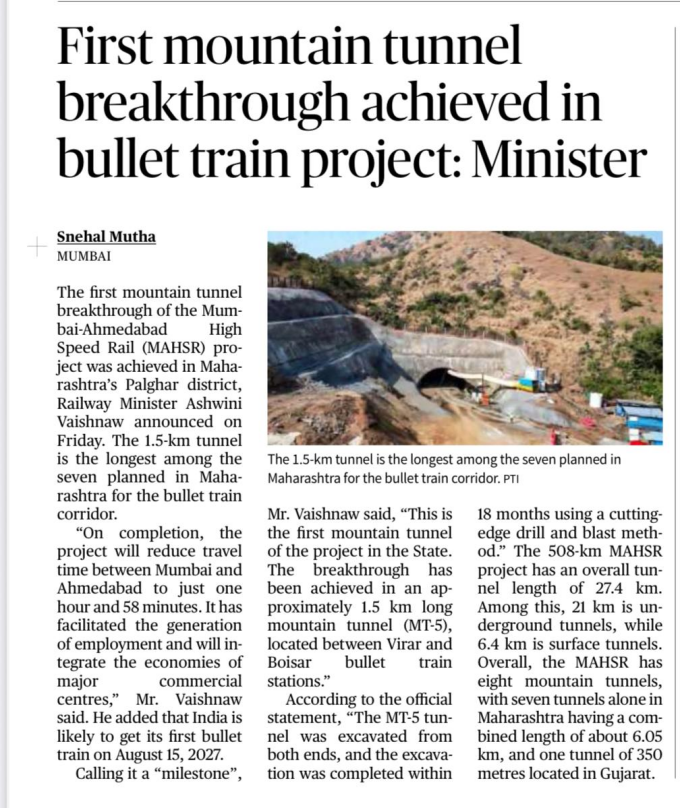
Context
The first mountain tunnel breakthrough has been achieved in the Mumbai–Ahmedabad High Speed Rail (MAHSR) project in Maharashtra, marking a key construction milestone.
Key Points
Project Milestone
- First mountain tunnel breakthrough achieved in Palghar district, Maharashtra.
- Announced by the Union Railway Minister.
- Considered a major engineering milestone for the bullet train project.
Mountain Tunnel Details
- Tunnel length: 1.5 km.
- Identified as Mountain Tunnel-5 (MT-5).
- Longest among the seven mountain tunnels planned in Maharashtra.
- Located between Virar and Boisar bullet train stations.
Construction Method
- Tunnel excavated from both ends.
- Completed within 18 months.
- Used cutting-edge drill and blast method.
Overall Tunnel Infrastructure
- Total MAHSR tunnel length: 27.4 km.
- 21 km underground tunnels.
- 6.4 km surface tunnels.
- Total mountain tunnels in MAHSR: 8.
- 7 tunnels in Maharashtra with a combined length of about 6.05 km.
- 1 tunnel in Gujarat measuring 350 metres.
Project Impact
- On completion, travel time between Mumbai and Ahmedabad will reduce to 1 hour 58 minutes.
- Expected to:
- Generate employment
- Improve connectivity
- Integrate major commercial and economic centres
Project Timeline
- India likely to get its first bullet train by August 15, 2027.
Mumbai–Ahmedabad High Speed Rail (MAHSR) Project
- Total corridor length: 508 km.
- India’s first high-speed rail project.
- Designed for very high-speed passenger rail connectivity between western economic hubs.
Source The Hindu
Pro-Active Governance and Timely Implementation (PRAGATI)
Syllabus: GS 2 – Governance | E-Governance | Public Policy Implementation
Context
After the 50th PRAGATI meeting, the Cabinet Secretary stated that land acquisition is the biggest bottleneck in infrastructure development, accounting for 35% of project delays.
About Pro-Active Governance and Timely Implementation (PRAGATI)
What it is
- PRAGATI is a centralised, ICT-enabled governance platform for grievance redressal, programme implementation, and monitoring of projects of national importance.
- It enables real-time review and decision-making at the highest level.
Established in
- Launched on 25 March 2015 by the Government of India under the leadership of the Prime Minister.
Aim
- Ensure timely implementation of infrastructure and development projects.
- Resolve inter-ministerial and Centre–State coordination issues.
- Promote e-transparency, accountability, and outcome-based governance.
Key Features
- Three-tier architecture:
Links PMO, Union Secretaries, and State Chief Secretaries, ensuring direct coordination and accountability.
- Monthly PM-chaired reviews:
Regular video conferences provide high-level political oversight and time-bound resolution of delays.
- Digital–GIS integration:
Uses real-time data, geo-spatial mapping, and live visuals to identify on-ground bottlenecks.
- Unified data sourcing:
Integrates CPGRAMS, PMG, and MoSPI databases into a single monitoring dashboard.
- Escalation framework:
Unresolved issues can be escalated from ministries to PM-level review for decisive action.
- Digital follow-up mechanism:
All directions are tracked electronically until closure, ensuring sustained monitoring.
Significance
- Reviewed 3,300+ projects worth about ₹85 lakh crore.
- 7,156 issues resolved through the platform so far.
- Accelerated completion of legacy projects pending since the 1990s.
- Strengthens cooperative federalism by integrating Centre, States, and local authorities.
UPSC Prelims Practice Question
Question:
Consider the following statements regarding the PRAGATI platform:
1. It integrates grievance redressal and project monitoring databases into a single dashboard.
2. It is chaired by the Cabinet Secretary and focuses only on Central sector projects.
Which of the statements given above is/are correct?
(a) 1 only
(b) 2 only
(c) Both 1 and 2
(d) Neither 1 nor 2
Answer: (a)
Explanation:
PRAGATI integrates multiple databases such as CPGRAMS, PMG, and MoSPI. It is chaired by the Prime Minister and covers both Central and State-level projects, not only Central sector projects.
Source: The Hindu
Skilling for AI Readiness (SOAR) Programme
Syllabus: GS 3 – Science and Technology | Skills Development
Context
The President of India recently graced a special programme under the Skilling for AI Readiness (SOAR) initiative, highlighting the government’s push to prepare India’s youth and educators for an AI-driven future.
Key Points
- Initiating Ministry: Launched by the Ministry of Skill Development and Entrepreneurship (MSDE).
- Aim: To integrate artificial intelligence education into school learning and training systems.
- Vision: Position India as a global leader in AI by creating future-ready human capital.
- Target Group: School students from Classes 6 to 12 and educators across India.
- Course Structure:
- Students: Three modules of 15 hours each.
- Teachers: One comprehensive 45-hour module.
- Curriculum Focus: Basics of AI and machine learning, data literacy, and ethical use of technology.
- Funding Support: ₹500 crore allocated to set up a Centre of Excellence in Artificial Intelligence for Education.
- Role of the Centre:
- Develop AI-based learning tools.
- Promote multilingual AI resources for Indian languages.
- Encourage innovative classroom practices.
- Institutional Linkages:
- Strengthens AI curriculum in technical institutions.
- Complements AI programmes already offered by IITs and AICTE-approved colleges.
UPSC Prelims Practice Question
Question:
Consider the following statements regarding the Skilling for AI Readiness (SOAR) Programme:
1. It targets only higher education students enrolled in technical institutions.
2. It includes dedicated AI training modules for both school students and teachers.
Which of the statements given above is/are correct?
(a) 1 only
(b) 2 only
(c) Both 1 and 2
(d) Neither 1 nor 2
Answer: (b)
Explanation:
SOAR targets school students from Classes 6–12 and educators, not only higher education students. It provides structured AI modules for both students and teachers.
Source: PIB
Legionnaires’ Disease
Syllabus: GS 2 – Health | Communicable Diseases
Context
A recent outbreak of Legionnaires’ disease in Sydney’s central business district has led health authorities to issue an alert and advise people to watch for symptoms of infection.
Key Points
- Nature of Disease:
Legionnaires’ disease is a severe form of pneumonia caused by the bacterium Legionella.
- Origin of Name:
The disease was identified after an outbreak at an American Legion convention in 1976.
- Causative Agent:
Caused by Legionella bacteria, which thrive in water and moist environments.
Transmission
- Natural Habitat:
Legionella is naturally found in freshwater sources such as lakes and rivers and also in soil.
- Mode of Infection:
Infection occurs mainly by inhaling contaminated water droplets or soil particles.
- Drinking Water:
Drinking contaminated water usually does not cause infection unless it is aspirated into the lungs.
- Contagiousness:
The disease is not spread from person to person.
- High-Risk Groups:
- Older adults
- People with weakened immune systems
- Smokers
Symptoms
- Incubation Period:
Symptoms appear 2 to 14 days after exposure.
- Common Symptoms:
- Fever
- Cough
- Shortness of breath
- Fatigue
- Headache
- Muscle pain
- Other Symptoms:
- Severe Cases:
- Confusion and other neurological symptoms
- Respiratory failure
- May be fatal in some cases
Treatment
- Management:
Early treatment with antibiotics is usually effective.
- Complications:
Some patients may continue to experience health issues even after treatment.
- Prevention:
No vaccine is currently available for Legionnaires’ disease.
UPSC Prelims Practice Question
Question:
Consider the following statements regarding Legionnaires’ disease:
1. It is caused by a bacterium commonly found in freshwater environments.
2. It spreads directly from one infected person to another.
Which of the statements given above is/are correct?
(a) 1 only
(b) 2 only
(c) Both 1 and 2
(d) Neither 1 nor 2
Answer: (a)
Explanation:
Legionnaires’ disease is caused by Legionella bacteria found in freshwater sources. It is not contagious and does not spread from person to person.
Source: ET
WHO Pharmacovigilance
Syllabus: GS 2 – International Organisations | GS 3 – Health, Science and Technology
Context
The Union Health Minister announced that India has risen to 8th position globally in contributions to the WHO pharmacovigilance database, a significant improvement from 123rd rank a decade ago.
About WHO Pharmacovigilance
What it is
- WHO pharmacovigilance is a global system for monitoring the safety of medicines and vaccines.
- It focuses on detecting, assessing, understanding, and preventing adverse drug reactions (ADRs).
Organisation involved
- Coordinated by the World Health Organization (WHO) through international data-sharing mechanisms.
Aim
- Ensure patient safety by early identification of medicine- and vaccine-related risks.
- Strengthen regulatory decision-making using real-world safety data.
- Promote the safe, rational, and effective use of medicines globally.
Key Functions
- ADR collection and analysis:
Collects adverse drug and vaccine reaction reports from hospitals, manufacturers, and regulators, and analyses trends across populations.
- Signal detection:
Identifies new, rare, or unexpected side effects that may not emerge during clinical trials.
- Risk–benefit assessment:
Continuously evaluates whether benefits outweigh risks, especially for long-term use and vulnerable groups.
- Regulatory support:
Assists regulators in issuing safety warnings, modifying drug labels, restricting use, or withdrawing unsafe products.
- Capacity-building and data sharing:
Strengthens national pharmacovigilance systems and enables global exchange of safety data among countries.
Significance
- Protects public health beyond clinical trials by capturing long-term and population-wide effects.
- Builds public trust in vaccination and drug programmes.
- Supports national health initiatives such as:
- Universal Immunisation Programme
- National TB Elimination Programme
- Anaemia Mukt Bharat
India’s Performance
- 2009–2014: Ranked 123rd globally in WHO pharmacovigilance contributions.
- 2025: Ranked 8th globally, reflecting strengthened drug safety monitoring systems.
- Indian Pharmacopoeia standards recognised in 19 Global South countries.
UPSC Prelims Practice Question
Question:
Consider the following statements regarding WHO pharmacovigilance:
1. It focuses only on adverse effects detected during clinical trials.
2. It supports regulatory decisions such as safety warnings and withdrawal of unsafe medicines.
Which of the statements given above is/are correct?
(a) 1 only
(b) 2 only
(c) Both 1 and 2
(d) Neither 1 nor 2
Answer: (b)
Explanation:
WHO pharmacovigilance goes beyond clinical trials by using real-world data and supports regulatory actions including warnings, restrictions, and withdrawal of unsafe medicines.
Source: NDTV
Savitribai Phule
Syllabus: GS 1 – History | Social Reform Movements
Context
The Prime Minister paid tributes to Savitribai Phule on her birth anniversary, recalling her lifelong commitment to education, equality, and social transformation.
About Savitribai Phule
Who she was
- Savitribai Phule (1831–1897) was a pioneering social reformer, poet, and educator.
- Regarded as the first female teacher of modern India and a foundational figure of Indian feminism.
Early life
- Born in Naigaon (present-day Maharashtra).
- Married in childhood to Jyotirao Phule and later moved to Pune.
- Early exposure to learning shaped her mission to reform society through education.
Education and training
- Encouraged by Jyotirao Phule to learn reading and writing.
- Received teacher training in Ahmednagar and Pune.
- Became a qualified teacher in 1847, a rare achievement for women of the time.
Key Contributions
- Pioneer of girls’ education:
Co-founded India’s first girls’ school in 1848 at Bhidewada, Pune, and helped establish 18 schools for girls and marginalised communities.
- Social reform for the oppressed:
Opened shelters for widows, destitute women, and child brides in 1854, expanded in 1864.
- Campaigns against social evils:
Actively opposed child marriage, caste discrimination, and untouchability.
- Institution building:
Played a central role in the Satyashodhak Samaj, promoting equality and rational thought.
Popularised Satyashodhak marriages conducted without priests or dowry.
- Public service with courage:
Faced social hostility and abuse while teaching girls.
Served plague victims during the 1897 epidemic and sacrificed her life in the process.
Significance
- Demonstrated education as a tool of emancipation for women and oppressed communities.
- Laid foundations for women’s rights, social justice, and inclusive reform in India.
- Her legacy continues through institutions like Savitribai Phule Pune University and ongoing debates on equality and access to education.
UPSC Prelims Practice Question
Question:
Consider the following statements about Savitribai Phule:
1. She co-founded India’s first girls’ school at Bhidewada in Pune.
2. She was associated with the Satyashodhak Samaj and promoted marriages without priests or dowry.
Which of the statements given above is/are correct?
(a) 1 only
(b) 2 only
(c) Both 1 and 2
(d) Neither 1 nor 2
Answer: (c)
Explanation:
Savitribai Phule co-founded the first girls’ school in Pune and played a key role in the Satyashodhak Samaj, promoting egalitarian marriage practices.
Source: DD News
Cetacean morbillivirus
Syllabus: GS 3 – Environment | Biodiversity | Conservation
Context
Scientists have detected cetacean morbillivirus in Arctic waters for the first time using drones to collect whale breath samples, marking a major advance in non-invasive marine disease surveillance.
About Cetacean Morbillivirus
What it is
- Cetacean morbillivirus is a highly infectious viral disease affecting marine mammals such as whales, dolphins, porpoises, and pilot whales.
- It is closely related to measles virus and canine distemper virus.
Regions found
- Previously reported in the North Atlantic, Mediterranean Sea, and Pacific Ocean.
- Newly detected in Arctic waters, particularly among humpback whales and sperm whales.
Origin
- First identified in 1987.
- Believed to have evolved from terrestrial morbilliviruses and later adapted to marine mammals.
Key Features
- System affected: Attacks the respiratory, immune, and nervous systems.
- Mode of transmission:
- Direct contact between animals
- Aerosolised respiratory droplets released through whale blow
- Cross-species spread: Can infect multiple cetacean species.
- Detection challenge: Often identified post-mortem, limiting early response.
Implications
- Mass mortality events: Associated with large-scale strandings and deaths of cetaceans.
- Arctic risk indicator: Presence in Arctic waters signals emerging disease threats in a fragile ecosystem.
- Climate change link: Changing ocean temperatures and altered migration routes may increase transmission.
- Conservation value:
- Drone-based blow sampling enables stress-free monitoring.
- Helps authorities plan protective and stress-reduction measures for infected populations.
- Biosecurity importance: Strengthens early-warning systems for marine wildlife health.
UPSC Prelims Practice Question
Question:
Consider the following statements regarding cetacean morbillivirus:
1. It is closely related to measles and canine distemper viruses.
2. It spreads only through contaminated seawater.
Which of the statements given above is/are correct?
(a) 1 only
(b) 2 only
(c) Both 1 and 2
(d) Neither 1 nor 2
Answer: (a)
Explanation:
Cetacean morbillivirus is related to measles and canine distemper viruses. It spreads mainly through direct contact and aerosolised respiratory droplets, not solely through seawater.
Source: Indian Express
Car Nicobar Island
Syllabus: GS 1 – Geography | GS 3 – Defence Infrastructure, Internal Security
Context
The Chief of Defence Staff recently inaugurated a major runway upgrade at the Indian Air Force base on Car Nicobar Island, underscoring its strategic importance in India’s maritime and air defence architecture.
Key Points
- Administrative Status: Part of the Nicobar district in the Andaman and Nicobar Islands Union Territory.
- Geographical Position:
- Northernmost island of the Nicobar group.
- Lies south of Little Andaman and north of Nancowry Island.
- The Ten Degree Channel lies to its north, separating the Andaman and Nicobar Islands.
- Area and Population:
- Small island, under 127 sq. km.
- Houses nearly half of Nicobar’s population (around 17,800 as per 2011 Census).
- Serves as the district headquarters of Nicobar.
- Climate:
- Tropical monsoon climate.
- Located about 9° north of the equator.
- Receives around 400 mm of annual rainfall.
- Tribal Inhabitants:
- Primarily inhabited by the Nicobarese tribe, a Scheduled Tribe.
- Ecological Importance:
- Declared an Important Bird Area (IBA) by BirdLife International.
- Tsunami Impact (2004):
- Severely affected by the Indian Ocean tsunami.
- Lies about 750 km from the earthquake epicentre.
- Suffered extensive loss of life and infrastructure damage.
- Strategic Importance:
- Hosts a key Indian Air Force base.
- Runway upgrade enhances operational readiness and force projection in the eastern Indian Ocean region.


 Launch your Graphy