Daily Current Affairs for UPSC 3rd Dec 2025


| Index |
| S.No | Topic | Page No |
| Daily Hindu Analysis (YouTube) |
| 1. | The dismal state of India’s environment |
|
| 2. | A template for security cooperation in the Indian Ocean |
|
| 3. | New complex housing PMO to be called ‘Seva Teerth’ |
|
| 4. | Only 20% of candidates accepted PM Internship Scheme offers |
|
| 5. | WHO backs use of GLP-1 drugs for weight loss |
|
| 6. | DRDO conducts high-speed test of fighter escape system |
|
| 7. | SC gives go-ahead to Kerala to allot prison land to BrahMos unit |
|
| |
| Daily Current Affairs (App) |
| 8. | Khiamniungan Tribe | |
| 9. | RBI releases National Strategy for Financial Inclusion (NSFI) 2025–30 |
|
| 10. | 50th Anniversary of the Biological Weapons Convention |
|
| 11. | Exercise EKUVERIN |
|
The dismal state of India’s environment

Context
The article highlights the rapid environmental degradation across India, especially the destruction of the Aravalli range, worsening air pollution, weakened environmental regulations, and the government’s disregard for ecological safeguards.
Detailed Analysis
1. Environmental Threat to Aravalli Range
- Aravalli range acts as a natural barrier preventing desertification of the Indo-Gangetic plains.
- Illegal mining has nearly destroyed hills below 100 meters, which are now exempt from protection under new norms.
- 90% of the range falls below the height cap, opening it to large-scale exploitation.
2. Severe Air Pollution Crisis - The NCR witnesses hazardous air quality each winter, with over 34,000 deaths in just 10 major cities attributed to pollution.
- Toxic haze is now a yearly phenomenon due to vehicular emissions, construction dust, and crop burning.
3. Groundwater Contamination - CGWB reported 13–15% of groundwater samples in Delhi containing uranium above permissible limits.
- Similar contamination found in Punjab and Haryana — posing long-term health risks.
4. Weakening of Environmental Laws - Forest Conservation Amendment Act, 2023 reduces protection for large categories of land.
- Draft EIA Notification 2020 proposed diluted public hearings and relaxed compliance norms.
- CRZ Notification 2018 opened ecologically sensitive coastal areas to infrastructure projects.
- These changes favour commercial interests over ecological balance.
5. High-Profile Environmental Failures - Clean Air Programme funds underutilised; monitoring infrastructure weak.
- Compensatory afforestation funds often diverted.
- Large-scale wildlife and habitat destruction witnessed in various states (Nicobar, MP’s Dhirail, Rajasthan’s hills).
6. Marginalisation of Local Communities - Forest-dwelling communities face eviction under Forest Rights Act misinterpretation.
- Development projects frequently displace marginalised groups without rehabilitation.
Suggestions of the Author 1. Halt Further Environmental Harm Stop indiscriminate deforestation in Aravallis, Madhya Pradesh, and Western Ghats.
2. Review and Restore Key Environmental Policies
- Reinstate earlier, stronger forest conservation norms.
- Strengthen National Green Tribunal, fill vacancies, restore independence.
3. Adopt a Rights-Based, Community-Centric Approach Policies should integrate local community rights and ecological concerns.
4. Improve Federal Coordination A stronger inter-governmental approach for pollution and climate resilience.
5. Promote Evidence-Based Environmental Governance Use science and environmental data to guide decisions.
Conclusion India is facing an unprecedented environmental crisis driven by deforestation, air pollution, contaminated water sources, and weakened regulatory frameworks. Urgent reforms, strong political will, and community-centric approaches are essential to safeguard the ecological future of the country.
UPSC Mains Practice Question
"Discuss the major environmental challenges currently facing India, especially in light of recent policy changes. How can India balance development needs with ecological sustainability?"
A template for security cooperation in the Indian Ocean
Context
The article evaluates the growing role of the Colombo Security Conclave (CSC) as a framework for maritime security cooperation in the Indian Ocean, in light of India hosting the 7th NSA-level CSC summit in November 2025. It examines the grouping’s evolution, strategic relevance, challenges (including China’s presence) and the way ahead.
DETAILED ANALYSIS:
1. Evolution of the Colombo Security Conclave
- Began as a trilateral initiative (India–Sri Lanka–Maldives) in 2011 focused on maritime security.
- Lost momentum due to political transitions and divergence of priorities in Sri Lanka and Maldives.
- Re-energised in 2020 as the CSC with a framework for cooperation in maritime security, counter-terrorism, trafficking/organised crime and cyber security.
- Mauritius joined in 2022, Bangladesh in 2024; Seychelles and Malaysia have participated as observer/guest.
2. Why the 2025 summit is pivotal - Comes amid a strategic churn in the Indo-Pacific and Indian Ocean, where great-power rivalry and sea-borne globalisation are intensifying.
- Signals deepening member-country engagement, with the CSC positioning itself as a core security forum for the sub-region.
- Reflects recognition that non-traditional threats (piracy, trafficking, cybercrime, coastal disasters) are as important as traditional naval competition.
3. Maritime security–development linkage - Indian Ocean littoral economies are heavily dependent on the seas for trade, fisheries and energy.
- Maritime insecurity directly affects livelihoods of coastal communities and opportunities from blue-economy growth.
- For CSC members, tackling security challenges is inseparable from development priorities, e.g., port safety, sea-lane protection, disaster response.
4. CSC’s recent gains - Expansion to include Seychelles as a full member seen as deeper regional commitment.
- For India, CSC provides:
- A platform to institutionalise security cooperation with neighbours.
- An avenue to shape regional norms on maritime security amid China’s growing footprint.
- The 2025 summit further underscored the security dimension in broader regional cooperation, beyond purely economic or SAARC-style forums.
5. The China factor - For India, Chinese presence in the Indian Ocean (ports, bases, dual-use facilities) is a key maritime security concern.
- Other CSC members may view China primarily as a development partner, not a threat.
- The article stresses the need for India to balance its China-related concerns with the developmental expectations of smaller states, so CSC remains attractive to them.
6. Gaps in institutionalisation - CSC currently functions as a National Security Adviser–level mechanism without a strong permanent institutional framework.
- To sustain momentum, the group needs:
- Clear institutional structures (possibly a small secretariat/coordination cell).
- Defined implementation pathways for decisions.
- Regular joint exercises, information-sharing mechanisms and capacity-building projects.
7. Domestic political uncertainties - Internal politics in states like Bangladesh can influence how firmly they engage with India and other CSC members.
- Such uncertainties may affect the resilience and continuity of CSC initiatives and must be factored into India’s regional diplomacy.
Suggestions of the Author 1. Institutional Strengthening of CSC
o Move from a loose NSA-level forum to a
more institutionalised regional security mechanism with permanent coordination structures and follow-up processes.
2.
Balanced Handling of the China Question
o India should
avoid framing CSC as overtly anti-China, instead emphasising
collective security and development benefits, so smaller states are not forced into binary choices.
3.
Development-centric Maritime Agenda
o CSC should foreground
blue economy, coastal livelihoods, disaster management and connectivity alongside hard security issues, aligning with members’ development priorities.
4.
Inclusive and Flexible Cooperation
o Keep CSC
open to gradual expansion and flexible forms of engagement (observers, project-based cooperation) to build a wider
Indian Ocean security community.
Conclusion The Colombo Security Conclave is emerging as an important “template” for sub-regional security cooperation in the Indian Ocean, linking maritime security with development imperatives. Its future relevance will depend on how effectively it is institutionalised, how India manages the China factor without alienating partners, and how well it delivers tangible security and economic gains to member states. If nurtured carefully, the CSC can become a crucial pillar of India’s Indo-Pacific strategy and regional maritime order.
UPSC Mains Question
Discuss the significance of the Colombo Security Conclave (CSC) for India’s maritime security in the Indian Ocean. What challenges does India face in using the CSC as a platform to balance regional development needs with concerns over China’s growing presence?
New complex housing PMO to be called ‘Seva Teerth’ 
Context
The new complex being built to house the Prime Minister’s Office (PMO) under the Central Vista Redevelopment Project is in its final stages and will be officially called ‘Seva Teerth’. The name is meant to symbolise a shift from power-centric to service-centric governance.
Key Points Name and Concept
- The complex, earlier referred to as the ‘Executive Enclave’, has been renamed ‘Seva Teerth’.
- It is designed to embody the spirit of service (seva) in governance, moving from “satta (power) to seva (service)”.
Offices to be Housed - Will house:
- Prime Minister’s Office (PMO)
- Cabinet Secretariat
- National Security Council Secretariat
- India House, a venue for talks with visiting dignitaries.
Functional Role - Envisioned as a workplace where national priorities are shaped and high-level decision-making takes place.
- Intended to reflect the ongoing institutional shift in India’s public architecture towards service-oriented governance.
UPSC Prelims Practice Question Q. With reference to ‘Seva Teerth’, recently seen in the news, consider the following statements:
1. It is the new name of the complex that will house the Prime Minister’s Office under the Central Vista Redevelopment Project.
2. It will also include offices of the Cabinet Secretariat and the National Security Council Secretariat.
Which of the statements given above is/are correct?
A. 1 only
B. 2 only
C. Both 1 and 2
D. Neither 1 nor 2
Answer: C Explanation:
- Statement 1 is correct: The new complex, earlier known as the Executive Enclave, is now named ‘Seva Teerth’ and will house the PMO.
- Statement 2 is correct: The same complex will also host the Cabinet Secretariat and the National Security Council Secretariat, along with India House for talks with visiting dignitaries.
Only 20% of candidates accepted PM Internship Scheme offers: data
Context
Data presented in Parliament show that, under the Prime Minister Internship Scheme (PMIS) pilot, companies made 1.65 lakh internship offers, but only about 20% were accepted, and a significant share of those who joined quit before completing their internships.
Key Points Overall uptake and completion
- Over two phases, companies made 1.65 lakh internship offers under PMIS.
- Only about 33,300 offers (≈20.2%) were accepted.
- Of those who accepted, around 6,618 interns (≈19.9%) quit before completion.
Phase 1 – low acceptance and high dropout - Companies posted 1.27 lakh internship opportunities, receiving over 6.21 lakh applications.
- They made 82,000 offers, of which 8,700 (≈10.6%) were accepted.
- As of 26 November, 4,565 candidates from the first round left their internships before completing them – more than half of those who had joined.
Phase 2 – better acceptance but continued exits - From January onwards, companies posted 1.18 lakh internship opportunities, drawing over 4.55 lakh applications.
- By November 26, companies made 83,000 offers, of which 24,600 (≈30%) were accepted.
- 2,053 candidates (8.3%) who accepted internships in the second round left before completion.
Reasons for low acceptance - Candidates cited location, roles and duration of internships as key reasons for declining offers.
- Government had initially targeted 1.25 lakh internships in a year as part of the pilot.
Budget and expenditure - Initial allocation: ₹840 crore for the pilot project.
- Later revised to ₹380 crore for FY 2024–25.
- Actual spending so far has been about ₹73.72 crore.
Prime Minister Internship Scheme (PMIS) – Overview - Announced in Union Budget 2024 to provide internship opportunities to youth in top 500 companies over five years.
- Implemented by the Ministry of Corporate Affairs through a dedicated online internship portal.
- Objective: bridge the industry–academia gap, provide practical exposure, and improve employability of young graduates.
- Companies participating in the scheme offer paid internships, with central support and guidelines for duration, stipend and reporting.
UPSC Prelims Practice Question Q. With reference to the Prime Minister Internship Scheme (PMIS), recently seen in the news, consider the following statements:
1. The scheme aims to provide internship opportunities for youth in the country’s top 500 companies.
2. It is implemented by the Ministry of Corporate Affairs through an online internship portal. Which of the statements given above is/are correct?
A. 1 only
B. 2 only
C. Both 1 and 2
D. Neither 1 nor 2
Answer: C Explanation:
- Statement 1 is correct: PMIS targets internships for youth in top 500 companies in India.
- Statement 2 is correct: The scheme is run by the Ministry of Corporate Affairs, using a dedicated online portal through which companies post opportunities and students apply.
WHO backs use of GLP-1 drugs for weight loss
Context
The World Health Organization (WHO) has issued its first global guidelines supporting the use of GLP-1 (glucagon-like peptide-1) drugs for the treatment of obesity in adults, highlighting their effectiveness and the need for equitable access worldwide.
Key Points
1. WHO’s recommendation on GLP-1 drugs
- WHO recognises GLP-1 drugs as effective for treating obesity and associated health risks.
- Recommended for adults, except pregnant women, and only for long-term treatment.
2. Conditional endorsement - Conditional due to limited long-term data on safety, efficacy, and outcomes after discontinuation.
- WHO stresses that drugs must be combined with diet, physical activity, and behavioural interventions.
3. Rising global obesity burden - Obesity is a major driver of NCDs such as cardiovascular diseases, diabetes and certain cancers.
- Global economic cost of obesity expected to reach $3 trillion annually by 2030.
4. Need for equitable access - WHO emphasises equitable access, noting that medication alone cannot solve global obesity.
- High cost of these drugs is a barrier, especially for low- and middle-income countries, including India.
5. Benefits of GLP-1 drugs - Provide significant weight loss.
- Offer metabolic benefits, improving multiple health risk factors.
About World Health Organization (WHO) About WHO - A UN specialised agency for health, established in 1948.
- Headquarters: Geneva, Switzerland.
- Has 194 Member States, 150 country offices, and 6 regional offices.
- Observes World Health Day on 7 April, the day WHO began functioning.
Objectives - Act as the directing and coordinating authority on international health work.
- Strengthen global health systems and assist governments on request.
- Promote cooperation among scientific and professional health groups.
- Shape global health research and policies.
Governance Structure World Health Assembly (WHA) - WHO’s decision-making body, attended by all member states.
- Held annually in Geneva.
- Sets policies, approves budgets, supervises financial matters, and reviews global health priorities.
Secretariat - Consists of the Director-General and technical/admin staff.
- Director-General appointed by the WHA based on the Executive Board’s recommendation.
UPSC Prelims Practice Question Q. With reference to WHO’s recent guidelines on GLP-1 drugs for obesity management, consider the following statements:
1. WHO has recommended GLP-1 drugs for all adults including pregnant women, provided they are combined with behavioural therapy.
2. WHO has noted that long-term data on GLP-1 drug safety and outcomes remain limited. Which of the statements given above is/are correct?
A. 1 only
B. 2 only
C. Both 1 and 2
D. Neither 1 nor 2
Answer: B Explanation:
- Statement 1 is incorrect: WHO excludes pregnant women from GLP-1 drug recommendations.
- Statement 2 is correct: WHO made a conditional recommendation because long-term efficacy and safety data are limited.
DRDO conducts high-speed test of fighter escape system 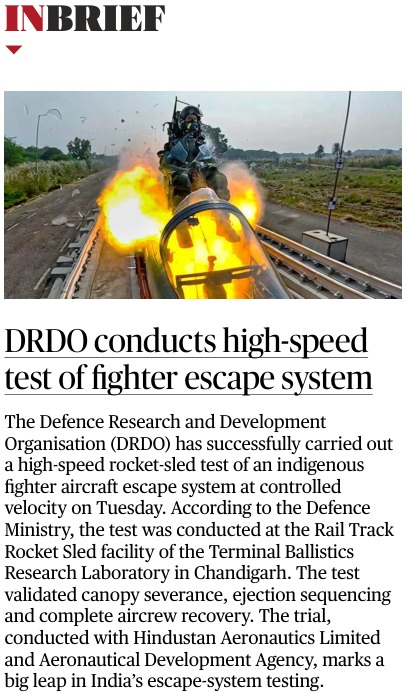
Context
The Defence Research and Development Organisation (DRDO) has successfully conducted a high-speed rocket-sled test of an indigenous fighter aircraft escape system at the Terminal Ballistics Research Laboratory in Chandigarh.
Key Points
1. About the test
- Conducted at the Rail Track Rocket Sled (RTRS) facility of TBRL, Chandigarh.
- Involved a high-speed controlled-velocity rocket-sled test.
- Purpose: validate canopy severance, ejection sequencing, and aircrew recovery.
2. Significance - Demonstrates successful progress in developing indigenous fighter escape (ejection) systems.
- Marks a major milestone for India’s efforts in self-reliant safety systems for fighter pilots.
- Conducted jointly by DRDO, Hindustan Aeronautics Ltd (HAL) and Aeronautical Development Agency (ADA).
Defence Research and Development Organisation (DRDO) About DRDO
- Works under the Ministry of Defence, Government of India.
- Mandate: build a world-class defence science & technology base, providing the armed forces with indigenous, competitive and advanced defence systems.
Origin and Growth - Established in 1958 by merging three organisations:
- Technical Development Establishments (TDEs)
- Directorate of Technical Development & Production (DTDP)
- Defence Science Organisation (DSO)
- Started with 10 laboratories; now expanded to 52 laboratories across India.
Areas of Research DRDO develops systems in:
- Aeronautics, Armaments, Missiles, Radars
- Combat vehicles, Advanced computing, Naval systems
- Electronic warfare, Artificial intelligence, Life sciences
- Special materials and sensors
Human Resources - Supported by 5,000+ scientists and around 25,000 technical and support staff.
UPSC Prelims Practice Question Q. Consider the following statements regarding the Defence Research and Development Organisation (DRDO):
1. DRDO was established by merging the Defence Science Organisation with two technical development bodies of the Indian Army.
2. DRDO currently functions under the Ministry of Home Affairs. Which of the statements given above is/are correct?
A. 1 only
B. 2 only
C. Both 1 and 2
D. Neither 1 nor 2
Answer: A Explanation:
- Statement 1 is correct: DRDO was formed in 1958 by combining TDEs, DTDP and DSO.
Statement 2 is incorrect: DRDO works under the
Ministry of Defence, not the Ministry of Home Affairs.
SC gives go-ahead to Kerala to allot prison land to BrahMos unit
Context
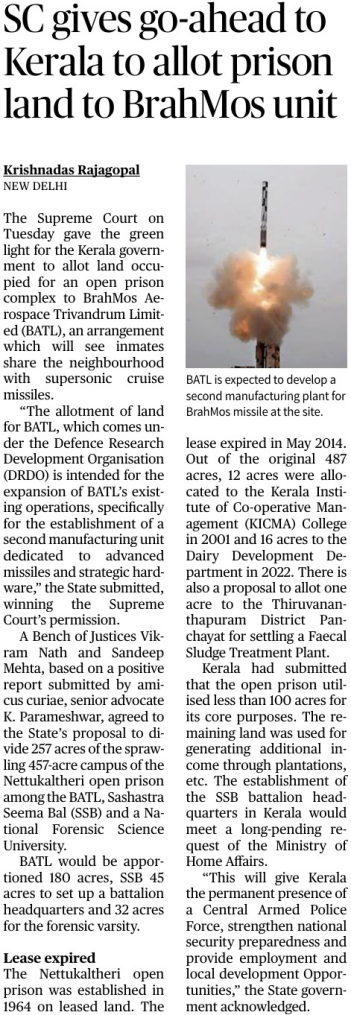
The Supreme Court has allowed the Kerala government to allot part of the Nettukaltheri open prison land to BrahMos Aerospace Trivandrum Limited (BATL) for establishing a second manufacturing unit for advanced missiles.
Key Points
1. Supreme Court approval
- SC permitted Kerala to divide 257 acres of the Nettukaltheri open prison campus among BATL, Sashastra Seema Bal (SSB) and a National Forensic Science University.
- Decision based on positive findings by the court-appointed amicus curiae.
2. Land allocation - BATL: 180 acres for expansion and setting up a second manufacturing unit for advanced missile systems.
- SSB: 45 acres for establishing battalion headquarters.
- Forensic University: 32 acres for academic and training facilities.
3. Why land was available? - The prison, established in 1964 on leased land, used less than 100 acres for core activities.
- Remaining area was used for plantation and income generation.
4. Strategic significance - BATL, functioning under DRDO, will produce advanced supersonic cruise missile components.
- Support for expanding India's domestic missile manufacturing capabilities.
5. Additional developments - The establishment of an SSB battalion HQ meets a long-pending request from the Ministry of Home Affairs for strengthening border security presence in Kerala.
- State government stated the move will boost local development and employment.
About BrahMos Aerospace Trivandrum Limited (BATL) - A defence PSU under DRDO and a key industrial unit of BrahMos Aerospace.
- Manufactures essential components of the BrahMos supersonic cruise missile.
- Expansion will enhance India’s missile production capacity and reduce dependency on imports.
About BrahMos Missile - A supersonic cruise missile jointly developed by India and Russia.
- Can be launched from land, air, sea, submarine platforms.
- Known for high precision and versatility.
UPSC Prelims Practice Question Q. With reference to BrahMos Aerospace Trivandrum Limited (BATL), consider the following statements:
1. BATL functions under the Defence Research and Development Organisation (DRDO).
2. BATL is responsible for developing components of the BrahMos supersonic cruise missile.
Which of the statements given above is/are correct?
A. 1 only
B. 2 only
C. Both 1 and 2
D. Neither 1 nor 2
Answer: C Explanation:
- Statement 1 is correct: BATL works under DRDO.
Statement 2 is correct: It manufactures components for the BrahMos missile, and expansion aims to set up a second production unit.
Khiamniungan Tribe
Syllabus: GS Paper 1 – Indian Society; Tribal Communities of India
Context The
Khiamniungan tribe of Nagaland was recently highlighted by the
Prime Minister in the ‘Mann Ki Baat’ programme, bringing attention to their culture, traditions, and livelihoods.
Key Points - Location and Distribution
- A major Naga tribe residing in eastern Nagaland and north-western Myanmar.
- Their name means “source of great water or river.”
- Social Structure
- Traditionally organised under a clan-based system.
- Language
- They speak Khiamniugan, a Sino-Tibetan language.
- Festivals
- Tsokum Sumai (Sept–Oct): Celebrated to invoke blessings for a good harvest.
- Khaotzao Sey Hok-ah Sumai: Marks the end of annual agricultural activities.
- Economic Activities
- Farming is the primary occupation; they traditionally practice jhum cultivation.
- Known for cliff-honey hunting, a unique and age-old practice.
Source: PIB
RBI releases National Strategy for Financial Inclusion (NSFI) 2025–30
Syllabus: GS Paper 3 – Indian Economy; Inclusive Growth; Financial Inclusion Context The Reserve Bank of India (RBI) has released the National Strategy for Financial Inclusion (NSFI) 2025–30, aimed at expanding access to financial services, improving their quality and enhancing usage among underserved and vulnerable groups. Key Points 1. Focus of NSFI 2025–30
- Adopts an ecosystem-based approach involving multiple institutions and stakeholders.
- Aims to improve last-mile financial access for remote households, micro-enterprises and informal-sector workers.
- Places emphasis on usage, ensuring that access leads to meaningful and sustained financial participation.
2. Panch-Jyoti Objectives - Strategy built around five core objectives (“Panch-Jyoti”) supported by 47 action points.
- Focus areas include:
- Enhancing financial resilience across households.
- Ensuring equitable, responsible and affordable access to financial products.
- Gender-sensitive interventions to promote women-led financial inclusion.
- Tailored initiatives for vulnerable groups.
3. Strengthening Financial Ecosystems - Promotes integration of financial services with livelihood development and skill enhancement.
- Aims to create a system where financial access supports income generation and long-term household security.
- Highlights the importance of financial education for building discipline, sound money management and informed financial decisions.
Source: RBI / Indian Express
50th Anniversary of the Biological Weapons Convention
Syllabus: GS Paper 2 – International Relations; Multilateral Treaties; Global Security Context India hosted the international conference “50 Years of BWC: Strengthening Biosecurity for the Global South” in New Delhi to commemorate 50 years of the Biological Weapons Convention (BWC) entering into force. Key Points
- What is the Biological Weapons Convention (BWC)?
- The world’s first multilateral disarmament treaty banning an entire category of Weapons of Mass Destruction (WMD).
- Prohibits development, production, stockpiling, acquisition, transfer and use of biological and toxin weapons.
- Establishment Timeline
- Opened for signature: 10 April 1972 (London, Moscow, Washington)
- Entered into force: 26 March 1975
- India is a founding State Party and one of 189 signatories.
- Core Prohibitions (Articles I–III)
- No development, stockpiling or use of biological agents or toxins for hostile purposes.
- Mandatory destruction of any existing stockpiles or weaponisation activities.
- Lack of Verification Mechanism
- BWC has no formal verification system, considered its biggest weakness.
- Past violations include Soviet Union and Iraq, raising concerns over compliance.
- Review Conferences
- Held approximately every five years.
- Aim to address new technological developments, strengthen norms and improve global governance.
- International Cooperation (Article X)
- Ensures access to peaceful uses of biological sciences.
- Supports capacity building, technology transfer and biosafety for developing nations / Global South.
Source: MEA
Exercise EKUVERIN
Syllabus: GS Paper 2 – International Relations; GS Paper 3 – Defence and Security
Context The 14th edition of Exercise EKUVERIN, a bilateral military exercise between India and the Maldives, is scheduled to be held in Thiruvananthapuram, Kerala. The exercise focuses on strengthening defence cooperation and enhancing interoperability in counterinsurgency and counterterrorism operations.
Key Points
- Meaning and Origin
- Ekuverin means “Friends” in the Dhivehi language.
- Started in 2009 as an annual bilateral military exercise.
- Nature of the Exercise
- Conducted alternatively in India and the Maldives every year.
- One of the three major joint exercises involving the two countries.
- Operational Focus
- Aims to enhance interoperability in counterinsurgency and counterterrorism operations.
- Training conducted in semi-urban, jungle and coastal terrain.
- Technology and Best Practices
- Emphasis on integration of niche technologies to improve joint operations.
- Both sides share best practices, reflecting a shared commitment to regional peace and security.
- Other India–Maldives Exercises
- Bilateral: Ekuverin and Ekatha.
- Trilateral: Dosti (India–Maldives–Sri Lanka).
- India–Maldives Relations
- India was among the first countries to recognise Maldives after its independence in 1965.
- Ties rooted in ethnic, linguistic, cultural, religious and commercial linkages.
Source: News On Air

 Launch your Graphy