Daily Current Affairs for UPSC 31st Oct 2025


| Index |
| S.No | Topic | Page No |
| Daily Hindu Analysis (YouTube) |
| 1. | Sardar Patel’s vision and the meaning of national unity today | |
| 2. | AI’s rewriting of the rules of education | |
| 3. | Trump-Xi bonhomie, reference to G-2 may impact India, Quad | |
| 4. | India gets a waiver on U.S. sanctions against Iran port | |
| 5. | Cyprus ready to be part of IMEC: Foreign Minister Kombos | |
| 6. | Justice Surya Kant to take over as 53rd Chief Justice of India on November 24 | |
| Daily Current Affairs (App) |
| 7. | National Disaster Response Force (NDRF) | |
| 8. | 20th East Asia Summit Adopts the Kuala Lumpur Declaration | |
| 9. | Global Firepower (GFP) Index 2025: Ranking the World’s Most Powerful Armed Forces | |
| 10. | CLAMP Portal and KOYLA SHAKTI Dashboard Launched by Ministry of Coal | |
Sardar Patel’s vision and the meaning of national unity today

GS Paper: GS-I (Modern Indian History & Freedom Struggle), GS-II (Governance, Role of Leaders in Nation-Building)
Context: On October 31, India observes Rashtriya Ekta Diwas (National Unity Day) to commemorate the birth anniversary of Sardar Vallabhbhai Patel, India’s first Deputy Prime Minister and Home Minister. Patel’s legacy as the architect of India’s political integration continues to define the idea of national unity in an era of growing diversity and regional aspirations.
Analysis:
1. Patel’s Role in Building National Unity:
- Post-Independence, India faced the daunting task of integrating 560+ princely states into the Indian Union.
- Patel’s realism, firmness, and persuasive diplomacy ensured smooth accession of states such as Hyderabad, Junagadh, and Jammu & Kashmir.
- His leadership prevented the newly independent nation from fragmentation and chaos in the aftermath of Partition.
- Patel believed unity was not uniformity, but a federation of diverse minds bound by shared heritage and purpose.
2. The Evolving Idea of Unity in Modern India: - The 2014 decision to declare Patel’s birth anniversary as National Unity Day reaffirmed that national unity is a continuous process, not a one-time achievement.
- Events like Run for Unity symbolize the spirit of collective action and patriotism as participatory values, not mere sentiment.
- The 150th birth anniversary celebrations in 2025 include large-scale programs at Ekta Nagar, home to the Statue of Unity, showcasing India’s cultural diversity through parades, tableaux, and performances by artists across states.
3. Culture as a Unifying Bond: - India’s cultural unity lies in its linguistic and regional diversity, where folk traditions, art forms, and festivals coexist harmoniously.
- The Ministry of Culture’s initiatives — from Zonal Cultural Centres to National Museums — democratize heritage, ensuring every region finds representation in the national narrative.
- Schemes like ‘Ek Bharat Shreshtha Bharat’ foster cultural pairing between states to promote linguistic and artistic exchanges — e.g., Assam and Maharashtra, Gujarat and Tamil Nadu.
- These interactions help citizens appreciate that knowing one another is the first step toward standing together.
4. Tourism and Civic Unity: - Tourism serves as a tool of cohesion, connecting citizens across geography and culture.
- The ‘Dekho Apna Desh’ campaign and digital platforms under ‘Incredible India’ encourage Indians to discover the country’s cultural diversity firsthand.
- Flagship schemes like Swadesh Darshan and PRASHAD not only improve infrastructure but create livelihoods that bridge communities — e.g., artisans in Rajasthan selling crafts to tourists from Nagaland.
- This exchange of culture and experience builds empathy and reinforces a shared national identity.
5. Renewing Patel’s Ideal for the 21st Century: - Patel envisioned unity as a dynamic national renewal, not a static condition.
- In today’s context, his vision calls for resisting fragmentation, regionalism, and indifference — reasserting the emotional and civic fabric of India.
- The ongoing ‘Azadi ka Amrit Mahotsav’ with its Panch Pran (five vows) carries forward Patel’s philosophy:
- Strengthening India’s unity and integrity,
- Promoting duty consciousness,
- Removing colonial mindset,
- Taking pride in Indian heritage,
- Fulfilling the vision of a developed India.
UPSC Mains Question: Q. “Sardar Vallabhbhai Patel’s vision of unity went beyond territorial integration to encompass cultural and civic cohesion.”
Discuss its relevance for India’s national integration in the 21st century.
AI’s rewriting of the rules of education
GS Paper: GS-II (Education & Governance) | GS-III (Science and Technology – Applications of AI)
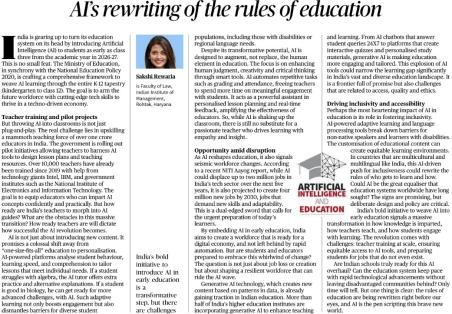
Context: India is preparing to integrate Artificial Intelligence (AI) into its school curriculum from 2026–27, starting as early as Class I, under the Ministry of Education’s framework aligned with the National Education Policy (NEP) 2020.
This initiative aims to equip students with future-ready digital and cognitive skills, marking a transformative step toward creating a tech-driven learning ecosystem.
What is Artificial Intelligence (AI)?
AI refers to the simulation of human intelligence by machines, enabling them to perform tasks such as learning, reasoning, problem-solving, and decision-making.
In the context of education, AI is used for:
- Personalised learning: Adapting lessons to each student’s needs.
- Automation: Handling repetitive tasks like grading or attendance.
- Predictive analytics: Identifying learning gaps and providing real-time feedback.
Core Objective: To shift education from rote learning to adaptive learning, where technology personalises lessons, enhances teacher efficiency, and nurtures creativity and critical thinking among students.
Detailed Analysis:
1. Transformative Vision under NEP 2020
- The NEP 2020 emphasises integrating digital literacy and computational thinking at all levels of education.
- The government is building a comprehensive AI learning ecosystem across K–12 levels, aligning India with global trends in AI-driven education.
- The focus is on preparing students for the future workforce, where AI skills will be indispensable.
2. Teacher Training and Pilot Projects - The government has trained over 10,000 teachers through partnerships with Intel, IBM, and the National Institute of Electronics and IT.
- Teachers are being equipped to design AI-based lesson plans and use data analytics tools for student assessments.
- The challenge lies in upskilling over one crore teachers—a massive transition that determines the success of this AI revolution.
- Pilot programs are already underway in select schools to test AI-enabled teaching platforms and gather insights for scalability.
3. From One-Size-Fits-All to Personalised Learning - Traditional teaching follows uniform methods; AI introduces customised learning pathways based on each student’s ability.
- AI tools assess student behaviour, performance, and comprehension levels, providing targeted feedback.
- For instance:
- A student weak in algebra gets additional visual explanations.
- A biology learner can access advanced simulations.
- This ensures equity in learning outcomes and boosts student engagement.
4. Empowering Teachers, Not Replacing Them - AI is designed to augment, not replace, the human role in education.
- By automating routine tasks (attendance, grading, scheduling), AI allows teachers to focus on conceptual and emotional engagement.
- Teachers become facilitators of creativity and critical thinking, supported by AI-driven insights on student progress.
5. Opportunities and Challenges (AI & Employment) - According to a NITI Aayog report, AI may displace up to 2 million jobs in India’s tech sector within five years but create 4 million new jobs demanding digital adaptability.
- Hence, AI education isn’t just about job creation—it’s about building a resilient, future-ready workforce.
- The new generation must acquire AI literacy, data interpretation skills, and ethical awareness to thrive in an automated world.
6. Inclusivity and Accessibility Through AI - AI-powered adaptive learning tools and language processing systems can break barriers for:
- Students with disabilities (speech, hearing, or visual).
- Non-native language learners in multilingual classrooms.
- Initiatives like AI-based chatbots, translation platforms, and interactive virtual tutors make education more inclusive and equitable.
- This could redefine who gets access to quality education, particularly in rural and underserved areas.
7. Ethical, Quality, and Data Concerns - The introduction of AI in classrooms brings challenges such as:
- Data privacy risks due to student data collection.
- Algorithmic bias impacting equitable learning.
- Digital divide between well-equipped and under-resourced schools.
- Addressing these requires strong data protection laws, teacher oversight, and ethical AI design frameworks.
8. India’s Global Positioning in AI Education - India’s proactive AI inclusion aligns with global best practices seen in Finland, Singapore, and South Korea, where AI literacy is now a core competency.
- By embedding AI early, India aims to lead the global South in democratizing digital learning, ensuring its youth are future-ready in the Fourth Industrial Revolution.
UPSC Mains Q. “AI in education is not about replacing teachers but empowering them to create inclusive and personalised learning ecosystems.”
Discuss this statement in the context of India’s National Education Policy 2020 and recent AI initiatives.
Trump-Xi bonhomie, reference to G-2 may impact India, Quad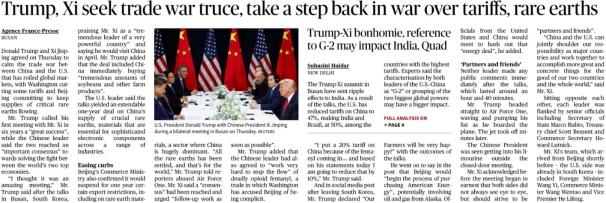
GS Paper: GS-II (International Relations), GS-III (Economy – External Sector, Trade & Industry)
Context: U.S. President Donald Trump and Chinese President Xi Jinping met in Busan and agreed to a temporary truce in their prolonged trade war. Both sides decided to ease tariffs and ensure the continued flow of rare earth materials, which are critical to global industries. The truce, although short-term, has wide-ranging implications for global supply chains, India, and the Quad countries, especially given China’s dominance in rare earths and strategic manufacturing.
What are Rare Earths?
- Group of 17 elements: the 15 lanthanides (La to Lu) + Scandium (Sc) and Yttrium (Y).
- Chemically similar, often occur together in low concentrations; need complex separation/refining.
Significance of Rare Earths in the Trade Truce: - China’s dominance gives it strategic leverage in trade negotiations.
- The U.S. depends heavily on Chinese REEs for defence technologies and clean energy goals, making the assurance crucial to its industrial resilience.
- Any disruption could destabilize global production in multiple sectors, prompting diversification efforts by the U.S., India, and allies.
Key Outcomes of the Busan Meeting: 1. Trade Truce: Both nations agreed to suspend new tariffs and review existing ones.
2. Rare Earth Supply Assurance: o China committed to continue exporting rare earth elements, vital for high-tech industries like EVs, electronics, and defence systems. The U.S. views this as a strategic gain since China controls over 85% of global refining capacity of these materials.
3. Agriculture & Energy: o China pledged to import large quantities of soybeans and farm products from the U.S. o Discussions also included a potential energy deal, with China considering imports of U.S. liquefied natural gas (LNG).
4. Fentanyl Control: China agreed to work towards stopping the flow of fentanyl, a synthetic opioid causing a major drug crisis in the U.S.
Impact on India and the Quad:
- The U.S.–China bonhomie could reshape global trade alignments, impacting India’s position in Quad-led economic strategies.
- Reduced U.S. tariffs on Chinese goods may lessen the trade diversion benefits India was enjoying.
- India, however, can leverage this situation to:
- Strengthen rare earth mining and refining capabilities (notably monazite sands).
- Collaborate with Australia, Japan, and the U.S. for critical mineral supply chains.
- Reinforce its Act East and Indo-Pacific trade linkages to maintain strategic balance.
Analysis: Global Strategic Dimensions - The U.S.–China truce signals temporary de-escalation, but not a resolution.
- Both sides seek economic stability ahead of domestic political cycles — Trump before U.S. elections, Xi amidst slow Chinese growth.
- For the world economy, this deal stabilizes global trade sentiment, especially in electronics, automobile, and clean-tech sectors.
- However, experts warn of fragile trust, as underlying issues—technology rivalry, semiconductor restrictions, and Indo-Pacific competition—remain unresolved.
UPSC Prelims: Q. With reference to Rare Earth Elements (REEs), which of the following statements is/are correct? 1. They are used in electric vehicles, renewable energy technologies, and defence systems. 2. China is the leading producer and refiner of rare earths globally. 3. India has significant reserves of REEs in its beach sands, particularly in monazite deposits. Select the correct answer using the code below:
(a) 1 and 2 only
(b) 2 and 3 only
(c) 1 and 3 only
(d) 1, 2, and 3
Answer: (d)
India gets a waiver on U.S. sanctions against Iran port
Syllabus: GS-II (International Relations – India’s Foreign Policy; India and its Neighbourhood Relations)
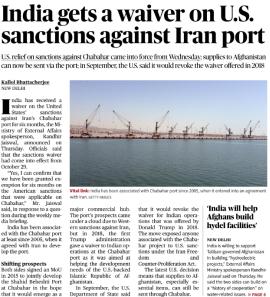
Context: The United States has granted India a six-month waiver on sanctions imposed against Iran’s Chabahar Port, allowing New Delhi to continue its operations and use the port for trade, particularly with Afghanistan. The waiver came into effect on October 29, 2025, as confirmed by the Ministry of External Affairs. This development comes amid renewed U.S. sanctions pressure on Iran and marks an important strategic relief for India in maintaining connectivity to Afghanistan and Central Asia, bypassing Pakistan.
About the Chabahar Port:
- Location: Southeastern Iran, on the Gulf of Oman.
- Developed by: India and Iran through an MoU signed in 2015 to jointly develop the Shahid Beheshti terminal.
- Strategic Importance:
- Provides India access to Afghanistan and Central Asia without transiting through Pakistan.
- Seen as a counterbalance to China’s Gwadar Port in Pakistan (developed under CPEC).
- Supports India’s role in regional connectivity projects, including the International North–South Transport Corridor (INSTC).
- Operational History:
India has been associated with Chabahar since 2005, but sanctions on Iran often slowed its progress. In 2018, the U.S. (under Donald Trump) granted India a waiver to operate the port, acknowledging its role in Afghanistan’s reconstruction.
Analysis: 1. Strategic and Diplomatic Significance for India: - The Chabahar Port acts as a gateway to Afghanistan, enabling India to deliver humanitarian aid and essential supplies even under Taliban rule.
- It strengthens India’s geo-economic presence in West and Central Asia and supports its “Connect Central Asia” policy.
- The waiver reaffirms U.S.–India strategic alignment, recognizing India’s role in regional stability and development.
2. Geopolitical Background: - Western sanctions against Iran have historically hindered India’s investments.
- The 2018 waiver by the Trump administration allowed India to work on the project to aid U.S.-backed Afghan development.
- In September 2025, the U.S. hinted it might revoke the earlier waiver — this new relief signals continued recognition of India’s unique position in the region.
3. Economic and Developmental Impact: - The port’s operations facilitate trade in food grains, pharmaceuticals, and construction materials to Afghanistan.
- It promotes regional trade diversification by linking India’s west coast ports (like Kandla and Mundra) to the Iranian hinterland and beyond.
4. Challenges: - Political instability in Afghanistan and Iran continues to pose operational risks.
- Dependence on U.S. waivers makes India’s engagement vulnerable to Washington’s shifting foreign policy priorities.
- China’s expanding presence in nearby Gwadar Port intensifies competition in the Arabian Sea region.
- Diversification of logistics and self-reliance in energy and connectivity infrastructure will reduce dependency on U.S. permissions.
UPSC Prelims: Q. What is the importance of developing Chabahar Port by India? (2017)
(a) India’s trade with African countries will enormously increase.
(b) India’s relations with oil-producing Arab countries will be strengthened.
(c) India will not depend on Pakistan for access to Afghanistan and Central Asia.
(d) Pakistan will facilitate and protect the installation of a gas pipeline between Iraq and India.
Ans: (c)
Cyprus ready to be part of IMEC: Foreign Minister Kombos
Syllabus: GS-II (International Relations – Bilateral, Regional and Global Groupings; India’s Foreign Policy) Context: · Cyprus has expressed strong interest in joining the India–Middle East–Europe Economic Corridor (IMEC) project, calling it a strategically significant initiative. During his visit to India, Cypriot Foreign Minister Constantinos Kombos emphasized that Cyprus, with its strategic geographic position, EU membership, and robust shipping sector, can play a key role in IMEC-related projects. · The statement comes amid regional complexities involving Turkey (which occupies Northern Cyprus) and highlights Cyprus’s intent to strengthen bilateral cooperation with India, especially as it prepares to assume the EU Council Presidency in January 2026.
About IMEC (India–Middle East–Europe Economic Corridor):
- Announced at: G20 Summit, New Delhi (September 2023).
- Participating Members: India, the U.S., Saudi Arabia, UAE, France, Germany, Italy, and the European Union.
- Purpose: To establish a multimodal transport and trade corridor connecting India to Europe via the Middle East, integrating shipping and rail networks.
- Key Components:
- Eastern Corridor: India → Middle East (via sea link to UAE/Saudi Arabia).
- Northern Corridor: Middle East → Europe (via Israel → Greece).
- Objectives:
- Boost connectivity and economic integration.
- Provide an alternative to China’s Belt and Road Initiative (BRI).
- Promote energy security and supply chain resilience.
Analysis: 1. Strategic Importance of Cyprus Joining IMEC: - Geographical Advantage:
Cyprus sits at a crucial maritime crossroads between Asia, Europe, and Africa, making it a natural logistical hub for the IMEC route. - EU Gateway:
As an EU member, Cyprus’s inclusion can strengthen the corridor’s link to Europe’s internal market and help coordinate EU participation in infrastructure financing and standards. - Shipping Strength:
Cyprus has one of the world’s largest merchant shipping registries, and its modern port infrastructure complements IMEC’s maritime logistics goals.
2. Diplomatic Significance for India: - Strengthening ties with Cyprus diversifies India’s partnerships in the Mediterranean region, especially at a time of strained India–Turkey relations.
- India’s outreach aligns with its larger “Act West” policy, aiming to deepen engagement with West Asia and Europe.
- The India–Cyprus Joint Action Plan (2025–2029) will further cooperation in trade, maritime security, and multilateral platforms.
3. Broader Geopolitical Implications: - IMEC is increasingly viewed as a counterweight to China’s BRI, and Cyprus’s involvement adds EU legitimacy and maritime strength.
- The move underscores a realignment in Eurasian connectivity politics, where India’s influence in global trade routes is expanding.
- The development also reflects U.S. and EU backing for India-led infrastructure projects, reinforcing multipolar cooperation.
UPSC Prelims: Q. With reference to the India-Middle East-Europe Corridor (IMEC) consider the following statements:
1. It is a proposed multimodal transportation network that would connect India to Europe via the Middle East.
2.It has gained support from the World Bank.
3.It will be the longest transportation corridor in the world.
Which of the statements given above is/are correct?
[A] 1 and 2 only
[B] 1 only [C] 2 and 3 only
[D] 1, 2 and 3
Answer: A
Justice Surya Kant to take over as 53rd Chief Justice of India on November 24
Syllabus Mapping:
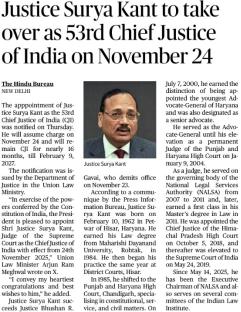
GS Paper II – Polity & Governance: Structure, Organization, and Functioning of the Judiciary, Appointment and Tenure of Judges of the Supreme Court · Justice Surya Kant has been appointed as the 53rd Chief Justice of India (CJI). He will assume office on November 24, 2025, succeeding Justice Bhushan R. Gavai, and will serve till February 9, 2027. · Born in Hisar, Haryana (1962), Justice Surya Kant earned his law degree from Maharishi Dayanand University and began his practice in 1984. He became the youngest Advocate-General of Haryana in 2000, later served as the Chief Justice of Himachal Pradesh High Court, and was elevated to the Supreme Court in 2019. · Currently, he serves as the Executive Chairman of NALSA (National Legal Services Authority), contributing to legal aid and access to justice initiatives.
UPSC Prelims Q. In the context of appointment of Supreme Court judges, consider the following statements:
1. The Chief Justice of India appoints judges of Supreme Court in consultation with four senior most judges of Supreme Court.
2. According to the constitution, the appointment of acting Chief Justice is made by the President.
3. Till now, not a single person who has been a distinguished Jurist in the opinion of the President has been appointed as a judge of the Supreme Court.
How many statements given above are correct?
[A] Only one
[B] Only two
[C] All three
[D] None
Answer: B
National Disaster Response Force (NDRF)
Syllabus: GS Paper 2 – Polity and Governance (Disaster Management)
Context:
Ahead of
Cyclone Montha’s landfall, the
National Disaster Response Force (NDRF) deployed
25 teams across Andhra Pradesh, Chhattisgarh, Odisha, Puducherry, and Tamil Nadu, with
20 additional teams on standby to ensure effective disaster response and mitigation.
Key Points - Establishment: Formed under Section 44 of the Disaster Management Act, 2005.
- Operational Since: 2006, with an initial 8 battalions, now expanded to 16 battalions.
- Composition: Personnel drawn from CAPFs – BSF, CRPF, CISF, ITBP, SSB, and Assam Rifles.
- Nodal Ministry: Functions under the Ministry of Home Affairs (MHA), headed by a Director General.
- Objective: To provide a specialised response to both natural and man-made disasters.
- Role: Capable of handling floods, cyclones, earthquakes, landslides, building collapses, and accidents.
- Deployment Strategy: Emphasises proactive availability and pre-positioning of teams during impending disasters.
- International Operations: Participated in global missions such as the 2011 Fukushima (Japan) disaster and the 2015 Nepal earthquake.
- Significance: Plays a crucial role in disaster preparedness, response, and mitigation, both nationally and internationally.
Source: The Hindu
20th East Asia Summit Adopts the Kuala Lumpur Declaration
Syllabus: GS Paper 2 – International Relations (Regional Groupings and Agreements) Context:
The
20th East Asia Summit (EAS) was recently held, where leaders adopted the
Kuala Lumpur Declaration, reaffirming their commitment to regional peace, stability, and cooperation among member nations.
Key Points - Establishment: The East Asia Summit was formed in 2005, with the first summit held in Kuala Lumpur, Malaysia.
- Membership: Includes 10 ASEAN countries — Brunei, Cambodia, Indonesia, Laos, Malaysia, Myanmar, Philippines, Singapore, Thailand, and Vietnam — along with Australia, China, India, Japan, New Zealand, Republic of Korea, the United States, and Russia.
- Membership Criteria:
1. Must
sign the ASEAN Treaty of Amity and Cooperation (TAC).
2. Must be a
formal dialogue partner of ASEAN.
3. Must maintain
substantive cooperative relations with ASEAN.
- Priority Areas of Cooperation:
1.
Environment and Energy
2.
Education
3.
Finance
4.
Global Health Issues and Pandemic Diseases
5.
Natural Disaster Management
6.
ASEAN Connectivity
Source: News On Air
Global Firepower (GFP) Index 2025: Ranking the World’s Most Powerful Armed Forces
Syllabus: GS Paper 2 – International Relations; GS Paper 3 – Defence and Security
Context:
The
Global Firepower (GFP) Index 2025 assesses the military capabilities of nations across more than
60 parameters, including manpower, defence spending, logistics, and technology. The
lower the Power Index (PwrIndx) score, the stronger the nation’s military capability.
Key Points
- About GFP Index:
- Evaluates 145 countries on 60+ military, economic, and geographic factors.
- Lower PwrIndx score = Higher capability.
- Reflects modernisation trends and global strategic shifts.
- Top Five in 2025:
1. United States
2. Russia
3. China
4. India
5. South Korea
- United States:
- Retains top global rank with a defence budget of over $860 billion.
- Dominance across land, sea, air, and cyber domains.
- Strengthened by F-35 jets, nuclear submarines, and space-based systems.
- Russia:
- Holds 2nd position despite sanctions and economic strains.
- Possesses one of the largest tank and nuclear arsenals.
- Advancing in S-500 air defence and hypersonic missile technologies.
- China:
- Matches Russia in strength through rapid military modernisation.
- Focuses on cyber warfare, AI, and naval expansion.
- Operates the world’s largest standing army and a growing blue-water navy.
- India:
- Ranked 4th globally, with growing emphasis on Atmanirbhar Bharat (self-reliance).
- Key projects: Tejas Mk1A fighters, Arihant-class submarines, BrahMos upgrades.
- Emerging as a major regional power in South Asia.
- South Korea:
- 5th rank, reflecting a strong defence industry and U.S. partnership.
- Focus on advanced missile systems and modernised armed forces.
- Increasing influence in East Asian security architecture.
Source: PIB / Global Firepower Report 2025
CLAMP Portal and KOYLA SHAKTI Dashboard Launched by Ministry of Coal
Syllabus: GS Paper 3 – Infrastructure (Energy Sector), E-Governance Initiatives Context:
The Union Minister of Coal and Mines recently launched two digital platforms — the
KOYLA SHAKTI Dashboard and the
CLAMP Portal — to enhance transparency, efficiency, and data-driven decision-making in India’s coal sector.
Key Points - Full Form: CLAMP stands for Coal Land Acquisition, Management, and Payment portal.
- Purpose: It serves as a unified digital solution for managing land acquisition, compensation, and R&R (Rehabilitation & Resettlement) processes in the coal sector.
- Function: Acts as a centralized repository of land records, enabling data integration and accountability.
- Benefits: Streamlines procedures, reduces delays, and ensures transparency in land management across coal PSUs.
- Initiative of: Ministry of Coal.
- Outcome: Improves inter-agency coordination and strengthens efficiency in coal land management practices.
KOYLA SHAKTI Dashboard - Objective: To integrate the entire coal value chain — from mine to market — on a single digital interface.
- Functionality: Provides real-time coordination among coal companies, railways, ports, and end users.
- Features: Offers live analytics and digital dashboards for faster and smarter decision-making.
- Benefits: Enhances operational efficiency, transparency, and data-driven monitoring in the coal supply chain.
Source: PIB

 Launch your Graphy