Daily Current Affairs for UPSC 30th Dec 2025


| Index |
| S.No | Topic |
|
| Daily Hindu Analysis (YouTube) |
| 1. | The quiet foundations for India’s next growth phase |
|
| 2. | Why is Myanmar voting amid conflict? |
|
| 3. | Indian Navy’s stitched sailing vessel INSV Kaudinya sets off for Oman |
|
| 4. | DAC gives its nod for defence purchases worth ₹79,000 crore |
|
| 5. | IIP Growth Climbs to 25-Month High of 6.7% |
|
| 6. | Top court pauses its judgment on Aravallis |
|
| |
| Daily Current Affairs |
| 7. | 140th Foundation Day of Indian National Congress |
|
| 8. | Passenger Assistance Control Room |
|
| 9. | Scheme for Promotion of International Cooperation for AYUSH |
|
| 10. | Kolleru Lake |
|
| 11. | INS Vagsheer |
|
| 12. | PM-YUVA 3.0 Scheme |
|


The quiet foundations for India’s next growth phase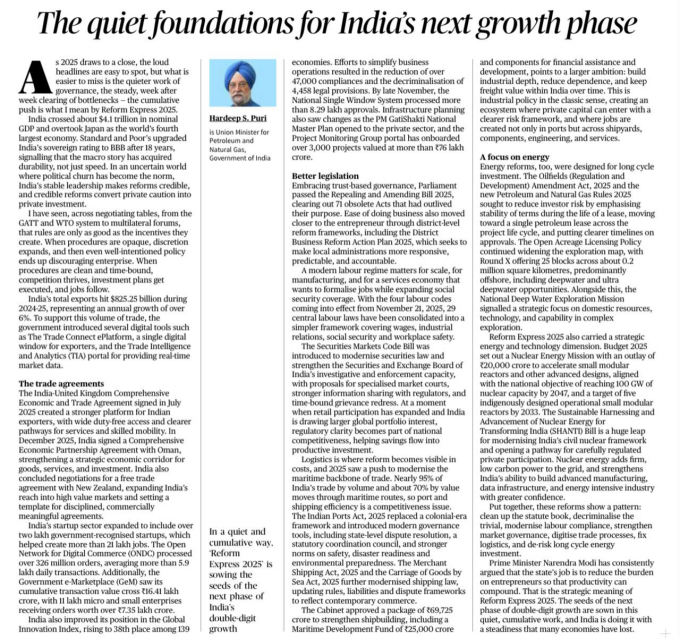
Context
The article examines how India’s recent economic reforms—though less headline-grabbing—are quietly laying the groundwork for sustained long-term growth. It highlights structural reforms, institutional strengthening, and policy consistency as the real drivers of India’s next economic phase.
Detailed Analysis
1. Economic Context and Momentum
- India has crossed $4 trillion GDP, becoming the world’s fifth-largest economy.
- Credit rating upgrades and stable macroeconomic indicators reflect improved economic credibility.
- Growth is being driven not by short-term stimulus but by systemic reforms and institutional strengthening.
2. Reforming the Regulatory and Administrative Framework - Major simplification of rules and procedures:
- Over 47,000 compliances reduced and 3,400+ legal provisions decriminalised.
- Digitisation of approvals through platforms like the National Single Window System.
- Faster approvals and transparency have improved the ease of doing business.
3. Trade, Logistics and Infrastructure Push - Export ecosystem strengthened through:
- Trade facilitation platforms such as Trade Connect and Trade Intelligence & Analytics (TIA).
- Expansion of logistics infrastructure under PM Gati Shakti.
- Maritime reforms including Indian Ports Act, 2025, modernising port governance.
- Enhanced logistics efficiency has reduced transaction costs and improved competitiveness.
4. Industrial and Manufacturing Focus - Emphasis on domestic manufacturing through Production Linked Incentive (PLI) schemes.
- Investment in semiconductors, electronics, and clean energy manufacturing.
- Creation of industrial clusters and export hubs to integrate India into global value chains.
5. Energy and Sustainability Reforms - Acceleration of renewable energy and green transition.
- Push for green hydrogen, energy storage, and nuclear energy expansion.
- Focus on long-term energy security and decarbonisation.
6. Financial and Capital Market Reforms - Strengthening of financial markets through SEBI reforms.
- Improved investor protection, transparency, and market depth.
- Enhanced capital mobilisation for infrastructure and innovation.
UPSC Mains Question “India’s current phase of economic reforms prioritises institutional strengthening over short-term stimulus.”
Discuss with reference to recent policy initiatives. Source: The Hindu
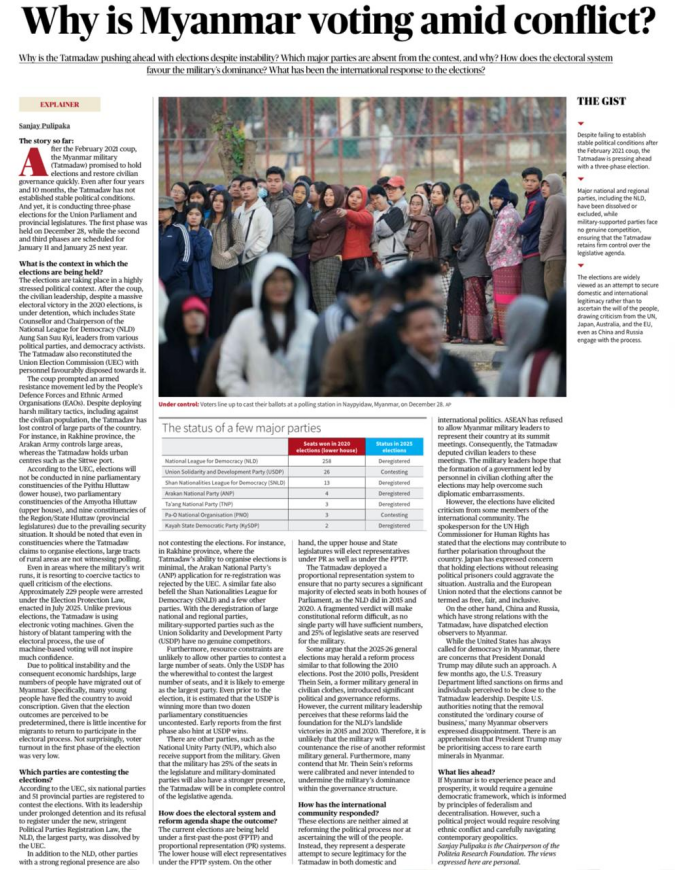
Why is Myanmar voting amid conflict?
Context
The article examines why Myanmar’s military regime (Tatmadaw) is proceeding with elections despite an ongoing civil conflict, widespread violence, and political instability following the 2021 military coup.
Detailed Analysis Background of the Crisis
- In February 2021, Myanmar’s military overthrew the elected government led by the National League for Democracy (NLD).
- The coup led to mass protests, civil disobedience, and the formation of armed resistance groups.
- Since then, the country has witnessed prolonged internal conflict, economic collapse, and humanitarian distress.
Why Elections Are Being Held Now - The military regime seeks political legitimacy after failing to stabilise the country.
- Elections are projected as a return to “constitutional order” under the 2008 Constitution.
- The Tatmadaw aims to consolidate power by forming a civilian façade while retaining real control.
Nature of the Electoral Process - Elections are planned in phases across regions due to security concerns.
- Major opposition parties, including the National League for Democracy (NLD), have been dissolved or barred.
- Many ethnic regions remain conflict zones, making free and fair voting impossible.
- Voting is being conducted under heavy military presence.
Structural Advantages for the Military - The 2008 Constitution reserves 25% of parliamentary seats for the military, giving it veto power.
- Electoral laws favour the Union Solidarity and Development Party (USDP), backed by the military.
- The military controls election administration and security forces.
International Response - Western democracies and human rights organisations have criticised the elections as illegitimate.
- ASEAN has expressed concern but remains divided on strong punitive action.
- China and Russia maintain engagement with the junta, prioritising strategic interests.
Implications - The elections are unlikely to resolve Myanmar’s political crisis.
- Risk of further internal conflict and humanitarian deterioration.
- Undermines prospects of democratic transition and regional stability.
UPSC Mains Question “Elections conducted in conflict zones often fail to ensure democratic legitimacy.” Discuss this statement with reference to the ongoing political situation in Myanmar. Source: The Hindu
Indian Navy’s stitched sailing vessel INSV Kaudinya sets off for Oman.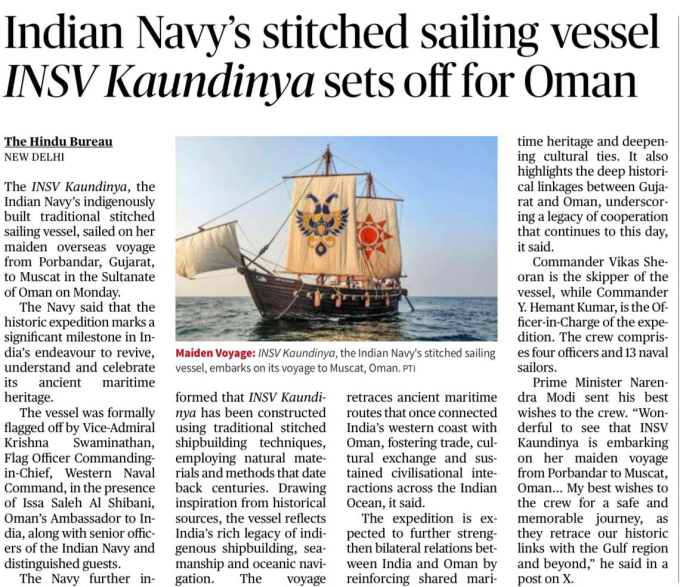
Context
The Indian Navy’s indigenously built stitched sailing vessel INSV Kaundinya has embarked on its maiden international voyage from Porbandar, Gujarat to Muscat, Oman, highlighting India’s ancient maritime heritage and strengthening cultural and maritime ties with the Gulf region.
Key Points About INSV Kaundinya
- INSV Kaundinya is a traditional stitched sailing vessel built using ancient shipbuilding techniques.
- Constructed using wooden planks stitched together with coir rope, without the use of metal nails.
- Inspired by ancient Indian maritime practices and archaeological evidence from the Harappan and later periods.
Historical Significance - Named after Kaundinya ,an ancient Indian mariner and trader.
- Reflects India’s historic maritime trade links with West Asia, the Arabian Peninsula, and Southeast Asia.
- The voyage retraces ancient sea routes between India and Oman, highlighting centuries-old commercial and cultural exchanges.
Strategic and Cultural Importance - Demonstrates India’s maritime heritage and shipbuilding expertise.
- Strengthens India–Oman bilateral relations, especially in maritime and cultural domains.
- Highlights India’s role as a historical seafaring nation in the Indian Ocean Region (IOR).
Voyage Details - Sailed from Porbandar, Gujarat, to Muscat, Oman.
- Flagged off by senior Indian Navy officials.
- The expedition crew includes naval officers trained in traditional navigation techniques.
Symbolic and Diplomatic Significance - Reinforces India’s maritime diplomacy and cultural diplomacy.
- Showcases continuity between ancient maritime trade routes and modern naval outreach.
- Enhances people-to-people connections between India and Oman.
Prelims Practice Question Consider the following statements regarding INSV Kaundinya:
1. It is a traditionally stitched sailing vessel built using ancient Indian shipbuilding techniques.
2. The vessel retraces ancient maritime trade routes between India and Southeast Asia only.
Which of the above statements is/are correct?
(a) 1 only
(b) 2 only
(c) Both 1 and 2
(d) Neither 1 nor 2
Answer: (a) 1 only Explanation:
INSV Kaundinya retraces ancient maritime routes between India and Oman, not exclusively Southeast Asia, and is built using traditional stitched-ship techniques.
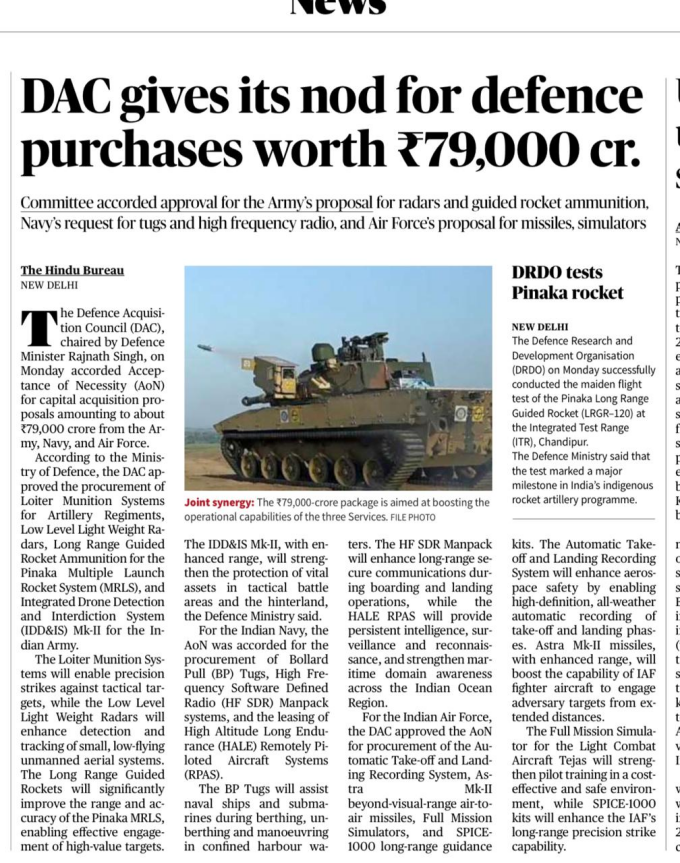
DAC gives its nod for defence purchases worth ₹79,000 crore
Context
The Defence Acquisition Council (DAC), chaired by the Defence Minister, has approved capital acquisition proposals worth about ₹79,000 crore for the Army, Navy and Air Force, strengthening India’s military preparedness and indigenisation drive. Key Points About the Approval
- The Defence Acquisition Council (DAC) granted Acceptance of Necessity (AoN) for multiple defence procurement proposals.
- The approvals aim to enhance operational preparedness, surveillance, and strike capability of the Armed Forces.
Major Procurements Approved - Indian Army
- Procurement of Loitering Munition Systems for precision strikes.
- Acquisition of Low-Level Light Weight Radars (LLLR) for improved detection of low-flying aerial threats.
- Induction of Long-Range Guided Rockets for the Pinaka Multi-Barrel Rocket Launcher System.
- Indian Navy
- Procurement of Bollard Pull (BP) Tugs to assist naval ships during berthing and harbour operations.
- Acquisition of High Frequency Software Defined Radio (HF SDR) systems for secure communications.
- Leasing of High Altitude Long Endurance (HALE) Remotely Piloted Aircraft Systems (RPAS) for maritime surveillance.
- Indian Air Force
- Procurement of Automatic Take-Off and Landing (ATOL) systems.
- Acquisition of Air-to-Air Missiles and Full Mission Simulators to enhance pilot training and combat preparedness.
Strategic Significance - Strengthens joint operational capability of the three services.
- Promotes indigenisation under ‘Aatmanirbhar Bharat’ in defence manufacturing.
- Enhances maritime domain awareness, air defence, and surveillance capabilities.
About the Defence Acquisition Council (DAC) - Chairperson: Defence Minister of India
- Purpose: Highest decision-making body for defence procurement.
- Key Functions:
- Approval of long-term capability development plans.
- Granting Acceptance of Necessity (AoN) for capital acquisitions.
- Approving acquisition categories such as Buy (Indian), Buy & Make, and Make.
- Oversight of defence procurement reforms and indigenisation.
Prelims Practice Question
Consider the following statements regarding the Defence Acquisition Council (DAC): 1. It is chaired by the Defence Minister of India. 2. It approves capital acquisition proposals for the Armed Forces. 3. It functions under the Ministry of Defence and oversees indigenisation in defence procurement.
Which of the above statements is/are correct?
(a) 1 and 2 only
(b) 2 and 3 only
(c) 1 and 3 only
(d) 1, 2 and 3
Answer: (d) 1, 2 and 3 Explanation: All of the above
IIP Growth Climbs to 25-Month High of 6.7% Context India’s
Index of Industrial Production (IIP) recorded a
25-month high growth of 6.7% in November, reflecting a broad-based recovery in industrial activity, led primarily by manufacturing and capital goods output.
Key Points What is IIP? - The Index of Industrial Production (IIP) measures the short-term changes in the volume of production of industries.
- Published monthly by the National Statistical Office (NSO) under the Ministry of Statistics and Programme Implementation (MoSPI).
- Base year: 2011–12.
Recent Performance (November Data) - Overall IIP growth: 6.7%, the highest in 25 months.
- Growth driven mainly by manufacturing and capital goods sectors.
- Improvement reflects recovery in demand, festive season impact, and easing of supply constraints.
Sector-wise Performance - Manufacturing (77.63% weight): Grew at 2.9%, showing steady recovery.
- Mining (14.37% weight): Slowed to 1.6%, reflecting moderation in extraction activities.
- Electricity (7.99% weight): Grew at 3.6%, lower than the previous year.
Eight Core Industries (40.27% of IIP weight) - Includes coal, crude oil, natural gas, refinery products, fertilisers, steel, cement, and electricity.
- Performance of these sectors strongly influences overall IIP trends.
Economic Significance - Rising IIP indicates improved industrial momentum and demand revival.
- Supports higher GDP growth and strengthens investor confidence.
- Reflects partial normalization after supply-side disruptions and uneven monsoon effects.
Prelims Practice Question Consider the following statements regarding the Index of Industrial Production (IIP):
1. The IIP is compiled and released by the Ministry of Statistics and Programme Implementation. 2. Manufacturing has the highest weight in the IIP basket. 3. The base year for the current IIP series is 2011–12.
Which of the above statements is/are correct?
(a) 1 and 2 only
(b) 2 and 3 only
(c) 1, 2 and 3
(d) 1 and 3 only
Answer: (c) 1, 2 and 3 Explanation: All of the above
Source: The Hindu
Top court pauses its judgment on Aravallis
Context
The Supreme Court has paused its judgment on the definition of the Aravalli range after concerns were raised that a narrow interpretation could weaken environmental protection and enable unchecked mining and construction activities across multiple States.
Key Points Background of the Issue
- The Supreme Court had earlier upheld a restrictive definition of the Aravalli range.
- This sparked widespread concern among environmentalists and civil society groups.
- The fear was that a narrow definition would permit mining and infrastructure expansion in ecologically sensitive zones.
Geographical Significance of the Aravallis - One of the oldest mountain ranges in the world, extending across Rajasthan, Haryana, Delhi, and parts of Gujarat.
- Acts as a natural barrier against desertification, preventing the eastward spread of the Thar Desert.
- Plays a critical role in groundwater recharge, climate regulation, and biodiversity conservation.
Supreme Court’s Observations - The court noted that the existing definition might have unintentionally excluded ecologically connected areas.
- Emphasised the need for a scientific, geological, and ecological assessment rather than administrative boundaries.
- Observed that unregulated mining and construction in “non-Aravalli” zones could damage the region’s ecological balance.
Proposed Action - The court directed the constitution of an expert panel to:
- Re-evaluate the definition of the Aravalli range.
- Conduct scientific mapping and environmental impact analysis.
- Assess short-term and long-term ecological consequences.
Environmental Significance - The Aravallis act as a green barrier protecting Delhi-NCR from desertification and air pollution.
- They support wildlife habitats, groundwater recharge, and regional climate stability.
Prelims
Practice Question Consider the following statements regarding the Aravalli Range:
1. The Aravalli range acts as a natural barrier against the eastward expansion of the Thar Desert.
2. The Supreme Court has emphasised the need for a scientific and ecological definition of the Aravalli range.
3. The Aravallis are among the youngest mountain ranges in India.
Which of the above statements is/are correct?
(a) 1 and 2 only
(b) 2 and 3 only
(c) 1 and 3 only
(d) 1, 2 and 3
Answer: (a) 1 and 2 only Explanation:
The Aravallis are among the oldest mountain ranges in the world, not the youngest. The Court highlighted the need for a scientific definition to protect ecological integrity.
Source: The Hindu
140th Foundation Day of Indian National Congress .
Syllabus: GS Paper I – Modern Indian History Context The Indian National Congress (INC) observed its 140th Foundation Day on December 28, 2025, marking over a century of its pivotal role in India’s freedom struggle and post-Independence nation-building. Key Points Formation and Early History
- The Indian National Congress was founded on 28 December 1885 at Gokuldas Tejpal Sanskrit College, Bombay.
- Womesh Chandra Bonnerjee was its first President.
- It was established by Allan Octavian Hume, along with Indian leaders such as Dadabhai Naoroji, Surendranath Banerjee, Pherozeshah Mehta, and Gopal Krishna Gokhale.
Initial Objectives - To provide a common platform for Indians to express grievances to the British government.
- To promote political awareness and constitutional reforms through peaceful means.
Evolution of the Congress Movement - Transitioned from moderate constitutional methods to mass-based nationalism.
- Played a leading role in major movements such as:
- Non-Cooperation Movement (1920–22)
- Civil Disobedience Movement (1930–34)
- Quit India Movement (1942)
- Under Mahatma Gandhi’s leadership, it became a mass organisation mobilising millions.
Post-Independence Role - Dominated Indian politics in the early decades after independence.
- Instrumental in shaping the Constitution of India, parliamentary democracy, and federal governance.
- Championed ideals of secularism, social justice, mixed economy, and non-alignment.
Contemporary Significance - Remains one of the country’s major political parties.
- Continues to influence national discourse on democracy, social justice, and constitutional values.
UPSC Prelims Practice Question Consider the following statements regarding the Indian National Congress:
1. The Indian National Congress was founded in 1885 at Bombay.
2. Womesh Chandra Bonnerjee was its first President.
3. The Indian National Congress initially began as a mass movement for complete independence. Which of the above statements is/are correct?
(a) 1 and 2 only
(b) 2 and 3 only
(c) 1 and 3 only
(d) 1, 2 and 3
Answer: (a) 1 and 2 only Explanation:
The INC was founded in 1885 at Bombay with W.C. Bonnerjee as its first President. It initially sought constitutional reforms and became a mass movement later under Gandhi’s leadership.
Source: The Indian Express
Passenger Assistance Control Room
Syllabus: GS Paper III – Infrastructure / Civil Aviation
Context
To strengthen passenger grievance redressal and ensure quicker resolution of aviation-related complaints, the Ministry of Civil Aviation has operationalised the Passenger Assistance Control Room (PACR) as a 24×7 centralized mechanism. Key Points
- Purpose:
Established to ensure real-time resolution of passenger grievances and improve service quality in the aviation sector.
- Nodal Ministry:
Operates under the Ministry of Civil Aviation, Government of India.
- Integrated Structure:
Brings together officials from the Ministry of Civil Aviation, DGCA, Airports Authority of India (AAI), airline operators, and other stakeholders under one roof.
- Operational Hub:
Located at Udaan Bhawan, New Delhi, functioning round-the-clock.
- Technology Integration:
- Fully integrated with the AirSewa grievance redressal platform.
- Uses an omni-channel digital system to track complaints and ensure time-bound resolution.
- Real-time dashboards provide live monitoring of grievance types, response times, and agency actions.
- Scope of Grievances Addressed:
- Flight delays and cancellations
- Baggage loss or damage
- Refund-related complaints
- Passenger service deficiencies
- Key Feature:
Presence of airline representatives inside the control room enables instant coordination and on-the-spot problem resolution.
Prelims Practice Question
Consider the following statements regarding the Passenger Assistance Control Room (PACR):
1. It functions under the Ministry of Civil Aviation to address passenger grievances in real time.
2. It integrates the AirSewa platform for grievance redressal and monitoring.
Which of the above statements is/are correct?
(a) 1 only
(b) 2 only
(c) Both 1 and 2
(d) Neither 1 nor 2
Answer: (c) Both 1 and 2 Explanation:
The PACR operates under the Ministry of Civil Aviation and integrates the AirSewa system to ensure efficient and time-bound grievance redressal.
Source: The Hindu
Scheme for Promotion of International Cooperation for AYUSH
Syllabus: GS Paper III – Health, Science & Technology / Government Schemes
Context The Ministry of AYUSH has highlighted the
Scheme for Promotion of International Cooperation for AYUSH, aimed at expanding the global footprint of India’s traditional systems of medicine and strengthening international collaboration in the AYUSH sector.
Key Points
- Nature of the Scheme:
A Central Sector Scheme implemented by the Ministry of AYUSH.
- Primary Objective:
To promote and strengthen the global presence of AYUSH systems including Ayurveda, Yoga, Naturopathy, Unani, Siddha, Sowa-Rigpa, and Homoeopathy.
- International Outreach:
Supports global awareness and acceptance of AYUSH through participation in international exhibitions, trade fairs, and promotional events.
- Support to Stakeholders:
Provides financial and institutional support to AYUSH drug manufacturers, service providers, and institutions for international expansion.
- Academic and Research Promotion:
Encourages establishment of AYUSH Chairs in foreign universities and promotes academic collaborations and research partnerships.
- Capacity Building:
Facilitates international exchange of experts, scholars, and practitioners to strengthen knowledge-sharing and best practices.
- Institutional Support Abroad:
Supports establishment of AYUSH Information Cells and strengthening of healthcare institutions overseas.
- Skill and Education Promotion:
Provides international fellowships and scholarships for foreign students to pursue AYUSH courses in India.
Prelims Practice Question Consider the following statements regarding the Scheme for Promotion of International Cooperation for AYUSH:
1. It is a Central Sector Scheme implemented by the Ministry of AYUSH. 2. It supports international promotion of AYUSH systems through academic exchange and market development.
Which of the above statements is/are correct?
(a) 1 only
(b) 2 only
(c) Both 1 and 2
(d) Neither 1 nor 2
Answer: (c) Both 1 and 2 Explanation:
The scheme is a Central Sector initiative under the Ministry of AYUSH and focuses on global promotion, academic exchange, and market development of AYUSH systems.
Source: PIB
Kolleru Lake
Syllabus: GS Paper I – Geography (Physical Geography & Environment)
Context Kolleru Lake has recently gained attention for its unique black dried fish, which is gaining popularity in both domestic and international markets. The development has highlighted the ecological and economic significance of this important freshwater wetland in Andhra Pradesh. Key Points
- Geographical Location:
Kolleru Lake is located in Andhra Pradesh, between the Krishna and Godavari river deltas, near the city of Eluru.
- Physical Features:
It is one of the largest freshwater lakes in India, covering about 308 sq. km, expanding up to 954 sq. km during floods.
The lake is shallow in nature and acts as a natural flood-balancing reservoir.
- Hydrology:
Receives water from Budameru, Ramileru, Tammileru, and Errakalva rivers and drains into the Bay of Bengal through the Upputeru outlet.
- Ecological Importance:
Known as the “Bird Paradise of Andhra Pradesh”, it supports over 20 million migratory birds, including grey pelicans, painted storks, and open-billed storks.
- Conservation Status:
Declared a Wildlife Sanctuary in 1999 and designated a Ramsar Wetland of International Importance in 2002.
- Livelihood Support:
The lake supports thousands of livelihoods through fishing, aquaculture, duck rearing, and paddy cultivation.
- Economic Importance:
The lake’s black dried fish has gained recognition for its taste and export potential, adding to the region’s economic value.
Prelims Practice Question Consider the following statements regarding Kolleru Lake:
1. It is a freshwater lake located between the Krishna and Godavari river basins.
2. It is designated as a Ramsar site and supports large populations of migratory birds.
Which of the above statements is/are correct?
(a) 1 only
(b) 2 only
(c) Both 1 and 2
(d) Neither 1 nor 2
Answer: (c) Both 1 and 2 Explanation:
Kolleru Lake is a freshwater lake situated between the Krishna and Godavari rivers and is recognised as a Ramsar site for its rich avian biodiversity.
Source: The Hindu
INS Vagsheer
Syllabus: GS Paper III – Defence and Security
Context
President Droupadi Murmu recently undertook a submarine sortie onboard INS Vagsheer, marking her as the second Indian President to do so. The event highlighted India’s growing indigenous submarine capabilities and naval preparedness.
Key Points
- About INS Vagsheer:
INS Vagsheer is the sixth and final submarine of the Kalvari-class (Scorpene-class) built for the Indian Navy under Project–75.
- Naming and Significance:
Named after the sandfish, a deadly deep-sea predator found in the Indian Ocean, symbolising stealth and agility.
- Commissioning:
Commissioned into the Indian Navy on 15 January 2025.
- Construction and Technology:
Built by Mazagon Dock Shipbuilders Limited (MDL) in Mumbai with technology transfer from France under the Make in India initiative.
- Class and Capabilities:
- Diesel-electric attack submarine
- Equipped for anti-surface and anti-submarine warfare
- Capable of long-duration submerged operations
- Sister Vessels in the Class:
- INS Kalvari (2017)
- INS Khanderi (2019)
- INS Karanj (2021)
- INS Vela (2021)
- INS Vagir (2023)
- Strategic Importance:
Strengthens India’s undersea warfare capability and enhances maritime security in the Indian Ocean Region (IOR).
Prelims Practice Question Consider the following statements regarding INS Vagsheer: 1. It is the sixth submarine of the Kalvari-class built under Project-75. 2. It was constructed under a technology transfer agreement with France.
Which of the above statements is/are correct?
(a) 1 only
(b) 2 only
(c) Both 1 and 2
(d) Neither 1 nor 2
Answer: (c) Both 1 and 2 Source: The Hindu
PM-YUVA 3.0 Scheme
Syllabus: GS Paper II – Governance / Social Justice / Education
Context The results of the Prime Minister’s Scheme for Mentoring Young Authors (PM-YUVA 3.0) have been announced, selecting young writers from across the country to nurture creative talent and promote Indian knowledge systems and literature.
Key Points About the Scheme
- PM-YUVA 3.0 is a mentorship-based initiative aimed at encouraging young writers below 30 years of age.
- It seeks to promote creative writing, research, and documentation of India’s heritage, culture, and contemporary themes.
Implementing Agency - Implemented by the National Book Trust (NBT), India, under the Ministry of Education.
Objectives of the Scheme - To develop a new generation of authors reflecting India’s past, present, and future.
- To strengthen literary culture and knowledge creation in India.
- To provide a national platform for young writers to express ideas and perspectives.
Themes Covered under PM-YUVA 3.0 - Contribution of the Indian Diaspora in nation-building
- Indian Knowledge Systems
- Makers of Modern India (1950–2025)
Selection Process - Applications invited through the MyGov portal.
- Candidates submit a 10,000-word book proposal.
- A multi-stage evaluation is conducted by a committee constituted by NBT.
- 50 young authors are selected under the scheme.
- Previous beneficiaries of PM-YUVA 1.0 and 2.0 are not eligible.
Mentorship and Financial Support - Selected authors receive six months of structured mentorship.
- Each author receives a scholarship of ₹50,000 per month for six months (total ₹3 lakh).
- Final manuscripts are published by NBT India, with authors receiving 10% royalty.
- Selected works may be translated into other Indian languages.
Additional Opportunities - Participation in National Book Fair and literary festivals.
- Exposure through a National Authors’ Camp during the New Delhi World Book Fair.
UPSC Prelims Practice Question Consider the following statements regarding the PM-YUVA 3.0 Scheme:
1. It is implemented by the National Book Trust under the Ministry of Education. 2. Selected authors receive financial assistance and mentorship for six months. 3. The scheme is open to authors who were selected in previous editions of PM-YUVA.
Which of the above statements is/are correct?
(a) 1 and 2 only
(b) 2 and 3 only
(c) 1 and 3 only
(d) 1, 2 and 3
Answer: (a) 1 and 2 only Explanation:
Applicants selected under earlier editions of PM-YUVA are
not eligible for PM-YUVA 3.0, making statement 3 incorrect.
Source: The Hindu

 Launch your Graphy