Daily Current Affairs for UPSC 2nd Dec 2025



| Index |
| S.No | Topic | Page No |
| Daily Hindu Analysis (YouTube) |
| 1. | The new action plan on AMR needs a shot in the arm |
|
| 2. | The need for ‘heart-resilient’ urban planning |
|
| 3. | Growth in industrial activity slips to 14-month low of 0.4% | |
| 4. | Armed forces to procure additional Heron Mk II UAVs | |
| 5. | Sanchar Saathi app must be pre-installed on phones: DoT | |
| 6. | SC tasks CBI to tackle ‘digital arrests’ |
|
| Daily Current Affairs (App) |
| 7. | International Institute for Democracy and Electoral Assistance (International IDEA) | |
| 8. | INS Taragiri | |
| 9. | Northeast India Organic Week – Meghalaya | |
| 10. | Abujhmadiya Tribe | |
| 11. | Tex-RAMPS Scheme |
|
The new action plan on AMR needs a shot in the arm
Context
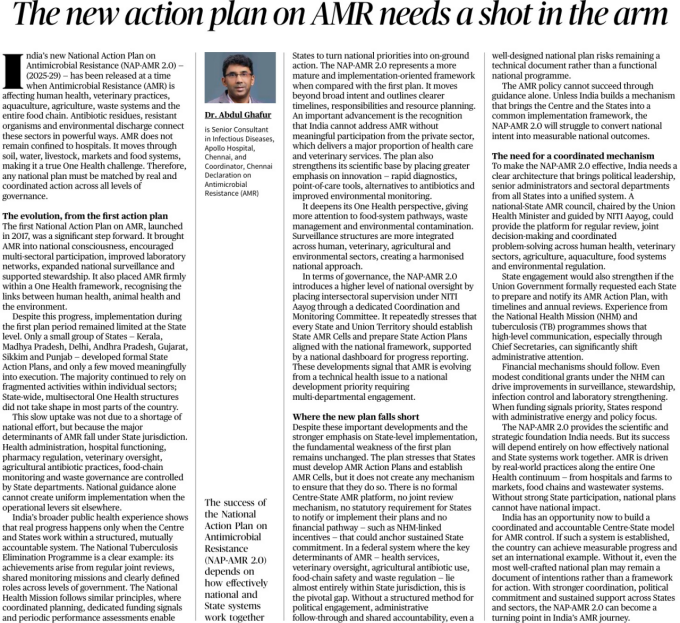
The article analyses India’s new National Action Plan on Antimicrobial Resistance (NAP-AMR 2.0, 2025–29), arguing that while it is an improvement over the first plan (2017), it still lacks clear mechanisms, funding and Centre–State coordination needed to translate intent into effective on-ground control of antimicrobial resistance (AMR). DETAILED ANALYSIS: 1. Why AMR is a One Health challenge - AMR affects human health, veterinary practice, aquaculture, agriculture, water systems and the food chain.
- Antibiotic residues and resistant organisms travel through soil, water, livestock, markets and food systems, so action is needed across all levels of governance, not just hospitals.
2. Evolution from NAP-AMR 1.0 to 2.0 - First NAP (2017):
- Brought AMR into national consciousness, promoted One Health thinking and created laboratory networks and surveillance.
- But implementation stayed limited: only a few States (Kerala, MP, Delhi, Andhra Pradesh, Gujarat, Sikkim, Punjab) prepared State AMR Action Plans, and even fewer implemented them meaningfully.
- Most States continued with fragmented, sectoral activities; national guidance alone could not ensure implementation.
- New NAP-AMR 2.0 (2025–29):
- Described as a more mature and implementation-oriented framework.
- Moves beyond broad intent and sets timelines, responsibilities and resource planning.
- Recognises that India cannot fight AMR without private sector participation (hospitals, labs, pharma, animal health industry).
- Strengthens One Health perspective – more focus on food systems, water management and environment, and integrated surveillance across human, veterinary, agriculture and environment sectors.
3. Governance changes under NAP-AMR 2.0 - Proposes higher inter-ministerial supervision under NITI Aayog via a dedicated National AMR Monitoring Committee.
- Every State and UT is to set up State AMR Cells and prepare their own action plans aligned with the national plan, with national dashboards tracking progress.
- Signals that AMR is being elevated from a technical issue to a national development priority needing multi-department engagement.
4. Gaps and challenges highlighted - Despite design improvements, key weaknesses remain:
- The plan says States must develop action plans but does not specify a mechanism to ensure they actually do so.
- No formal Centre–State AMR platform, no joint review mechanism, no statutory requirement for States to notify or implement AMR steps.
- Without binding timelines and accountability, the risk is that NAP-AMR 2.0 remains a technical document rather than a functional national programme.
- Financial constraints: conditional grants for AMR are still unclear; States may struggle to strengthen labs, surveillance and regulatory systems without dedicated funds.
5. What needs a “shot in the arm” (author’s core concern) - The author stresses that success depends on how effectively national and State systems work together:
- AMR control is a long-term systems problem across the entire One Health spectrum – from hospitals and farms to food chains and wastewater.
- Without strong State participation and clear incentives, national plans cannot impact local practice (prescribing, animal use of antibiotics, food safety, waste management etc.).
Suggestions of the Author 1. Strong Centre–State institutional mechanism o Create a robust Centre–State AMR coordination platform under NITI Aayog with joint reviews, fixed timelines and shared targets. o Make State AMR Action Plans mandatory, linked to performance-based funding.
2. Dedicated and predictable funding o Introduce earmarked financial incentives, similar to NHM-linked incentives, for States that strengthen labs, surveillance, infection control and antimicrobial stewardship.
3. Integrated surveillance and data use o Build a real-time integrated AMR data system across human health, veterinary, food, agriculture and environment to guide policy. o Use data for regulation (e.g., antibiotic use in animals), procurement, infection-control standards and hospital accreditation.
4. Private sector and community engagement o Formalise the role of private hospitals, laboratories, pharmacies and veterinary services in AMR stewardship programmes. o Encourage behaviour change in prescribing, over-the-counter sale of antibiotics, and infection prevention practices.
5. Link AMR to broader development agenda o Treat AMR control as part of food safety, water quality, agricultural practice and environmental regulation, not just as a health ministry issue.
o Use NITI Aayog to embed AMR indicators into national development monitoring.
Conclusion
India’s NAP-AMR 2.0 provides a stronger scientific and strategic framework than the first plan and correctly embraces a One Health, multi-sectoral approach. However, without hard mechanisms for Centre–State coordination, mandatory State plans, accountability and dedicated funding, the plan risks remaining largely on paper. To truly give AMR control the “shot in the arm” it needs, India must convert this improved blueprint into enforceable, well-resourced and jointly owned action across all sectors and States.
UPSC Mains Question
Critically examine the strengths and limitations of India’s National Action Plan on Antimicrobial Resistance (NAP-AMR 2.0). How can stronger Centre–State coordination and a One Health approach improve AMR governance in the country?
The need for ‘heart-resilient’ urban planning
Context
The article argues that India’s cities face a hidden emergency of rising cardiovascular diseases (CVDs), with prevalence and mortality much higher than in rural areas, and that urban planning – not just hospitals and treatment – must be redesigned to build “heart-resilient” cities. DETAILED ANALYSIS: 1. Urban life and rising heart disease - Urban India sees:
- Long commutes, high air pollution, shrinking green spaces, heat, and stress.
- Limited access to care in many low-income or peripheral areas despite overall urban growth.
- Cardiovascular ailments are now a major cause of urban deaths, with prevalence nearly twice that of rural India, and more patients below 50 years.
- Health care distribution still follows profit and land value, not need – leaving poorer neighbourhoods underserved.
2. Gaps in current urban planning - Planning remains fragmented: transport, housing, land use, and health are handled in silos.
- Practices have:
- Encouraged car dependence and long commutes.
- Ignored green infrastructure and safe walking/cycling.
- Led to unhealthy diets through car-oriented retail and junk food environments.
- Without health integrated into planning, cities lock in pollution, sedentary lifestyles, and inequity.
3. “Heart-resilient” planning – what it means The article links heart-healthy planning to a One Health / Healthy Cities style approach: 1. Walkability and active mobility o Continuous footpaths, cycle lanes, safe crossings. o Mixed land use so work, shops, and services are closer to homes, reducing car trips.
2. Green infrastructure o Trees, parks, and urban forests to cool neighbourhoods, cut pollution, reduce stress and heat-linked heart attacks.
3. Healthy land use and food environments o Limit over-zoning for commercial uses that drive traffic and junk food; support local markets, community gardens, healthy food access.
4. Public transport systems o Affordable, reliable mass transit to reduce private vehicle dependence, emissions, and sedentary travel.
5. Community design and social connection o Compact, mixed-use neighbourhoods and shared spaces that promote social interaction, key for mental and cardiovascular health.
4. Making urban health visible in governance - Urban health risks (PM2.5, extreme heat, unsafe streets, poor water and housing) are often invisible in urban decision-making.
- The article calls for:
- Integrating health indicators into planning decisions.
- Using tools like health impact assessments for transport, housing and land-use projects.
- Aligning schemes such as PMAY (Urban), Smart Cities, AMRUT and National Urban Health Mission (NUHM) with explicit cardiovascular health goals.
5. Equity and participation - Low-income communities suffer the worst conditions – polluted air, overcrowded housing, poor connectivity, scarce green space.
- “Green gentrification” risks pushing them out when areas are improved.
- Heart-resilient planning must:
- Prioritise vulnerable areas first.
- Ensure equitable access to parks, transit and safe streets.
- Involve communities in decisions on neighbourhood design and health campaigns (e.g., tobacco-free zones, active-living campaigns).
6. National opportunity and global linkages - With NUHM’s expanded investment and Asian Development Bank’s urban health financing, India can embed health into urban development.
- Collaboration among MoHUA, Health Ministry, NITI Aayog, city agencies and civil society can align land use, mobility, and environment with measurable well-being outcomes.
- India can position itself as a global example of heart-conscious urban design if it treats cardiovascular health as a central metric of city success.
Suggestions of the Author - Integrate health into master plans: Make cardiovascular risk reduction an explicit objective in city master plans, transport policies, and building regulations.
- Develop measurable health indicators: Track metrics like walkability, green cover, air quality, heat exposure, access to parks and public transport as part of urban performance.
- Cross-sector coordination: Create institutional mechanisms linking urban planning, health, transport, housing, and environment departments at city and state levels.
- Prioritise vulnerable communities: Focus first on low-income and marginalised neighbourhoods for safe streets, green spaces, and health services.
- Promote citizen engagement: Involve residents, especially youth and community groups, in redesigning streets, neighbourhoods, and health campaigns.
Conclusion The article argues that India’s fight against cardiovascular disease cannot be won inside hospitals alone; it must be designed into the city itself. Urban planning that prioritises walkability, green spaces, clean air, equitable access and social connection can turn today’s health crisis into an opportunity for resilient, heart-healthy cities. Aligning national urban schemes with health outcomes, and embedding equity and participation at their core, is essential for India’s urban future.
UPSC Mains Question
How can integrating health considerations—particularly cardiovascular health—into urban planning help address the rising burden of lifestyle diseases in Indian cities? Discuss with suitable examples.
Growth in industrial activity slips to 14-month low of 0.4%
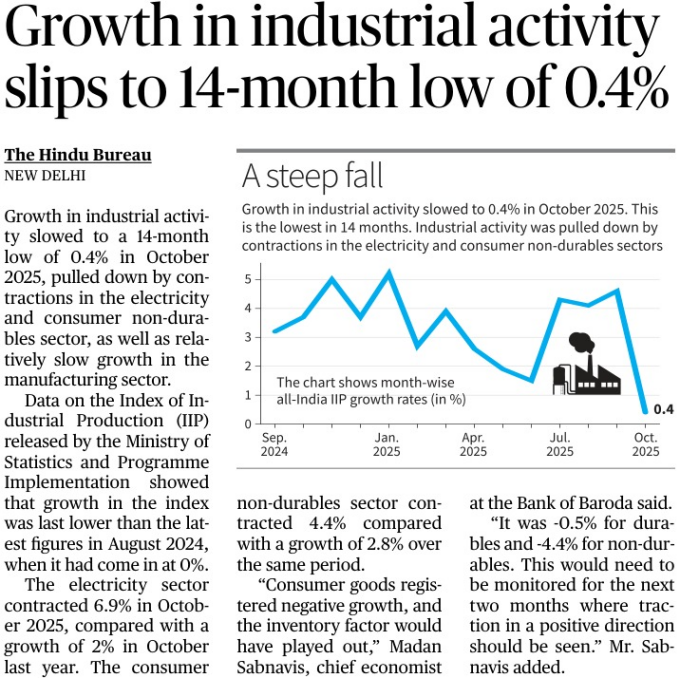
Context - Industrial output, as measured by the Index of Industrial Production (IIP), grew just 0.4% in October 2025, the lowest in 14 months.
- The slowdown was mainly due to contractions in the electricity and consumer non-durables sectors and weak manufacturing growth.
Key Points Recent IIP performance - IIP growth in October 2025: 0.4%, much lower than the level in August 2024, when it was at 0%.
- Indicates a sharp moderation in industrial activity after relatively better growth in preceding months.
Sector-wise performance - Electricity sector:
- Contracted 6.9% in October 2025.
- Same month last year saw a 2% growth, showing a sharp reversal.
- Consumer non-durables:
- Sector contracted 4.4%, compared with 2.8% growth in the same period last year.
- Overall manufacturing growth was relatively weak, dragging down the index.
Consumer goods and inventory effect - Consumer goods registered negative growth.
- Economist Madan Sabnavis (Bank of Baroda) noted that an inventory overhang may be playing out, and trends in the next two months will be crucial to see if growth returns to a positive trajectory.
- For October alone, it was about –0.5% for durables and –4.4% for non-durables, indicating subdued demand.
Index of Industrial Production (IIP) - Purpose: Measures short-term changes in the volume of production in Indian industries; key indicator of industrial and overall economic performance.
- Publishing authority: Released by the Central Statistics Office (CSO) under the Ministry of Statistics and Programme Implementation (MoSPI).
- Current base year: 2011–12, revised to reflect the modern industrial structure; earlier base years included 1937, 1946, 1951, 1956 etc.
Sectoral composition (weight in IIP) - Manufacturing: 77.63% (809 items)
- Mining: 14.37% (29 items)
- Electricity: 7.99% (1 item)
Eight Core Industries (combined weight in IIP: 40.27%) Listed in decreasing order of weight: 1. Refinery products
2. Electricity
3. Steel
4. Coal
5. Crude oil
6. Natural gas
7. Cement
8. Fertilisers
UPSC Prelims Practice Question
Q. With reference to the Index of Industrial Production (IIP), consider the following statements:
1. The Index of Industrial Production is released by the Ministry of Statistics and Programme Implementation.
2. In the IIP, manufacturing has a higher weight than mining and electricity combined. Which of the statements given above is/are correct? A. 1 only
B. 2 only
C. Both 1 and 2
D. Neither 1 nor 2
Answer: C
Source: The Hindu
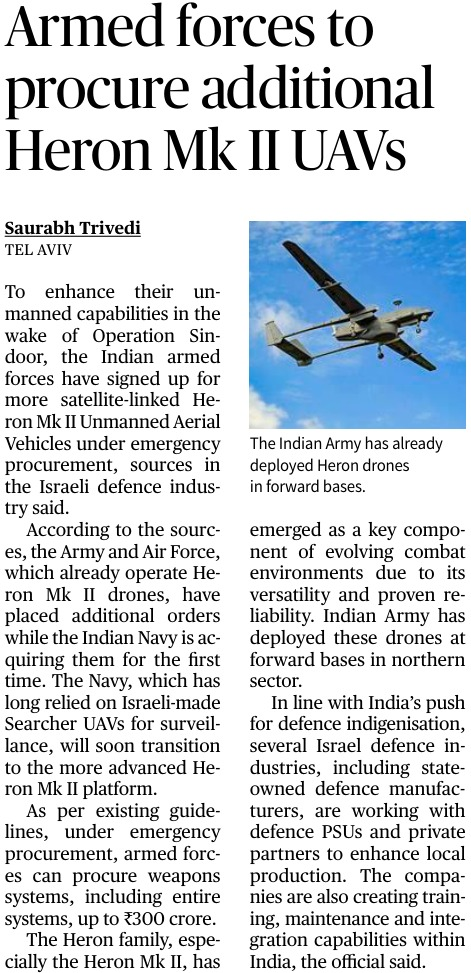
Armed forces to procure additional Heron Mk II UAVs
Context - The Indian armed forces have placed fresh orders for satellite-linked Heron Mk II Unmanned Aerial Vehicles (UAVs) from Israel under emergency procurement.
- The Army and Air Force already operate Heron Mk II; the Indian Navy is acquiring them for the first time.
Key Points 1. About the new procurement - Under existing emergency procurement guidelines, the three services can buy weapon systems, including drones, up to ₹300 crore per case with shortened procedures.
- Fresh orders have been placed by the Army and Air Force, while the Navy is joining the Heron Mk II user base now.
- The move follows operational experience from Operation Sindoor, highlighting the need to enhance unmanned ISR capabilities.
2. Heron Mk II UAV – features and operational role - Origin: Israeli-made, from the Heron family of Medium Altitude Long Endurance (MALE) UAVs.
- Satellite-linked: Beyond-line-of-sight operations through SATCOM, enabling long-range surveillance and persistent monitoring.
- Roles:
- Intelligence, Surveillance and Reconnaissance (ISR)
- Target acquisition and battlefield awareness
- Maritime surveillance for the Navy.
- Known for versatility and reliability; Heron variants are already deployed at forward bases in the northern sector by the Indian Army.
3. Shift from older Israeli UAVs - The Indian Navy has so far relied mainly on Searcher UAVs for surveillance.
- With this procurement, it will transition to the more advanced Heron Mk II platform, improving range, endurance and sensor capabilities.
4. Link to defence indigenisation - Several Israeli defence companies, including state-owned firms, are partnering with Indian defence PSUs and private industry to:
- Enhance local production,
- Build training, maintenance and integration capabilities in India.
- This complements India’s Atmanirbhar Bharat push, even while some critical systems (like Heron Mk II) are imported under urgent operational requirements.
DRDO / HAL – Indigenous Drone and UAV Ecosystem - DRDO Abhyas (ADE, Bengaluru): High-speed expendable aerial target (HEAT) drone used to train air defence crews and test missile systems.
- DRDO Ghatak / SWiFT (ADE): Stealth Unmanned Combat Aerial Vehicle (UCAV) technology demonstrator intended for autonomous deep-strike roles.
- HAL CATS (HAL & NewSpace R&D): Combat Air Teaming System – loyal wingman unmanned aircraft networked with a manned fighter.
- Rustom series / TAPAS-BH-201 (ADE): Indigenous MALE UAV designed for long-endurance surveillance and reconnaissance missions.
- DRDO Imperial Eagle (ADE & CSIR-NAL): Mini-UAV for tactical surveillance for the armed forces.
- DRDO Lakshya (ADE): Pilotless target aircraft used as an aerial target to train gun and missile crews.
- DRDO Netra (R&DE & IdeaForge): Lightweight quadcopter UAV for close-range surveillance and reconnaissance in urban and border areas.
- DRDO Nishant (ADE): Tactical UAV for day/night battlefield surveillance, target tracking and artillery fire correction.
- NAL/ADE Golden Hawk & Pushpak (ADE & CSIR-NAL): Small UAV platforms intended for basic training and light surveillance roles.
UPSC Prelims Practice Question Q. With reference to Heron Mk II and India’s UAV capability, consider the following statements:
1. Heron Mk II is a satellite-linked Medium Altitude Long Endurance (MALE) UAV of Israeli origin.
2. Under current emergency procurement guidelines, the Indian armed forces can procure weapon systems, including UAVs, up to ₹300 crore per case. Which of the statements given above is/are correct?
A. 1 only
B. 2 only
C. Both 1 and 2
D. Neither 1 nor 2
Answer: C
Sanchar Saathi app must be pre-installed on phones: DoT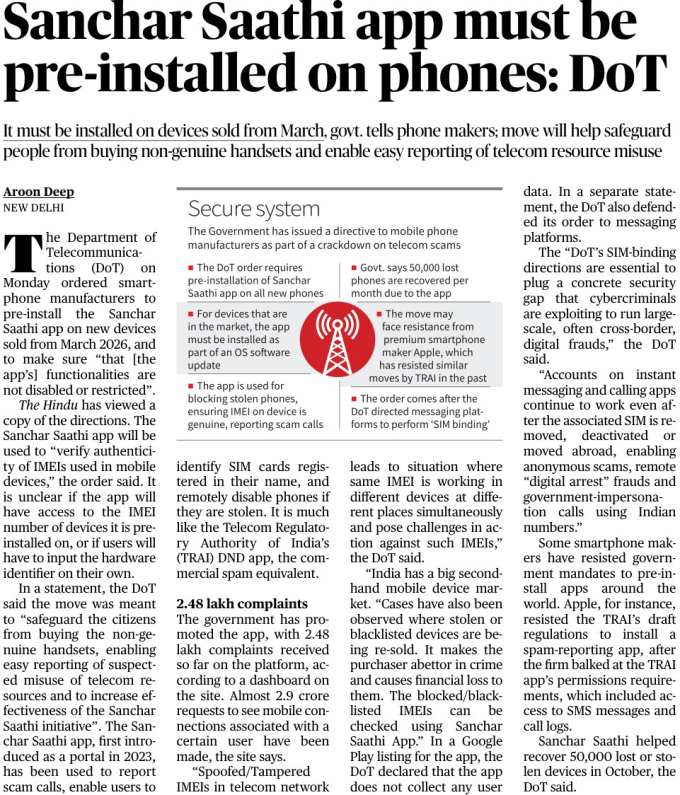
Context - The Department of Telecommunications (DoT) has directed smartphone manufacturers to pre-install the Sanchar Saathi app on all new phones sold from March 2026.
- The move aims to curb telecom frauds, use of non-genuine handsets, and misuse of mobile connections.
Key Points 1. DoT directive to smartphone manufacturers - All smartphones sold in India from March 2026 must come with the Sanchar Saathi app pre-installed.
- For devices already in the market, the app must be added through an OS software update, and manufacturers must ensure its functionalities are not disabled or restricted.
2. Purpose of Sanchar Saathi app - App will help verify authenticity of IMEIs used in mobile devices.
- Enables users to:
- Block stolen or lost phones by disabling IMEI on networks.
- Report scam calls and telecom resource misuse.
- The system supports the broader Sanchar Saathi initiative, which includes tools like CEIR (Central Equipment Identity Register) for IMEI blocking.
3. Scale of complaints and usage - Government platform has received around 2.48 lakh complaints so far.
- Nearly 2.9 crore requests to see mobile connections linked with a citizen have been made via the site.
- DoT says about 50,000 lost or stolen phones are recovered per month through the app/ecosystem.
4. Tackling SIM misuse and IMEI fraud - DoT highlights issues of spoofed/tempered IMEIs and same IMEI working on multiple devices, complicating action against such devices.
- There are cases where stolen or blacklisted devices are re-sold, drawing unsuspecting buyers into cyber-crime trails and financial loss.
- DoT’s broader efforts include SIM-binding directions to messaging platforms so accounts stop working when SIM is removed/deactivated, preventing anonymous scams.
5. Industry response and challenges - Some premium smartphone makers (like Apple, mentioned in article) have earlier resisted similar regulatory mandates (for spam-reporting apps, SMS access etc.), indicating possible friction in implementing compulsory pre-installation.
- DoT argues that these measures are crucial to maintain purity of telecom resources and are in the public interest against large-scale digital frauds.
UPSC Prelims Practice Question Q. With reference to the Sanchar Saathi initiative, consider the following statements:
1. It allows users to block lost or stolen mobile phones by disabling their IMEI on telecom networks.
2. The Department of Telecommunications has directed that the Sanchar Saathi app be pre-installed on all new smartphones sold in India. Which of the statements given above is/are correct?
A. 1 only
B. 2 only
C. Both 1 and 2
D. Neither 1 nor 2
Answer: C
SC tasks CBI to tackle ‘digital arrests’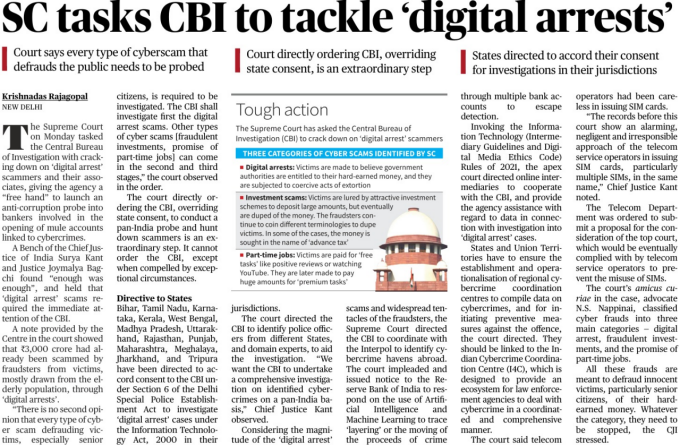
Context - The Supreme Court has directed the CBI to take over investigations into digital arrest scams, calling it an “extraordinary circumstance” requiring immediate central intervention.
- The SC noted that cybercriminals have already defrauded citizens—mostly elderly—of ₹3,000 crore through such scams.
Key Points 1. SC Directs CBI to Lead Investigation - The Supreme Court ordered the CBI to conduct a pan-India probe into digital arrest scams.
- Court bypassed the requirement of state consent, stating that national-scale cyber fraud requires centralised investigation.
- CBI may rope in police, domain experts, and Interpol to trace criminals abroad.
2. States Directed to Cooperate - States including Bihar, Tamil Nadu, Karnataka, Kerala, West Bengal, Rajasthan, Punjab, Maharashtra, Uttarakhand, Meghalaya, Jharkhand, Tripura must accord consent to CBI under Section 6 of Delhi Special Police Establishment Act.
- States and UTs must also establish cybercrime coordination centres for data sharing and preventive measures.
3. What are Digital Arrest Scams? - Scammers impersonate police, CBI, ED, Narcotics Bureau, etc.
- Victims—often elderly—are told that a case is filed against them, forcing them into a fake “digital arrest”.
Modus Operandi - Contact via audio calls, later switching to video calls from fake locations (airport, police station, court).
- Scammers use fake police station setups, photos of officers, fake arrest warrants, and legal notices.
- Victims are accused of crimes like drug trafficking, money laundering, cybercrime.
- They fabricate digital “evidence” to threaten victims into paying money.
SC Classification of Cyber Scams - Digital arrest scams
- Investment scams
- Part-time job scams
4. Cyber Frauds Enabled by Telecom Gaps - SC criticised telecom operators for negligent SIM issuance, including:
- Multiple SIMs in same name
- Poor KYC
- Facilitating creation of “mule accounts”
- DoT asked to issue strong measures for SIM-binding, preventing WhatsApp-type apps from functioning after SIM removal.
5. Policy Directions Given by SC - SC invoked IT (Intermediary Guidelines and Digital Media Ethics Code) Rules, 2021, directing intermediaries to cooperate.
- RBI asked to use AI and machine learning to trace money flow via mule accounts.
- SC held that “every type of cyber scam that defrauds citizens must be probed comprehensively.”
About Digital Arrest Scams - Cybercriminals pose as enforcement agencies such as State police, CBI, ED, Narcotics Bureau.
- They accuse victims of crimes, threaten “arrest”, and extort money.
- They use fake IDs, fake police station backdrops, forged documents, and online intimidation tactics.
Legal Provision - No specific law exists for digital arrest.
- Such cases are currently handled under the Information Technology Act, 2000, and relevant IPC provisions on fraud, impersonation, and extortion.
UPSC Prelims Practice Question Q. With reference to ‘digital arrest scams’, consider the following statements:
1. Digital arrest scams typically involve cybercriminals impersonating agencies such as CBI, ED, or State police to extort money.
2. India has a dedicated law specifically dealing with digital arrest scams. Which of the statements given above is/are correct?
A. 1 only
B. 2 only
C. Both 1 and 2
D. Neither 1 nor 2
Answer: A
International Institute for Democracy and Electoral Assistance (International IDEA)
Syllabus: GS Paper 2 – Polity & Governance, International Institutions Context - The Chief Election Commissioner (CEC) of India is set to assume the role of Chairperson of International IDEA for the year 2026.
- This highlights India’s growing leadership in global democratic and electoral governance initiatives.
Key Points - Establishment: Formed in 1995 as an inter-governmental organisation to strengthen democratic systems worldwide.
- Objective: Works to promote stronger democratic institutions, sustainable governance and legitimate democratic processes.
- Secretariat: Headquartered in Stockholm, Sweden.
- UN Status: Recognised as a UN observer organisation.
- Membership: Consists of 35 member countries; India is a founding member. The US and Japan participate as observers.
- Governance Structure: Includes a Council of Member States, Steering Committee, Finance & Audit Committee, Board of Advisers, and a Secretariat led by a Secretary-General.
- Core Functions: Works through knowledge production, capacity development, advocacy, and dialogue convening.
- Focus Areas:
- Electoral Processes
- Constitution-Building
- Democracy Assessment
- Political Participation & Representation
- Climate Change & Democracy
- Digitalization & Democracy
Source: The Hindu
Syllabus: GS Paper 3 – Defence, Security & Critical Infrastructure Context - INS Taragiri has been delivered to the Indian Navy by Mazagon Dock Shipbuilding Ltd (MDL), Mumbai.
- The warship is part of India’s ongoing efforts to enhance indigenous naval capability under Project 17A.
Key Points - Class & Project: Fourth ship of the Nilgiri-class (Project 17A) frigates built by MDL.
- Reincarnation: Revives the legacy of the earlier INS Taragiri, a Leander-class frigate of the Indian Navy.
- Design Agency: Designed by the Warship Design Bureau (WDB).
- Enhanced Capabilities: P17A ships carry more advanced weapons and sensors than the earlier P17 Shivalik class.
- Stealth & Technology: Designed as a stealth guided-missile frigate with modern automation and reduced radar signature.
- About Project 17A: Indian defence initiative to build a series of seven stealth frigates—four by MDL and three by GRSE.
Source: PIB
Northeast India Organic Week – Meghalaya
Syllabus: GS Paper 3 – Agriculture, Marketing of Agricultural Produce & Organic Farming
Context - Meghalaya has launched its first Northeast India Organic Week, a four-day event to promote the state and the region as strong contenders in the global organic market.
- The programme aims to boost market access while showcasing the region’s biodiversity-driven organic produce.
Key Points - Lead Organisers: Conducted by the Meghalaya Agriculture Department in partnership with APEDA, the Union Commerce Ministry, and IFOAM–Organics Asia.
- Objective: Strengthens global linkages by showcasing high-value organic produce and building long-term commercial partnerships.
- International Delegations: Representatives from 13 countries, including Malaysia, Taiwan, Mongolia, New Zealand and Indonesia, are participating.
- Buyer–Seller Meet: APEDA is conducting a major buyer-seller interaction to connect local producers directly with global organic markets.
- Regional Strengths: Highlights Meghalaya’s growing global demand for ginger, turmeric, fruits and niche spices.
- Biodiversity Advantage: Community-led farming systems and the region’s rich biodiversity support expansion into sustainable and certified organic agriculture.
- Market Expansion: Expected to help the Northeast tap into emerging organic markets across regions through quality assurance and buyer engagement.
Source: The Hindu
Abujhmadiya Tribe
Syllabus: GS Paper 1 – Society, Tribal Communities & PVTGs Context - The Bastar Olympics have witnessed rising participation from the Abujhmadiya tribe, highlighting their cultural presence and growing engagement in regional events.
Key Points - Location: Primarily inhabit the Abujmarh region of Chhattisgarh.
- Related Tribe: A sub-group of the Gond tribe of Central India.
- PVTG Status: Classified as a Particularly Vulnerable Tribal Group (PVTG).
- Language: Speak Abuj Maria, and also use Hindi or Chhattisgarhi.
- Social Structure: Organised into clans, each following its own customs and traditions.
- Religious Beliefs: Practice animism, worshipping nature spirits and deities linked to natural elements.
- Tattoo Tradition: Women consider Godana (tattooing) as a permanent and sacred ornament.
- Festivals: Celebrate Saja festival and Bastar Dussehra, featuring traditional dance, rituals and communal gatherings.
- Economic Activities: Engage in subsistence agriculture (rice, maize, pulses), along with hunting, fishing, and forest product gathering.
Source: The Indian Express
Syllabus: GS Paper 3 – Economy, Industrial Policies & Government Schemes
Context - The Government of India has approved the Tex-RAMPS Scheme to strengthen research, innovation and competitiveness in the textiles sector.
- The scheme aims to build a future-ready textile ecosystem through technology, data and start-up support.
Key Points - Scheme Type: A Central Sector Scheme focused on research, assessment, monitoring, planning and start-up support for the textile sector.
- Implementing Ministry: Ministry of Textiles, Government of India.
- Objective: Seeks to future-proof India’s textiles and apparel sector through innovation, data systems, capacity building and entrepreneurship support.
- Duration & Outlay: Total outlay of ₹305 crore for FY 2025-26 to FY 2030-31; co-terminus with the next Finance Commission cycle.
- Research & Innovation: Promotes advanced research in smart textiles, sustainability, process efficiency and emerging technologies.
- Data & Analytics: Establishes strong data systems for employment mapping, supply-chain assessment and the India-Size study to support evidence-based policymaking.
- Integrated Textiles Statistical System (ITSS): Provides a real-time analytics platform for structured monitoring and strategic decision-making.
- Capacity Development: Enhances State-level planning, shares best practices, conducts capacity-building workshops and organises sectoral events.
- Start-up Support: Encourages incubators, hackathons and industry–academia collaboration to nurture high-value textile start-ups.
- Expected Outcomes:
- Enhanced global competitiveness
- Stronger research and innovation ecosystem
- Improved data-driven policymaking
- Increased employment generation
- Deeper collaboration among States, industry, academia and government
Source: PIB

 Launch your Graphy