Daily Current Affairs for UPSC 28th Nov 2025


| Index |
| S.No | Topic | Page No |
| Daily Hindu Analysis (YouTube) |
| 1. | Why India struggles to clear its air |
|
| 2. | Enabling a modern and future-ready labour ecosystem |
|
| 3. | SC asks govt. to regulate content on Internet |
|
| 4. | IMF gives ‘C’ grade for India’s national accounts statistics |
|
| 5. | India and Indonesia make progress on BrahMos deal at Defence Ministers’ Dialogue |
|
| 6. | Japan will pay a ‘painful price’ if it steps out of line over Taiwan: China |
|
| 7. | China’s rare earth dominance gives it crucial leverage over U.S. in trade war |
|
| Daily Current Affairs |
| 8. | Vitamin B12 |
|
| 9. | Commonwealth Games |
|
| 10. | Chanakya Defence Dialogue 2025 |
|
| 11. | India–Indonesia Defence Industrial Cooperation |
|
Why India struggles to clear its air
1. CONTEXT
Every winter, India—especially Delhi—relapses into severe air pollution. Public responses focus on short-term “quick fixes” such as cloud seeding, smog towers, water sprinkling, odd-even rules, and festival crackdowns.
However, the article argues that the
real crisis is structural: a fragmented, multi-layered air-quality governance system with limited accountability and short-term political incentives.
2. WHAT THE ARTICLE IS ABOUT The article describes two major “traps”: 1. Intellectual trap—importing Western ideas without adapting them to Indian realities.
2. Political/administrative trap—systemic inertia, overlapping powers, and lack of policy continuity.
3. DETAILED ANALYSIS
A. India’s Short-Termism in Pollution Control Every year, attention spikes during smog season, and the same quick fixes are repeated. These measures:
- Grab visibility
- Are easy to deploy
- Create urgency
But they do not change the air on the ground.
Public debate collapses quickly, and bureaucratic action remains unchanged.
B. Fragmented & Weak Governance Architecture The article highlights a deep structural flaw:
India’s air-quality governance is scattered across dozens of bodies:
- Ministry of Environment
- Central & State Pollution Control Boards
- Commission for Air Quality Management
- Municipal corporations
- Transport, industry, power agencies
- Agriculture and rural departments
No single institution has full jurisdiction or decision-making authority.
This leads to:
- Lack of accountability
- Conflicting mandates
- Ineffective enforcement
- Slow and inconsistent action
C. Unlike Western/Northeast Asian Countries Countries such as
U.S., UK, Japan, China had strong national laws and empowered regulators for 40+ years. India, from the start, had: Fragmented authority, Scattered mandates, Very weak environmental enforcement Thus, annual interventions do little because
institutional incentives stay unchanged.
D. The Two Traps The “Intellectual Trap” India often imports:
- Western pollution control models
- Urban design paradigms
- Sectoral frameworks
These assume: Abundant resources, Strong local governments, Reliable public transport, Consistent enforcement, Predictable administration But these assumptions
do not hold in India, where: Urban administration is weak, Local bodies lack capacity, Land-use is chaotic, Enforcement is irregular. Hence imported models fail.
The “Political/Administrative Trap”
- Multiple overlapping jurisdictions
- Conflicts between municipal corporations, state agencies, and regulators
- Administrative turf wars
- Incentives for short-term visible action, not long-term systemic reform
- No incentive to confront powerful economic actors. This results in policy stagnation.
E. Need for a New Institutional Architecture The article stresses:
- Pollution is not merely a technocratic issue—it is a governance issue.
- India needs institutions that can integrate: Science, Governance, Social behaviour, Local political conditions
Without Local capacity, Scientific expertise, Budgetary support, Administrative ownership air quality will not improve.
F. Clear Air Is a Social Aspiration, Not Just a Technical Goal
- Citizens must trust institutions.
- Decision-makers must rely on local scientific knowledge.
- Enforcement must be predictable.
- Governance must be accountable.
- Long-term investment in monitoring, modelling, and institutions is crucial.
UPSC MAINS Examine how India’s fragmented air-quality governance structure undermines long-term pollution control efforts. Suggest institutional reforms suited to Indian conditions.
Enabling a modern and future-ready labour ecosystem
1. CONTEXT
November 21, 2025, marks a major milestone: implementation of India’s four modernised Labour Codes
Code on Wages (2019)
Industrial Relations Code (2020)
Code on Social Security (2020)
Occupational Safety, Health and Working Conditions (OSH) Code (2020)
- These Codes aim to create a fair, modern, and future-ready labour ecosystem aligned with a fast-growing and diverse workforce.
- The article highlights how these Codes will empower workers, improve enterprise competitiveness, and support India’s transition to Viksit Bharat and Atmanirbhar Bharat.
- Labour reforms were long needed due to the multiplicity of fragmented labour laws and outdated compliance systems.
2. DETAILED ANALYSISA. Why the Labour Codes Were Needed
- India’s labour framework evolved over several decades, resulting in multiple, overlapping statutes with different requirements.
- With one of the largest and youngest workforces in the world, labour laws needed simplification and consolidation.
- The Second National Commission on Labour recommended merging laws into broader codes.
- Extensive consultations from 2015 to 2019 led to these four comprehensive Codes.
B. Major Benefits & Reforms Introduced 1. A workforce that is large and young
- Over 468 million workers with millions joining in future years.
- Between 2017–18 and 2023–24:
- 16.83 crore new jobs created
- Unemployment rate declined from 6.0% to 3.2%
- Formal employment increased significantly
The Codes respond to this demographic strength.
2. Stronger and more consistent protections
- Universal minimum wages, national floor wage
- Timely payment of wages
- Clear rules on working hours including the 48-hour week
- Stronger safety committees, preventive health check-ups, and upgraded workplace standards (under OSH Code)
- Emphasis on well-being and productivity
3. Social Security expansion - Coverage widened beyond organised workers to include:
- Gig workers
- Platform workers
- Unorganised workers
- Aligns with India’s growing digital and gig economy.
- Introduces:
- Universal ESIC coverage depending on geographic feasibilities
- Universal EPF coverage
- National Social Security Fund for various worker categories
4. Simplification of compliance - Single registration and single licence
- Single return system significantly reduces compliance burden.
- Clarity introduced across wage-related definitions.
- Enables digital processes, promoting transparency and tech-based compliance.
5. A boost for women in the workforce - Female labour force participation rate: 32.8% (ILO 2024).
- Codes support:
- Reinforced equal remuneration
- Stronger maternity benefits
- Protection extended to gig, platform and unorganised workers
- Women can work at night with consent and adequate safety measures
- This widens opportunities across sectors.
6. Preparing for the future of work - Indian labour market is rapidly diversifying into:
- Gig and platform work
- Hybrid and flexible work models
- Digital-enabled employment
- The Codes help India transition to the new economy by offering:
- Greater mobility of labour
- Clear rules
- Wider social protection
7. Balance between worker protection and enterprise needs - Article stresses the importance of:
- Considering the demands of a competitive business environment
- Ensuring workers have access to rights, safety, and social security
- Industrial Relations Code aims for:
- Clear industrial relations framework
- Faster dispute resolution
- Labour Codes aim to balance flexibility with fairness.
8. Importance of state-level implementation - States must align with:
- Minimum thresholds
- Guiding principles in Codes
- Uniform implementation is key.
9. Parallel reforms: GST - GST reforms mentioned as another major structural reform supporting labour and business environments.
UPSC MAINS “Labour Codes aim to balance worker protection with economic competitiveness.”
Critically analyse this statement in the context of India’s modernising labour ecosystem.
SC asks govt. to regulate content on Internet
1. Supreme Court’s Direction
- SC asked the Ministry of Information & Broadcasting (MIB) to frame guidelines for user-generated online content.
- Purpose: protect citizens from obscene, perverse, anti-national, or personally damaging online content.
2. Proposal for an Independent Authority - SC suggested an “impartial and autonomous body” to vet ‘prima facie permissible’ content.
- This body should not be controlled by the government or private broadcasters.
3. Concerns Highlighted by the Court - Millions of users become victims before harmful posts are taken down.
- Takedown takes at least 24 hours, by which time damage is complete.
- Social media is borderless, content spreads within seconds.
4. Aadhaar-Based Age Check Suggestion - SC noted online adult-content warnings are ineffective.
- Suggested use of Aadhaar details to verify user age (only as a proposal mentioned in court discussion).
5. Free Speech Clarification - SC said guidelines should not interfere with free speech under Article 19(1)(a).
- Reasonable restrictions under Article 19(2) still apply.
6. Additional Judicial Concerns - Terms like “anti-national” may be vague (observation from advocates). “Preventive mechanisms” should not become pre-censorship.
UPSC Prelims Q. Which of the following grounds are included under Article 19(2) of the Constitution of India as permissible restrictions on the freedom of speech and expression? 1. Security of the State
2. Contempt of Court
3. Public Order
4. Efficient Administration Select the correct answer using the code below:
A. 1 and 2 only
B. 1, 2 and 3 only
C. 2, 3 and 4 only
D. 1, 2, 3 and 4
Answer: B. 1, 2 and 3 only
IMF gives ‘C’ grade for India’s national accounts statistics
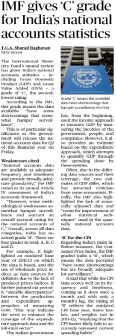
Context
- IMF’s annual review has given India’s national accounts statistics (GDP & GVA) a ‘C’ grade→ second-lowest rating.
What a ‘C’ grade means (as per IMF) - Data have “some shortcomings that somewhat hamper surveillance.”
IMF-Identified Weaknesses - National accounts data → adequate frequency & timeliness, but:
- Methodological weaknesses hamper surveillance.
- Outdated base year (2011-12) for GDP estimation.
- Use of wholesale price indices as deflators due to lack of producer price indices.
- Sizeable discrepancies between:
- Production approach
- Expenditure approach
- Indicates need to improve:
- Expenditure-side data coverage
- Statistical techniques used in quarterly accounts.
- India overall receives ‘B’ grade across all data categories (grades: A, B, C, D).
GDP Measurement Issues Cited - India uses the income approach, but also provides an estimate based on expenditure approach.
- Two estimates often differ due to different data sources & coverage.
IMF Grade for CPI (Inflation Measure) - CPI graded ‘B’→ “Some shortcomings but broadly adequate for surveillance.”
- Reasons:
- Outdated CPI base year (2011-12)
- Items basket and weights also from 2011-12
→ CPI may fail to accurately represent current consumption patterns.
UPSC PRELIMS Q. Which of the following statements is/are correct regarding statistical grading by international institutions such as the IMF? 1. Countries may be graded on the quality of national accounts data using categories such as A, B, C, and D.
2. A lower grade typically indicates shortcomings in data methodology, frequency, or coverage that can hamper economic surveillance. Select the correct answer using the codes below:
A. 1 only
B. 2 only
C. Both 1 and 2
D. Neither 1 nor
2 Answer: C
India and Indonesia make progress on BrahMos deal at Defence Ministers’ Dialogue
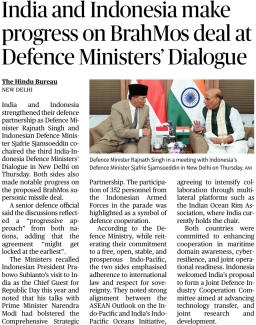
Context
- India and Indonesia held the 3rd India–Indonesia Defence Ministers’ Dialogue in New Delhi.
- Defence Ministers:
- India: Rajnath Singh
- Indonesia: Sjafrie Sjamsoeddin
Key Facts for Prelims 1. Progress on BrahMos Deal
- Both sides made notable progress on the proposed BrahMos supersonic missile deal.
- Discussions showed a “progressive approach”, and the agreement might get locked early.
2. Strengthening of Defence Partnership - Dialogue reflected stronger Comprehensive Strategic Partnership.
- Visit of Indonesian President Prabowo Subianto as Chief Guest for India’s Republic Day highlighted closeness.
3. Indo-Pacific Alignment - Both sides reaffirmed commitment to a free, open, stable, and prosperous Indo-Pacific.
- Emphasised:
- Adherence to international law
- Respect for sovereignty
- Alignment between ASEAN Outlook on Indo-Pacific and India’s Indo-Pacific Oceans Initiative
4. Defence Cooperation Highlights - Participation of 352 Indonesian Armed Forces personnel in India’s Republic Day parade symbolised cooperation.
5. Maritime & Security Collaboration - Focus areas: Maritime domain awareness, Cyber resilience, Joint operational readiness
- Indonesia welcomed India’s proposal to form a Joint Defence Industry Cooperation Committee (for tech transfer & joint R&D).
6. Multilateral Platforms - Agreement to intensify collaboration through Indian Ocean Rim Association (IORA), chaired by India.
UPSC PRELIMS Q. India’s defence cooperation with Indonesia relates to which of the following? 1. BrahMos supersonic cruise missile 2. Maritime domain awareness and joint operational readiness 3. Indian Ocean Rim Association (IORA) initiatives 4. ASEAN Outlook on the Indo-Pacific (AOIP) Select the correct answer:
A. 1 and 2 only
B. 1, 2 and 3 only
C. 2, 3 and 4 only
D. 1, 2, 3 and 4
Answer: D
Japan will pay a ‘painful price’ if it steps out of line over Taiwan: China
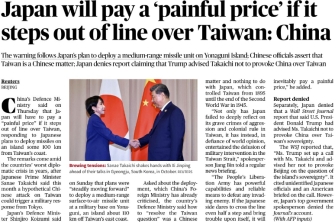
Context China warned that Japan would “pay a painful price” if it “steps out of line” over Taiwan.
The warning came after reports of Japan planning to deploy a medium-range missile unit on Yonaguni Island, around 100 km from Taiwan’s coast.
Key Facts
1. China’s Warning to Japan
- China’s Defence Ministry stated Japan will face a “painful price” if it interferes in the Taiwan issue.
- China asserts the Taiwan question is solely a Chinese internal matter.
2. Trigger: Japan’s Missile Deployment Plan - Japan reportedly plans to deploy a medium-range surface-to-air missile unit on Yonaguni Island, part of Okinawa’s chain.
- Yonaguni Island is ~100 km from Taiwan’s east coast.
3. Japan’s Stance - Japan’s PM Sanae Takaichi earlier said a Chinese attack on Taiwan could trigger a military response from Tokyo.
- Japan denied a Wall Street Journal report that former U.S. President Donald Trump advised Japan not to provoke China on Taiwan sovereignty.
4. China’s Accusations Against Japan - China criticizes Japan for:
- Not reflecting on its historical actions in Taiwan (1895–1945 period).
- “Entertaining the delusion” of military intervention in the Taiwan Strait.
5. China’s Statement on Military Capability - China said the People’s Liberation Army (PLA) has:
- “Powerful capabilities”
- Means to “defeat any invading enemy”.
UPSC Prelims Q. Consider the following pairs:
| Location | Country | Approximate Strategic Relevance |
| 1. Yonaguni Island | Japan | Located close to Taiwan’s east coast |
| 2. Taiwan Strait | China–Taiwan | Major global maritime chokepoint |
| 3. Okinawa Islands | Japan | Hosts U.S. military bases |
Which of the pairs given above are correctly matched? A. 1 and 2 only
B. 2 and 3 only
C. 1 and 3 only
D. 1, 2 and 3
Answer: D
China’s rare earth dominance gives it crucial leverage over U.S. in trade war
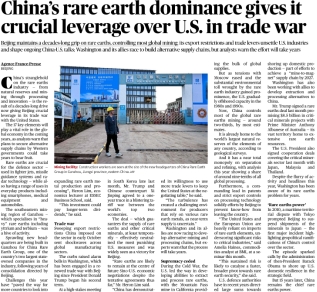
1. China’s Dominance in Rare Earths
- China has a decades-long grip over the rare earth industry—from natural reserves, mining, processing, to refining.
- Controls most global rare earth mining — around two-thirds (as per estimates mentioned in article).
- Holds a near-total monopoly on separation and refining, which are the most difficult parts of the supply chain.
- China is the world’s largest natural resources surveyor, with the most complete data for 17 rare-earth elements.
2. Importance of Rare Earth Elements Rare earths are crucial for: - Defence sector: fighter jets, missile guidance systems, radar systems
- High-tech uses: smartphones, medical equipment, electric vehicles, consumer electronics
- Automobiles and renewable energy components
These 17 elements will play a vital role in the global economy in the coming years.
3. Strategic Leverage Over the U.S.
- China’s control gives it crucial leverage in the ongoing trade war with the United States.
- The U.S. had offshored much of its rare earth processing capability in the 1980s–90s, increasing dependence.
- Washington is cooperating with Japan, EU, and U.S. allies to develop alternate supply chains—but analysts say this will take years.
4. Recent Developments - China’s southeastern region Ganzhou is a major hub specializing in “heavy” rare earths.
- New headquarters of China Rare Earth Group being built in Ganzhou.
- China has tightened export restrictions and environmental controls.
- U.S. has revived rare earth projects and signed cooperation deals in the Indo-Pacific, but remains heavily dependent for now.
5. Why Diversification Is Hard - Rare earth processing is complex, polluting, and cost-intensive.
- China benefits from: expertise, established supply chains, state support
- Western countries face long timelines to rebuild processing capacity.
UPSC PRELIMS Q. With reference to Rare Earth Elements (REEs), consider the following statements: 1. They are essential components in modern defence systems and high-tech electronics.
2. China currently dominates both the mining and the refining stages of global rare earth supply chains.
3. Rare earth elements are rare because they are found only in a few countries. Which of the statements given above is/are correct?
A. 1 and 2 only
B. 2 and 3 only
C. 1 and 3 only
D. 1, 2 and 3
Answer: A
Vitamin B12 Syllabus: GS Paper 3 – Science & Technology / Health & Nutrition
Context:
Vitamin B12 deficiency often shows early symptoms through skin changes such as hyperpigmentation, dryness, or paleness, which indicate reduced oxygen and nutrient supply to skin cells.
Key Points
- Vitamin B12 is a water-soluble vitamin, also known as cobalamin.
- It supports the formation of healthy nerve cells and red blood cells.
- It is essential for producing DNA, the genetic material in all cells.
- The body cannot synthesize B12; it must be obtained through diet or supplements.
- It occurs naturally in animal foods like fish, meat, poultry, eggs, and dairy products.
- Plant foods lack B12 unless they are fortified.
- The liver stores B12, and the body can retain it for 2–5 years.
- Excess B12 is eliminated through urine.
Vitamin B12 Deficiency - Vegans and vegetarians are more prone due to absence of B12 in plant foods.
- Older adults and those who have undergone stomach surgery may have poor absorption.
- Severe deficiency may cause fatigue, muscle weakness, stomach issues, nerve damage, vision problems, and mood disturbances.
- It may lead to anemia or low blood counts.
Source: TOI
Commonwealth Games
Syllabus: GS Paper 1 / Miscellaneous – International Sports Events Context:
The Commonwealth Sport’s General Assembly in Glasgow has officially confirmed Ahmedabad as the host city for the centenary edition of the Commonwealth Games 2030. Key Points
- The Commonwealth Games is the world’s 2nd largest multi-sport event after the Olympics, featuring athletes from 71 nations and territories.
- First held in 1930 at Hamilton, Canada, originally called the British Empire Games.
- Renamed over time and officially known as the Commonwealth Games since 1978.
- Managed by the Commonwealth Games Federation (CGF).
- Held once every 4 years and often called the “Friendly Games”, reflecting values of Humanity, Equality, and Destiny.
- Promotes sports, education, recreation, and celebrates the Commonwealth’s cultural and linguistic diversity.
Commonwealth Nations - A voluntary association of countries, mostly former British colonies, promoting development, democracy, and peace.
- Origin traced to the Imperial Conference (1926), establishing equality among the UK and Dominions.
- The London Declaration (1949) created the modern Commonwealth, allowing republics and non-British monarchies to join.
- Comprises 56 independent countries; membership is voluntary.
- Guided by the Commonwealth Charter, with the Commonwealth Secretariat (London) aiding member states.
- India is the largest member by population and 4th largest financial contributor; hosted the 1983 Commonwealth Summit and the 2010 Commonwealth Games.
Source: Indian Express
Chanakya Defence Dialogue 2025
Syllabus: GS Paper 3 – Security, Defence, Strategic Issues
Context:
The
President of India inaugurated the
third edition of the Indian Army’s
Chanakya Defence Dialogue 2025 in New Delhi, a platform aimed at shaping strategic thinking on India’s future security landscape.
Key Points - Chanakya Defence Dialogue (CDD) is an annual platform for discussions on security challenges, defence technologies, and strategic partnerships.
- It is organised by the Indian Army in collaboration with the Centre for Land Warfare Studies (CLAWS).
- CDD 2025 marks the third edition of the dialogue.
- Venue: New Delhi, conducted as a two-day conference.
- Participants include military leaders, diplomats, industry experts, global strategists, and young scholars.
- Named after Chanakya, it aims to build a comprehensive platform for strategic deliberation on India’s security architecture.
- The dialogue analyses security challenges and technological frontiers in a contested global environment.
- Its outcomes will help shape future military policies and strengthen cooperative security mechanisms.
Source: The Hindu
India–Indonesia Defence Industrial Cooperation
Syllabus: GS Paper 2 & 3 – International Relations, Defence & Security Context:
India and Indonesia, during high-level talks in New Delhi, agreed to expand defence industrial collaboration, reflecting shared strategic priorities in the Indo-Pacific and India’s growing emergence as a defence manufacturing hub.
Key Points
- Indonesia acknowledged India’s submarine expertise, especially the Scorpene-class programme built through technology transfer with France.
- India has inducted six Scorpene-class submarines (2017–2023), with three more planned, strengthening its indigenous naval capacity.
- Jakarta sees India’s supply-chain capability and shipbuilding ecosystem as useful for its naval modernisation.
- Both nations agreed to set up a Joint Defence Industry Cooperation Committee.
- The committee will strengthen collaboration on technology transfer, joint R&D, and defence industrial partnerships.
- The engagement reflects converging Indo-Pacific security interests and aims to deepen long-term strategic cooperation.
Source: The Hindu / Indian Express

 Launch your Graphy