|   
| Index | | S.No | Topic | Page No | | Daily Hindu Analysis (YouTube) | | 1. | Presidential opinion vs the federal structure | | | 2. | How to navigate a complex global paradigm | | | 3. | Constitution is document of our national pride | | | 4. | Chief Justice calls for national judicial policy to encourage coherence across jurisdiction | | | 5. | Can a ‘foreigner’ be allowed to use Aadhaar to enter poll rolls, asks SC | | | 6. | 3.5 billion-year-old crater on Mars to be christened after geologist M.S. Krishnan | | | Daily Current Affairs (App) | | 7. | Constitution Day Celebration | | | 8. | Entrepreneur-in-Residence Programme | | | 9. | New Era of Entrepreneurial Ecosystem and Vision (NEEV) Programme | |
Presidential opinion vs the federal structure 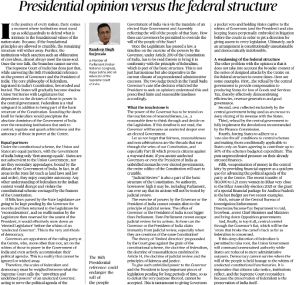
CONTEXT
The article discusses the tension between Presidential opinion, especially in the context of the 16th Presidential Reference, and India’s federal structure.
It argues that recent judicial interpretations affecting the powers of Governors and the President threaten the foundational principle of federalism, which is part of the Constitution’s basic structure.
The author believes that unchecked powers of Governors and the Centre undermine the democratic mandate of elected State governments.
DETAILED ANALYSIS Erosion of Federalism - The Supreme Court, while answering the 16th Presidential Reference, has (according to the author) weakened federal principles.
- States risk becoming shadow Union Territories if Governors act as per directions of the Centre rather than the Constitution.
- Federalism exists to protect against central domination and preserve the democratic mandate of States.
Union and States as Equal Partners - Constitutionally, Union and States are equal partners; States are not subordinate to the Centre.
- In State subjects (law and order, land, etc.), States act autonomously.
- If Governors withhold or delay assent to State legislation indefinitely, the will of elected State governments is overridden.
- This results in an “unelected Governor ruling over an elected Legislature”, which the author calls undemocratic.
The Issue Raised in the Presidential Reference - The reference asked whether the President of India can override the will of an elected State government after a law is passed.
- The Supreme Court stated that once the Legislature passes a law, the Governor must act within a reasonable timeline, as required by Article 200.
- Delays erode federalism and encourage administrative excesses.
The Touchstone: Reasonableness - The author argues that the Governor’s power must be judged on fairness, reasonableness, and non-arbitrariness, values embedded in the Constitution and protected by Part III (Fundamental Rights).
- Without timelines, Governors risk becoming “unelected emperors”.
Judicial Review is Part of Basic Structure - The article states that judicial review applies even to actions of the President and Governor.
- No authority—including Parliament—is above constitutional scrutiny.
- Removing judicial review would destroy constitutional balance.
Expanding Central Dominance Weakens Federal Structure
(a) Withholding compensation due to States - For example, GST compensation.
(b) Using centrally collected funds as leverage - Funds become a tool to pressure States or influence political outcomes.
(c) Imposing one-size-fits-all conditions on centrally sponsored schemes - This forces States to adhere to terms they may not agree with, adding financial burden.
(d) Withholding or delaying funds deliberately - This intensifies political tensions and reduces States’ autonomy.
Financial Penalties and Political Pressure - The article cites that huge funds were cut or withheld in some States (e.g., Bihar, Andhra Pradesh).
- This increases pressure on States already dealing with fiscal stress.
Conclusion: Danger to Constitutional Order - If Governors and the Centre continue to act without checks, constitutional federalism will weaken.
- Over-centralization undermines democracy and the basic structure.
- The article calls for restoring balance between constitutional authorities so that India’s federal framework remains functional and democratic.
UPSC MAINS
“Critically examine how the exercise of discretionary powers by Governors, combined with increasing central intervention in State matters, poses a challenge to India’s federal structure.”
How to navigate a complex global paradigm
1. CONTEXT - A recent forum in Hong Kong (China–United States Exchange Foundation – CUSEF) highlighted the tense relationship between the U.S. and China.
- Despite deep bilateral distrust, both countries recognise the need for dialogue, predictability, and mechanisms to avoid conflict.
- Hong Kong emerges as a “middle space” — a unique vantage point shaped by its cosmopolitan identity and historical ability to connect China with the wider world.
- The article argues that Hong Kong offers a metaphorical middle ground for navigating today’s fragmented global order, marked by strategic rivalry and geopolitical turbulence.
2. DETAILED ANALYSIS A. A World of Intensifying Rivalries - U.S.–China relations remain strained, with disagreements on:
- Technology and AI
- Trade and supply chains
- Security and defence posture
- The forum noted that the relationship is stuck in a cycle of strategic misperception and deteriorating trust.
- Yet, both sides also admit they must find ways to manage competition responsibly to avoid dangerous escalation.
B. Why Hong Kong Matters in the Current Global Scenario - Hong Kong has always existed between multiple worlds:
- Chinese cultural foundations
- British colonial legal traditions
- Global business and cosmopolitan society
- This hybridity allows Hong Kong to serve as a bridge between different political and social systems.
- Even amid tighter integration with mainland China, the city still offers unique connectivity, transparency, and openness, which global actors continue to value.
C. Hong Kong’s Cosmopolitan Function is its Strategic Asset The article emphasises three essential features:
1. Connectivity - Hong Kong remains a major global financial and trade hub.
- Its networks allow ideas, capital, and people to cross borders despite political tensions.
2. Cultural Hybridity - The city fuses Chinese identity with global openness.
- This enables conversations between countries or entities that may otherwise not meet on neutral terms.
3. Middle-Ground Diplomacy - Hong Kong offers a platform where U.S. and Chinese stakeholders can talk, away from ideological rigidity.
- This role is becoming crucial as global politics become more fragmented, with sharp ideological and geopolitical divides.
D. Key Concerns Raised at the Forum 1. AI & Technology Governance - AI and emerging technologies were major themes.
- Concerns include:
- Technology becoming a tool of divide
- Declining transparency
- Need for global cooperation to prevent misuse
2. Economic Fragmentation - Geopolitical tensions are disrupting supply chains and trade flows, contributing to a fractured global economy.
- Businesses are uncertain how to operate in an unreliable world order.
3. Risks of Strategic Miscalculation - With shrinking diplomatic engagement and rising mutual suspicion, missteps can have major consequences.
- Hong Kong’s forum attempted to restore dialogue channels, not as a solution but as a space to keep talks alive.
E. The Path Forward: Need for New Frameworks - The article stresses that old Cold War templates do not fit the current geopolitical reality.
- Hong Kong can help articulate or host:
- New mechanisms for managing U.S.–China tensions
- New frameworks for global governance (AI, climate, supply chains)
- New ways to encourage civil society, business, and academic cooperation
- The future depends on sustaining Hong Kong’s cosmopolitan character while navigating an increasingly polarized world.
UPSC MAINS Q. In an era of growing great-power rivalry, how can middle-spaces or intermediary platforms contribute to fostering dialogue and reducing geopolitical tensions? Discuss how India can leverage its own strategic location, cultural hybridity, and diplomatic traditions to play a bridging role in the emerging global order.
Constitution is document of our national pride Key Facts - The Constitution is described by the President as the document of India’s national pride and a guiding text for nation-building.
- It helps India move forward by abandoning the colonial mindset and adopting a nationalist mindset.
- The Indian Parliament is highlighted as an example of public wisdom, especially due to universal adult franchise.
- The Constitution expresses core ideals: Social justice, Economic justice, Political justice, Liberty, Equality, Fraternity
- Constitution Day event was held at the Central Hall of the Old Parliament building, now renamed Samvidhan Sadan.
- President said the executive, legislature and judiciary have together strengthened Indian democracy and provided stability.
- The Nari Shakti Vandan Act (Women’s Reservation Act) was mentioned as a major milestone in women-led development.
- The President also referred to the passage of the three new criminal justice laws
- She expressed confidence that India will become a developed nation by 2047.
UPSC PRELIMS Q. Constitution Day (Samvidhan Divas) is observed on:
A) 26 January
B) 26 November
C) 15 August
D) 9 December
Answer: B) 26 November
Chief Justice calls for national judicial policy to encourage coherence across jurisdiction Key Facts from the Article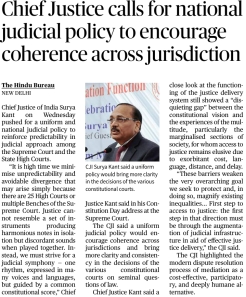 - Chief Justice of India Surya Kant called for a uniform and national judicial policy.
- Purpose: To bring Predictability, Clarity, Consistency in judicial decision-making across the Supreme Court and 25 High Courts.
- Issue highlighted: Avoidable divergence in judicial approaches because of multiple Benches and courts.
- CJI compared the judiciary to a “symphony” — many voices but guided by a common constitutional score.
- He noted a “disquieting gap” between:
- Constitutional vision of justice, and
- Actual experience of people, especially the marginalised, facing: High cost, Language barriers, Distance, Delays
- Access to justice must improve by strengthening judicial infrastructure.
- CJI emphasised mediation as: Cost-effective, Participatory, Humane and an important method of modern dispute resolution.
Q. With reference to the Indian judiciary, consider the following statements:
1. A uniform national judicial policy can help reduce divergence in judicial decisions across different courts. 2. Increasing judicial infrastructure is essential for improving access to justice in India. 3. Mediation is recognised as a cost-effective and participatory method of dispute resolution. Which of the above statements is/are correct?
A. 1 and 2 only
B. 2 and 3 only
C. 1 and 3 only
D. 1, 2 and 3
Answer: D
Can a ‘foreigner’ be allowed to use Aadhaar to enter poll rolls, asks SC
Key Facts - The Supreme Court examined the use of Aadhaar in the Special Intensive Revision (SIR) of electoral rolls.
- The Court earlier allowed Aadhaar to be used as a “12th document” during the Bihar SIR process.
- Concern raised: Foreigners who possess Aadhaar (for accessing welfare benefits such as subsidised ration) may misuse it for automatic entry into voter lists.
- Aadhaar is not proof of citizenship — highlighted during arguments.
- EC’s authority to examine, vet, and verify documents traces to:
- Section 21, Representation of the People Act (revision of electoral rolls)
- Article 326, Constitution (elections based on adult suffrage)
- Petitioners argue the SIR process is hasty and unreasonable, possibly excluding genuine voters.
- The SC noted EC has a residual jurisdiction to check credibility of entries.
- The Court questioned whether the SIR can be completed within the specified short timeline.
UPSC Prelims Q. Under which provisions does the Election Commission derive authority to examine and verify documents during revision of electoral rolls? A. Article 324 and Section 33 of the RP Act
B. Article 326 and Section 21 of the RP Act
C. Article 325 and Section 8 of the RP Act
D. Article 330 and Section 16 of the RP Act
Answer: B
3.5 billion-year-old crater on Mars to be christened after geologist M.S. Krishnan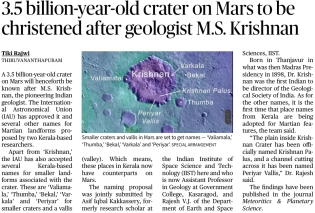
Key Facts - A 3.5 billion-year-old crater on Mars has been officially named “Krishnan Crater” by the International Astronomical Union (IAU).
- Named after M.S. Krishnan, pioneering Indian geologist and first Indian Director of the Geological Survey of India (GSI).
- Kerala-based researchers proposed the name.
- IAU also approved Kerala place names for nearby Martian landforms: Valiamala, Thumba, Bekal, Varkala, Periyar (Periyar Vallis — valley)
- Krishnan Palus – plain inside the crater.
- Periyar Vallis – channel cutting across the crater.
- Names proposed by researchers from:
- IIST (Indian Institute of Space Science and Technology)
- Govt. College, Kasaragod
- Findings published in Meteoritics & Planetary Science.
UPSC Prelims Q. With reference to planetary nomenclature, consider the following statements:
1. The International Astronomical Union (IAU) is the authority responsible for naming landforms on planets and moons.
2. The recently named Krishnan Crater on Mars honours an Indian geologist who served as Director of the Geological Survey of India. 3. Periyar Vallis is a valley feature associated with the Krishnan Crater on Mars. Which of the above statements is/are correct?
A. 1 and 2 only
B. 2 only
C. 1, 2 and 3
D. 1 and 3 only
Answer: C
Constitution Day Celebration
Syllabus: GS Paper 2 – Polity & Governance (Indian Constitution)
Context:
India will observe the 76th anniversary of the adoption of the Constitution at Samvidhan Sadan, with President Droupadi Murmu and Prime Minister Narendra Modi leading the national ceremony. The event underscores the continuing relevance of constitutional values in India’s democratic framework.
Key Points - Constitution Day is observed every year on 26 November.
- The Constitution was adopted on 26 November 1949 by the Constituent Assembly.
- It came into force on 26 January 1950, marking the birth of the Republic.
- During the ceremony, translated versions of the Constitution will be released in nine Indian languages.
Source: The Hindu
Entrepreneur-in-Residence Programme
Syllabus: GS Paper 3 – Science & Tech / Startups & Innovation (Government Schemes) Context:
The Union Minister of State for Science & Technology highlighted that the Entrepreneur-in-Residence (EIR) Programme is increasingly popular among young startups and innovators. It supports aspiring entrepreneurs through financial fellowship and mentoring under the NIDHI framework.
Key Points - Entrepreneur-in-Residence (EIR) is a programme under the National Initiative for Developing and Harnessing Innovations (NIDHI).
- It aims to encourage graduate students to choose entrepreneurship as a career through fellowship-based support.
- Financial support: Up to ₹30,000 per month is provided as fellowship.
- The fellowship is available for a maximum duration of 12 months.
- The programme offers access to TBI infrastructure, labs, and workspaces.
- It provides mentoring, guidance, and networking with experts and industry.
- Participants receive technical and financial advice to shape their startup ideas.
- Implementation: Run by the Department of Science and Technology (DST) with NCL Venture Centre, Pune as a key partner.
- NIDHI is an umbrella programme to nurture knowledge- and technology-driven innovations into successful startups.
Source: PIB
New Era of Entrepreneurial Ecosystem and Vision (NEEV) Programme
Syllabus: GS Paper 2 – Education & Governance (School Reforms, Skill Development) Context:
The Delhi government’s NEEV Programme is transforming school education by shifting from rote memorisation to experiential, activity-based learning, equipping students of Classes 8–12 with entrepreneurial and life skills.
Key Points - NEEV aims to replace traditional rote learning with hands-on, real-world experiences to build confidence and creativity.
- It provides structured entrepreneurial skill modules that promote independent thinking and problem-solving.
- Inspirational storytelling is a central feature, helping students learn from those who overcame adversity.
- Activities like Role Model Research and Talk Show encourage middle-school students to explore success journeys.
- The approach creates a supportive, cooperative, and aspirational learning environment.
Source: Indian Express / News Reports
|

 Launch your Graphy