Daily Current Affairs for UPSC 27th Dec 2025

| Index |
| S.No | Topic |
|
| Daily Hindu Analysis |
| 1. | Health care does not need the PPP route |
|
| 2. | Decoding air pollution concerns in Delhi–NCR |
|
| 3. | A year of dissipating promises for Indian foreign policy |
|
| 4. | Invasive mosquito species threatens India’s 2030 malaria elimination goal |
|
| 5. | India’s small business credit resilient and perked up |
|
| 6. | Analyse previous terror cases, boost capabilities: Shah |
|
| 7. | Indian Army relaxes social media policy, allows ‘passive participation’ |
|
| 8. | GCCs keep India’s technology job market alive as IT lags |
|
| 9. | Mediation is a successful, cost-effective tool, says CJI |
|
| |
| Daily Current Affairs (App) |
| 10. | India launches national database to track lost and stolen firearms |
|
| 11. | Kimberley Process: India to Assume Chairmanship in 2026 |
|
| 12. | Jiyo Parsi Scheme |
|
| 13. | Village Defence Guards (VDGs) |
|
| 14. | AILA (Artificially Intelligent Lab Assistant) |
|
Health care does not need the PPP route
Context
The article examines the growing push for Public–Private Partnership (PPP) models in healthcare, especially medical education and district hospitals, using Andhra Pradesh as a case study. The author critically assesses whether PPPs actually strengthen public health systems or weaken them structurally.
Detailed Analysis
1. Policy Objective Behind PPP in Healthcare
- PPPs are promoted to expand capacity, attract investment, and reduce fiscal burden on governments.
- In medical education, PPPs are justified as a way to quickly increase the number of colleges and doctors.
- However, the design of the PPP framework reflects a revenue-driven approach rather than a public welfare orientation.
2. Expansion of Medical Colleges: Andhra Pradesh Case
- Andhra Pradesh expanded government medical colleges from 11 to 17 and plans 10 more under PPP mode.
- Around 835 acres of land have already been acquired, and colleges are under various stages of development.
- Each college costs roughly ₹450 crore, with funding mobilised through NABARD and government schemes.
Issue:
- The focus is on infrastructure expansion without proportional investment in faculty, specialists, and institutional capacity.
3. PPP Model Structure and Its Risks
- Under PPP, land and district hospitals are leased for 33 + 33 years at nominal rates.
- Private partners are required to reserve 70% beds for government-referred patients under Ayushman Bharat rates and provide free outpatient services.
- The remaining 30% beds are commercialised, creating incentives to prioritise profit.
Key Concern:
- Risk-sharing is uneven, with the government bearing long-term risks while control shifts to private entities.
4. Impact on Equity and Access
- High fees for private and NRI seats limit access for middle- and lower-income students.
- Evidence shows that students paying high fees are more likely to work abroad or in urban private hospitals, not public health systems.
- This undermines the goal of addressing doctor shortages in rural and public hospitals.
5. Fragmentation of the Public Health System
- PPP at the district level breaks the organic integration of primary, secondary and tertiary care.
- Effective public health systems require vertical integration, strong referral mechanisms and continuity of care.
- Fragmentation weakens chronic disease management and public health planning.
6. Regulatory and Enforcement Challenges
- Successful PPPs require strong state capacity to enforce contracts and regulations.
- Andhra Pradesh, like many States, struggles to enforce even the Clinical Establishments Act effectively.
- Weak enforcement risks poor quality of care, faculty shortages, and denial of services under contractual excuses.
7. Ignoring Evidence-Based Health Planning
- Uniform assumptions such as 650-bed hospitals everywhere ignore changing disease patterns.
- With better primary care, 30% of hospitalisations can be avoided.
- Technological advances are reducing the need for prolonged hospital stays.
Author’s Suggestions
- Avoid privatisation of critical public assets like district hospitals.
- Strengthen government-funded medical education with subsidised training and bonded service.
- Invest in primary healthcare, doctors, and specialists rather than selling seats.
- Build strong institutional and regulatory capacity before experimenting with PPPs.
- Adopt evidence-based planning aligned with demographic and epidemiological transitions.
Conclusion
The article argues that healthcare, unlike infrastructure sectors, cannot be treated as a commercial enterprise. PPPs in health risk inequity, fragmentation and loss of public control. Strengthening public institutions, workforce capacity and primary care offers a more sustainable and equitable path than relying on PPP-driven expansion.
UPSC Mains Question
“Critically examine the role of Public–Private Partnerships (PPP) in India’s healthcare sector. Do PPP models strengthen or weaken public health systems?”
Decoding air pollution concerns in Delhi–NCR
Context
The article examines the deep-rooted causes of air pollution in Delhi–NCR, questioning the over-reliance on blaming stubble burning and highlighting the limitations of current legal and policy responses. It critically analyses the application of the Polluter Pays Principle (PPP) and the evolving role of the judiciary in addressing air pollution.
Detailed Analysis:
1. Misplaced Attribution of Air Pollution Sources
- Vehicular emissions remain the primary contributor to air pollution in Delhi–NCR, followed by industrial emissions.
- Farmers are often blamed for stubble burning despite contributing only a fraction of total pollution.
- Air pollution is transboundary in nature, influenced by emissions beyond state and national borders.
2. Polluter Pays Principle (PPP) and Its Limits
- PPP holds that those causing pollution should bear the cost of environmental damage.
- Recognised by the Supreme Court in Vellore Citizens’ Welfare Forum vs Union of India (1996).
- Effective where pollution sources are identifiable, but problematic in diffuse pollution such as air pollution.
- Courts increasingly rely on government responsibility rather than individual liability in complex pollution scenarios.
3. Judicial Evolution in Environmental Governance
- Indian courts have expanded environmental jurisprudence through principles like:
- Precautionary Principle
- Sustainable Development
- Polluter Pays Principle
- However, assigning liability for air pollution is challenging due to:
- Transboundary pollution flows
- Multiple and overlapping emission sources
- Difficulty in scientific attribution
4. Shift from ‘Polluter Pays’ to ‘Government Pays’
- In practice, governments often bear mitigation costs through:
- Air quality management programmes
- Public health expenditure
- Pollution control infrastructure
- This reflects a shift toward welfare-based environmental governance, especially where enforcement against individuals is impractical.
5. Need for Cooperative and Scientific Solutions
- Effective air pollution control requires:
- Regional and interstate coordination
- Scientific emission inventories and modelling
- Integration of climate, health, and urban planning policies
- Judicial interventions alone cannot replace robust executive action.
Conclusion
The article underscores that Delhi’s air pollution crisis cannot be solved through punitive legal doctrines alone. A coordinated, science-based and cooperative governance framework—backed by strong institutions and regional collaboration—is essential to address the systemic and transboundary nature of air pollution.
UPSC Mains Question
Discuss the limitations of the ‘Polluter Pays Principle’ in addressing air pollution in India. How can a cooperative and science-based governance framework improve air quality management?
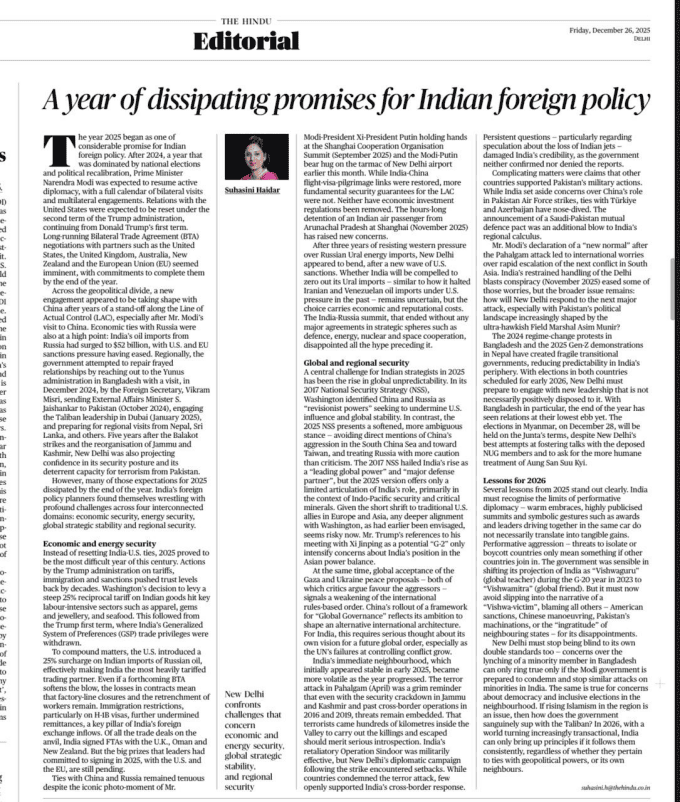
A year of dissipating promises for Indian foreign policy
Context
The article analyses India’s foreign policy trajectory in 2025, arguing that despite high expectations and diplomatic activism, outcomes have fallen short due to geopolitical shifts, economic pressures, and unresolved regional challenges.
Detailed Analysis
1. Initial Optimism and Diplomatic Expectations
- 2025 began with optimism after India’s diplomatic engagements in 2024, including leadership summits and high-profile international visits.
- Expectations included stronger strategic partnerships with the U.S., Europe, and Indo-Pacific allies, and deeper influence in multilateral forums.
2. Economic and Trade Pressures
- India faced setbacks in trade diplomacy due to protectionist trends globally.
- The U.S. continued tariff measures and trade restrictions, affecting Indian exports.
- Negotiations for key trade agreements with the EU, UK, and others remained inconclusive.
3. Strategic and Security Challenges
- India’s relations with China remained tense despite dialogue, with unresolved border issues and continued military posturing.
- Regional instability in South Asia, especially developments in Pakistan and Bangladesh, posed additional diplomatic challenges.
- India’s balancing act between strategic autonomy and deeper alignment with the West became more complex.
4. Global Order and Multipolar Realities
- The weakening of multilateral institutions and increasing great power rivalry reduced space for consensus-driven diplomacy.
- India’s attempts to project leadership in the Global South through platforms like G20 and Voice of the Global South faced limitations due to competing geopolitical interests.
5. Energy and Economic Vulnerabilities
- Dependence on energy imports and global price volatility continued to strain economic planning.
- Sanctions regimes and geopolitical conflicts complicated India’s access to affordable energy.
6. Domestic Constraints Affecting Foreign Policy
- Economic slowdown, social challenges, and governance constraints limited India’s external manoeuvring space.
- The article highlights the need for coherence between domestic economic strength and foreign policy ambitions.
Way Forward
- Adopt a realistic, interest-based foreign policy rather than symbolic diplomacy.
- Strengthen economic fundamentals to support global ambitions.
- Balance strategic autonomy with pragmatic partnerships.
- Reinforce regional diplomacy, especially in South Asia and the Indian Ocean Region.
Conclusion
The article argues that while India’s global ambitions remain strong, 2025 exposed the limits of ambition without adequate economic, diplomatic, and institutional backing. A recalibration grounded in realism, economic strength, and regional stability is essential for sustaining India’s global role.
UPSC Mains Question
“India’s foreign policy in recent years reflects growing ambition but also growing constraints.” Critically examine this statement in the context of contemporary global developments.
Invasive mosquito species threatens India’s 2030 malaria elimination goal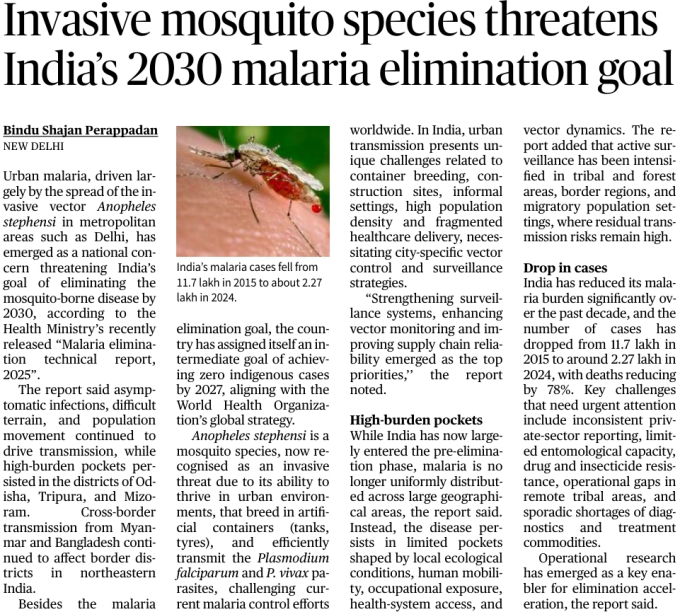
Context
India’s target of eliminating malaria by 2030 faces new challenges due to the spread of the invasive mosquito Anopheles stephensi, particularly in urban areas. The concern has been highlighted in a recent national malaria elimination assessment.
Key Points
1. Emergence of Anopheles stephensi
- An invasive mosquito species originally from West Asia and the Horn of Africa.
- Now established in Indian urban and peri-urban areas, especially in Delhi and other cities.
- Thrives in artificial water containers like tanks, drums and construction sites.
2. Urban Malaria Challenge
- Unlike traditional rural malaria vectors, Anopheles stephensi adapts easily to dense urban settings.
- Makes malaria control difficult in cities with high population density and informal settlements.
3. Threat to Malaria Elimination Targets
- India aims to eliminate malaria by 2030 and achieve zero indigenous cases by 2027.
- Presence of invasive vectors threatens this timeline by sustaining local transmission.
4. Disease Burden and Trends
- Malaria cases declined from 11.7 lakh in 2015 to about 2.27 lakh in 2024.
- Deaths reduced by nearly 78%, showing progress despite emerging risks.
5. Operational and Surveillance Challenges
- Gaps in surveillance, especially in urban and peri-urban areas.
- Cross-border movement and migration contribute to reintroduction of malaria.
- Insecticide resistance and limited diagnostic reach remain major concerns.
6. Way Forward
- Strengthening urban vector surveillance and entomological capacity.
- Integrating malaria control with urban planning and sanitation programmes.
- Enhancing early detection, community participation and inter-state coordination.
UPSC Prelims Question
Q. With reference to malaria elimination in India, consider the following statements:
1. Anopheles stephensi is an invasive mosquito species contributing to urban malaria transmission.
2. India aims to eliminate malaria nationwide by the year 2030.
Which of the statements given above is/are correct?
a) 1 only
b) 2 only
c) Both 1 and 2
d) Neither 1 nor 2
Answer: c) Both 1 and 2
Explanation:
Anopheles stephensi is an invasive urban malaria vector, and India has officially committed to eliminating malaria by 2030 under its national strategy aligned with WHO goals.
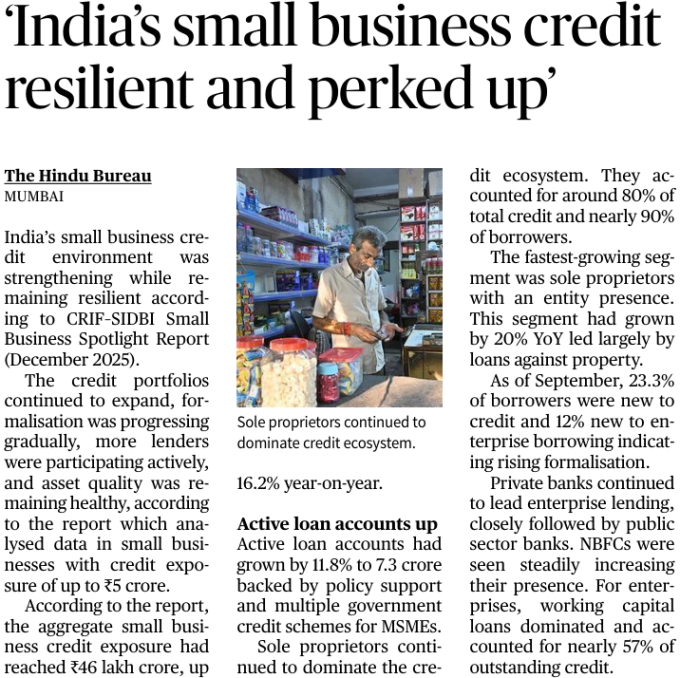
India’s small business credit resilient and perked up
Context
India’s small business credit ecosystem has shown resilience and steady growth despite global uncertainties, as highlighted in the CRIF–SIDBI Small Business Spotlight Report (December 2025).
Key Points
1. Expansion of Small Business Credit
- Total small business credit exposure reached ₹46 lakh crore, reflecting steady expansion.
- Credit growth is supported by improving economic activity and policy support.
2. Rising Formalisation
- Share of formal credit is increasing as more enterprises enter the organised financial system.
- Nearly 23% of borrowers were first-time credit users, indicating widening financial inclusion.
3. Growth in Active Loan Accounts
- Active loan accounts increased by 11.8% year-on-year, reaching about 7.3 crore accounts.
- Policy support and digital lending platforms contributed to improved access.
4. Dominance of Sole Proprietors
- Sole proprietors remain the largest borrower segment.
- This category recorded around 20% year-on-year growth, driven mainly by loans against property.
5. Lending Pattern and Institutions
- Private sector banks lead enterprise lending, followed by public sector banks.
- NBFCs have increased their presence, especially in small-ticket and last-mile credit.
- Working capital loans form nearly 75% of total enterprise credit.
6. Improved Asset Quality
- Asset quality remained stable with controlled NPAs, reflecting better risk assessment and credit monitoring.
Significance
- Indicates strengthening of India’s MSME and small business ecosystem.
- Reflects progress in formalisation, digital lending, and credit deepening.
- Supports employment generation and economic recovery.
Analyse previous terror cases, boost capabilities: Shah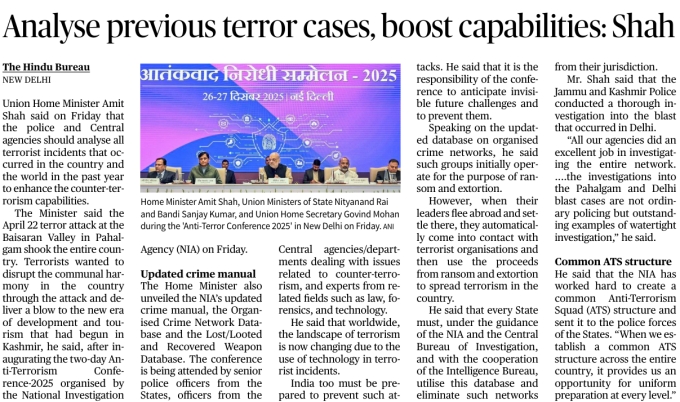
Context
The Union Home Minister chaired the Anti-Terror Conference 2025 and urged security agencies to analyse past terror incidents and strengthen counter-terrorism capabilities to effectively tackle evolving threats.
Key Points
1. Review of Past Terror Incidents
- Emphasis on analysing past terror attacks to identify operational gaps and improve preparedness.
- Focus on learning from incidents such as the Pahalgam terror attack to prevent future occurrences.
2. Strengthening Counter-Terror Mechanisms
- Need for continuous upgrading of counter-terror strategies in response to changing terrorist tactics.
- Terror groups increasingly use technology, encrypted communication, and digital financing.
3. Role of Central Agencies
- The National Investigation Agency (NIA) has been tasked with maintaining updated databases on terror networks.
- Creation of a comprehensive crime and terror database, including organised crime, weapons, and financing networks.
4. Common Anti-Terror Structure
- Emphasis on a uniform Anti-Terrorism Squad (ATS) structure across States for coordinated response.
- Strengthening cooperation among NIA, State police, Intelligence Bureau, and other agencies.
5. Preventive and Intelligence-Based Policing
- Focus on anticipatory intelligence, early warning systems, and data-driven investigations.
- Recognition that terror networks often evolve from organised crime and extortion rackets.
6. Capacity Building and Training
- Enhancing technical capabilities of police forces through training in cyber forensics, digital surveillance, and financial tracking.
- Stress on inter-agency coordination and real-time information sharing.
Indian Army relaxes social media policy, allows ‘passive participation
Context
The Indian Army has revised its social media guidelines to allow limited online presence for its personnel, balancing operational security with the realities of digital communication.
Key Points
1. Policy Change
- Army personnel are now permitted passive participation on social media platforms.
- Passive participation means viewing content only, without posting, commenting, sharing, or reacting.
2. Platforms Allowed
- Limited access to platforms such as Instagram, X (Twitter), YouTube, and WhatsApp is permitted only for viewing content.
- Active engagement like posting photos, videos, comments, or messages remains strictly prohibited.
3. Security Concerns
- The move aims to prevent leakage of sensitive operational information.
- Personnel are barred from sharing any content related to deployments, locations, equipment, or operational activities.
4. Controlled Communication
- Communication is allowed only through approved, secure platforms.
- Sharing of classified or sensitive information, even inadvertently, can attract disciplinary action.
5. Reason for Policy Revision
- Acknowledges changing digital realities while maintaining operational security.
- Balances morale and connectivity needs of soldiers with national security concerns.
6. Previous Restrictions
- Earlier, the Army had imposed a near-total ban on social media usage due to security breaches.
- The revised policy reflects a calibrated approach rather than a complete prohibition
GCCs keep India’s technology job market alive as IT lags
Context
India’s technology job market is witnessing resilience despite a slowdown in traditional IT services, driven by the rapid expansion of Global Capability Centres (GCCs) set up by multinational corporations.
Key Points
1. Role of GCCs in Employment
- GCCs are offshore units established by global firms to handle high-value functions such as R&D, analytics, engineering, and digital transformation.
- They are now the primary drivers of tech employment growth in India, even as IT services hiring slows.
2. Growth Trends
- India hosts around 1,850 GCCs employing nearly 2 million professionals.
- Projections indicate over 2,400 GCCs employing more than 3 million people by 2030.
- GCC employment grew by about 5–7% despite global technology sector headwinds.
3. Shift Towards High-Value Work
- GCCs increasingly focus on advanced areas such as AI, data science, cloud computing, cybersecurity, and product engineering.
- This marks a shift from cost-arbitrage to value-driven and innovation-led operations.
4. Geographic Diversification
- Growth is no longer limited to Bengaluru, Hyderabad, or Pune.
- Tier-2 and Tier-3 cities like Coimbatore, Kochi, Indore, and Ahmedabad are emerging as GCC hubs.
5. Impact on India’s Tech Ecosystem
- GCCs are stabilising employment amid IT sector uncertainty.
- They are contributing to skill upgradation, higher wages, and India’s positioning as a global technology innovation hub.
Mediation is a successful, cost-effective tool, says CJI
Context
The Chief Justice of India highlighted the growing importance of mediation in India while addressing a conference in Goa, stressing its role in reducing litigation burden and strengthening access to justice.
Key Points
1. Mediation as an Effective Justice Mechanism
- The Chief Justice described mediation as a cost-effective, time-saving, and collaborative dispute resolution method.
- It encourages consensus and cooperation rather than adversarial litigation.
2. Shift from Litigation to Participation
- Emphasised a transition from a culture of adversarial adjudication to participatory justice.
- Courts should evolve into comprehensive dispute-resolution centres, not merely trial forums.
3. Institutional Support for Mediation
- The judiciary has launched initiatives like “Mediation for the Nation” to promote amicable dispute resolution.
- The Supreme Court has actively encouraged mediation in civil, commercial, and family disputes.
4. Advantages of Mediation
- Reduces pendency and burden on courts.
- Preserves relationships between disputing parties.
- Provides quicker, mutually acceptable outcomes.
5. Wider Impact on Justice Delivery
- Mediation promotes access to justice by being less formal, more inclusive, and cost-efficient.
- It strengthens public confidence in the justice system and supports judicial efficiency.
UPSC Prelims Practice Question
Q. With reference to mediation in India, consider the following statements:
1. Mediation is a voluntary and confidential dispute resolution process.
2. It aims to replace the judiciary as the primary mechanism of dispute resolution.
3. The Supreme Court of India actively promotes mediation to reduce case pendency.
Which of the above statements are correct?
A. 1 and 2 only
B. 1 and 3 only
C. 2 and 3 only
D. 1, 2 and 3
Correct Answer: B
Explanation:
Mediation is voluntary and confidential, and it complements—not replaces—the judiciary by reducing litigation burden. The Supreme Court actively promotes mediation as an effective dispute resolution mechanism.
India launches national database to track lost and stolen firearms
Syllabus: GS Paper 3 – Internal Security
Context
The Union Government has launched India’s first national database to track lost, looted and recovered firearms, aiming to strengthen internal security and counter terrorism, organised crime and insurgency-related violence.
Key Points
1. Purpose of the Database
- Designed to monitor and track government-owned firearms that are lost, stolen, or recovered.
- Aims to prevent diversion of weapons into the hands of terrorists, extremists and criminal networks.
2. Launch and Implementation
- Launched during the Anti-Terror Conference 2025 by the Union Home Minister.
- Developed and managed by the National Investigation Agency (NIA) under the Ministry of Home Affairs.
3. Coverage and Scope
- Includes weapons belonging to State Police Forces and Central Armed Police Forces (CAPFs).
- Covers sensitive regions such as Jammu & Kashmir, Left Wing Extremism-affected areas, and border states.
4. Technological Features
- Digital, real-time database enabling tracking, verification, and recovery of firearms.
- Accessible to authorised agencies through a secure digital platform.
- Facilitates inter-agency coordination and intelligence sharing.
5. Strategic Significance
- Strengthens counter-terror and counter-insurgency operations.
- Helps identify leakages in armouries and prevent misuse of government weapons.
- Enhances accountability and transparency in arms management.
UPSC Prelims Practice Question
Q. With reference to the ‘Lost, Looted and Recovered Firearm’ database, consider the following statements:
1. It is managed by the National Investigation Agency under the Ministry of Home Affairs.
2. It includes data on firearms belonging to both State Police and Central Armed Police Forces.
3. It is accessible only to international intelligence agencies for counter-terror coordination.
Which of the above statements is/are correct?
A. 1 and 2 only
B. 2 and 3 only
C. 1 and 3 only
D. 1, 2 and 3
Correct Answer: A
Explanation:
The database is managed by the NIA under the MHA and includes firearms of State and Central forces. It is accessible to authorised Indian agencies, not international bodies.
Source: The Hindu
Kimberley Process: India to Assume Chairmanship in 2026
Syllabus: GS Paper II – International Relations
Context:
India has been selected to assume the Chairmanship of the Kimberley Process (KP) from January 2026, highlighting its growing role in global diamond governance and ethical trade practices.
Key Points
About the Kimberley Process (KP)
- A global multi-stakeholder initiative involving governments, the diamond industry and civil society.
- Aims to prevent the trade in conflict diamonds, which finance armed conflicts and undermine legitimate governments.
- Established in 2003 following UN resolutions on conflict diamonds.
- Currently has 60 participants representing 86 countries, with the European Union as a single member.
Governance Structure
- The Chair and Vice-Chair are selected annually by consensus.
- The Vice-Chair automatically becomes the Chair in the following year.
- India will assume the Chair position in 2026, marking its third tenure.
Kimberley Process Certification Scheme (KPCS)
- The operational mechanism of the KP to regulate trade in rough diamonds.
- Ensures diamonds traded internationally are conflict-free.
- Each participating country enforces certification through domestic laws.
- In India, the Department of Commerce is the nodal authority.
- The Gem & Jewellery Export Promotion Council (GJEPC) acts as the importing and exporting authority.
Significance for India
- Strengthens India’s role in ethical global supply chains.
- Enhances credibility of India’s diamond industry.
- Supports global efforts against conflict financing.
Prelims Practice Question
Consider the following statements regarding the Kimberley Process:
1. The Kimberley Process aims to prevent the trade in conflict diamonds by enforcing a certification system.
2. India will assume the Chair of the Kimberley Process for the first time in 2026.
Which of the statements given above is/are correct?
a) 1 only
b) 2 only
c) Both 1 and 2
d) Neither 1 nor 2
Correct Answer: a) 1 only
Explanation:
Statement 1 is correct as the Kimberley Process focuses on preventing conflict diamond trade.
Statement 2 is incorrect because India has previously chaired the Kimberley Process; 2026 will be its third term.
Source: PIB
Jiyo Parsi Scheme
Syllabus: GS Paper II – Social Justice / Government Policies
Context:
The International Institute for Population Sciences (IIPS) has reported that the Jiyo Parsi Scheme has been effective in addressing the declining population of the Parsi community in India through targeted medical and social interventions.
Key Points
About the Jiyo Parsi Scheme
- A Central Sector Scheme implemented by the Ministry of Minority Affairs.
- Launched in 2013–14 to address the demographic decline of the Parsi community in India.
- Aims to stabilise and increase the Parsi population through scientific, medical and social interventions.
Objectives
- Arrest the declining trend in Parsi population.
- Promote family formation through assisted reproductive support.
- Provide social and financial security to Parsi families.
Target Beneficiaries
- Parsi couples and families across India.
- Income-linked eligibility:
- Medical assistance for families with income up to ₹30 lakh.
- Community support benefits for families earning up to ₹15 lakh.
Key Components of the Scheme
- Medical Component: Financial assistance for infertility treatment and related medical procedures.
- Health of the Community: Support for elderly care and child-rearing to encourage larger families.
- Advocacy Component: Awareness programmes, counselling, medical camps, and outreach initiatives.
Implementation Mechanism
- Implemented through State Governments in coordination with local Parsi institutions.
- Financial assistance is provided through Direct Benefit Transfer (DBT).
- Beneficiary verification includes biometric authentication.
Village Defence Guards (VDGs)
Syllabus: GS Paper 3 – Internal Security
Context
The Indian Army’s Sabre Brigade recently conducted an intensive training programme for Village Defence Guards (VDGs) in Jammu to strengthen grassroots-level security and improve coordination with security forces in vulnerable border and remote areas.
Key Points
1. What are Village Defence Guards (VDGs)?
- VDGs are armed civilian defence groups constituted to support security forces in counter-terrorism and village protection.
- They function mainly in vulnerable and border areas of Jammu & Kashmir.
2. Background and Evolution
- Launched in 2022 by the Ministry of Home Affairs.
- Replaced the earlier Village Defence Committees (VDCs) formed in 1995.
- Aim was to create a more structured, trained, and accountable local defence mechanism.
3. Objectives of VDGs
- Provide immediate local response against militant threats.
- Strengthen area domination and intelligence gathering.
- Act as a force multiplier for the Army, police, and paramilitary forces.
4. Composition and Structure
- Consist of trained civilians and ex-servicemen from local villages.
- Group size: Up to 15 members per village.
- Operate under the District Superintendent of Police (SSP/SP).
5. Training and Equipment
- Training provided by the Army and CRPF.
- Equipped with Self-Loading Rifles (SLRs) replacing older .303 rifles.
- Focus on weapon handling, surveillance, and coordination drills.
6. Remuneration and Support
- Group leaders receive ₹4,500 per month.
- Members receive ₹4,000 per month as honorarium.
7. Operational Role
- Conduct patrols and night surveillance.
- Protect villages, infrastructure, and religious places.
- Assist in search operations and intelligence sharing.
8. Strategic Significance
- Enhances last-mile security presence in sensitive areas.
- Leverages local knowledge for early threat detection.
- Strengthens civil-military cooperation in counter-terrorism efforts.
AILA (Artificially Intelligent Lab Assistant)
Syllabus: GS Paper 3 – Science and Technology
Context
Researchers at IIT Delhi have developed AILA, an advanced Artificial Intelligence system capable of independently conducting real-world scientific experiments, marking a major leap in India’s AI-driven research ecosystem.
Key Points
1. What is AILA?
- AILA (Artificially Intelligent Lab Assistant) is an autonomous AI-powered laboratory system.
- It can design, execute, monitor, and analyse scientific experiments without continuous human supervision.
2. Development and Collaboration
- Developed by IIT Delhi in collaboration with research teams from Denmark and Germany.
- Represents India’s first major step towards autonomous scientific discovery systems.
3. Core Capabilities
- Autonomous Experimentation: Independently plans and performs experiments.
- Instrument Control: Directly operates advanced tools like the Atomic Force Microscope (AFM).
- Real-time Decision Making: Adjusts experimental parameters dynamically based on results.
- End-to-End Automation: Handles experiment design, data collection, analysis, and interpretation.
- Learning Ability: Uses feedback from outcomes to improve future experiments.
4. Technological Significance
- Reduces experiment time from hours or days to minutes.
- Minimises human error and improves precision.
- Enables continuous, high-throughput scientific research.
5. Broader Impact
- Accelerates research in materials science, nanotechnology, and experimental physics.
- Lowers dependence on highly specialised human intervention.
- Supports India’s push toward AI-led scientific innovation under national research missions.
UPSC Prelims Practice Question
Q. With reference to the Artificially Intelligent Lab Assistant (AILA), consider the following statements:
1. AILA can autonomously design and conduct scientific experiments without human supervision.
2. It is capable of operating laboratory instruments such as Atomic Force Microscopes.
3. It has been developed jointly by IIT Delhi and international research institutions.
Which of the statements given above are correct?
A. 1 and 2 only
B. 1 and 3 only
C. 2 and 3 only
D. 1, 2 and 3
Correct Answer: D
Explanation:
AILA is an AI-driven system developed by IIT Delhi with international collaborators, capable of autonomously designing experiments, operating lab equipment, and learning from outcomes.
Source: Business Standard


 Launch your Graphy