Daily Current Affairs for UPSC 26th Nov 2025
| Index |
| S.No | Topic | Page No |
| Daily Hindu Analysis (YouTube) |
| 1. | What does the draft Seeds Bill entail? |
|
| 2. | Decoding personality rights in the age of AI |
|
| 3. | Over 80% nations got loans from China in the last two decades |
|
| 4. | ‘Rupee is Asia’s worst performing currency’ |
|
| 5. | India–U.K. military drill picks up intensity in Rajasthan |
|
| 6. | SC upholds dismissal of Christian officer from Indian Army |
|
| Daily Current Affairs (App) |
| 7. | Special Leave Petition (SLP) |
|
| 8. | WhatsApp Governance |
|
| 9. | Information Security Education and Awareness Project |
|
| 10. | Asian and Pacific Centre for Development of Disaster Information Management |
|
What does the draft Seeds Bill entail?
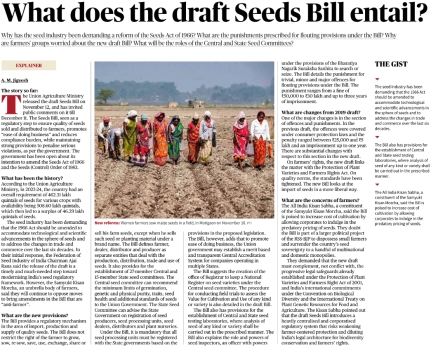
1. CONTEXT – Why is this in news?
- The Union Agriculture Ministry has released the draft Seeds Bill on November 12.
- It has invited public comments till December 11.
- The Bill is presented as a regulatory step to:
- ensure the quality of seeds sold and distributed to farmers,
- promote “ease of doing business” and reduce compliance burden,
- but still keep strong provisions to penalise serious violations.
- The government has openly stated its intention to amend:
- the Seeds Act, 1966, and
- the Seeds (Control) Order, 1983.
3. DETAILED ANALYSIS A. History and Seed Sector Context - According to the Union Agriculture Ministry, in 2023–24:
- India’s overall seed requirement for various crops was 462.31 lakh quintals.
- Availability was 508.60 lakh quintals.
- This resulted in a surplus of 46.29 lakh quintals.
- The seed industry has been demanding that the 1966 Act be amended:
- to accommodate technological and scientific advancements in seeds, and
- to address changes in trade and commerce over the last six decades.
- In their initial response, the Federation of Seed Industry of India (FSII) Chairman Ajai Rana called the release of the draft:
- a timely and much-needed step towards modernising India’s seed regulatory framework.
- In contrast, the Samyukt Kisan Morcha (SKM), an umbrella body of farmers, has said:
- they will continue to oppose moves to bring amendments in the Bill which they consider “anti-farmer”.
B. Key Provisions of the Draft Bill
1. Farmer’s Rights over Seeds o Farmer can: grow, sow, re-sow, save, use, exchange, share or sell his farm seeds. o Farmer cannot: sell such seed or planting material under a brand name without coming under the Bill’s regulatory framework.
2. Definitions and Regulatory Scope o The Bill defines: Farmer, Dealer, Distributor, and Producer as separate entities dealing with production, distribution, trade and use of seeds.
3. Central & State Seed Committees o Provides for the establishment of: Central and State Seed Committees. o The Central Seed Committee can recommend to the Union government: minimum limits of germination, genetic and physical purity, traits, seed health, and additional standards of seeds. o The State Seed Committee can advise the State Government on: registration of seed producers, seed processing units, seed dealers, distributors, and plant nurseries.
4. Registration of Seed Processing Units o It is mandatory that all seed processing units be registered with State governments based on provisions in the proposed legislation.
5. Central Accreditation System: To promote ease of doing business, the Union government may establish: a merit-based and transparent Central Accreditation System for companies operating in multiple States.
6. Registrar and National Register o The Bill suggests creating the office of Registrar to: keep a National Register of seed varieties under the Central Seed Committee. o The procedure for: conducting field trials to assess the Value for Cultivation and Use (VCU) of any kind or variety is also detailed in the draft Bill.
7. Seed Testing Laboratories o Provides for establishment of Central and State seed testing laboratories. o Analysis of seed of any kind or variety shall be carried out in the prescribed manner.
8. Seed Inspectors & Enforcement Powers o The Bill explains the role and powers of seed inspectors, an officer with powers under the Bharatiya Nagarik Suraksha Sanhita (BNSS) to search or seize. o The Bill details punishments for trivial, minor and major offences: § Fines ranging from ₹50,000 to ₹30 lakh. § Imprisonment of up to three years.
C. What has changed from the 2019 Draft?
1. Offences & Punishments · In the previous draft, offences: were covered under consumer protection laws, and penalties ranged between ₹25,000 and ₹5 lakh and imprisonment up to one year. · The new draft makes substantial changes in this section, raising fines and the term of imprisonment as noted above.
2. Farmers’ Rights & Quality Norms · On farmers’ rights, the new draft links the matter with the Protection of Plant Varieties and Farmers’ Rights Act (PPVFR Act). · On quality norms, the standards have been tightened.
3. Seed Imports: The new Bill looks at import of seeds in a more liberal way.
D. Concerns of Farmers’ Organisations
- The All India Kisan Sabha (AIKS), a constituent of the Samyukt Kisan Morcha, has raised serious concerns:
1.
Increase in Cost & Predatory Pricing o They say the Bill is
poised to increase the cost of cultivation by allowing
corporates to indulge in the predatory pricing of seeds.
2. Political and Structural Concerns o They doubt the Bill is part of a larger political project of the RSS-BJP: § to dispossess small farmers, and § to surrender the country’s seed sovereignty to a few multinational and domestic monopolies.
3. Need for Harmony with Existing Safeguards: They demand that the new draft must complement, not conflict with: the progressive legal safeguards already established under the
Protection of Plant Varieties and Farmers Rights Act, 2001, and India’s
international commitments under: · the
Convention on Biological Diversity, and · the
International Treaty on Plant Genetic Resources for Food and Agriculture.
4. Centralisation & Corporatisation of Regulation The Kisan Sabha points out that the draft Bill introduces a heavily centralised and corporatised regulatory system. They fear this: weakens farmer-centred protection, and dilutes India’s legal architecture for: biodiversity conservation, and farmers’ rights.
UPSC Mains Q. The draft Seeds Bill seeks to ensure quality seeds and promote ease of doing business, but has been criticised by farmers’ organisations as centralised and anti-farmer. Based solely on the provisions and concerns highlighted in the recent draft, critically examine its implications for farmers’ rights and seed sovereignty in India.
Decoding personality rights in the age of AI
1. CONTEXT
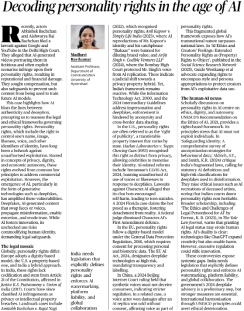
- Actors Abhishek Bachchan and Aishwarya Rai Bachchan recently filed a lawsuit against Google and YouTube in the Delhi High Court.
- They alleged that AI-generated videos portrayed them in fictitious and often explicit scenarios, violating their personality rights and causing reputational and financial damage.
- They also sought safeguards to prevent such AI-generated content from being used to train future AI models.
This controversy highlights: - how AI blurs boundaries between authenticity and deception,
- how it pressures legal and ethical frameworks governing personality rights,
- and how traditional protections are inadequate in the age of deepfakes and generative AI.
2. DETAILED ANALYSIS A. Personality Rights — What They Are & Why They Matter - Personality rights include the right to control one's name, image, likeness, voice, and other identifiers of identity.
- Historically, personality rights have protected individuals against unauthorised exploitation.
- These rights evolved from common law principles to protect commercial benefits and reputation.
- With the rise of AI — especially deepfakes — risks have grown:
- AI-generated content that swaps faces or voices
- can spread misinformation,
- enable extortion, and
- erode trust.
- While AI fosters innovation, unchecked use commodifies human identity and demands legal safeguards.
B. The Legal Mosaic — Fragmented Global Approaches 1. Globally - Personality rights differ:
- Europe adopts a dignity-based model.
- United States follows a property-based model.
- India has a hybrid approach.
2. In India - Personality rights stem partly from Article 21 of the Constitution and the privacy ruling in Justice K.S. Puttaswamy v. Union of India (2017).
- Courts classify personality rights as privacy or intellectual property rights.
- These rights are invoked in: breach of privacy, commercial misappropriation, taxation, and celebrity endorsements.
3. Indian court cases mentioned - Amitabh Bachchan v. Rajat Nagi (2022) → recognised personality rights.
- Anil Kapoor v. Simply Life India (2023) → AI reproductions of Anil Kapoor’s identity and “jhakaas” were banned for diluting brand value.
- Arijit Singh v. Cdable Ventures LLP (2024) → Bombay High Court protected Arijit Singh’s voice from AI replication.
These cases show movement toward a privacy-property hybrid, but India’s framework remains reactive.
4. Existing Indian laws
- Information Technology Act, 2000
- 2024 Intermediary Guidelines
- These address impersonation and deepfakes, but
- enforcement is hindered by online anonymity and cross-border data sharing.
C. International Comparisons Mentioned in the Article 1. United States - Personality rights are treated as “right of publicity” → a transferable property right.
- Standards vary by state.
2. U.S. related examples given - Haelan Laboratories v. Topps Chewing Gum (1953) → recognised personality rights as distinct from privacy.
- U.S. legal actions include:
- Tennessee’s ELVIS Act (2024) → bans unauthorised voice likeness use in relation to deep fakes.
- Lawsuits against Character.AI, including claims that bots: encouraged self-harm, led to teen suicides
- A 2024 Florida case:
- The article refers to a 2024 Florida case where:
- a chatbot posed as a therapist, it was seen as fostering detachment from reality, and was treated by the court as posing a threat.
- Judge dismissed Character.AI’s First Amendment defence.
3. European Union - Follows a dignity-based model.
- Under the General Data Protection Regulation (GDPR) 2016: Processing of personal and biometric data requires consent.
- The EU AI Act, 2024:
- classifies deepfake technologies as high-risk,
- mandates transparency and labelling.
4. China - A 2024 Beijing Internet Court ruling: Held that synthetic voices must not deceive consumers.
- Related case: Awarded damages after a synthetic voice impersonated the plaintiff in a scam.
D. India’s Need — As Highlighted in the Article The article clearly states: India needs legislation that: - explicitly defines personality rights, and
- enforces: AI watermarking, platform liability, global collaboration.
The government’s 2024 deepfake advisory is a preliminary step, but stronger measures are essential.
E. AI’s Transnational Nature & the Limits of Current Frameworks
- The article cites a chapter titled
“AI Ethics and Creators’ Feelings: Extended Personality Rights as (Property) Rights to Object”, in Social Science Research Network (2025). - It argues for: expanding personality rights, protecting creators from AI’s exploitative data use.
F. The Human–AI Nexus Scholarly debates highlighted in the article include: - Personality rights in AI touch: ethics, dignity, and autonomy.
- UNESCO’s Recommendation on the Ethics of AI (2021):
- Provides a rights-based framework.
- Says AI must not exploit individuals.
Research referenced in the article - Safeguarding Identity → analysis of anonymization strategies to limit behavioural tracking.
- Ethics and Challenges of Legal Personhood for AI (Forrest & B. K., 2023, Yale Law Journal): Warns that granting AI legal status may erode human rights.
- Experts (Aldrich, Smith, K.) highlight:
- need for clear legal definitions,
- high-risk classification of deepfakes,
- issues of AI recreation of deceased artists,
- that Indian courts treat personality rights as non-heritable.
UPSC MAINS Q.
Personality rights are facing unprecedented challenges due to AI-generated content and deepfakes. Using only the developments and concerns highlighted in recent judicial and regulatory debates, critically analyse India’s preparedness to address these challenges.
Over 80% nations got loans from China in the last two decades
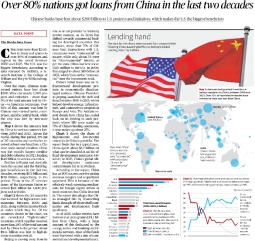
1. China’s Global Lending (2000–2023) - China lent more than $2 trillion in loans and grants.
- Over 80% of countries/territories (179 out of 227) received at least one loan from China.
- The U.S. was the biggest beneficiary → about $209 billion.
2. Nature of Lending - Nearly 2,500 projects and initiatives funded.
- More than 90% of total lending went to: Chinese state-owned banks, enterprises, central bank.
- Less than 10% through non-state players.
3. Country-wise highest recipients - U.S. – ~$209 billion
- Russia – ~$172 billion
- Venezuela – ~$130 billion
(India borrowed $11.8 billion from Chinese banks.)
4. China’s shift in lending pattern - Earlier → focus on infrastructure & development, mostly to low-income and developing nations.
- Now → shift towards high-income countries and commercial lending.
- Example: With the U.S., 75% of Chinese loans to U.S. companies were commercial. Only 25% were for “developmental” purposes.
5. Key Charts - U.S., Russia, Venezuela – top 3 recipients.
- Countries with highest number of Chinese-funded projects: Pakistan, Indonesia, U.K., Australia, Brazil, Singapore, India (11.8b), S. Arabia.
- China’s BRI-related lending dropped to 25% of its total portfolio (earlier ~75%).
- Share of loans to high-income countries has risen.
- Share of loans to low-/middle-income countries has declined.
6. India-specific: India borrowed $11.8 billion from Chinese banks (2000–2023).
UPSC Prelims
Q. Consider the following statements regarding China’s global lending (2000–2023):
1. Over 80% of countries and territories received at least one loan from China.
2. The United States received the highest amount of Chinese loans during this period.
3. More than 75% of China’s loans to U.S. companies were for developmental purposes. Which of the statements is/are correct?
A. 1 and 2 only
B. 2 and 3 only
C. 1 and 3 only
D. 1, 2 and 3
Answer: A
Rupee is Asia’s worst performing currency
1. Rupee’s Performance (2025)
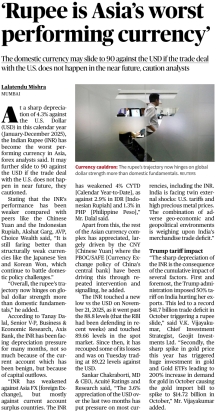
- Indian Rupee (INR) has depreciated 4.3% against the USD (Jan–Dec 2025).
- It has become Asia’s worst-performing currency.
- Analysts caution INR may slide to 90 per USD if India–U.S. trade deal does not materialise soon.
2. Performance vs Other Asian Currencies - INR underperformed compared to: Chinese Yuan (CNY), Indonesian Rupiah (IDR), Philippine Peso (PHP)
- INR weakened 4% CYTD, while IDR weakened 2.9% and PHP 1.3%.
- Most Asian currencies appreciated except INR, largely due to: Chinese Yuan strength, PBOC/SAFE (Chinese central bank) intervention.
3. Reason for Rupee Weakness - Pressure not due to current account deficit (which is benign), but due to capital outflows.
- Rupee depends more on global dollar strength than domestic fundamentals.
4. INR Market Movements - INR hit new low of 88.8 per USD on Nov 21, 2025.
- Touched 89.66 in spot market.
- Later recovered to 89.22 levels.
5. External Shocks Impacting INR India is facing three major external shocks:
1. U.S. tariffs on India o Trump administration imposed 50% tariffs. o Led to record $41.7 billion trade deficit in October, causing rupee slide.
2. High precious metal prices o Global gold price spike → huge Indian gold imports. o Gold import bill hit $14.72 billion in October.
3. Geo-economic & geopolitical environment o Worsening conditions weighing on merchandise trade deficit.\
UPSC Prelims
Q. Consider the following statements regarding the performance of the Indian Rupee in 2025:
1. The Indian Rupee became Asia’s worst-performing currency after depreciating more than 4% against the USD.
2. The depreciation was largely due to India’s widening current account deficit.
3. U.S. tariffs and rising gold imports contributed to the rupee’s weakness. Which of the statements is/are correct?
A. 1 and 3 only
B. 1 and 2 only
C. 2 and 3 only
D. 1, 2 and 3 Answer: A
India–U.K. military drill picks up intensity in Rajasthan India–U.K. Military Exercise

- Name: AJEYA WARRIOR-25
- Location: Mahajan Field Firing Ranges, Rajasthan
- Participants: Indian Army’s Sikh Regiment + U.K. Army
Key Features - Aim: Strengthen interoperability under a United Nations mandate.
- Type: Biennial joint military exercise.
- Activities include: Firing practices, Reflex shooting, Rocket launcher firing, Sniper and MMG drills, Replication of real combat scenarios
Timeline: Exercise ends on: November 30.
UPSC Prelims
Q. With reference to the India–U.K. joint military exercise “AJEYA WARRIOR-25”, consider the following statements:
1. It is conducted between the Indian Army and the British Army.
2. The 2025 edition is being held in Rajasthan.
3. The exercise is aimed at strengthening interoperability under a United Nations mandate. Which of the statements given above is/are correct?
A. 1 and 2 only
B. 2 and 3 only
C. 1 and 3 only
D. 1, 2 and 3
Answer: D
SC upholds dismissal of Christian officer from Indian Army Supreme Court Case
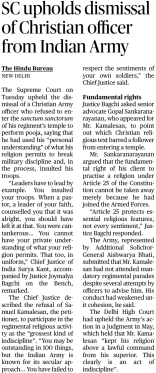
- The Supreme Court upheld the dismissal of a Christian Army officer, Samuel Kamalesan.
- Reason: He refused to enter the sanctum sanctorum of his regiment’s temple to perform pooja.
- Court held he used his “personal understanding” of religion to violate military discipline and insulted his troops.
- Refusal to participate in regimental religious activities was considered the “grossest kind of indiscipline.”
Article 25 Argument
- Counsel argued his Article 25 right to freedom of religion could not be taken away.
- Court response:
- Article 25 protects essential religious practices, not every sentiment.
- No Christian religious text bars entering a temple.
UPSC PrelimsQ. With reference to Article 25 of the Constitution of India, which of the following statements is/are correct?
1. Article 25 guarantees freedom of conscience and the right to freely profess, practise and propagate religion.
2. The rights under Article 25 are subject to public order, morality and health.
3. Article 25 protects only essential religious practices as determined by the individual’s personal belief.
4. The State may regulate secular activities associated with religious practices under Article 25. Select the correct answer using the code below:
A. 1 and 2 only
B. 1, 2 and 4 only
C. 1, 3 and 4 only
D. 1, 2, 3 and 4
Answer: B
Special Leave Petition (SLP)
Syllabus: GS Paper 2 – Polity & Governance (Judiciary) Context:
A
Special Leave Petition (SLP) is a mechanism through which an aggrieved party seeks the
Supreme Court’s special permission to appeal against any judgment or order when no statutory appeal is available. It is a
discretionary power of the Supreme Court under
Article 136.
Key Points - SLP is a request, not a right— granted at the Supreme Court’s discretion.
- Article 136 empowers the Supreme Court to grant special leave to appeal against any judgment, decree, determination, or order of any court or tribunal (except military tribunals).
- The Court may use this power only when there is a substantial question of law or gross injustice.
- Interim/interlocutory orders can also be challenged through an SLP; final orders are not mandatory.
- SLP is an optional power of the Supreme Court; it can be refused without assigning reasons.
- Aggrieved parties eligible to file SLP include individuals, companies, government bodies, PSUs, NGOs etc., if affected by the impugned order.
- SLP can be filed in civil or criminal matters against decisions of High Courts, tribunals (except armed forces tribunals), and quasi-judicial bodies.
Time Limits - 90 days from the date of the High Court’s judgment, or
- 60 days from the date the High Court refuses to grant a certificate of fitness for appeal to the Supreme Court.
Procedure - SLP must state all relevant facts and grounds for invoking Article 136.
- It must be signed by an Advocate-on-Record.
- Petition must contain a declaration that no similar petition has been filed before any High Court.
- After filing, the Court hears the petitioner and may seek a counter affidavit from the opposite party.
- Based on the merits, the Court may grant leave for further hearing or dismiss the petition.
Source: LiveLaw
WhatsApp Governance
Syllabus: GS Paper 2 – Governance (E-Governance, Citizen-Centric Service Delivery) Context:
The
Delhi Government is planning to adopt a
WhatsApp-based e-governance platform and has proposed a study visit to
Tamil Nadu, Andhra Pradesh, and Karnataka to learn best practices in digital governance.
Key Points - WhatsApp Governance is a digital public service platform that enables citizens to apply for services, verify documents, and download certificates via WhatsApp.
- It works by integrating government services with WhatsApp API and GenAI tools for automated assistance.
Key Features - Single-window access: Citizens can access multiple services through a single WhatsApp number.
- AI-enabled support: Combines chatbot and GenAI for query resolution, document verification, and guided applications.
- No additional app: Citizens use a platform they already have, increasing accessibility.
- Multi-department integration: Offers services like birth/marriage certificates, licences, and caste certificates.
- 24×7 availability: Reduces physical visits and bureaucratic delays.
Significance - Citizen-centric governance: Delivers public services directly to mobile phones, improving convenience and inclusion.
- Higher efficiency: Cuts down office footfall and speeds up service delivery.
- Supports Digital India: Aligns with goals of Digital Public Infrastructure, AI-driven governance, and automated services.
- Scalable model: Can be expanded across departments and replicated by other states.
Source: Indian Express
Information Security Education and Awareness Project
Syllabus: GS Paper 3 – Cyber Security, Science and Technology Context:
The Ministry of Electronics and Information Technology (MeitY) has launched the
Cyber Security Innovation Challenge (CSIC) 1.0 under the
Information Security Education and Awareness (ISEA) Project to promote research-driven, indigenous cyber security solutions and build skilled manpower in this domain.
Key Points - Information Security Education and Awareness (ISEA) Project is an initiative of MeitY, Government of India.
- The project started in 2005 and is currently in its third phase (from October 2023 onwards).
- Purpose: To generate human resources in Information Security and promote cyber hygiene / cyber security awareness among citizens.
- Aim: To support safe, trusted and secure cyberspace through dedicated human resource development.
- Implementation: The project is implemented through 50 selected institutions in a hub-and-spoke model.
- These institutions include IITs, NITs, IIITs, and other premier academic institutions.
- It also involves autonomous organisations of MeitY such as C-DAC and NIELIT.
- Technical universities across the country are part of the implementation network.
Cyber Security Innovation Challenge (CSIC) 1.0 - CSIC 1.0 is an initiative of MeitY under the ISEA Project.
- It is launched for students and researchers to work on real-world cyber security problems.
- The Challenge aims to foster indigenous, research-driven cyber security solutions from the academic ecosystem.
- It focuses on problem statements across 10 domains:
- Computer & Network Security
- Mobile Device Security
- Systems & Software Security
- Hardware Security
- Security in Futuristic Technologies
- Cryptography
- Security in Distributed Wireless Networks
- Cyber Forensics
- Governance, Operations & Services
- Fintech Security
Source: PIB
Asian and Pacific Centre for Development of Disaster Information Management
Syllabus: GS Paper 3 – Disaster Management Context:
The
10th Session of the Asian and Pacific Centre for Development of Disaster Information Management (APDIM) focusing on
Inclusive Disaster Risk Data Governance was recently held in
New Delhi, highlighting regional cooperation in strengthening disaster information systems.
Key Points - APDIM is a regional institution of UN-ESCAP dedicated to disaster information management.
- Vision: To ensure effective disaster risk information supports sustainable development in the Asia-Pacific region.
- Mandate: To reduce human and material losses from natural hazards and strengthen disaster risk reduction (DRR) and resilience policies.
- Governance: Managed by a Governing Council of eight ESCAP member states; India is a member (2022–2025).
- Headquarters: Located in Tehran, Iran.
Functions of APDIM - Risk Information & Knowledge Repository: Acts as a regional hub to strengthen the science–policy interface for DRR.
- Information Capacity & Application: Facilitates knowledge exchange, expertise sharing, and capacity-building on disaster information management.
- Regional Cooperation: Promotes regional coordination and dialogue to improve disaster risk information systems across countries.
Source: PIB



 Launch your Graphy