1) Context
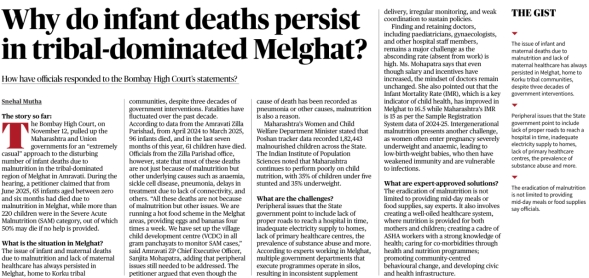
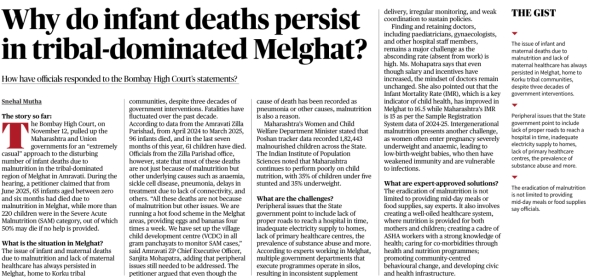
The Bombay High Court sharply criticised the Maharashtra and Union governments (November 12) for an “extremely casual” response to the disturbingly high infant deaths due to malnutrition in Melghat, a tribal region in Amravati district.
A petition before the court highlighted
dozens of deaths among infants aged 0–6 months and over
220 children in Severe Acute Malnutrition (SAM) — a condition where nearly half may die if untreated. The Court questioned
why deaths continue despite three decades of government interventions.
2) What the Article Is About
The article examines:
- Why infant and maternal deaths continue in Melghat
- What government officials have said in response
- What underlying challenges persist
- Why interventions so far have not worked
- What expert-approved solutions are required to break the cycle of malnutrition
3) Detailed Analysis A. Long-standing crisis in Melghat For
30+ years, Melghat (home to
Korku tribal communities) has faced:
- High infant deaths
- High maternal deaths
- Chronic malnutrition
- Weak maternal healthcare
Despite multiple schemes,
fatality trends have not improved consistently.
B. Recent official data shows continuing deaths From April 2024 – March 2025: 96 infants died In the last seven months alone: 61 infants died Officials say deaths are due not only to malnutrition but also:
- Anaemia
- Sickle-cell disease
- Pneumonia
- Delays reaching treatment due to poor connectivity
Officials claim they run food schemes (eggs, bananas) and local monitoring centres — but
peripheral failures remain unaddressed.
C. Maharashtra’s overall nutrition record remains poor
- 1,82,443 malnourished children recorded in the State (Poshan tracker).
- According to IIPS, 35% of children under 5 are stunted, and 35% underweight.
Thus, the State’s broader nutrition challenges mirror Melghat’s crisis.
D. Persistent structural challenges (as stated by officials) The government highlights peripheral issues such as:
- Poor roads → delays reaching hospitals
- Inadequate electricity in homes
- Lack of primary health centres
- Substance abuse
- Weak monitoring
- Broken coordination across departments
Even when salaries were increased,
doctor absenteeism remains high.
Retention of paediatricians, gynaecologists, and nurses is a major challenge.
E. Intergenerational malnutrition deepens the crisis
Women in Melghat often enter pregnancy: Severely underweight, Anaemic This results in:
- Low-birth-weight infants
- Weak immunity
- Higher vulnerability to infections
This cycle continues across generations.
F. IMR numbers and partial improvements Infant Mortality Rate (IMR):
- Melghat: 16.5
- Maharashtra average: 15 (Sample Registration System 2024-25)
Though improved slightly, Melghat still performs worse than the State average.
G. Experts say malnutrition eradication requires more than food Experts emphasise that solutions cannot be limited to providing mid-day meals or nutrition supplies.
Effective policy must include:
1) A well-functioning healthcare system Reliable healthcare for mothers and children, regular monitoring, and strong coordination.
2) Properly trained ASHA workers Workers must know child health, nutrition, co-morbidities, and early intervention.
3) Community-centred programmes Behavioural change and local involvement are crucial.
4) Strong health + nutrition integration Programmes across departments must not operate in silos.
5) Better infrastructure Good roads, reliable electricity, and functioning primary healthcare. These structural issues determine survival outcomes as much as nutrition access.
UPSC Mains
Despite decades of interventions, infant deaths due to malnutrition persist in Melghat. Identify the structural causes behind this crisis and suggest a multi-sectoral policy response.”
Bridging India’s numeracy gap
1) Context
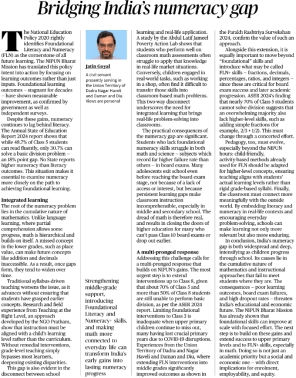
Despite improvements in foundational literacy under NIPUN Bharat Mission, India continues to show large gaps in foundational numeracy (FLN).
The ASER 2024 report shows that while nearly half of Class 5 children can read fluently, only 30.7% can solve a basic division problem — an 18% improvement, but still alarming.
Given that no State shows higher numeracy than literacy, the article highlights the urgent need to strengthen numeracy skills through integrated learning, better pedagogy, and extended interventions up to middle school.
2) Detailed Analysis
A. Why numeracy is still weak despite policy focus
NEP 2020 identifies FLN as foundational for future learning.
NIPUN Bharat has improved foundational outcomes, but numeracy lags.
ASER 2024 reveals:
- 48.7% of Class 5 → can read fluently
- Only 30.7% → can solve division
No state performs better in numeracy than literacy.
Therefore, strengthening numeracy is nationally critical.
B. Numeracy learning is cumulative Math builds on itself.
If a child doesn’t grasp early concepts — place value, basic operations — later topics like decimals and fractions become inaccessible. Traditional syllabus-driven teaching moves forward without ensuring earlier concepts are mastered.
Thus, gaps formed in lower grades widen sharply in higher classes.
C. Weak real-life application of mathematical skills A study shows:
- Students good at classroom math struggle with real-life math
- Children good at real-life math (e.g., shop work) struggle with school math
This mismatch emphasizes the need for integrated learning connecting math with practical everyday problem-solving.
D. The consequences of the numeracy gap Students with weak foundational math face challenges in:
- Math and science learning
- Board exam performance
- Higher education
- Future employability
Many fail in Class 10 due to poor math comprehension, not lack of intelligence but because persistent learning gaps compound over years.
E. Need to extend interventions beyond Class 3 NIPUN covers FLN only up to Grade 3.
But ASER 2024 shows:
But ASER 2024 shows: - 70% of Class 5 students
- 50% of Class 8 students
cannot perform basic division. Thus, limiting intervention to early primary grades is inadequate.
Interventions must extend to Grade 8 to rebuild competence lost during COVID years and earlier deficiencies.
F. Moving from FLN to “FLN+ skills”
To support later academic progression and board exam success, schools must introduce: Fractions, Decimals, Percentages, Ratios, Integers ASER 2024 shows majority lack higher-level skills (like adding fractions).
Thus, FLN+ is essential for India’s learning recovery.
G. Pedagogy must evolve Math teaching must shift towards:
- Child-friendly, activity-based approaches (as used in NIPUN)
- Grade-level teaching matched to students’ actual learning levels
- Embedding math in real-life contexts
- Motivating students through success experiences
- Connecting classrooms with the outside world
This makes learning meaningful, enjoyable, and durable.
H. Multi-pronged response needed To truly bridge India’s numeracy gap, interventions must be:
- Long-term (extending to middle school)
- Multi-grade
- Integrated with literacy
- Aligned with real-life problem-solving
- Supported by improved teacher capacity
Experiences from UTs like Dadra & Nagar Haveli and Daman & Diu show that extending FLN to middle school produces rapid gains.
UPSC Mains “India’s numeracy crisis is rooted in the cumulative nature of mathematics learning and gaps in early-grade instruction. Discuss the key reasons for persistent numeracy challenges and suggest a multi-pronged strategy to address them.”
Justice Surya Kant takes oath as 53rd Chief Justice
1) CONTEXT
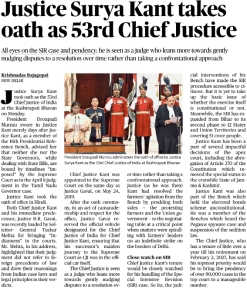
- Justice Surya Kant took oath as the 53rd Chief Justice of India (CJI) at Rashtrapati Bhavan sworn in by President Droupadi Murmu.
- His appointment came shortly after he advised the President and State Governors (as part of the 16th Presidential Reference Bench) on timelines that bind them while dealing with State Bills — as per the Supreme Court’s judgment in the Tamil Nadu Governor case.
2) KEY PROVISIONS A. Background of Justice Surya Kant - Appointed to the Supreme Court on May 24, 2019, on the same day as Justice Gavai.
- Played a key role in resolving the farmers’ agitation by bringing both farmers and the Union government to the negotiation table.
B. Important Cases & Benches He Has Been Part Of Justice Kant has been involved in major Supreme Court decisions including: - Article 370 abrogation case — removal of special status of Jammu & Kashmir.
- Electoral bonds case — held bonds unconstitutional.
- Pegasus spyware case.
- Sedition law (Section 124A) suspension proceedings.
D. Tenure - Justice Surya Kant has a short tenure as CJI — till February 2, 2027.
- His primary task will be to bring down the pendency of over 90,000 cases in the Supreme Court.
UPSC Prelims Q. Consider the following pairs related to important constitutional offices and their administering authority:
| Office | Administered Oath By |
| 1. Chief Justice of India | President of India |
| 2. Governor of a State | Chief Justice of India |
| 3. Judge of a High Court | Governor of the State |
Which of the above pairs is/are correctly matched? (a) 1 and 3 only
(b) 1 only
(c) 2 and 3 only
(d) 1, 2 and 3
Answer: (a) 1 and 3 only
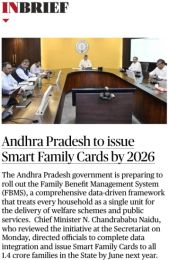
Andhra Pradesh to issue Smart Family Cards by 2026
CONTEXT
- Andhra Pradesh is preparing to launch the Family Benefit Management System (FBMS).
- FBMS is a data-driven framework that treats every household as a single unit for delivering welfare schemes and public services.
- Chief Minister N. Chandrababu Naidu reviewed the initiative at the Secretariat.
- He instructed officials to:
- Complete data integration
- Issue Smart Family Cards
- These Smart Family Cards will be given to all 1.4 crore families in the State. The deadline set is June 2026.
UPSC Prelims Q. Consider the following pairs regarding digital governance initiatives in India:
| Initiative | | Implementing Entity |
| 1. Diksha Portal | | Ministry of Education |
| 2. Ayushman Bharat Digital Mission | | National Health Authority |
| 3. Smart Family Cards (2026) | | Government of Andhra Pradesh |
Which of the above pairs is/are correctly matched? (a) 1 and 2 only
(b) 2 and 3 only
(c) 1 and 3 only
(d) 1, 2 and 3
Answer: (d) 1, 2 and 3
Hardly any incident of crop burning in past 10 days CONTEXT - Stubble burning incidents in Delhi-NCR, Punjab, and Haryana have reduced this year, according to Agriculture Secretary Devesh Chaturvedi.
- Reduction attributed to government support such as:
- Provision of farm machinery
- Other necessary interventions
- Hardly any incidents of stubble burning reported in the last 10 days.
- Stubble burning has been a major contributor to winter air pollution in Delhi and surrounding regions.
- As per ICAR–CREAMS data (Sep 15–Nov 23):
- Overall incidents fell 15% → from 32,596 (last year) to 27,720 (this year).
- However, burning incidents increased in:
- Uttar Pradesh → from 4,298 to 5,622
- Rajasthan → from 2,622 to 2,804
- Madhya Pradesh recorded the highest number of incidents at 13,584, slightly down from 13,796 last year.
- On Nov 23, satellites detected 1,154 residue-burning events across six States.
KEY PROVISIONS - Government provided equipment and interventions to help farmers manage stubble without burning.
- Data monitoring done through:
- ICAR’s Consortium for Research on Agroecosystem Monitoring and Modelling from Space (CREAMS).
- Stubble burning trends vary by State:
- Decrease → Delhi-NCR region, Punjab, Haryana
- Increase → Uttar Pradesh, Rajasthan
- Highest overall → Madhya Pradesh
- Stubble burning remains an important pollution factor but other pollution sources were not elaborated by the Secretary.
UPSC Prelims Q. Which of the following institutions is associated with monitoring agricultural residue burning using satellite-based data? 1. ISRO 2. ICAR – CREAMS 3. CPCB Select the correct answer using the code below: (a) 1 and 2 only
(b) 2 only
(c) 1 and 3 only
(d) 1, 2 and 3
Answer: (b) 2 only
India braces for disruption of air travel after Ethiopia’s Hayli Gubbi volcano erupts
CONTEXT
- India is preparing for possible air travel disruptions after the Hayli Gubbi volcano in Ethiopia erupted on November 23, 2025.
- Forecasts suggest the volcanic ash cloud may drift towards mainland India.
- The DGCA has issued advisories instructing airlines to:
- Avoid affected airspace/altitudes,
- Ensure flight safety, as volcanic ash contains abrasive, glass-like particles that damage aircraft engines.
- Ash ingestion can melt on hot engine components, harden into glass, and stick to turbine blades, impacting performance.
- Airlines must report any ash-related issues—engine anomalies, cabin smoke or odour.
- Airports have been advised to:
- Inspect runways for ash contamination,
- Restrict or suspend flight operations if required.
- Ash clouds moved from Ethiopia → Yemen → Oman → India, entering via Western Rajasthan, moving towards:
- Central India, Delhi, Parts of Uttar Pradesh, Bihar, Sikkim, Arunachal Pradesh.
The famous 10 Volcanoes | Volcano | Country/Region | Type / Importance |
| Hayli Gubbi | Ethiopia | Recent eruption, ash clouds towards India |
| Krakatoa | Indonesia | Sunda Strait, massive 1883 eruption |
| Mauna Loa | Hawaii (USA) | Largest active volcano on Earth |
| Mount Agung | Indonesia (Bali) | Frequent eruptions, air travel impact |
| Mount Fuji | Japan | Cultural icon, Ring of Fire |
| Mt. Etna | Italy | Highly active, convergent boundary |
| Mt. Vesuvius | Italy | Pompeii, high-risk region |
| Mt. Pinatubo | Philippines | 1991 eruption, global cooling |
| Mt. St. Helens | USA | 1980 eruption, Cascade Range |
| Eyjafjallajökull | Iceland | 2010 eruption stopped EU flights |
UPSC PRELIMS Q. Match the following volcanoes with their correct locations:
| List – I (Volcano) | List – II (Location) |
| A. Krakatoa (Krakatau) | 1. Hawaii, USA |
| B. Mauna Loa | 2. Ethiopia |
| C. Hayli Gubbi | 3. Sunda Strait |
| D. Mount Agung | 4. Bali |
Select the correct code: (a) A-3, B-1, C-2, D-4
(b) A-4, B-3, C-1, D-2
(c) A-1, B-4, C-3, D-2
(d) A-3, B-2, C-1, D-4
Answer: (a) A-3, B-1, C-2, D-4
Operation Crystal Fortress: Major Meth Seizure in Delhi
Syllabus: GS Paper II — Internal Security (Policing, Drug Trafficking)
Context: A major joint raid in Delhi—
Operation Crystal Fortress—uncovered a large cache of methamphetamine linked to a transnational cartel. The seizure highlights growing synthetic-drug networks using urban hubs for distribution.
Key points
- Seizure quantity: 329 kg of methamphetamine recovered — one of Delhi’s largest single hauls.
- Estimated value: Consigned drugs worth Rs 262 crore, indicating high commercial scale.
- Operation name: The crackdown was codenamed Operation Crystal Fortress.
- Agencies involved: Joint operation by the Narcotics Control Bureau (NCB) and Delhi Police.
- Target: A transnational cartel using Delhi as a key distribution and transit hub.
- NCB role: NCB is the nodal drug-enforcement agency under Ministry of Home Affairs, coordinating multi-agency action.
- Legal framework: Enforcement under the NDPS Act, 1985, which governs seizure, prosecution and penalties.
- Significance: Disrupts local supply chains and raises alarms about synthetic drug availability in urban markets.
- Follow-up: Likely outcomes include arrests, cross-border intelligence sharing, and prosecution under NDPS.
- Policy implication: Underlines need for stronger inter-agency coordination, monitoring of transit hubs, and international cooperation to counter synthetic-drug networks.
Source: The Hindu
Syllabus: GS Paper-1 – Indian Culture (GI Tags)
Context:
The
Meerut bugle, a traditional brass wind instrument widely used in military parades and ceremonies, has been granted the Geographical Indication (GI) tag, recognising its historic craftsmanship and cultural value.
Key Points
- Nature: A brass wind instrument used in military drills, parades, ceremonies and signalling across Army, paramilitary and police units.
- Use in Forces: Traditionally used to signal movements, announcements and ceremonial events for decades.
- Origin: Bugle-making in Meerut began in the late 19th century, closely tied to India’s evolving military traditions.
- Craft Hub: Meerut has become one of India’s major centres for handmade bugles due to skilled local artisans.
- Manufacturing Process: Fully handcrafted; brass sheets are cut, hammered, moulded, polished and fitted with a mouthpiece.
- Cultural Significance: Represents living military heritage connecting colonial-era communication tools with modern ceremonial functions.
- Types Manufactured:
- Copper bugle: Highest demand.
- Gold-finish bugle: Polished gold-like appearance.
- Silver-finish bugle: Produced upon request.
Source: The New Indian Express
Malaysia will implement a nationwide restriction prohibiting users under 16 from accessing social media platforms from next year
Syllabus: GS Paper II — Governance: Digital governance, child rights and online safety.
Context: Malaysia plans a nationwide rule to bar users under 16 from social media to curb cyberbullying, scams and exploitation. The move follows international models and tighter domestic regulation of large digital platforms.
Key points
- What’s being introduced: A nationwide ban on social-media access for users under 16, to take effect next year.
- Government rationale: Aim is to reduce cyberbullying, scams and online exploitation of minors.
- International models: Malaysia is studying Australia and European approaches to age verification and account disabling.
- Platform compliance: Authorities expect major platforms to comply with the new age requirement by next year.
- Regulatory backdrop: A January rule requires digital platforms with >8 million Malaysian users to register with regulators.
- Enforcement reasons: The government cites harmful content (online gambling, sensitive race/religion posts) as drivers for stricter oversight.
- Broader trend: Several countries are tightening youth access rules, reflecting concerns over teen mental health and online harms.
Source: The Hindu.
Inland Waterways Authority of India (IWAI)
Syllabus: GS Paper 3 – Infrastructure: Transport & Inland Waterways Context The IWAI has recently signed multiple agreements aimed at expanding cargo movement and promoting river-based tourism in the Northeast, strengthening inland water transport as a cost-effective logistics alternative.
Key Points About IWAI
- Statutory body created under the Inland Waterways Authority of India Act, 1985.
- Established: 27 October 1986 for developing and regulating inland waterways.
- Nodal Ministry: Ministry of Ports, Shipping and Waterways.
- Objective: Develop and maintain Inland Water Transport (IWT) infrastructure on National Waterways.
- Headquarters: Noida, Uttar Pradesh.
Structure & Presence - Regional offices: Patna, Kolkata, Guwahati, Kochi.
- Sub-offices: Located in cities such as Allahabad, Varanasi, Haldia, Silchar, Vijayawada, etc.
Functions - Development of National Waterways like NW-1 (Ganga), NW-2 (Brahmaputra), NW-16 (Barak).
- Fairway development: Dredging, channel marking, and river training works.
- Navigation infrastructure: Terminals, jetties, Ro-Ro/Ro-Pax services, night navigation.
- Regulation: Vessel movement, pilotage, and coordination with state IWT departments.
- Advisory role: Assists Centre and States on IWT policy and feasibility studies.
Source: DD News
Syllabus: GS Paper III — Biodiversity, Conservation (Species in news)
Context: RTI replies from 19 States/UTs show no Forest Department holds records of registered breeders or authorised pet shops selling African grey parrots, despite their easy availability in markets.
Key points - Species: Psittacus erithacus — a medium-sized, highly intelligent parrot, famed for mimicry.
- Distribution: Native to West and Central Africa; two subspecies — Congo (CAG) and Timneh (TAG).
- IUCN status: Endangered — threatened by habitat loss and heavy capture for trade.
- Trade issue: Protected under CITES Appendix I, but domestic markets in India show widespread illegal and unregulated trade.
- RTI finding: No State has a registry of authorised breeders or pet shops — indicating a data vacuum.
- Worry spots: Tamil Nadu, Kerala, and Karnataka are reported as major hubs for exotic bird trade despite official records claiming otherwise.
- Ecological role: Important seed disperser in native African ecosystems.
- Care needs: Highly social and stress-sensitive — require enriched environments and specialised diets.
- Conservation implication: Lack of domestic regulation undermines CITES protections and complicates enforcement.
Source:
The Hindu Syllabus: GS Paper II — International Relations (India-Australia strategic partnership); GS Paper III — Security (Defence cooperation and maritime interoperability).
Context:
AUSINDEX is a major biennial maritime exercise between
India and Australia designed to deepen naval cooperation and improve interoperability.
AUSINDEX 2025 featured complex surface, sub-surface and air operations in the Northern Pacific, testing joint tactics and coordination.
Key points:
- Biennial exercise since 2015 that strengthens naval ties between India and Australia.
- AUSINDEX 2025 was conducted in the Northern Pacific with intensive joint operations.
- INS Sahyadri (Indian Navy) participated alongside HMAS Ballarat (Royal Australian Navy).
- Focus areas included anti-submarine warfare, gunnery drills, and advanced flying operations.
- Enhances tactical interoperability, communications, and coordinated manoeuvres between both navies.
- Supports regional stability by improving maritime domain awareness and coordinated responses.
- Complements other India–Australia and multilateral engagements like AUSTRA HIND, EX PITCH BLACK, Malabar, and Quad drills.
- Demonstrates India’s increasing role in Indian Ocean–Pacific security cooperation and defence diplomacy.
Source: The Hindu




 Launch your Graphy