There are no items in your cart
Add More
Add More
| Item Details | Price | ||
|---|---|---|---|


| Index | ||
| S.No | Topic | Page No |
| Daily Hindu Analysis (YouTube) | ||
| 1. | The Future of Health Lies in Harmony | |
| 2. | Safe Processing Matters More Than Zesty Flavours | |
| 3. | PM Proposes New Growth Initiatives at G-20 | |
| 4. | No plan to introduce Bill on Chandigarh – Centre’s clarification | |
| 5. | PM discusses trade, critical minerals with Ramaphosa | |
| 6. | More Efficient Technique to Mine Polymetallic Nodules | |
| 7. | High Costs & Poor Training Deepen India’s Snakebite Toll | |
| 8. | U.P. CM Pushes for Stringent Action on Illegal Immigrants | |
| 9. | COP30 Ends With Plan for Road Maps to Curb Fossil Fuel Use and Prevent Deforestation | |
| Daily Current Affairs (App) | ||
| 10. | Juvenile Justice and Children in Conflict with the Law: A Study of Capacity at the Frontlines | |
| 11. | Sangai Festival | |
| 12. | Centre Designates CISF as New Safety Regulator for Indian Seaports | |
| 13. | Strait of Malacca | |
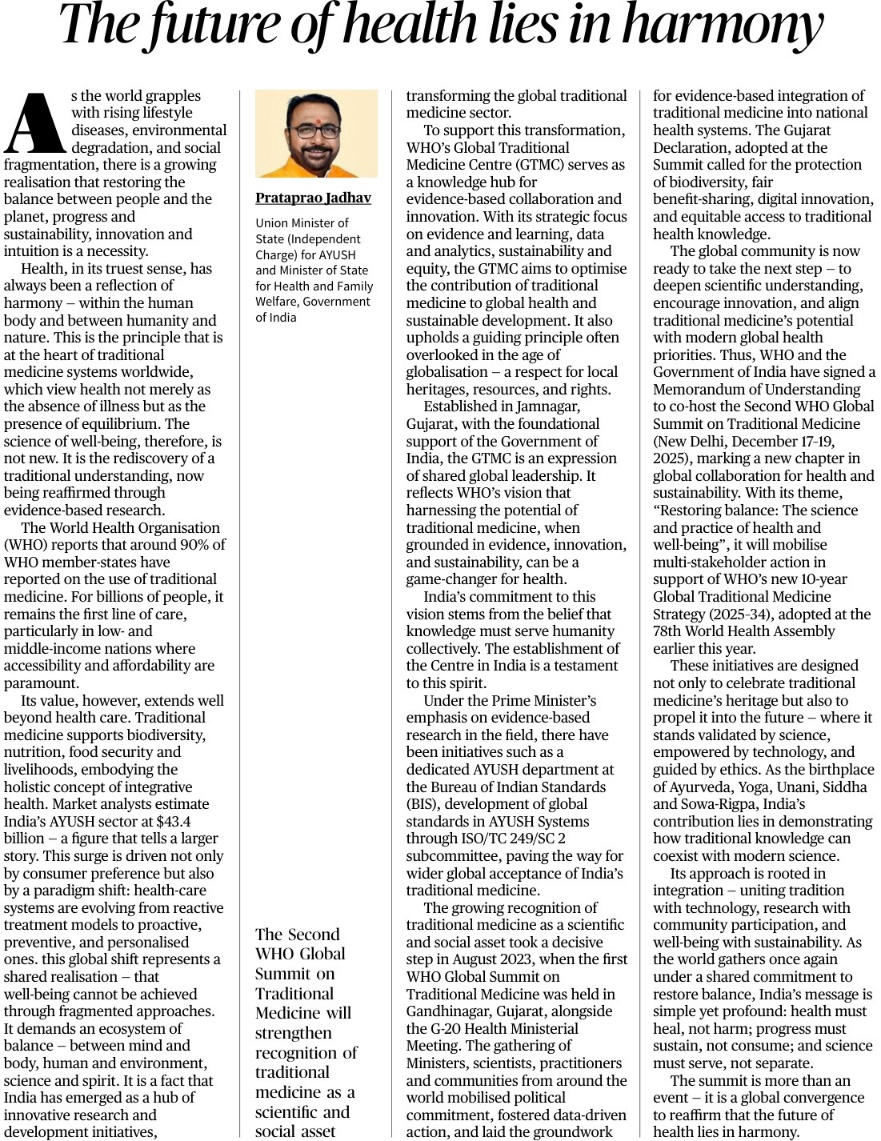
CONTEXT ·
As the world faces rising lifestyle diseases, environmental degradation, pandemics, and social fragmentation, there is an increasing global shift towards holistic, integrative, and sustainable healthcare models. · Traditional medicine—Ayurveda, Yoga, Unani, Siddha, Sowa-Rigpa, and homeopathy—plays a major role in this transition. The article discusses how India and WHO are working together to mainstream traditional medicine as a scientific, evidence-based component of global health systems. · It highlights the establishment of the WHO Global Traditional Medicine Centre (GTMC) in Gujarat and the outcomes of the Global Summits on Traditional Medicine, emphasising India’s leadership in promoting holistic, sustainable, and inclusive health solutions.
1. Health is not merely the absence of disease—it is a state of harmony within the body, between humans and nature.
2. Traditional medical systems embody this holistic philosophy and are increasingly relevant.
3. India is playing a significant role in mainstreaming traditional medicine globally, especially through: · the WHO Global Traditional Medicine Centre (Gujarat), evidence-based research initiatives, standardisation through BIS, the Gujarat Declaration, WHO–India MoU for collaborative research.
4. Future healthcare must blend technology, tradition, evidence, and sustainability.
3. DETAILED ANALYSIS
A. Traditional Medicine: A Global Revival ·
WHO reports that 90% of member states use traditional medicine. · It is the first line of care for billions, especially in resource-poor regions. · Growing demand arises from lifestyle diseases, high treatment costs, and the desire for personalised, preventive care. · Traditional medicine systems are gaining momentum because they focus on: holistic well-being, harmony between mind-body-environment, sustainability, prevention rather than symptomatic treatment
B. India’s Role in Strengthening Global Health Harmony · India’s AYUSH sector (valued at $43.4 billion) reflects increasing global and domestic interest.
Key actions by India:
1. WHO Global Traditional Medicine Centre (GTMC), Gujarat
A global knowledge hub for evidence-based traditional medicine.
Focus on: · data and analytics · sustainability · digital innovation · biodiversity protection
2. Gujarat Declaration (2023) · Adopted at the 1st WHO Global Summit on Traditional Medicine.
Emphasises: · fair benefit sharing · equitable access · biodiversity protection · scaling up science-based traditional medical research
3. India–WHO MoU (2024) · Signed to co-host the 2nd Global Summit on Traditional Medicine in December 2025.
Focus areas: · integrating traditional medicine into national health systems · sustainable global health solutions · multi-stakeholder action
C. Science and Evidence: Key to Modern Acceptance · India is moving beyond traditional knowledge into evidence-based validation.
Recent initiatives: · Creation of the AYUSH Standards Division at BIS · Standardisation through ISO/TC 249/SC2 · Research on medicinal plants, integrative medicine, and digital health · Pharmacovigilance and global regulatory harmonisation
This is critical to: · remove pseudoscience · build global trust · facilitate international collaborations · integrate traditional medicine with modern healthcare
D. Health as Harmony: A Paradigm Shift The article stresses a new health paradigm: · From fragmented interventions to integrated care · From reactive medicine to preventive and personalised health · From disease treatment to well-being and sustainability · From consumption-driven models to nature-aligned health systems
This aligns with: · Ayurveda’s concept of Swasthya · WHO’s new Traditional Medicine Strategy (2025–2034)
E. A Unified Approach: Tradition + Technology Modern healthcare trends: · genomics · AI in diagnostics · digital public health · personalised nutrition
When combined with: · AYUSH systems · yoga · nature-based healing · it creates a model of integrative health that is both scientific and humane. · India advocates that future healthcare must not choose between modern science and traditional medicine—rather, it must harmonise them.
F. Global Significance India is positioning traditional medicine as: · a global public good · a tool for planetary health · a culturally rooted yet scientifically validated healthcare resource · a pillar of sustainable development
The world is recognising this approach as: · inclusive · accessible · affordable · culturally respectful · ecologically responsible
4. TAKEAWAYS · Traditional medicine is transitioning from cultural heritage to evidence-backed global healthcare resource. · India plays a central role through WHO collaborations, research ecosystems, and global summits. · Integrative health is the future—uniting science, tradition, sustainability, and innovation. · Holistic, preventive, and community-based care is becoming essential.
MAINS QUESTION
Q. “The future of healthcare lies in integrating evidence-based traditional medicine with modern scientific systems.” Discuss the relevance of India’s role in promoting holistic and sustainable health solutions in this context.
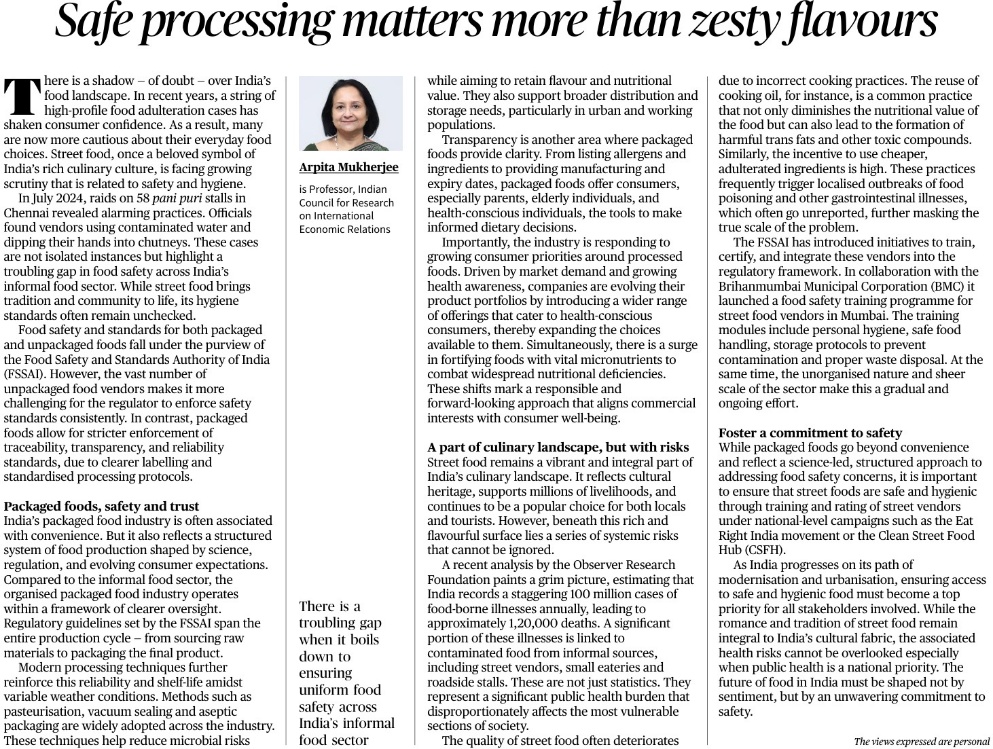
1. CONTEXT ·
India’s food safety landscape has come under intense scrutiny in recent years due to a series of high-profile food adulteration cases, especially involving popular street foods. These incidents have shaken public confidence, highlighted gaps in food hygiene and informal food processing, and sparked discussions on the need for scientific, regulated, and safe food production practices. · The article uses recent examples—such as the 2024 Chennai pani puri scandal—to illustrate widespread problems in India’s informal food ecosystem and argues that safe processing must take precedence over taste, tradition, or convenience. 2. WHAT THIS IS ABOUT The article focuses on:
1. Food safety concerns in India’s informal food sector 2. Importance of structured processing systems for packaged foods 3. Role of regulatory frameworks such as the FSSAI 4. Health risks associated with unhygienic practices 5. Need for training, certification, and traceability for street vendors 6. The larger challenge of ensuring uniform food safety across India The author argues that while India’s street food culture is rich and vibrant, a lack of standardization, hygiene, and regulatory oversight creates risks that surpass flavour and nostalgia.
3. DETAILED ANALYSIS
A. Rise of Food Safety Incidents Recent episodes of:
contaminated water usage · unhygienic dipping of hands in chutneys · adulterated oils and reused cooking fat have exposed systemic issues in the food ecosystem. · The Chennai incident is not isolated—states have repeatedly reported similar issues, indicating a national-level gap in informal food safety.
B. Packaged Foods vs Unpackaged Foods
1. Packaged Foods Under strict purview of FSSAI High compliance requirements: · traceability · labelling · shelf-life norms · scientific processing · Methods like pasteurisation, aseptic packaging, heat treatment reduce risks.
2. Street / Unpackaged Foods · Highly decentralized · Vendor-dependent hygiene · Minimal traceability · Limited accountability · The author emphasizes that packaged food, despite being commercial, is often safer due to consistency of standards.
C. Health Risks in Informal Food Sector Problems include: · Reuse of cooking oil → toxic compounds, trans fats · Contaminated ingredients · Poor waste disposal · No temperature control · Cross-contamination These lead to outbreaks of: · food poisoning · diarrheal diseases · gastrointestinal infections · Yet most cases go under-reported, masking the scale of the problem.
D. Economic Impact of Unsafe Food · Unsafe food causes massive health costs. · Research estimates foodborne illnesses may cause 120,000 deaths annually in India.
Significant burden falls on: · women · elderly · children · poor households · Unsafe food also reduces workforce productivity and increases public health expenditure.
E. The Urbanisation Challenge As cities grow: · more people rely on informal food vendors · pressure for cheap, fast food increases · storage and contamination risks grow · This makes safe processing even more crucial.
F. Government and Regulatory Initiatives 1. FSSAI Interventions Efforts include: · training food handlers · vendor certifications · hygiene ratings · Clean Street Food Hub (CSFH) initiative · Eat Right India movement
2. Municipal Collaborations · Example: BMC’s food safety training programme Training covers: · personal hygiene · safe storage · waste disposal · contamination prevention · However, coverage remains limited due to the scale and informality of the sector.
G. Need for Scientific, Structured, Standards-Based Approach The author argues: · Food safety must reflect science, not sentiment. · Should be based on traceability, accountability, and standardised processing. Demand for healthier options is increasing → the food industry evolving toward: · nutrient fortification · consistent quality · reduced toxic ingredients
H. Cultural Importance vs Health Risks · Street food is a crucial part of Indian culinary identity, but the romance of flavours cannot overshadow health hazards. · Ensuring safe food is a public health priority, not just a consumer preference.
4. TAKEAWAYS · Food safety requires systemic reforms, not just vendor discipline. · Packaged food may be safer not because it is superior but due to regulation and standardisation. · Informal food sector needs better integration, scientific training, and regulatory oversight. · Public health must guide food choices—safe processing > flavour.
MAINS QUESTION
Q. India’s vibrant street food culture is central to its culinary heritage, yet it poses significant public health risks due to inadequate regulation and unsafe processing practices. Discuss the challenges in ensuring food safety in India’s informal food sector and suggest measures to strengthen regulatory frameworks and public health outcomes.
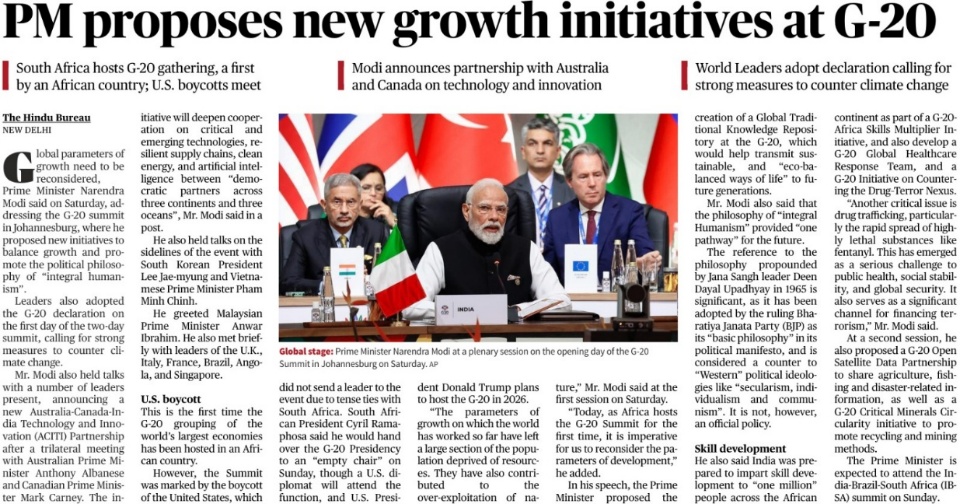
1. CONTEXT ·
The 2025 G-20 Summit, hosted for the first time by an African country (South Africa) at Johannesburg, saw India calling for a rethink of global growth parameters and proposing new multilateral initiatives. · Prime Minister Narendra Modi emphasised the philosophy of Integral Humanism, resilient global supply chains, cooperation on cutting-edge technologies, climate action, traditional knowledge preservation, and new partnerships with Australia and Canada. · The summit also witnessed U.S. absence due to geopolitical reasons, raising questions about global leadership.
2. WHAT IS THE ISSUE ABOUT? The article highlights India’s major proposals and interventions at the G-20, including: · Need to reassess global growth models · Announcing technology and innovation partnerships · New initiatives on traditional knowledge, healthcare, drug-terror nexus, minerals circularity, and satellite data · The geopolitical backdrop of the USA boycotting the meet · Expanding cooperation with Global South, especially Africa · Strong global measures needed for climate action · The central theme is India’s attempt to shape global governance through inclusive, human-centric, and sustainable frameworks.
Leave large populations deprived of resources · Promote over-exploitation of nature · Ignore sustainable and inclusive development · He proposed a shift towards “Integral Humanism”, a philosophy rooted in balancing material progress with human welfare and environmental sustainability.
B. New India-led Initiatives at G-20
1. Australia–Canada–India Technology & Innovation Partnership (ACITT) · Deepens cooperation in AI, clean energy, critical & emerging technologies, and resilient supply chains. · Strengthens the democratic technology alliance across three continents.
2. Global Traditional Knowledge Repository · A platform for documenting and sharing sustainable and eco-balanced lifestyles. · Aimed at preserving indigenous knowledge and promoting sustainable living.
3. G-20 Healthcare Response Team · Strengthens global ability to handle pandemics and health emergencies. · A step towards global health security architecture.
4. G-20 Initiative on Countering the Drug-Terror Nexus · Focus on rising narcotics trade (e.g., fentanyl) and its links to terrorism financing. · Recognised as a global threat to public health, social stability, and security.
5. G-20 Open Satellite Data Partnership · Sharing satellite data for agriculture, disaster-related information, and climate resilience.
6. G-20 Critical Minerals Circularity Initiative · Promotes recycling, reducing dependency on high-risk mineral supply chains. · Supports India’s clean-energy transition and material security.
7. G-20 Africa Skills Multiplier Initiative · India commits to impart skill development to one million young Africans. · Strengthens India-Africa partnership and Global South leadership.
C. Climate Action at G-20 The leaders adopted a declaration urging:
Stronger measures to counter climate change · Equitable green transitions · Increased climate finance · Global support for adaptation efforts · India emphasised balancing developmental needs with climate responsibilities.
D. Geopolitical Element: U.S. Boycott · The U.S. left the summit chair vacant due to tensions with South Africa. · Raises concerns about commitment of major powers to multilateralism. · India’s active participation contrasted with the U.S. absence, enhancing India’s leadership profile.
E. India's Soft Power: “Integral Humanism” · PM Modi referenced Deen Dayal Upadhyaya’s 1965 philosophy. · Presented as an alternative to Western economic thinking (individualism, materialism). · Promotes balanced, human-centric growth. · Though not an official G-20 concept, it adds to India’s normative influence.
F. India’s Broader Strategic Goals Reflected · Leadership of Global South · Credibility as a responsible global actor · Promoting technology standards aligned with democratic values · Reducing dependence on China-centric supply chains · Strengthening multilateral solutions to climate, health, and security challenges
MAINS QUESTION
Q. “India’s proposals at the 2025 G-20 Summit reflect a shift towards a more human-centric, sustainable, and inclusive model of global governance.” Discuss.
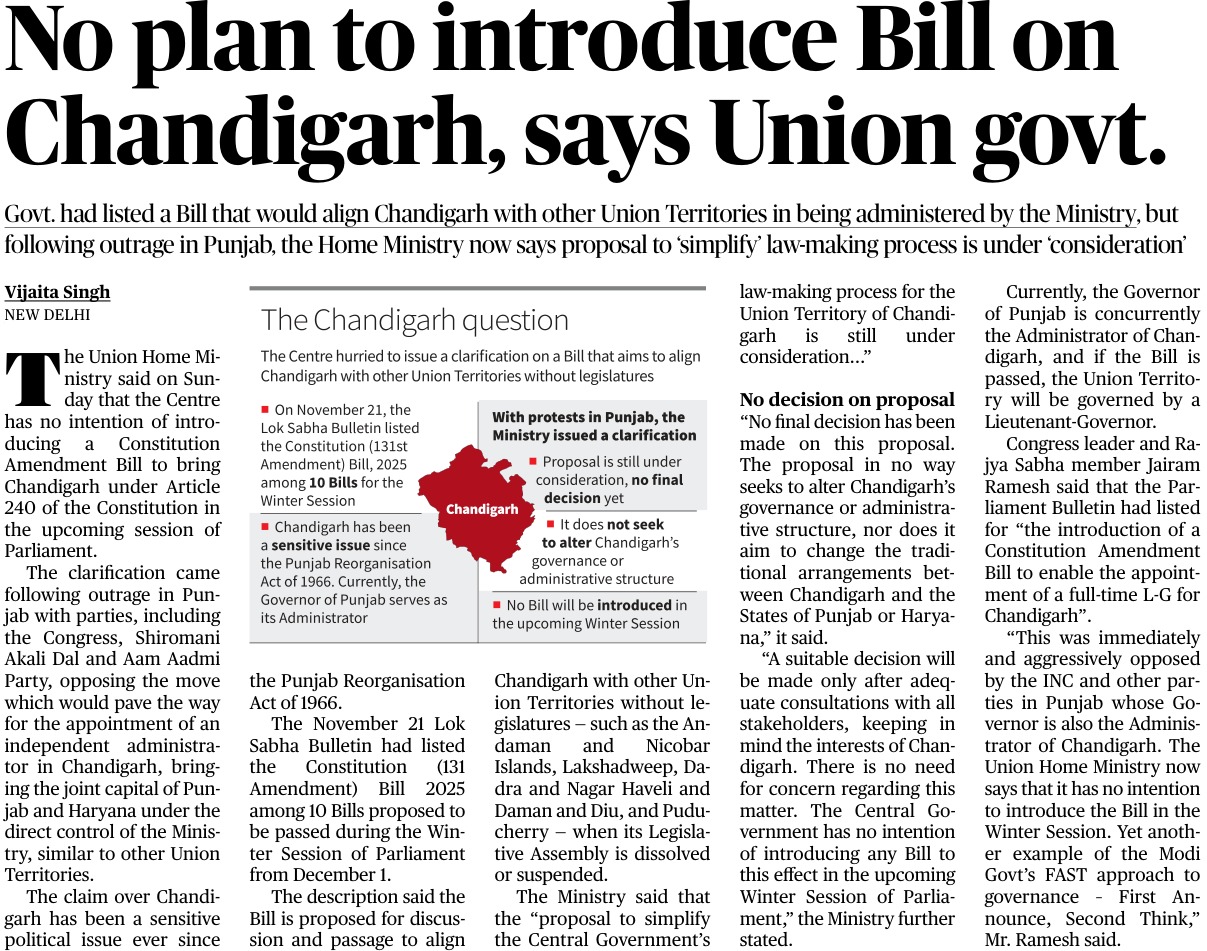
1. CONTEXT ·
The Union Home Ministry has clarified that the Central Government has no intention of introducing a Constitution Amendment Bill in the upcoming Winter Session to bring Chandigarh under Article 240—a provision used to administer Union Territories without legislatures. This clarification came after strong political outrage in Punjab, where parties feared that such a move would: · Alter Chandigarh’s existing administrative structure, · Pave the way for a separate Administrator/Lieutenant Governor, and · Disturb the historical arrangements between Punjab, Haryana, and Chandigarh laid since the Punjab Reorganisation Act, 1966. · The controversy erupted after the Lok Sabha Bulletin listed the Constitution (131st Amendment) Bill, 2025 among Bills proposed for the Winter Session—leading many to assume that Chandigarh’s administrative setup might be changed.
2. WHAT THIS IS ABOUT The Centre issued a clarification explaining: · The proposal is only under consideration as part of a broader exercise to simplify the law-making process for Union Territories. · No final decision has been taken. The proposed Bill does NOT aim to change: · Chandigarh’s governance structure · The administrative relationship with Punjab or Haryana · No Bill will be introduced in the upcoming Winter Session.
3. KEY PROVISIONS / KEY POINTS
A. Background: Why is Chandigarh sensitive?
Chandigarh has been a contentious and emotive issue since 1966. Under the Punjab Reorganisation Act, 1966: ·
Chandigarh became a Union Territory. · Governor of Punjab acts as the ex-officio Administrator of Chandigarh. · Any move altering this arrangement is politically sensitive.
B. What did the Lok Sabha Bulletin mention? · Listed the Constitution (131st Amendment) Bill, 2025 meant to align Chandigarh with other UTs without legislatures (like Andaman & Nicobar, Lakshadweep, Daman & Diu, Dadra & Nagar Haveli, etc.). · Caused speculation that Chandigarh may get a separate LG and its governance may be altered.
C. Home Ministry’s Clarification ·
No decision finalised regarding the Bill. Aim (if any future proposal emerges) is merely to: · Simplify the law-making process for Chandigarh. · Bring administrative ease, NOT change political status. · No Bill will be introduced this session. · Stakeholder consultations will be held before any final move.
D. Political Reaction · Parties in Punjab (Congress, SAD, AAP) strongly opposed the idea of changing Chandigarh’s arrangement. Congress MP Jairam Ramesh accused the Centre of trying to: · Introduce a Bill enabling appointment of a full-time LG for Chandigarh, · Which was withdrawn following backlash.
E. Current administrative status remains unchanged · Governor of Punjab = Administrator of Chandigarh. · Centre affirms there is no change planned in this traditional arrangement.
4. WHY THIS MATTERS (Constitutional & Administrative Significance) · Chandigarh is crucial due to its shared capital status for Punjab and Haryana.
Any amendment under Article 240 could significantly shift: · Centre–State administrative dynamics · Federal relations · Political sensitivities in North India · Thus, clarifications were issued quickly to prevent escalation.
UPSC PRELIMS QUESTION
Q. Consider the following statements regarding the administration of Chandigarh:
1. Chandigarh is administered under the Punjab Reorganisation Act, 1966.
2. The Governor of Punjab functions as the ex-officio Administrator of Chandigarh.
3. Article 240 of the Constitution empowers only Parliament to create legislatures for Union Territories.
Which of the above statements are correct?
A. 1 and 2 only
B. 1 and 3 only
C. 2 and 3 only
D. 1, 2 and 3 Correct
Answer: A
1. CONTEXT · During the sidelines of the G-20 Summit in Johannesburg, Prime Minister Narendra Modi met South African President Cyril Ramaphosa to review and strengthen the India–South Africa bilateral partnership. · The discussions focused on trade, investment, mining, critical minerals, AI, food security, digital public infrastructure, skill development, and people-to-people ties. · The meeting highlights the growing strategic convergence between two leading nations of the Global South, especially in the context of G-20, BRICS, and IBSA cooperation platforms.
2. WHAT THIS IS ABOUT The article covers: · Key areas of cooperation discussed between India and South Africa · Strengthening bilateral ties in trade and strategic sectors · Collaboration in technology, innovation, youth exchange, and public digital platforms · The role of the Global South and joint efforts to amplify its voice on global governance issues · It also highlights India’s support for South Africa’s leadership as the first African host of a G-20 Summit.
3. KEY POINTS / KEY PROVISIONS A. Strengthening India–South Africa Partnership PM Modi and President Ramaphosa discussed enhancing cooperation in:
1. Trade and Investment · Review of the full spectrum of bilateral economic ties · Focus on diversifying trade and strengthening commercial linkages
2. Critical Minerals and Mining Cooperation in exploring, processing, and securing supply chains of critical minerals essential for: · clean energy transitions · electronics · batteries · semiconductors · Given South Africa’s rich mineral reserves and India’s demand for minerals like platinum group metals, rare earths and critical inputs—this collaboration has strategic significance.
B. Technology, AI & Digital Public Infrastructure (DPI) · Collaboration in Artificial Intelligence, digital technology, and DPI solutions such as India Stack. · India’s DPI is increasingly being adopted by Global South nations, and South Africa is exploring deeper partnerships in this sphere.
C. Food Security & Skill Development Both leaders: · Reviewed cooperation on food security challenges · Discussed skill development programmes · Emphasised developing tech-enabled youth talent ecosystems · Youth exchange programmes were discussed to enhance people-to-people ties.
D. Global South & Multilateral Cooperation PM Modi and President Ramaphosa agreed to: · Jointly amplify the voice of the Global South on global governance platforms · Continue strengthening IBSA (India–Brazil–South Africa) cooperation · Support multilateral reform efforts, including at the UN and G-20 · Build upon decisions made during India’s G-20 Presidency (2023) · South Africa’s leadership in hosting the first-ever G-20 Summit in Africa was appreciated.
E. Historical and Cultural Ties Both leaders recalled: · The long-standing friendship between India and South Africa · Shared struggles against colonialism and apartheid · Strong diplomatic partnership since the 1990s · This historical bonding shapes contemporary cooperation.
4. SIGNIFICANCE · Enhances India’s Africa outreach and Indo-Pacific vision · Strengthens supply chain resilience for critical minerals · Boosts South–South cooperation through platforms like G-20, BRICS, and IBSA · Aligns with India's vision of technology-led, inclusive development · Positions India and South Africa as key advocates of Global South interests
UPSC PRELIMS QUESTION
Q. With reference to India–South Africa cooperation, consider the following statements:
1. Critical minerals are an emerging area of bilateral engagement between India and South Africa.
2. India and South Africa cooperate under the IBSA framework.
3. South Africa is the first African country to host a G-20 Summit. Which of the above statements is/are correct?
A. 1 and 2 only
B. 2 and 3 only
C. 1 and 3 only
D. 1, 2 and 3
Correct Answer: D
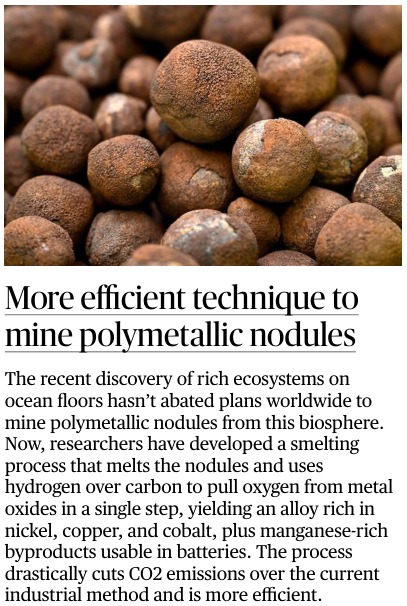
1. CONTEXT · Polymetallic nodules—potato-sized mineral concretions rich in nickel, cobalt, copper and manganese—lie scattered across deep ocean floors, especially in the Clarion-Clipperton Zone (CCZ) of the Pacific. · Despite concerns about the newly discovered deep-sea ecosystems and biodiversity, global interest in mining these resources remains strong due to their role in battery production and green technologies. · Recently, researchers have developed a new smelting method that significantly improves the efficiency and sustainability of extracting metals from these nodules.
2. KEY PROVISIONS / KEY FEATURES OF THE NEW TECHNIQUE
A. Hydrogen-Based Smelting Process · The new method melts polymetallic nodules and uses hydrogen instead of carbon to remove oxygen from metal oxides. · This single-step reduction process effectively separates metals.
B. Alloy Output · Produces an alloy rich in nickel, copper, and cobalt. · Also yields manganese-rich byproducts, which can be used in battery manufacturing.
C. Lower Environmental Footprint · Hydrogen replaces carbon, which drastically cuts CO₂ emissions compared with conventional smelting. · More energy-efficient than traditional extraction methods.
D. Industrial Significance · Offers a cleaner, faster, and more economical pathway for deep-sea mineral extraction. · Could accelerate the commercial mining of nodules despite ecological concerns.
UPSC PRELIMS QUESTION
Consider the following statements regarding Polymetallic Nodules and India’s Exclusive Economic Zone (EEZ):
1. Polymetallic nodules, rich in critical minerals, are mainly found in deep-sea regions beyond national EEZs, regulated under UNCLOS.
2. India has exploration rights for polymetallic nodules in the Central Indian Ocean Basin, granted by the International Seabed Authority (ISA). 3. Deep-sea mining of polymetallic nodules in India’s EEZ is currently commercially operational, contributing significantly to India’s mineral resources. How many of the above statements are correct?
A. Only one
B. Only two
C. All three
D. None
Answer: B
1. CONTEXT ·
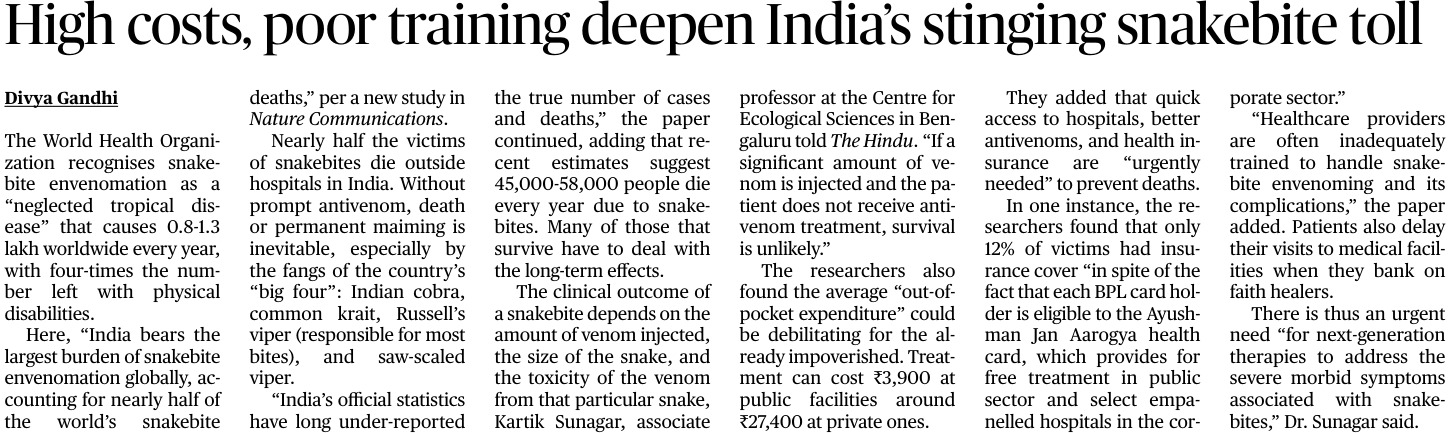
Snakebite envenomation is recognised by the WHO as a “neglected tropical disease”, causing 0.8–1.3 lakh deaths globally every year, and nearly four times more people suffer permanent disabilities. · India bears the largest global burden, accounting for nearly half of world snakebite deaths, Per a new study in nature communication. Most deaths occur outside hospitals, and many survivors face long-term complications. · A recent scientific study highlights how poor access to antivenom, inadequate healthcare training, high out-of-pocket costs, and reliance on traditional healers significantly worsen India’s snakebite crisis.
2. KEY PROVISIONS / KEY FINDINGS OF THE ARTICLE
A. Massive Underreporting & High Mortality · India’s official data historically underreports snakebite cases and deaths. · New estimates show 45,000–58,000 deaths per year in India alone. · Many victims die before reaching hospitals due to delayed treatment.
B. The “Big Four” Snakes Responsible for Most Deaths · Indian cobra · Common krait · Russell’s viper (responsible for most bites) · Saw-scaled viper · These snakes account for the majority of severe envenomation cases.
C. Determinants of Clinical Outcome · Amount of venom injected · Size of the snake · Toxicity of species-specific venom · Delay in receiving appropriate antivenom · Researchers emphasise: If venom is injected and antivenom isn’t administered promptly, survival is unlikely.
D. High Treatment Costs Burden the Poor Out-of-pocket costs remain extremely high: · ₹3,900 at government hospitals · Up to ₹27,400 at private hospitals · This is financially devastating for many rural families.
E. Poor Insurance Coverage · Only 12% of snakebite victims had insurance cover, even though BPL families are eligible for Ayushman Bharat. · Lack of awareness and poor enrolment limit benefits.
F. Inadequate Training of Healthcare Providers · Many healthcare providers are not properly trained to handle snakebite complications. · Patients often first approach faith healers, leading to fatal delays.
G. Need for Next-Generation Therapies · Current polyvalent antivenom is often ineffective against regional venom variations. · The article calls for next-generation antivenom technologies and improved rural healthcare capacity.
UPSC PRELIMS QUESTION
Q. With reference to snakebite envenomation in India, consider the following statements:
1. India accounts for nearly half of the world’s snakebite deaths.
2. Russell’s viper is responsible for the majority of snakebites in the country.
3. Ayushman Bharat provides free snakebite treatment to all patients regardless of income category.
4. Snakebite envenomation is classified by the WHO as a neglected tropical disease. Which of the statements given above are correct?
A. 1, 2 and 4 only
B. 1 and 3 only
C. 2, 3 and 4 only
D. 1, 2, 3 and 4
Answer: A
1. CONTEXT ·
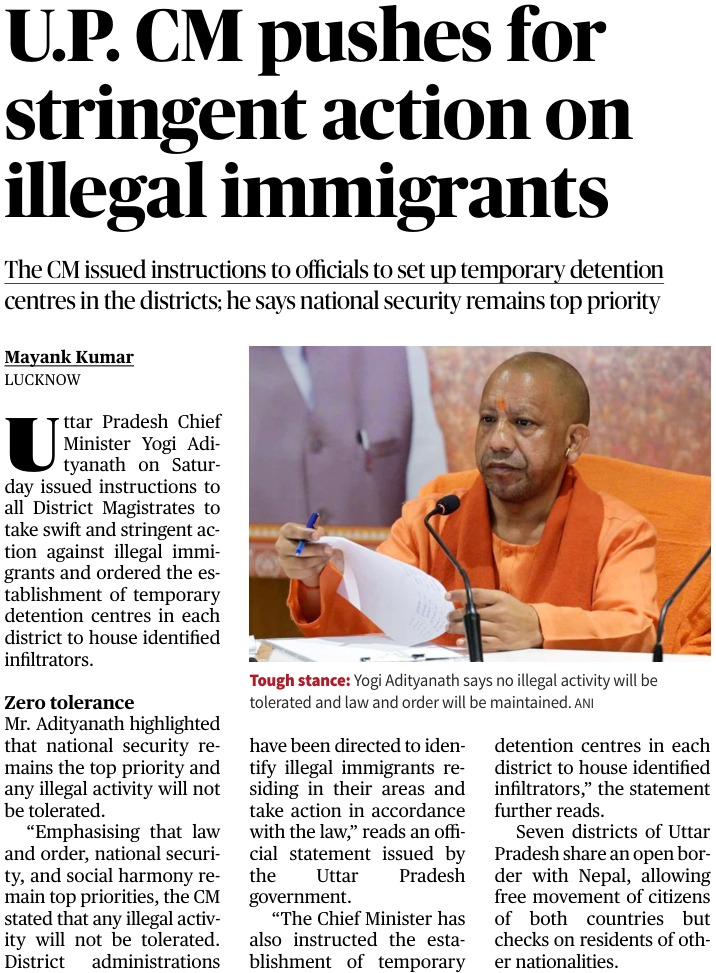
The Uttar Pradesh (U.P.) Chief Minister has directed district administrations to take swift and strict action against illegal immigrants, citing national security, law and order, and social harmony as top priorities. · The government has instructed all District Magistrates to identify illegal immigrants, take legal action, and establish temporary detention centres in every district to house those found without legal documentation. · This move is significant as seven districts of U.P. share an open border with Nepal, enabling free movement of citizens of both countries but requiring checks on non-Nepalese foreign nationals.
2. KEY PROVISIONS / KEY POINTS FROM THE ARTICLE
A. Strict Action Ordered Against Illegal Immigrants · District Magistrates have been instructed to identify, verify, and act against illegal immigrants. · Authorities must take action in accordance with existing laws.
B. Establishment of Temporary Detention Centres · U.P. will set up temporary detention centres in every district. · These centres will house identified infiltrators until further processing.
C. National Security as Central Justification · Government highlights national security, law and order, and social harmony as the rationale. · The CM emphasised zero tolerance for illegal activity.
D. Administrative Coordination · District administrations must ensure vigilance, verification drives, and cooperation with law enforcement.
E. Border Considerations · Seven U.P. districts share an open border with Nepal. · The border allows free movement only for Indian and Nepalese citizens. · Hence, authorities must check and verify citizens of other nationalities, preventing illegal entry.
UPSC PRELIMS QUESTION
Q. Which of the following ministry responsible for illegal immigrants in India
A. Ministry of Defence
B. Ministry of Home Affairs
C. Ministry of Law and Justice
D. Ministry of Railway
Answer: B
2. KEY PROVISIONS / KEY TAKEAWAYS FROM THE ARTICLE A. Two Global Roadmaps Proposed
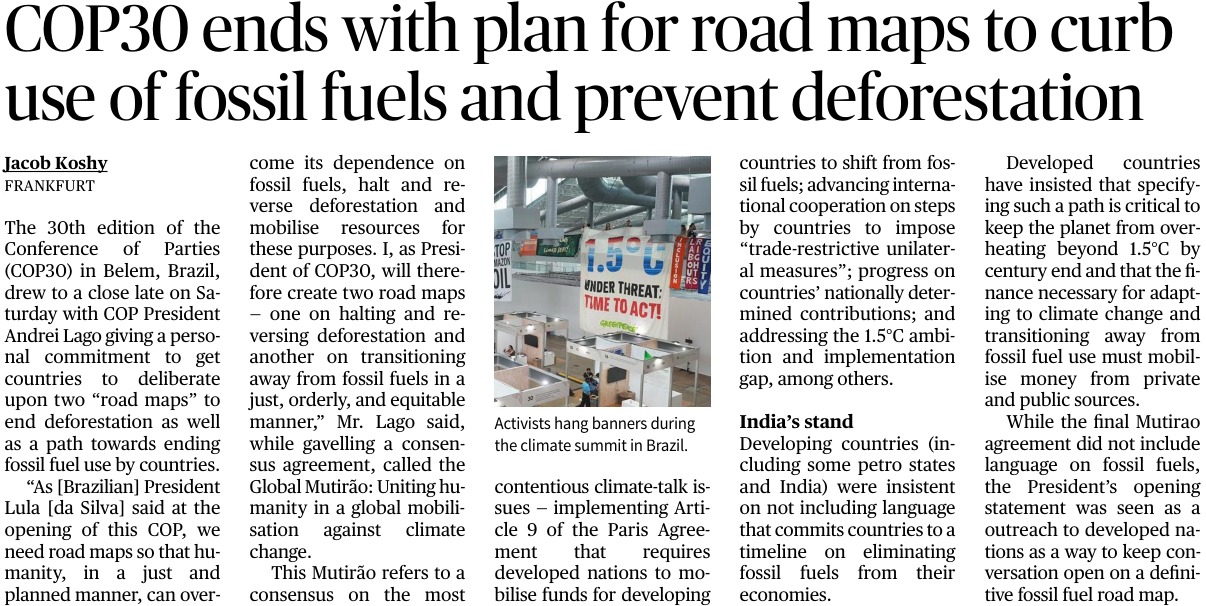
1. Roadmap for Ending Deforestation · Target: Halt and reverse deforestation worldwide. · Emphasis on sustainable development, protection of biodiverse regions (especially Amazon), and climate justice. 2. Roadmap for Phasing Out Fossil Fuels · Goal: Transition countries away from fossil fuels in an equitable, planned manner. · Recognises differentiated responsibilities and national circumstances.
B. Contentious Issues at COP30 · Finance (Article 9 of Paris Agreement) Developing countries demanded that developed nations mobilise climate finance. · Developed countries insisted finance must come from both public and private sources. · Fossil Fuel Language Petro-states and some developing countries (including India) opposed explicit language committing countries to eliminate fossil fuels. · Result: Final agreement avoided hard commitments on fossil-fuel phase-out.
C. Progress Areas Identified · Advancing global cooperation to prevent unilateral trade-restrictive climate measures. · Strengthening implementation of Nationally Determined Contributions (NDCs). · Addressing the 1.5°C ambition gap with enhanced action and monitoring.
D. Significance of the COP President’s Announcement · Though not part of the negotiated text, the statement acts as a political signal. · Seen as outreach to developed nations to maintain dialogue on fossil fuel transition. · Keeps pressure alive for COP31 discussions on a concrete global fossil fuel roadmap.
3. INDIA’S STAND · India, along with several developing and fossil-fuel-dependent nations, objected to language explicitly requiring elimination of fossil fuels.
It emphasised principles of: · Common but Differentiated Responsibilities (CBDR) · National developmental needs · Fair timelines & equity
UPSC PRELIMS QUESTION
Q. With reference to recent global climate negotiations, consider the following statements: 1. At COP30, a proposal was announced to prepare separate global roadmaps for ending deforestation and transitioning away from fossil fuels.
2. Article 9 of the Paris Agreement relates to climate finance obligations of developed countries.
3. The final COP30 agreement included explicit language committing countries to eliminate fossil fuel use by 2050. Which of the statements given above is/are correct?
A. 1 and 2 only
B. 2 and 3 only
C. 1 only
D. 1, 2 and 3
Answer: A
Context:
Key Points
Key Points
 Launch your Graphy