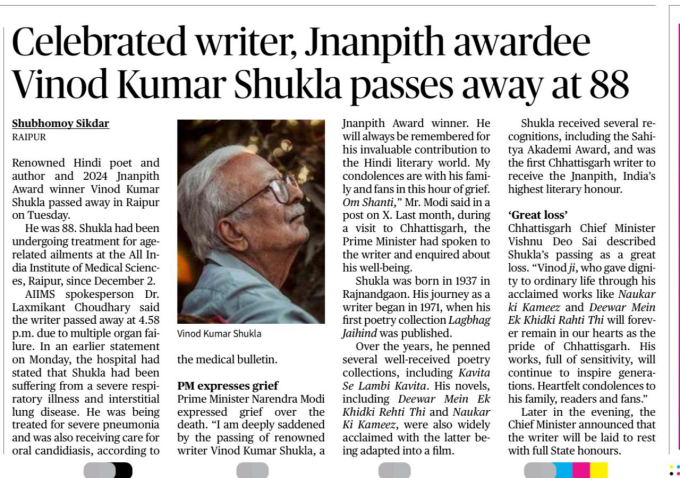
Renowned Hindi poet and author Vinod Kumar Shukla, a 2024 Jnanpith Award recipient, passed away in Razipur at the age of 88, marking a major loss to Indian literary and cultural life.
Key Points
About Vinod Kumar Shukla • Eminent Hindi poet, novelist, and short-story writer from Chhattisgarh. • Born in 1937 in Rajnandgaon, his literary career began in 1971. • Known for giving dignity to ordinary life through simple yet profound language. Major Literary Works • Poetry collections such as Lagbhag Jaihind and Kavita Se Lambi Kavita. • Acclaimed novels include Naukar Ki Kameez and Deewar Mein Ek Khidki Rehti Thi. • Naukar Ki Kameez was adapted into a feature film. Awards and Recognition • Awarded the Jnanpith Award (2024), India’s highest literary honour. • Recipient of the Sahitya Akademi Award. • First writer from Chhattisgarh to receive the Jnanpith Award. Legacy • His writings are noted for minimalism, sensitivity, and humanism. • Regarded as one of the most original voices in modern Hindi literature. • His works continue to influence generations of readers and writers. Jnanpith Award • Instituted in 1961, first awarded in 1965. • Conferred annually by Bharatiya Jnanpith. • Recognises outstanding contributions to Indian literature in English and Indian languages. • Award includes ₹11 lakh, a Vagdevi (Saraswati) statue, and a citation.
• Given only to Indian citizens and not awarded posthumously.
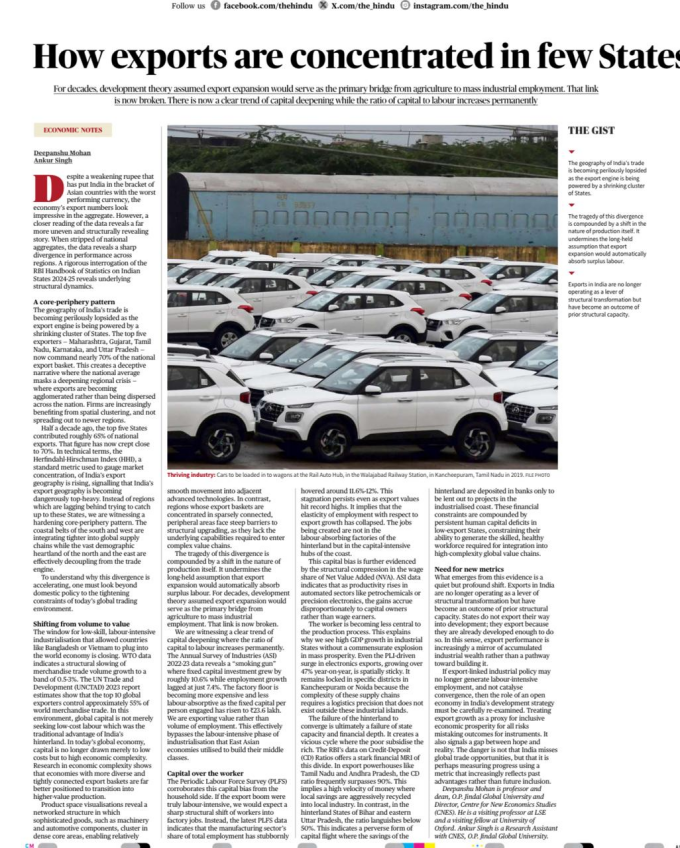
How exports are concentrated in few States
Context
The article examines how India’s export growth, despite appearing strong in aggregate terms, is increasingly concentrated in a few States. The authors argue that this pattern reflects deeper structural changes in India’s economy, particularly the shift from labour-intensive to capital-intensive production.
Detailed Analysis 1. Export Growth with Structural Imbalance • Aggregate export figures suggest resilience, but disaggregated data reveal sharp regional divergence. • A small group of States now dominates India’s export basket, masking stagnation in many other regions. 2. Core–Periphery Pattern in Indian Exports • States such as Maharashtra, Gujarat, Tamil Nadu, Karnataka, and Uttar Pradesh account for nearly 70% of national exports. • Earlier, about half the States contributed around 65%, indicating increasing spatial concentration rather than diffusion of export capacity. 3. Capital-Intensive Bias in Export Sectors • Export growth is driven largely by capital-intensive and automated sectors like petrochemicals, electronics, and precision manufacturing. • These sectors generate high value but absorb limited labour, weakening the traditional link between exports and mass employment. 4. Breakdown of the Labour-Absorption Assumption • Development theory assumed export expansion would shift surplus labour from agriculture to industry. • The article highlights that this assumption no longer holds, as capital-to-labour ratios are rising permanently, reducing employment elasticity of exports. 5. Inland vs Coastal Divide • Coastal and western States benefit from logistics, ports, supply-chain integration, and skilled labour pools. • Inland and eastern States face structural deficits such as weaker infrastructure, limited financial depth, and human capital constraints. 6. Financial and Institutional Asymmetries • States with high exports also show stronger financial intermediation, reflected in higher credit–deposit ratios. • In contrast, surplus savings from poorer States are often recycled to industrial hubs, reinforcing regional inequality. 7. Exports as Outcome, Not Driver • The authors argue exports are now an outcome of prior industrial capacity, not a trigger for transformation. • Treating exports as a proxy for inclusive growth risks misdiagnosing structural stagnation in lagging regions.
Suggestions Highlighted by the Authors
• Reorient industrial policy towards labour-intensive and employment-generating sectors. • Strengthen inland States’ capacity through investment in human capital, logistics, and urban-industrial ecosystems. • Avoid using export growth alone as a development metric; focus instead on employment quality and regional balance. • Integrate export strategy with domestic demand expansion and skill development.
The upskilling gap: why women risk being left behind by AI
Context
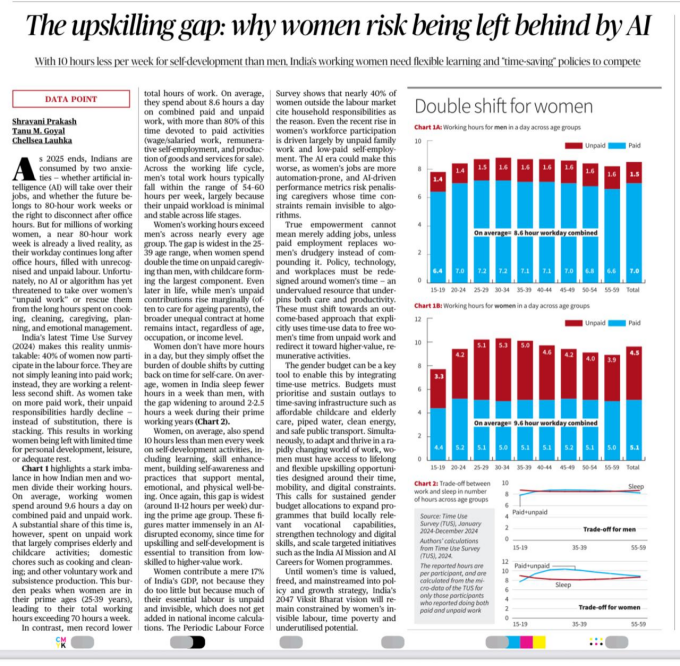
The article examines how artificial intelligence (AI) and automation risk deepening existing gender inequalities in India’s workforce, as women face severe time poverty due to unpaid care work, limiting their ability to upskill and adapt to an AI-driven economy.
Detailed Analysis
1. Women’s Workload: The Invisible Double Shift • Indian women work longer total hours than men when paid and unpaid work are combined. • Time Use Survey (2024) shows women spend around 9.6 hours a day on combined work, compared to 8.6 hours for men. • Over 80% of women’s time is absorbed by unpaid caregiving, domestic chores, and subsistence work. Example from article: Women in the 25–39 age group spend nearly double the time men spend on unpaid caregiving, especially childcare.
2. Time Poverty and the Upskilling Deficit • Women spend 10 hours less per week than men on self-development activities such as learning, skill enhancement, and self-care. • Sleep deprivation is higher among working women, with an average 2–2.5 hours less sleep per week during prime working years. • This severely constrains women’s ability to engage in AI-related reskilling, which demands continuous learning. 3. AI and Automation: A Gendered Risk • Jobs dominated by women are often low-paid, informal, and automation-prone. • AI-driven performance metrics may penalise caregivers, as care-related constraints remain invisible to algorithms. • Increased participation of women in the workforce has been driven more by unpaid family labour and self-employment, not secure wage employment. 4. Structural Inequality in Economic Contribution • Women contribute only 17% of India’s GDP, not due to low productivity, but because unpaid labour is excluded from national income calculations. • Nearly 40% of women outside the labour force cite household responsibilities as the primary reason. • AI risks reinforcing this inequality unless paid employment replaces unpaid drudgery. 5. Policy Blind Spots in the AI Transition • Current labour laws and AI strategies ignore women’s time constraints. • Upskilling programmes assume availability of “free time”, which women structurally lack. • Without redesigning work and learning systems, AI may widen gender gaps instead of closing them. Suggestions of the Author 1. Redesign Policy Around Women’s Time • Treat women’s time as an economic resource, not an infinite buffer. • Use time-use data explicitly in policymaking and budgeting. 2. Gender-Responsive Budgeting • Integrate time-use metrics into gender budgets. • Prioritise sustained investment in time-saving infrastructure such as: • Affordable childcare and eldercare • Clean cooking energy • Piped water • Reliable public transport 3. Flexible and Lifelong Upskilling • Provide flexible, modular, and digital learning opportunities aligned with women’s schedules. • Ensure access to AI and digital skills training tailored to mobility and caregiving constraints. • Strengthen initiatives like AI Mission and Careers for Women programmes. 4. Shift from Job Creation to Time Liberation • True empowerment requires replacing unpaid work with paid employment, not stacking responsibilities. • Technology and workplaces must be designed to reduce women’s unpaid workload, not merely increase productivity. Conclusion AI will not automatically empower women. Without recognising and reducing unpaid care burdens, women risk being systematically excluded from the future of work. Bridging the upskilling gap requires valuing women’s time, redesigning labour and learning systems, and embedding gender justice at the core of India’s AI and growth strategy. Otherwise, India’s demographic and technological dividend will remain underutilised.
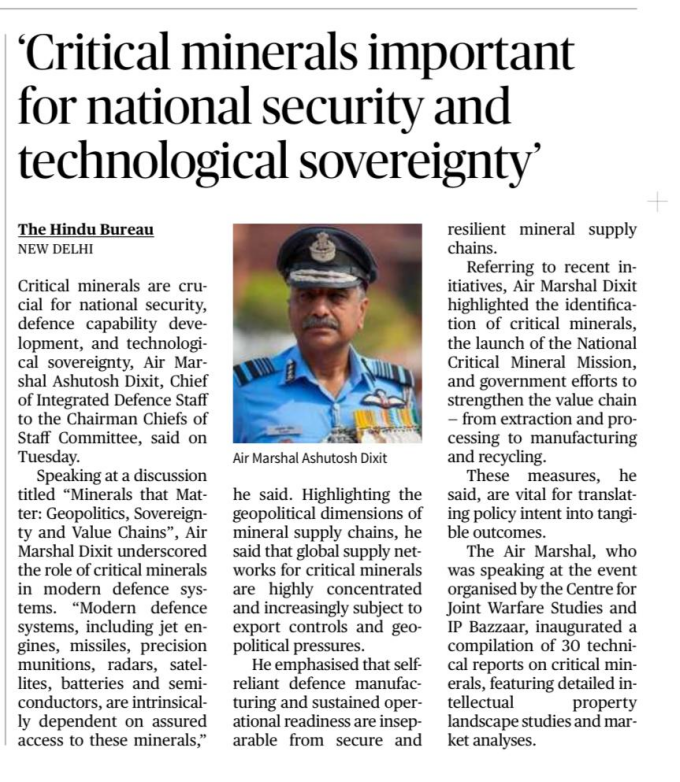
Critical minerals important for national security and technological sovereignty
Context
Senior defence leadership highlighted that critical minerals are essential for national security, defence preparedness, and technological sovereignty, amid global supply chain concentration and geopolitical risks.
Key Points
Why Critical Minerals Matter • Essential for defence systems such as jet engines, missiles, radars, satellites, batteries, and semiconductors. • High import dependence exposes India to export controls, geopolitical pressure, and supply disruptions. Geopolitical and Supply Chain Risks • Global supply of critical minerals is highly concentrated in a few countries. • Increasing use of export restrictions makes secure access a strategic necessity. India’s Policy Response • Government has identified critical minerals and prioritised supply chain resilience. • Emphasis on strengthening the entire value chain from extraction to recycling. National Critical Mineral Mission (NCMM) Overview • Approved by the Union Cabinet with an outlay of ₹34,300 crore over seven years. • Aligned with Atmanirbhar Bharat and national security objectives. Objectives • Reduce import dependence for high-tech industries, clean energy, and defence. • Ensure long-term availability of critical minerals for strategic sectors. Scope of the Mission • Covers exploration, mining, beneficiation, processing, recycling, and recovery from end-of-life products. • Includes onshore and offshore mineral exploration. Institutional Approach • Whole-of-government approach involving ministries, PSUs, private sector, and research institutions. • Fast-track approvals for critical mineral mining projects. Strategic Measures • Stockpiling of critical minerals to meet future demand shocks. • Encourages overseas acquisition of mineral assets and partnerships with resource-rich countries. Infrastructure and Innovation • Establishment of mineral processing parks. • Promotion of recycling and circular economy for critical minerals. • Creation of a Centre of Excellence for Critical Minerals. • Expansion of PRISM initiative to support startups and MSMEs in the sector. • Financial incentives to promote domestic processing units. National Security Dimension • Self-reliant access to critical minerals is vital for defence manufacturing readiness and technological autonomy. • Secure mineral supply chains are inseparable from economic security and strategic autonomy.
RBI announces fresh measures to inject ₹2.90 lakh cr. Liquidity
Context
The Reserve Bank of India (RBI) announced a fresh set of liquidity infusion measures to ease tight liquidity conditions in the banking system and manage pressures arising from forex market operations.
Key Points
Liquidity Infusion Measures • RBI will inject ₹2.90 lakh crore into the banking system through multiple instruments. • Measures include Open Market Operations (OMO) and dollar-rupee swap auctions. Open Market Operations (OMO) • RBI will conduct OMO purchase auctions of Government of India securities worth ₹2,00,000 crore. • Purchases will be done in four tranches of ₹50,000 crore each. • Auction dates: December 29, 2025; January 5, 12 and 22, 2026. • Objective: Increase rupee liquidity by injecting durable liquidity into banks. Dollar-Rupee Swap Auction • RBI will conduct a $10 billion dollar-rupee swap auction. • Tenor: 3 years. • Auction date: January 13, 2026. • Purpose: Absorb excess dollar liquidity while injecting rupees into the system. Rationale Behind the Measures • Excess dollar liquidity had inflated the dollar-rupee forward premium. • RBI had sold $11.88 billion in the inter-bank forex market in October 2025 to arrest rupee depreciation. • These steps provide a breather to declining foreign exchange reserves while stabilising liquidity. Expected Impact • Improves banking system liquidity and credit flow. • Helps stabilise forex markets and forward premiums. • Supports overall financial stability and economic activity. Reserve Bank of India • RBI is India’s central bank, responsible for monetary policy, currency management, banking regulation, and financial stability. • Liquidity management tools include OMO, repo/reverse repo, CRR, SLR, and forex swaps.
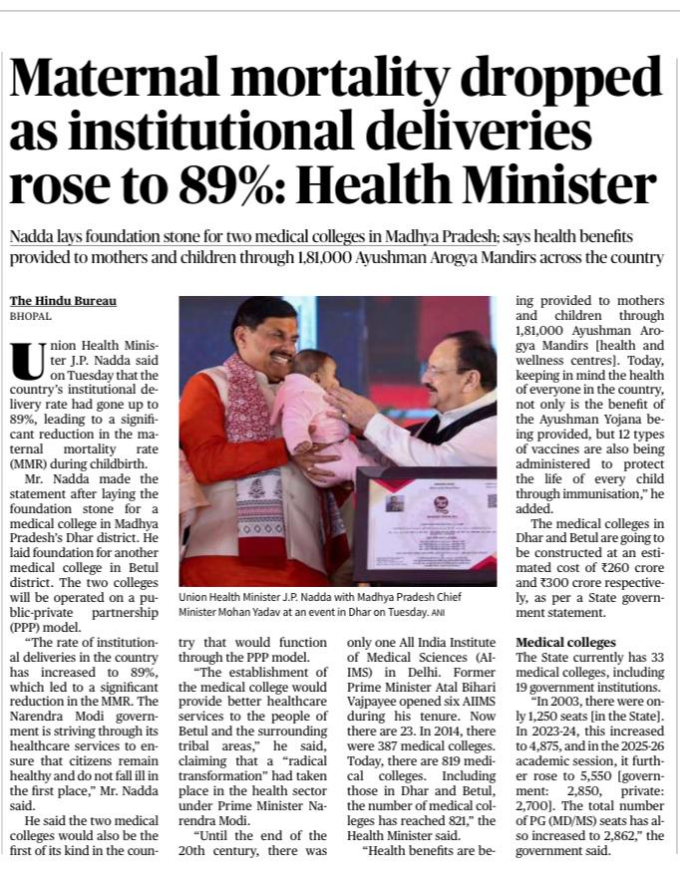
Maternal mortality dropped as institutional deliveries rose to 89%: Health Minister
Context
The Union Health Minister stated that a sharp rise in institutional deliveries to 89% has led to a significant decline in Maternal Mortality Ratio (MMR) in India, highlighting improvements in public health infrastructure.
Key Points
Improvement in Maternal Health • Institutional delivery rate increased to 89% nationwide. • Rise in hospital-based births has resulted in a substantial reduction in maternal deaths during childbirth. Government Health Interventions • Expansion of Ayushman Arogya Mandirs across the country. • Around 1,81,000 Ayushman Arogya Mandirs providing maternal, child health, and preventive care. • Strengthened immunisation coverage to protect maternal and child health. Medical Education Expansion • Foundation stone laid for two new medical colleges in Dhar and Betul districts of Madhya Pradesh. • Colleges to be developed under the Public-Private Partnership (PPP) model. • Aim is to improve access to healthcare, especially in tribal and underserved regions. Growth in Medical Infrastructure • Number of medical colleges increased from 387 in 2014 to over 819 currently. • Total MBBS seats rose to over 1 lakh, and PG seats crossed 2.8 lakh. • Madhya Pradesh alone has seen a significant rise in medical institutions and seats. Ayushman Bharat Initiative • Focus on preventive, promotive, curative, rehabilitative, and palliative care. • Strengthens primary healthcare delivery and early maternal risk detection. • Contributes to reducing out-of-pocket expenditure and improving access. Expected Outcomes • Sustained decline in maternal and infant mortality rates. • Improved healthcare availability in rural and tribal regions. • Enhanced doctor availability and healthcare quality through medical education expansion.
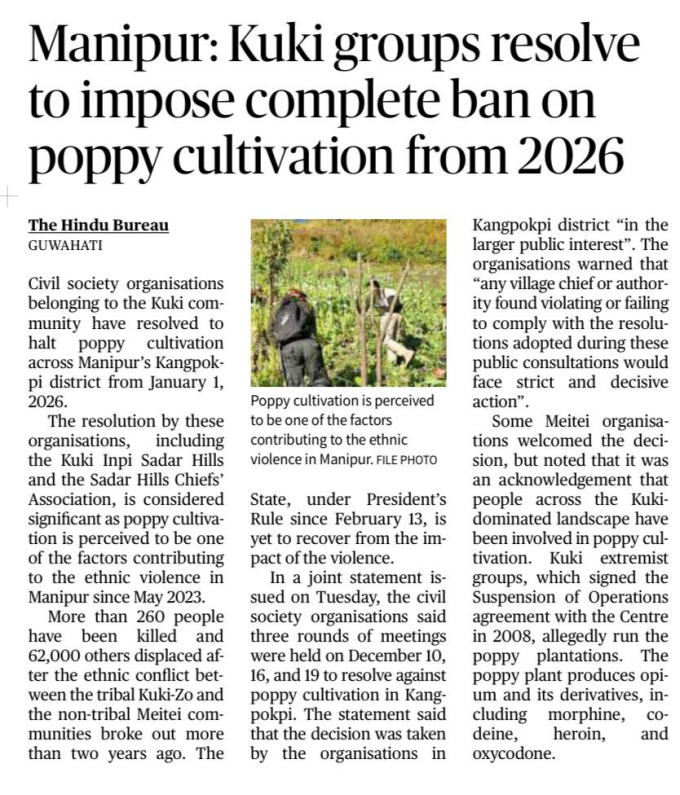
Manipur: Kuki groups resolve to impose complete ban on poppy cultivation from 2026
Context
Civil society organisations of the Kuki community in Manipur’s Kangpokpi district have resolved to impose a complete ban on poppy cultivation from January 1, 2026, citing public interest and its linkage with ethnic violence.
Key Points
Decision by Kuki Civil Society • Resolution adopted after three rounds of public consultations in December. • Key organisations include Kuki Inpi Sadar Hills and Sadar Hills Chiefs’ Association. • Ban applies across Kangpokpi district. Link with Ethnic Violence • Poppy cultivation is perceived as one factor fuelling ethnic conflict in Manipur since May 2023. • The State has witnessed over 260 deaths and large-scale displacement. • The region remains under President’s Rule. Enforcement Mechanism • Village chiefs or authorities violating the resolution will face strict and decisive action. • The ban is intended to ensure community-level accountability. Reactions from Other Groups • Some Meitei organisations welcomed the move. • They observed that the resolution implicitly acknowledges widespread involvement in poppy cultivation in Kuki-dominated areas. Security and Drug Nexus • Kuki extremist groups, signatories to the Suspension of Operations (SoO) agreement (2008), are alleged to be involved in poppy plantations. • Poppy plants produce opium and derivatives such as morphine, codeine, heroin, and oxycodone. • Drug trafficking is linked to insurgency financing and organised crime in the Northeast. Broader Implications • Strengthens the fight against narco-terrorism. • Supports efforts to restore law and order and social stability. • Highlights the role of community-led initiatives in conflict resolution.
CERT-In has issued an advisory warning WhatsApp users about an active cyber threat campaign using a new technique called GhostPairing, which enables unauthorised takeover of accounts without SIM swap or passwords.
Key Points
What is GhostPairing • GhostPairing is a cyberattack where hackers secretly link their device to a victim’s WhatsApp account. • It enables near-complete access to chats and data without alerting the user. Nature of the Threat • The attack does not require SIM swapping or passwords. • It exploits WhatsApp’s device-pairing feature through social engineering. Modus Operandi • Victims receive a message like “Hi, check this photo” from a trusted contact. • The link opens a fake Facebook-style preview page. • Users are prompted to verify by entering their phone number and pairing code. • This action unknowingly links the attacker’s device to the victim’s WhatsApp. Impact • Attackers gain access to messages, contacts, and media. • The victim may remain unaware as WhatsApp continues to function normally. Indian Computer Emergency Response Team (CERT-In) • National nodal agency for cyber incident response in India. • Functions under the Ministry of Electronics and Information Technology. • Designated under Section 70B of the Information Technology Act, 2000. • Responsibilities include incident alerts, advisories, coordination, and cyber threat mitigation. • Empowered to issue directions to service providers, intermediaries, and data centres. UPSC Prelims Practice Question GhostPairing, recently seen in news, is associated with which of the following statements? • It allows unauthorised access to WhatsApp accounts without SIM swapping. • It relies on malware installation through third-party mobile applications. Select the correct answer using the code below: A. 1 only B. 2 only C. Both 1 and 2 D. Neither 1 nor 2 Answer: A Explanation: GhostPairing exploits WhatsApp’s device-pairing mechanism through social engineering and does not require SIM swap or malware installation.
Source: Indian Express
With reference to the Indian Computer Emergency Response Team (CERT-In), consider the following statements: • CERT-In is the national agency designated to handle cyber security incidents under the Information Technology Act, 2000. • CERT-In functions under the administrative control of the Ministry of Home Affairs. Which of the statements given above is/are correct? A. 1 only B. 2 only C. Both 1 and 2 D. Neither 1 nor 2
Answer: A Explanation: • Statement 1 is correct: CERT-In is designated under Section 70B of the IT Act, 2000 as the national nodal agency for cyber security incident response. • Statement 2 is incorrect: CERT-In functions under the Ministry of Electronics and Information Technology (MeitY), not the Ministry of Home Affairs.
Paliyar Tribe
Syllabus: GS 1 – Indian Society – Tribal Communities in India
Context: Families belonging to the Paliyar tribe in Tamil Nadu’s Dindigul district have approached the district administration seeking official recognition and development of their long-existing settlement as a formal village.
Key Points Geographical distribution • Indigenous tribal community found mainly in the hilly regions of Tamil Nadu and Kerala, especially Dindigul district and Palani–Sirumalai hills of the Western Ghats. Alternative names • Known by various names such as Paliyans, Pazhaiyarares, and Panaiyars, reflecting regional variations. Language • Speak a Tamil-related dialect, belonging to the Dravidian linguistic family. Traditional occupation • Historically hunters and gatherers, dependent on forest resources of the Western Ghats. Present livelihood pattern • Engage in collection and trade of minor forest produce, food cultivation, beekeeping, and seasonal wage labour, especially in plantations. Traditional knowledge • Possess rich ethnobotanical knowledge, particularly in the use of medicinal plants. Social organisation • Live in small settlements called kudis, sometimes inhabiting caves or mud shelters. Cultural practices • Follow burial of the dead, not cremation, usually near their habitation on the western side. • Festivals are nature-centric, involving rituals, dance, music, and ceremonies to invoke rain and protect forest spirits.
SHAKTI Scholars – NCW Young Research Fellowship
Syllabus: GS 2 – Social Justice – Government Policies and Interventions for Women
Context: The National Commission for Women (NCW) has launched the SHAKTI Scholars – NCW Young Research Fellowship to promote policy-oriented, evidence-based research on women-centric issues and strengthen gender-responsive governance.
Key Points Nature of the fellowship • A six-month, grant-based research fellowship supporting young scholars and independent researchers. • Focuses on policy-relevant and multidisciplinary research related to women’s issues in India. Implementing authority • Launched by the National Commission for Women (NCW), a statutory body. Objectives • Encourage evidence-based research on women-centric challenges. • Build a pool of young researchers contributing to laws, schemes, and institutional reforms. Eligibility conditions • Indian citizens aged 21–30 years. • Minimum qualification: Graduation from a recognised institution. • Preference to candidates with PG, M.Phil., or PhD background in relevant disciplines. Financial and time support • Research grant of ₹1 lakh for fieldwork, data collection, and analysis. • Duration of 6 months, ensuring timely policy relevance. • Phased release of funds linked to progress and accountability. Major research themes • Women’s safety, dignity, and gender-based violence. • Legal rights, access to justice, and POSH implementation. • Cyber safety, health, education, nutrition, and skills. • Economic empowerment, labour force participation, and leadership. National Commission for Women (NCW) • A statutory and autonomous body established under the National Commission for Women Act, 1990. • Mandate: Protect and promote women’s rights and advise the government on policy and legal reforms. • Composition: Chairperson, 5 Members, and a Member-Secretary, nominated by the Central Government. • Term of office: 3 years. UPSC Prelims Practice Question
SHAKTI Scholars – Young Research Fellowship is often seen in the news. It is associated with which of the following institutions? A. Ministry of Women and Child Development B. National Commission for Women C. NITI Aayog D. University Grants Commission
Answer: B Explanation: The SHAKTI Scholars Fellowship is launched and administered by the National Commission for Women (NCW) to promote policy-oriented research on women-centric issues.
Source: DD News
Tamil Nadu launches conservation drive to protect smooth-coated otter in Cauvery delta
GS 3: Environment and Ecology – Biodiversity Conservation
Context
Tamil Nadu has launched a targeted conservation initiative to protect the smooth-coated otter in the Cauvery delta amid rising human–wildlife conflict, habitat degradation, and declining freshwater ecosystems.
Key Points
Ecological importance of smooth-coated otter • The largest otter species in Asia and a key indicator of wetland and riverine ecosystem health. • Lives in social groups called bevvies and hunts cooperatively, helping regulate fish populations. • Occupies irrigation canals, slow-flowing tributaries, and mangrove fringes, sheltering in earthen holts along riverbanks. Human–wildlife conflict in the Cauvery delta • Locally called “meenakutty” by fisherfolk due to its playful behaviour around nets and boats. • Reduced river flows and declining fish stocks have intensified competition with fishing communities. • Otters often get injured in fishing nets, while damaged gear and loss of catch affect livelihoods. Drivers of habitat stress • Pollution, pesticide runoff, and plastic waste degrading water quality. • Upstream dams and altered river flows reducing prey availability and suitable habitats. State-backed conservation programme • Announced in the Tamil Nadu Assembly as part of endangered species protection measures. • Focus areas include population assessment, behaviour studies, and habitat quality mapping. • Covers Thanjavur, Thiruvarur, and Cuddalore districts of the Cauvery delta. Legal status and funding • Listed as Vulnerable and protected under Schedule I of the Wildlife Protection Act, 1972. • ₹20 lakh administrative approval granted, with funding allocated for 2025–26.
UPSC Prelims Practice Question
The smooth-coated otter, recently in the news, is protected under which of the following provisions in India? A. Schedule II of the Wildlife Protection Act, 1972
B. Schedule I of the Wildlife Protection Act, 1972
C. Convention on Migratory Species (CMS) Appendix I only
D. Biological Diversity Act, 2002
Correct Answer: B Explanation: The smooth-coated otter is classified as Vulnerable and receives the highest level of legal protection under Schedule I of the Wildlife Protection Act, 1972, which covers species requiring strict conservation measures.



 Launch your Graphy