Daily Current Affairs for UPSC 22nd Nov 2025


Index
S.No Topic
Daily Hindu Analysis (YouTube)
1. Rethinking a symbol of ‘environment responsibility’
2. The new direction for India should be toward Asia
3. Centre notifies four new Labour Codes
4. Govt. plans to unify security regulations for 250 seaports
5. Modi meets Australian PM, discusses cooperation in trade, defence and security
6. Guidelines defining ‘obscenity’ in online content proposed
Daily Current Affairs (App)
7. Arunachal Pradesh dao gets GI tag
8. Coastal Security Exercise ‘Sagar Kavach’
9. Australia expands social media ban for under-16s to include Twitch
10. Acanthosis Nigricans


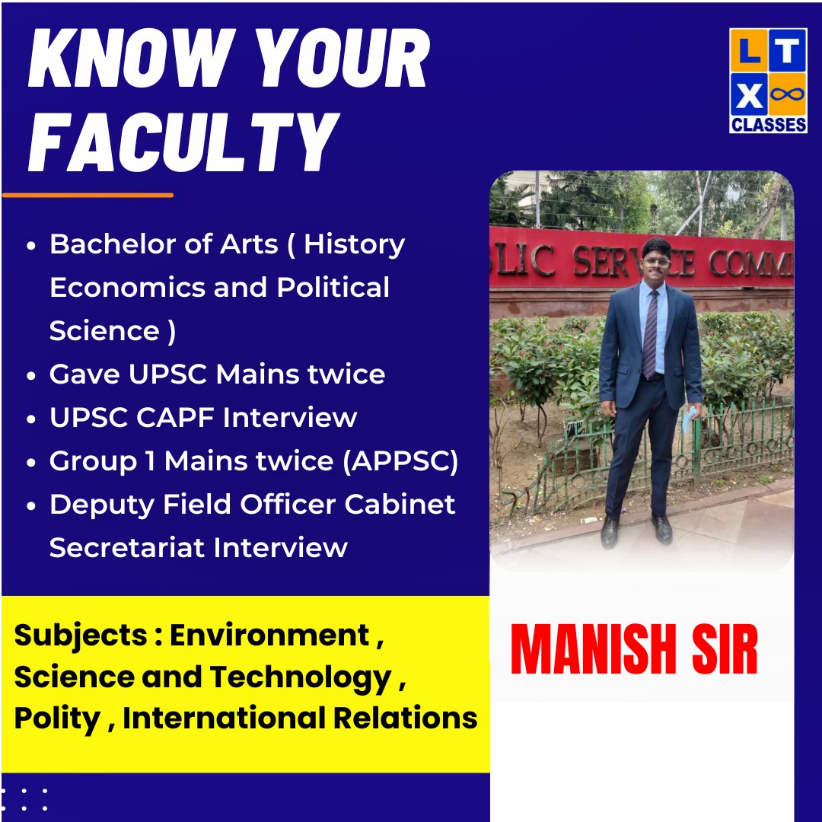
Rethinking a symbol of ‘environment responsibility.


 1. CONTEXT 

 A major global trend today is the relaxation of environmental norms for industries—particularly reducing green-cover requirements for industrial estates, units within estates, and standalone industries. This is often celebrated as an “ease of doing business” reform. However, the article questions whether lowering mandatory plantation norms is truly an environmentally responsible step, or whether we are mistaking compliance simplification for sustainability. India is witnessing similar moves, often justified by citing international examples. But ecological conditions vary widely, and blind imitation may lead to poor environmental outcomes.

2. WHAT IS THE ARTICLE ALL ABOUT? The article critically examines: ✔ Whether on-site green belts around industries can actually compensate for broad ecological losses caused by industrial development. 

 ✔ Why uniform green-cover standards borrowed from abroad are ecologically inappropriate. 

 ✔ The limitations of green belts in absorbing pollution and maintaining ecological health.

 ✔ The need for a balanced, landscape-level approach, which integrates industrial growth with broader ecological restoration.

 ✔ Why industries should be seen as ecological stewards and partners in regeneration, not merely entities to be regulated or penalised. 

3. DETAILED ANALYSIS A. On-site green belts ≠ Full ecological restoration 

 Industrial development inevitably alters habitats. Industries often argue that their internal green belts offset the damage, but the article clearly states: Green belts provide only localised benefits, such as:

  • microclimatic regulation
  • dust suppression
  • visual greening
They do not:
  • restore lost biodiversity
  • reverse habitat fragmentation
  • rebuild ecosystem resilience
Their role is mitigative, not restorative. 

  B. Evidence shows limited benefits of on-site greening Studies in polluted regions show:

  • Green belts can reduce Total Suspended Particulate Matter (TSP) by up to 65%.
  • They reduce ambient noise by up to 10 decibels in industrial or roadside environments.
  • Vegetation acts as a filter, lowering stress and improving air quality.
But:
These benefits are narrow, local, and cannot substitute for natural forests, mangroves, or connected ecosystems. 

  C. Why applying foreign benchmarks to India is flawed Countries with low population density and intact natural systems can afford smaller green buffers. But in:

  • dense Indian cities,
  • industrial clusters,
Green buffers are essential for liveability. A uniform percentage borrowed from elsewhere ignores:
  • population density
  • ecosystem stress
  • climatic differences
→ Evidence-based, ecological calibration is essential. D. Need for a landscape-scale, two-tiered strategy The article proposes a balanced approach, involving: 

  1. Partial relaxation of internal green cover, but only if accompanied by mandatory off-site ecological commitments, like:

  • State-level green reserves around industrial clusters
  • restoring degraded lands
  • river basin protection
  • ecological restoration of protected areas
  • measurable ecological outcomes through regional programmes
  • integration with regional green-credit or carbon-offset systems
This ensures industries compensate for ecological losses meaningfully. 

  E. Industries as ecological stewards The article strongly argues that industries must:

  • not limit responsibility to their premises
  • actively participate in landscape restoration
  • work with local communities
  • support regional ecological programmes
This will transform industries from agents of ecological pressure into partners in regeneration.

  F. On-site greening alone is insufficient Industrial plots are limited, narrow, and fragmented. They cannot:

  • support wildlife
  • provide hydrological regulation
  • ensure landscape connectivity
  • substitute intact forests or natural systems
True sustainability comes from restoring broader natural systems beyond factory boundaries. 

  UPSC MAINS Q. “Industrial green belts provide only limited ecological benefits. Discuss why India must adopt a landscape-level, ecologically calibrated approach to balance industrial growth with environmental sustainability.”
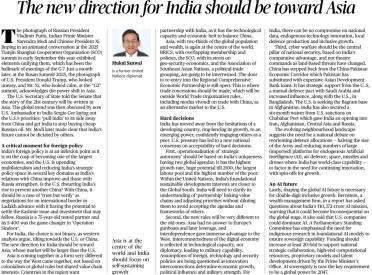

The new direction for India should be toward Asia


1. CONTEXT The article discusses a major shift in India’s foreign policy direction, arguing that India’s future strategic choices should increasingly align with Asia, rather than being dictated by the power dynamics of the U.S. or China. The argument is built around:

  • Changing global geopolitical alignments.
  • Shifting U.S. priorities.
  • India’s rising economic and strategic profile.
  • The growing centrality of Asia in geopolitics, economics, and technology.
2. WHAT IS THIS ALL ABOUT?
✔ The world’s power centre is visibly shifting from the West to Asia.
✔ India is at a foreign policy inflection point due to its massive economic rise and changing global alignments.
✔ India must prioritise Asia-centred partnerships (BRICS, SCO, ASEAN) over being drawn into U.S.–China bipolarity.
✔ India must operationalise strategic autonomy, protect national data, enhance technology & defence indigenisation, and prepare for AI-driven power shifts.
✔ India’s neighbourhood (Russia, China, Pakistan, Iran, Afghanistan) is evolving, demanding a new defence and economic posture. 

  3. DETAILED ANALYSIS

A. Shifting geopolitical imagery

  • Photographs from the 2025 SCO and G-20 summits are symbolic:
    • At SCO, Modi, Xi, and Putin appeared aligned.
    • At G-20, Trump looked uneasy while Xi looked calm.
  • These visuals reflect a deeper reality:
    The centre of global politics is moving to Asia.
B. U.S. Acknowledges the Shift
  • The U.S. Secretary of State stated that the 21st century will be written in Asia.
  • American diplomacy now openly prioritises:
    • Getting India to distance itself from China
    • Pulling India away from Russian energy and defence supplies
The article stresses that: India’s choices cannot be dictated by these Western pressures. 

  C. India at a foreign policy inflection point

  • India is emerging as one of the largest economies.
  • U.S. policies are increasingly transactional:
    • retreat from multilateralism
    • reduced strategic commitments
    • bilateral pressure on partners
2. India must avoid being forced into choosing sides
  • India’s relationship with China is tense (Ladakh, border issues).
  • India’s relationship with Russia remains important (S-400, energy).
  • Therefore:
India cannot be forced into a "with us or against us" binary between the U.S. and China. 

  D. Asia’s rise and why India must focus on it Asia accounts for:

  • Two-thirds of global population and wealth.
  • The strongest growth potential.
Key regional groupings: BRICS, SCO, ASEAN
These are becoming interlinked in geo-economics, technology, and politics, making Asia the strategic centre of gravity. India must embed itself in these structures.

  2. RCEP re-entry is still open

  • India exited RCEP in 2019, but the door is still open.
  • Concessions can be negotiated (specific agreements) with China.
  • This could offer India:
    • A non-WTO route to trade
    • Access to Asia-wide value chains
E. Hard decisions India must take

1. Operationalise “Strategic Autonomy” rooted in India’s uniqueness o Fastest-growing large economy. o Largest youth population. o Stronger alignment with Global South development interests. o Need to clarify what “partnership” in global value chains means. 

 2. Move beyond old assumptions o Asia now benefits from interconnected digital economies. o Europe’s colonial-era advantages are irrelevant. o India must prioritise: § National data § Endogenous technology § Local innovation § Defence production 

 3. Cyber warfare must be central to national security o India’s AI, missile, space, and drone capabilities are globally competitive. o Need major investments in indigenous technology.

 4. Reorient defence spending o Proposes: § Halving army size. § Increasing budgets for AI, missiles, drones, cyber capabilities. o Defence must match India’s innovation-led growth needs. 

  F. Navigating the neighbourhood The article identifies major regional developments India must adapt to

  1. China’s reduced interest in some Belt & Road projects

  • China has stepped back from the China–Pakistan Economic Corridor (CPEC).
  • Pakistan now relies on ADB loans.
2. Strengthening India–U.S.–Saudi–Bangladesh axis
  • U.S. & Saudi Arabia jointly support Bangladesh.
  • This reduces Chinese leverage in the Bay of Bengal region.
3. U.S. Base in Afghanistan (Bagram)
  • The U.S. is building influence in South/Central Asia through:
    • military access
    • energy routes
    • sanctions negotiation (e.g., Chabahar waiver)
4. India’s Strategic Wins
  • India secured:
    • A six-month U.S. waiver for Chabahar Port
    • Openings in: Iran, Afghanistan, Russia, Central Asia
This reshapes India's neighbourhood significantly. 

  G. An AI-driven economic and security future 

 India must:

  • Boost indigenous R&D.
  • Lift scientific capability.
  • Scale national strategic collaboration.
  • Achieve AI excellence for long-term global competitiveness.
4. WHY IS THIS SIGNIFICANT?
  • Asia—not the West—is emerging as the strategic and economic heart of the 21st century.
  • India must formulate a foreign policy that reflects:
    • Its own priorities,
    • Self-sustaining partnerships,
    • Technological independence,
    • Security rooted in innovation,
    • And a bold Asian strategy, not Western approval.

India’s future lies in an Asia-centric, technologically driven, strategically autonomous foreign policy. 


  UPSC MAINS “India is at an inflection point in its foreign policy. Critically examine the argument that India’s strategic future lies in an Asia-centric approach rooted in strategic autonomy, rather than alignment with major Western powers.”
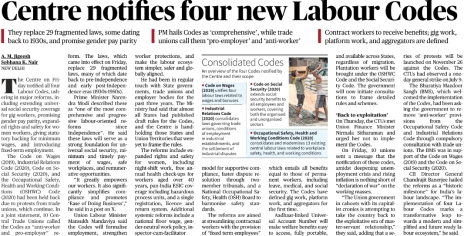

Centre notifies four new Labour Codes

1. CONTEXT

The Central Government has notified all four Labour Codes, introducing one of the most comprehensive reforms in India’s labour landscape.

These Codes replace 29 fragmented labour laws, some dating back to the 1930s and 1950s. The government says the Codes ensure:

  • Universal social security (including for gig workers)
  • Gender pay parity
  • Safer workplaces
  • Minimum wage protection
  • Simplified compliance
  • Fixed-term employment
Trade unions, however, have strongly criticised the Codes as “anti-worker” and pro-employer. 

  2. KEY PROVISIONS 

A. Consolidation of Old Laws

1. Code on Wages (2019) – Unifies four wage-related laws. 

 2. Industrial Relations Code (2020) – Merges laws on trade unions, industrial employment, and dispute settlement. 

 3. Social Security Code (2020) – Extends social security to all workers, including organised, unorganised, gig and platform workers. 

 4. Occupational Safety, Health and Working Conditions Code (OSHWC, 2020) – Consolidates 13 central laws on worker safety and working conditions. These four Codes replace 29 older laws.

  B. Major Labour Reforms Introduced 

 1. Social Security Expansion (including ESIC)

  • Universal ESIC coverage across States, regardless of migration.
  • Plantation workers will be covered under OSHWC Code and Social Security Code.
2. Support for Women, Gender Neutrality & Safety
  • Expanded rights and safety for women workers, including:
    • Permission for night shifts (with safety conditions).
  • Gender pay parity is promised.
  • Provisions aim to make workplaces safer, gender-friendly, and humane.
3. Single Registration, Licence, and Return System The Codes introduce:
  • Single registration
  • Single licence
  • Single return filing system
This simplifies compliance for employers and makes labour governance more efficient. 4. Inspector-cum-Facilitator Model A new compliance model includes:
  • Inspector-cum-facilitator approach
  • Greater emphasis on facilitation rather than punishment
  • Streamlined compliance inspections
This aims to reduce harassment and create a supportive environment for both employers and workers. 5. National Occupational Safety and Health (OSH) Board
  • A National OSH Board will harmonise safety standards across India.
  • It will help create uniform practices for workplace safety and health.
6. National Floor Wage
  • These reforms will form a strong foundation for minimum wages, implying continued emphasis on a national floor wage concept through the Code on Wages.
7. Gig, Platform & Contract Workers Recognised for the First Time
  • Gig workers, platform workers, and aggregators are legally recognised.
  • Social security schemes will be framed for them.
  • Contractual workers will receive “fixed-term employee” benefits.
8. Additional Reforms Listed in the Article The article specifically mentions:
  • Protection of hazardous process units
  • Improved labour ecosystem
  • Simplification of customs of compliance
  • Streamlined contractual worker system
  • Two-member tribunals for faster dispute settlement
  • Simplified licensing, registration, and assessments
  • Guidelines for ensuring: Safer, simpler, globally aligned labour systems
C. Stakeholder Reactions Government & Industry
  • PM Modi calls these reforms “progressive, comprehensive, and historic”.
  • CII says these reforms are a “historic milestone” and modernise India’s labour market.
Trade Unions
  • CTUs call the Codes “anti-worker” and “pro-employer.”
  • They oppose the move and have announced protests.
  • They argue the Codes will lead to:
    • Exploitation
    • Dilution of worker rights
    • “Master-servant relationship”
Bharatiya Mazdoor Sangh (BMS):
  • Supports the notification of the Codes but objects to some “anti-worker” provisions earlier.
UPSC PRELIMS

Q. With reference to India’s recent labour reforms, consider the following statements: 

 1. The four new Labour Codes consolidate multiple existing labour laws into four broad areas. 

 2. The Codes introduce a single registration, licence, and return system to simplify compliance.

 3. Gig and platform workers are recognised under the new Social Security Code. 

 4. The new framework removes the National Occupational Safety and Health Board. How many of the above statements are correct? A. Only one

B. Only two
C. Only three
D. All four

 Answer: C


Govt. plans to unify security regulations for 250 seaports 


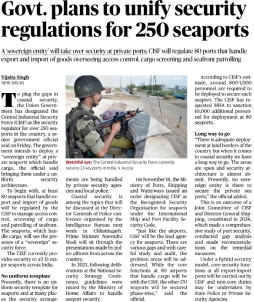
  1. CONTEXT The Union Government has initiated a major reform to strengthen coastal and port security by designating the Central Industrial Security Force (CISF) as the security regulator for more than 250 seaports across India. This step aims to address vulnerabilities in the current port security ecosystem, where many private ports depend on private security agencies and local police, resulting in inconsistent standards. A “sovereign entity” (CISF) will now oversee access control, cargo screening, and seafront patrolling to create a uniform security architecture across India’s coastline.

2. KEY PROVISIONS A. CISF designated as the lead security regulator

  • CISF will act as the primary agency responsible for security at over 250 seaports.
  • Begins with 80 cargo-handling ports that deal with import and export of goods.
  • CISF will oversee: Access control, Cargo screening, Patrolling of seafronts
B. Addressing current security gaps
  • Presently, there is no uniform security template for seaports.
  • Many ports rely on private security agencies and local police.
  • This creates inconsistent standards and potential vulnerabilities.
C. Expansion of CISF deployment
  • CISF currently secures 13 major ports.
  • The new plan extends CISF’s role to:
    • 80 ports immediately
    • Another 170 ports in a phase-wise manner
  • CISF estimates that 800–1,000 personnel per port are required.
  • CISF has requested 10,000 additional personnel from the MHA for the first phase.
D. National policy alignment and recent decisions
  • The Ministry of Ports, Shipping and Waterways (November 18) designated CISF as the Recognised Security Organisation under the International Ship and Port Facility Security (ISPS) Code.
  • This formalises CISF’s authority to regulate seaport security.
E. Hybrid security model
  • CISF will handle core functions at the 80 cargo-handling ports.
  • State police or private security may manage non-core functions at smaller ports.
F. Review and policy background
  • A Joint Committee of CISF and Directorate General of Shipping, formed in 2024, conducted: Gap analysis, Security audits, Assessment of problem areas
  • Their recommendations form the basis of this unified security plan.
G. Long way to go in coastal security
  • Government officials acknowledge that while land border security is strong, coastal security needs:
    • Better monitoring
    • Sophisticated policing
    • A sovereign entity at all ports
  • Private ports currently lack sovereign-level oversight.
UPSC PRELIMS 

Q. With reference to India’s maritime and coastal security architecture, consider the following statements:

 1. The Central Industrial Security Force (CISF) is mandated to provide security to critical infrastructure installations, including ports and airports. 

 2. Coastal security in India involves multiple agencies, including the Indian Navy, Coast Guard, Marine Police, and State authorities. 

 3. The International Ship and Port Facility Security (ISPS) Code provides a global framework for enhancing maritime safety and port security. How many of the above statements are correct? 

 A. Only one

B. Only two
C. All three
D. None

 Answer: C


Modi meets Australian PM, discusses cooperation in trade, defence and security 


  1. CONTEXT 

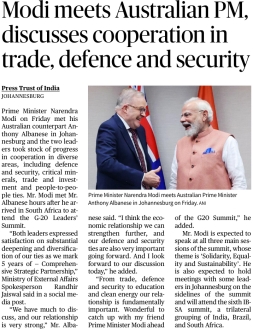
 Prime Minister Narendra Modi met Australian Prime Minister Anthony Albanese in Johannesburg on the sidelines of the G-20 Leaders’ Summit.

The meeting took place soon after PM Modi arrived in South Africa. The leaders reviewed the progress of India–Australia cooperation across several sectors and reaffirmed the strength of their Comprehensive Strategic Partnership, which is completing five years.

  2. KEY PROVISIONS 

A. Review of Bilateral Cooperation Both leaders took stock of progress in diverse areas, including:

  • Defence and Security
  • Critical Minerals
  • Trade and Investment
  • People-to-People ties
B. According to the Ministry of External Affairs spokesperson Randhir Jaiswal:
Both leaders expressed satisfaction on the substantial deepening and diversification of ties.
They highlighted the importance of the India–Australia relationship as part of a Comprehensive Strategic Partnership.
C. G-20 Summit Participation
  • PM Modi will speak at all three main sessions of the G-20 Summit.
  • The themes are: Solidarity, Equality, Sustainability
  • He is also expected to hold bilateral meetings with other leaders.
  • PM Modi will attend the sixth IBSA Summit (India-Brazil-South Africa trilateral grouping).
UPSC PRELIMS

Q. With reference to India's relations with Australia, consider the following statements: 

 1. India and Australia are partners in a Comprehensive Strategic Partnership.

 2. Cooperation between the two countries includes critical minerals, defence, education, and clean energy. 

 3. India and Australia are both members of the IBSA Forum. How many of the above statements are correct? 

 A. Only one

B. Only two

C. All three

D. None

 Answer: B
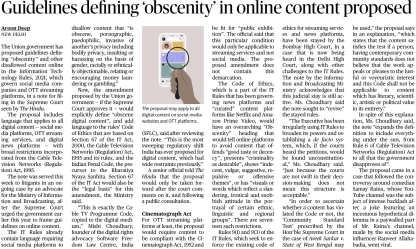

Guidelines defining ‘obscenity’ in online content proposed 


  1. CONTEXT 

 The Union Government has submitted a proposal to the Supreme Court to explicitly define “obscene digital content” under the Information Technology (IT) Rules, 2021, which govern social media companies, OTT platforms, and digital news platforms. This proposal is part of an ongoing litigation. The Supreme Court had earlier asked the government to clarify and frame guidelines on what constitutes online obscenity.

2. KEY PROVISIONS 

A. New Definition of Obscene and Disallowed Content The proposal seeks to disallow digital content that is: Obscene, Pornographic, Paedophilic, Invasive of bodily privacy, Insulting or harassing on basis of gender, race, or ethnicity, Objectionable, Related to or encouraging money laundering or gambling This will apply to all digital content (social media, OTT, streaming services, digital news).

B. Explicit Inclusion of “Obscene Digital Content”

  • The amendment will explicitly define “obscene digital content” in the IT Rules.
  • It will insert this language into the Code of Ethics section of the IT Rules.
C. Legal Basis for the Amendment

The proposal draws from:

  • Section 67 of the IT Act, 2000
  • Cable Television Networks (Regulation) Act, 1995
  • Indian Penal Code
  • Bharatiya Nyaya Sanhita (new criminal code)
The government states these provide the legal basis. Officials said:
“This is exactly the Cable TV Programme Code copied to the digital medium.” 

  D. Cinematograph Act Requirement for OTT

  • For OTT platforms, content must be fit for “public exhibition.”
  • This requirement does not apply to social media, and the proposed amendment does not draw that distinction.
E. New “Obscenity” Heading in the Code of Ethics 

 The Code of Ethics will gain a new overarching heading: “Obscenity.” Platforms (news + curated content like Netflix, Prime Video) would be required to avoid content that:

  • Offends good taste or decency
  • Presents criminality as desirable
  • Shows indecent, vulgar, suggestive, repulsive, or offensive themes
  • Uses insulting visuals or words based on ethnicity, linguistic group, or regional group
  • Reflects slanderous, irrational, or snobbish attitudes in portrayal of themes
There are seven such restrictions, based on the Cable Television Act’s Programme Code.

  F. Judicial Background

  • These rules for streaming and news platforms have been stayed by the Bombay High Court in an ongoing case.
  • A similar case is now before the Delhi High Court.
  • The Information & Broadcasting Ministry says the proposal seeks to revive the stayed rules.
G. Civil Society Concerns

Digital rights advocate Mishi Choudhary (SFLC) said:

  • This is the most sweeping regulatory shift ever proposed for digital content.
  • The government has been using IT Rules to expand its powers into a de facto censorship system.
  • Courts have not completed hearings; the executive is proceeding regardless.
She said the note expands the definition of content far beyond what the government disapproves, by importing Rule 6 of the Cable Television Networks Act into all digital content.

  H. Supreme Court Test for Obscenity 

 The proposal says the content must satisfy the test:

  • If a person with contemporary community standards
  • Does not believe that the work appeals to lustful or voyeuristic interest
AND the Code will not apply to content with literary, scientific, artistic, or political value. 

  UPSC PRELIMS 

Q. Under the Information Technology (Intermediary Guidelines and Digital Media Ethics Code) Rules, 2021, which of the following categories of entities are regulated for online content standards? 

 1. Social media intermediaries 

 2. OTT streaming platforms 

 3. Digital news publishers 

 4. Internet service providers How many of the above are regulated for content under the IT Rules? 

 A. Only one

B. Only two
C. Only three
D. All four 

 Answer: C

Arunachal Pradesh dao gets GI tag 


  Syllabus: GS Paper I – Indian Culture
Topic:

Topic: Art, Craft & Heritage
GS Paper III – Economy
Topic:
Role of GI Tags in Rural Economy Context The traditional Arunachal Pradesh dao, a hand-forged tribal blade, has received the Geographical Indication (GI) tag, recognising its cultural significance and blacksmithing heritage. 

  Key Points Recognition for Indigenous Craftsmanship

  • GI tag acknowledges the dao as a distinct cultural product tied to Arunachal Pradesh.

  • The blade is crafted using inherited blacksmithing skills, reflecting precision and cultural symbolism.

  • Certification will preserve traditional forging practices and uphold the identity of tribal artisans.

Economic Impact on Artisan Communities
  • GI status strengthens market access and improves branding authenticity.

  • Expected to enhance income stability for tribal blacksmiths.

  • Government plans training programmes, quality upgrades, and promotional support for rural craft clusters.

Growing Roster of GI-Tagged Products
  • The dao joins other notable Arunachal GI products such as Wakro Orange, Idu Mishmi textiles, Khamti rice, Yak churpi, Wancho wooden craft.

  • Arunachal Pradesh has secured about 20 GI-tagged items so far.

  • Highlights the state’s growing significance in India’s GI landscape.

Geographical Indication (GI) Framework – Key Facts
  • GI tag protects products linked to a specific geographical origin and traditional knowledge.

  • India’s GI Registry functions under the Geographical Indications of Goods (Registration and Protection) Act, 1999.

  • The GI for the dao supports preservation of tribal blacksmithing techniques.


Source: The Hindu


Coastal Security Exercise ‘Sagar Kavach’ 


  Syllabus: GS Paper III – Internal Security
Topic: Coastal Security & Maritime Preparedness Context: The biannual coastal security exercise ‘Sagar Kavach’ began in Tamil Nadu’s Cuddalore and Villupuram districts, involving multiple agencies to test coastal preparedness. 

Key Points About ‘Sagar Kavach’

  • A biannual multi-agency coastal security exercise conducted along India’s coastline.

  • Hosted by the Indian Coast Guard to test real-time preparedness against seaborne threats.

Aim
  • Validate Standard Operating Procedures (SOPs) for coastal security.

  • Assess readiness against intrusions, sabotage, smuggling, and terrorist infiltration.

Key Features
  • Conducted twice every year across coastal states and island territories.

  • Uses realistic threat simulations, including dummy intruders (Red Force) and infiltration drills.

  • Activities include sea patrols, boat checks, harbour inspections, coastline surveillance, and securing vital installations.

  • Trains coastal police in intelligence gathering, interrogation, interception, and patrolling.

  • Enhances synergy among military, paramilitary, intelligence agencies, state police, and fisheries departments.

  • Covers coastal villages, harbours, ports, bus/rail stations, and critical public infrastructure.

  • Integrates surface assets, air surveillance platforms, radar chains, and communication systems across agencies.


Source: The Hindu


Australia expands social media ban for under-16s to include Twitch


Syllabus: GS Paper II – Governance
Topic:
Regulation of Digital Platforms & Online Safety Context Australia has added Twitch to its list of restricted platforms under a new national policy that bans social media use for children aged 16 and under from 10 December. Key Points Revised List of Restricted Platforms
  • Twitch added to the list along with Instagram, TikTok, Snapchat and other high-engagement platforms.

  • Platforms that fail to take reasonable compliance measures may face penalties up to 49.5 million Australian dollars.

  • Pinterest excluded after assessment due to lower risk compared to real-time interaction platforms.

Rationale Behind Targeting Twitch
  • Twitch’s live-streaming model allows unfiltered, real-time broadcasts.

  • Higher risk of exposing minors to harassment, explicit material, grooming, and harmful behaviour.

  • Limited safeguards make it unsuitable for children under the new regulatory framework.

Part of a Broader Online Safety Overhaul
  • Comes under reforms linked to the Online Safety Act, which is currently under review.

  • Government aims to address:

    • Screen addiction

    • Child grooming risks

    • Cyberbullying and mental-health concerns

    • Exposure to inappropriate or harmful content

  • Critics believe the restrictions may limit access to educational and creative online communities.


Source: The Hindu


Acanthosis Nigricans 


  Syllabus: GS Paper II – Health

Topic: Non-Communicable Diseases & Early Diagnosis Context: Early identification of Acanthosis Nigricans helps detect prediabetes or diabetes in both children and adults before complications arise. Key Points:

  • Definition: A skin condition marked by dark, velvety patches on skin folds.

  • Causes:

    • Obesity, insulin resistance, metabolic syndrome, diabetes mellitus.

    • Rarely linked to melanoma, stomach, or liver cancers.

  • Symptoms:

    • Appears in neck, underarms, groin, elbows, under the breasts, behind knees.

    • Skin becomes dark, thick, rough, or velvety.

    • May be itchy or have a foul smell.

    • Skin changes develop gradually over months.

    • Fast progression indicates insulin resistance.

  • Treatment:

    • Treat underlying condition like diabetes or hormonal disorders.

    • Use prescription creams to lighten the skin.

    • Laser therapy and dermabrasion help reduce skin thickness.


Source: The Hindu