Daily Current Affairs for UPSC 22nd Dec 2025


�
�
�
|
| | |
|
| Keeping a close watch on Bangladesh events: India | |
| Where does India stand on child marriage? | |
| The bulldozed demolition of MGNREGA | |
| Lessons from China on tackling pollution | |
| Environment Minister reviews measures to address human-wildlife conflict | |
| Sugar mills seek revision of minimum selling price | |
| Drogue parachute tests for Gaganyaan mission successful | |
| CJI Bench to hold special vacation sitting tomorrow | |
| SEBI group to review non-agri commodity derivatives | |
| ISRO set to launch mobile broadband satellite | |
|
Daily Current Affairs (App) |
| | |
| Corporate Social Responsibility (CSR) | |
| National Scheduled Caste and Scheduled Tribe Hub (NSSH) Scheme | |
| Bureau of Port Security (BoPS) | |
| Regional Rural Banks (RRBs) | |
�
�
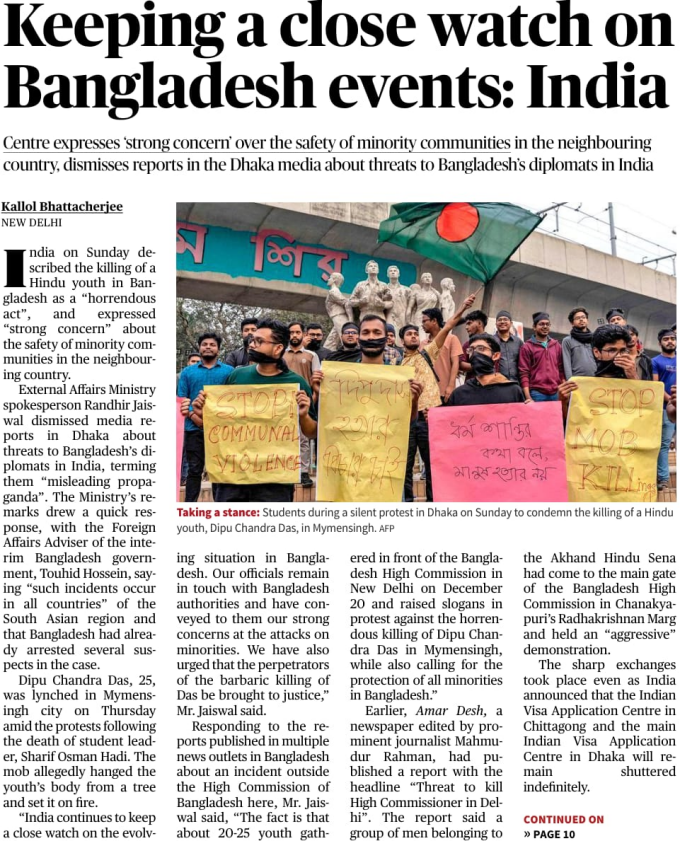
Keeping a close watch on Bangladesh events: India
Context
India expressed strong concern over the safety of minority communities in Bangladesh following the lynching of a Hindu youth, while dismissing reports in Bangladeshi media about threats to Bangladeshi diplomats in India.
Key Points
Triggering Incident
• A Hindu Youth, Dipu Chandra Das, was lynched in Mymensingh, Bangladesh, which India described as a horrendous act.
• The incident occurred amid protests following the death of a student leader in Bangladesh.
India’s Official Response
• The Ministry of External Affairs (MEA) conveyed serious concern over attacks on minorities in Bangladesh.
• India urged Bangladeshi authorities to ensure protection of minorities and bring perpetrators to justice.
Position on Diplomatic Security
• India rejected Bangladeshi media reports claiming threats to Bangladeshi diplomats in India.
• Such reports were termed misleading propaganda by the MEA.
Engagement with Bangladesh
• Indian officials remain in touch with Bangladeshi authorities on the evolving situation.
• Bangladesh stated that suspects have been arrested, and such incidents occur across the region.
Protests and Diplomatic Fallout
• Protests were held outside the Bangladesh High Commission in New Delhi, demanding justice.
• Following tensions, Indian Visa Application Centres in Chittagong and the main centre in Dhaka were shut indefinitely.
Minority Rights and Regional Stability
• India reiterated that minority protection is integral to bilateral relations.
• The issue highlights the sensitivity of communal violence in India’s neighbourhood and its foreign policy implications.
�
�
Where does India stand on child marriage?

Context
The article examines India’s progress, challenges, and policy approach in reducing child marriage, especially in the context of commitments under the UN Sustainable Development Goals (SDGs) and recent legal and social interventions.
Detailed Analysis
Global and Constitutional Context
• Ending child marriage aligns with SDG 5.3, which seeks to eliminate harmful practices like child and forced marriage.
• India’s commitment is linked to broader goals of gender equality, education, health, and dignity of women and girls.
• Progress is measured through indicators such as age at marriage and prevalence among women aged 20–24.
India’s Progress So Far
• India has made significant reductions in child marriage rates over the last two decades.
• Prevalence declined from 47.4% (2005–06) to 26.8% (2015–16) and further to 23.3% (2019–21).
• This reflects improvements in female education, awareness, and economic participation.
Regional and Social Disparities
• Progress is uneven across States and regions.
• Higher incidence persists in States like West Bengal, Bihar, Jharkhand, and Assam, while southern States show relatively lower rates.
• Rural areas and economically weaker households continue to witness higher prevalence.
Legal and Policy Framework
• Prohibition of Child Marriage Act, 2006 criminalises child marriage and enables annulment.
• Right to Education Act, 2009 indirectly delays marriage by ensuring school enrolment.
• Government initiatives like Beti Bachao Beti Padhao emphasise education and empowerment of girls.
• Digital tools and community-level interventions are used for prevention and reporting.
Limitations of Legal Measures
• Laws alone have limited deterrence without strong social reform.
• Criminalisation may push the practice underground and sometimes penalise families without addressing root causes.
• Social norms, poverty, and gender inequality remain key drivers.
Author’s Suggestions / Way Forward
Shift from Control to Empowerment
• Focus on education of girls, especially secondary education.
• Improve access to health, nutrition, and reproductive rights.
• Promote economic opportunities for women to delay marriage voluntarily.
Community and Behavioural Change
• Engage local communities, religious leaders, and families.
• Address patriarchal norms and the perception of daughters as economic burdens.
• Strengthen awareness campaigns at the grassroots level.
Integrated Policy Approach
• Combine legal enforcement with social protection schemes.
• Target vulnerable regions with customised interventions.
• Strengthen data monitoring and accountability mechanisms.
Conclusion
India has made notable progress in reducing child marriage, but elimination by 2030 requires more than legislation. A sustained strategy centred on education, empowerment, social reform, and economic security for girls is essential to translate legal intent into social reality.
UPSC Mains Question
Child marriage in India is increasingly seen as a social and developmental issue rather than merely a legal one. Discuss the progress made so far and examine the challenges that must be addressed to eliminate child marriage by 2030.�
�
The bulldozed demolition of MGNREGA
Context
The article critiques recent policy and legislative changes affecting MGNREGA, arguing that these measures dilute its rights-based, demand-driven character and weaken decentralised governance, thereby undermining rural livelihoods and constitutional guarantees.
Detailed Analysis
MGNREGA: A Rights-Based Foundation
• Enacted in 2005, MGNREGA operationalised the constitutional right to work under Article 41.
• It was designed as a demand-driven guarantee, not a discretionary welfare scheme.
• Gram Sabhas played a central role in planning, implementation, and social audits, strengthening grassroots democracy.
Shift from Rights to Bureaucratic Control
• The author argues that recent changes convert MGNREGA into a bureaucratic programme, stripping it of legal entitlement.
• Employment is now capped by pre-determined budgets, unlike the earlier uncapped, demand-based allocation.
• Workdays and coverage depend increasingly on Union government priorities, not local needs.
Fiscal Burden Shift to States
• Earlier, the Centre bore 90% of the cost, incentivising States to implement the scheme actively.
• The revised 60:40 cost-sharing ratio increases fiscal pressure on already strained State finances.
• Any expenditure beyond Union allocations must now be fully borne by States, discouraging employment generation.
Erosion of Decentralisation
• MGNREGA aligned with the 73rd Constitutional Amendment, empowering Gram Sabhas.
• The article highlights a shift towards centralised planning, particularly through top-down frameworks like national master plans.
• This weakens local self-government and sidelines community-led development.
Impact on Rural Wages and Livelihoods
• MGNREGA strengthened the bargaining power of landless labourers, pushing up rural wages.
• Suppressing employment under the scheme risks wage stagnation, distress migration, and rural impoverishment.
• During crises like COVID-19, MGNREGA proved crucial in providing income security to vulnerable populations.
Broader Assault on Rights-Based Laws
• The author situates MGNREGA’s dilution within a wider trend affecting rights-based legislations.
• Examples cited include changes impacting RTI, Forest Rights Act, Right to Education, and land acquisition laws.
• This is portrayed as a systematic weakening of constitutional accountability and social protection.
Suggestions Highlighted by the Author
• Restore demand-driven and uncapped funding for MGNREGA.
• Reaffirm the central role of Gram Sabhas in planning and social audits.
• Ensure timely wage payments and adequate budgetary support.
• Treat MGNREGA as a constitutional obligation, not a fiscal burden.
Conclusion
The article argues that dismantling MGNREGA undermines not just a welfare scheme but the constitutional vision of social justice and the right to work. Weakening such a large-scale social security intervention risks long-term economic, social, and moral consequences for rural India, calling for urgent course correction.
UPSC Mains Question
MGNREGA was envisaged as a rights-based, demand-driven employment guarantee. Critically examine how recent policy changes affect its federal, decentralised, and social justice objectives.
�
�
Lessons from China on tackling pollution
Context
The article compares the sharply diverging air pollution trajectories of China and Indiaover the last decade, highlighting how Beijing achieved major PM2.5 reductions while Indian cities like Delhi continue to struggle, and examines what India can realistically learn from China’s experience.
Detailed Analysis
Divergent Outcomes: China vs India
• China reduced PM2.5 levels by over 50% (2013–2021), with Beijing dropping from about 102 µg/m³ to nearly 31 µg/m³.
• Delhi, despite multiple interventions, remains among the world’s most polluted cities, indicating systemic weaknesses.
China’s Clean-Air Transformation
• China’s progress was deliberate and structural, not incremental.
• Two major drivers were the Air Pollution Prevention and Control Action Plan and the Blue Sky Protection Campaign.
• Measures covered energy, transport, and industry simultaneously, including closure or relocation of polluting industries, coal-to-gas transitions, and strict vehicle emission norms (China VI).
Governance and Enforcement Strength
• A key reform was China’s Environmental Vertical Reform, creating a clear hierarchy of environmental responsibility.
• Local governments were directly accountable, enabling uniform enforcement, swift decision-making, and strong penalties for non-compliance.
• China invested heavily in real-time air quality monitoring and enforcement capacity.
India’s Regulatory Fragmentation
• India has robust laws like the Air Act (1981) and Environment Protection Act (1986), but enforcement is weak.
• Pollution governance is fragmented across Union, State, municipal bodies, and regulators, leading to diffused accountability.
• Institutions such as pollution control boards are chronically understaffed and underfunded.
Reactive Policies vs Long-Term Planning
• Indian measures like GRAP, odd-even schemes, construction bans, and work-from-home advisories are largely reactive, activated during pollution peaks.
• Long-term embedding of air quality goals into urban planning, transport policy, and industrial zoning remains limited.
• Behavioural change and public transport expansion have lagged behind city growth.
Regional Coordination Deficit
• China adopted an airshed-based approach, coordinating Beijing with Tianjin and Hebei to tackle transboundary pollution.
• In India, bodies like CAQM lack strong authority over neighbouring States, making regional pollution control ineffective.
What India Can Borrow from China
Mission-Oriented Governance
• Treat air pollution as a national public health emergency, not a seasonal inconvenience.
• Shift from episodic actions to long-term, outcome-based strategies.
Accelerated Energy Transition
• Rapidly reduce dependence on coal and expand clean energy and energy efficiency standards across sectors.
Transport and Mobility Reforms
• Enforce BS-VI norms rigorously with credible PUC systems and modern testing centres.
• Expand public transport, electric mobility, vehicle scrappage, and charging infrastructure.
Industrial and Urban Planning Reform
• Move beyond paper-based relocation to functional industrial zones with full infrastructure and emissions monitoring.
• Adopt real-time emissions tracking and strict compliance mechanisms.
Regional Airshed Governance
• Implement a Beijing–Tianjin–Hebei style airshed model for Delhi-NCR with binding authority and coordination across States.
Conclusion
India does not need to replicate China’s political system to improve air quality, but it must adopt the principles of coherent governance, strict enforcement, regional coordination, and sustained investment. Without embedding pollution control into long-term planning and accountability structures, India’s air quality crisis will remain unresolved.
UPSC Mains Question
India has strong environmental laws but weak air quality outcomes. In the context of China’s experience, analyse the governance and institutional reforms required for effective pollution control in India.
�
�
Environment Minister reviews measures to address human-wildlife conflic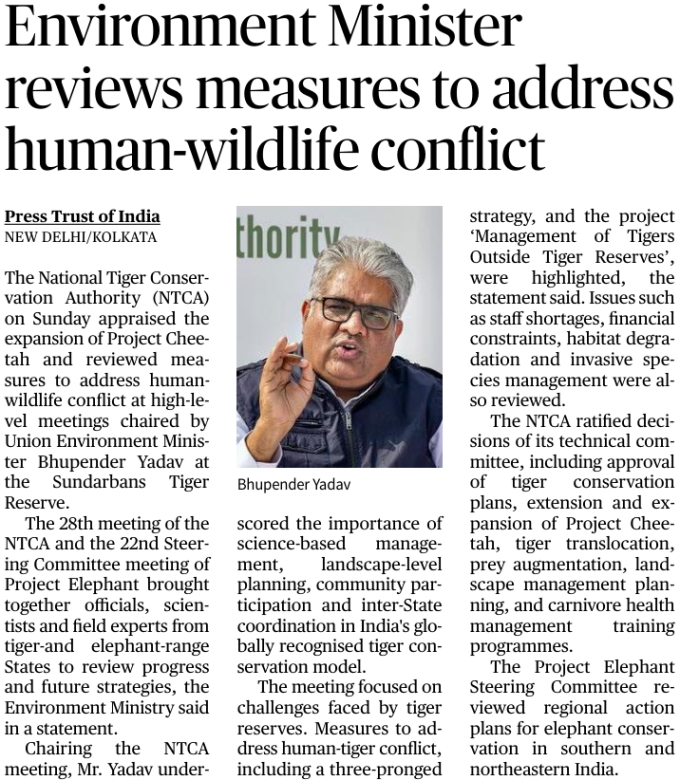
Context
The Union Environment Minister chaired high-level meetings of the National Tiger Conservation Authority and Project Elephant to review conservation progress and measures to address rising human-wildlife conflict, particularly in tiger and elephant landscapes.
Key Points
High-level Review Meetings
• The 28th meeting of NTCA and 22nd Steering Committee of Project Elephant were held.
• Officials, scientists and field experts from tiger- and elephant-range States participated.
Focus on Human-Wildlife Conflict
• Discussions centred on human–tiger and human–elephant conflict in and around reserves.
• Emphasis was placed on science-based management and landscape-level planning.
Project Cheetah Expansion
• The expansion of Project Cheetah was reviewed.
• Measures related to tiger translocation, landscape management and carnivore health were discussed.
Tiger Conservation Measures
• NTCA ratified decisions of its technical committee.
• Approved tiger conservation plans, extension of Project Cheetah, and habitat augmentation.
Elephant Conservation Strategy
• The Project Elephant Steering Committee reviewed regional action plans for southern and northeastern India.
• Focus on mitigation of elephant corridors and conflict-prone zones.
Operational Challenges Identified
• Key constraints include staff shortages, financial limitations, habitat degradation, and invasive species management.
• Need for better inter-State coordination was highlighted.
Community Participation
• Importance of local community involvement in conservation and conflict mitigation was underlined.
• India’s globally recognised tiger conservation model was reaffirmed.
National Tiger Conservation Authority (NTCA)
• Statutory body under the Wildlife (Protection) Act, 1972.
• Responsible for tiger conservation, reserve management and policy oversight.
• Implements Project Tiger across India.
UPSC Prelims Practice Question
With reference to the National Tiger Conservation Authority (NTCA), consider the following statements:
1. NTCA is a statutory body established under the Wildlife (Protection) Act, 1972.
2. NTCA is responsible for implementing Project Elephant in India.
Which of the statements given above is/are correct?
A. 1 only
B. 2 only
C. Both 1 and 2
D. Neither 1 nor 2
Answer: A
�
�
Sugar mills seek revision of minimum selling price

Context
Sugar mills, through the Indian Sugar and Bio-energy Manufacturers Association, have urged the Union government to revise the Minimum Selling Price (MSP) of sugar, citing rising production costs and financial stress in the 2025–26 sugar season.
Key Points
Minimum Selling Price (MSP) of Sugar
• MSP of sugar was introduced in 2018–19 to protect mills from distress sales.
• MSP has remained unchanged at ₹31 per kg since early 2019, despite rising costs.
• Mills argue that stagnant MSP affects their ability to pay farmers on time.
Rising Cost Pressures
• Cost of sugar production is around ₹41.46 per kg, far above the current MSP.
• Cane prices, labour costs and input expenses have increased continuously.
• Mismatch between sugar prices and cane prices has widened.
Impact on Farmers
• Mills are legally required to pay cane dues promptly.
• If MSP is not revised, mills warn of payment delays to farmers from January onwards.
• Financial stress on mills directly impacts cane growers’ liquidity.
Demand Trends
• Domestic sugar consumption softened in 2024–25, falling to about 281 lakh tonnes.
• Growth in sugar demand is projected at only 1.5–2% CAGR over the next five years.
• Lower demand limits mills’ ability to absorb higher costs.
Industry Concern
• Sugar mills seek immediate MSP revision to ensure viability.
• Without intervention, arrears to farmers and sectoral instability may increase.
Fair and Remunerative Price (FRP) of Sugarcane
• FRP is the statutory minimum price that sugar mills must pay farmers for sugarcane.
• It is fixed by the Union government (CCEA) based on recommendations of CACP.
• Governed by the Sugarcane (Control) Order, 1966.
Key Features of FRP
• Payment must be made within 14 days of cane delivery.
• Mills may pay in instalments if an agreement exists with farmers.
• Delayed payments attract interest up to 15% per annum.
• Unpaid FRP can be recovered as arrears of land revenue by attaching mill properties.
Factors Considered in Fixing FRP
• Cost of production of sugarcane
• Returns from alternative crops
• Trend of agricultural commodity prices
• Sale price of sugar
• Sugar recovery rate
• Value of by-products like molasses, bagasse and press mud
• Reasonable margins for farmers to cover risk and profit
�
�
Drogue parachute tests for Gaganyaan mission successful
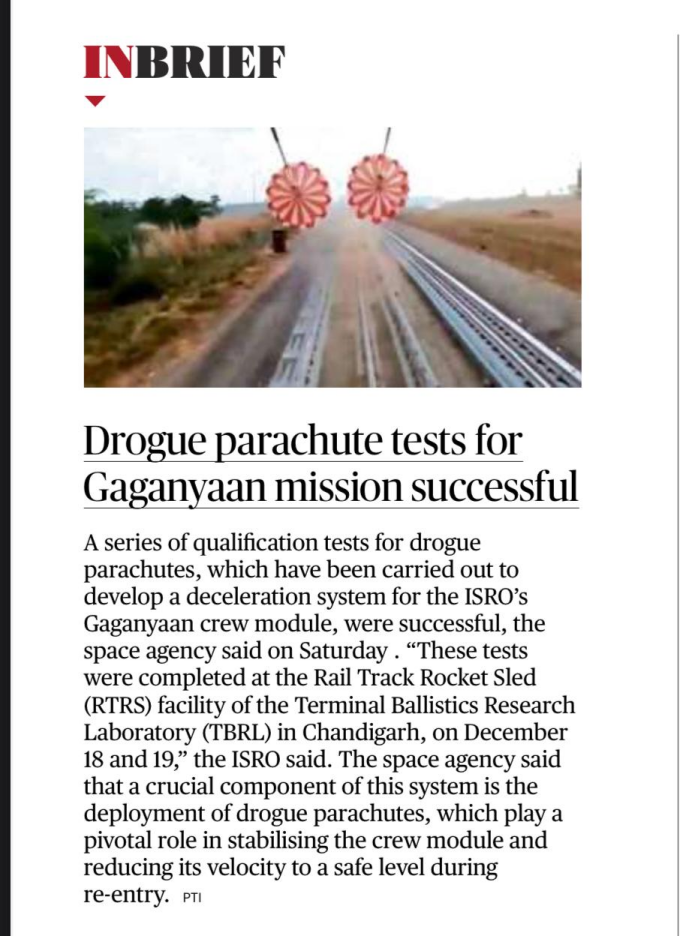
Context
ISRO successfully conducted qualification tests of drogue parachutes for the Gaganyaan crew module at the Rail Track Rocket Sled (RTRS) facility, Chandigarh, validating a critical deceleration and stabilisation system for safe re-entry.
Key Points
What are Drogue Parachutes
• Drogue parachutes are deployed during re-entry to stabilise the crew module and reduce high velocity before main parachutes open.
• They ensure controlled orientation and safe descent of the crew module.
About the Recent Tests
• Tests conducted on December 18–19 at TBRL’s RTRS facility.
• Part of the parachute-based deceleration system for Gaganyaan’s crew module.
• Successful tests confirm readiness of a crucial crew safety technology.
Gaganyaan Mission – Overview
• India’s first human spaceflight mission.
• Objective: Send 3 astronauts to Low Earth Orbit (400 km) for 3 days and ensure safe return.
• Mission sequence includes multiple unmanned missions before the first manned mission, expected around 2027.
Crew Safety Technologies
• Human-Rated LVM3 (HLVM3): Modified ISRO launch vehicle meeting human-rating norms.
• Crew Escape System (CES): High-burn solid motors enabling safe abort during launch or ascent.
• Orbital Module (OM):
o Crew Module (CM): Pressurised, habitable module designed for re-entry.
o Service Module (SM): Provides propulsion, power, thermal and avionics support in orbit.
Mission Preparatory Tests
• Integrated Air Drop Test (IADT): Validation of parachute and deceleration systems.
• Test Vehicle Missions (TV): Abort and launch system checks.
• Pad Abort Test (PAT): Crew safety validation at different altitudes.
• Water Survival Test Facility (WSTF): Recovery trials with Indian Navy support.
Significance of Gaganyaan
• Will place India among elite human spaceflight nations: USA, Russia, China.
• Boosts indigenous space technology, strategic capability, and scientific prestige.
Additional Information
Indian Space Research Organisation (ISRO)
• ISRO is the national space agency responsible for India’s civil space programme, including launch vehicles, satellites, planetary missions, and human spaceflight initiatives like Gaganyaan.
�
�
CJI Bench to hold special vacation sitting tomorrow
Context
Amid mounting case pendency, the Chief Justice of India has constituted a Special Vacation Bench during the Christmas–New Year recess to hear urgent matters, signalling an institutional response to the growing backlog in the Supreme Court.
Key Points
Special Vacation Bench
• A Special Bench comprising CJI Surya Kant and Justice Joymalya Bagchi will sit during court vacations.
• Objective is to ensure timely hearing of urgent and pressing cases despite the court being officially closed.
Rationale for the Special Sitting
• Supreme Court normally remains closed from December 19 to January 5.
• Exception made due to phenomenal pendency and the need for immediate judicial intervention in select matters.
Extent of Case Pendency
• Supreme Court case pendency touched 88,417 cases in August 2025, despite operating at its full sanctioned strength of 34 judges.
• Disposal rate stands at about 80%, indicating pressure on judicial capacity.
• Across India:
o High Courts: ~63.3 lakh cases pending
o District and subordinate courts: ~4.6 crore cases
o Total pendency: Over 5 crore cases
Key Reasons for High Case Pendency in Indian Courts
Low Judge-to-Population Ratio
• India has around 15 judges per million people, far below the Law Commission’s recommendation of 50.
• Comparatively, the US has about 150 judges per million, and Europe averages over 200 judges per million.
Underutilisation of Alternative Dispute Resolution
• Mechanisms like mediation, arbitration, and conciliation remain inadequately used.
• Effective ADR could divert a significant volume of civil and commercial disputes away from regular courts.
Vacancies and Infrastructure Constraints
• Over 5,600 judicial vacancies across all levels.
• High Courts face around 33% vacancy rate.
• Shortage of courtrooms, judicial staff, modern ICT tools, and weak case management systems delays adjudication.
High Volume of Government Litigation
• Nearly half of all pending cases involve government departments.
• Supreme Court has repeatedly criticised the filing of frivolous and repetitive appeals by the State, contributing to avoidable backlog.
Significance
• Special vacation sittings reflect judicial willingness to innovate within existing frameworks to address pendency.
• However, ad hoc measures cannot substitute structural reforms in judicial capacity, governance, and litigation culture.
�
�
SEBI group to review non-agri commodity derivatives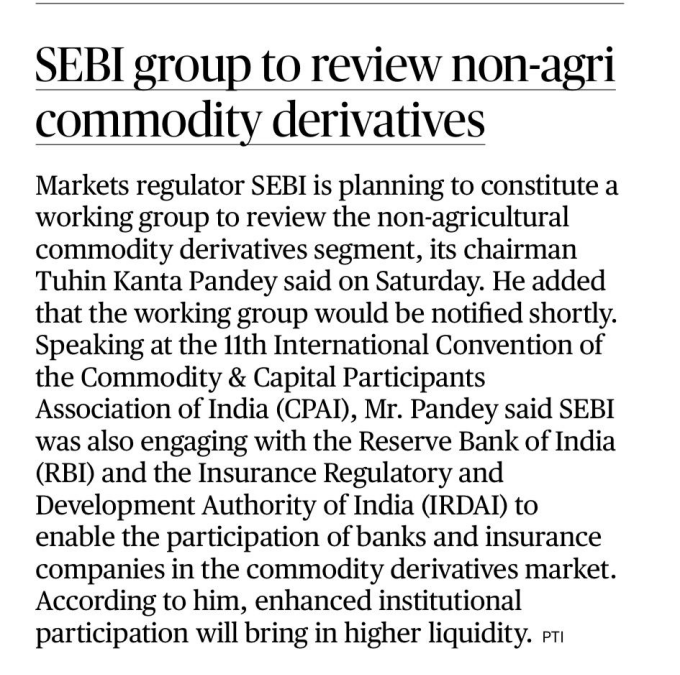
Context
SEBI has announced the formation of a working group to review the non-agricultural commodity derivatives segment, aiming to deepen market liquidity and strengthen regulatory architecture, including possible participation of banks and insurance companies.
Key Points
Decision by SEBI
• SEBI plans to constitute a working group to examine the performance and structure of non-agricultural commodity derivatives.
• The group will be notified shortly, as stated by SEBI Chairman Tuhin Kanta Pandey.
Regulatory Coordination
• SEBI is engaging with RBI and IRDAI to enable banks and insurance companies to participate in commodity derivatives markets.
• Enhanced institutional participation is expected to improve liquidity and price discovery.
Objective of the Review
• Assess market depth, risk management practices, and participation constraints.
• Explore reforms to make non-agri commodity derivatives more robust and efficient.
About Derivatives
What are Derivatives
• Financial contracts whose value is derived from an underlying asset, index, or rate.
• Used for hedging risk, speculation, and portfolio diversification.
Common Underlying Assets
• Commodities, stocks, bonds, currencies, interest rates, and market indices.
Types of Derivatives
Futures
• Contracts to buy or sell an asset at a pre-agreed price on a future date.
• Widely used by commodity traders to hedge price risk.
Options
• Provide the right but not the obligation to buy (call) or sell (put) an asset.
• Used to limit downside risk while retaining upside potential.
Swaps
• Agreements to exchange cash flows based on financial variables.
• Commonly used for managing interest rate or currency risk.
Forwards
• OTC contracts to buy or sell assets at a future date.
• Frequently used by importers and exporters to hedge currency exposure.
Significance for the Economy
• Stronger commodity derivatives markets aid inflation management and price stability.
• Institutional participation can align Indian commodity markets with global best practices.
• Supports producers, consumers, and investors through better risk hedging mechanisms.
�
ISRO set to launch mobile broadband satellite

Context
ISRO’s LVM3 M6 mission is scheduled to place the BlueBird Block-2 satellite into Low Earth Orbit under a commercial agreement, marking a step towards enabling direct-to-smartphone cellular broadband from space.
Key Points
Mission Overview
• Launch vehicle: LVM3 M6 of ISRO.
• Launch date: December 24.
• Nature of mission: Commercial launch for a U.S.-based firm.
Satellite Details
• Satellite name: BlueBird Block-2.
• Designed to provide high-speed cellular broadband directly to smartphones without terrestrial towers.
• Described as the largest commercial communication satellite to be deployed in Low Earth Orbit (LEO).
Commercial Partner
• AST SpaceMobile is developing a space-based cellular broadband network.
• Network targets both commercial and government users.
Connectivity Significance
• Aims to bridge connectivity gaps for billions of mobile users globally.
• Enables coverage in remote and underserved regions.
AST SpaceMobile Network Expansion
• Five satellites (BlueBird 1–5) were launched in September 2024.
• Partnerships with over 50 mobile operators worldwide to augment coverage.
India’s Space Commercialisation
• The mission reflects ISRO’s growing role in global commercial launches.
• Strengthens India’s position in the new space economy and satellite communications market.
AST SpaceMobile
• A U.S.-based company building a space-enabled cellular broadband network.
• Focuses on direct-to-device connectivity using standard smartphones.
• Works with telecom operators to extend terrestrial networks via satellites
�
UN Peacekeepers
Syllabus: GS II – International Relations | International Organisations
Context
The UN Security Council recently condemned drone attacks on UN peacekeepers in Sudan’s South Kordofan, which killed six Bangladeshi personnel serving with the UN Interim Security Force for Abyei (UNISFA).
Key Points
What are UN Peacekeepers
• UN Peacekeeping is a United Nations mechanism to help conflict-affected countries transition from war to peace.
• It stabilises volatile regions and supports political and peace-building processes.
Core Functions
• Ceasefire monitoring: Observes buffer zones and reports violations.
• Protection of civilians: Uses force when mandated to protect civilians from imminent threats.
• Disarmament, Demobilisation and Reintegration (DDR): Helps former combatants reintegrate into civilian life.
• Support to governance: Assists in elections and strengthening local institutions.
• Human rights and rule of law: Monitors abuses and supports judicial reforms.
• Humanitarian assistance: Facilitates relief delivery and early recovery efforts.
Mandate and Authority
• Peacekeepers are deployed only with UN Security Council authorisation.
• Operations are guided by principles of consent of parties, impartiality, and limited use of force.
India and UN Peacekeeping
Global Contribution
• India is among the largest troop-contributing countries to UN peacekeeping missions.
• Over 2,90,000 Indian personnel have served in 50+ missions worldwide.
Current Deployment
• Around 5,000 Indian peacekeepers are deployed across nine active UN missions.
Sacrifice
Nearly 180 Indian peacekeepers have laid down their lives in service of global peace.
UPSC Prelims Practice Question
With reference to UN Peacekeeping operations, consider the following statements:
1. UN peacekeepers can be deployed only with authorisation from the UN Security Council.
2. India is among the largest contributors of uniformed personnel to UN peacekeeping missions.
Which of the statements given above is/are correct?
a) 1 only
b) 2 only
c) Both 1 and 2
d) Neither 1 nor 2
Correct Answer: c) Both 1 and 2
Explanation:
• Statement 1 is correct: UN peacekeeping missions require Security Council authorisation.
• Statement 2 is correct: India is one of the largest contributors to UN peacekeeping forces globally.
Source: NH
�
Corporate Social Responsibility (CSR)
GS II – Polity and Governance (Bills, Acts and Judicial Interventions)
Context
The Supreme Court of India has ruled that Corporate Social Responsibility must inherently include environment and ecology, holding that CSR spending on environmental protection is a constitutional obligation under Article 51A(g) and not a charitable act.
Key Points
What is Corporate Social Responsibility
• CSR refers to the responsibility of companies to contribute to social welfare and sustainable development.
• It integrates social, environmental and ethical concerns into business operations and stakeholder relations.
Legal Basis in India
• CSR was made mandatory under the Companies Act, 2013, making India the first country to legislate CSR spending.
• Governed mainly by Section 135 and Schedule VII of the Act.
Eligibility Criteria for CSR
CSR provisions apply to companies having any one of the following in the preceding financial year:
• Net worth of ₹500 crore or more
• Turnover of ₹1,000 crore or more
• Net profit of ₹5 crore or more
Mandatory CSR Spending
• Eligible companies must spend at least 2% of the average net profits of the last three financial years on CSR activities.
• Unspent CSR amounts must be disclosed and, in certain cases, transferred to specified funds.
CSR Governance Structure
• CSR Committee at the Board level to formulate and monitor CSR policy.
• Disclosure norms mandate reporting of CSR policy, expenditure and unspent amounts in the Board’s Report.
Schedule VII Activities
• CSR spending must align with approved areas such as:
o Education and health
o Rural development
o Environmental sustainability
o Protection of flora, fauna and biodiversity
Supreme Court on Environmental CSR
• The Court held that environmental protection is intrinsic to CSR, not discretionary.
• CSR spending on ecology flows from Fundamental Duty under Article 51A(g) to protect and improve the natural environment.
Significance of the Ruling
• Reinforces corporate accountability towards society and environment.
• Aligns economic activity with constitutional values.
• Strengthens the role of CSR in sustainable development and ecological balance.
UPSC Prelims Practice Question
With reference to Corporate Social Responsibility (CSR) in India, consider the following statements:
1. CSR provisions are mandatory for companies meeting specified financial thresholds under the Companies Act, 2013.
2. The Supreme Court has held that CSR expenditure on environmental protection is a constitutional obligation linked to Fundamental Duties.
Which of the statements given above is/are correct?
a) 1 only
b) 2 only
c) Both 1 and 2
d) Neither 1 nor 2
Correct Answer: c) Both 1 and 2
Explanation:
• Statement 1 is correct: CSR is mandatory under Section 135 of the Companies Act, 2013 for eligible companies.
• Statement 2 is correct: The Supreme Court linked CSR’s environmental dimension to Article 51A(g), making it a constitutional obligation.
Source: TOI
�
National Scheduled Caste and Scheduled Tribe Hub (NSSH) Scheme
Syllabus: GS II – Government Policies and Interventions | GS III – Inclusive Growth, MSMEs
Context
The Ministry of Micro, Small and Medium Enterprises has intensified implementation of the National Scheduled Caste and Scheduled Tribe Hub (NSSH) Scheme to promote entrepreneurship, capacity building and market access for SC/ST communities.
Key Points
Nature of the Scheme
• Flagship initiative of the Ministry of Micro, Small & Medium Enterprises.
• Implemented through the National Small Industries Corporation Ltd. (NSIC).
Core Objective
• Aims at capacity enhancement of SC/ST entrepreneurs and promoting an entrepreneurship culture among SC/ST communities.
Public Procurement Focus
• Enables SC/ST enterprises to participate in government procurement.
• Supports fulfilment of the mandatory 4% procurement target from SC/ST enterprises by Ministries, Departments and CPSEs.
Financial Support
• Facilitates access to credit and financial assistance for SC/ST entrepreneurs.
• Works in collaboration with banks, financial institutions and NBFCs.
Skill Development
• Focuses on skill upgradation, mentoring and capacity building of SC/ST-owned MSMEs.
• Aims to improve competitiveness and sustainability of enterprises.
Broader Significance
• Promotes inclusive growth, economic empowerment and social equity through entrepreneurship.
• Strengthens participation of marginalised communities in the MSME ecosystem.
Source: PIB
�
Bureau of Port Security (BoPS)
Syllabus: GS III – Internal Security | Infrastructure (Ports and Shipping)
Context
The Union Home Minister recently convened a meeting to operationalise the Bureau of Port Security (BoPS) as a dedicated institutional mechanism to strengthen security of ports and vessels amid rising maritime and cyber threats.
Key Points
Legal Basis
• BoPS will be constituted as a statutory body under Section 13 of the Merchant Shipping Act, 2025.
Administrative Control
• It will function under the Ministry of Ports, Shipping and Waterways (MoPSW).
• Headed by a Director General (DG) of IPS rank (Pay Level-15).
Leadership Arrangement
• During a one-year transition period, the Director General of Shipping (DGS/DGMA)will act as DG, BoPS.
Institutional Design
• BoPS is being modelled on the Bureau of Civil Aviation Security (BCAS).
• Responsible for regulatory and oversight functions related to security of ships and port facilities.
Core Functions
• Ensures collection, analysis and exchange of security-related intelligence.
• Special focus on cyber security, including protection of port IT and digital infrastructure.
Role of CISF
• Central Industrial Security Force (CISF) has been designated as a Recognised Security Organisation (RSO).
• CISF will conduct security assessments and prepare port facility security plans.
Significance
• Strengthens maritime security architecture.
• Addresses emerging threats including cyber attacks, smuggling and port vulnerabilities.
• Enhances compliance with international maritime security norms.
UPSC Prelims Practice Question
With reference to the Bureau of Port Security (BoPS), consider the following statements:
1. The Bureau of Port Security will be constituted as a statutory body under the Merchant Shipping Act, 2025.
2. The Bureau of Port Security will function under the Ministry of Home Affairs.
Which of the statements given above is/are correct?
a) 1 only
b) 2 only
c) Both 1 and 2
d) Neither 1 nor 2
Correct Answer: a) 1 only
Explanation:
• Statement 1 is correct: BoPS is a statutory body under Section 13 of the Merchant Shipping Act, 2025.
• Statement 2 is incorrect: BoPS functions under the Ministry of Ports, Shipping and Waterways, not the Ministry of Home Affairs.
Source: PIB�
Regional Rural Banks (RRBs)
GS III – Indian Economy (Banking and Financial Inclusion)
Context
The Union Finance Ministry has unveiled a new unified logo for Regional Rural Banks (RRBs) to reflect a single, common brand identity and strengthen public recognition of RRBs across India.
Key Points
Establishment and Legal Basis
• RRBs were established under the Regional Rural Banks Act, 1976.
• They were set up based on the recommendations of the Narasimham Committee on Rural Credit (1975).
Objective
• To meet the credit needs of small and marginal farmers, agricultural labourers and weaker sections in rural and semi-urban areas.
• To promote financial inclusion and rural development.
Institutional Structure
• RRBs are jointly owned by the Central Government, State Government and Sponsor Bank.
• Equity pattern: 50% (Centre) : 15% (State) : 35% (Sponsor Bank).
Regulation and Supervision
• Regulated by the Reserve Bank of India.
• Supervised by the National Bank for Agriculture and Rural Development.
First Regional Rural Bank
• Rathama Grameen Bank was the first RRB, established on 2 October 1975.
Operational Nature
• Designed as hybrid institutions, combining:
o Local familiarity of cooperative banks.
o Professional banking practices of commercial banks.
Priority Sector Lending (PSL)
• RRBs must lend 75% of total advances to priority sectors.
• This is higher than the 40% PSL target for Scheduled Commercial Banks.
Area of Operation
• Limited to notified districts in one or more States, as specified by the Government of India.
Sources of Funds
• Owned funds and deposits.
• Borrowings from NABARD, sponsor banks and institutions like SIDBI and NHB.
Management Structure
• Governed by a Board of Directors, comprising:
o One Chairman.
o Directors nominated by the Centre, State Government and Sponsor Bank.
Current Network
• 28 RRBs are currently operational.
• Network includes over 22,000 branches across 700+ districts.
UPSC Prelims Practice Question
With reference to Regional Rural Banks (RRBs), consider the following statements:
1. Regional Rural Banks are regulated by the Reserve Bank of India and supervised by NABARD.
2. The Priority Sector Lending target for RRBs is higher than that for Scheduled Commercial Banks.
Which of the statements given above is/are correct?
a) 1 only
b) 2 only
c) Both 1 and 2
d) Neither 1 nor 2
Correct Answer: c) Both 1 and 2
Explanation:
• Statement 1 is correct: RBI regulates RRBs while NABARD supervises them.
• Statement 2 is correct: RRBs have a 75% PSL target, higher than the 40% target for Scheduled Commercial Banks.
Source: The Hindu
LTX Classes - Courses Offered UPSC, APPSC Group I and II.
Address: Sector 8, MVP Colony, 7893899553.

 Launch your Graphy