Daily Current Affairs for UPSC 21st Nov 2025


| Index |
| S.No | Topic | |
| Daily Hindu Analysis (YouTube) |
| 1. | Courts cannot fetter President, Governor: SC |
|
| 2. | India’s fisheries and aquaculture, its promising course |
|
| 3. | As trade row eases, U.S. clears missile sale to India |
|
| 4. | Coastal security exercise begins in two T.N. districts |
|
| 5. | Ajit Doval hosts seventh meeting of Colombo Security Conclave in Delhi |
|
| 6. | India, Israel ink terms of reference for trade talks |
|
| Daily Current Affairs (App) |
| 7. | Indira Gandhi Peace Prize |
|
| 8. | UAE as the World’s Third-Largest Humanitarian Donor (2025) |
|
| 9. | Trade Intelligence and Analytics Portal |
|
| 10. | SEHER Programme |
|
Courts cannot fetter President, Governor: SC
1. CONTEXT
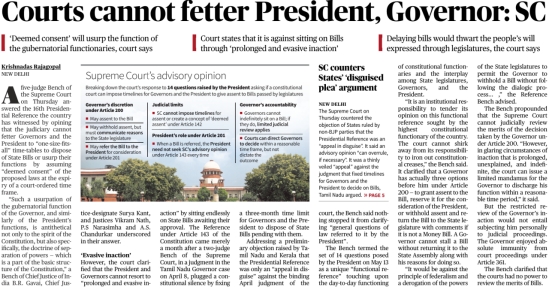
A five-judge Constitution Bench of the Supreme Court delivered an important opinion in response to a Presidential Reference under Article 143, concerning whether courts can impose strict timelines on Governors and the President for granting assent to State Bills. The Court clarified:
- Judiciary cannot impose “one-size-fits-all” timelines.
- “Deemed assent” at the expiry of a court-ordered time is unconstitutional.
- Governors and the President cannot engage in prolonged and evasive inaction.
- Courts may issue limited mandamus directing action within a reasonable time, but cannot dictate the outcome.
This resolves ongoing disputes between several State governments and Governors, especially over allegations of delayed assent to Bills.
2. WHAT IS THIS ISSUE ABOUT?
Several States have accused Governors of:
- Sitting on Bills indefinitely
- Withholding assent without reasons
- Not returning Bills to the Assembly
- Delaying forwarding of Bills to the President
This led to litigation, and even the Supreme Court recently directed Governors to dispose of pending Bills.
To clarify constitutional boundaries, the President sought an advisory opinion under
Article 143. The core question:
Can courts order the Governor/President to decide State Bills within a fixed time or declare “deemed assent” if they delay? The Supreme Court answered NO.
3. DETAILED ANALYSIS
A. Court Rejects “Deemed Assent” & Fixed Deadlines
The Court held that:
- Imposing a uniform judicially created deadline
- Or declaring Bills “deemed passed” if the Governor delays
would
usurp the constitutional functions of the Governor and President. This violates the
Doctrine of Separation of Powers, which prevents one organ of the State from taking over the core functions of another. The Bench said this would be
“antithetical to the spirit of the Constitution.” B. Governor’s Discretion under Article 200 Under Article 200, a Governor has only three options:
1. Assent to the Bill
2. Withhold assent, but must communicate reasons to the State Legislature
3. Refer the Bill to the President under Article 201 The Court reiterated that withholding assent requires reasons, and a Governor cannot indefinitely sit on a Bill.
C. Judicial Limits under Article 142 The Court clearly stated:
- It cannot impose strict timelines using its powers under Article 142.
- It cannot create a doctrine of “deemed assent.”
Courts may intervene only when there is:
- “Prolonged and evasive inaction”
- “Glaring circumstances” of unexplained delay
In such cases, the Court can issue a
limited mandamus, directing the Governor to act
within a reasonable time (but not dictate what the assent outcome must be).
D. President’s Role under Article 201 When a Bill is referred to the President:
- The President need not seek the Supreme Court’s advisory opinion every time.
- This advisory opinion was only for clarification of constitutional practice, not for deciding individual Bills.
The Court also clarified that this reference was not an “appeal in disguise” against earlier judgments (as Tamil Nadu argued).
E. Governor Cannot Sit Indefinitely on Bills The Court emphasized:
- Governors cannot sit on Bills endlessly.
- They have to act within a “reasonable time.”
The Bench stated that
delayed Bills thwart the people’s will, because the Legislature represents the democratic mandate. Courts can direct the Governor to
perform his constitutional duty, but cannot evaluate the
merits of his decision.
F. Governor Enjoys Immunity The Court reaffirmed:
- Governors enjoy absolute immunity from court proceedings under Article 361.
- Courts cannot summon or prosecute Governors.
Thus, judicial remedies must be
institutional, not personal.
G. Why the Court Intervened The Supreme Court explained:
- It has a responsibility to clear constitutional confusion, especially when the President seeks guidance.
- It cannot refuse to answer the reference because it concerns the highest constitutional functionaries and the Centre-State interplay.
4. SIGNIFICANCE OF THE JUDGMENT Reinforces separation of powers Courts cannot take over executive decision-making.
Clarifies constitutional roles of Governor and President Particularly Articles 200, 201, 142, 143, 361. Prevents misuse of gubernatorial office By stating that indefinite inaction is unconstitutional. Preserves federal structure Judicial oversight is limited, but not entirely absent.
Protects legislative supremacy Delays cannot override the people’s mandate.
UPSC MAINS Q. Discuss the constitutional boundaries of the Governor’s discretion under Articles 200 and 201 in light of the recent Supreme Court advisory opinion. How does the judgment reinforce the doctrine of separation of powers while addressing concerns of gubernatorial inaction?

India’s fisheries and aquaculture, its promising course
1. CONTEXT
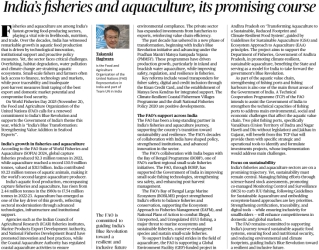
On the occasion of World Fisheries Day 2025 (November 21), the Food and Agriculture Organization of the United Nations (FAO) highlights India’s remarkable progress in fisheries and aquaculture, while also pointing to the major challenges and opportunities for the future.
FAO calls for renewed commitment to India’s Blue Revolution and supports the Government’s theme for the year:
“India’s Blue Transformation: Strengthening Value Addition in Seafood Exports.” India today is one of the fastest-growing food-producing sectors, crucial for livelihoods, nutrition, trade, and rural development.
2. WHAT IS THIS ABOUT? The article explains:
- The rapid growth India has achieved in fisheries and aquaculture.
- Key reforms and government initiatives driving this transformation.
- Challenges such as overfishing, habitat degradation, water pollution, climate change, and constraints faced by small traditional fishers.
- The critical role of FAO in supporting policy, technology, sustainability, and global best practices.
- A forward-looking focus on sustainability, traceability, digital tools, climate resilience, and inclusive growth.
The article is written by Takayuki Hagiwara, FAO Representative in India.
3. DETAILED ANALYSIS
A. India’s Fisheries Sector – Importance and Challenges
- The sector has grown due to technological innovation, institutional support, and proactive policy measures.
- Despite progress, the sector faces critical challenges: Overfishing, Habitat degradation, Water pollution, Climate change effects, Weak traceability systems, Poor post-harvest infrastructure
Small-scale fishers lacking access to: - Finance
- Technology
- Markets
These factors limit export and domestic potential and threaten food security.
B. India’s Growth in Fisheries and Aquaculture – Key Numbers From FAO’s SOFIA 2024 report:
- Global capture fisheries (2022): 92.3 million tonnes
- Global aquaculture (2022): 130.9 million tonnes ($313 billion value)
- India’s contribution: 10.23 million tonnes, making it the world’s second-largest aquaculture producer.
India’s aquatic food production has grown from: - 2.44 million tonnes (1980s) → 17.54 million tonnes (2022–23)
This growth is driven by: - Structural modernisation
- Technological improvements
- Infrastructure development
- Strong institutional support
Supportive agencies: - ICAR fisheries institutes
- Marine Products Export Development Authority (MPEDA)
- National Fisheries Development Board (NFDB)
C. Public and Private Sector Transformation - Public sector:
- Reforms, policies, and programmes such as Pradhan Mantri Matsya Sampada Yojana (PMMSY).
- Emphasis on inland and brackish water aquaculture.
- Focus on safety, digitalisation, credit access, and resilience.
- Private sector:
- Increased investment in technology and efficiency.
- Enhanced exports and value chain improvements.
Past decade’s change linked to:
India’s Blue Revolution initiatives + the advancement under PMMSY.
D. Key Government Reforms Highlighted reforms include: - Vessel transponders for safety
- Digital tools and credit inclusion via Kisan Credit Card
- Matsya Seva Kendras for integrated support
- Climate-Resilient Coastal Fishermen Villages Programme
- Draft National Fisheries Policy 2020
E. FAO’s Support to India FAO has been a long-standing partner in India's fisheries development, particularly in: - Policy strengthening
- Institutional capacity
- Sustainability initiatives
- Improving post-harvest management
- Technology adoption
- Safety and traceability
Major FAO Programmes Mentioned: 1. Bay of Bengal Large Marine Ecosystem Programme (BOBLME) o Supports coastal small-scale fisheries. o Strengthens governance and sustainable management.
2. Ecosystem Approach to Fisheries Management (EAFM) o Aligns with FAO’s global priorities. o Encourages balanced and sustainable marine ecosystems.
3. Technical Cooperation Programme (TCP) o Technical assistance to improve fishing ports and harbours. o Pilot sites: Dadra & Nagar Haveli and Diu (without legislation), Jakhau in Gujarat o Helps with: Strategic planning, Operational tools, Investment formulation, Environmental, social, and economic priorities
4. Guidelines for Sustainable Aquaculture (GSA)
5. Ecosystem Approach to Aquaculture (EAA) These focus on:
- Climate-resilient aquaculture
- Reduced environmental footprint
- Model practices for States (e.g., Andhra Pradesh)
F. Focus on Sustainability India’s future in fisheries depends on strong sustainability measures:
- Science-based stock assessments
- Monitoring, Control, and Surveillance (MCS) to tackle IUU fishing
- Strengthened certification and traceability
- Digital tools for governance
- Resilience to climate change
- Support for smallholders
- Ecosystem-based management
- Ensuring competitiveness in global markets
FAO commits to supporting: Nutrition, Food security, Sustainable livelihoods, Climate-resilient systems, Safe aquatic food, Stronger institutions
4. WHY THIS MATTERS
- India is rapidly emerging as a global fisheries powerhouse.
- Fisheries are vital for rural employment, exports, and nutrition.
- Sustainability must stay central to prevent resource depletion.
- Policies must include: Small-scale fishers, Climate resilience, Digital innovation, Better governance
UPSC MAINS Q.
“India has emerged as a major global player in fisheries and aquaculture, yet sustainability challenges remain central.” Discuss in the context of recent government reforms and FAO-supported initiatives.
As trade row eases, U.S. clears missile sale to India
1. CONTEXT
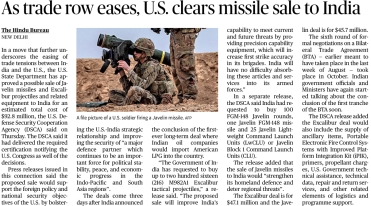
The U.S. State Department has approved a possible sale of Javelin missiles, Excalibur projectiles, and related equipment to India worth $92.8 million.
This comes at a time when India–U.S. trade tensions are easing, and both countries are moving forward diplomatically and economically. The sale was confirmed through a notification issued by the U.S. Defense Security Cooperation Agency (DSCA) to the U.S. Congress. This development is linked to:
- Strengthening India–U.S. strategic partnership
- Signalling confidence-building after recent trade disagreements
- Progress on the Bilateral Trade Agreement (BTA) talks
- India’s growing defence modernization needs
2. KEY PROVISIONS OF THE MISSILE SALEA. Total Value and Items Included The U.S. approved a possible foreign military sale worth $92.8 million, which includes:
1. Excalibur Projectiles
- India requested 216 M982A1 Excalibur tactical projectiles
- Estimated cost: $47.1 million
- These will:
- Improve India’s capability to meet current and future threats
- Increase first-strike accuracy of Indian Army brigades
- Be easily absorbed into India’s existing systems
2. Javelin Missile Package In a separate DSCA release, India requested:
- 100 FGM-148 Javelin rounds
- 1 Javelin FGM-148 missile
- 25 Javelin Lightweight Command Launch Units (LwCLU) OR Javelin Block 1 Command Launch Units (CLU)
- Estimated cost: $45.7 million
The DSCA emphasised the Javelin sale will:
- Strengthen India’s homeland defence
- Deter regional threats
B. Additional Ancillary Items Included in the Excalibur Package The sale also covers: - Portable Electronic Fire Control Systems with Improved Platform Integration Kit (iPIK)
- Primers and propellant charges
- U.S. Government technical assistance
- Technical data
- Repair and return services
- Other logistics & program support elements
C. Strategic Rationale (as per DSCA) According to U.S. press releases:
- The sale supports U.S. foreign policy and national security objectives
- It strengthens the security of a “major defence partner”
- India is seen as:
- An important force for political stability
- A partner for peace
- A driver of economic progress in the Indi-Pacific and South Asia
D. Link to Recent India–U.S. Trade Developments The approval comes days after:
- Conclusion of the first-ever long-term LPG import deal between Indian oil companies and the U.S.
The article also notes:
- The sixth round of negotiations on the Bilateral Trade Agreement (BTA) (earlier expected in August) actually took place in October
- Indian officials and Ministers have resumed discussions on concluding the first tranche of the BTA soon
This indicates an overall improvement in India–U.S. relations.
3. WHY THIS MATTERS
- Shows improvement in India–U.S. trade and defence ties
- Reinforces India’s status as a Major Defence Partner
- Helps India upgrade its precision-strike capability
- Supports deterrence against regional threats
- Fits into ongoing India–U.S. strategic cooperation in the Indo-Pacific
- Comes at a crucial time when both sides are negotiating a large BTA
UPSC PRELIMS
Q. With reference to recent defence developments between India and the United States, consider the following statements:
1. The U.S. Defense Security Cooperation Agency (DSCA) is responsible for notifying the U.S. Congress about proposed foreign military sales.
2. Excalibur projectiles approved for India are intended to improve first-strike accuracy for Indian Army brigades.
3. The recent Javelin missile package cleared for India includes command launch units in addition to missile rounds.
How many of the above statements are correct?
A. Only one
B. Only two
C. All three
D. None
Answer: C
Coastal security exercise begins in two T.N. districts

1. CONTEXT
A two-day joint coastal security exercise named ‘Sagar Kavach’ has begun in Cuddalore and Villupuram districts of Tamil Nadu.
The drill aims to assess the preparedness and alertness of all stakeholders involved in coastal security. Stakeholders include:
- Indian Coast Guard
- Indian Navy
- Tamil Nadu Police
- Coastal Security Group (CSG)
- District Police
- Other relevant agencies
The exercise began in the early hours of Thursday and will conclude on Friday.
2. KEY PROVISIONS & ACTIVITIES
A. Purpose of the Exercise
The objective of Sagar Kavach is to:
- Test the preparedness of coastal security agencies
- Enhance coordination among stakeholders
- Strengthen surveillance and response capability
- Improve sensitivity among fishermen & coastal communities
- Detect and counter intrusions, smuggling, sabotage, and maritime threats
B. Major Components of the Exercise
1. Deployment of Police Teams
Police teams were deployed to:
- Protect high-value targets
- Gather intelligence on the coastline
- Monitor suspicious activities
2. Interception Drills The drill included:
- Interception of intrusions
- Detection of sabotage materials
- Monitoring movements of intruders
3. Coastal Patrolling Coastal Security Group (CSG) personnel:
- Carried out sea patrolling on patrol boats
- Checked fishing vessels at sea and at harbours
- Ensured vigilance in coastal villages
- Sensitised fishermen to report suspicious movement
C. Participation of Red Force Teams The exercise included a simulation component:
- Five members from Red Force teams (security personnel) acted as aggressors
- They were deployed in Thazhanguda
- CSG personnel successfully secured them as part of the drill
D. Coverage of Vital Installations
Teams also combed railway stations, bus stands, and other vital installations, as these are potential targets during coastal intrusions.
UPSC PRELIMS
Q. With reference to the coastal security exercise ‘Sagar Kavach’, consider the following statements:
1. It is a three-day exercise conducted to assess preparedness of coastal security stakeholders.
2. The exercise in the article was conducted in the districts of Cuddalore and Villupuram.
3. Red Force teams participated in the drill by acting as aggressors.
How many of the above statements are correct? A. Only one
B. Only two
C. All three
D. None
Answer: B
Ajit Doval hosts seventh meeting of Colombo Security Conclave in Delhi
1. CONTEXT
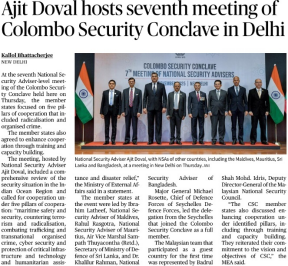
The seventh National Security Adviser (NSA)-level meeting of the Colombo Security Conclave (CSC) was held in New Delhi on Thursday, hosted by India’s NSA Ajit Doval. The meeting brought together member states and participating countries to review cooperative security measures in the Indian Ocean Region (IOR).
The discussion centred around five pillars of cooperation, including radicalisation, organised crime, cyber security, maritime safety, and capacity building.
2. WHAT THIS MEETING WAS ABOUT The meeting included:
- A comprehensive review of regional security in the Indian Ocean Region
- A call for cooperation under five pillars of CSC
- Participation of NSAs and senior security officials from member and partner countries
- Discussions on training, capacity building, and disaster relief cooperation
The Ministry of External Affairs (MEA) reaffirmed commitment to the vision and objectives of the CSC.
3. KEY PROVISIONS & DETAILS
A. CSC Focus Areas – Five Identified Pillars Member states discussed cooperation in the following five pillars: 1. Maritime safety and security 2. Countering terrorism and radicalisation 3. Combating trafficking and transnational organised crime 4. Cyber security and protection of critical infrastructure/technology 5. Humanitarian assistance and disaster relief (HADR) These pillars formed the central framework of discussion.
B. Participation & Representation The meeting was attended by senior security officials from: Full CSC Member States:
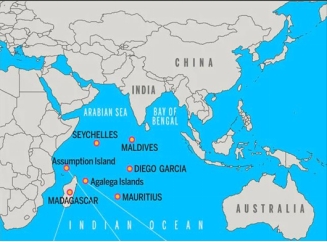
- India (host – NSA Ajit Doval), Maldives, Mauritius, Sri Lanka, Bangladesh, Seychelles
Guest Country: - Malaysia-This is the first time Malaysia participated in CSC as a guest country.
C. Discussions Held During the Meeting Member states: - Conducted a review of security cooperation in the IOR
- Discussed increased coordination under the identified pillars
- Reiterated commitment to training and capacity building
- Emphasised the need to enhance cooperation against:
- Radicalisation
- Terrorism
- Organised crime
- Cyber threats
- Maritime threats
MEA’s statement noted that the states renewed commitment to CSC’s vision.
D. Significance The article highlights:
- Strengthening of regional coordination
- India’s leadership in IOR security frameworks
- CSC’s growing influence and expansion (e.g., Seychelles becoming a full member; Malaysia participating as a guest)
- Joint efforts to secure the region from terrorism, cyber threats, organised crime, and maritime challenges
UPSC PRELIMS
Consider the following countries:
1. India
2. Sri Lanka
3. Maldives
4. Mauritius
5. Seychelles
How many of the above are full members of the Colombo Security Conclave (CSC)?
A. Three
B. Four
C. Five
D. Two
Answer: C
India, Israel ink terms of reference for trade talks
1. CONTEXT
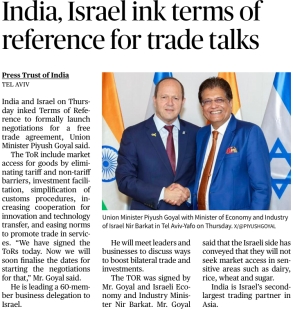
India and Israel on Thursday signed the Terms of Reference (ToR) to formally begin negotiations for a Free Trade Agreement (FTA).
The announcement was made by Union Minister Piyush Goyal, who is currently leading a 60-member business delegation to Israel. The signing of the ToR marks the formal starting point of structured negotiations and demonstrates the intent of both nations to deepen bilateral trade and economic cooperation.
2. WHAT THIS IS ABOUT
The ToR lays down the framework and scope for India–Israel FTA negotiations.
It outlines priority areas such as:
- Market access
- Elimination of tariff and non-tariff barriers
- Investment facilitation
- Customs procedure simplification
- Innovation & technology transfer
- Promotion of trade in services
It also records an important assurance from the Israeli side: They will not seek market access in India’s sensitive agricultural sectors — dairy, rice, wheat, and sugar. India is currently Israel’s second-largest trading partner in Asia.
UPSC PRELIMS
Q. With reference to India’s trade relations, consider the following statements:
1. India recently signed a Terms of Reference (ToR) with Israel to formally begin negotiations for a Free Trade Agreement.
2. The ToR includes provisions related to market access, investment facilitation, and customs simplification.
3. Israel has agreed not to seek market access in certain sensitive agricultural sectors of India. How many of the above statements are correct?
A. Only one
B. Only two
C. All three
D. None
Answer: C
Indira Gandhi Peace Prize
Syllabus: GS Paper 2 — International relations & important institutions
Context:
Former Chilean President Michelle Bachelet was awarded the Indira Gandhi Prize for Peace, Disarmament and Development (2024) in recognition of her contributions to human rights and global cooperation. The prize honours creative efforts that advance peace, development and the common good.
Key points
- Instituted: Set up in 1986 by the Indira Gandhi Memorial Trust to honour the former Prime Minister.
- Purpose: Recognises work promoting peace, disarmament, racial equality, goodwill and harmony among nations.
- Monetary award: Carries ₹25 lakh and a citation.
- Eligibility: Open annually to any person or organisation, irrespective of nationality, race or religion.
- Other aims: Rewards efforts securing economic cooperation, a fair international economic order, and using science for the public good.
- Scope: Also honours work that enlarges freedom and enriches the human spirit.
- Notable recipients: Mikhail Gorbachev (1987); UNICEF (1989); Jimmy Carter (1997); UN & Kofi Annan (2003); Angela Merkel (2013); ISRO (2014); Manmohan Singh (2017); David Attenborough (2019); Pratham (2021); Indian Medical Association & Trained Nurses Association of India (2022); Daniel Barenboim & Ali Abu Awwad (2023).
- 2024 awardee: Michelle Bachelet — recognised for her sustained advocacy for human rights and international cooperation.
Source: Indian Express
UAE as the World’s Third-Largest Humanitarian Donor (2025)
Syllabus: GS Paper 2 —
International Relations: Global Aid & Humanitarian Assistance
Context: Updated UN data shows that the
United Arab Emirates (UAE) has emerged as the
third-largest donor for 2025, highlighting its significant role in global humanitarian support.
Key Points - UN ranking: UAE is the 3rd-largest donor globally, after the US and the European Union, and the largest individual donor nation.
- Contribution: Provided $1.46 billion in humanitarian assistance in 2025.
- Share of global aid: Accounts for 7.2% of total global humanitarian funding ($20.28 billion).
- Focus areas: Supports emergency response and long-term recovery in sectors like health, education, energy and infrastructure.
- Relief philosophy: Operates on neutrality & inclusivity, offering aid regardless of nationality, ethnicity or religion.
- Approach: Combines rapid crisis response with sustained development efforts to build resilience in vulnerable regions.
Source: The Hindu
Trade Intelligence and Analytics Portal
Syllabus: GS Paper 3 — Indian Economy: Trade & Infrastructure
Context: The Union Minister of Commerce and Industry launched the
Trade Intelligence & Analytics (TIA) Portal in New Delhi to streamline access to trade data and support evidence-based policymaking.
Key Points - Developed by: Department of Commerce, Ministry of Commerce & Industry.
- Nature: A one-stop integrated platform combining global and national trade databases.
- Function: Acts as a centralised digital hub with consolidated bilateral and global trade information.
- Analytics: Provides 270+ interactive visualisations across 28+ dashboards.
- Insights offered: Real-time data on India & global trade, commodities, sectors and market intelligence.
- Automated reports: Tracks trends for PLI sectors and critical minerals.
- Comparative tools: Enables comparison of macroeconomic, trade & investment indicators across countries.
- Trade indices included:
- Trade Complementarity Index: Matches India’s exports with partners’ import needs.
- Revealed Comparative Advantage: Identifies India’s competitive export products.
- Trade Intensity Index: Measures bilateral trade strength against global flows.
- Significance: Enhances accessibility, usability and quality of trade data for policymakers and researchers.
Source: PIB
SEHER Programme
Syllabus: GS Paper 2 — Governance & Social Justice (Women Empowerment)
Context: NITI Aayog’s Women Entrepreneurship Platform (WEP), in partnership with TransUnion CIBIL, launched the
SEHER Programme to strengthen financial literacy and business skills among women entrepreneurs.
Key Points - Purpose: A comprehensive credit education programme to boost financial literacy and business capabilities of women entrepreneurs.
- Impact: Helps women access financial tools essential for business expansion and job creation.
- Launched by: WEP (NITI Aayog) and TransUnion CIBIL.
- Target group: Supports WEP’s mission to improve financing access for women in 63 million MSMEs.
Key Facts: Women Entrepreneurship Platform (WEP) - Established: Incubated in 2018 in NITI Aayog; became a public–private partnership in 2022.
- Role: A national aggregator platform providing ecosystem support to women entrepreneurs.
- Aim: Reduces information asymmetry and offers end-to-end support across pillars such as:
- Entrepreneurship promotion
- Access to finance
- Market linkages
- Training & skilling
- Mentoring & networking
- Business development services
- Approach: Works through convergence and collaboration with multiple stakeholders to strengthen women's entrepreneurship.
Source: PIB


 Launch your Graphy