| Index |
| S.No | Topic | Page No |
| Daily Hindu Analysis (YouTube) |
| 1. | Hidden cost of polluted groundwater |
|
| 2. | The threat of digital tradecraft in terrorism |
|
| 3. | India’s Russian oil cuts predate U.S. tariffs: data |
|
| 4. | Attribution science: the tricky task of linking disasters to emitters |
|
| 5. | ISRO tests bootstrap mode start on CE20 cryogenic engine |
|
| 6. | SC strikes down provisions of Tribunal Reforms Act, tells govt. to set up panel |
|
| 7. | India will become hub of natural farming; science, tradition to lead way: PM |
|
| Daily Current Affairs (App) |
| 8. | Leadership Group for Industry Transition |
|
| 9. | Blackbuck |
|
| 10. | YUVA AI for ALL Initiative |
|
| 11. | India Launches National Action Plan on Antimicrobial Resistance 2.0 (NAP-AMR 2.0) |
|
Hidden cost of polluted groundwater
CONTEXT
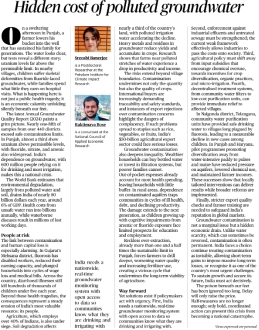
The Annual Groundwater Quality Report 2024 reveals alarming levels of toxic groundwater contamination across India. With nearly one-fifth of samples from over 4400 districts failing standards, and widespread presence of fluoride, nitrate, arsenic and uranium, India stands at the brink of a slow-burning public health and economic crisis. The article uses real cases—from Punjab to Gujarat and Telangana—to show how polluted groundwater silently erodes health, productivity, exports, and future generations.
DETAILED ANALYSIS
A. Scale of the Groundwater Crisis
- One-fifth of all collected samples exceed contamination limits;
- Punjab’s water shows dangerously high uranium levels;
- Fluoride, nitrate and arsenic contamination are widespread in major agrarian states.
India depends on groundwater for:
- ~600 million people,
- 90% of rural drinking water,
- Nearly 60% of irrigation.
This makes contamination a
national crisis, not a local issue.
B. Public Health Impact
- Fluorosis, skeletal deformities, dental issues, and lifelong disabilities are rising.
- In Gujarat’s Mehsana district alone, fluorosis has pushed families into a cycle of medical debt and poverty.
- Waterborne diseases cost billions annually and lead to millions of lost workdays.
Children growing up with contaminated water face:
- Cognitive impairment
- Lower educational outcomes
- Limited future employment
Thus contaminated groundwater undermines India’s
human capital.
C. Economic Impact Groundwater pollution reduces:
- Agricultural productivity
- Quality of crops
- Household incomes
- Export competitiveness
Contaminated soil and water result in:
- Rejections of export consignments
- Declining yields of staples like rice, pulses, oilseeds
- Higher input costs for marginal farmers
India’s
$50-billion agricultural export sector is increasingly at risk due to soil chemical residues.
D. Environmental and Industrial Drivers Major contributors include:
- Industrial effluents
- Untreated sewage
- Chemical fertilisers and pesticides
- Over-extraction causing arsenic/nitrate intrusion
- Crop patterns encouraging excessive water usage (e.g., paddy)
Industrial regulation is weak; many industries bypass safe disposal requirements due to
inefficient enforcement.
E. Inequality Dimensions Wealthier households can:
- Buy bottled water
- Install filtration systems
Poor families cannot afford such protections and suffer the
worst health impacts. Thus groundwater contamination is also a
social justice issue.
F. Positive Examples & Local Solutions - Nalgonda (Telangana): community water purification units cut fluorosis cases.
- Punjab and Haryana: pilot shifts from paddy to pulses reduced aquifer stress.
However, such successes are isolated, not systemic.
G. Way Forward The article gives a clear reform roadmap:
1. Nationwide Real-Time Groundwater Monitoring
- Open to communities
- Data transparency
- Early warning alerts
2. Strengthen Industrial Regulation - Strict enforcement
- Revise effluent standards
- Penalise polluters
3. Shift Agricultural Policy - Incentivize crop diversification
- Promote micro-irrigation
- Reduce chemical fertiliser dependency
4. Expand decentralized purification systems - Community RO units
- Rainwater harvesting
- Local water treatment
5. Periodic Quality Checks - Mandatory audits
- Accountability mechanisms
The core message: half-measures will not work; only coordinated nationwide action can avert a looming catastrophe.
UPSC MAINS Q. “Groundwater contamination in India is not merely an environmental problem but a silent economic and public health emergency.” Discuss.
The threat of digital tradecraft in terrorism
GS Paper: GS3 – Internal Security, Terrorism, Cyber Security; GS2 – Governance
1 — Introduction: A new kind of terrorist threat
- A car explosion near Delhi’s Red Fort on November 10 killed at least 15 people and injured more than 30.
- Ongoing investigation shows that the people behind the attack used advanced digital methods to plan and coordinate the operation.
- The article argues that the next frontier of counter-terrorism is not just physical policing, but tracking and disrupting highly encrypted and anonymised digital networks used by terror modules.
2 — What happened near Red Fort? A car exploded near Gate No.1 of Red Fort Metro Station.
Key points: - 15 killed, 30+ injured
- One of the deadliest city explosions in recent times
- Early investigations suggest it was deliberate, not an accident
- NIA (National Investigation Agency) is probing the case
This indicates increased sophistication of terror operations in urban centers.
3 — Who were the suspects?
The article mentions that three terrorists were allegedly connected to the attack:
- Dr. Umar Nabil
- Dr. Maazuddin Gamar
- Dr. Shaheen Salhaj
All reportedly linked to the Al-Rafah University in Pakistan. They supposedly used a digital module to plan and coordinate activities.
4 — What were the findings? (Encrypted Communication)
The suspected terrorists allegedly used Threema, a Swiss-developed encrypted messaging app. Why Threema?
- End-to-end encrypted
- Doesn’t require a phone number or email ID
- Allows anonymous ID
- Destroyed metadata
- Provides extreme privacy
Investigators found no personal metadata, meaning: - No call logs
- No chat history
- No meaningful digital footprint
This makes it extremely hard for agencies to track communication.
5 — What is "dead-drop messaging"? Terrorists now use “dead-drop messaging”, where:
- Information is kept in drafts
- Both parties access the same login
- No messages are sent
- Nothing appears in communication logs
This is a non-traceable communication method, often used by spies.
6 — Instructions via industrial-level exposure Evidence suggests that terrorists used industrial solvent exposure, which caused burns seen on the suspect linked to the module. Investigators also found:
- Chemical traces
- Explosive material
- Signs of scientific handling
This shows a sophisticated operational approach.
Digital forensics & misdirection Investigators suspect the terrorists used:
- Multiple IP masking tools
- VPN chains
- Device cloning
- Location spoofing
These steps created layers of misdirection, making forensic tracking extremely difficult. Some data suggested the suspect was nowhere near Delhi physically, showing how misleading digital footprints can be.
Why are terror modules harder to detect now? Traditional surveillance modules are failing because:
- Terrorists use privacy-preserving technologies
- Most communication is encrypted
- Advanced anonymity tools (VPNs, TOR, custom apps) erase footprints
- OSINT (Open-source Intelligence) becomes less useful
Thus, counter-terror strategies must evolve.
What does academic research show? Studies show that modern terrorists:
- Use deeper layers of digital infrastructure
- Employ AI-based identity spoofing
- Use dead-drop cloud storage chains
- Use burner operating systems (Tails, Qubes)
These techniques are similar to what intelligence agencies use — but now are being adopted by terrorists.
10 — What are the implications? The combination of:
- encrypted data
- privacy-protecting apps
- multi-step IP masking
- rapid data deletion
It means that: - Traditional investigative methods cannot keep pace
- Digital evidence is scarce
- Forensic attribution becomes extremely difficult
- Terrorists gain strategic advantage
Agencies depend on physical intelligence and HUMINT, which is risky and slow.
Why the government needs new rules The article proposes several upgrades:
1. Build a dedicated digital forensics team India needs:
- cyber forensics specialists
- encrypted platform analysts
- memory forensics units
- crypto-tracing experts
2. Regulate self-hosted communication infrastructure Platforms on private servers help terrorists avoid traceability.
3. Update legal frameworks Indian laws do not yet address:
- Encrypted messaging apps
- Self-destructing data
- Multi-layered VPN chains
- Offshore servers
4. Strengthen institutional architecture Doctors, educational institutions, and hospitals must be alert and report suspicious behaviour. Conclusion The Red Fort blast demonstrates:
- Terror modules are more decentralized
- Younger attackers use advanced digital tools
- India’s counter-terrorism must evolve beyond physical surveillance
- Digital spaces are now the primary battleground
A combination of: - updated laws
- specialised cyber teams
- stronger institutional monitoring
- tech-company cooperation
UPSC MAINS Q. “The evolution of digital tradecraft has transformed terrorism into a complex, encrypted challenge for modern states.” Discuss how India should strengthen its legal, technological, and institutional frameworks to address this threat.
India’s Russian oil cuts predate U.S.tariffs: data
Syllabus: GS2 – International Relations | GS3 – Economy (Energy Security)
1. CONTEXT
A recent analysis of Government trade data shows that India began reducing its oil imports from Russia much before the U.S. imposed a 25% additional tariff on Indian oil imports (effective August 27, 2025).
This directly contradicts claims that India cut Russian oil due to American pressure. Instead, the data suggests a longer-term Indian strategy to diversify and reduce overdependence on discounted Russian crude.
2. WHAT IS THE ISSUE ABOUT?
- The U.S. imposed 25% additional tariffs on Russian oil-related imports from India.
- Public statements in the U.S. suggested India was “forced” to cut Russian imports due to these tariffs.
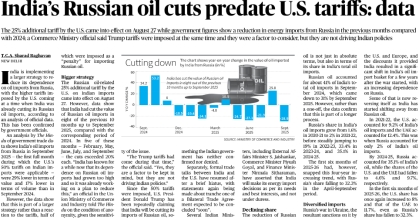
- Indian official data, however, shows that India had already reduced Russian oil imports in 8 of the 10 months before the tariffs came into force.
- The cuts in Feb, May, Jun, Jul, Sept 2025 were all above 20%, indicating a pattern.
The key message: Tariffs are not driving Indian energy choices; domestic strategy is.
3. KEY PROVISIONS
A. India’s oil import data trends
- Value of Russian oil imports reduced in 8 out of 10 months prior to tariffs (Sept 2024 – Sept 2025).
- September 2025 saw a 17% decrease in import volume compared to the previous year.
- India’s dependence had grown sharply in 2022–23, but is now being actively moderated.
B. U.S. Tariffs are not the main driver - U.S. tariffs (25%) + Trump-era 50% tariffs revived in Aug 2025 = not the main cause.
- Commerce Ministry:
“Tariffs are a factor, but they are NOT driving Indian policies.” India is pursuing autonomy in its energy policy.
C. Long-term strategy of diversification India is gradually reducing overdependence on Russian crude:
- Russia’s share in India’s oil imports:
- 1.6% (2020) → 2% (2021)
- 19% (2022)
- 33.4% (2023)
- 35.1% (2024)
- Now falling again – 32.3% in April–Sept 2025
This shows a peak followed by a correction, not an abrupt reaction.
D. India’s “energy autonomy” approach Indian ministers (MEA, Commerce, Finance) have repeatedly stated:
- India will not take energy decisions under external pressure.
- Decisions will be based on: domestic needs, economic rationale, long-term strategic diversification
E. Resumption of India–U.S. trade talks - After a pause, trade talks have resumed.
- Statements hint at Bilateral Trade Agreement progress.
- Energy trade friction should not derail broader ties.
F. Shifts in global crude sourcing With the Ukraine war changing global oil flows: - Russian crude is now discounted less than earlier.
- India is increasing purchases from: U.S, UAE, West African countries
Diversification lowers India’s long-term risk and increases bargaining power.
UPSC PRELIMS
Consider the following statements regarding India’s crude oil import basket:
1. India imports more than 80% of its crude oil requirement.
2. The Middle East has historically been the largest source of India’s crude imports.
3. India is legally bound under WTO rules to follow price caps imposed by G7 countries on Russian oil. Which of the above statements is/are correct?
(a) 1 and 2 only
(b) 2 and 3 only
(c) 1 and 3 only
(d) 1, 2 and 3
Answer: (a)
Attribution science: the tricky task of linking disasters to emitters
GS Paper: GS3 – Environment | Climate Change | Disaster Management
1. CONTEXT ·
India has recently witnessed a series of extreme environmental events —toxic air pollution in Delhi, acidifying rainwater, glacial lake burst floods, and intensifying cyclones. · As climate extremes increase, the global community is increasingly asking: Can we scientifically link a specific disaster to climate change and identify responsible emitters? · This is where Attribution Science becomes crucial. · With warming expected to cross 2°C by 2100, attribution will shape government action, insurance decisions, climate litigation, and global justice.
2. WHAT IS ATTRIBUTION SCIENCE?
Attribution science examines how climate change alters the probability, frequency, and intensity of extreme events. It answers questions like: · Did climate change make a heatwave more likely? · Was a flood worsened because of warming oceans? · Did human emissions increase rainfall intensity or cyclone strength? It does NOT say climate change “caused” an event, but quantifies how much it increased its severity or likelihood.
3. KEY PROVISIONS
A. Extreme events in India show increasing climate influence · Delhi’s severe pollution, acidifying rainfall, Himalayan flash floods, and cyclones point to more frequent and intense disasters. · Many of these match global warming patterns: warming atmosphere, more moisture-holding capacity, melting glaciers, hotter oceans.
B. Challenges: Natural vs. Human-made factors Many disasters could occur naturally, but attribution analyses determine: ·
How much more intense? · How much more frequent? · How much more likely due to human-induced warming? This makes attribution probabilistic, not absolute.
C. How attribution works (scientific process).
Models + Real-world data: Compare simulations with and without human emissions. · Advanced modelling: Better satellite monitoring, Higher-resolution models, Ability to track aerosols, CO₂, ocean temperatures · Statistical comparison of past vs present climate, identifying anomalies. · Improvement in model resolution has made attribution accuracy significantly higher.
D. Increasing evidence of emissions altering rainfall & storms · Northern India has seen stronger monsoon extremes since the 1980s due to greenhouse gases and aerosols. · Studies show 15% decline in annual rainfall but increase in cloudburst intensity because aerosols disturb rainfall patterns. · Rising CO₂ increases the probability of heatwaves and cyclones, as oceans warm and atmospheric moisture rises.
E. Accountability and Implications Attribution science has massive implications:
1. Legal & Judicial · Courts can use attribution to assign liability for: Flood damage, Heatwave deaths, Crop losses · Over 20 court cases globally (Nature 2024) already use attribution evidence. '
2. Economic: · Insurance pricing, Bank lending, Climate risk assessments, Loss and damage negotiations.
3. Ethical / Global Justice · India’s historical share of global CO₂ is <6%, yet it suffers disproportionate climate impacts. · Developed nations may be required to: Pay for losses, Fund adaptation, Support vulnerable countries
4. Policy Attribution will shape: urban planning, disaster management, emission regulation, climate finance mechanisms
F. The emerging future Attribution science is moving towards a future where: Specific emitters (e.g., fossil fuel companies) could be held responsible for specific harm. Climate compensation may become more enforceable. Policy and legal systems will increasingly rely on attribution models.
UPSC PRELIMS Q. With reference to “Attribution Science”, consider the following statements: It seeks to quantify how climate change alters the probability and intensity of specific extreme weather events. It provides absolute causation by determining that climate change alone caused a particular disaster. Improvements in satellite data and high-resolution climate models have enhanced the accuracy of attribution studies. Which of the statements are correct?
A. 1 and 2 only
B. 2 and 3 only
C. 1 and 3 only
D. 1, 2 and 3
Answer: C
ISRO tests bootstrap mode start on CE20 cryogenic engine
GS Paper: GS3 – Science & Tech, Space Technology, Achievements of Indians in S&T 1. CONTEXT
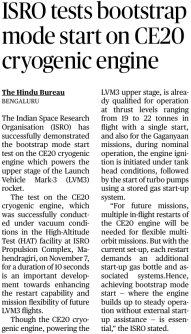
- ISRO has successfully demonstrated the bootstrap mode start on its CE20 cryogenic engine.
- This engine powers the upper stage of the LVM3 (Launch Vehicle Mark-3) rocket — India’s heaviest launch vehicle and the one used for Gaganyaan, Chandrayaan-3, and major communication satellites.
- The test was done at the High Altitude Test (HAT) facility at Mahendragiri under vacuum conditions for 10 seconds.
- This advancement aims to enhance restart capability and mission flexibility, especially for future deep-space and multi-orbit missions.
2. KEY PROVISIONS A. What is the CE20 Cryogenic Engine? - It is ISRO’s cryogenic upper-stage engine for LVM3.
- Operates using liquid oxygen (LOX) and liquid hydrogen (LH2).
- Supports thrust levels 19–22 tonnes.
- Currently capable of single-start operation in flight — adequate for LVM3 & Gaganyaan nominal missions.
B. What is “Bootstrap Mode Start”? - A start mechanism where the engine self-initiates turbopump operations without relying on external high-pressure gas bottles.
- It helps the engine build up pressure internally and reach steady operation automatically.
Significance: - Eliminates dependence on separate start-up bottles.
- Enables multiple in-flight restarts.
- Essential for missions requiring:
- multi-orbit insertion,
- payload deployment at different altitudes,
- interplanetary maneuvers.
C. Why is this important? - Current configuration needs external start-up gas for every restart, making multiple restarts difficult.
- Future missions demand flexibility and precision, such as:
- Earth observation constellation positioning,
- Deep space missions,
- Continuous orbit-raising maneuvers,
- Adapting to mission contingencies.
Bootstrap start capability solves these constraints.
D. Details of the Test
- Conducted at ISRO Propulsion Complex (IPRC), Mahendragiri.
- Duration: 10 seconds.
- Conditions: Vacuum simulation to mimic upper-stage environment.
- Marks a major step toward:
- improving LVM3 restart flexibility,
- enabling complex mission profiles,
- supporting advanced human spaceflight requirements.
E. Implications for Gaganyaan & Future Missions - While Gaganyaan’s nominal profile does not require multiple restarts, this capability will be crucial for:
- future human missions,
- interplanetary missions,
- commercial multi-payload launches,
- global space market competition.
UPSC PRELIMS Q. With reference to the CE20 cryogenic engine tested by ISRO, consider the following statements: 1. It is used in the upper stage of the LVM3 launch vehicle. 2. The bootstrap mode start allows the engine to initiate operations without external start-up assistance. 3. The CE20 engine uses a combination of liquid methane and LOX. Which of the above statements are correct? A. 1 and 2 only
B. 2 and 3 only
C. 1 and 3 only
D. 1, 2 and 3\
Answer: A
SC strikes down provisions of Tribunal Reforms Act, tells govt. to set up panel 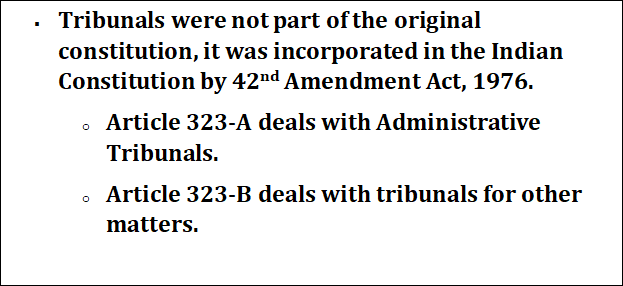
GS2 – Polity | Separation of Powers | Judicial Review | Tribunals
1. CONTEXT
The Supreme Court has struck down key provisions of the Tribunal Reforms Act, 2021, stating that the Act violated judicial independence, gave the Union executive undue control over tribunals, and attempted to bypass earlier Supreme Court rulings that had struck down similar provisions in the 2021 Ordinance. The Court also directed the government to establish a National Tribunal Commission within four months to ensure transparent and independent tribunal administration. This judgment reinforces the constitutional principle of separation of powers and the supremacy of judicial review
. 2. KEY PROVISIONS A. Act violated independence, impartiality, and fair adjudication
CJI B.R. Gavai held that any law altering tribunal functioning must comply with constitutional requirements of:
- independence
- impartial adjudication
- institutional integrity
The 2021 Act allowed executive dominance, which is unconstitutional.
B. Excessive executive control struck down The Court said the Act allowed the government to:
- control appointment of tribunal chairpersons & members
- decide tenures
- fix salaries
- interfere with functioning
Such control undermines tribunals as quasi-judicial bodies, making them dependent on the executive whose decisions they often review.
C. Act was a “repackaged ordinance” already struck down The Act was almost identical to the Tribunal Reforms Ordinance, 2021, which had already been struck down by the SC.
The Court held:
- Parliament cannot reintroduce provisions invalidated by the judiciary.
- Doing so violates the supremacy of the Constitution and judicial review, a basic feature.
D. Court orders creation of National Tribunal Commission The SC directed the Centre to set up a National Tribunal Commission within four months. Purpose: - ensure transparent tribunal appointments
- standardize service conditions
- strengthen independence
- ensure better administration of tribunals
The Commission is described as an “essential structural safeguard.”
E. Court rejects government’s claim of “Parliamentary discretion” The Attorney General argued Parliament had the discretion to ignore earlier SC judgments. The Court rejected this, stating:
- Judicial review is a basic feature
- Parliament cannot override SC decisions
- Re-enacting invalidated provisions breaches constitutional balance
F. Verdict based on multiple petitions The case involved petitions by: - Madras Bar Association
- Congress leader Jairam Ramesh, among others
They argued the Act undermined tribunal independence and revived an ordinance struck down earlier.
3. WHY THIS MATTERS
- Strengthens judiciary’s independence
- Protects tribunals as neutral adjudicators
- Clarifies that Parliament cannot bypass court rulings
- Reinforces constitutional checks and balances
- Pushes long-pending reform: National Tribunal Commission
UPSC PRELIMS Q. With reference to the Tribunal Reforms Act, 2021 and the recent Supreme Court judgment, consider the following statements:
1. The Supreme Court held that excessive executive control over tribunal appointments violates judicial independence.
2. The Court directed the government to set up a National Tribunal Commission within a specified timeline.
3. Parliament is constitutionally permitted to re-enact provisions that were struck down earlier by the Supreme Court. Which of the statements are correct?
A. 1 and 2 only
B. 2 and 3 only
C. 1 and 3 only
D. 1, 2 and 3
Answer: A
India will become hub of natural farming; science, tradition to lead way: PM
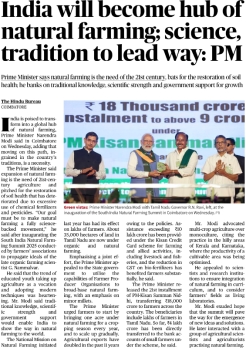
GS Paper: GS3 – Agriculture, Environment; GS2 – Government Policies 1. Context Prime Minister Narendra Modi, while inaugurating the South India Natural Farming Summit 2025 in Coimbatore, announced that India is poised to transform into a global hub of natural farming. He stressed that natural farming is essential for 21st-century agriculture due to rising soil degradation caused by excessive chemical inputs. The PM emphasised combining traditional knowledge, scientific advancements, and government support to expand natural farming across the country.
2. Key Provisions A. Natural Farming as a National Priority
- PM asserts that natural farming is the “need of the 21st century” to restore soil health.
- Excessive use of chemical fertilizers and pesticides has degraded soil fertility.
- Goal: make natural farming a science-backed, research-supported movement.
B. Government Support and Achievements - 35,000 hectares in Tamil Nadu are already under organic and natural farming.
- Over ₹10 lakh crore provided under the Kisan Credit Card scheme for agriculture and allied sectors.
- GST reduction on bio-fertilizers has directly benefited farmers.
- PM-Kisan Samman Nidhi:
- PM released the 21st installment (₹18,000 crore).
- Over 9 crore farmers benefited; lakhs from Tamil Nadu.
C. Scaling Up Through Institutions - PM urged State governments to use FPOs to promote natural farming.
- Farmers encouraged to adopt one acre under natural farming per season, increasing gradually.
D. Increasing Agricultural Exports - Government assistance and reforms have helped boost agricultural exports, showing positive outcomes of sustainable farming practices.
E. Science + Tradition Approach - PM advocates combining:
- traditional farming wisdom (e.g., local crop diversity),
- scientific innovations,
- and modern agricultural technologies.
F. Multi-Crop VS Monoculture - PM highlighted the success of multi-crop systems in areas such as Kerala and Karnataka.
- Warned against monoculture which reduces productivity and depletes soil nutrients.
G. Research & Farmer Involvement - Scientists and research institutions urged to:
- make natural farming curriculum-friendly,
- consider farmers’ fields as living laboratories.
UPSC Prelims Q. With reference to Natural Farming in India, consider the following statements:
1. Natural farming promotes the elimination of synthetic chemical fertilizers and pesticides.
2. Farmer Producer Organisations (FPOs) have been mandated to promote natural farming across India.
3. The PM-Kisan scheme provides direct income support to farmers which can be used to adopt natural farming practices. Which of the above statements are correct?
(a) 1 and 2 only
(b) 1 and 3 only
(c) 2 and 3 only
(d) 1, 2 and 3
Answer: (d)
Leadership Group for Industry Transition
Syllabus: GS Paper III — Environment and Climate Change (International climate initiatives & industrial decarbonisation)
Context: The Union Minister for Environment, Forest and Climate Change spoke at the LeadIT Industry Leaders’ Roundtable during UNFCCC CoP30 in Belém, Brazil. The article outlines LeadIT’s purpose, history, recent re-launch (LeadIT 2.0) and its priorities for enabling a net-zero transition in heavy industry.
Key points
- Launched (2019): Jointly initiated by Sweden and India at the UN Climate Action Summit to accelerate industrial decarbonisation.
- Support: Backed by the World Economic Forum to connect governments and private sector leaders.
- Primary aim: To achieve net-zero emissions from heavy industry by 2050 through public–private cooperation.
- Approach: Fosters policy frameworks, finance flows, and best-practice exchange for a just and inclusive transition.
- LeadIT 2.0 (2024–26): Relaunched at COP28 with a focused three-year mission for 2024–2026.
- LeadIT 2.0 priorities: Inclusive & just transition, co-development/transfer of low-carbon technologies, and financial support for emerging economies.
- Mission statement: A three-year roadmap adopted at the annual LeadIT summit to operationalise the 2.0 priorities.
- Secretariat: Hosted by the Stockholm Environment Institute (SEI), providing administrative and technical support.
- Membership: Comprises 18 countries and 27 companies, combining public authority and industry leadership for collective action.
- Sectoral focus: Targets heavy industries (steel, cement, chemicals, shipping) where rapid technology adoption and finance are critical.
Source: PIB
Blackbuck.

Syllabus: GS Paper III — Environment & Biodiversity (Species in News)
Context: Thirty-one blackbucks died due to a suspected bacterial infection at Kittur Rani Chennamma Zoo, Belagavi, leading to a high-level probe ordered by the Karnataka Forest Minister.
Key Points
- Scientific name: Antilope cervicapra; a diurnal grassland antelope native to the Indian subcontinent.
- Habitat: Prefers open short grasslands, semi-desert regions, and agricultural margins; avoids dense forests.
- Protection status: IUCN—Least Concern; Schedule I, Wildlife (Protection) Act, 1972.
- Sexual dimorphism: Males are dark brown/black with white underside, females are fawn/light brown.
- Horns: Only males have spiralled horns (50–71 cm) forming a V-shape.
- Speed: Among India’s fastest land animals, can reach ~80 km/h.
- Social structure: Forms female-young herds, bachelor male herds, and territorial males.
- Behaviour: Territorial males use preorbital gland markings and dung middens for scent marking.
- Incident cause: Bacterial infection triggered mortality; pathogen under investigation.
Source: NDTV
YUVA AI for ALL Initiative.
Syllabus: GS Paper II —
Government Policies & Digital Governance (Technology & Digital Literacy) Context: MeitY launched
‘YUVA AI for ALL’, a free national online course aimed at democratising AI literacy and making foundational AI education accessible to all.
Key Points - Nature of initiative: A free 4.5-hour self-paced online course introducing AI to the general public in an India-specific context.
- Implementing body: Launched by MeitY under the IndiaAI Mission; developed by AI expert Jaspreet Bindra.
- Objective: To empower 1 crore Indians with basic AI knowledge and enable responsible and ethical AI usage.
- Accessibility: Available on FutureSkills Prime, iGOT Karmayogi, and other ed-tech platforms.
- Course structure: Six modules covering AI concepts, applications, ethics, safety, and future opportunities.
- Certification: Free government-certified certificate upon completion.
- Target groups: Designed for students, professionals, and general learners; self-paced and widely accessible.
- Significance: Helps bridge digital divide, builds future-ready workforce, and promotes ethical AI adoption.
Source: PIB
India Launches National Action Plan on Antimicrobial Resistance 2.0 (NAP-AMR 2.0)
Syllabus: GS Paper II — Health & Government Policies (Public Health, One Health, Disease Control) Context: India launched NAP-AMR 2.0 (2025–29) during World AMR Awareness Week, updating the earlier 2017–21 plan to strengthen national response to antimicrobial resistance through a multi-sectoral One Health approach.
Key Points
- Nature: A five-year national strategy (2025–29) to curb antimicrobial resistance across human, animal, agriculture, and environmental sectors.
- Successor plan: Builds on NAP-AMR 2017–21, addressing implementation gaps and expanding its scope.
- Launched by: Union Ministry of Health & Family Welfare.
- Core aim: To reduce antimicrobial misuse/overuse and strengthen surveillance, stewardship, and infection control.
- One Health approach: Integrates human, veterinary, agriculture, food safety, and environment sectors under one framework.
- Multi-ministry plans: Over 20 ministries have sector-specific goals, budgets, and timelines.
- Surveillance focus: Expands AMR labs, diagnostics networks, pathogen tracking, and IPC systems in hospitals.
- Regulation & stewardship: Promotes rational antibiotic use, prescription audits, and curbs OTC antibiotic sales.
- Awareness & training: Nationwide campaigns + training for doctors, veterinarians, pharmacists; curriculum integration.
- Environment & agriculture measures: Regulates pharmaceutical waste, antimicrobial use in crops/livestock.
- Research push: Strengthens India AMR Innovation Hub for new technologies and collaborative R&D.
- Significance: Aligns with WHO Global Plan, tackles India’s high AMR burden, ensures whole-of-government and whole-of-society coordination.
Source: NIE




 Launch your Graphy