


Daily Current Affairs for UPSC 20th Dec 2025
|
| | |
|
| The significance of a strong defence industrial base | |
| Kerala 2.0 — a call to reclaim the State’s future | |
| IN-SPACe invites proposals to establish space labs across academic institutions | |
| Winter Session concludes with over 100% productivity | |
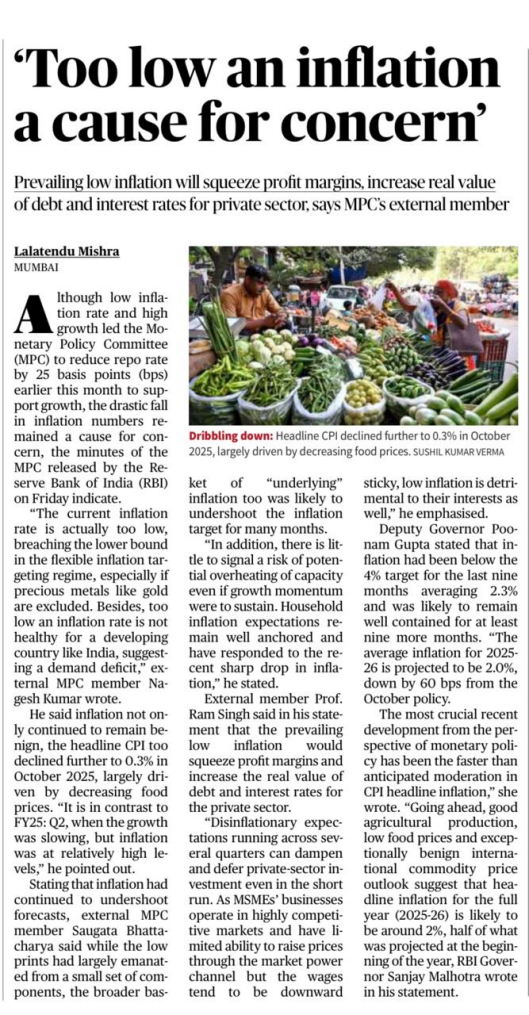
| ‘Too low an inflation a cause for concern’ | |
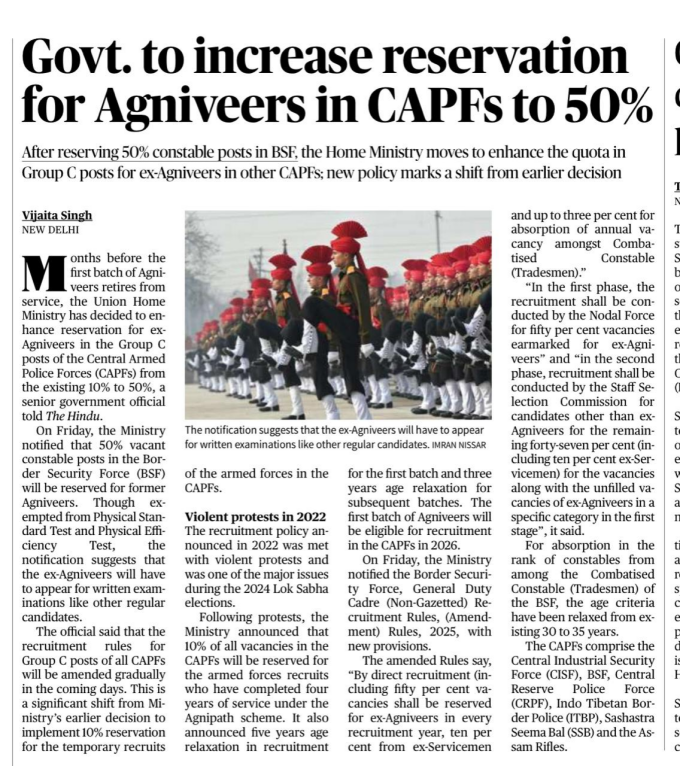
| Govt. to increase reservation for Agniveers in CAPFs to 50% | |
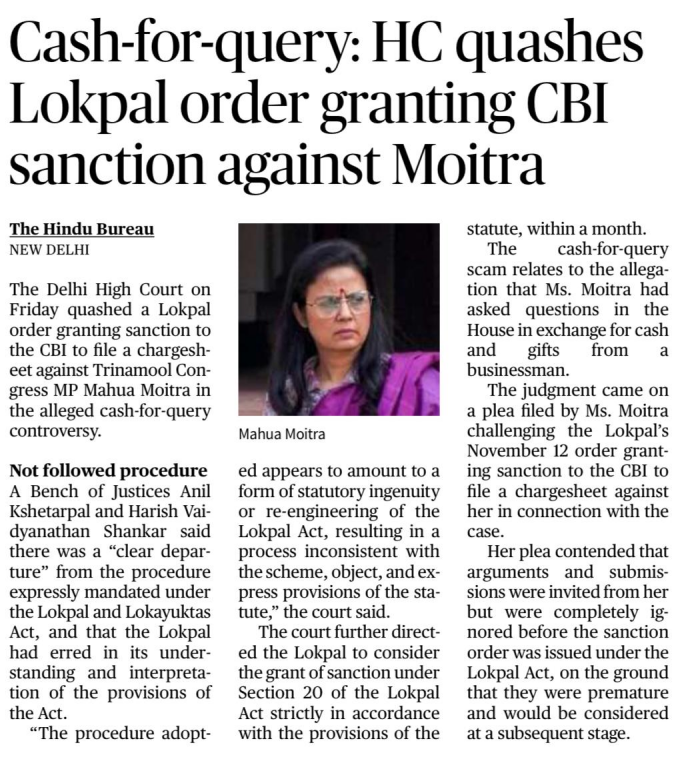
| Cash-for-query: HC quashes Lokpal order granting CBI sanction against Moitra | |
|
|
| | |
| Jharkhand clears Bill to regulate and protect gig workers | |
| India, Jordan aim to double bilateral trade to $5 billion in five years | |
| National Council of Science Museums (NCSM) | |
| | |
| Uttar Pradesh to set up India’s first dedicated forest university | |
| Raj Kumar Goyal sworn in as Chief Information Commissioner | |
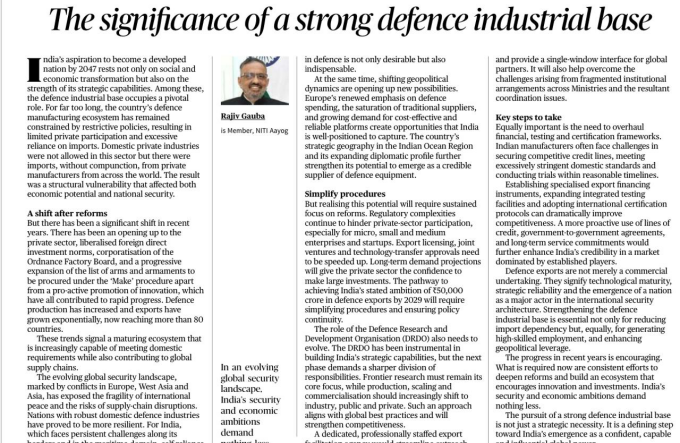
The significance of a strong defence industrial base

Context
The author discusses why a robust defence industrial base is central to India’s ambition of becoming a developed nation by 2047, highlighting recent reforms, emerging geopolitical opportunities, and the need for deeper structural changes to make India a reliable global defence manufacturer and exporter.
Detailed Analysis
1. Why defence industrial base matters
• Defence capability is not only about armed forces but also about domestic manufacturing strength.
• Excessive dependence on imports earlier created strategic vulnerability, affecting both national security and economic potential.
• A strong defence industrial base ensures self-reliance, supply chain resilience and strategic autonomy.
2. Impact of recent reforms
• Liberalisation of FDI norms, corporatisation of the Ordnance Factory Board, and expansion of procurement under Make procedures have transformed the ecosystem.
• Private sector participation has increased, leading to higher production and export growth.
• Indian defence exports now reach over 80 countries, signalling ecosystem maturity.
3. Changing global security landscape
• Conflicts in Europe, West Asia and Asia have exposed fragility of global supply chains.
• Countries with strong domestic defence industries have shown greater resilience.
• Europe’s renewed defence spending and saturation of traditional suppliers create export opportunities for India.
4. India’s strategic advantage
• India’s Indian Ocean Region geography and expanding diplomatic footprint strengthen its credibility as a defence supplier.
• Growing demand for cost-effective and reliable platforms aligns with India’s manufacturing strengths.
5. Regulatory and procedural bottlenecks
• Complex regulations continue to hinder MSMEs and startups.
• Delays in export licensing, joint ventures and technology transfer approvals reduce competitiveness.
• Lack of long-term demand visibility discourages large private investments.
6. Role of DRDO and R&D ecosystem
• DRDO has played a key role in building strategic capabilities.
• The next phase requires clear separation between frontier research and commercialisation.
• Greater industry, startup and public-private collaboration is needed to scale technologies.
7. Defence exports as strategic leverage
• Defence exports reflect technological maturity and strategic reliability, not just commerce.
• Reducing import dependence while generating high-skilled employment enhances geopolitical influence.
• Target of ₹50,000 crore defence exports by 2029 demands policy continuity and ecosystem depth.
Suggestions of the Author
• Simplify procedures for exports, joint ventures and technology transfer.
• Reform financial, testing and certification frameworks to meet global standards efficiently.
• Establish specialised export financing instruments and integrated testing facilities.
• Use government-to-government agreements, credit lines and long-term service commitments to build trust.
• Create a single-window interface to overcome inter-ministerial coordination issues.
• Strengthen institutional support to make India a competitive, reliable defence supplier.
Conclusion
Building a strong defence industrial base is not optional but indispensable for India’s security, economic growth and global stature. Recent progress is encouraging, but sustained reforms, innovation-driven ecosystems and export-oriented strategies are essential. A credible defence industry will define India’s role as a confident, capable and strategic global power.
UPSC Mains Question
Discuss the role of a strong defence industrial base in achieving India’s strategic autonomy and economic growth. Examine the reforms undertaken and the challenges that still need to be addressed.
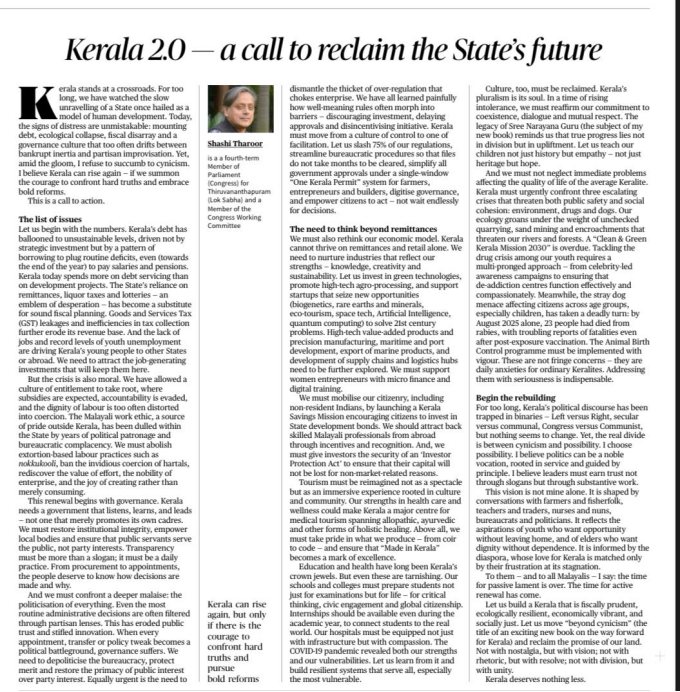
Kerala 2.0 — a call to reclaim the State’s futu
Context
The author argues that Kerala stands at a critical crossroads, facing fiscal stress, unemployment, ecological degradation and governance fatigue. The article is a call for deep, structural reforms to reclaim Kerala’s development path, social vitality and democratic ethos.
Detailed Analysis
1. Kerala’s economic distress
• Kerala’s debt has reached unsustainable levels, driven by borrowing to meet routine expenses like salaries and pensions.
• The State now spends more on debt servicing than on development projects, reflecting fiscal imbalance.
• Over-reliance on remittances, liquor taxes and lotteries signals weak productive capacity.
2. Employment crisis and youth migration
• High unemployment and underemployment are pushing Kerala’s youth to migrate to other States and abroad.
• The lack of job-generating investments has created a disconnect between education and employment.
• Attracting productive, knowledge-based investments is essential to retain talent.
3. Moral and cultural decline
• The author highlights a culture of entitlement, erosion of work ethic and declining dignity of labour.
• Practices such as hartals and coercive labour actions discourage enterprise and innovation.
• The joy of creation and entrepreneurship has been overshadowed by consumption-driven aspirations.
4. Governance and institutional decay
• Excessive politicisation of administration has weakened public trust in institutions.
• Bureaucracy often acts as a gatekeeper rather than a facilitator of growth.
• Transparency, accountability and depoliticisation of governance are presented as urgent needs.
5. Over-regulation and ease of doing business
• Kerala suffers from thickets of regulation that stifle enterprise and discourage investors.
• The author suggests abolishing at least 75% of outdated regulations.
• Proposals include single-window clearances, digitised governance and time-bound approvals.
6. Rethinking the development model
• Kerala cannot rely indefinitely on remittances and traditional sectors.
• New growth areas suggested include green technologies, high-tech agro-processing, biotech, AI, quantum computing, space technology, maritime industries and logistics hubs.
• Emphasis is placed on value-added production rather than consumption-driven growth.
7. Inclusive growth and gender empowerment
• Special focus is laid on women entrepreneurship, supported by microfinance and digital training.
• Investor protection laws must ensure capital security and policy stability.
• Tourism should shift from spectacle-based to community-rooted, experiential tourism.
8. Social and ecological crises
• Kerala faces multiple threats: environmental degradation, drug abuse, unchecked quarrying, sand mining and river destruction.
• The author calls for a Clean and Green Kerala Mission 2030.
• Public health vulnerabilities exposed during COVID-19 highlight the need for resilient systems.
9. Cultural pluralism and social harmony
• Kerala’s pluralism, tolerance and mutual respect are identified as core strengths.
• Rising intolerance demands reaffirmation of coexistence and dialogue.
• Education must prioritise critical thinking, empathy and civic responsibility, not just examinations.
10. Political renewal and civic participation
• Politics should move beyond binary ideological conflicts to problem-solving governance.
• Leadership must earn trust through substantive work rather than rhetoric.
• Citizens, including the diaspora, must be active partners in rebuilding the State.
Suggestions of the Author
• Undertake bold fiscal and governance reforms to restore sustainability.
• Drastically reduce regulatory burdens and digitise approvals.
• Promote innovation-led, environmentally sustainable industries.
• Invest in youth, women and entrepreneurship.
• Rebuild public institutions through depoliticisation and transparency.
• Address social and ecological crises with urgency and seriousness.
Conclusion
The vision of Kerala 2.0 is not nostalgic but forward-looking — fiscally prudent, economically vibrant, socially just and ecologically resilient. The author asserts that renewal is possible only through courage, honesty and bold reform, replacing cynicism with possibility. Kerala’s future depends on its willingness to confront hard truths and act decisively.
UPSC Mains Question
Kerala’s development model is facing structural and governance-related challenges. Critically examine the need for a “Kerala 2.0” reform agenda in light of fiscal stress, employment concerns and sustainability.
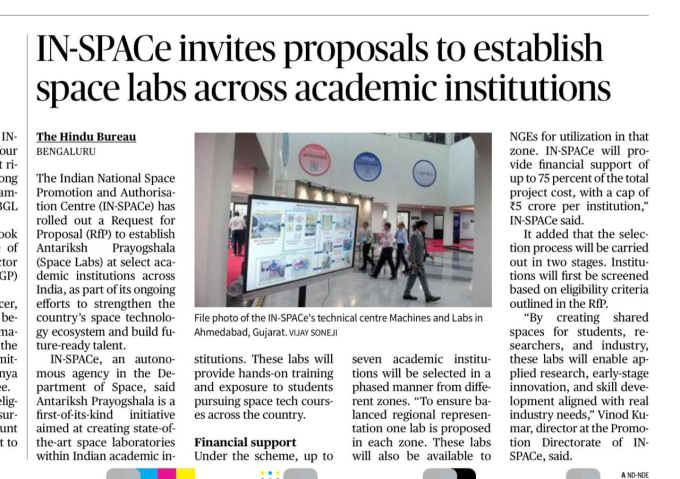
IN-SPACe invites proposals to establish space labs across academic institutions
Context
IN-SPACe has invited proposals from academic institutions to establish Antariksh Prayshala (Space Labs) as part of efforts to strengthen India’s space ecosystem and develop future-ready human resources.
Key Points
About the Initiative
• IN-SPACe issued an RFP to set up Antariksh Prayshala (Space Labs) in selected academic institutions across India.
• The initiative aims to provide hands-on training and exposure to students pursuing space-related courses.
Coverage and Selection
• Seven academic institutions will be selected in a phased manner.
• To ensure balanced regional representation, one lab is proposed in each zone.
• Selection will be conducted in two stages, beginning with eligibility screening.
Financial Support
• IN-SPACe will provide up to 75% of the project cost, capped at ₹5 crore per institution.
• Labs will also be available to Non-Governmental Entities (NGEs) for utilisation.
Objectives and Outcomes
• Creation of shared spaces for students, researchers and industry.
• Promotion of applied research, early-stage innovation and skill development.
• Alignment of academic training with real industry needs in the space sector.
Indian National Space Promotion and Authorization Center (IN-SPACe)
• Autonomous, single-window nodal agency under the Department of Space.
• Established after space sector reforms to enable private sector participation.
• Promotes, authorises and supervises space activities of non-governmental entities.
• Acts as an interface between ISRO and private players, including academia.
• Functions through Promotion Directorate, Technical Directorate and Program Management & Authorization Directorate.
UPSC Prelims Question
Q.With reference to IN-SPACe, consider the following statements:
1. IN-SPACe functions as an autonomous nodal agency under the Department of Space to facilitate private sector participation in space activities.
2. Under the Antariksh Prayshala initiative, IN-SPACe will fully fund the establishment of space labs in selected academic institutions.
Which of the statements given above is/are correct?
(a) 1 only
(b) 2 only
(c) Both 1 and 2
(d) Neither 1 nor 2
Correct Answer: (a)
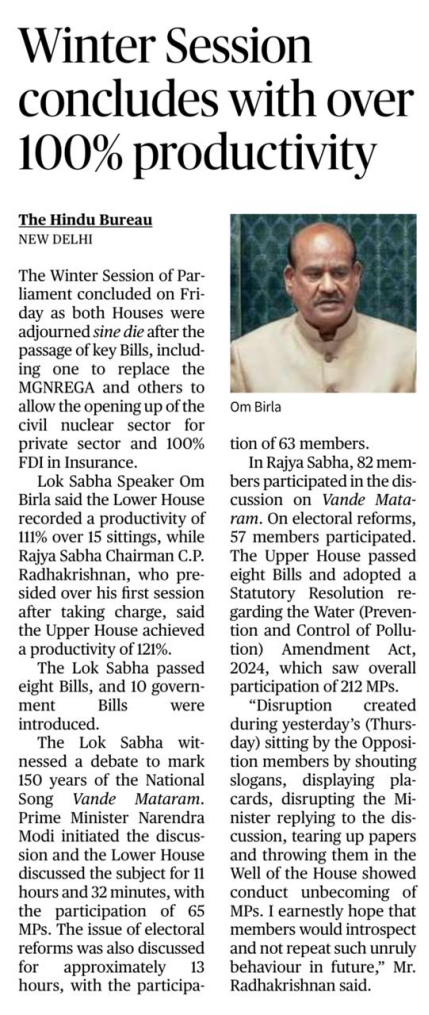
Winter Session concludes with over 100% productivity

Context
The Winter Session of Parliament concluded with both Houses being adjourned sine die after the passage of key legislations, recording productivity levels exceeding 100% in Lok Sabha and Rajya Sabha.
Key Points
Overall Productivity
• Lok Sabha recorded 111% productivity over 15 sittings, as stated by Speaker Om Birla.
• Rajya Sabha achieved 121% productivity, according to Chairman C.P. Radhakrishnan.
Legislative Business
• Lok Sabha passed 8 Bills and introduced 10 government Bills.
• Rajya Sabha passed 8 Bills and adopted a Statutory Resolution.
Key Legislations Passed
• Bill to open civil nuclear sector to private participation.
• Bill allowing 100% FDI in the insurance sector.
• Water (Prevention and Control of Pollution) Amendment Act, 2024.
Major Discussions Held
• Debate marking 150 years of “Vande Mataram”, initiated by the Prime Minister.
• Electoral reforms discussed extensively in both Houses.
Participation of Members
• 65 MPs participated in the Vande Mataram debate in Lok Sabha.
• 57 MPs participated in electoral reforms discussion in Rajya Sabha.
• Total participation of 212 MPs in the Water Act resolution debate.
Disruptions and Conduct
• Some sittings witnessed disruptions by Opposition members.
• Rajya Sabha Chairman emphasised the need for parliamentary decorum and introspection.
Parliament of India
• Lok Sabha is presided over by the Speaker and represents the people.
• Rajya Sabha is the Council of States, chaired by the Vice President of India.
• Parliamentary productivity measures actual working time against scheduled time.
‘Too low an inflation a cause for conce
Context
Minutes of the Monetary Policy Committee (MPC) of the Reserve Bank of India flagged concerns that persistently low inflation, despite supporting growth, could adversely affect investment, profits and debt dynamics in the economy.
Key Points
Current inflation scenario
• Headline CPI fell to 0.3% in October 2025, mainly due to declining food prices.
• Inflation has breached the lower bound of the flexible inflation targeting framework for several months.
MPC’s core concern
• Very low inflation is not healthy for a developing economy like India as it signals weak demand conditions.
• It may point towards a demand deficit, unlike temporary disinflation caused by supply-side factors.
Impact on businesses and MSMEs
• Low inflation squeezes profit margins, especially for firms operating in competitive markets.
• MSMEs face difficulty in raising prices, while wages remain sticky, hurting viability.
Effect on debt and interest rates
• Persistently low inflation increases the real value of debt, making repayments costlier.
• It also raises real interest rates for the private sector, discouraging fresh investment.
Monetary policy response
• The MPC had cut the repo rate by 25 basis points to support growth.
• However, members cautioned that continued undershooting of inflation could weaken monetary transmission.
Outlook on inflation
• RBI estimates average inflation for 2025–26 at around 2%, well below the 4% target.
• Good agricultural output, low food prices and benign global commodity prices are key drivers.
Reserve Bank of India
• The MPC highlighted that while household inflation expectations remain well anchored, prolonged low inflation may dampen private investment and capacity utilisation.
• Managing inflation close to the target is essential for sustainable growth and financial stability.
Govt. to increase reservation for Agniveers in CAPFs to 50%
Context
The Union Home Ministry has decided to significantly enhance reservation for ex-Agniveers in Group C posts of Central Armed Police Forces (CAPFs), ahead of the retirement of the first Agniveer batch, marking a major policy shift in post-service absorption.
Key Points
Policy decision
• Reservation for ex-Agniveers in Group C posts of CAPFs increased from 10% to 50%.
• This follows a similar move reserving 50% constable posts in BSF for former Agniveers.
Coverage and forces involved
• Applies to all CAPFs, including BSF, CRPF, CISF, ITBP, SSB and Assam Rifles.
• Recruitment rules for Group C posts will be amended gradually.
Recruitment process
• Ex-Agniveers are exempted from Physical Standard Test and Physical Efficiency Test.
• They must appear for written examinations like other candidates.
Phased recruitment
• First phase: 50% vacancies earmarked exclusively for ex-Agniveers, recruitment by the Nodal Force.
• Second phase: Remaining vacancies filled through Staff Selection Commission (SSC).
Age relaxation
• Five-year age relaxation for the first Agniveer batch.
• Three-year relaxation for subsequent batches.
• Age limit for certain posts raised from 30 to 35 years.
Background and rationale
• Agnipath scheme (2022) triggered violent protests over post-service security.
• Initial assurance was 10% reservation, now expanded to address employment concerns.
• First batch of Agniveers becomes eligible for CAPFs recruitment in 2026.
Central Armed Police Forces (CAPFs)
• CAPFs function under the Ministry of Home Affairs.
• They play a key role in border security, internal security, counter-insurgency and law & order support.
• The enhanced quota aims to absorb trained manpower and ensure smoother transition for Agniveers.
Cash-for-query: HC quashes Lokpal order granting CBI sanction against Moitra
Context
The Delhi High Court quashed the Lokpal’s order granting sanction to the CBI to file a chargesheet against Trinamool Congress MP Mahua Moitra in the alleged cash-for-query case, citing non-compliance with statutory procedure under the Lokpal Act.
Key Points
Delhi High Court ruling
• The High Court set aside the Lokpal’s sanction order permitting CBI prosecution.
• It held that there was a clear departure from the procedure mandated under the Lokpal and Lokayuktas Act, 2013.
Reasoning of the Court
• The Lokpal misinterpreted provisions of the Act, resulting in a process inconsistent with its scheme and objectives.
• Arguments and submissions of the accused were ignored at the sanction stage, which the court found procedurally improper.
Direction issued
• The Lokpal was directed to reconsider the issue of sanction strictly under Section 20 of the Lokpal Act.
• The reconsideration must follow due process and statutory safeguards.
About the case
• The cash-for-query controversy involves allegations that questions were raised in Parliament in exchange for cash and gifts from a businessman.
• The Lokpal had earlier granted sanction to the CBI to file a chargesheet, which was challenged before the High Court.
Significance
• Reinforces the principle that anti-corruption bodies must strictly adhere to statutory procedure.
• Highlights the role of judicial review in ensuring fairness, natural justice, and legality in sanction for prosecution.
Lokpal
• A statutory body established under the Lokpal and Lokayuktas Act, 2013.
• Mandate is to inquire into allegations of corruption against public functionaries, including MPs and Union officials.
• Comprises a Chairperson and eight Members, with at least 50% representation from SC/ST/OBC/Minorities and women.
• Appointments are made by the President of India on the recommendation of a high-level selection committee.
• Has jurisdiction over Union Ministers, MPs, and officials, and bodies substantially funded by government or receiving significant foreign contribution.
SabhaSaar Initiative
GS II – Polity | Governance, E-Governance
Context
The Union Minister informed the Rajya Sabha about the rollout of SabhaSaar, an AI-enabled tool aimed at improving documentation and transparency of Gram Sabha and Panchayat meetings across India.
Key Points
About SabhaSaar
• AI-enabled voice-to-text meeting summarisation tool for Gram Sabha and Panchayat meetings.
• Launched by: Ministry of Panchayati Raj.
• Coverage: Available to all States and Union Territories; adoption by Gram Panchayats is ongoing.
Technology Backbone
• Operates on AI and cloud infrastructure provisioned through the India AI Compute Portal.
• Part of the India AI Mission under the Ministry of Electronics and Information Technology (MeitY).
Core Features
• Converts audio/video recordings into structured minutes of meetings.
• Ensures uniformity in Gram Sabha minutes across the country.
• Panchayat officials upload recordings using e-GramSwaraj login credentials.
Language and Translation
• Built on Bhashini, the government’s AI-powered language translation platform.
• Provides transcription, translation, and summarisation in one workflow.
• Supports major Indian languages such as Hindi, Bengali, Tamil, Telugu, Marathi, Gujarati, and English.
Significance
• Streamlines documentation and record-keeping at the grassroots level.
• Enhances transparency, accessibility, and efficiency in local self-governance.
• Empowers rural stakeholders with easy access to meeting insights.
Additional Information – Bhashini
• A national AI language platform aimed at bridging language, literacy, and digital divides.
Source: PIB
Jharkhand clears Bill to regulate and protect gig workers
Syllabus: GS II – Governance; Social Justice; Labour Reforms
Context
Jharkhand has approved the Jharkhand Platform Based Gig Workers (Registration and Welfare) Bill, 2025, bringing platform-based gig workers under a formal welfare and social security framework for the first time in the State.
Key Points
Objective and Coverage
• Purpose: Ensure social security, welfare and economic protection for gig and platform-based workers.
• Scope: Covers workers engaged through digital platforms and aggregators in delivery, transport and on-demand services.
Gig Workers’ Welfare Board
• Institutional mechanism: Establishment of a Gig Workers’ Welfare Board.
• Composition: Labour Minister as ex-officio Chairperson; officials and nominated members for a three-year term.
• Functions: Registration of workers and aggregators, issuance of identity cards, and supervision of welfare schemes.
Registration of Aggregators
• Mandatory compliance: All platform aggregators operating in Jharkhand must be registered with the Board.
• Accountability: Enables monitoring of working conditions and enforcement of welfare provisions.
Wages and Social Security
• Minimum wages: Mandated based on nature and duration of work.
• Social security: Includes medical insurance and other welfare benefits for gig workers.
Penalties
• Deterrence: Aggregators violating the Act can be fined up to ₹10 lakh.
• Worker protection: Aims to safeguard income security and labour rights.
Significance
• Early mover: Places Jharkhand among States proactively regulating the gig economy.
• Policy shift: Recognises gig work as a distinct employment category requiring statutory protection.
Source: Indian Express
India, Jordan aim to double bilateral trade to $5 billion in five years
GS II: International Relations – Bilateral Relations
Context
During his visit to Amman, Narendra Modi proposed doubling India–Jordan bilateral trade to $5 billion over the next five years, signalling a renewed push to deepen economic engagement.
Key Points
High-Level Business Engagement
• PM Modi and King Abdullah II jointly addressed the India–Jordan Business Forum in Amman.
• Emphasis was placed on business-to-business ties to convert potential into concrete outcomes.
Trade Ambitions and Economic Rationale
• India highlighted its status as the fastest-growing major economy and a future top-three global economy.
• Jordan’s network of free trade agreements was projected as a bridge linking South Asia with West Asia.
Sectoral Areas of Cooperation
• Digital Public Infrastructure, IT, fintech, health-tech and agri-tech identified for collaboration.
• Strong scope in pharmaceuticals and medical devices, with Jordan positioned as a regional hub.
• Additional opportunities in renewables, green mobility, desalination, water recycling, agriculture, cold chains, fertilisers, infrastructure, automobiles and tourism.
Strategic and Economic Significance
• Jordan is among India’s key trading partners in the region.
• The proposal reflects India’s strategy of leveraging economic diplomacy to strengthen West Asia ties.
Prelims Practice Question
With reference to recent India–Jordan relations, consider the following statements:
1. India has proposed a target of doubling bilateral trade with Jordan to $5 billion within five years.
2. Cooperation between India and Jordan has been highlighted mainly in the defence sector, with limited focus on digital and green technologies.
Which of the statements given above is/are correct?
a) 1 only
b) 2 only
c) Both 1 and 2
d) Neither 1 nor 2
Answer: a)
Explanation:
Statement 1 is correct as India proposed a $5 billion trade target within five years.
Statement 2 is incorrect because cooperation spans digital infrastructure, pharmaceuticals, renewables, agri-tech and green mobility, not only defence.
Source: The Hindu
National Council of Science Museums (NCSM)
GS II – Polity | Governance | Culture & Institutions
Context
The National Council of Science Museums (NCSM) recently received two PRSI National Awards 2025 from the Public Relations Society of India (PRSI) for excellence in public communication and outreach.
Key Points
About NCSM
• Autonomous society under the Ministry of Culture, Government of India.
• Established: 4 April 1978.
• Headquarters: Kolkata.
Institutional Network
• Operates a network of 26 science museums/centres across India.
• Houses a Central Research & Training Laboratory (CRTL), Kolkata, for professional training, R&D.
• Forms the largest network of science centres and museums in the world under a single administrative umbrella.
National-Level Centres
• Science City, Kolkata
• Birla Industrial and Technological Museum (BITM), Kolkata
• Nehru Science Centre, Mumbai
• Visvesvaraya Industrial and Technological Museum (VITM), Bengaluru
• National Science Centre, Delhi
• National Science Centre, Guwahati
Satellite Units
• All national-level centres except Science City, Kolkata have regional and district-level Satellite Units (SUs).
Role and Functions
• Develops science centres and museums for States and Union Territories.
• Creates specialised centres and galleries for organisations like ONGC, BEL, ICAR.
• Conducts Mobile Science Exhibitions, lectures, demonstrations, training programmes, workshops and publications to promote scientific temper.
International Collaboration
• Developed or supported centres and galleries abroad such as:
o Rajiv Gandhi Science Centre, Mauritius
o India Gallery on Buddhism, International Buddhist Museum, Kandy, Sri Lanka
Awarding Body – PRSI
• Public Relations Society of India (PRSI) recognises excellence in public relations, outreach and strategic communication.
Source: PIB
With reference to the National Council of Science Museums (NCSM), consider the following statements:
1. NCSM is an autonomous organisation functioning under the Ministry of Culture, Government of India.
2. Except for Science City, Kolkata, all national-level centres of NCSM have regional and sub-regional Satellite Units.
Which of the statements given above is/are correct?
A. 1 only
B. 2 only
C. Both 1 and 2
D. Neither 1 nor 2
Correct Answer: C
Explanation:
• Statement 1 is correct: NCSM is an autonomous society under the Ministry of Culture.
• Statement 2 is correct: All national-level centres have Satellite Units except Science City, Kolkata.
Operation Hawkeye Strike
GS II – International Relations (International Security, Counter-terrorism)
Context
The United States launched Operation Hawkeye Strike in Syria following the killing of three Americans in a December ISIS attack, marking an escalation in US military retaliation against the terror group.
Key Points
Background and Trigger
• The operation was triggered by a December 13 ISIS attack in the Syrian desert.
• The attack killed two Iowa National Guard personnel and one US civilian interpreter.
Objective of the Operation
• Aimed at deterring further attacks on US personnel in the region.
• Focused on degrading ISIS leadership, logistics and operational capacity.
US Political Response
• President Donald Trump described the strikes as a serious retaliation and a fulfilment of US commitment to protect its citizens.
• Defence Secretary Pete Hegseth termed it a punitive action, not the start of a new war.
Military and Operational Details
• Conducted using F-15 Eagle fighter jets, A-10 Thunderbolt II aircraft and AH-64 Apache helicopters.
• Precision airstrikes targeted ISIS strongholds in eastern Syria, especially in desert regions.
Regional Coordination
• The US stated that Syrian government forces were informed and supportive.
• Indicates increased coordination between US forces and Syrian security elements against ISIS.
Significance
• Signals continued US commitment to counter-terrorism operations in West Asia.
• Reinforces the doctrine of retaliatory deterrence against attacks on US personnel abroad.
Source: International news reports
Q. Operation Hawkeye is often seen in the news in connection with which of the following?
a) United Nations peacekeeping operations in Africa
b) United States military action against ISIS in Syria
c) NATO naval exercises in the Mediterranean Sea
d) Russian air operations in Ukraine
Correct Answer: b)
Explanation
Operation Hawkeye Strike refers to a coordinated US airstrike campaign against Islamic State (ISIS) targets in Syria, launched in retaliation for the killing of American personnel. It is associated with US counter-terrorism operations in West Asia, not UN missions, NATO exercises, or the Ukraine conflict.
Uttar Pradesh to set up India’s first dedicated forest university
Syllabus: GS III – Environment; Conservation; Education and Research
Context
Uttar Pradesh has announced the establishment of India’s first dedicated Forest University at Gorakhpur, marking a significant step towards strengthening specialised education and research in forestry, wildlife and environmental sciences.
Key Points
Location and Campus
• Place: Gorakhpur, eastern Uttar Pradesh.
• Campus size: 125 acres, located near the Jatayu Conservation and Breeding Centre.
• Status: Land approval completed; project moving towards implementation.
Vision and Academic Focus
• Nature: A specialised university exclusively for forest and environmental sciences.
• Courses: Forestry, agroforestry, social forestry, horticulture, wildlife studies, ecology, climate change and sustainability.
• Approach: Strong emphasis on field-based learning, practical exposure and applied research.
Government Initiative and Funding
• Announcement: Made by Chief Minister Yogi Adityanath.
• Budget support: ₹50 crore allocated in the 2024 Uttar Pradesh budget for initial work.
• Legal framework: Draft Act under final review before DPR and tendering process.
Infrastructure Plan
• Facilities: Hostels for around 500 students, laboratories, classrooms, auditorium, sports facilities and faculty housing.
• Residential arrangements: Separate hostels for male and female students.
National Significance
• First of its kind: India’s first university solely focused on forest education.
• Impact: Expected to emerge as a national hub for forestry education, biodiversity research and conservation training.
• Long-term benefit: Strengthens India’s capacity in environmental protection and sustainable forest management.
Prelims Practice Question
With reference to the proposed Forest University in Uttar Pradesh, consider the following statements:
1. It will be India’s first university exclusively dedicated to forestry and environmental sciences.
2. The university is proposed to be established in Gorakhpur near the Jatayu Conservation and Breeding Centre.
Which of the statements given above is/are correct?
a) 1 only
b) 2 only
c) Both 1 and 2
d) Neither 1 nor 2
Answer: c)
Explanation:
The proposed institution is India’s first dedicated forest university and is planned on a 125-acre campus in Gorakhpur near the Jatayu Conservation and Breeding Centre.
Source: The Hindu
Raj Kumar Goyal sworn in as Chief Information Commissioner
GS II: Polity and Governance – Transparency & Accountability
Context
Retired IAS officer Raj Kumar Goyal was sworn in as the Chief Information Commissioner (CIC), marking an important development in India’s information governance and RTI framework.
Key Points
Appointment
• Raj Kumar Goyal, a retired IAS officer, has assumed charge as Chief Information Commissioner.
About the Central Information Commission
• Central Information Commission is the apex adjudicatory body under the Right to Information Act, 2005.
• It hears appeals and complaints related to denial or delay of information by public authorities.
• Plays a critical role in promoting transparency, accountability and good governance.
Significance
• Strengthens the institutional mechanism for effective implementation of the RTI Act.
• Ensures citizens’ right to information is protected against administrative opacity.
UPSC Prelims Practice Question
With reference to the Central Information Commission (CIC), consider the following statements:
1. The Central Information Commission is the apex body for adjudicating appeals and complaints under the Right to Information Act, 2005.
2. The Chief Information Commissioner is appointed by the Prime Minister of India alone.
Which of the statements given above is/are correct?
a) 1 only
b) 2 only
c) Both 1 and 2
d) Neither 1 nor 2
Answer: a)
Explanation:
Statement 1 is correct. The CIC is the apex authority under the RTI Act.
Statement 2 is incorrect. The CIC is appointed by the President on the recommendation of a committee consisting of the Prime Minister, Leader of Opposition (or largest opposition party leader), and a Union Cabinet Minister.
Source: The Hindu
LTX Classes - Courses Offered UPSC, APPSC Group I and II.
Address: Sector 8, MVP Colony, 7893899553.