Daily Current Affairs for UPSC 19th Dec 2025
Index
S.No Topic
Daily Hindu Analysis
1. A bold step amid an ambitious nuclear energy target
2. Is the Artificial Intelligence boom or a bubble?
3. Over 3,000 challans issued on Day 1 of ‘no PUC, no fuel’ drive
4. Retired judges don’t want to sit as junior ad hoc judges: CJI
5. SC recommends elevation of 5 judges as HC Chief Justices
6. Consider ‘ground realities’ in various States, SC tells EC
7. Supreme Court Guidelines on Dowry-Related Violence
8. Oman confers its highest civilian honour on Prime Minister Narendra Modi
9. Animal Husbandry Infrastructure Development Fund (AHIDF)
10. Global Declaration on Noncommunicable Diseases (NCDs) and Mental Health
A bold step amid an ambitious nuclear energy target
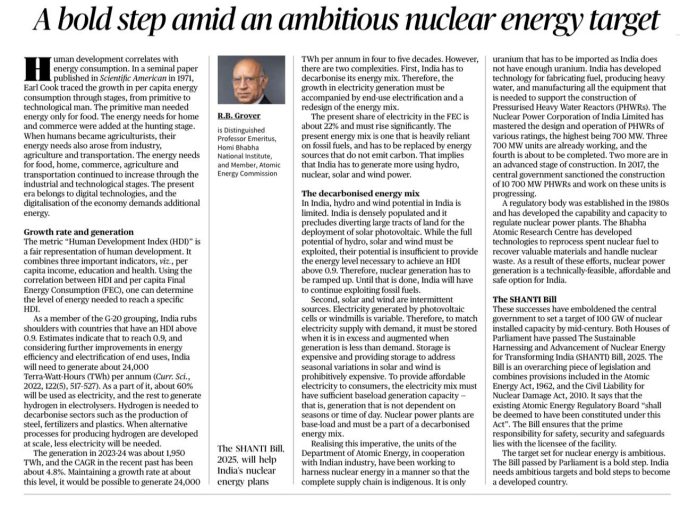
The article analyses India’s growing energy needs in relation to human development and argues that achieving higher HDI levels and deep decarbonisation requires a major expansion of nuclear power, supported by recent legislative and policy changes such as the
SHANTI Bill, 2025.
Detailed Analysis
Energy Consumption and Human Development
• Human development has a strong correlation with per capita energy consumption, as shown by global studies.
• To reach an HDI above 0.9, India must significantly raise its per capita Final Energy Consumption (FEC).
• Estimates suggest India would need around 24,000 TWh per year in the coming decades, far above current generation levels.
India’s Current Energy Scenario
• India’s electricity generation in 2023–24 was about 1,950 TWh, with recent CAGR of around 4.8%.
• The present energy mix is heavily dependent on fossil fuels, making decarbonisation a critical challenge.
• Electricity’s share in FEC is about 22% and must increase through electrification of end uses.
Limits of Renewable Energy Alone
• Hydro and wind potential is limited due to geography and population density.
• Solar and wind are intermittent, requiring large-scale storage to match demand.
• Storage solutions for seasonal and large-scale variability are costly and technologically challenging.
Role of Nuclear Energy in a Decarbonised Mix
• Nuclear power provides baseload, non-carbon electricity, independent of time and season.
• It is essential to support:
o Grid stability
o Large-scale electrification
o Production of green hydrogen for steel, fertilisers and plastics
• Without nuclear expansion, India would be forced to rely on fossil fuels for longer.
India’s Nuclear Capabilities
• India has developed indigenous nuclear fuel fabrication, heavy water production and reactor manufacturing.
• Pressurised Heavy Water Reactors (PHWRs) of up to 700 MW are operational or under construction.
• In 2017, the government sanctioned 10 new 700 MW PHWRs, strengthening domestic capacity.
Regulatory and Safety Framework
• A nuclear regulatory body has existed since the 1980s with expertise in safety oversight.
• Institutions like BARC have advanced capabilities in spent fuel reprocessing and waste management.
• These developments make nuclear power technically feasible, affordable and safe for India.
The SHANTI Bill, 2025
• Parliament passed the Sustainable Harnessing and Advancement of Nuclear Energy for Transforming India (SHANTI) Bill, 2025.
• It consolidates provisions of the Atomic Energy Act, 1962 and the Civil Liability for Nuclear Damage Act, 2010.
• The Bill:
o Reconstitutes the Atomic Energy Regulatory Board under statute
o Places primary responsibility for safety and safeguards on licensees
• It supports the government’s target of 100 GW nuclear capacity by mid-century.
Suggestions Highlighted by the Author
• Nuclear power must be treated as a core pillar of India’s decarbonisation strategy.
• Policy certainty, regulatory clarity and sustained investment are essential.
• Ambitious targets must be matched with bold legislative and institutional reforms.
Conclusion
The article concludes that India’s aspirations of high human development, energy security and climate responsibility cannot be met through renewables alone. Expanding nuclear power, supported by indigenous capabilities and the SHANTI Bill, is a bold but necessary step for India to transition into a developed, low-carbon economy.
UPSC Mains Question
Discuss why nuclear energy is critical for India’s long-term energy security and decarbonisation goals, despite the expansion of renewable energy sources.
Is the Artificial Intelligence boom a bubble?
Context
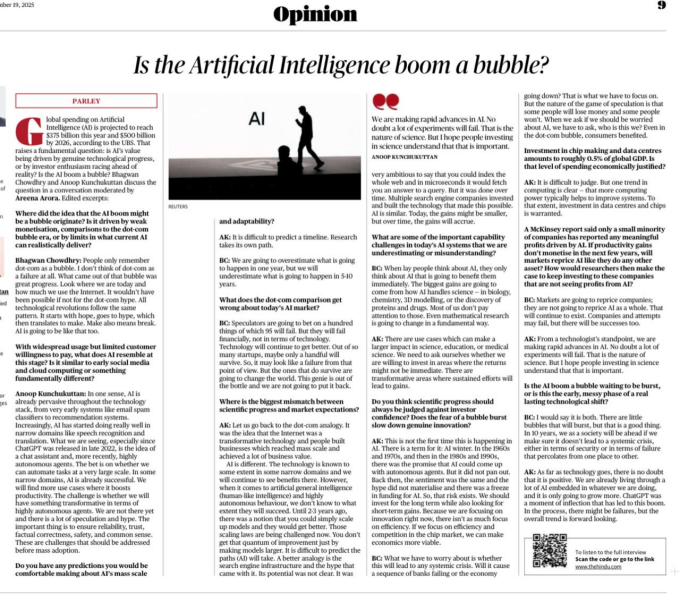
The article examines whether the rapid surge in Artificial Intelligence investment and adoption represents a speculative bubble similar to the dot-com era or the early phase of a transformative technological revolution, through a discussion between Bhagwan Chowdhry and Anoop Kunchukuttan.
Detailed Analysis
Rising Investments and the Bubble Question
• Global AI spending is projected to reach $375 billion in 2025 and $500 billion by 2026.
• This sharp rise has triggered concerns about overvaluation, hype, and unrealistic market expectations.
• The central question is whether AI’s value creation justifies the scale of current investment.
Dot-Com Analogy: Lessons and Limits
• The dot-com bubble is often recalled only for its crash, but it laid the foundation for today’s digital economy.
• Speculation and hype are natural in early technological waves.
• Many firms failed, but the surviving ones reshaped global commerce and communication.
• AI may follow a similar trajectory: many failures, few transformative successes.
Current Capabilities and Limits of AI
• AI has shown strong performance in narrow domains such as speech recognition, translation, spam detection and recommendation systems.
• Since ChatGPT’s release in 2022, AI assistants and autonomous agents have expanded rapidly.
• However, challenges remain in reliability, trust, factual accuracy, safety and common-sense reasoning.
• Scaling models does not guarantee proportional intelligence gains.
Mismatch Between Science and Market Expectations
• Markets expect quick, visible productivity gains, while scientific progress is often incremental.
• The biggest gains from AI are likely in science and research:
o Biology and protein structure prediction
o Chemistry and materials science
o Climate and medical research
• These benefits take time and may not yield immediate commercial returns.
Speculation, Failure and Innovation
• A large number of AI startups may fail financially, though technological learning will persist.
• Failure does not imply wasted effort; innovation often emerges from experimentation.
• Overestimation in the short term and underestimation in the long term is a recurring pattern in technology.
Economic Viability and Productivity Debate
• AI and chip-making investments are around 0.5% of global GDP.
• Whether this is economically justified depends on long-term productivity gains.
• If gains do not materialise, markets will reprice AI firms like any other asset class.
• Continued investment may still be rational given clear trends in computing power and system improvement.
Risk of Systemic Crisis
• Unlike financial bubbles, an AI slowdown is unlikely to cause a systemic economic collapse.
• Consumers may still benefit from AI diffusion even if valuations fall.
• The key concern is not collapse, but allocation of resources and managing expectations.
Suggestions Highlighted by the Authors
• Focus on long-term scientific impact, not short-term market hype.
• Encourage investment in foundational research, even where returns are delayed.
• Improve efficiency, safety, trust and governance of AI systems.
• Avoid judging AI solely by immediate profitability.
UPSC Mains Question
Artificial Intelligence today faces comparisons with the dot-com bubble. Critically examine whether the current AI boom represents speculative excess or a sustainable technological transformation.
Over 3,000 challans issued on Day 1 of ‘no PUC, no fuel’ drive
The Delhi government began strict enforcement of the ‘no PUC, no fuel’ order to curb vehicular emissions, leading to thousands of challans on the first day amid air quality concerns.
Key Points
‘No PUC, No Fuel’ Enforcement
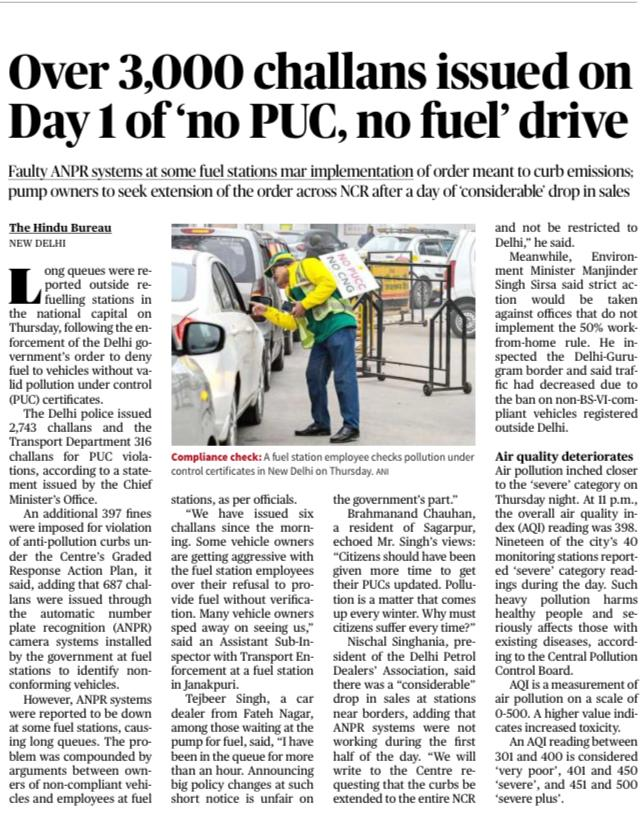
• Vehicles without valid Pollution Under Control (PUC) certificates were denied fuel at petrol pumps.
• Enforcement began across Delhi following directions under air pollution control measures.
Challans Issued
• Delhi Police issued 2,743 challans on Day 1.
• Transport Department issued 316 challans for PUC violations.
• 397 fines were imposed under anti-pollution curbs.
• 687 challans were issued using ANPR camera systems at fuel stations.
Role of ANPR Systems
• Automatic Number Plate Recognition (ANPR) cameras were installed at fuel stations to detect non-compliant vehicles.
• Faulty ANPR systems at some stations caused long queues and operational issues.
Concerns Raised by Fuel Pump Owners
• Dealers reported drop in fuel sales, especially near border areas.
• Fuel station associations sought extension of the order across the NCR to avoid uneven enforcement.
• Complaints were raised about inadequate system readiness on Day 1.
Public and Stakeholder Reactions
• Citizens expressed concern over insufficient time to update PUC certificates.
• Transport officials noted rising aggression at fuel stations due to denial of fuel.
Air Quality Situation
• Delhi’s Air Quality Index (AQI) reached 398 at night.
• 19 of 40 monitoring stations recorded ‘severe’ air quality.
• High pollution poses serious risks, especially to children, elderly and those with respiratory illnesses.
GRAP Context
• The drive aligns with measures under the Graded Response Action Plan (GRAP) to reduce emissions during high pollution episodes.
Central Pollution Control Board (CPCB)
• CPCB monitors AQI on a 0–500 scale.
• AQI above 400 falls under the ‘severe’ category with serious health impacts.
Additional Information
Graded Response Action Plan (GRAP)
• Implemented to tackle air pollution in Delhi-NCR.
• Prescribes emergency actions based on AQI severity, including traffic restrictions and fuel controls.
UPSC Prelims Practice Question
Consider the following statements regarding the ‘No PUC, No Fuel’ drive:
1. The drive restricts fuel supply to vehicles without valid Pollution Under Control certificates.
2. The measure is implemented as part of the Graded Response Action Plan to reduce air pollution.
Which of the statements given above is/are correct?
(a) 1 only
(b) 2 only
(c) Both 1 and 2
(d) Neither 1 nor 2
Answer: (c)
Retired judges don’t want to sit as junior ad hoc judges: CJI
Context
The Chief Justice of India highlighted practical difficulties in appointing retired High Court judges as ad hoc judges to reduce criminal case pendency, despite constitutional backing.
Key Points
Judicial Pendency in High Courts
• High Courts face a huge backlog, especially in criminal cases.
• As per National Judicial Data Grid, 18.98 lakh criminal cases are pending in 25 High Courts.
• 68.27% cases have been pending for more than one year.
Vacancies in High Courts
• Against a sanctioned strength of 1,122 judges, there are 298 vacancies (as of December 15).
• Vacancies significantly contribute to mounting arrears.
Ad hoc Judges under Article 224A
• The Supreme Court activated Article 224A in January to allow appointment of retired High Court judges as ad hoc judges.
• Objective: Clear long-pending criminal appeals.
Reluctance of Retired Judges
• Retired judges are reluctant to return as ad hoc judges.
• Reason cited by CJI: They feel embarrassed sitting as junior judges alongside younger, serving judges.
Operational Challenges
• Most criminal appeals are heard by Division Benches.
• Serving judges are unwilling to sit under a retired judge heading the Bench.
• Retired judges are uncomfortable being junior members of the Bench.
Uneven Response from High Courts
• Several High Courts have not forwarded names of retired judges for ad hoc appointments.
• Pendency is particularly high in Allahabad, Punjab & Haryana, and Patna High Courts.
Supreme Court’s Concern
• The CJI acknowledged willingness among some retired judges but stressed that institutional and psychological barriers hinder effective implementation.
• Indicates that ad hoc appointments alone may not solve structural issues.
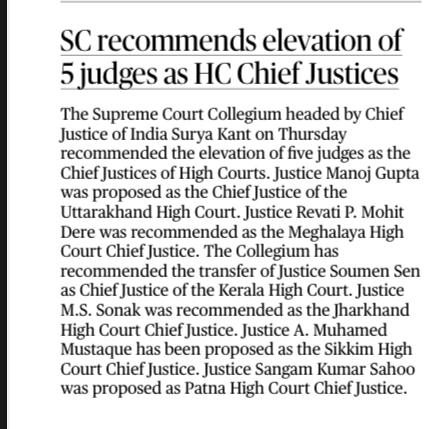
SC recommends elevation of 5 judges as HC Chief Justices
Context
The Supreme Court Collegium, headed by the Chief Justice of India Justice Surya Kant, recommended the elevation and transfer of judges as Chief Justices of various High Courts to fill leadership vacancies.
Key Points
Collegium Recommendations
• Justice Manoj Gupta proposed as Chief Justice of Uttarakhand High Court.
• Justice Revati P. Mohite Dere recommended as Chief Justice of Meghalaya High Court.
• Justice Soumen Sen recommended for transfer as Chief Justice of Kerala High Court.
• Justice M.S. Sonak proposed as Chief Justice of Jharkhand High Court.
• Justice A. Muhammad Mustaque proposed as Chief Justice of Sikkim High Court.
• Justice Sangam Kumar Sahoo proposed as Chief Justice of Patna High Court.
Role of the Supreme Court Collegium
• The Collegium system handles appointments and transfers of judges in higher judiciary.
• It aims to ensure judicial independence, merit-based elevation, and efficient court administration.
Importance of Chief Justices
• Chief Justices head High Courts and play a crucial role in case allocation, roster management, and judicial discipline.
• Timely appointments help address vacancies and pendency of cases.
Additional Information
Qualifications for Appointment as a Judge of the Supreme Court (Article 124(3))
• Must be a citizen of India.
• Must have served as a High Court judge for at least 5 years (in one or more High Courts), or
• Must have been an advocate of a High Court for at least 10 years, or
• Must be a distinguished jurist in the opinion of the President.
UPSC Prelims Practice Question
Consider the following statements regarding the appointment of High Court Chief Justices:
1. The Supreme Court Collegium plays a central role in recommending appointments and transfers of High Court Chief Justices.
2. The President of India appoints High Court Chief Justices only on the advice of the Union Cabinet.
Which of the statements given above is/are correct?
(a) 1 only
(b) 2 only
(c) Both 1 and 2
(d) Neither 1 nor 2
Answer: (a)
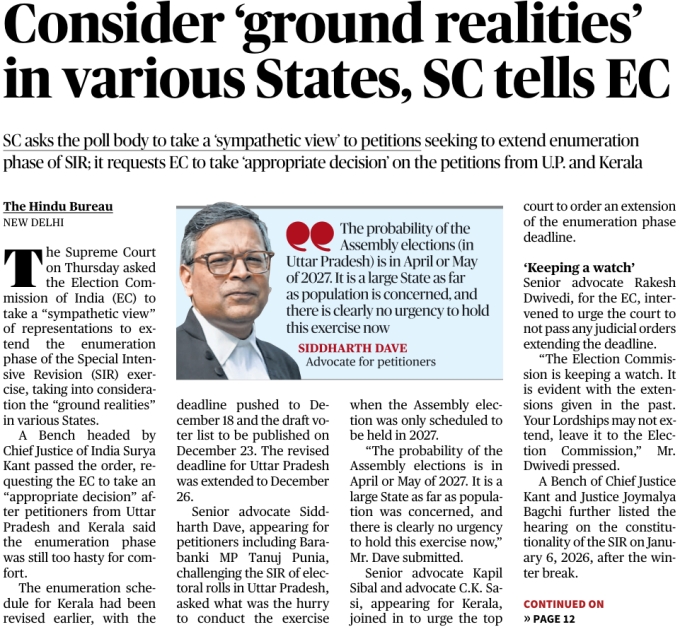
The Supreme Court directed the Election Commission of India (ECI) to take a sympathetic view and consider ground realities across States while deciding petitions seeking extension of the enumeration phase of the Special Intensive Revision (SIR) of electoral rolls, particularly from Uttar Pradesh and Kerala.
Key Points
Supreme Court’s Direction
• A Bench headed by Chief Justice of India Justice Surya Kant asked the ECI to take an appropriate and reasoned decision on requests for extending the SIR enumeration phase.
• The Court refrained from issuing a mandatory order, respecting the constitutional autonomy of the Election Commission.
Special Intensive Revision (SIR) of Electoral Rolls
• SIR is a detailed revision exercise aimed at ensuring accuracy and inclusiveness of electoral rolls.
• Petitioners argued that the enumeration schedule was too hurried, causing difficulties for voters and officials in large and diverse States.
Concerns Raised by Petitioners
• In Uttar Pradesh, petitioners highlighted that Assembly elections are due only in 2027, questioning the urgency.
• In Kerala, logistical constraints and administrative preparedness were cited as reasons for seeking more time.
Election Commission’s Stand
• The ECI informed the Court that it was keeping a watch and had granted extensions in the past where justified.
• It urged the Court not to pass judicial orders extending deadlines, maintaining that such decisions fall within the EC’s domain.
Judicial Approach
• The Court emphasised balancing electoral integrity with practical realities on the ground.
• It underlined that constitutional authorities must act with fairness, sensitivity, and reasonableness, especially in exercises affecting the right to vote.
Next Hearing
• The Bench listed the matter for further hearing on the constitutional validity of the SIR process after the winter recess.
Election Commission of India
• A constitutional body under
Article 324, responsible for conducting free and fair elections.
• Enjoys independence in matters of electoral administration, subject to judicial review on grounds of arbitrariness or unreasonableness.
Supreme Court Guidelines on Dowry-Related Violence
Syllabus:
GS II – Polity and Governance (Judiciary, Fundamental Rights)
GS I – Social Issues (Women, Social Evils)
Context
In State of Uttar Pradesh vs Ajmal Beg (2025), the Supreme Court set aside an acquittal in a dowry death case and issued wide-ranging guidelines to strengthen enforcement against dowry-related violence and deaths, treating dowry as a serious constitutional and social violation.
Key Points
Nature of the Judgment
• The Supreme Court delivered a landmark ruling addressing dowry as a criminal, social and constitutional issue.
• It held that dowry, even when disguised as “gifts”, undermines women’s dignity, equality and right to life.
Case Details
• Case name: State of Uttar Pradesh vs Ajmal Beg (2025).
• The Court overturned the Allahabad High Court’s acquittal and restored the trial court’s conviction.
Criminal Law Findings
• Convictions restored under Sections 304B and 498A IPC, read with Section 113B of the Indian Evidence Act.
• The Court reaffirmed the presumption of dowry death where cruelty precedes unnatural death.
Sociological Observations
• Dowry has shifted from voluntary gifting to a coercive and institutionalised practice.
• The practice cuts across religions and communities, rooted in patriarchy and hypergamy.
Constitutional Perspective
• Dowry violates Article 14 (Equality), Article 15 (Non-discrimination) and Article 21 (Right to Life).
• Eradication of dowry was termed a constitutional obligation of the State.
Extent of the Problem in India
• Around 7,000 dowry deaths annually as per NCRB data.
• Low conviction rates and prolonged investigations reflect systemic enforcement gaps.
Guidelines Issued by the Supreme Court
Preventive and Educational Measures
• Integrate constitutional values of equality and dignity into school education.
• Address dowry at the social conditioning stage.
Institutional Strengthening
• Ensure proper appointment and empowerment of Dowry Prohibition Officers.
• Improve visibility and accountability of enforcement machinery.
Capacity Building
• Regular sensitisation training for police and judicial officers on dowry-related crimes.
Judicial Efficiency
• High Courts to monitor and fast-track pending cases under Sections 304B and 498A IPC.
• Emphasis on time-bound disposal of cases.
Community-Level Awareness
• District administrations and District Legal Services Authorities (DLSAs) to conduct outreach programmes.
• Focus on awareness beyond formal education systems.
Monitoring and Compliance
• Directions to circulate the judgment to all States and High Courts.
• Continued judicial oversight to ensure implementation.
Source: Indian Express
Q. State of Uttar Pradesh vs Ajmal Beg (2025) is often seen in news in connection with which of the following?
a) Guidelines on misuse of sedition law
b) Supreme Court guidelines on dowry-related violence and dowry deaths
c) Decriminalisation of adultery
d) Uniform Civil Code implementation
Answer: b)
Explanation:
In State of Uttar Pradesh vs Ajmal Beg (2025), the Supreme Court set aside an acquittal in a dowry death case and issued comprehensive guidelines to strengthen enforcement against dowry-related violence, reaffirming the application of Sections 304B and 498A IPC and linking dowry practices to violations of Articles 14, 15 and 21 of the Constitution.
Oman confers its highest civilian honour on Prime Minister Narendra Modi
Syllabus:
GS II – International Relations (India–West Asia Relations; Diplomacy)
Context
During his official visit to Oman, Prime Minister Narendra Modi was conferred the Sultanate’s highest civilian decoration, reflecting the deepening strategic, economic and cultural partnership between India and Oman.
Detailed Analysis
The Order of Oman: Nature and Prestige
• Prime Minister Modi was awarded the First Class of the Order of Oman, the highest national honour of the Sultanate.
• The award is traditionally reserved for global leaders and eminent personalities who have strengthened Oman’s international relations.
• Past recipients include Queen Elizabeth II, Nelson Mandela, Emperor Akihito of Japan and King Abdullah II of Jordan.
• The conferment highlights Oman’s recognition of India’s rising global stature and Modi’s diplomatic outreach.
Significance for India–Oman Relations
• India and Oman share historic maritime, trade and cultural ties across the Indian Ocean.
• Bilateral cooperation has expanded into energy security, defence collaboration, counter-terrorism and port connectivity.
• Oman is a key pillar of India’s West Asia strategy, valued for its balanced regional diplomacy.
• The large Indian diaspora in Oman plays an important role in economic and social engagement.
Economic Dimension: CEPA Breakthrough
• The honour coincided with the signing of the India–Oman Comprehensive Economic Partnership Agreement (CEPA).
• CEPA aims to reduce tariffs, enhance duty-free access for Indian exports such as textiles, chemicals and engineering goods.
• It is expected to boost trade volumes and Indian investment in Oman’s logistics and industrial sectors.
• The agreement adds economic depth to the strategic partnership.
India’s Expanding Global Recognition
• This marks Prime Minister Modi’s 29th international honour, placing him among the most internationally recognised leaders.
• The award signals India’s growing diplomatic influence, particularly in West Asia and the Global South.
Broader Diplomatic Context
• The Oman visit concluded PM Modi’s three-nation tour covering Jordan, Ethiopia and Oman.
• The tour underscored India’s focus on economic diplomacy, strategic partnerships and South–South cooperation.
Animal Husbandry Infrastructure Development Fund (AHIDF)
Syllabus: GS III — Agriculture; Animal Husbandry; Food Processing; Infrastructure; Inclusive Growth
Context
The Government informed the Rajya Sabha that loans worth ₹10,320 crore have been sanctioned under the Animal Husbandry Infrastructure Development Fund (AHIDF) to strengthen livestock infrastructure and rural entrepreneurship.
Key Points
What it is:
• A ₹15,000 crore Central Sector Scheme launched under Atma Nirbhar Bharat Abhiyan to boost animal husbandry infrastructure.
Implementing agency:
• Department of Animal Husbandry and Dairying, Ministry of Fisheries, Animal Husbandry and Dairying.
Objectives:
• Expand milk and meat processing capacity and integrate small producers with organised markets.
• Ensure better price realisation for livestock farmers.
• Promote protein-rich food availability and reduce malnutrition.
• Encourage entrepreneurship, jobs and exports in livestock sector.
Infrastructure covered:
• Dairy and meat processing, animal feed plants, breed multiplication farms.
• Animal Waste-to-Wealth management.
• Veterinary vaccine and drug production facilities.
Eligible beneficiaries:
• FPOs, private companies, individual entrepreneurs, MSMEs and Section 8 companies.
Financial support pattern:
• 10% margin money by beneficiaries; 90% loan through scheduled banks.
• 3% interest subvention provided by Government of India.
• Repayment period: Up to 8 years, including 2-year moratorium.
Source: PIB
Q. With reference to the Animal Husbandry Infrastructure Development Fund (AHIDF), consider the following statements:
1. AHIDF is a Central Sector Scheme launched under the Atma Nirbhar Bharat Abhiyan to promote investments in animal husbandry infrastructure.
2. Under AHIDF, beneficiaries are required to contribute at least 25% of the project cost as margin money, while the remaining amount is provided as a government grant.
Which of the statements given above is/are correct?
a) 1 only
b) 2 only
c) Both 1 and 2
d) Neither 1 nor 2
Answer: a)
Explanation:
Statement 1 is correct as AHIDF is a ₹15,000 crore Central Sector Scheme under Atma Nirbhar Bharat Abhiyan aimed at boosting animal husbandry infrastructure.
Statement 2 is incorrect because beneficiaries contribute a minimum of 10% margin money, and the remaining 90% is provided as a loan by scheduled banks, with 3% interest subvention from the Government of India.
Global Declaration on Noncommunicable Diseases (NCDs) and Mental Health
Syllabus: GS II – International Relations; Global Health Governance; Role of International Organisations
Context
At the 80th United Nations General Assembly, world leaders adopted a historic political declaration jointly addressing noncommunicable diseases (NCDs) and mental health for the first time, signalling a shift towards integrated global health governance.
Key Points
What the Declaration Is
• A political declaration adopted by UN Member States to accelerate prevention, control and care of NCDs and mental health conditions.
• First UN declaration to treat NCDs and mental health together, recognising shared risk factors and societal impact.
Institutional Background
• Adopted by: United Nations General Assembly (UNGA).
• Occasion: Fourth UN High-Level Meeting on NCDs and Mental Health, 2025.
Global Fast-Track Targets (by 2030)
• 150 million fewer tobacco users globally.
• 150 million more people with hypertension under control.
• 150 million more people with access to mental health care.
Integrated Health Approach
• Treats NCDs and mental health as interconnected challenges driven by common risks such as unhealthy diets, tobacco, alcohol, physical inactivity and air pollution.
Expanded Scope of NCDs
• Includes oral health, lung health, childhood cancer, kidney and liver diseases, and rare diseases, broadening earlier NCD frameworks.
Focus on Emerging Risks
• Addresses environmental determinants like air pollution, clean cooking and lead exposure.
• Highlights digital harms such as excessive screen time, harmful online content and misinformation.
Stronger Regulatory Measures
• Calls for regulation of e-cigarettes and novel tobacco products.
• Emphasises front-of-pack food labelling, restrictions on unhealthy food marketing to children, and elimination of industrial trans fats.
Health System and Governance Reforms
• Advocates strong primary healthcare, affordable essential medicines and financial protection.
• Promotes multisectoral national plans and robust health surveillance systems.
Whole-of-Government and Society Approach
• Encourages participation of civil society, youth, persons with disabilities, and people with lived experience in policymaking.
Significance
• Addresses leading causes of premature death and disability worldwide.
• Prioritises vulnerable groups including Small Island Developing States (SIDS), climate-affected populations and humanitarian settings.
Source: PIB




 Launch your Graphy