There are no items in your cart
Add More
Add More
| Item Details | Price | ||
|---|---|---|---|


| Index | ||
| S.No | Topic | Page No |
| Daily Hindu Analysis (YouTube) | ||
| 1. | Overseas Bill betrays migrant workers | |
| 2. | How is the Aravalli range to be protected? | |
| 3. | Indian Army leaves for Desert Cyclone-II military exercise | |
| 4. | India, Oman to sign free trade pact today: Goyal | |
5. | ICG Ship Sarthak makes first port call at Iran’s Chabahar | |
| 6. | Navy commissions second MH-60R copter squadron, the ‘Ospreys’, at INS Hansa | |
|
| ||
7. | Project Mausam | |
| 8. | Bharat Ranbhoomi Darshan | |
9. | United Nations Alliance of Civilizations |
|
| 10. | National Digital Livestock Mission |
|
| 11. | Ekam AI and SAMBHAV |
|
Context
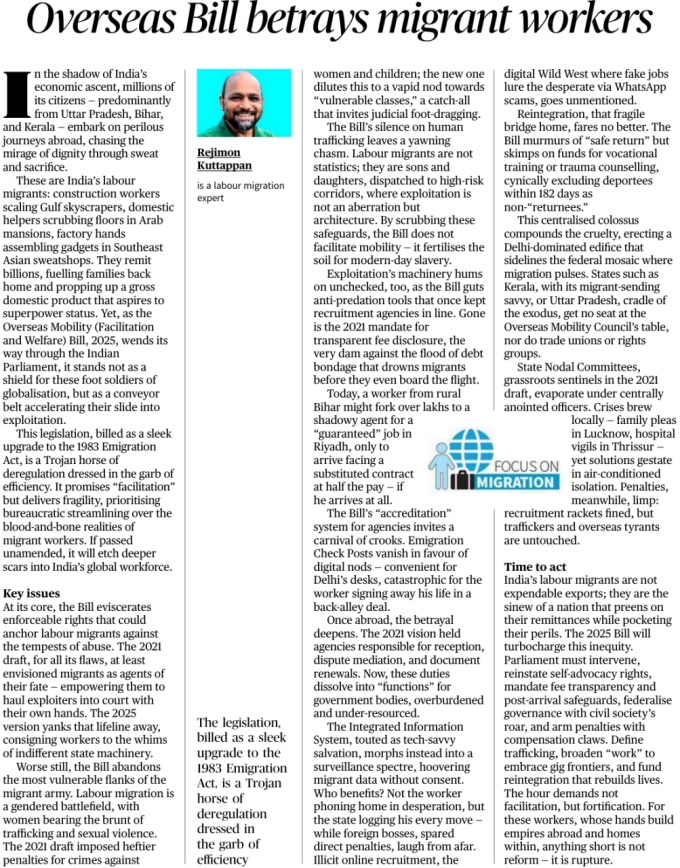
The author critically examines the Overseas Mobility (Facilitation and Welfare) Bill, 2025, arguing that instead of protecting India’s migrant workers, the Bill weakens safeguards and accelerates their vulnerability to exploitation in overseas labour markets.
Detailed Analysis
India’s Migrant Workers and Their Economic Role
From Protection to Deregulation
Dilution of Legal Safeguards
Gendered and Social Vulnerabilities
Recruitment Exploitation and Debt Bondage
Weakening of Overseas Protection Mechanisms
Digitalisation Without Safeguards
Federal and Institutional Exclusion
Reintegration and Return Migration Failures
Enforcement Gaps and Impunity
Suggestions Highlighted by the Author
Conclusion
The author concludes that India’s migrant workers are not expendable exports but central to the nation’s economic and social fabric. The Overseas Mobility Bill, 2025, in its current form, replaces protection with procedural convenience, risking deeper exploitation. What is needed is not facilitation alone, but fortification of rights, accountability and dignity for those whose labour sustains India’s global presence.
UPSC Mains Question
Critically examine the Overseas Mobility (Facilitation and Welfare) Bill, 2025 in the context of India’s obligations towards protecting migrant workers’ rights and welfare.
 Context
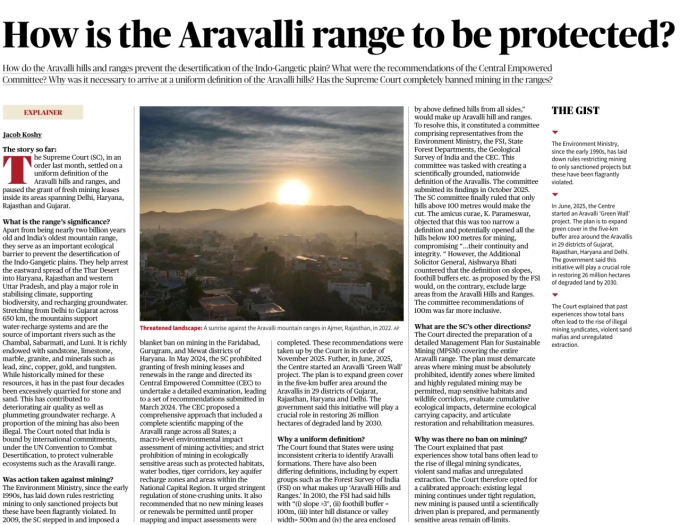
The Supreme Court has recently settled a uniform definition of the Aravalli hills and ranges and paused fresh mining leases, addressing long-standing concerns over ecological degradation and desertification risks in north-west India.
Detailed Analysis
Ecological Significance of the Aravalli Range
Impact of Mining and Degradation
Supreme Court’s Intervention
Role of the Central Empowered Committee (CEC)
Uniform Definition of the Aravallis
Aravalli ‘Green Wall’ Initiative
Managed Plan for Sustainable Mining
Suggestions Highlighted
Conclusion
The protection of the Aravalli range reflects a shift from fragmented regulation to integrated environmental governance. By combining judicial oversight, scientific mapping and restoration initiatives like the Green Wall, India aims to balance ecological security with developmental needs, ensuring the long-term resilience of a critical natural barrier against desertification.
UPSC Mains Question
Discuss the ecological significance of the Aravalli range and evaluate the role of judicial interventions and scientific governance in ensuring its sustainable protection.
Context
An Indian Army contingent has departed for the United Arab Emirates (UAE) to participate in the second edition of the India–UAE Joint Military Exercise DESERT CYCLONE-II, scheduled from December 18 to 30 in Abu Dhabi.
Key Points
About the Exercise
Indian Army Contingent
UAE Representation
Objectives of the Exercise
Strategic Significance
Additional Information
India–UAE Defence Cooperation
UPSC Prelims Practice Question
Consider the following statements regarding Exercise DESERT CYCLONE-II:
1. It is a joint military exercise conducted between India and the United Arab Emirates.
2. The exercise aims to enhance interoperability between the Indian Army and the UAE Land Forces.
Which of the statements given above is/are correct?
a) 1 only
b) 2 only
c) Both 1 and 2
d) Neither 1 nor 2
Answer: c) Both 1 and 2
 Context
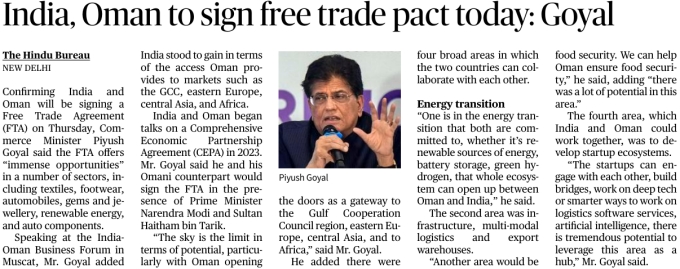
India and Oman are set to sign a Free Trade Agreement (FTA)/Comprehensive Economic Partnership Agreement (CEPA), aimed at expanding trade, investment, and strategic economic cooperation between the two countries.
Key Points
Nature of the Agreement
Sectors Benefiting from the FTA
Market Access and Strategic Reach
Energy Transition Cooperation
Infrastructure and Logistics Collaboration
Food Security and Agriculture
Startup and Technology Ecosystem
Additional Information
India–Oman Relations
UPSC Prelims Question
Consider the following statements regarding the India–Oman Free Trade Agreement:
1. The agreement aims to provide India enhanced access to GCC and African markets through Oman.
2. Energy transition, including green hydrogen and renewable energy, is a key area of cooperation under the agreement.
Which of the statements given above is/are correct?
a) 1 only
b) 2 only
c) Both 1 and 2
d) Neither 1 nor 2
Answer: c) Both 1 and 2
Context
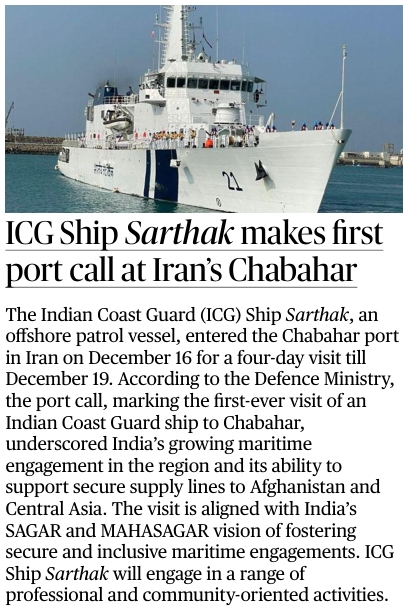
The Indian Coast Guard (ICG) Ship Sarthak made its first-ever port call at Chabahar, Iran, marking a significant step in India’s expanding maritime engagement in the region.
Key Points
About the Port Call
Strategic Significance of Chabahar
Maritime Security and Diplomacy
Alignment with India’s Maritime Vision
Activities During the Visit
Indian Coast Guard
UPSC Prelims Question
Consider the following statements regarding Chabahar Port:
1. Chabahar Port provides India with direct maritime access to Afghanistan and Central Asia bypassing Pakistan.
2. ICG Ship Sarthak’s visit marks the first-ever visit of any Indian naval asset to Chabahar port.
Which of the statements given above is/are correct?
a) 1 only
b) 2 only
c) Both 1 and 2
d) Neither 1 nor 2
Answer: a)
Context
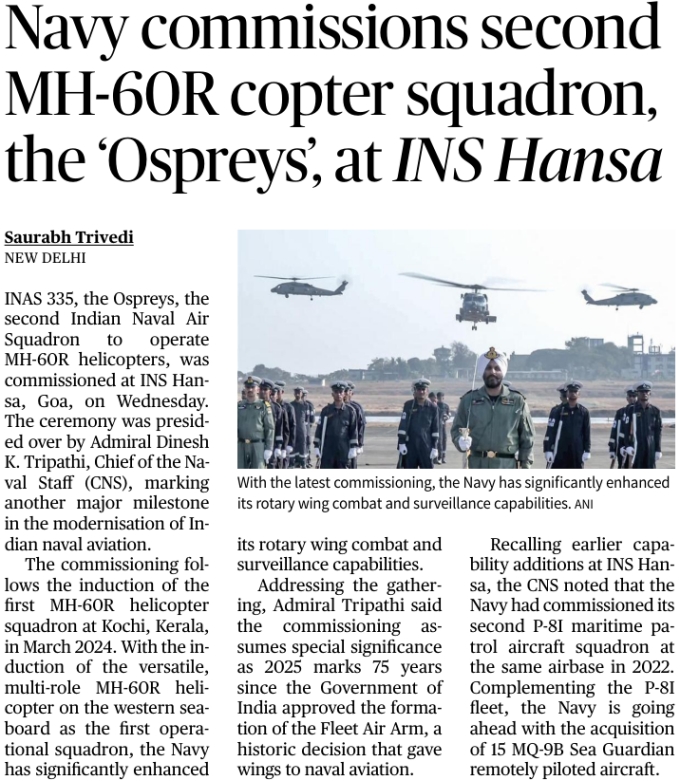
The Indian Navy has commissioned its second MH-60R helicopter squadron (INAS 335 – ‘Ospreys’) at INS Hansa, Goa, strengthening naval aviation and maritime surveillance capabilities.
Key Points
Commissioning Details
Significance of MH-60R Helicopters
Boost to Naval Aviation
Operational and Strategic Importance
Complementing Existing Assets
Future Capability Expansion
Additional Information
Indian Navy – Fleet Air Arm
Syllabus: GS-I — Indian Culture; GS-II — International Relations; Cultural Diplomacy
Context
The Archaeological Survey of India (ASI) recently organised a National Workshop on Project Mausam titled “Islands at the Crossroads of Maritime Networks within the Indian Ocean Region”, highlighting India’s maritime cultural heritage and historical linkages across the Indian Ocean.
Key Points
What is Project Mausam:
An Indian government–led cultural diplomacy and maritime heritage initiative launched in 2014.
Nodal ministry:
Ministry of Culture, Government of India.
Implementing agency:
Implemented by the Archaeological Survey of India (ASI) as the nodal body.
Core objective:
To study and document the Indian Ocean world, focusing on cultural, commercial and religious exchanges across centuries.
Geographical scope:
Covers 39 Indian Ocean littoral countries, reflecting transnational maritime interactions.
UNESCO linkage:
Aims to nominate identified sites as trans-national inscriptions on UNESCO’s World Heritage List.
Research focus:
Promotes archaeological and historical research on ancient maritime routes through a multidisciplinary approach.
Academic engagement:
Encourages international seminars, scientific meetings and publications for both scholars and the general public.
Conceptual aim:
Promotes the idea of shared heritage and multiple identities shaped by oceanic connectivity.
Project structure:
Operates through two major units —
• Project Research Unit
• World Heritage Nomination Unit
Supporting institutions:
Research support provided by the Indira Gandhi National Centre for the Arts (IGNCA) and the National Museum.
Mission Mausam (Not to be Confused with Project Mausam)
Mission Mausam:
A separate initiative launched in 2024 by the Ministry of Earth Sciences.
Implementing agencies:
India Meteorological Department (IMD),
National Centre for Medium-Range Weather Forecasting (NCMRWF),
Indian Institute of Tropical Meteorology (IITM).
Objective:
To strengthen weather and climate services through improved observation, modelling and forecasting for sectors like agriculture and disaster management.
Source: PIB
UPSC Prelims MCQ
Q1.Consider the following statements about Project Mausam:
1. Project Mausam is a cultural diplomacy initiative led by the Ministry of Culture to document India’s maritime heritage across the Indian Ocean region.
2. The project aims to nominate identified maritime sites as trans-national inscriptions on UNESCO’s World Heritage List.
Which of the statements given above is/are correct?
(a) 1 only
(b) 2 only
(c) Both 1 and 2
(d) Neither 1 nor 2
Answer: (c)
Explanation:
Project Mausam was launched in 2014 by the Ministry of Culture as a maritime heritage and cultural diplomacy initiative. A key objective of the project is to identify sites across 39 Indian Ocean countries and pursue their trans-national nomination to UNESCO’s World Heritage List.
Q2.Consider the following statements about Mission Mausam:
1. Mission Mausam was launched by the Ministry of Earth Sciences to strengthen weather and climate forecasting services in India.
2. The Archaeological Survey of India (ASI) is the nodal agency for implementing Mission Mausam.
Which of the statements given above is/are correct?
(a) 1 only
(b) 2 only
(c) Both 1 and 2
(d) Neither 1 nor 2
Answer: (a)
Explanation:
Mission Mausam was launched in 2024 by the Ministry of Earth Sciences to improve weather and climate services. It is implemented by IMD, NCMRWF, and IITM, not by the ASI (which is the nodal agency for Project Mausam, not Mission Mausam).
Syllabus: GS III — Defence and Security; Tourism; Border Area Development
Context
The Chief Minister of Sikkim recently announced the opening of Cho La and Dok La for tourists under the Bharat Ranbhoomi Darshan initiative, aimed at promoting border tourism and regional development.
Key Points
What is Bharat Ranbhoomi Darshan?
Aim of the Initiative
Strategic and Developmental Significance
Key Features
Identified Locations
Tourism and Awareness
Source: News On Air
Q. Consider the following statements regarding the Bharat Ranbhoomi Darshan initiative:
1. It is a joint initiative of the Ministry of Defence and the Ministry of Tourism to promote border tourism.
2. The initiative focuses exclusively on virtual tours and does not allow physical tourist access to border areas.
Which of the above statements is/are correct?
a) 1 only
b) 2 only
c) Both 1 and 2
d) Neither 1 nor 2
Answer: a)
Explanation:
Statement 1 is correct as Bharat Ranbhoomi Darshan is a joint initiative of the Ministry of Defence and the Ministry of Tourism to promote border tourism and development.
Statement 2 is incorrect because the initiative allows both physical access to selected border sites and virtual tours, not virtual-only engagement.
Syllabus: GS II — International Relations; Global Institutions; Soft Power Diplomacy
Context
India reaffirmed its commitment to Vasudhaiva Kutumbakam and religious harmony at the 11th United Nations Alliance of Civilizations (UNAOC) Forum held in Riyadh, highlighting India’s support for intercultural dialogue at the global level.
Key Points
Establishment and Origin
Nature and Purpose
Core Functions
Global Forum
Funding Mechanism
Administration of Trust Fund
Secretariat
Source: News on Air
Q.Consider the following statements regarding the United Nations Alliance of Civilizations (UNAOC):
1. It was established in 2005 as a political initiative of former UN Secretary-General Kofi Annan and was co-sponsored by Spain and Türkiye.
2. The highest decision-making body of UNAOC is the UN General Assembly, which administers its Trust Fund and Secretariat.
Which of the above statements is/are correct?
a) 1 only
b) 2 only
c) Both 1 and 2
d) Neither 1 nor 2
Answer: a)
Explanation:
Statement 1 is correct. UNAOC was established in 2005 as an initiative of Kofi Annan and co-sponsored by Spain and Türkiye to promote intercultural and interreligious dialogue.
Statement 2 is incorrect. The Global Forum is the highest-profile event of UNAOC, while its Trust Fund is administered by the UN Secretariat, and the Secretariat of UNAOC is based in New York, not under direct administration of the UN General Assembly.
Syllabus: GS-II — Governance; E-Governance; Agriculture and Allied Sectors (Animal Husbandry)
Context
The Minister of Fisheries, Animal Husbandry and Dairying informed the Lok Sabha about the progress and implementation of the National Digital Livestock Mission (NDLM), which aims to digitally transform livestock management and service delivery across India.
Key Points
What it is:
A national initiative launched to create a comprehensive digital database of livestock and related services in the country.
Implementing authority:
Launched by the Department of Animal Husbandry and Dairying, Government of India.
Coverage:
Implemented across all States in India, ensuring nationwide livestock data integration.
Digital backbone:
The mission is anchored on the Bharat Pashudhan platform, which supports mobile and web-based applications.
Animal identification:
Each animal is assigned a unique 12-digit bar-coded ear tag, serving as its permanent digital identity.
Data captured:
Includes animal registration, breeding and artificial insemination, vaccinations, disease reporting, milk recording, ration balancing, ownership changes and e-prescriptions.
Core objectives:
Enhancing livestock productivity, improving breed quality, enabling real-time disease surveillance and establishing traceability of livestock products.
Farmer-centric approach:
Facilitates easy access to livestock services, information on government schemes and efficient delivery of veterinary support.
Strategic significance:
Strengthens disease control, improves food safety, boosts farmers’ income and modernises India’s livestock sector through digital governance.
Department of Animal Husbandry and Dairying:
The nodal department responsible for livestock development, dairy sector growth and implementation of digital initiatives like NDLM.
Source: PIB
Q. Consider the following statements regarding the National Digital Livestock Mission (NDLM):
1. The mission aims to enable real-time disease surveillance and traceability of livestock products across India.
2. The National Digital Livestock Mission is implemented only in selected pilot States due to regional diversity.
Which of the statements given above is/are correct?
a) 1 only
b) 2 only
c) Both 1 and 2
d) Neither 1 nor 2
Answer: a) 1 only
Explanation:
Statement 1 is correct as NDLM focuses on real-time disease monitoring and traceability mechanisms.
Statement 2 is incorrect because the mission has been implemented across all States in India, not limited to pilot States.
Syllabus: GS Paper III – Security
Topic: Defence technology, indigenisation, internal security
Context
During the Vijay Diwas celebrations, the Indian Army showcased indigenous defence technologies, highlighting India’s push towards self-reliance in secure digital and communication systems.
Key Points
Ekam AI
Features of Ekam AI
Significance of Ekam AI
SAMBHAV Project
Features of SAMBHAV
Significance of SAMBHAV
Vijay Diwas
Source: PIB
Q. Consider the following statements:
1. Ekam AI is a fully indigenous artificial intelligence platform designed to operate in sensitive environments without reliance on foreign software or external cloud systems.
2. SAMBHAV is a portable satellite-based communication system that can be rapidly deployed in remote and disaster-affected areas.
Which of the statements given above is/are correct?
a) 1 only
b) 2 only
c) Both 1 and 2
d) Neither 1 nor 2
Answer: c) Both 1 and 2
Explanation:
Ekam AI is an indigenous, secure AI platform ensuring data sovereignty, while SAMBHAV provides satellite-supported mobile connectivity for quick deployment in remote and emergency situations.
 Launch your Graphy