Daily Current Affairs for UPSC 17th Dec 2025



Index S.No Topic 1. The future of governance in post-Maoist India
2. India and the U.S.: 2005 versus 2025
3. Rashtrapati Bhavan displays portraits of all 21 Param Vir Chakra awardees 4. India-Maldives joint military exercise EKUVERIN concludes 5. Lok Sabha passes Bill on 100% FDI in insurance
6. Six children in M.P. hospital test positive for HIV after ‘contaminated’ transfusions 7. Sydney beach shooter was Indian citizen, say officials
8. Exercise Ekatha 2025 9. Channa bhoi
10. Jordan
11. The Tianjin Declaration 12. Tigris River
The future of governance in post-Maoist India
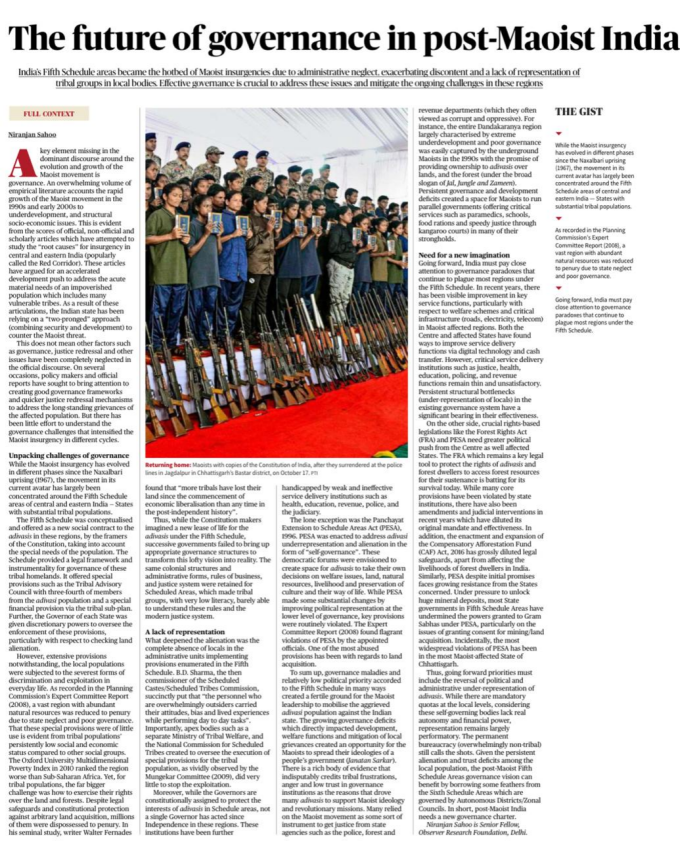
Context
The article examines how administrative neglect, weak governance and lack of tribal representation in Fifth Schedule areas enabled Maoist insurgency, and argues that effective, inclusive governance is central to sustaining peace in post-Maoist regions.
Detailed Analysis
Governance Blind Spot in Maoist Discourse
- Maoist insurgency debates have been dominated by security-centric narratives.
- Governance failures, justice delivery gaps and administrative alienation were largely under-analysed.
- The two-pronged approach of security plus development ignored institutional weaknesses.
Fifth Schedule Areas and Structural Neglect - Maoism largely spread in Fifth Schedule regions of Central and Eastern India.
- These areas witnessed administrative absence, corruption and exploitative revenue practices.
- Example: Dandakaranya region, where parallel Maoist systems emerged due to governance vacuum.
Erosion of Constitutional Safeguards - Fifth Schedule, FRA and PESA were designed to protect tribal autonomy and resources.
- In practice, these safeguards were diluted by:
- Weak implementation
- Bureaucratic dominance
- Political apathy at State and Centre levels
- Gram Sabhas were bypassed, especially in land acquisition and mining approvals.
Lack of Representation and Trust Deficit - Severe under-representation of tribals in administration and decision-making bodies.
- Institutions like health, education, policing and judiciary remained inaccessible.
- Resulted in alienation, distrust and dependence on Maoist parallel justice systems.
PESA and FRA: Missed Opportunities - PESA (1996) aimed to empower Gram Sabhas on land, forest and welfare issues.
- FRA (2006) sought to correct historical injustices in forest rights.
- Violations of both Acts, particularly in mining states like Chhattisgarh, deepened grievances.
Post-Maoist Transition Challenges - Decline of armed Maoism does not automatically ensure governance legitimacy.
- Persisting issues:
- Service delivery gaps
- Weak local institutions
- Continued bureaucratic control
- Risk of relapse remains if governance reforms lag behind security gains.
Learning from Sixth Schedule Areas - Sixth Schedule regions provide relatively stronger autonomy via Autonomous Councils.
- The author suggests selective borrowing of decentralised governance features.
- Emphasis on empowered local bodies rather than centralized bureaucratic control.
Suggestions Highlighted by the Author - Reverse political and administrative marginalisation of adivasis
- Strengthen Gram Sabhas and local self-governing institutions
- Ensure genuine implementation of FRA and PESA
- Improve service delivery in health, education, justice and policing
- Reduce bureaucratic dominance and enhance local representation
- Treat governance reform as central, not secondary, to internal security
Conclusion Post-Maoist India requires a decisive shift from security-first approaches to governance-led stabilization. Without inclusive institutions, accountability and tribal empowerment, peace will remain fragile. Effective governance is not a by-product of security success but its foundation.
UPSC Mains Question
Discuss how governance failures in Fifth Schedule areas contributed to Maoist insurgency in India. Examine the reforms required for sustaining peace in post-Maoist regions.
India and the U.S.: 2005 versus 2025
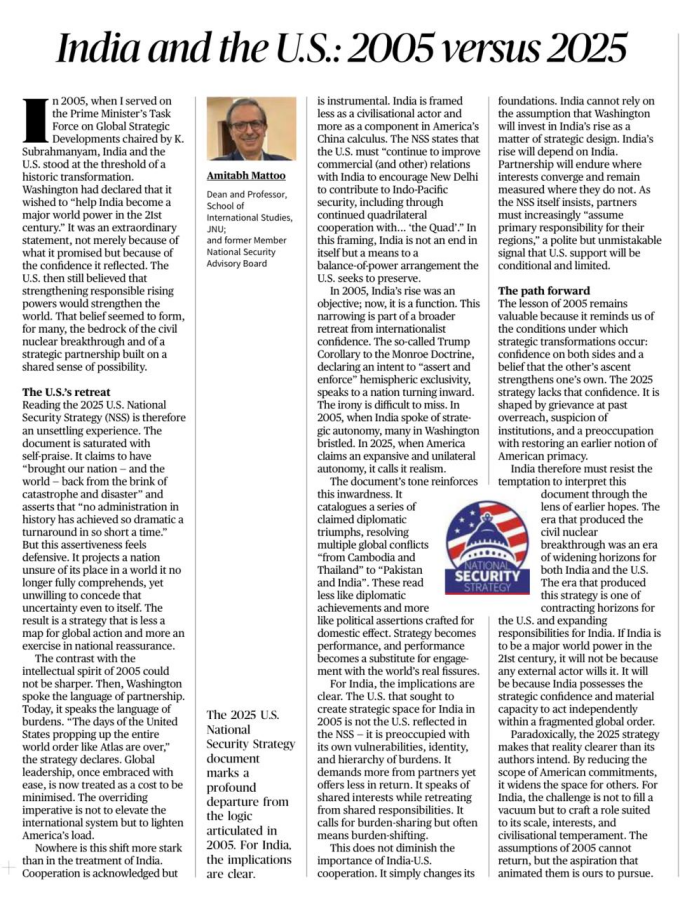
Context
The article compares India–U.S. relations in 2005 and 2025 by analysing shifts in American strategic thinking, especially as reflected in the U.S. National Security Strategy (NSS) 2025, and their implications for India’s global role and strategic autonomy.
Detailed Analysis
2005: A Moment of Strategic Confidence
- In 2005, India–U.S. ties stood at the threshold of a historic transformation.
- The U.S. explicitly supported India’s rise as a major global power in the 21st century.
- The civil nuclear agreement symbolised mutual confidence and shared optimism.
- India’s rise was seen as strengthening global order, not challenging it.
The Spirit of Partnership in 2005 - Washington spoke the language of partnership and shared responsibility.
- India’s strategic autonomy was respected, even if it made U.S. policymakers uneasy.
- Cooperation was framed as mutually reinforcing rather than instrumental.
- The relationship was built on expanding horizons and global leadership.
2025 U.S. National Security Strategy: A Shift in Tone - The 2025 NSS reflects an inward-looking and defensive American posture.
- It is marked by self-assertion, reassurance and emphasis on burden-sharing.
- Global leadership is no longer seen as an asset but as a cost to be reduced.
- Strategy appears performative, focused on domestic validation rather than global engagement.
India’s Reframing in U.S. Strategy - India is no longer treated as an end in itself but as a means to U.S. objectives.
- Cooperation is framed through the Indo-Pacific lens, especially China containment.
- Quad cooperation is emphasised, but India is positioned as a component of balance-of-power politics.
- Support for India is conditional, limited and interest-driven.
From Strategic Autonomy to Strategic Instrumentalism - In 2005, India’s rise was an objective of U.S. policy.
- In 2025, India’s rise is a function of American strategy.
- The U.S. expects partners to assume greater regional responsibility while offering less in return.
- Shared interests replace shared responsibilities, signalling burden-shifting.
Implications for India - India cannot rely on external endorsement for its rise.
- Strategic partnerships will endure only where interests converge.
- The U.S. support will be selective, transactional and conditional.
- India’s rise must be anchored in its own confidence, capabilities and autonomy.
Contrasting Strategic Eras - 2005 represented expanding horizons for both countries.
- 2025 reflects contracting horizons for the U.S. and expanding responsibilities for India.
- The earlier era was defined by optimism; the current one by caution and grievance.
- The confidence that enabled the civil nuclear breakthrough is absent today.
Suggestions Highlighted by the Author - India must resist interpreting 2025 through the lens of 2005 optimism.
- Avoid dependence on external powers for strategic validation.
- Build material capacity, strategic confidence and independent decision-making.
- Craft a global role aligned with India’s scale, interests and civilisational outlook.
- Accept partnership where interests converge, without expecting unconditional support.
Conclusion The comparison between 2005 and 2025 reveals a profound shift in U.S. strategic outlook and its approach towards I
ndia. While the era of expansive partnership has narrowed, this clarity creates space for India to pursue an autonomous rise. India’s future as a major power will depend not on external sponsorship, but on its ability to act independently in a fragmented global order.
UPSC Mains Question
Compare the nature of India–U.S. strategic relations in 2005 and 2025. What does the shift in U.S. strategic outlook imply for India’s pursuit of strategic autonomy?
Rashtrapati Bhavan displays portraits of all 21 Param Vir Chakra awardees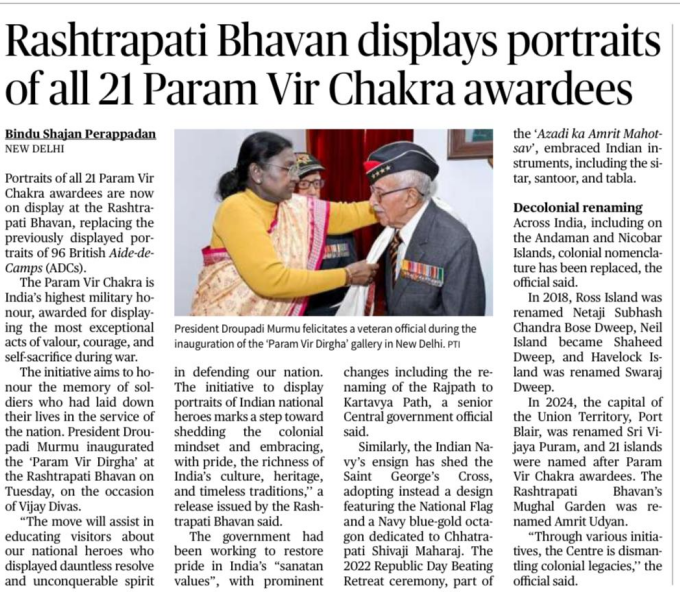
Context
Portraits of all 21 Param Vir Chakra awardees have been installed at Rashtrapati Bhavan, replacing portraits of British-era military officers, as part of an initiative inaugurated on Vijay Diwas.
Key Points About the Initiative
- Portraits are displayed at the newly inaugurated Param Vir Dhirgha in Rashtrapati Bhavan.
- Earlier portraits of 96 British Aide-de-Camps have been removed.
- The initiative honours India’s highest military heroes who displayed exceptional valour.
About Param Vir Chakra - India’s highest military gallantry award.
- Awarded for extraordinary courage, valour and self-sacrifice in wartime.
- Instituted in 1950 and awarded only during war or conflict.
Symbolism and Significance - Reflects a shift away from colonial military symbolism.
- Reinforces national pride, sacrifice and remembrance.
- Aims to educate visitors about India’s military history and heroes.
Part of Decolonisation Efforts - Aligns with the broader push to shed colonial legacies.
- Renaming initiatives include:
- Rajpath renamed Kartavya Path
- Mughal Garden renamed Amrit Udyan
- Ross Island renamed Netaji Subhas Chandra Bose Dweep
- Andaman & Nicobar islands renamed after Param Vir Chakra awardees
Cultural and National Identity - Linked with the spirit of Azadi ka Amrit Mahotsav.
- Emphasises India’s civilisational values, traditions and armed forces ethos.
Rashtrapati Bhavan - Official residence of the President of India.
- Acts as a symbol of Indian sovereignty and constitutional authority.
- Increasingly used to showcase national heritage and heroes.
Indian Armed Forces - The Param Vir Chakra is awarded to personnel of the Army, Navy and Air Force.
- Recognises supreme bravery in defence of the nation.
UPSC Prelims Practice Question Consider the following statements regarding the Param Vir Chakra:
1. The Param Vir Chakra is awarded for acts of gallantry during peacetime.
2. It is the highest military decoration for valour in India.
Which of the statements given above is/are correct? a) 1 only
b) 2 only
c) Both 1 and 2
d) Neither 1 nor 2
Answer: b) 2 only
India-Maldives joint military exercise EKUVERIN concludes
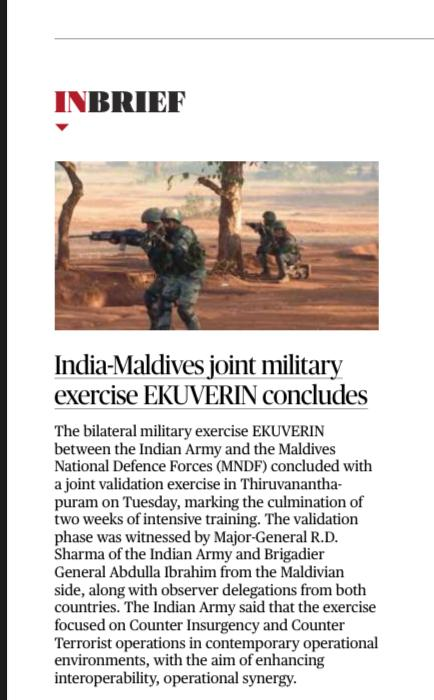
Context
The bilateral military exercise EKUVERIN between the Indian Army and the Maldives National Defence Forces (MNDF) concluded with a joint validation exercise in Thiruvananthapuram, marking the end of two weeks of training.
Key Points About Exercise EKUVERIN
- EKUVERIN is a bilateral military exercise between India and Maldives.
- Conducted alternately in India and Maldives.
- Aims to strengthen defence cooperation and mutual trust.
Focus Areas - Training focused on Counter-Insurgency and Counter-Terrorist operations.
- Emphasis on contemporary operational environments.
- Designed to enhance interoperability and operational synergy between forces.
Validation Phase - Culminated in a joint validation exercise.
- Observed by senior military officers from both countries.
- Assessed tactical drills, coordination and joint response mechanisms.
Strategic Significance - Reinforces India’s Neighbourhood First Policy.
- Enhances maritime and regional security cooperation in the Indian Ocean Region (IOR).
- Builds capacity for joint response to security challenges.
Indian Army – Maldives National Defence Forces (MNDF) - MNDF is the unified armed force of Maldives.
- Defence cooperation includes training, capacity building and joint exercises.
UPSC Prelims Practice Question Consider the following statements regarding Exercise EKUVERIN: 1. Exercise EKUVERIN is conducted jointly by the Indian Army and the Maldives National Defence Forces.
2. The exercise focuses exclusively on naval operations in the Indian Ocean Region.
Which of the statements given above is/are correct? a) 1 only
b) 2 only
c) Both 1 and 2
d) Neither 1 nor 2
Answer: a) 1 only
Lok Sabha passes Bill on 100% FDI in insurance

Context
The Lok Sabha has passed a Bill to increase Foreign Direct Investment (FDI) in the insurance sector from 74% to 100%, along with amendments to insurance-related laws, amid opposition protests.
Key Points Increase in FDI Limit
- Raises FDI cap in insurance companies from 74% to 100%.
- Aims to attract greater foreign capital infusion into the sector.
- Facilitates easier entry of global insurance companies without mandatory domestic partners.
Rationale Behind the Move - Strengthens insurers’ capital base and risk-bearing capacity.
- Encourages technology transfer and innovation in insurance products.
- Supports expansion of insurance penetration in India.
Regulatory Framework - All companies, including foreign-owned insurers, will be regulated under Indian laws.
- Amendments proposed to:
- Insurance Act, 1938
- Life Insurance Corporation Act, 1956
- Insurance Regulatory and Development Authority Act, 1999
Empowerment of IRDAI - IRDAI empowered to disgorge wrongful gains made by insurers and intermediaries.
- Maximum penalty on insurance intermediaries increased from ₹1 crore to ₹10 crore.
- Intended to strengthen regulatory compliance and deterrence.
Support to Public Sector Insurers - Government infused ₹17,450 crore into three public sector general insurers.
- Listing of LIC, GIC Re and New India Assurance highlighted as steps to boost transparency and capital strength.
Reinsurance Reforms - Net owned fund requirement for foreign reinsurance branches reduced from ₹5,000 crore to ₹1,000 crore.
- Expected to attract more global reinsurers into India.
Sectoral Significance - Builds trust by strengthening policyholder protection.
- Enhances transparency and creates a level playing field for foreign and domestic players.
Insurance Regulatory and Development Authority of India (IRDAI) - Statutory body established under the IRDAI Act, 1999.
- Regulates and promotes orderly growth of the insurance and reinsurance sector in India.
UPSC Prelims Practice Question Consider the following statements regarding the recent Insurance Amendment Bill:
1. The Bill increases the FDI limit in the insurance sector to 100%.
2. The Bill empowers IRDAI to order disgorgement of wrongful gains and enhances the maximum penalty on insurance intermediaries.
Which of the statements given above is/are correct? a) 1 only
b) 2 only
c) Both 1 and 2
d) Neither 1 nor 2
Answer: c) Both 1 and 2
Six children in M.P. hospital test positive for HIV after ‘contaminated’ transfusions
Context
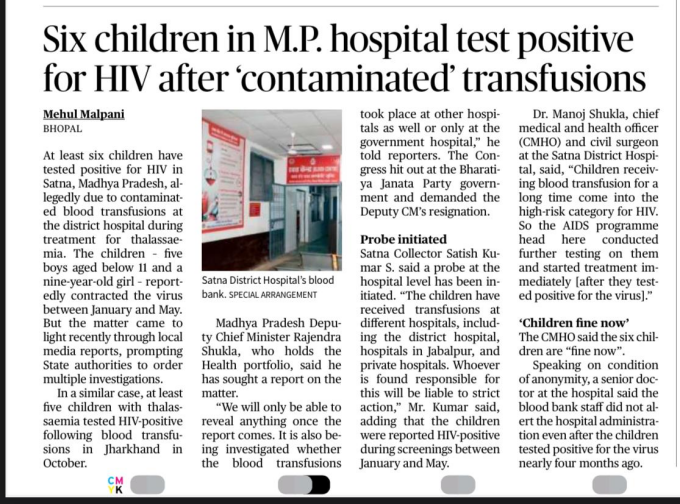
At least six children undergoing treatment for thalassaemia in Satna district, Madhya Pradesh, tested HIV-positive, allegedly due to contaminated blood transfusions, prompting multiple investigations by State authorities.
Key Points Incident Details
- Six children (five boys below 11 years and one nine-year-old girl) tested HIV-positive.
- Infections reportedly occurred between January and May during blood transfusions.
- All children were receiving regular transfusions for thalassaemia.
Hospitals Involved - Transfusions took place at Satna District Hospital.
- Children also received blood at other government hospitals, including Jabalpur, and some private hospitals.
Detection and Reporting - Case surfaced after local media reports, leading to official scrutiny.
- Children were identified as HIV-positive during routine screening.
Administrative Response - Probe initiated at the hospital level by the district administration.
- Madhya Pradesh Deputy Chief Minister (Health) sought a detailed report.
- Authorities stated that strict action will be taken against those found responsible.
Medical Response - Children were immediately started on treatment under the AIDS control programme.
- District CMHO stated that the children are currently clinically stable.
Systemic Concerns Highlighted - Raises serious questions on blood bank screening protocols.
- Highlights gaps in quality control, monitoring, and reporting within public health facilities.
- Similar case reported earlier in Jharkhand, indicating a broader systemic risk.
Public Health Implications - Blood transfusion safety is critical for high-risk groups like thalassaemia patients.
- Emphasises the need for strict compliance with HIV screening and blood safety norms.
- Reinforces accountability of hospital administration and blood banks.
Sydney beach shooter was Indian citizen, say officials
Context
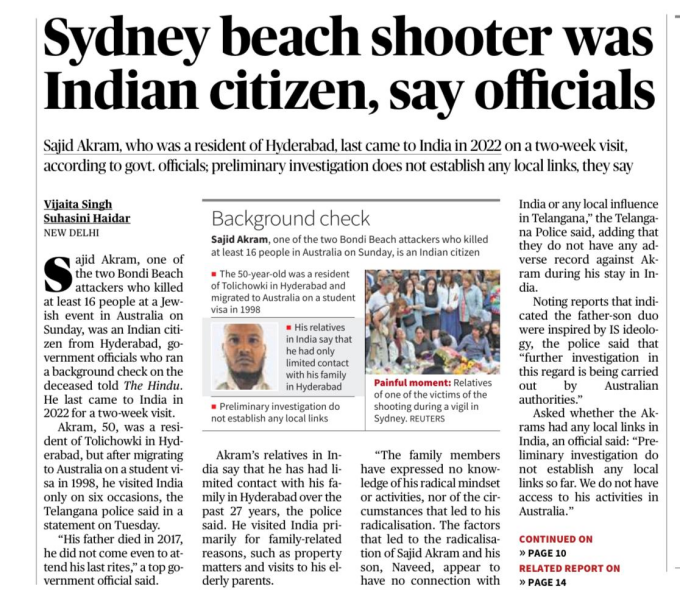
Indian authorities confirmed that one of the attackers involved in the Sydney beach shooting was an Indian citizen originally from Hyderabad, following a background verification after the incident in Australia. Key Points Identity of the Attacker
- Sajid Akram, aged 50, identified as an Indian citizen.
- Native of Tolichowki, Hyderabad, Telangana.
- Migrated to Australia in 1998 on a student visa.
Visits and Local Links in India - Last visited India in 2022 for a two-week visit.
- Visited India only six times in the last 27 years.
- Preliminary investigation found no active local links in India.
Radicalisation Angle - Police noted reports suggesting possible IS-inspired ideology.
- Indian agencies stated no evidence of radicalisation within India.
- Investigation into ideological influences being pursued by Australian authorities.
Coordination with Foreign Agencies - Indian agencies coordinating with Australian law enforcement.
- Access to details of activities in Australia remains limited at present.
Security Implications - Highlights challenges of cross-border radicalisation.
- Reinforces the need for international intelligence cooperation.
- Shows that long-term overseas residence can reduce domestic traceability.
Internal Security Perspective - Lone-wolf attacks often show weak domestic linkages.
· Emphasises importance of
global counter-terrorism coordination and monitoring extremist ideologies beyond national borders.
Exercise Ekatha 2025
Syllabus: GS III – Defence and Security; International Relations (India and Neighbourhood)
Context
The Deputy Chief of the Naval Staff of the Indian Navy visited Maldives to attend the closing ceremony of Exercise Ekatha 2025, highlighting ongoing maritime cooperation between India and Maldives.
Key Points About Exercise Ekatha 2025 - Nature: Annual bilateral maritime exercise between the Indian Navy and the Maldives National Defence Force (MNDF).
- Established: 2017; 2025 is the eighth edition.
- Objective: Enhance bilateral maritime cooperation and operational synergy.
- Focus: Improving interoperability and coordination between the two navies.
Major Activities Conducted - Operational drills: Boarding operations, firing drills, asymmetric warfare tactics.
- Specialised training: Technical and combat diving, demolition and explosive handling.
- Aviation element: Heli-borne special operations to enhance joint response capability.
Maldives – Key Facts - Geography: Island nation in the north-central Indian Ocean with about 1,200 coral islands grouped into atolls.
- Size: 298 sq. km, making it Asia’s smallest country by area.
- Vulnerability: Average elevation under 2 metres, highly exposed to sea-level rise.
- Capital: Male; Largest island: Gan.
- Governance: Presidential system under the 2008 Constitution.
- Economy: Dependent mainly on tourism, fisheries and foreign aid.
Source: PIB
Channa bhoi
Syllabus: GS III – Environment & Ecology; Biodiversity and Conservation Context
Scientists have discovered a new species of snakehead fish, Channa bhoi, from Meghalaya, adding to India’s rich freshwater biodiversity.
Key Points Discovery and Location
- New species: Channa bhoi, a species of snakehead fish.
- Location: Discovered in a small mountain stream near Iewmawlong village, Ri-Bhoi district, Meghalaya.
Nomenclature and Community Link - Named after: The indigenous Bhoi people of the Khasi tribe inhabiting the Ri-Bhoi region.
- Reflects recognition of local communities in biodiversity discoveries.
Taxonomic Classification - Genus: Channa (snakehead fishes).
- Group: Belongs to the Gachua group, known for high diversity in the Eastern Himalayan region.
- Phylogeny: Identified as a sister species to Channa bipuli.
Distinctive Features - Body colour: Bluish-grey with minute black spots on each scale.
- Pattern: Eight to nine horizontal rows of broken lines along the sides.
- Fins: Distinctive banding patterns on pectoral fins, differentiating it from close relatives.
Biodiversity Significance - Species count: Discovery increases the total number of Channa species in India to 26.
- Highlights the Eastern Himalayas as a hotspot of freshwater fish diversity.
Source: Indian Scientist (IS)
Jordan
Syllabus: GS I – World Geography; GS II – International Relations Context
The Prime Minister of India has embarked on a three-nation visit to Jordan, Ethiopia and Oman, highlighting India’s engagement with West Asia and Africa. Key Points Location and Boundaries
- Region: Landlocked country in the rocky desert of the northern Arabian Peninsula.
- Borders: Syria (north), Iraq (east), Saudi Arabia (south & southeast), Israel and Palestine (west).
Water Bodies and Access to Sea - Major water bodies: Dead Sea, Gulf of Aqaba, Sea of Galilee.
- Dead Sea: Lies along Jordan’s western border.
- Port: Al-Aqabah, the only port, located on the Gulf of Aqaba.
Capital and Political Geography Physical Geography - Terrain: Predominantly arid desert plateau.
- Topography: Marked by a north–south geological rift along the western side.
- Highest point: Jabal Umm ad Dami.
Drainage - Major river: Jordan River, which drains into the Dead Sea.
Natural Resources - Rich in phosphates, potash and shale oil.
Source: DD News
The Tianjin Declaration
Syllabus: GS II – International Relations; International Organisations Context
At the
2025 Shanghai Cooperation Organisation (SCO) Summit in Tianjin, India joined other member states in endorsing the
Tianjin Declaration, with a focus on cooperation in
Artificial Intelligence governance and capacity building.
Key Points What is the Tianjin Declaration? - An outcome document adopted by the SCO Council of Heads of States at the 2025 Tianjin Summit.
- Sets collective positions on security, development, technology and institutional reforms.
AI Cooperation Framework - Reaffirms that all countries have equal rights to develop and use AI.
- Aligns with the UN General Assembly resolution on AI capacity building.
AI Risk Mitigation - SCO members committed to improving security, accountability, transparency, inclusiveness, trustworthiness and fairness of AI systems.
SCO AI Cooperation Roadmap - Supports implementation of a common roadmap for joint research, standards and capacity building in AI.
Regional AI Centre - Welcomed the UNGA proposal for a Regional AI Centre in Dushanbe, aimed at strengthening Central Asia’s digital ecosystem.
Shanghai Cooperation Organisation (SCO) - Nature: Permanent intergovernmental organisation focused on regional security, economic cooperation and people-to-people ties.
- Established: 15 June 2001, Shanghai.
- Headquarters: Secretariat – Beijing, China; RATS – Tashkent, Uzbekistan.
- Members (10): India, China, Russia, Kazakhstan, Kyrgyzstan, Tajikistan, Uzbekistan, Pakistan, Iran, Belarus.
- Observers (2): Afghanistan, Mongolia.
- Official languages: Russian and Chinese.
Source: DD News
UPSC Prelims Practice Question With reference to the Tianjin Declaration, consider the following statements: 1. It was adopted at the Shanghai Cooperation Organisation (SCO) Summit held in Tianjin in 2025.
2. It supports the view that only technologically advanced countries should regulate global AI development.
Which of the statements given above is/are correct? A. 1 only
B. 2 only
C. Both 1 and 2
D. Neither 1 nor 2
Answer: A Explanation:
Statement 1 is correct as the Tianjin Declaration was adopted at the
2025 SCO Tianjin Summit.
Statement 2 is incorrect because the declaration emphasises
equal rights of all countries in AI development, not exclusive control by advanced nations.
Tigris River
Syllabus: GS I – Physical Geography (Rivers); GS II – International Relations (Transboundary Water Issues) Context
Iraq’s Tigris River is facing a severe crisis due to shrinking water flows, pollution and upstream water controls, raising concerns that sections of the river could dry up. Key Points What is the Tigris River?
- One of the two great rivers of ancient Mesopotamia, along with the Euphrates.
- Forms the core of the Fertile Crescent, where early human civilisation developed.
Origin and Course - Originates from Lake Hazar in the Taurus Mountains of southeastern Türkiye.
- Flows southeast, largely parallel to the Euphrates.
- After joining the Euphrates, forms the Shatt al-Arab, which drains into the Persian Gulf.
Countries Traversed - Türkiye (upper reaches)
- Iraq (major stretch and utilisation)
Major Tributaries - Greater Zab, Lesser Zab, Al-Adhaim, Diyala, Karkheh (from Iran).
Key Features - Second-largest river in Western Asia.
- Vital for irrigation in arid and semi-arid regions.
- Used for drinking water, agriculture, transport, industry and hydropower.
- Regulated by multiple dams for power generation and storage.
Significance - Cradle of civilisation: Supported early cities, farming, writing and technology.
- Economic lifeline: Backbone of Iraq’s agriculture and food security.
- Cultural and religious value: Sacred to communities like the Mandaeans, whose rituals require flowing water.
- Geopolitical importance: A transboundary river impacted by upstream dams, climate change and regional water politics.
Source: TG

 Launch your Graphy