Daily Current Affairs for UPSC 16th Dec 2025

| Index |
| S.No | Topic | Page No |
| Daily Hindu Analysis (YouTube) |
| 1. | The Oman visit is more than a routine diplomatic trip |
|
| 2. | A broad-based development model | |
| 3. | SHANTI Bill to allow private sector to make, run nuclear power plants |
|
| 4. | With new Bill, demand-led job scheme set to turn supply-driven | |
| 5. | Does India need to upgrade its biosecurity measures? | |
| 6. | Central govt. to send new higher education Bill to JPC | |
| 7. | Trade deficit falls to $6.6 bn. in Nov. Due to merchandise export growth |
|
| 8. | Thirupparankundram row: T.N. tells High Court pillar belongs to Jains, not Hindus |
|
| |
| Daily Current Affairs (App) |
| 9. | Dandami Madia Tribe | |
| 10. | Right to Disconnect Bill, 2025: Re-defining Work–Life Boundaries | |
| 11. | Operation Thunder 2025: Global Crackdown on Environmental Crime |
|
| 12. | Red-Shanked Douc Monkey | |
| 13. | Umngot Traditional Boat Race and Tri-Hills Ensemble Festival | |
The Oman visit is more than a routine diplomatic trip
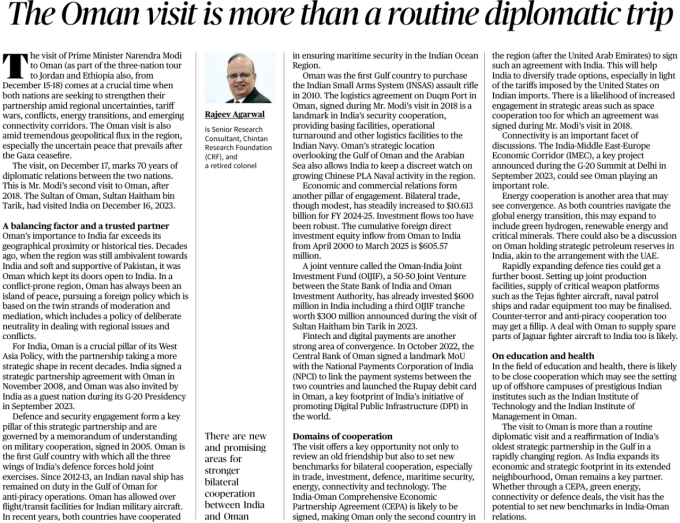
Context
- The article analyses Prime Minister Narendra Modi’s visit to Oman in December.
- It highlights how the trip goes beyond symbolism to address evolving strategic, economic, security and connectivity priorities amid regional instability and global power shifts.
Detailed Analysis Oman as a Trusted and Balancing Partner - Oman has historically played a moderating and neutral role in West Asia.
- It maintains diplomatic channels with all regional actors.
- Unlike other Gulf states, Oman pursued quiet diplomacy and mediation.
- It kept its doors open to India even during periods of Pakistan’s regional influence.
Strategic Importance for India’s West Asia Policy - Oman is a critical pillar of India’s West Asia engagement.
- It complements India’s ties with the UAE and Saudi Arabia.
- The relationship evolved from goodwill to a structured strategic partnership.
- Formalised in 2008 and strengthened during India’s G-20 outreach.
Defence and Maritime Security Cooperation - Defence cooperation forms the backbone of the partnership.
- Oman is the first Gulf country with which India conducts tri-services exercises.
- Indian naval ships have maintained a presence in the Gulf of Oman since 2012 for anti-piracy operations.
- The Duqm Port logistics agreement (2018) provides:
- This enhances the Indian Navy’s reach and surveillance, especially amid rising Chinese PLA Navy activity.
Economic and Investment Engagement - Bilateral trade, though modest, has shown steady growth.
- Trade crossed $10.6 billion in 2024–25.
- Oman has emerged as a reliable investment partner.
- Cumulative FDI into India has exceeded $600 million since 2000.
- The Oman–India Joint Investment Fund (OIJIF) reflects:
- Long-term economic confidence
- Institutionalised cooperation
Fintech, Digital Public Infrastructure and Payments - Fintech cooperation has expanded rapidly.
- The linkage between:
- Enabled the launch of RuPay cards in Oman.
- This extended India’s Digital Public Infrastructure (DPI) footprint globally.
Connectivity and Trade Architecture - Connectivity is a central theme of the visit.
- Oman could play a strategic role in the:
- India–Middle East–Europe Economic Corridor (IMEC)
- Announced at the G-20 Summit 2023
- A proposed India–Oman CEPA would:
- Diversify India’s trade routes
- Reduce vulnerability to global tariff uncertainties
- Support supply chain realignments
Energy and Green Transition Cooperation - Energy cooperation remains vital to the partnership.
- Scope is expanding into:
- Oman’s:
- Strategic petroleum reserves
- Energy transition ambitions
- Align with India’s long-term energy security goals.
Emerging Defence Industrial Collaboration - Defence ties are moving beyond exercises.
- Focus is shifting towards:
- This strengthens India’s defence exports.
Education, Health and People-to-People Ties - Soft power dimensions remain strong.
- The visit may facilitate:
- Offshore campuses of IITs and IIMs in Oman
- This reinforces long-term human capital and people-to-people links.
Suggestions Highlighted by the Author - Institutionalise maritime and defence logistics cooperation in the Indian Ocean Region.
- Fast-track CEPA negotiations to anchor economic ties.
- Expand collaboration in:
- Leverage Oman’s neutrality for:
UPSC Mains Question Discuss the strategic significance of India–Oman relations in the context of India’s West Asia policy and the evolving security dynamics of the Indian Ocean Region.
A broad-based development model
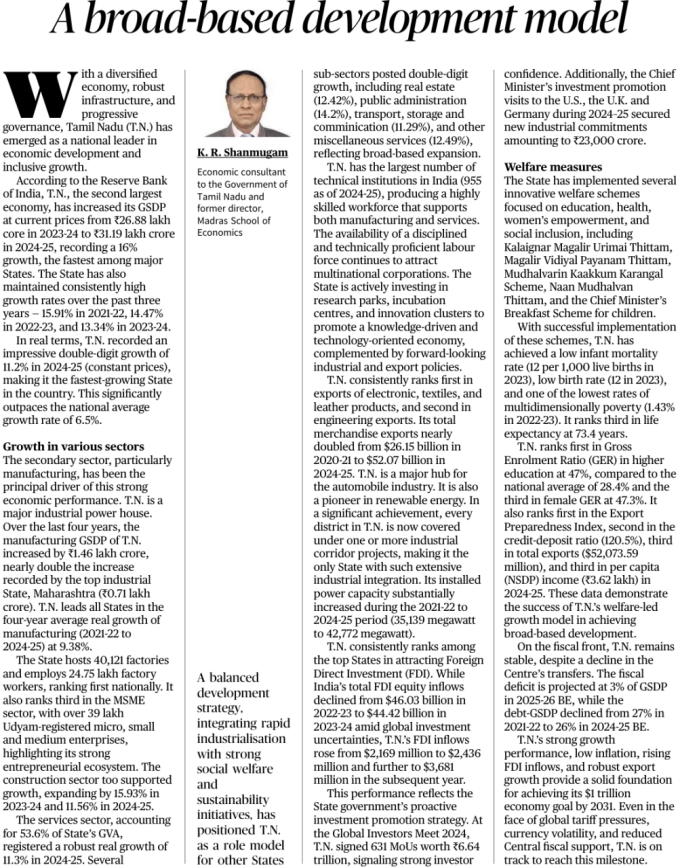
Context
The author discusses how Tamil Nadu has emerged as a national leader in economic growth by following a diversified, inclusive and fiscally prudent development strategy. The article evaluates the State’s performance across growth, manufacturing, welfare, exports, investments and fiscal stability.
Detailed Analysis
1. Strong and Sustained Economic Growth
- Tamil Nadu has achieved high and consistent growth over the last three years, outperforming the national average.
- GSDP rose from ₹26.88 lakh crore (2023–24) to ₹31.19 lakh crore (2024–25), recording 16% growth.
- In real terms, the State recorded double-digit growth of 11.2% in 2024–25, making it the fastest-growing State.
2. Manufacturing as the Growth Engine - Manufacturing is the principal driver of Tamil Nadu’s economy.
- Manufacturing GSDP increased by ₹1.46 lakh crore in four years, nearly double that of Maharashtra.
- The State leads India with an average manufacturing growth of 9.38%.
- Tamil Nadu hosts over 40,000 factories and employs nearly 25 lakh factory workers, ranking first nationally.
3. Robust Services and Infrastructure Expansion - The services sector contributes 53.6% of the State’s GVA and grew by 11.3% in real terms.
- Sub-sectors like real estate, public administration, transport and communications showed double-digit growth.
- Construction activity expanded strongly, reflecting sustained public and private infrastructure investment.
4. Skilled Workforce and Technology-Led Development - Tamil Nadu benefits from a strong technical education ecosystem led by institutions such as IIT Madras.
- Availability of skilled and disciplined labour attracts multinational corporations.
- Investments in research parks, incubation centres and innovation clusters support a knowledge-driven economy.
5. Exports, Investment and Global Integration - Merchandise exports doubled from $26.15 billion (2020–21) to over $52 billion (2024–25).
- Tamil Nadu ranks among the top States in FDI inflows, with steady year-on-year growth.
- The Global Investors Meet 2024 secured MoUs worth ₹6.64 trillion, indicating strong investor confidence.
- Targeted international outreach helped secure industrial commitments worth ₹23,000 crore.
6. Renewable Energy and Industrial Corridors - The State is a pioneer in renewable energy and a major automobile manufacturing hub.
- Tamil Nadu is the only State with every district covered under one or more industrial corridor projects.
- Installed power capacity expanded significantly, ensuring industrial and energy security.
7. Welfare-Oriented and Inclusive Governance - Welfare schemes focusing on women, children, education and nutrition underpin inclusive growth.
- Tamil Nadu has achieved low infant mortality, low birth rate and one of the lowest multidimensional poverty levels in India.
- The State ranks first in Gross Enrolment Ratio in higher education, reflecting human capital development.
8. Fiscal Discipline and Macroeconomic Stability - Despite reduced central transfers, Tamil Nadu maintained fiscal discipline.
- Fiscal deficit declined from 3% of GSDP to 2.6%, and the debt-GSDP ratio fell to 26%.
- Stable inflation, strong exports and steady investment flows support long-term fiscal sustainability.
Suggestions Highlighted by the Author - Continue integrating industrial growth with social welfare rather than pursuing growth in isolation.
- Strengthen innovation-led manufacturing and services to remain competitive globally.
- Maintain fiscal prudence while expanding social sector investments.
- Use Tamil Nadu’s model as a template for balanced federal development across States.
UPSC Mains Question
“Tamil Nadu’s development experience shows that inclusive growth and fiscal discipline need not be contradictory. Discuss in the context of India’s federal economic structure.”
SHANTI Bill to allow private sector to make, run nuclear power plants
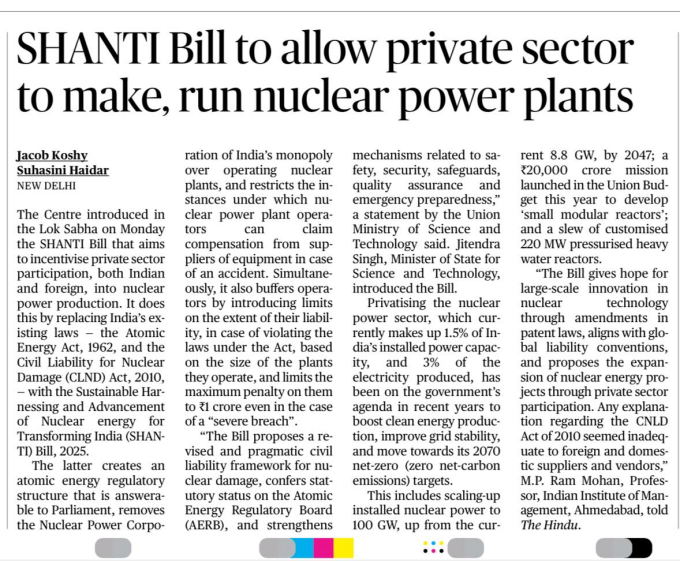
Context
The Union government has introduced the SHANTI Bill, 2025 in the Lok Sabha to allow private sector participation in nuclear power generation by overhauling India’s existing nuclear energy and liability framework.
Key Points What is the SHANTI Bill, 2025
- SHANTI stands for Sustainable Harnessing and Advancement of Nuclear energy for Transforming India.
- It seeks to incentivise Indian and foreign private sector participation in nuclear power production.
Replacement of Existing Laws - Replaces the Atomic Energy Act, 1962.
- Replaces the Civil Liability for Nuclear Damage (CLND) Act, 2010.
- Ends India’s monopoly over operating nuclear power plants.
Private Sector Participation - Allows private entities to make, own and operate nuclear power plants.
- Enables private operators to claim compensation from suppliers in case of accidents under defined conditions.
Revised Nuclear Liability Framework - Introduces limits on operator liability, linked to plant size.
- Caps maximum penalty at ₹1 crore, even in cases of severe breach.
- Aligns India’s framework with global nuclear liability conventions.
Regulatory and Safety Strengthening - Confers statutory status on the Atomic Energy Regulatory Board (AERB).
- Makes the regulator answerable to Parliament.
- Strengthens mechanisms related to safety, security, safeguards, quality assurance and emergency preparedness.
Boost to Clean Energy and Net-Zero Goals - Nuclear power currently accounts for 1.5% of installed capacity and 3% of electricity generation in India.
- The Bill supports India’s 2070 net-zero commitment by scaling clean baseload power.
- Target to raise nuclear capacity to 100 GW by 2047, from the current ~8.8 GW.
Technology and Innovation Push - Supports development of Small Modular Reactors (SMRs).
- Backed by a ₹20,000 crore mission announced in the Union Budget.
- Includes customised 220 MW Pressurised Heavy Water Reactors (PHWRs).
Investment and Patent Reforms - Encourages large-scale innovation through amendments in patent laws.
- Aims to attract foreign vendors and domestic manufacturers who earlier found CLND provisions restrictive.
With new Bill, demand-led job scheme set to turn supply-driven
Context
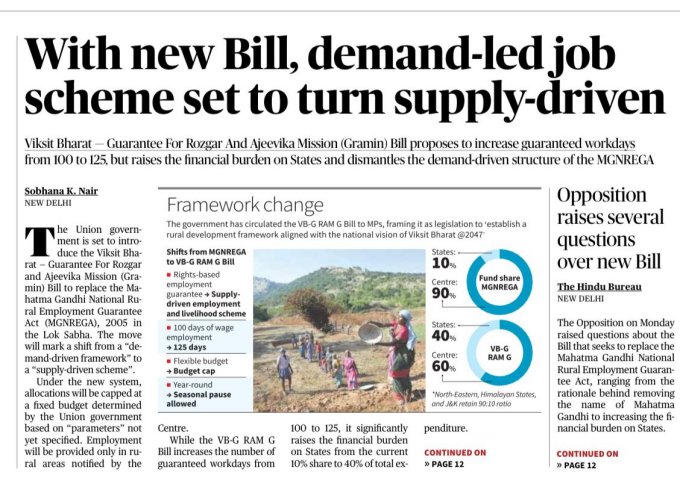
The Union government has circulated the Viksit Bharat – Guarantee For Rozgar and Ajeevika Mission (Gramin) Bill to replace MGNREGA, proposing higher guaranteed workdays but fundamentally altering the scheme’s demand-driven nature.
Key Points Proposed New Framework
- Replaces MGNREGA, 2005 with VB-G RAM (Gramin) Bill.
- Recasts rural employment as a supply-driven employment and livelihood scheme.
Shift from Demand-Driven to Supply-Driven - MGNREGA: Rights-based, demand-led employment guarantee.
- VB-G RAM G: Employment provision subject to budget ceilings and parameters fixed by the Centre.
Change in Guaranteed Workdays - Guaranteed employment proposed to increase from 100 days to 125 days per household.
- Increase accompanied by tighter fiscal controls.
Budgetary Architecture - Introduces a fixed budget cap instead of open-ended demand-based funding.
- Allows year-round planning and seasonal pauses in employment.
Centre–State Cost Sharing - MGNREGA: Centre 90%, States 10% (NE, Himalayan States and J&K retain 90:10).
- VB-G RAM G: Centre 60%, States 40%, significantly raising States’ financial burden.
Geographical and Administrative Changes - Employment to be provided only in Centre-notified rural areas.
- Reduces States’ discretion in identifying work demand.
Concerns Raised - Dismantles the statutory right to work embedded in MGNREGA.
- Higher fiscal pressure on States may reduce actual employment generation.
- Risks excluding workers during lean seasons due to capped budgets.
About Mahatma Gandhi National Rural Employment Guarantee Act (MGNREGA): - Enacted in 2005 to provide a legal right to 100 days of unskilled wage employment.
- Operates on a demand-driven principle, with unemployment allowance if work is not provided.
· Considered a cornerstone of rural livelihood security.
Q. Consider the following statements regarding the Viksit Bharat – Guarantee For Rozgar and Ajeevika Mission (Gramin) Bill: 1. The Bill proposes to replace the demand-driven framework of MGNREGA with a supply-driven employment scheme. 2. The Bill reduces the guaranteed number of employment days for rural households compared to MGNREGA. Which of the statements given above is/are correct? a) 1 only
b) 2 only
c) Both 1 and 2
d) Neither 1 nor 2
Answer: a) 1 only
Does India need to upgrade its biosecurity measures?
Context
The article discusses whether India’s existing biosecurity framework is adequate in the face of rapid advances in biotechnology, rising non-state actor threats, and increased risks of biological misuse and cross-border bio-risks.
Key Points What is Biosecurity
- Biosecurity refers to policies, practices and systems to prevent the intentional misuse of biological agents, toxins or technologies.
- It includes lab safety, pathogen handling, disease surveillance, and outbreak containment.
Biosecurity vs Biosafety - Biosecurity focuses on preventing deliberate misuse of biological materials.
- Biosafety aims to prevent accidental leakage of pathogens from labs or facilities.
Why Biosecurity is Becoming Critical - Advances in synthetic biology, gene editing and biotechnology lower entry barriers for misuse.
- Increased human control over biology raises risks of malicious experimentation.
India’s Vulnerability - India’s geography and ecology make it vulnerable to cross-border biological threats.
- Large population and dependence on agriculture and livestock amplify potential damage.
- Reports of ricin-based toxins linked to terror activities highlight non-state actor risks.
Biological Weapons Convention (BWC) - Came into force in 1975.
- First international treaty banning development, production and stockpiling of biological weapons.
- Mandates destruction of existing stockpiles by signatories.
India’s Existing Biosecurity Framework - Environment (Protection) Act, 1986 regulates hazardous microorganisms and GMOs.
- WMD Act, 2005 criminalises biological weapons and their delivery systems.
- Biosafety Rules, 1989 and 2017 guidelines govern recombinant DNA research.
- NDMA issues guidelines for biological disaster management.
Institutional Mechanisms - Department of Biotechnology oversees lab safety and research governance.
- National Centre for Disease Control (NCDC) handles outbreak surveillance and response.
- Department of Animal Husbandry monitors livestock biosecurity.
- Plant Quarantine Organisation of India regulates agricultural imports and exports.
Gaps in the Current System - Lack of a unified national biosecurity framework.
- Multiple agencies operate in silos, affecting coordination.
- India’s Global Health Security Index rank is low, indicating weak preparedness.
Risks Ahead - Inadequate biosecurity could endanger public health, agriculture and economy.
- Growing biotech diffusion increases risks from terrorism, accidents and pandemics.
Way Forward - Develop a national biosecurity framework integrating all agencies.
- Strengthen lab oversight, surveillance and public health infrastructure.
- Invest in capacity building, coordination and early-warning systems.
Source: The Hindu
UPSC Prelims Practice Question Consider the following statements regarding biosecurity in India:
1. Biosecurity primarily focuses on preventing the intentional misuse of biological agents and technologies.
2. The Biological Weapons Convention allows the development of biological weapons for defensive purposes. Which of the statements given above is/are correct? a) 1 only
b) 2 only
c) Both 1 and 2
d) Neither 1 nor 2
Answer: a) 1 only
Central govt. to send new higher education Bill to JPC
Context
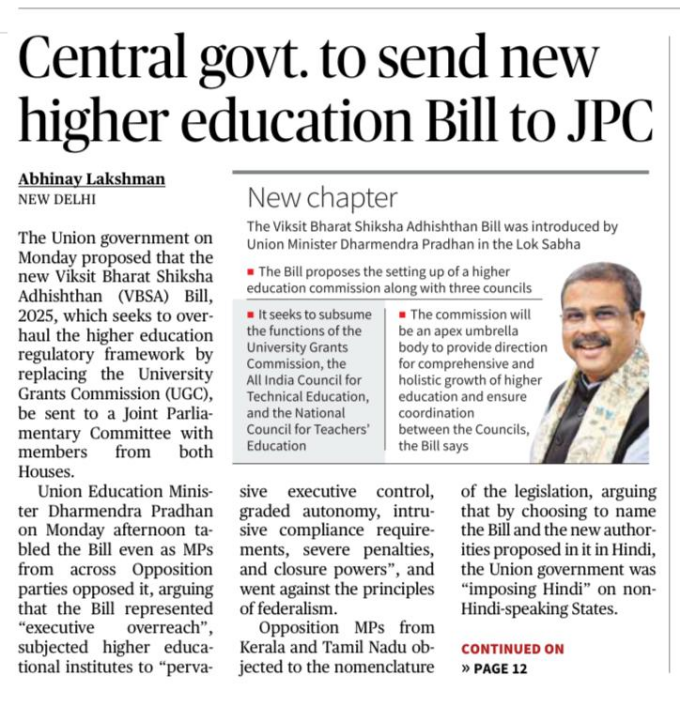
The Union government has proposed to refer the Viksit Bharat Shiksha Adhisthan (VBSA) Bill, 2025, which seeks to overhaul the higher education regulatory framework, to a Joint Parliamentary Committee (JPC) amid opposition concerns.
Key Points About the Viksit Bharat Shiksha Adhisthan (VBSA) Bill, 2025
- Introduced in the Lok Sabha by the Union Education Minister.
- Aims to replace the existing higher education regulatory structure.
Proposed Regulatory Architecture - Establishes a Higher Education Commission as an apex body.
- The Commission will function along with three councils.
- Intended to ensure holistic growth, coordination and uniform direction in higher education.
Replacement of Existing Bodies - Seeks to subsume the functions of:
- University Grants Commission (UGC)
- All India Council for Technical Education (AICTE)
- National Council for Teacher Education (NCTE)
Powers and Functions - The new commission will act as an umbrella regulator.
- It will provide policy direction and ensure coordination among councils.
Opposition Concerns - Allegations of executive overreach and excessive centralisation.
- Fear of erosion of institutional autonomy through intrusive compliance and penalties.
- States like Tamil Nadu and Kerala raised objections citing violation of federal principles.
- Objections also raised over nomenclature in Hindi, viewed as linguistic imposition.
Reference to Joint Parliamentary Committee - Government agreed to send the Bill to a JPC comprising members from both Houses.
- Intended to allow wider consultation and scrutiny of provisions.
Source: The Hindu
UPSC Prelims Practice Question Consider the following statements regarding the Viksit Bharat Shiksha Adhisthan (VBSA) Bill, 2025: 1. The Bill proposes the establishment of a Higher Education Commission to subsume the functions of UGC, AICTE and NCTE.
2. The Bill has been referred to a Joint Parliamentary Committee due to concerns related to federalism and institutional autonomy.
Which of the statements given above is/are correct? a) 1 only
b) 2 only
c) Both 1 and 2
d) Neither 1 nor 2
Answer: c) Both 1 and 2
Trade deficit falls to $6.6 bn. in Nov. Due to merchandise export growth
Context
India’s merchandise trade deficit declined sharply in November 2025 due to strong growth in exports and a moderation in imports, according to data released by the Ministry of Commerce and Industry.
Key Points Trade Deficit Trend
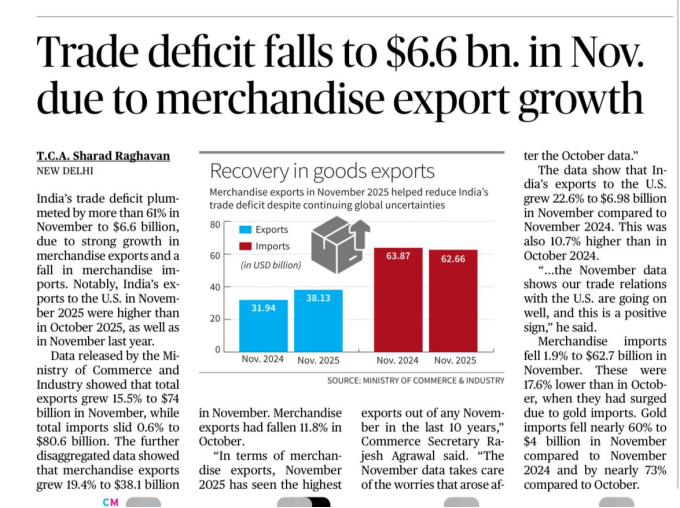
- India’s trade deficit fell by over 61% to $6.6 billion in November 2025.
- The decline reflects a combination of rising exports and lower imports.
Merchandise Exports - Total exports grew 15.5% to $74 billion in November.
- Merchandise exports rose 19.4% to $38.1 billion, the highest November level in the last 10 years.
- Exports had contracted 11.8% in October, indicating a strong recovery.
Merchandise Imports - Total imports declined 0.6% to $80.6 billion.
- Merchandise imports fell 1.9% to $62.7 billion.
- Gold imports declined sharply by nearly 60% year-on-year and about 73% month-on-month.
India–US Trade - Exports to the United States increased 22.6% to $6.98 billion in November 2025.
- US-bound exports were also 10.7% higher than October 2025, signalling stronger bilateral trade momentum.
Overall Assessment - Strong export performance helped offset global uncertainties.
- Import compression, especially of gold, played a key role in reducing the deficit.
Thirupparankundram row: T.N. tells High Court pillar belongs to Jains, not Hindus
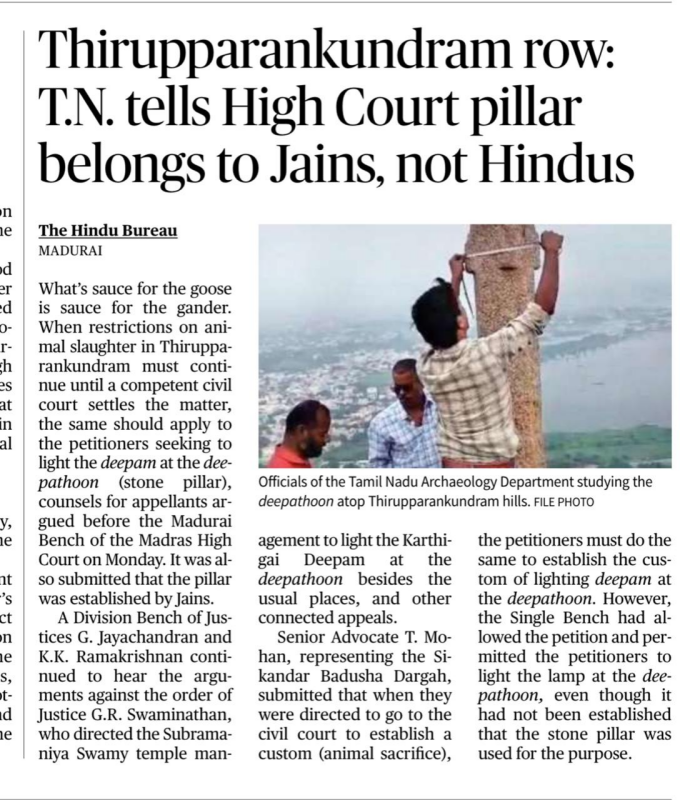
Context:
The Tamil Nadu government informed the Madurai Bench of the Madras High Court that the stone pillar (deepathoon) at Thirupparankundram hills was originally established by Jains, amid a dispute over religious practices at the site.
Key Points Background of the Dispute
- The issue arose over lighting of Karthigai Deepam at the deepathoon on Thirupparankundram hills.
- Petitions were filed seeking permission to light lamps, while related disputes on animal sacrifice were pending before civil courts.
State Government’s Stand - The Tamil Nadu government submitted that the pillar was established by Jains, not Hindus.
- It argued that religious practices at the site must await determination by a competent civil court.
Judicial Proceedings - A Division Bench of the Madras High Court is hearing appeals against a Single Bench order.
- The Single Bench had permitted lighting of the lamp despite the custom not being conclusively established.
Principle of Uniformity - Counsel argued that if restrictions on animal slaughter continue until civil adjudication, the same standard must apply to lighting of lamps.
- Emphasis was placed on avoiding selective application of judicial relief.
Heritage and Religious Significance - The dispute highlights the layered religious history of Thirupparankundram hills, associated with Jain and Hindu traditions.
· Archaeological examination by the State Archaeology Department is part of the evidentiary process.
Dandami Madia Tribe
Syllabus: GS Paper I – Indian Society; Indian Art and Culture; Tribal Communities
Context:
Members of the
Dandami Madia tribe recently performed the traditional
Bison Horn Maria dance during a village festival at
Judiya Para in Jagdalpur, drawing attention to the cultural heritage of tribal communities in Chhattisgarh.
Key Points About Dandami Madia Tribe - Also known as Dandami Maria, Bison Horn Maria, and Khalpati Maria.
- A tribal community of Chhattisgarh, identifying themselves as part of the larger Gond tradition.
- The name is derived from their distinctive head-gear resembling wild bison horns, worn mainly during ceremonies.
Language - Primary language is Dandami Maria.
- Some members also speak Gondi dialects, an oral language of Dravidian origin.
Society and Customs - Economy: Based on agriculture, supplemented by hunting and fishing.
- Beliefs: A blend of Hinduism and animistic practices.
- Ghotul system: Youth dormitory for unmarried boys and girls; a key social institution.
- Social practices: Divorce and widow remarriage are permitted.
Cultural Expression - Bison Horn Maria dance is a major traditional dance form.
- Performed by both men and women during village festivals and ceremonies.
Source: The Hindu
UPSC Prelims Practice Question Consider the following statements regarding the Dandami Madia tribe: 1. They are associated with the Gond tradition and are primarily found in Chhattisgarh. 2. The Bison Horn Maria dance is performed only by men during religious ceremonies. Which of the statements given above is/are correct? A. 1 only
B. 2 only
C. Both 1 and 2
D. Neither 1 nor 2
Answer: A Explanation:
- Statement 1 is correct: The Dandami Madia identify with the Gond tradition and live in Chhattisgarh.
- Statement 2 is incorrect: The Bison Horn Maria dance is performed by both men and women, mainly during village festivals.
Right to Disconnect Bill, 2025: Re-defining Work–Life Boundaries
Syllabus: GS Paper II — Governance; Social Justice; Labour Reforms Context:
A Private Member’s Bill titled the Right to Disconnect Bill, 2025, introduced by NCP MP Supriya Sule, has revived national debate on work–life balance amid rising digital work pressures and extended working hours.
Key Points What the Bill Proposes
- Seeks to provide a statutory right to employees to disengage from work-related communication beyond agreed working hours.
- Addresses challenges arising from remote work, digital connectivity, and blurred personal–professional boundaries.
Legal Right to Disconnect - Section 7 guarantees employees the right to ignore work calls, emails, or messages after work hours.
- Ensures no disciplinary action for exercising this right.
Definition of Out-of-Work Hours - Clearly defines time beyond contractual work schedules.
- Prevents ambiguity and limits employer overreach.
Institutional Mechanism - Proposes an Employees’ Welfare Authority to oversee implementation.
- Focuses on protecting employee dignity and promoting work–life balance.
Employer–Employee Negotiation Charter - Mandates a formal charter defining after-hours communication norms.
- Allows mutually agreed exceptions in extraordinary situations.
Overtime Compensation - Section 11 provides overtime wages at normal rates if employees voluntarily respond after hours.
Digital Well-being Measures - Requires awareness programmes, counselling services, and Digital Detox Centres.
- Special emphasis on employees engaged in remote and hybrid work.
Penalties for Non-Compliance - Organisations violating provisions may face a financial penalty of 1% of total employee remuneration, acting as a deterrent.
Source: The Economic Times
UPSC Prelims Practice Question Consider the following statements regarding the Right to Disconnect Bill, 2025:
1. The Bill proposes a statutory right for employees to ignore work-related communication beyond agreed working hours. 2. It mandates overtime compensation at enhanced double wage rates for any after-hours communication. Which of the statements given above is/are correct?
A. 1 only
B. 2 only
C. Both 1 and 2
D. Neither 1 nor 2
Answer: A Explanation:
- Statement 1 is correct: The Bill grants a legal right to disconnect after work hours.
- Statement 2 is incorrect: The Bill provides overtime pay at normal wage rates, not double wages.
Operation Thunder 2025: Global Crackdown on Environmental Crime
Syllabus: GS Paper III — Environment and Ecology; Biodiversity Conservation; Internal Security (Transnational Crime) Context
Interpol announced the seizure of over 30,000 live animals, protected plants, and illegally logged timber during Operation Thunder 2025, highlighting the expanding scale and profitability of global environmental crime networks.
Key Points About Operation Thunder 2025
- Conducted between 15 September and 15 October 2025.
- Coordinated by Interpol in collaboration with the World Customs Organization (WCO).
- Involved enforcement agencies from 134 countries, making it one of the largest global crackdowns.
Scale of Enforcement Action - A total of 4,640 seizures recorded within one month.
- Demonstrates high levels of international coordination against wildlife and forestry crimes.
Wildlife and Bushmeat Seizures - Confiscated items included elephant ivory, rhino horns, pangolin scales, and big cat derivatives.
- A record 5.8 tonnes of bushmeat seized, indicating increased trafficking from Africa to Europe.
- Examples include primate meat in Belgium, giraffe meat in Kenya, and zebra and antelope products in Tanzania.
Marine Wildlife Exploitation - Marine seizures totalled 245 tonnes and over 91,000 pieces, including thousands of shark fins.
- Reflects large-scale illegal exploitation of marine biodiversity.
Smaller Species and Plant Trade - Nearly 10,500 arthropods (butterflies, spiders, insects) seized, many protected under CITES.
- Large numbers of turtles, tortoises, birds, reptiles, and primates intercepted.
- Illegal plant trade surged with over 10 tonnes of live plants and derivatives seized, driven by horticulture and collector demand.
- Environmental crime is estimated by Interpol to be worth up to $20 billion annually.
- CITES regulates international trade in endangered species of wild fauna and flora.
Source: The Hindu
UPSC Prelims Practice Question Consider the following statements regarding Operation Thunder 2025:
1. Operation Thunder 2025 was coordinated by Interpol in partnership with the World Customs Organization and involved enforcement agencies from more than 130 countries.
2. The Convention on International Trade in Endangered Species of Wild Fauna and Flora (CITES) governs domestic trade in endangered species within national boundaries. Which of the statements given above is/are correct? A. 1 only
B. 2 only
C. Both 1 and 2
D. Neither 1 nor 2
Answer: A Explanation:
- Statement 1 is correct: The operation involved 134 countries and was coordinated by Interpol with the WCO.
- Statement 2 is incorrect: CITES regulates international trade, not domestic trade within countries.
Red-Shanked Douc Monkey
Syllabus: GS Paper III – Environment and Ecology; Biodiversity and Conservation Context:
Customs officials at Kempegowda International Airport arrested a passenger for smuggling two red-shanked douc monkeys, highlighting concerns over illegal wildlife trade and endangered species protection.
Key Points About Red-Shanked Douc Monkey - Scientific name: Pygathrix nemaeus; an Old World monkey known as the “Queen of primates.”
- Distribution: Native to Southeast Asia, mainly Vietnam, southern Laos, and Cambodia.
Characteristics - Appearance: Among the most colourful primates; often called the “costumed ape.”
- Behaviour: Arboreal, herbivorous, and diurnal; lives, feeds, and sleeps in trees.
- Communication: Uses facial expressions for social interaction.
Conservation Status and Threats - IUCN status: Critically Endangered.
- Threats: Hunting for subsistence and traditional medicine; illegal international pet trade.
Source: The Hindu
UPSC Prelims Practice Question Consider the following statements regarding the Red-shanked douc monkey: 1. It is an Old World monkey found mainly in Vietnam, southern Laos, and Cambodia.
2. It is listed as Endangered on the IUCN Red List and is primarily carnivorous.
Which of the statements given above is/are correct? A. 1 only
B. 2 only
C. Both 1 and 2
D. Neither 1 nor 2
Answer: A Explanation:
- Statement 1 is correct: The species is an Old World monkey native to Southeast Asia.
- Statement 2 is incorrect: It is Critically Endangered, not Endangered, and is herbivorous, not carnivorous.
Umngot Traditional Boat Race and Tri-Hills Ensemble Festival
Syllabus: GS Paper I — Indian Art and Culture; Society; Regional Cultural Heritage Context
The
Umngot Traditional Boat Race and Tri-Hills Ensemble Festival concluded on
December 13 at
Darrang in West Jaintia Hills district, Meghalaya, celebrating indigenous river traditions through sports, culture, and conservation awareness.
Key Points About the Festival - A two-day cultural festival held along the Umngot River, organised by the Meghalaya Department of Arts and Culture.
- Focuses on the revival of indigenous river-based traditions, heritage sports, and cultural identity.
Indigenous Boat Race and River Traditions - Began with the ceremonial arrival of traditional boats representing local communities.
- Showcased ancestral knowledge of river navigation and boat craftsmanship.
- Participants were received by the Darrang Elaka, reflecting customary and community practices.
Cultural Performances and Heritage Expression - Featured folk dances, music, and storytelling traditions of the Jaintia Hills and neighbouring regions.
- Cultural programmes were held on the banks of the Umngot River, linking ecology with heritage.
International and Diplomatic Presence - Attended by dignitaries including Meghan O’Regan, Head of the Welsh Government in India at the British Deputy High Commission.
- Highlights growing international cultural engagement with indigenous traditions.
Cultural and Conservation Significance - Blended heritage sports with conservation messaging, emphasising sustainable river use.
- Reinforced the role of festivals in preserving indigenous knowledge systems and regional identity.
Source: The Hindu
UPSC Prelims Practice Question Consider the following statements regarding the
Umngot Traditional Boat Race and Tri-Hills Ensemble Festival: 1. The festival is held in the West Jaintia Hills district of Meghalaya along the Umngot River.
2. It is organised by the Union Ministry of Culture as part of a national river conservation programme.
Which of the statements given above is/are correct? A. 1 only
B. 2 only
C. Both 1 and 2
D. Neither 1 nor 2
Answer: A Explanation:
- Statement 1 is correct: The festival was held at Darrang in West Jaintia Hills along the Umngot River.
- Statement 2 is incorrect: It was organised by the Meghalaya State Department of Arts and Culture, not the Union Ministry of Culture.

 Launch your Graphy