There are no items in your cart
Add More
Add More
| Item Details | Price | ||
|---|---|---|---|




| Index | ||
| S.No | Topic | Page No |
| Daily Hindu Analysis (YouTube) | ||
| 1. | How will Australia’s social media ban work? | |
| 2. | Courts must protect, not regulate free speech | |
| 3. | Are methane emissions in India being missed? | |
4. | ‘Ponduru Khadi’ from A.P. gets Geographical Indication tag | |
| 5. | How mangroves’ cells help plants survive in saltwater | |
6. | Firm threatens to pull out of power project in J&K | |
7. | Toughest restrictions invoked as air quality drops to season’s low | |
| 8. | Indian Navy to commission second MH-60R helicopter squadron in Goa | |
| 9. | Kerala Governor says there is judicial overreach in Vice-Chancellor selection | |
|
| ||
| Daily Current Affairs (App) | ||
| 10. | International Fund for Agricultural Development | |
11. | India ranks third globally in AI competitiveness: Stanford study | |
| 12. | Ponduru khadi gets GI tag | |
| 13. | Chenchu tribe | |
14. | India among world’s most overworked nations, says ILO data | |
Context
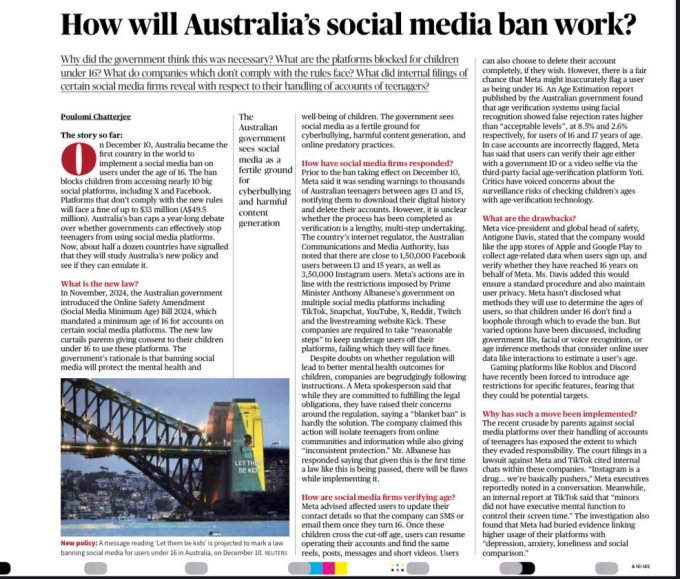
The article examines Australia’s decision to impose a social media ban on children under 16, explaining the rationale behind the move, how the law will operate, the compliance burden on platforms, and concerns arising from age-verification and enforcement mechanisms.
Detailed Analysis
Rationale behind the ban
What the new law provides
Platforms covered under the ban
How social media firms are responding
Age-verification mechanisms
Drawbacks and concerns
Legal and regulatory accountability
Suggestions:
UPSC Mains Question
“Australia’s social media ban for children under 16 highlights the tension between child protection and digital rights.”
Critically examine the implications of such regulatory approaches for democracies in the digital age.
Context
The article discusses recent Supreme Court observations on online content regulation and cautions against judicial overreach that may convert courts from protectors of free speech into regulators, thereby undermining constitutional freedoms.
Detailed Analysis
Free Speech as a Democratic Pillar
• Freedom of speech is central to democracy, and any erosion directly affects democratic functioning.
• The article argues that threats to free speech can also emanate from the judiciary, not only the executive or legislature.
Existing Legal Framework in India
• India already has extensive statutory regulation through the Information Technology Act and the Bharatiya Nyaya Sanhita (BNS).
• Provisions such as Section 67 and 66E of the IT Act and obscenity-related sections under BNS penalise unlawful speech.
• The IT (Intermediary Guidelines and Digital Media Ethics Code) Rules, 2021 create oversight mechanisms and impose prior restraints on publishers.
Judicial Expansion of Regulation: Concerns
• The Supreme Court, in recent cases, suggested that self-regulation of online content is insufficient and hinted at neutral autonomous bodies.
• The authors argue that content regulation falls within the legislative domain, not judicial policymaking.
• Courts lack technical expertise and institutional capacity to design and manage online media regulation.
Separation of Powers and Institutional Limits
• Referring to Common Cause v. Union of India (2008), the article stresses that courts must respect separation of powers.
• Judicial intervention in regulatory design risks violating constitutional boundaries.
Regulation vs Unlawful Restraint
• The article distinguishes between legitimate regulation and unconstitutional restraint.
• In Sahara India Real Estate Corp. v. SEBI (2012), the Court warned against blanket prohibitions and upheld the principle that prior censorship must be avoided.
• In Kaushal Kishor v. State of UP (2023), the Supreme Court held that restrictions beyond Article 19(2) are impermissible.
Constitutional Limits on Restrictions
• Grounds under Article 19(2) are exhaustive.
• Additional restrictions cannot be justified under the guise of balancing other fundamental rights.
• Courts themselves have historically restrained from imposing broad prohibitory measures, as seen in Adarsh Co-operative Housing Society Ltd. v. Union of India (2018).
Comparative International Experience
• Democracies like the EU, Germany, the UK, and Australia have enacted strict digital laws.
• The article warns that even democratic regulations risk sliding into surveillance and pre-censorship.
• Research cited shows courts worldwide sometimes end up facilitating executive overreach in speech regulation.
Suggestions by the Authors
• Courts should confine themselves to constitutional adjudication, not regulatory design.
• Any expansion of speech regulation must come through legislative debate, not judicial suggestion.
• Judicial scrutiny should focus on reasonableness and proportionality, not content control.
• Free speech cases require heightened caution when restrictions originate from the judiciary itself.
UPSC Mains Question
Critically examine the role of the judiciary in regulating freedom of speech in India. How does the principle of separation of powers limit judicial intervention in content regulation?
Context
The article examines evidence from satellite observations suggesting that India’s methane emissions, especially from landfills and waste sites, may be significantly underreported in official inventories, raising concerns about climate mitigation accuracy.
Detailed Analysis
Why Methane Matters
• Methane is about 84 times more potent than carbon dioxide over a 20-year period.
• Although shorter-lived than CO₂, it contributes heavily to near-term global warming.
• In India, methane emissions are largely associated with waste, agriculture, and fossil fuel use.
India’s Methane Profile
• About 15% of India’s methane emissions originate from the waste sector.
• Waste-related methane arises mainly from landfills, where organic matter decomposes anaerobically.
• India relies largely on model-based estimates, not continuous direct measurements.
Limitations of Current Estimation Methods
• Ground-based monitoring is sparse, expensive, and logistically complex.
• Emission inventories depend on assumptions, default factors, and infrequent updates.
• Such methods struggle to capture localized hotspots and temporal variation.
Role of Satellite Observations
• Advances in satellite technology now allow detection of methane plumes at high resolution.
• Satellites can identify emission hotspots within a few square metres, enabling targeted action.
• Studies show emissions at some Indian landfills are up to 10 times higher than official estimates.
Evidence from Indian Cities
• Landfills like Ghazipur and Bhalswa in Delhi show major discrepancies between reported and observed emissions.
• Satellite data reveal that methane releases are often concentrated in small, intense plumes, missed by models.
• Similar underestimations are observed in Ahmedabad, Mumbai, and Chennai.
Why the Gap Exists
• Official inventories cannot resolve emissions at the site-specific scale.
• Emission factors fail to reflect local waste composition, climate, and management practices.
• Lack of transparency and fragmented institutional responsibility worsen the problem.
Policy and Governance Challenges
• Pollution Control Boards primarily focus on air pollutants, not methane.
• Existing waste portals track solid waste but do not integrate methane emissions data.
• Absence of a coordinated national methane monitoring framework limits corrective action.
Opportunities from Data Integration
• Satellite data can strengthen waste management policy by identifying priority sites.
• Integrating methane monitoring into municipal solid waste governance can improve mitigation outcomes.
• India’s methane strategy can align climate goals with public health and urban management.
Suggestions by the Author
• Make satellite data the backbone of waste and methane policy.
• Combine satellite detection with ground verification and municipal action.
• Expand national waste portals to include methane emissions tracking.
• Strengthen coordination among urban bodies, Pollution Control Boards, and climate agencies.
• Use transparent, standardized data-sharing mechanisms to guide mitigation.
UPSC Mains Question
Discuss the challenges in accurately estimating methane emissions in India. How can satellite-based monitoring improve India’s climate mitigation and waste management strategies?
Context
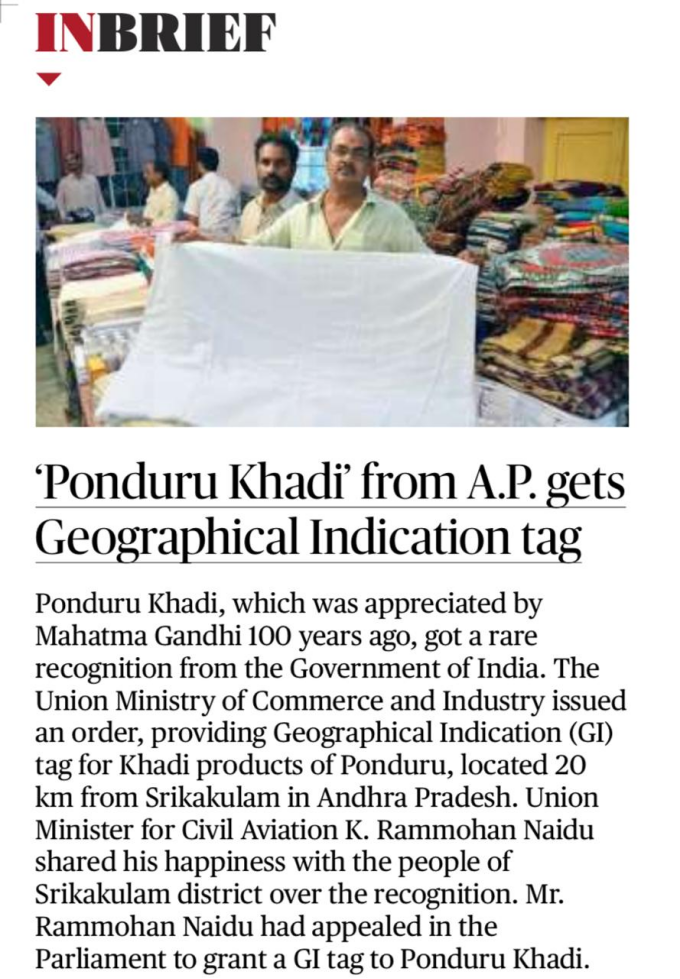
Ponduru Khadi from Andhra Pradesh has been granted the Geographical Indication (GI) tag by the Geographical Indications Registry under the Union Ministry of Commerce and Industry, recognising its unique traditional production and heritage value.
Key Points
About Ponduru Khadi
Unique Features
What is a GI Tag
Benefits of GI Tag
GI Act, 1999
Source:The Hindu
UPSC Prelims Question
Q. Consider the following statements regarding Ponduru Khadi:
1. It is a handspun and handwoven cotton fabric produced in Srikakulam district of Andhra Pradesh and is locally known as Patnulu.
2. The GI tag for Ponduru Khadi was granted under the Geographical Indications of Goods (Registration and Protection) Act, 1999.
Which of the statements given above is/are correct?
A. 1 only
B. 2 only
C. Both 1 and 2
D. Neither 1 nor 2
Answer: C
Explanation:
Context
A recent study reported explains how cell-level adaptations in mangroves enable them to survive extreme salinity, offering insights that could help develop salt-tolerant crops as sea levels rise.
Key Points
Why mangroves survive in saltwater
Cellular adaptations
Photosynthesis and leaf structure
Multiple salt-management mechanisms
Ecological and human relevance
About Mangroves
What are mangroves
Key characteristics
Global distribution
Mangroves in India
Source: The Hindu
UPSC Prelims Question
Q. Consider the following statements regarding mangroves:
1. Mangroves possess specialised cellular traits such as thicker cell walls that help them tolerate high salinity.
2. Mangroves are found across all climatic zones, including temperate regions, due to their salt tolerance.
Which of the statements given above is/are correct?
A. 1 only
B. 2 only
C. Both 1 and 2
D. Neither 1 nor 2
Answer: A
Explanation:
Statement 2 is incorrect: Mangroves are restricted to tropical and subtropical regions and cannot withstand freezing temperatures.
Context
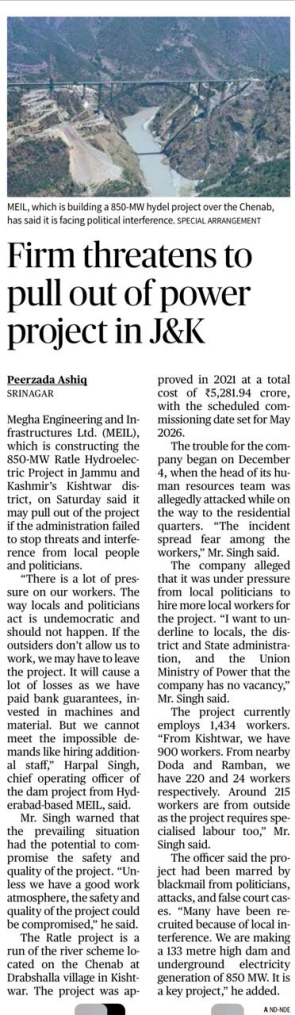
A private infrastructure firm has warned of pulling out of a major hydropower project in Jammu and Kashmir, citing alleged political interference and security concerns affecting project execution.
Key Points
About the project
Concerns raised by the company
Strategic importance
Employment and regional impact
Hydropower and the Indus system
Major Hydroelectric Projects on the Indus River System:
Key Indian projects
Key Pakistani projects
Source:The Hindu
UPSC Prelims Question
Q. Consider the following statements regarding the Ratle Hydroelectric Project:
1. It is located on the Chenab River in Jammu and Kashmir.
2. The Chenab River is part of the Indus River System.
Which of the statements given above is/are correct?
A. 1 only
B. 2 only
C. Both 1 and 2
D. Neither 1 nor 2
Answer: C
Context
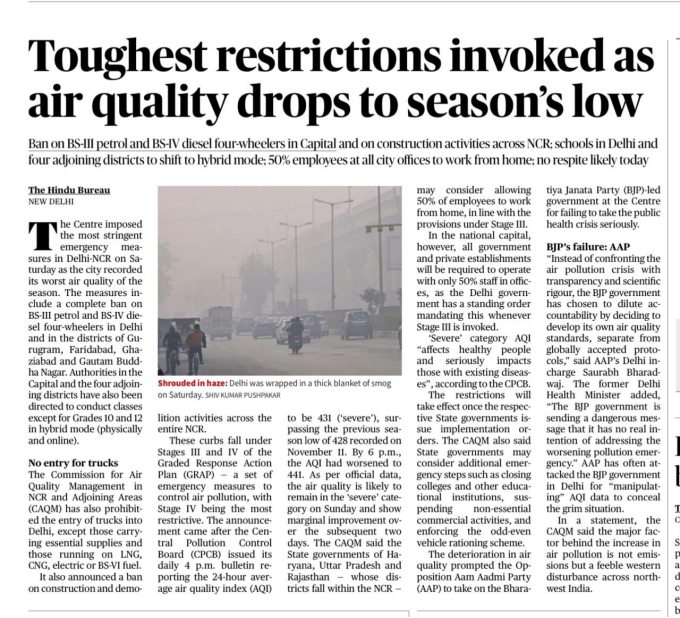
Delhi–NCR recorded its worst air quality of the season, with AQI entering the severe category, leading to the invocation of the strictest pollution-control measures under the Graded Response Action Plan (GRAP).
Key Points
Air Quality Situation
• AQI touched 431 (Severe category), exceeding the previous seasonal low.
• PM2.5 levels increased sharply during the day, worsening respiratory risks.
• CPCB stated that severe AQI impacts even healthy individuals and severely affects those with existing illnesses.
Emergency Restrictions Imposed
• Complete ban on BS-III petrol and BS-IV diesel four-wheelers in Delhi and NCR districts.
• Construction and demolition activities banned across the entire NCR.
• Entry of trucks restricted, except those carrying essential goods or running on LNG, CNG, electric or BS-VI fuel.
Work and Education Measures
• Schools shifted to hybrid mode, except Classes 10 and 12.
• 50% employees to work from home in government and private offices in Delhi.
• NCR States instructed to issue immediate enforcement orders.
GRAP Framework
• Restrictions fall under Stage III and Stage IV of GRAP, with Stage IV being the most stringent.
• CAQM may impose further steps, including closure of colleges, suspension of non-essential commercial activities, and odd-even vehicle rationing.
Political and Administrative Responses
• CAQM cited unfavourable meteorological conditions, including weak western disturbances, as a key factor.
• Opposition criticised the Centre for lack of long-term solutions and questioned transparency in AQI reporting.
About Commission for Air Quality Management (CAQM)
• CAQM is a statutory body responsible for coordinated air pollution management in Delhi-NCR.
• It oversees the implementation of GRAP based on AQI thresholds.
Context
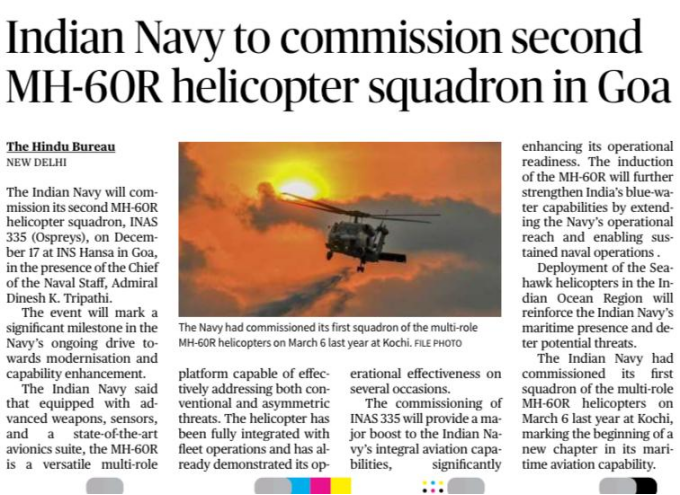
The Indian Navy is set to commission its second MH-60R Seahawk helicopter squadron at INS Hansa, Goa, strengthening its aviation and maritime security capabilities as part of ongoing naval modernisation.
Key Points
Background of the Commissioning
About MH-60R Seahawk Helicopter
Operational Significance
Strategic Importance
Indian Navy Modernisation Drive
Context
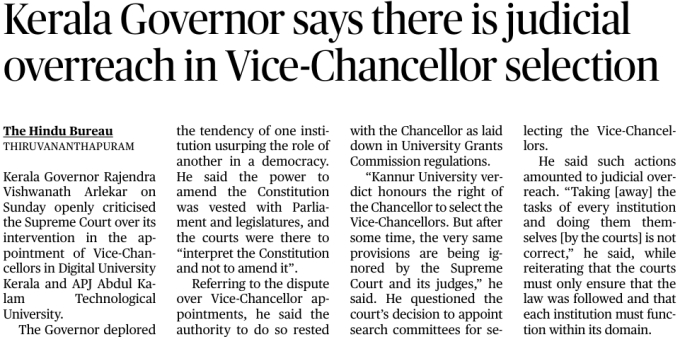
The Kerala Governor criticised the Supreme Court’s interventions in the appointment of Vice-Chancellors in State universities, alleging judicial overreach and encroachment into domains assigned to constitutional and statutory authorities.
Key Points
Issue Raised by the Governor
Argument on Separation of Powers
Reference to Judicial Precedents
Concern over Institutional Autonomy
Role of Vice-Chancellor (VC)
Principal Authority of the University
Leadership and Governance Role
Statutory and Administrative Functions
Ensuring Legal Compliance
Expert Committee Emphasis
Importance of the VC’s role highlighted by the Radhakrishnan Commission (1948), Kothari Commission (1964–66), Gnanam Committee (1990), and Ramlal Parikh Committee (1993).
Syllabus: GS-II — International Relations; International Institutions
GS-III — Agriculture; Rural Development
Context
The Government of India highlighted its achievements in rural transformation and development leadership at the IFAD–India Day event held in Rome, showcasing India’s experience in poverty alleviation and inclusive growth.
Key points
About IFAD
Mandate and focus areas
Funding and assistance
Membership and governance
Institutional details
Source: PIB
UPSC Prelims Practice Question
Q. Consider the following statements regarding the International Fund for Agricultural Development (IFAD):
1. IFAD is a specialised agency of the United Nations established in 1977 to eradicate rural poverty and hunger.
2. India is a founding member of IFAD and its headquarters is located in Geneva.
Which of the statements given above is/are correct?
A. 1 only
B. 2 only
C. Both 1 and 2
D. Neither 1 nor 2
Answer: A
Explanation:
Syllabus: GS-III — Science and Technology: Artificial Intelligence; Innovation and Technology Policy
Context
India has emerged as the world’s third most competitive country in artificial intelligence, according to Stanford University’s Global AI Vibrancy Tool, marking a major milestone for a lower-middle-income economy.
Key points
Stanford AI Vibrancy Rankings
Assessment framework
Drivers of India’s performance
India’s unique global position
Source: The Hindu
UPSC Prelims Practice Question
Q. Consider the following statements regarding the Stanford Global AI Vibrancy Tool:
1. It ranks countries based on indicators such as AI research, talent, investment, infrastructure, and governance.
2. India is the only lower-middle-income country placed among the top three in global AI competitiveness.
Which of the statements given above is/are correct?
A. 1 only
B. 2 only
C. Both 1 and 2
D. Neither 1 nor 2
Answer: C
Explanation:
Ponduru khadi gets GI tag
Syllabus: GS-I — Indian Culture: Handicrafts; Geographical Indications
Context
Ponduru khadi, a traditional handspun fabric from Andhra Pradesh, has been granted the Geographical Indication (GI) tag by the GI Registry under the Ministry of Commerce and Industry.
Key points
Production features
Unique characteristics
Source: The Hindu
UPSC Prelims Practice Question
Q. Consider the following statements regarding Ponduru khadi:
1. Ponduru khadi is a handspun cotton fabric from Srikakulam district of Andhra Pradesh and has recently received a GI tag.
2. The cotton used for Ponduru khadi is imported from other States and the spinning is done using multi-spindle power charkhas.
Which of the statements given above is/are correct?
A. 1 only
B. 2 only
C. Both 1 and 2
D. Neither 1 nor 2
Answer: A
Explanation:
Chenchu tribe
Syllabus: GS-I — Indian Society: Tribes; Indian Culture
GS-II — Governance: Tribal Affairs
Context
The National Sanskrit University (NSU) organised a symposium and exhibition highlighting the special religious privilege of the Chenchu tribe in relation to the Ahobilam shrine and the worship of Lord Narasimha.
Key points
About the Chenchu Tribe
Social organisation
Livelihood
Religion and temple association
Source: The Hindu
UPSC Prelims Practice Question
Q. Consider the following statements regarding the Chenchu tribe:
1. The Chenchus are classified as a Particularly Vulnerable Tribal Group (PVTG) in Andhra Pradesh.
2. They are traditionally associated with the Srisailam temple and enjoy special ritual privileges there.
Which of the statements given above is/are correct?
A. 1 only
B. 2 only
C. Both 1 and 2
D. Neither 1 nor 2
Answer: C
Explanation:
Syllabus: GS-II — Governance: Labour reforms; Workers’ welfare
GS-III — Indian Economy: Employment; Productivity; Human capital
Context
Recent International Labour Organization (ILO) data shows that India is among the most overworked countries globally, intensifying concerns over worker well-being and fuelling policy debate on regulating work hours.
Key points
Findings from ILO data (2024)
Structural drivers of long working hours
Implications for workers
Policy debate: Right to Disconnect
Changing workforce expectations
Source: The Hindu
UPSC Prelims Practice Question
Q. Consider the following statements regarding working hours in India as per recent ILO data:
1. Indian workers average more than 45 hours of work per week, placing India among the most overworked nations globally.
2. The ILO data indicates that developed economies generally record higher average working hours than developing economies.
Which of the statements given above is/are correct?
A. 1 only
B. 2 only
C. Both 1 and 2
D. Neither 1 nor 2
Answer: A
Explanation:
 Launch your Graphy