Daily Current Affairs for UPSC 13th Dec 2025

| Index |
| S.No | Topic | Page No |
| Daily Hindu Analysis (YouTube) |
| 1. | The Indian Ocean as cradle of a new blue economy |
|
| 2. | A critical story that a chunk of the media missed |
|
| 3. | Technical textile mission likely to be extended |
|
| 4. | UNEA adopts India’s proposal on wildfire management |
|
| 5. | Govt. likely to rename MGNREGS to ‘Pujya Bapu Gramin Rozgar Yojana’ |
|
| 6. | RS resolution seeks free, compulsory early childhood care | |
| 7. | Centre increases minimum support price for copra |
|
| |
| Daily Current Affairs (App) |
| 8. | CITES Convention marks 50 years at CoP20 in Samarkand |
|
| 9. | PM Vishwakarma Scheme |
|
| 10. | UNESCO’s Intangible Cultural Heritage List |
|
| 11. | Sanchar Mitra Scheme |
|
The Indian Ocean as cradle of a new blue economy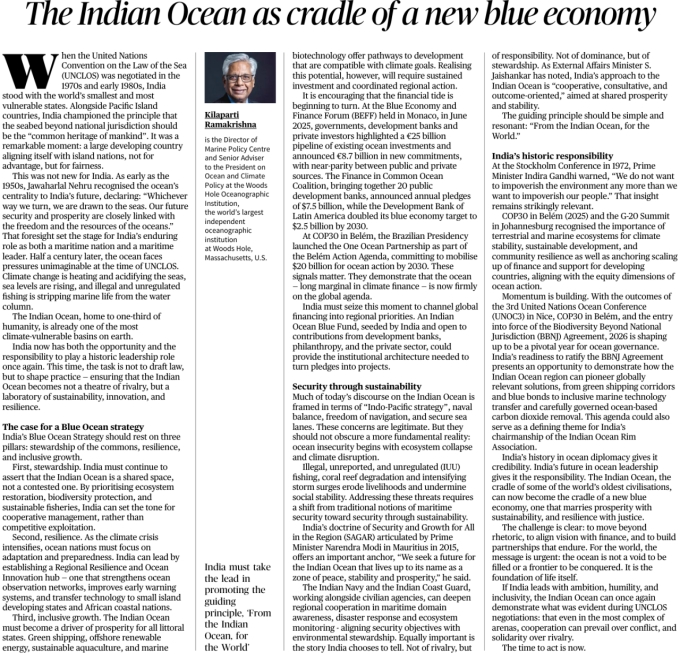 Context
The author discusses how the Indian Ocean, historically championed by India as a shared global commons, is now central to shaping a new blue economy that balances prosperity, sustainability, and climate resilience amid rising ecological and geopolitical pressures.
Detailed Analysis
India’s historical role in ocean governance
- During the UNCLOS negotiations, India stood with small and vulnerable states to assert that seabed resources beyond national jurisdiction are the common heritage of mankind.
- Leaders like Jawaharlal Nehru and Indira Gandhi earlier linked India’s future security and prosperity with oceans and environmental responsibility.
Rising ecological and strategic pressures- Climate change is heating and acidifying oceans, raising sea levels and threatening marine biodiversity.
- Illegal, unreported and unregulated (IUU) fishing, coral reef degradation, and extreme storms are eroding livelihoods and social stability, especially in the Indian Ocean region, home to one-third of humanity.
Need for a Blue Ocean strategyThe author argues for a Blue Ocean Strategy built on three pillars:
- Stewardship: Treating the Indian Ocean as a shared space, prioritising ecosystem restoration, biodiversity protection, and sustainable fisheries over competitive exploitation.
- Resilience: Building adaptation and preparedness through regional cooperation, early-warning systems, and technology transfer to small island and coastal states.
- Inclusive growth: Using green shipping, offshore renewable energy, sustainable aquaculture, and marine biotechnology to ensure prosperity for all littoral states.
Finance turning towards the ocean- Global momentum is visible through initiatives like the Blue Economy and Finance Forum (BEFF) in Monaco, pledging billions for ocean action.
- New commitments include public–private financing pipelines, development bank pledges, and coalitions such as the Finance in Common Ocean Coalition.
- The author suggests India could anchor this momentum through an Indian Ocean Blue Fund to convert pledges into projects.
Security through sustainability- The article reframes maritime security: ocean insecurity originates from ecosystem collapse, not just naval imbalance.
- India’s SAGAR doctrine and cooperation among the Indian Navy, Coast Guard, and civilian agencies exemplify linking security objectives with environmental stewardship.
Global governance opportunities- Outcomes of UN Ocean Conference (UNOC3), COP30, and the Biodiversity Beyond National Jurisdiction (BBNJ) Agreement make 2026 a pivotal year.
- India’s potential ratification of BBNJ can demonstrate leadership in areas like green shipping corridors, blue bonds, and responsibly governed ocean-based carbon removal.
Suggestions by the Author- India should channel global finance into regional priorities rather than rhetoric.
- Establish institutional mechanisms such as an Indian Ocean Blue Fund.
- Promote the guiding principle: “From the Indian Ocean, for the World”, emphasising cooperation, stewardship, and shared prosperity.
ConclusionThe Indian Ocean must not become a theatre of rivalry but a
laboratory of sustainability and resilience. India’s history in ocean diplomacy gives it both credibility and responsibility to lead a blue economy that marries growth with justice, climate action, and global cooperation.
UPSC Mains Question“Discuss how India can leverage the Indian Ocean to build a sustainable and inclusive blue economy while balancing environmental stewardship, security concerns, and regional cooperation.”
A critical story that a chunk of the media missed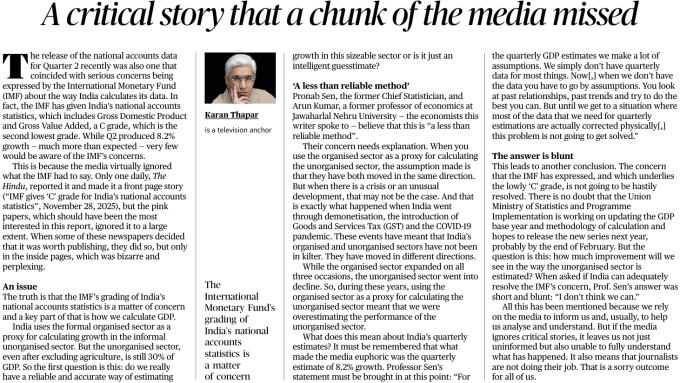
Context
The author examines the IMF’s concerns over India’s national accounts statistics, especially GDP estimation, and critiques how a large section of the media overlooked this serious issue despite its implications for economic understanding and policy credibility.
Detailed Analysis
IMF’s grading and why it matters
- The IMF assigned India’s national accounts statistics a ‘C’ grade, the second-lowest, raising concerns about the quality of GDP and GVA estimation.
- This coincided with the release of Q2 GDP growth at 8.2%, which was widely celebrated while IMF concerns received minimal attention.
Media’s selective focus- Most newspapers ignored the IMF’s assessment; only one daily reported it prominently.
- Even when covered, it was often relegated to inside pages, reflecting a failure to prioritise data quality over headline growth numbers.
Core methodological issue in GDP calculation- India estimates growth in the unorganised (informal) sector using the organised sector as a proxy.
- The unorganised sector still accounts for around 30% of GDP (excluding agriculture), making this assumption crucial.
Why the proxy approach is problematic- The method assumes organised and unorganised sectors move in the same direction and magnitude.
- During shocks like demonetisation, GST rollout, and COVID-19, this assumption failed.
- While the organised sector expanded, the unorganised sector contracted, leading to overestimation of overall growth.
Quarterly GDP estimates and assumptions- Quarterly GDP relies heavily on assumptions, past trends, and relationships, due to lack of real-time data.
- Without sufficient correction using actual data, quarterly estimates risk becoming intelligent guesswork rather than precise measurement.
Expert assessment- Former Chief Statistician Pronab Sen and economist Arun Kumar describe the method as “less than reliable.”
- According to them, India cannot adequately resolve IMF concerns until direct and frequent data on the unorganised sector is available.
Limits of ongoing reforms- The Ministry of Statistics is working on updating the GDP base year and methodology.
- However, experts argue this may not substantially improve unorganised sector estimation without structural data improvements.
Implications for public understanding- Ignoring such issues leaves citizens uninformed and unable to fully understand economic reality.
- The author concludes that this represents a failure of the media’s analytical and watchdog role.
Suggestions of the Author- Improve direct measurement of the unorganised sector, instead of relying on proxies.
- Treat IMF concerns as a serious institutional warning, not a peripheral critique.
- Media must engage critically with data quality, not just growth figures.
ConclusionHigh GDP growth numbers lose meaning if the underlying data is unreliable. The IMF’s ‘C’ grade highlights structural weaknesses in India’s national accounts, especially regarding the informal sector. Addressing this gap is essential not only for policymaking but also for restoring credibility and ensuring informed public debate.
UPSC Mains Question“Critically examine the challenges in estimating India’s GDP, particularly with respect to the unorganised sector. How do data limitations affect economic policymaking and public discourse?”
Technical textile mission likely to be extended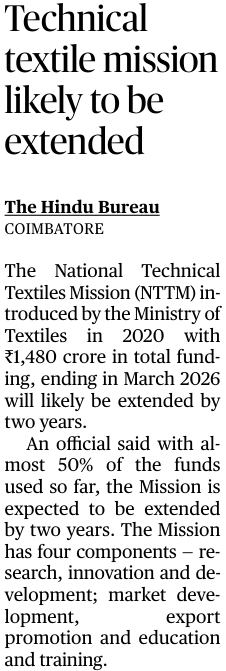
Context
The National Technical Textiles Mission (NTTM), launched in 2020 and ending in March 2026, is likely to be extended by two years as nearly 50% of the allocated funds are yet to be utilised.
Key Points
National Technical Textiles Mission (NTTM)
- Launched in 2020 by the Ministry of Textiles to promote technical textiles in India.
- Duration: 2020–21 to 2025–26; Outlay: ₹1,480 crore.
- Likely extension by two years due to partial utilisation of funds.
Core Components of NTTM- Research, Innovation and Development: Supports R&D for new materials and processes in technical textiles.
- Promotion and Market Development: Enhances domestic adoption and global collaboration.
- Export Promotion: Boosts exports through a dedicated export council.
- Education, Training and Skill Development: Focuses on education, training, and internships with industry and institutes.
Technical Textiles – Overview- Defined by functional and performance-based properties, not aesthetics.
- Also called industrial/functional/hi-tech textiles.
- 12 categories: Agrotech, Oekotech, Buildtech, Meditech, Geotech, Clothtech, Mobiltech, Hometech, Sportstech, Indutech, Protech, Packtech.
- Applications: Automotive parts, construction materials, medical equipment, safety gear, and machinery components.
UPSC Prelims Practice QuestionQ. With reference to the National Technical Textiles Mission (NTTM), consider the following statements:1. It was launched by the Ministry of Textiles with an outlay of ₹1,480 crore for the period 2020–21 to 2025–26.
2. One of its components focuses on education, training, and skill development in technical textiles.
Which of the statements given above is/are correct?A. 1 only
B. 2 only
C. Both 1 and 2
D. Neither 1 nor 2
Answer: C
UNEA adopts India’s proposal on wildfire management
Context
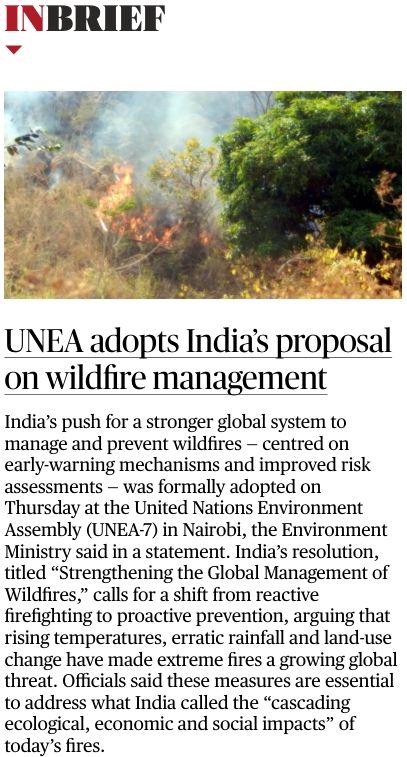
At the United Nations Environment Assembly (UNEA-7) in Nairobi, India’s proposal on strengthening global wildfire management was formally adopted, emphasising early warning systems and proactive prevention.
Key Points
India’s Proposal on Wildfire Management
- Calls for a shift from reactive firefighting to proactive prevention.
- Focuses on early-warning mechanisms, improved risk assessment, and global coordination.
- Highlights that rising temperatures, erratic rainfall, and land-use change have increased the frequency and intensity of wildfires.
- Recognises the cascading ecological, economic, and social impacts of extreme fires worldwide.
Significance of the Resolution- Strengthens global cooperation in wildfire prevention and management.
- Aims to integrate climate adaptation and disaster risk reduction strategies.
- Positions India as a key voice in global environmental governance on climate-linked disasters.
United Nations Environment Assembly (UNEA)- Established: 2012, at the UN Conference on Sustainable Development.
- Role: World’s highest-level decision-making body on environmental matters under UNEP.
- Functions:
- Sets the global environmental agenda.
- Provides policy guidance and defines responses to emerging environmental challenges.
- Structure: President and 8 Vice Presidents (UNEA Bureau).
- Membership: All 193 UN Member States.
UPSC Prelims Practice Question
Q. With reference to the United Nations Environment Assembly (UNEA), consider the following statements:
1. UNEA is the highest decision-making body on environmental matters under UNEP.
2. Its membership consists only of countries that are parties to major multilateral environmental agreements.
Which of the statements given above is/are correct?A. 1 only
B. 2 only
C. Both 1 and 2
D. Neither 1 nor 2
Answer: A
Govt. likely to rename MGNREGS to ‘Pujya Bapu Gramin Rozgar Yojana’
Context
The Union government is likely to introduce a Bill in Parliament to rename MGNREGS as “Pujya Bapu Gramin Rozgar Yojana”, with the amended Bill already cleared by the Union Cabinet.
Key Points
Proposed Renaming of MGNREGS
- The government plans to amend the Mahatma Gandhi National Rural Employment Guarantee Act, 2005.
- The scheme may be renamed “Pujya Bapu Gramin Rozgar Yojana.”
- The suffix “Mahatma Gandhi” was added in 2009 to the original Act.
- No formal Cabinet briefing announcement has been made yet.
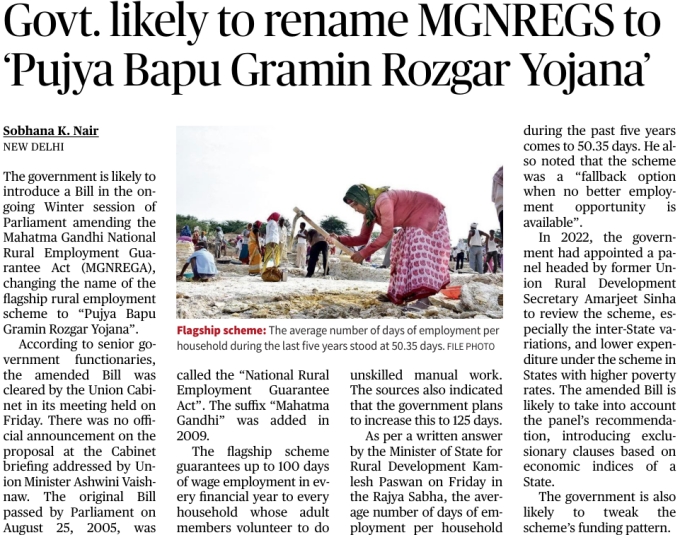
Performance and Review of the Scheme- Average employment per household over the last five years stood at 50.35 days.
- The scheme functions as a fallback option when no other employment is available.
- In 2022, a review panel headed by former Rural Development Secretary Amarjeet Sinha was constituted.
- The panel examined inter-State variations and lower expenditure in poorer States.
- Amendments may introduce exclusionary clauses based on State-level economic indices.
- The government may also tweak the funding pattern and consider increasing guaranteed workdays beyond 100.
About MGNREGA (Mahatma Gandhi National Rural Employment Guarantee Act, 2005)- A rights-based law guaranteeing 100 days of unskilled manual work per financial year to rural households.
- Provides unemployment allowance if work is not given within 15 days.
- Social audit is mandatory under Section 17 for all works.
- Employment is generally provided within 5 km of residence.
- Panchayati Raj Institutions and Gram Sabhas play a central role in planning and implementation.
- Payments must be made within 15 days, with compensation for delays.
- The movement for the right to work was strongly supported by MKSS and economist Jean Drèze.
UPSC Prelims Practice QuestionQ. With reference to the Mahatma Gandhi National Rural Employment Guarantee Act (MGNREGA), consider the following statements:
1. It guarantees 100 days of unskilled manual employment to rural households as a legal right.
2. Social audit of works under MGNREGA is optional and left to State discretion.
Which of the statements given above is/are correct?A. 1 only
B. 2 only
C. Both 1 and 2
D. Neither 1 nor 2
Answer: A
RS resolution seeks free, compulsory early childhood care
Context
The Rajya Sabha discussed a private member’s resolution urging the Union government to amend the Constitution to provide free and compulsory Early Childhood Care and Education (ECCE) for children aged 3–6 years.
Key Points
Private Member’s Resolution
- Moved by nominated member Sudha Murty in the Rajya Sabha.
- Urges insertion of a new Article 21B in the Constitution.
- Seeks to guarantee free and compulsory ECCE for children between 3 and 6 years.
Scope of ECCE Proposed- Includes nutrition, health services, and pre-primary learning.
- Emphasises universal access to quality ECCE across the country.
Rationale Behind the Demand- Early childhood education is critical for strong foundations of lifelong learning and development.
- Recognises children as the future human capital of the nation.
- Highlights ECCE’s central role in ensuring holistic development during early years.
Role of Anganwadi Services- Resolution stresses strengthening Anganwadi services as the backbone of ECCE delivery.
- Calls on the government to prioritise ECCE within its social sector agenda.
Link with Existing Constitutional Framework- Currently, Article 21A guarantees free and compulsory education for children aged 6–14 years.
Centre increases minimum support price for copra
Context
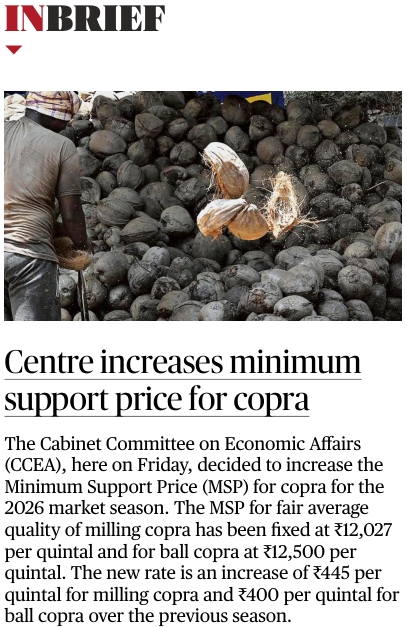
The Cabinet Committee on Economic Affairs (CCEA) has approved a hike in the Minimum Support Price (MSP) for copra for the 2026 market season, aiming to safeguard coconut farmers against market fluctuations. Key PointsMSP Revision for Copra
- Fair Average Quality (FAQ) milling copra: ₹12,027 per quintal.
- Ball copra: ₹12,500 per quintal.
- Increase of ₹445 per quintal for milling copra and ₹400 per quintal for ball copra over the previous season.
- The revision is intended to ensure remunerative prices and income stability for coconut growers.
Cabinet Committee on Economic Affairs (CCEA)
- A standing committee of the Union Cabinet, chaired by the Prime Minister of India.
- Plays a central role in economic governance and macroeconomic decision-making.
- Deals with important economic policy matters, including:
- Approval of MSPs for agricultural crops.
- Decisions on public sector investments, industrial policy, and infrastructure projects.
- Matters related to economic reforms, growth strategy, and fiscal priorities.
- Acts as the final decision-making authority on MSP proposals after technical recommendations.
- Ensures inter-ministerial coordination on key economic issues.
Minimum Support Price (MSP)- Definition: MSP is the assured procurement price at which the government purchases crops directly from farmers to protect them from price volatility and market crashes.
- Objective:
- Provide income security to farmers.
- Encourage crop production and ensure food security.
- Stabilise agricultural markets.
Institutional Framework- MSPs are recommended by the Commission for Agricultural Costs and Prices (CACP).
- CACP is an attached office under the Ministry of Agriculture and Farmers Welfare, established in 1965.
- Final approval of MSPs is given by the CCEA.
CITES Convention marks 50 years at CoP20 in SamarkandSyllabus: GS-III — Environment: International Conventions; Wildlife Protection; Biodiversity Governance.
ContextThe 20th meeting of the
Conference of the Parties (CoP20) to CITES concluded in
Samarkand, Uzbekistan, commemorating
50 years of the Convention’s entry into force.
Key Points- Full form: Convention on International Trade in Endangered Species of Wild Fauna and Flora.
- Nature: A voluntary international agreement regulating global wildlife trade.
- Adoption: Adopted in 1973, came into force in 1975.
- Objective: Ensure that international trade in wild animals and plants does not threaten their survival.
- Membership: 185 Parties; regulates trade in 38,000+ species.
- Legal status: Legally binding, but does not replace national laws; Parties must enact domestic legislation.
- Secretariat: Administered by UNEP, located in Geneva, Switzerland.
- Governance:
- Conference of the Parties (CoP) is the supreme decision-making body.
- Meets every 2–3 years to review implementation and revise species listings.
- Collaboration: Promotes coordination among wildlife authorities, customs, police, and national parks to combat wildlife crime involving species such as elephants and rhinos.
CITES Appendices- Appendix I:
- Species threatened with extinction.
- No commercial trade permitted.
- Appendix II:
- Species not yet threatened but could become so without regulation.
- Controlled trade allowed with export permits ensuring legality and no harm to the species’ survival.
- Appendix III:
- Species listed by a specific country requesting international cooperation.
- Trade regulated through export permits (listing country) and certificates of origin (other countries).
Source: Down To Earth
Prelims Practice Question
Consider the following statements regarding CITES:
1. CITES is legally binding on member countries but does not override domestic wildlife laws.
2. Appendix I of CITES allows commercial trade in endangered species under strict certification.
Which of the statements given above is/are correct?
A. 1 only
B. 2 only
C. Both 1 and 2
D. Neither 1 nor 2
Answer: A
Explanation:- Statement 1 is correct: CITES requires Parties to implement its obligations but does not replace national laws.
- Statement 2 is incorrect: Appendix I prohibits commercial trade in endangered species.
PM Vishwakarma Scheme
Syllabus: GS-II — Governance: Schemes for welfare and livelihood; MSME policy.
ContextThe National Steering Committee approved proposals to streamline
loan sanctions and disbursements under the PM Vishwakarma Scheme to improve credit flow and implementation for artisans.
Key points- What it is: A central sector scheme by the Ministry of MSME to support traditional artisans through recognition, skilling, market linkages and credit.
- Objective: Strengthen the Guru–Shishya parampara and preserve family-based traditional crafts while improving artisans’ livelihoods.
- Timeframe: Five years — FY 2023–24 to FY 2027–28.
- Coverage: Available to rural and urban artisans and craftspeople across India.
- Trades covered: Covers 18 traditional crafts (examples include boat makers, armourers, blacksmiths, hammer & tool-kit makers).
- Eligibility: Aged 18+, practising specified traditional trades, and no similar loans in the past five years.
- Recognition: Issuance of PM Vishwakarma certificate and ID card to beneficiaries.
- Skill upgradation: Basic training (5–7 days) and advanced training (15+ days) with a stipend of ₹500/day.
- Toolkit incentive: E-voucher up to ₹15,000 for purchasing toolkits at the start of basic training.
- Credit support: Collateral-free Enterprise Development Loans up to ₹3 lakh in two tranches (₹1 lakh + ₹2 lakh) at a concessional interest rate of 5%.
- Target coverage: 5 lakh families in year one and 30 lakh families over five years.
- Recent policy action: NSC measures aim to speed up loan sanctioning and disbursal for better on-ground uptake.
Source: PIB
UNESCO’s Intangible Cultural Heritage List
Syllabus: GS-I — Indian Culture: UNESCO Heritage, Festivals, Cultural Traditions.
Context
UNESCO has inscribed Deepavali (Diwali) on the Intangible Cultural Heritage of Humanity List, adding it as India’s 16th element recognised under the 2003 Convention.
Key Points
- Definition: Intangible heritage refers to “living heritage”—oral traditions, performing arts, rituals, social practices, festive events, nature-related knowledge and traditional craftsmanship.
- Objective: Safeguard and promote cultural practices; ensure their transmission to future generations; enhance global awareness and cultural diversity.
- Administration: Managed under the 2003 UNESCO Convention; decisions taken by the Intergovernmental Committee based on nominations from member states.
- Five domains:
1.
Oral traditions & expressions (including language)
2.
Performing arts
3.
Social practices, rituals, and festive events
4.
Knowledge & practices concerning nature and the universe
5.
Traditional craftsmanship
India’s 16 Elements on the List (after Deepavali’s inclusion)1. Vedic chanting (2008)
2. Kutiyattam (2008)
3. Ramlila (2008)
4. Ramman (2009)
5. Mudiyettu (2010)
6. Kalbelia songs & dances (2010)
7. Chhau dance (2010)
8. Buddhist chanting of Ladakh (2012)
9. Sankirtana of Manipur (2013)
10. Thatheras’ craft of Punjab (2014)
11. Yoga (2016)
12. Kumbh Mela (2017)
13. Durga Puja, Kolkata (2021)
14. Garba, Gujarat (2023)
15. Navroz/Nowruz (2024)
16. Deepavali (2025)
Source: PIB
Prelims Practice Question
Q. Consider the following statements regarding UNESCO’s Intangible Cultural Heritage List:1. The list is maintained under the UNESCO Convention of 2003.
2. Only performing arts and festive events are eligible for inscription.
Which of the statements given above is/are correct?A. 1 only
B. 2 only
C. Both 1 and 2
D. Neither 1 nor 2
Answer: AExplanation:- Statement 1 is correct: The list is administered under the 2003 Convention for Safeguarding the Intangible Cultural Heritage.
- Statement 2 is incorrect: UNESCO recognises five domains, which include oral traditions, nature-related knowledge, traditional craftsmanship, etc., not just performing arts or festive events.
Sanchar Mitra Scheme
Syllabus: GS-II – Government Policies & Interventions (Digital Governance, Cyber Safety)
ContextThe government stated in the Lok Sabha that
222 institutions are currently participating in the
Sanchar Mitra Scheme, reflecting its expanding outreach.
Key Points- What it is: A youth-oriented initiative of the Department of Telecommunications (DoT) to promote safe digital and telecom practices.
- Aim: To utilise young students to spread awareness about mobile safety, telecom fraud prevention, and government digital initiatives.
- Sanchar Mitras: Student volunteers who conduct outreach in communities, schools, and public spaces to promote secure and responsible telecom usage.
- Eligibility: Open to students from technical institutes offering programmes in telecom, electronics, computers, cybersecurity, etc., that agree to participate.
- Training: Provided by experts and the National Communications Academy–Technology (NCA-T) on cybersecurity, emerging telecom technologies, policies, and regulations.
- Opportunities for top performers:
- Access to R&D projects and telecom start-ups.
- Involvement in policy and standards work.
- Participation in field surveys and DoT initiatives.
- Exposure to national conferences and events.
- Implementation: Active in all States/UTs through DoT’s Licensed Service Area (LSA) field offices.
- Recognition: Incentives and certification coordinated through DoT using existing institutional mechanisms.
Source: PIB
Prelims Practice Question Q. Consider the following statements about the PM Vishwakarma Scheme:1. The scheme provides collateral-free enterprise loans of up to ₹3 lakh at a concessional interest rate of 5%.
2. The scheme is available only to rural artisans and excludes urban artisans.
Which of the statements given above is/are correct?
A. 1 only
B. 2 only
C. Both 1 and 2
D. Neither 1 nor 2
Answer: A
Explanation:- Statement 1 is correct: The scheme offers collateral-free loans up to ₹3 lakh in two tranches at 5% concessional interest.
- Statement 2 is incorrect: The scheme covers both rural and urban artisans

 Launch your Graphy