There are no items in your cart
Add More
Add More
| Item Details | Price | ||
|---|---|---|---|




| Index | ||
| S.No | Topic | Page No |
| Daily Hindu Analysis (YouTube) | ||
| 1. | Act of Evil: Promoting Social Harmony is Integral to Any Counterterrorism Strategy | |
| 2. | Exploited Workers, a Labour Policy’s Empty Promises | |
| 3. | India Recorded the Highest Greenhouse Gas Emissions for 2024 | |
| 4. | SC Judge: Imported Ideas May Not Save Endangered Species | |
| 5. | ISRO Conducts Crucial Safety Tests on Main Parachutes for Gaganyaan Crew | |
| 6. | INA Not Founded by Subhas Bose, He Took Up the Reins Only Later, Claims New Book | |
| Daily Current Affairs (App) | ||
| 7. | UIDAI launches new Aadhaar App for Digital ID Access | |
| 8. | Shaikha Nasser Al Nowais Appointed First Woman to Head UN Tourism | |
| 9. | National Education Day: Tribute to Maulana Abul Kalam Azad | |
| 10. | Assam Approves Bill to Ban Polygamy | |
| 11. | 8th Namdapha Butterfly Festival to be Held in Arunachal Pradesh | |
| 12. | Maldives Inaugurates Hanimaadhoo International Airport with Indian Assistance | |
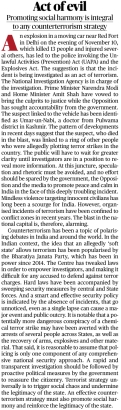
Context The article discusses the terrorist blast near Red Fort in Delhi (November 10) that killed 13 people and injured several others.
The incident has led to an investigation under the Unlawful Activities (Prevention) Act (UAPA) and the Explosives Act, marking it as an act of terrorism. Prime Minister Narendra Modi and Home Minister Amit Shah have promised to bring the culprits to justice, while the National Investigation Agency (NIA) has taken charge of the case.
The suspect, Umar-un-Nabi, a doctor from Pulwama district (Jammu & Kashmir), is believed to have links to a broader terror network allegedly plotting coordinated strikes across the country.
Analysis
1. Nature of the Incident and Legal Framework The explosion near a prominent national landmark has triggered the UAPA and the Explosives Act, both of which empower agencies to act firmly against terror activities. The UAPA (1967) serves as India’s primary anti-terror legislation, allowing pre-emptive action against individuals or organizations threatening the nation’s integrity. The NIA, as the central investigative body, ensures coordination between intelligence and enforcement wings.
Such incidents underscore the persistent terror threats in urban areas, highlighting the need for robust intelligence and preemptive security measures rather than reactive policing.2. Political and Public Response The government has vowed strict action, while the Opposition has sought transparency and accountability. The editorial stresses that speculation, political blame games, and media sensationalism must be avoided until investigations are complete. It emphasizes that peace and calm must be collectively preserved during such crises to avoid communal polarization.
Acts of terror often aim not just to kill but to spread fear and division. Hence, responsible communication and community unity are essential to defeat the psychological objectives of terrorism.3. Broader Trends and Security Concerns Organized terror incidents have largely been limited to conflict zones in recent years, making this blast in the national capital particularly alarming. The editorial connects this to broader debates about the “soft state” narrative, where the government’s hardline counterterrorism measures since 2014 have sought to project strength and deterrence.
While stronger laws like UAPA empower agencies, they also raise debates on civil liberties and judicial oversight. Balancing security with constitutional safeguards remains critical.4. The Need for a Comprehensive Counterterrorism Strategy The article emphasizes that counterterrorism cannot rely on policing alone. A “smart and effective” national security policy must integrate: Timely intelligence coordination between agencies. Efficient border and cyber surveillance. Community-based de-radicalization efforts. The editorial argues that terrorism aims to provoke social discord and delegitimize the state, and therefore, preserving social harmony and trust is as vital as operational success.
Sustainable counterterrorism demands not only coercive power but also inclusive governance, ensuring no community feels alienated or targeted. 5. Way Forward A transparent investigation is essential to maintain public confidence. Long-term counterterrorism should focus on: Promoting inter-community harmony. Building local intelligence networks. Addressing socio-economic roots of radicalization. Ensuring accountability under the rule of law.UPSC Mains Q. “Counterterrorism in India must combine hard power with social harmony to ensure lasting peace and internal stability.”
Discuss in the context of recent terror incidents and India’s evolving security framework.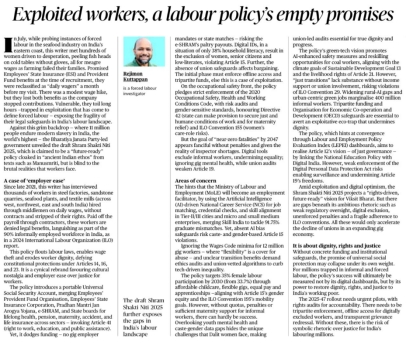
Syllabus: GS Paper II – Governance, Welfare Schemes for Vulnerable Sections, and Issues Relating to Poverty and Employment
Context The article critiques India’s labour policy framework, particularly the draft Shram Shakti Niti 2025, which claims to create a “future-ready” workforce but fails to address the ground realities of worker exploitation, job insecurity, and erosion of legal protections.
It highlights that, despite promises of reform, many workers—especially in unorganised and gig sectors—remain trapped in precarious conditions without dignity, fair wages, or social security.
Key Provisions
1. Ground Realities of Labour Exploitation
The article begins with instances of forced labour in India’s seafood industry, where workers were reclassified as daily wagers, losing ESIC and Provident Fund benefits. These workers are emblematic of the wider informal sector, which employs over 90% of India’s workforce. The author argues that India’s labour landscape continues to lack basic enforcement of legal and constitutional safeguards, leaving workers vulnerable to exploitation.
2. The Draft Shram Shakti Niti 2025 Launched by the Bharatiya Janata Party-led government, it claims to be a “future-ready” labour policy inspired by ancient Indian texts. However, it allegedly prioritises employer ease over worker justice, enabling wage theft and eroding worker dignity. It merges major welfare schemes under a portable Universal Social Security Account, integrating: Employees’ Provident Fund Organisation (EPFO) Employees’ State Insurance Corporation (ESIC) Pradhan Mantri Jan Arogya Yojana e-SHRAM platform While designed to simplify administration, the policy reportedly dodges enforcement and inspection mechanisms, resulting in ineffective safeguards.
3. Legal and Constitutional Concerns The policy undermines Articles 14, 16, and 23 of the Constitution by allowing casualisation of labour without guarantees of fair wages or dignity. It points to the lack of collective bargaining rights and union-led audits, which are critical for labour dignity. ILO Conventions 29 (Forced Labour) and Convention 105 (Abolition of Forced Labour) are referenced to argue that India’s commitments to fair labour standards remain weak in practice.
4. Labour Market Inequality and Technology Gaps The article criticises the proposed use of AI-driven employment platforms such as the National Career Service (NCS), arguing that digital illiteracy and poor internet access will exclude millions of low-skilled and rural workers. Only 38% of households have digital access, violating Article 15 on non-discrimination. Labour reforms such as Wages Code and “flexibility” for employers are seen as legitimising gig-based precarious work.
5. Policy Gaps and the “Employer Ease” Bias The government’s narrative of “future-ready” labour is viewed as corporate-friendly, with little concern for social justice or collective bargaining. While policies speak of women’s safety, maternity benefits, and skill-building, enforcement remains minimal. The absence of offline audits and independent grievance redressal has left labour rights diluted under the guise of digital transparency.
6. Need for Dignity, Rights, and Justice True reform, the article asserts, lies not in digital dashboards but in: Tripartite consultations (between government, employers, and unions) Independent audits for accountability Transparent grievance redressal systems Without these, “future-ready” labour policies risk becoming empty rhetoric, detached from the lived experiences of India’s informal and gig workers.
UPSC Mains Q. “India’s labour reforms must move beyond digital rhetoric to ensure dignity, justice, and fair work conditions for all.”
Discuss this statement in light of the Shram Shakti Niti 2025 and its implications for informal and gig workers.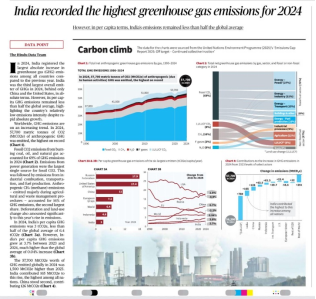
Syllabus: GSIII – Environment, Climate Change, Conservation, and Sustainable Development
Context According to the United Nations Environment Programme’s (UNEP) Emissions Gap Report 2025, India recorded the largest absolute increase in greenhouse gas (GHG) emissions among all countries in 2024, compared to the previous year.
Despite this increase, India’s per capita emissions remained less than half the global average, reflecting the country’s low emissions intensity and ongoing economic growth. India was the third-largest emitter of GHGs in 2024—behind China and the United States—in absolute terms. Key Provisions:
1. Global Emission Trends Total global anthropogenic (human-caused) GHG emissions in 2024: 57,700 million tonnes of CO₂ equivalent (MtCO₂e) — the highest ever recorded. Major contributors: Fossil fuels (CO₂ from coal, oil, and gas) accounting for 69% of total GHG emissions. Methane (CH₄), nitrous oxide (N₂O), and fluorinated gases contributed the remaining share.
2. India’s Performance India’s emissions increased by 126 MtCO₂e in 2024 from 2023 — the highest increase globally. India’s total GHG emissions in 2024: approximately 3.7% higher than 2023 levels. Per capita emissions: 3.2 tonnes of CO₂e, compared to the global average of 6.4 tonnes. India’s per capita GHG emissions are less than half the global average, showing efficiency in emissions intensity relative to population size.
3. Sectoral Breakdown (India) Energy and Power Generation: Largest contributor (over half of total CO₂ emissions). Industry and Transport: Major contributors following energy. Agriculture: Major source of methane emissions (from livestock and paddy cultivation). Land Use, Land-Use Change, and Forestry (LULUCF): Minor offsetting effect on overall emissions.
4. Comparative Global Analysis China, the U.S., and India together accounted for over 50% of global emissions. India’s contribution to the global rise in GHG emissions (from 2023 to 2024) exceeded that of the U.S. and EU combined. Other countries showing notable increases: Indonesia, Russia, and Brazil.
5. Key Takeaways The rise in India’s emissions reflects its rapid industrial and energy expansion, driven by economic growth and increasing energy demand. However, India’s low per capita emissions highlight its developmental constraints and equitable responsibility stance under the UNFCCC principle of Common but Differentiated Responsibilities (CBDR). The data underscores the urgent need for green transition policies, including renewable energy expansion, carbon capture, and sustainable agriculture practices.
UPSC Prelims Q. With reference to greenhouse gas emissions, consider the following statements:
1. In 2024, India recorded the largest absolute increase in greenhouse gas emissions among all countries.
2. India’s per capita GHG emissions in 2024 were higher than the global average.
3. Fossil fuel combustion accounted for nearly 70% of total global GHG emissions. Which of the statements given above is/are correct?
(a) 1 and 3 onlyAnswer: (a)
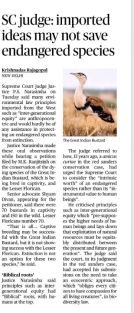
Syllabus: GSIII – Environment & Biodiversity Conservation Context Supreme Court Judge Justice P.S. Narasimha observed that many environmental law principles imported from the West, such as “inter-generational equity”, may not be effective in conserving India’s endangered species like the Great Indian Bustard and Lesser Florican.
He made these remarks while hearing a petition filed by conservationist M.K. Ranjitsinh, seeking protection measures for these critically endangered birds.
Key Provisions:
1. Background of the Case
[A] 1 and 2 only
[B] 2 and 3 only
[C] 1 and 3 only
[D] 1, 2 and 3
Answer: C
Syllabus: GS Paper III – Science and Technology (Space Technology, Achievements of Indian Scientists)
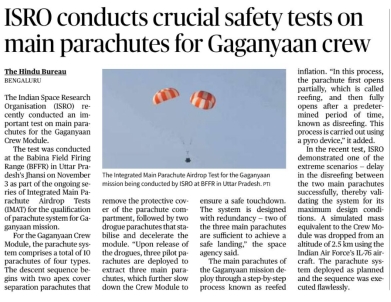
Context The Indian Space Research Organisation (ISRO) successfully conducted a key Integrated Main Parachute Airdrop Test (IMAT) for the Gaganyaan Crew Module at the Babina Field Firing Range (BFFR) in Jhansi, Uttar Pradesh on 3 November 2025.
This test is a critical step in validating the parachute-based deceleration and landing system that will ensure a safe return of astronauts to Earth after India’s first human space mission. Key Details & Provisions 1. Purpose of the Test2. The Integrated Main Parachute Airdrop Tests (IMAT) were conducted at the Babina Field Firing Range in Jhansi, Uttar Pradesh.
3. The Crew Module’s descent sequence begins with the deployment of main parachutes followed by drogue parachutes. Which of the statements given above are correct?
(a) 1 and 2 onlyAnswer: (a)
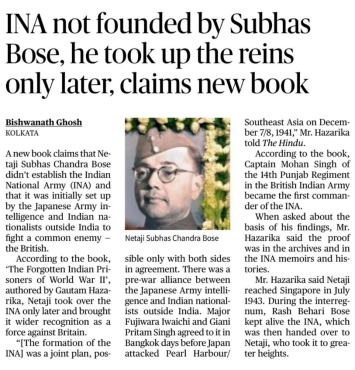
Context A new book titled “The Forgotten Indian Prisoners of World War II” by Gautam Hazarika challenges the widely held belief that Netaji Subhas Chandra Bose founded the Indian National Army (INA). The book claims that the INA was initially established by Japanese Army intelligence in collaboration with Indian nationalists living abroad to fight against the British, and that Netaji took charge only later, transforming it into a powerful symbol of India’s struggle for freedom.
Key provisions:
Syllabus: GS Paper II — Governance: Digital governance & citizen services
Context: The Unique Identification Authority of India (UIDAI) has introduced a new Aadhaar app enabling citizens to carry and verify their Aadhaar digitally, ensuring privacy, security, and ease of access without relying on physical cards. Key points
Syllabus: GS Paper II — International Relations: Global institutions and leadership
Syllabus: GS Paper II — Governance: Education policy & institutions
Syllabus: GS Paper II — Governance: Government policies & social justice
Syllabus: GS Paper II — International Relations: India and its Neighbourhood – Cooperation & Development
 Launch your Graphy