Daily Current Affairs for UPSC 12th Dec 2025


| Index |
| S.No | Topic | Page No |
| Daily Hindu Analysis (YouTube) |
| 1. | The stark reality of educational costs in India |
|
| 2. | Is the falling rupee a cause for alarm? |
|
| 3. | What does Supreme Court’s ruling on narco tests mean? |
|
| 4. | Panel on simultaneous polls gets more time | |
| 5. | V-C appointment impasse: SC turns to Justice Dhulia panel | |
| 6. | Rhythm of the harvest | |
| 7. | 40 farmers detained over ethanol plant protest in Rajasthan |
|
| Daily Current Affairs (App) |
| 8. | ‘Your Money, Your Right’ Movement | |
| 9. | SAMPANN Portal | |
| 10. | Swasthya Portal |
|
| 11. | Shilp Didi Programme |
|
| 12. | UNEP Champions of the Earth Award – 2025 |
|
The stark reality of educational costs in India
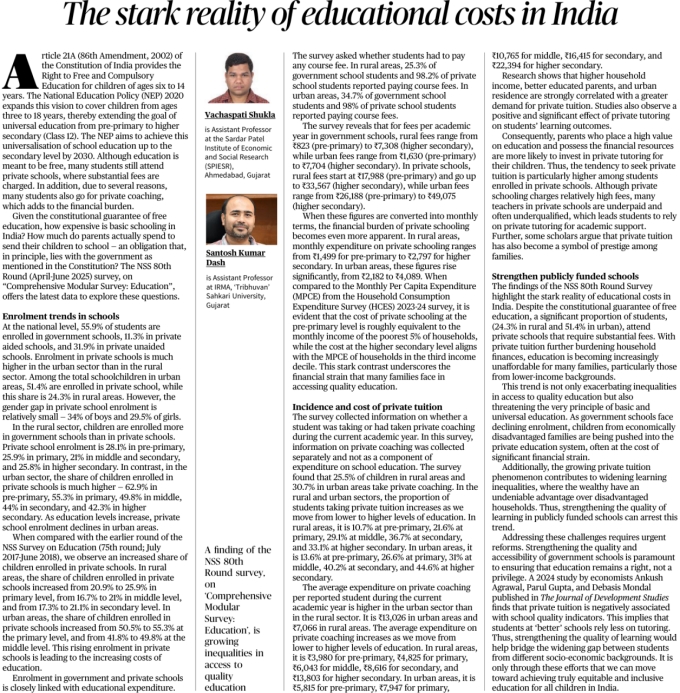
Context
The author examines findings from the NSS 80th Round (Comprehensive Modular Survey: Education, Apr–Jun 2025) to show how school costs — tuition, private coaching and related expenses — are rising, shifting families toward private tuition and deepening educational inequality.
Detailed analysis
1. Enrollment pattern — public vs private
- NSS shows a large share of children remain in government schools (about 56%), but private unaided schools account for a significant share (≈32%), especially in urban areas.
- Urban schooling is more privatised (over half in private schools in some levels), creating access differentials between urban and rural students.
2. Direct cost of schooling - The survey reports wide variation in school fees: rural government school annual fees are very low while private school fees rise steeply by level; urban private fees are several times higher than rural government fees.
- When converted to monthly terms, private schooling becomes a substantial household expenditure for many — comparable to or exceeding incomes of poorer deciles.
3. Burden of private tuition - A large proportion of students take private coaching: the share increases with level — modest at pre-primary, substantial by higher secondary.
- Private tutoring adds material monthly/annual costs (often unaccounted for in assessing schooling affordability) and is higher in urban areas and among private-school students.
4. Who bears the burden — distributional impact - Financial burden falls disproportionately on middle- and low-income households who aspire for quality education but lack public alternatives.
- Households in the lower income quintiles spend a higher share of monthly income on private schooling/tuition than richer households, inducing regressive pressure.
5. Supply-side constraints in public schools - Despite constitutional commitment (Article 21A / RTE), many families opt for private schools because of perceived quality gaps: teacher absenteeism, poor learning outcomes, and inadequate infrastructure in some government schools.
- The author links demand for private tuition to learning deficits in school — families pay to compensate for system failures.
6. Long-run consequences - Rising costs and dependence on private tuition widen learning and attainment gaps, entrenching inequality across socio-economic groups.
- Education becomes less of a universal right and more of a commodity, threatening social mobility and inclusive growth.
Suggestions made by the author 1. Strengthen publicly funded schools — invest in teacher quality, learning outcomes, facilities and accountability to make public schools competitive.
2.
Target learning recovery — remedial programmes in government schools to reduce dependence on private coaching.
3.
Regulate private tuition and fees — transparency in school fee structures and measures to limit excessive private coaching commercialization.
4.
Expand subsidy/assistance for vulnerable households — conditional cash transfers or fee waivers targeted at students from low-income families.
5.
Periodic data-driven monitoring — use national surveys to track household education spending and learning outcomes to guide policy.
Conclusion Rising school costs and the hidden burden of private tuition are undermining the constitutional promise of free, equitable education. Unless public schooling is substantially strengthened and targeted measures protect vulnerable households, educational inequality will widen — making universal learning outcomes unattainable.
UPSC Mains Question
"Analyse how rising private schooling costs and the proliferation of private tuition in India are affecting equity and the right to education. Suggest policy measures to ensure affordable, high-quality schooling for all."
Is the falling rupee a cause for alarm?
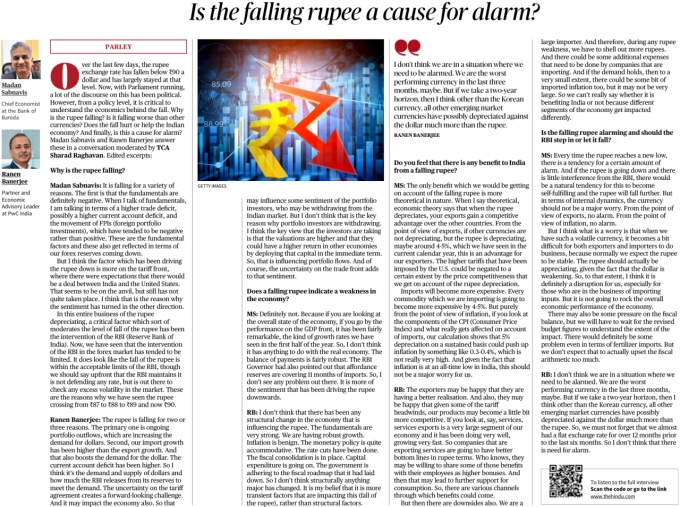
Context The article discusses the recent depreciation of the rupee (near ₹90/USD), examines why the currency is falling, whether it signals macro weakness, and whether policymakers (RBI/Government) should intervene or be alarmed.
Detailed analysis
1. Recent movement — what happened
- The rupee has weakened to around ₹90 per USD, prompting public and parliamentary debate.
- Movements have been sharp over a few days but comparable depreciation has occurred in other emerging-market currencies over longer horizons.
2. Supply–demand drivers cited by experts - Trade fundamentals: A higher trade deficit and stronger import demand increase dollar needs.
- Portfolio flows (FPIs): Foreign portfolio outflows or weaker FPI inflows put downward pressure on the rupee.
- Tariff & policy uncertainty: Expectations around tariff outcomes and India–U.S. trade discussions have influenced sentiment.
- Dollar strength: Global dollar appreciation and monetary conditions abroad are important external drivers.
- RBI market operations: The Reserve Bank’s forex intervention has been limited at times, helping moderate volatility but not completely arresting the fall.
3. Is the fall signalling economic weakness? - Several experts argue no structural panic: GDP performance has been reasonably robust and reserves cover months of imports.
- The fall is partly sentiment-driven and linked with global factors rather than a sudden collapse in domestic fundamentals.
- However, a sustained depreciation can make imports costlier, impact inflation and fiscal arithmetic (subsidies, input costs).
4. Winners and losers from a weaker rupee - Exporters: Gain competitiveness; exporters may benefit via higher rupee realisation.
- Importers & consumers: Face higher import bills (fuel, capital goods), which can push inflation and raise production costs.
- Firms with foreign-currency debt: Face higher servicing costs.
- Macroeconomic aggregates: Higher import bill can widen current account and affect fiscal targets if not offset.
5. Policy responses and trade-offs - RBI intervention: Sterilised or unsterilised FX intervention can calm markets but uses reserves and may be temporary.
- Monetary stance: Tightening to defend the currency risks slowing growth; easing risks inflation — a calibration challenge.
- Fiscal policy: Fiscal consolidation strengthens confidence; large deficits may amplify currency pressures.
- Structural measures: Improving export competitiveness, diversifying export markets, and reducing import dependence on critical goods.
6. Expert view summarized - Some commentators urge no panic — transient volatility with manageable macro indicators.
- Others caution that repetitive falls require monitoring and occasional RBI action to prevent self-fulfilling declines.
- Net assessment: manageable concern, not an immediate crisis — but warrants vigilance.
Suggestions 1.
Active monitoring and calibrated RBI intervention to contain excessive volatility without exhausting reserves.
2.
Strengthen FX buffers — maintain adequate reserve cover and contingency planning.
3.
Fiscal prudence to sustain investor confidence and reduce macro vulnerability.
4.
Boost export competitiveness via incentives, quality upgrades and market diversification.
5.
Reduce import dependence on vulnerable items through substitution and strategic stockpiles.
6.
Communicate clearly to markets to reduce sentiment-driven swings and avoid knee-jerk political rhetoric.
UPSC Mains Question "Analyse the causes of recent volatility in the Indian rupee. Discuss the policy tools available to the RBI and the Government to manage exchange-rate instability and evaluate their trade-offs."
What does Supreme Court’s ruling on narco tests mean?
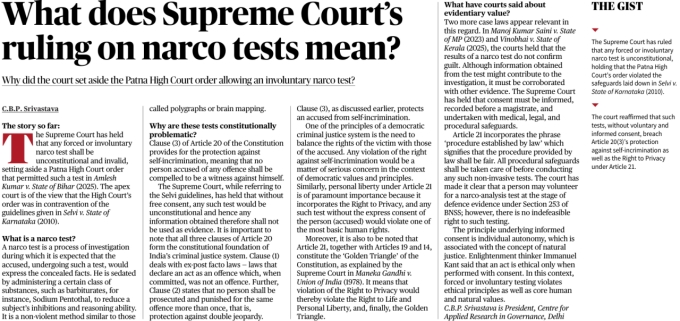
Context The Supreme Court held that any forced or involuntary narco test is unconstitutional and invalid, setting aside a Patna High Court order that had allowed involuntary testing; the judgment reaffirms precedents on consent and self-incrimination.
Key points: 1. What is a narco test?
- A narco test (narco-analysis) involves administering sedative drugs (e.g., sodium pentothal) to reduce inhibitions so the subject may disclose information; similar investigatory techniques include polygraph and brain-mapping.
2. Supreme Court ruling (core holding) - Forced/involuntary narco tests are unconstitutional; information obtained without the accused’s free and informed consent cannot be used as evidence.
3. Constitutional grounds relied upon - The judgment grounds the ban principally in Article 20(3) (protection against self-incrimination) and Article 21 (personal liberty/right to privacy), following earlier precedent.
4. Precedent — Selvi v. State of Karnataka (2010) - Selvi held that narco-analysis, polygraph and brain-mapping require prior informed consent; absent consent, results are inadmissible — the Supreme Court applies and reaffirms this position.
5. Evidentiary consequences - Any confessional or investigatory material extracted through involuntary narco testing is inadmissible in court; using such material risks violation of fundamental rights and may taint prosecution cases.
6. Impact on investigations and policing - Ruling restricts a coercive investigative shortcut; police must rely on forensic evidence, witness testimony, digital forensics and lawful interrogation rather than compulsory physiological tests.
7. Victim-rights vs accused-rights balance - Court emphasises balancing victims’ needs with constitutional protections for accused persons — civil liberties cannot be overridden by investigative expediency.
8. Consent safeguards (what remains permissible) - Voluntary narco or polygraph tests with informed consent, conducted under strict safeguards and independent oversight, may be permissible but their evidentiary weight is limited and subject to judicial scrutiny.
9. Policy and procedural implication - Need for clearer statutory/regulatory framework if such techniques are to be used at all (consent procedures, medical ethics, independent monitoring, chain of custody, admissibility rules).
Constitution — Article 20(3) - Article 20(3) protects against self-incrimination: no person accused of any offence shall be compelled to be a witness against himself.
- The right to remain silent under Article 20(3) applies once a person is formally accused and continues through investigation and trial; it forbids compulsion to give testimonial evidence that incriminates oneself.
UPSC Prelims Practice Question (MCQ) Consider the following statements: 1. Article 20(3) of the Constitution protects an accused from being compelled to be a witness against himself.
2. As per settled Supreme Court precedent, narco-analysis conducted without the subject’s prior informed consent is admissible in criminal trials.
Which of the statements given above is/are correct?
A. 1 only
B. 2 only
C. Both 1 and 2
D. Neither 1 nor 2
Answer: A
Panel on simultaneous polls gets more time
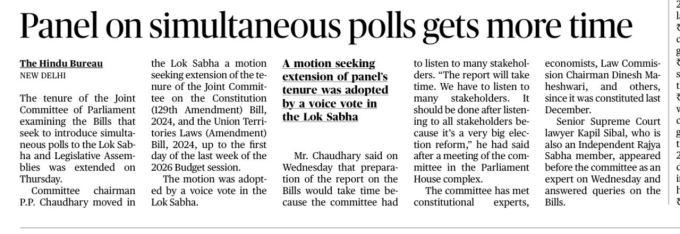
Context The Joint Committee of Parliament examining the Bills for simultaneous elections (including the Constitution (129th Amendment) Bill, 2024 and related Territory/Assembly amendments) had its tenure extended to allow more stakeholder consultations and time to prepare the report.
Key points
1. Extension of committee tenure
- The Joint Committee’s tenure was extended by a voice vote in the Lok Sabha to enable comprehensive deliberations.
- Extension period: the committee will continue work up to the first day of the last week of the 2026 Budget session.
2. Purpose of the committee - To examine multiple Bills that aim to enable simultaneous polls to the Lok Sabha and State Assemblies and related legal changes.
- To prepare a detailed report after consulting experts and stakeholders.
3. Chairman & procedure - Chairman P.P. Chaudhary moved the motion in the Lok Sabha seeking the extension.
- Committee meetings will include sessions with constitutional experts, economists, and officials.
4. Expert consultations - The committee has met constitutional experts and stakeholders; noted appearances include senior jurists and public policy experts to address legal, administrative and federal concerns.
- Input sought on safeguards, amendment routes, and implementation logistics.
5. Legislative timeline and complexity - Bills under review include a constitutional amendment and supporting laws; achieving simultaneous polls requires amendments across constitutional & statutory provisions and operational protocols.
- Committee needs time to examine Centre-State implications, transitional arrangements, and phasing mechanisms.
About One Nation One Election: - The idea proposes holding elections to the Lok Sabha, State Assemblies and local bodies together to reduce frequency of polls and administrative disruption; phased polling across regions is possible rather than a single-day national vote.
- India had a synchronised election system until 1967; desynchronisation followed due to premature dissolutions of state assemblies, creating the current staggered cycle.
- Key issues for reform include constitutional amendments, federal consent, transitional arrangements for states with mid-term dissolutions, and balancing democratic accountability with administrative efficiency.
V-C appointment impasse: SC turns to Justice Dhulia panel Context The Supreme Court intervened in the ongoing dispute between the Kerala Governor and Chief Minister over Vice-Chancellor appointments by constituting a panel headed by former SC judge Justice S. Dhulia to recommend candidates in order of preference.
Key points 1. Reason for SC intervention - A prolonged deadlock between the Kerala Governor (as Chancellor of State universities) and the Chief Minister on approving names for V-C positions.
- No consensus on shortlisted candidates led to administrative paralysis in two universities.
2. SC directions to the panel - Justice Dhulia’s committee must re-examine candidates and propose names for each university in a sealed cover, arranged in order of preference.
- Next hearing scheduled for December 18.
- Attorney-General informed the Court that the State had not provided objections/material on candidates earlier.
3. Nature of disagreements - The Governor approved certain nominees for V-C posts; the Chief Minister objected.
- Both sides remained “not on the same page” regarding eligibility and suitability of candidates.
- SC noted continued deadlock despite attempts at reconciliation.
4. Role of VC in universities - Under university statutes, the Vice-Chancellor is the principal academic and executive officer.
- Acts as a bridge between administrative and academic wings.
- Expected to possess integrity, academic excellence, leadership and administrative experience.
- Historically emphasised by major commissions: Radhakrishnan (1948), Kothari (1964–66), Gnanam (1990), Ramlal Parikh (1993).
- VC is ex-officio Chairperson of key bodies — Executive Council, Academic Council, Finance Committee, Selection Committees.
- Duty-bound to ensure compliance with all Acts/Statutes/Ordinances; has necessary powers to enforce them.
5. Significance of the case - Highlights recurring tensions between Governor (as Chancellor) and elected government in higher-education appointments.
- Raises issues of autonomy, federal balance and procedural fairness in academic governance.
- SC intervention aims to restore institutional functioning while respecting constitutional roles.
UPSC Prelims Practice Question Consider the following statements regarding the role of a Vice-Chancellor in Indian universities: 1. The Vice-Chancellor is the principal academic and executive officer of the university.
2. The Vice-Chancellor is the ex-officio chairperson of the Academic Council and Executive Council. Which of the statements given above is/are correct?
A. 1 only
B. 2 only
C. Both 1 and 2
D. Neither 1 nor 2
Answer: C Explanation:
University statutes universally designate the VC as (i) the
principal academic and executive officer and (ii)
ex-officio chairperson of bodies such as the Executive Council and Academic Council, making both statements correct.
Rhythm of the harvest Context The news highlights the Tiwa community’s traditional collective harvesting of paddy in Umswai village, Assam.
Key points 1. Community harvest practice - Men and women of the Hill Tiwa community harvest paddy together as a coordinated cultural activity.
2. Social-cultural significance - Harvesting is accompanied by rhythmic drumming, showing the community’s integrated approach to work and culture.
3. Location - The event takes place in Umswai village in Karbi Anglong district of Assam.
About Tiwa community: - Tiwa (Lalung) are an ethnic group mainly in Assam and Meghalaya; also present in Arunachal Pradesh, Manipur, and Nagaland.
- Recognised as a Scheduled Tribe in Assam.
- Historically referred to as Lalungs in Buranjis and colonial records; the community prefers the name Tiwa.
UPSC Prelims Practice Question Which of the following statements about the Tiwa (Lalung) community is correct? 1. They are recognised as a Scheduled Tribe in the State of Assam. 2. They are found only in Assam.
A. 1 only
B. 2 only
C. Both 1 and 2
D. Neither 1 nor 2
Answer: A Explanation:
- Statement 1 is correct — Tiwas are a Scheduled Tribe in Assam.
- Statement 2 is incorrect — Tiwas also inhabit Meghalaya and parts of Arunachal Pradesh, Manipur, and Nagaland.
40 farmers detained over ethanol plant protest in Rajasthan
Context
Farmers in Hanumangarh district, Rajasthan, protested against the construction of an ethanol factory at Tibbi, leading to violent clashes with police and detention of 40 farmers.
Key points
1. Reason for the protest
- Farmers have opposed the ethanol plant’s construction for over a year, alleging risks of air and water pollution, which they fear will make agricultural land barren and threaten livelihoods.
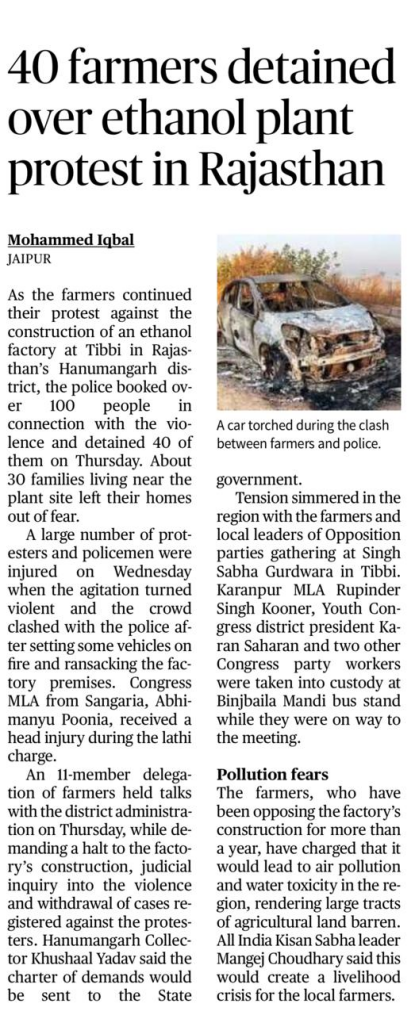
2. Law and order situation - Protest turned violent; vehicles were torched and factory premises ransacked.
- Over 100 people booked; 40 detained.
- Several protesters and policemen injured; a Congress MLA received a head injury during police action.
3. Administrative engagement - An 11-member farmers’ delegation held talks with district officials demanding:
- Halt to construction
- Judicial inquiry into violence
- Withdrawal of cases against protesters
- The district administration agreed to forward demands to the State government.
4. Political involvement - Opposition leaders attempted to visit protest sites; some detained en route.
- Tension continues in the region with ongoing gatherings and solidarity meetings.
5. Pollution fears (core concern) - Farmers believe the plant will cause:
- Air pollution
- Water contamination
- Long-term soil degradation
- Local leaders warn of a potential livelihood crisis for small farmers.
Ethanol - What it is: Ethanol (ethyl alcohol) is a biofuel produced from crops like sugarcane, corn, rice, wheat, and biomass.
- Main source in India: Molasses from sugar industry — A, B, and C molasses have varying sugar content and industrial uses.
- Production: Fermentation of sugars or petrochemical conversion (ethylene hydration).
- Properties: Clear, combustible liquid; fully water-soluble; boiling point 78.37°C; cleaner-burning than petrol.
- Applications:
- Fuel blending with petrol (cleaner alternative)
- Industrial solvent
- Medical disinfectant
- Chemical feedstock
- Basis of alcoholic beverages
‘Your Money, Your Right’ Movement
Syllabus: GS-II — Governance: Government schemes; Financial inclusion and consumer protection. Context Launched in October 2025 and highlighted by the Prime Minister, the campaign mobilises citizens to identify and claim long-forgotten financial assets held across banks, insurers, mutual funds and companies.
Key points
- Objective: Enable citizens to reclaim unclaimed deposits, insurance proceeds, mutual-fund payouts and dividends.
- Scale of unclaimed assets: Banks hold ₹78,000 crore, insurers ₹14,000 crore, mutual funds ₹3,000 crore, and unpaid dividends ~₹9,000 crore.
- Definition: Bank deposits inactive for 10 years are classified as unclaimed deposits.
- Coordination: National campaign coordinated by the Department of Financial Services (DFS), Ministry of Finance.
- Dedicated portals: RBI — UDGAM (unclaimed bank deposits), IRDAI — Bima Bharosa (insurance), SEBI — MITRA (mutual funds), MCA/IEPFA (unpaid dividends & shares).
- Facilitation camps: District-level camps provide on-the-spot guidance, record updates and claim assistance in urban and rural areas.
- Digital support: Campaign showcases digital tools and step-by-step demonstrations to simplify searches and claims.
- Stakeholder involvement: Brings together government agencies, regulators, banks and financial institutions for coordinated asset return.
- Citizen action: Individuals urged to verify records of deceased/elderly relatives and claim entitlements.
- Expected outcome: Improve financial justice, restore citizen assets and strengthen trust in formal financial systems.
Source: PIB
SAMPANN Portal
Syllabus: GS-II — Governance: E-governance; Public Service Delivery; Pension Management.
Context The Controller General of Communication Accounts (CGCA) began onboarding MTNL employees retiring in November 2025 onto the SAMPANN portal, marking an expansion of the Department of Telecommunications’ online pension processing for its retirees. Key points
- What is SAMPANN:
- System for Accounting and Management of Pension — a Comprehensive Pension Management System (CPMS) for DoT pensioners.
- Implementing agency: Developed and run by the Controller General of Communication Accounts (CGCA), Department of Telecommunications.
- Launch date: Launched on 29 December 2018.
- Core function: Provides end-to-end online pension processing — sanction, authorisation, disbursement and accounting on a single platform.
- Direct credit: Enables direct bank credit of pension to beneficiaries without intermediaries.
- Grievance redressal: Includes online grievance management, reducing paperwork and delays.
- Transparency: Allows pensioners to track pension status online, improving accountability.
- Operational benefits: Facilitates faster settlement of cases, quicker arrears/revisions, and simplified reconciliation/auditing.
- Service reach: Now being rolled out for retiring MTNL employees, demonstrating scalability across telecom units.
- Policy significance: Strengthens e-governance, timely pension delivery, and administrative efficiency in public service pensions.
Source: PIB
Swasthya Portal
Syllabus: GS-II — Governance: Health Systems; Welfare Schemes for Vulnerable Sections; Tribal Welfare.
Context The Minister of Tribal Affairs informed the Rajya Sabha that there are no plans to expand the Swasthya Portal to integrate national health databases, district dashboards, or AI-enabled analytics. Key points
- Purpose: A one-stop platform providing the health and nutrition status of India’s tribal population.
- Developed under: The TRI ECE Central Sector Scheme of the Ministry of Tribal Affairs.
- Hosting & maintenance: Hosted on NIC servers and maintained by the Centre of Excellence for Knowledge Management for Health and Nutrition.
- Functionality: Curates data, innovative practices, research briefs, case studies, and best practices from across India.
- Dashboard feature: Covers 177 high-priority tribal districts with consolidated health and nutrition indicators.
- Additional segments: Includes a knowledge repository, partner section, and Sickle Cell Disease (SCD) support corner.
- Stakeholder use: Provides evidence-based insights for policymakers, researchers, and organisations working on tribal health and nutrition.
Key facts about TRI ECE Scheme - Type: Central Sector Scheme under the Ministry of Tribal Affairs.
- Support: Provides funding to research institutions, universities, and reputed organisations with expertise in tribal-related domains.
Source: PIB
Shilp Didi Programme
Syllabus: GS-II — Governance: Women Empowerment; Skill Development; Livelihood Promotion. Context The Union Textiles Secretary announced that the Shilp Didi Programme has significantly increased women artisans’ earnings, with some achieving incomes of over ₹5 lakh through improved skills and market access.
Key points
- What it is: A government initiative to economically empower women artisans (“Shilp Didis”) through training, digital skills, and market linkages.
- Launch year: 2024 (100-day pilot started in June 2024).
- Implementing body: Ministry of Textiles, via the Office of the Development Commissioner (Handicrafts).
- Aim: To ensure financial independence, enhance design and business capabilities, and enable modern marketing and entrepreneurship.
- E-training modules: Includes entrepreneurship, regulatory compliance, social media use, and e-commerce onboarding.
- Market access: Opportunities via Dilli Haat, craft fairs, curated events, and exhibitions.
- E-commerce integration: Ensures nationwide and global visibility for women artisans’ products.
- Coverage (pilot): 100 artisans from 72 districts across 23 states.
- Diverse crafts: Covers 30 handicrafts — textiles, pottery, metal crafts, embroidery, and more.
- Capacity building: Supported through NHDP clusters, enabling skill enhancement and better production support.
- Significance:
- Generates sustainable livelihoods in rural and non-farm sectors.
- Strengthens women-led micro-entrepreneurship.
- Enhances digital inclusion, enabling artisans to use social media and online marketplaces effectively.
Source: News On Air
UNEP Champions of the Earth Award – 2025
Syllabus: GS-III — Environment: Global Environmental Governance; International Awards; Climate Leadership. Context Supriya Sahu, Additional Chief Secretary of Tamil Nadu, has received the UNEP Champions of the Earth 2025 Award for her outstanding leadership in climate mitigation, adaptation, and heat resilience.
Key points
- What it is: The highest environmental honour of the United Nations, awarded annually by UNEP to recognise exceptional environmental leadership.
- Established: Created in 2005; has honoured 127 laureates including heads of state, scientists, activists, and innovators.
- Award categories: Four categories — Policy Leadership, Inspiration & Action, Entrepreneurial Vision, Science & Innovation.
- 2025 focus areas: Climate justice, resilient buildings, sustainable cooling, methane reduction, and forest protection.
- Purpose: To acknowledge innovative, community-led, and scalable environmental solutions that advance global climate and sustainability goals.
- Global significance: Encourages ambition aligned with the Paris Agreement and the Sustainable Development Goals (SDGs).
Source: UNEP

 Launch your Graphy