Daily Current Affairs for UPSC 11th Dec 2025


| Index |
| S.No | Topic | Page No |
| Daily Hindu Analysis (YouTube) |
| 1. | A verdict that is an abdication of judicial function |
|
| 2. | Is India’s 8.2% growth rate sustainable? |
|
| 3. | Karnataka govt. tables in House Bill to curb hate speech; BJP MLAs resist |
|
| 4. | MGNREGS delay: farm outfit sends notice to Centre, Bengal govt. |
|
| 5. | SC order, enforcement lapse allow overage vehicles to ply: CAQM |
|
| 6. | India gives tepid response to Russian push for Su-57, long-range drones and submarines |
|
| 7. | Illegal immigrants will be detected, deported: Shah |
|
| |
| Daily Current Affairs (App) |
| 8. | About Large Language Models (LLMs) |
|
| 9. | UN Environment Assembly |
|
| 10. | Bluetongue Virus | |
| 11. | India International Science Festival | |
| 12. | International Organization for Marine Aids to Navigation | |
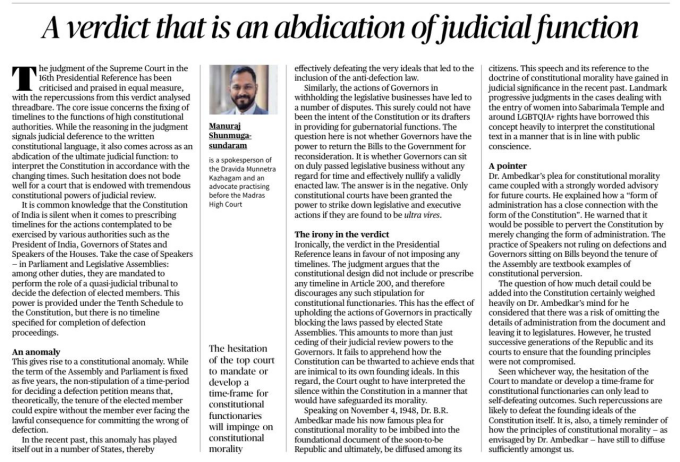
A verdict that is an abdication of judicial function
Context
The author critiques the Supreme Court’s judgment in the 16th Presidential Reference which, by refusing to fix timelines for certain constitutional functions (notably Speaker/Governor actions), is said to amount to judicial abdication and to weaken constitutional accountability.
Detailed analysis Judicial restraint vs abdication
- The judgment emphasises judicial deference to the text and institutional role of constitutional actors.
- The author contends this deference crosses into abdication when the Court declines to interpret the Constitution so as to provide workable time-limits or guidance for executive/legislative functionaries.
- Risk: When courts avoid specifying clear standards, constitutional gaps are filled by inertia or political expediency.
The problem of non-prescribed timelines - Several high-impact constitutional functions (e.g., Speaker’s decision on defections, Governor’s reservation/return of Bills) lack statutory or constitutional timelines.
- Without judicially enforced timelines, these functions can be delayed indefinitely, undermining accountability and the rule of law.
- The author calls this an anomaly that can subvert representative democracy (e.g., delayed defection proceedings altering the effective tenure of elected members).
Examples and precedent used by the author - The article refers to Speakers not deciding defection petitions and Governors withholding legislative business, illustrating how inaction can change political outcomes.
- The author invokes constitutional history and Dr. B.R. Ambedkar’s plea for constitutional morality as normative basis for judicial intervention—courts should preserve founding ideals rather than retreat into pure textualism.
Irony in the Presidential Reference verdict - The Court’s view that Article 200 (and related provisions) do not prescribe timelines is interpreted as encouraging passivity by constitutional actors.
- The verdict is seen as effectively sanctioning delay, allowing Governors or Speakers to stall processes that affect democratic governance.
Constitutional morality and the role of the judiciary - The author stresses that the judiciary has a duty to develop interpretative norms where silence in the text could otherwise defeat constitutional values.
- Citing Ambedkar, the piece argues for constitutional morality — judges should ensure administration conforms to the spirit of the Constitution, not merely its letter.
Suggestions of the author - Judicial engagement: Courts should interpret gaps (like absence of timelines) in a manner that safeguards democratic functioning and prevents abuse.
- Develop standards: The Supreme Court ought to formulate reasoned standards or reasonable timeframes for exercise of crucial constitutional functions where silence exists.
- Protect constitutional morality: The judiciary must actively preserve the founding principles by insisting on procedures that prevent arbitrary or indefinite inaction by constitutional actors.
- Avoid formalistic passivity: Where non-action undermines rights or representative governance, courts should not hide behind textual lacunae.
Conclusion The author warns that the 16th Presidential Reference judgment, by refusing to fill constitutional lacunae, risks normalising delay and eroding accountability. Rather than abdicating interpretative responsibility, the judiciary should use its constitutional review power to frame principles and timelines that protect democratic governance and constitutional morality.
UPSC Mains Question: “Judicial hesitation to regulate the exercise of power by constitutional functionaries can itself become a threat to constitutional governance.”
Discuss in light of the Supreme Court’s verdict in the 16th Presidential Reference, highlighting the roles of Governors, Speakers, and the doctrine of constitutional morality.
Is India’s 8.2% growth rate sustainable?

Context
The article analyses India’s reported 8.2% GDP growth, highlighting strong economic momentum across manufacturing, services, and consumption. However, it simultaneously brings out concerns raised by the IMF and RBI regarding data quality, structural weaknesses, external vulnerabilities, and whether such high growth can be sustained over the long term.
Detailed Analysis
1. Growth Momentum and Sectoral Performance India’s GDP rising to ₹48.63 lakh crore reflects broad-based expansion.
- Manufacturing posted strong growth, indicating improved capacity utilisation and healthier demand.
- Services, including financial and real estate services, supported overall output and credit activity.
- Agriculture grew modestly, aided by horticulture output and rural demand revival.
2. Drivers of Demand: Consumption and Investment The article notes that Private Final Consumption Expenditure (PFCE) increased, reflecting stronger household spending.
Industrial output and infrastructure activity also show signs of improved investment demand.
However, the author warns that without a broad-based private investment revival, current growth could remain cyclical rather than structural.
3. Inflation Softening and Macro Stability Inflation, high through much of the previous years, eased, providing relief to real incomes and improving consumption.
Banks, benefiting from cleaner balance sheets and reduced NPAs, supported credit growth.
Yet, inflation remains vulnerable to commodity price shocks and supply disruptions.
4. Institutional Concerns: IMF’s “Grade-C” and Data Reliability The IMF’s Grade-C rating on India’s national accounts methodology raises concerns about the robustness of GDP estimates.
The article argues that accurate statistical systems are essential because flawed data can misguide fiscal and monetary policy.
5. External Sector Risks Highlighted by RBI The RBI Annual Report 2023–24 cited slowing global trade, geopolitical tensions, and protectionist trends as major threats to India’s export trajectory.
With global demand subdued, India’s ability to sustain high growth becomes uncertain.
Volatile capital flows, a strong dollar, or geopolitical shocks could strain the balance of payments and financial stability.
6. Structural Vulnerabilities The author emphasises that India still faces:
- Uneven productivity across sectors
- Dependence on services rather than labour-intensive manufacturing
- Weak job creation relative to economic expansion
- Gaps in infrastructure and regulatory bottlenecks
These limit the durability of high growth unless addressed through deeper reforms.
Suggestions by the Author 1.
Strengthen statistical systems to address IMF concerns and improve data reliability.
2.
Boost private investment through regulatory reforms and sectoral incentives
3.
Enhance export competitiveness to navigate global volatility.
4.
Focus on labour-intensive manufacturing to generate sustainable, employment-driven growth.
5.
Maintain macro-stability via prudent fiscal management and inflation anchoring.
Conclusion India’s 8.2% growth is encouraging and broad-based, but its sustainability depends on addressing structural gaps, improving data quality, and managing external risks. Without deep reforms, the present momentum may remain temporary.
UPSC Mains Question “India’s high GDP growth figures reflect strong momentum, yet institutional and external vulnerabilities raise doubts about sustainability. Discuss.” (250 words)
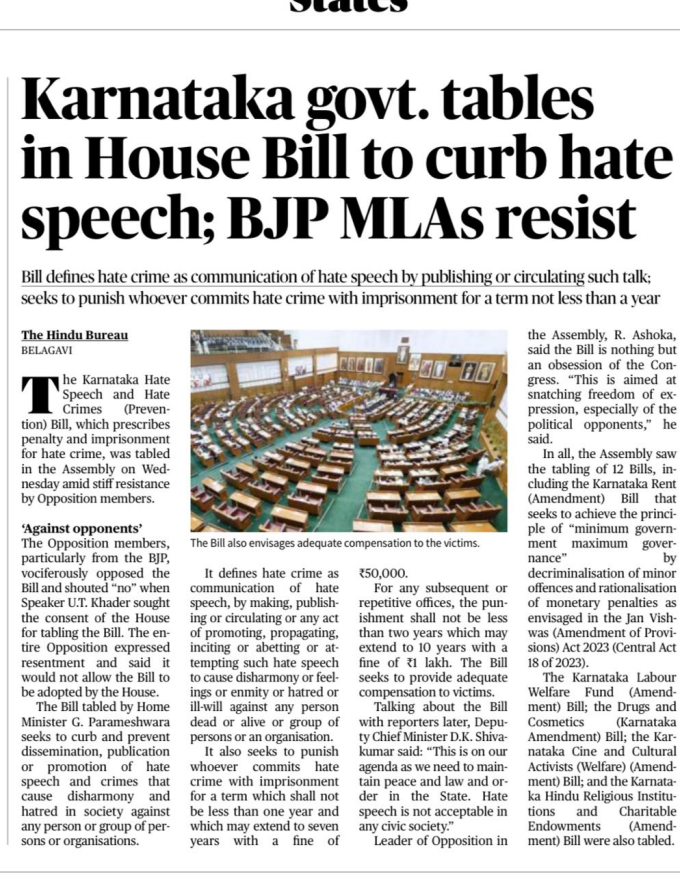
Karnataka govt. tables in House Bill to curb hate speech; BJP MLAs resist
Context
The Karnataka government introduced the Karnataka Hate Speech and Hate Crimes (Prevention) Bill in the Assembly to curb dissemination and promotion of hate speech. Opposition MLAs resisted its introduction, alleging curbs on free expression.
Key Points
1. Purpose of the Bill
- Seeks to prevent, control, and punish hate speech and hate crimes in the State.
- Aims to curb communication of content that promotes disharmony, enmity, hatred, or ill-will against any person or group.
2. Definition of Hate Crime - Defined as communication of hate speech by making, publishing, circulating, promoting, inciting, abetting or attempting such expressions.
- Target may be any person (dead or alive) or any group/organisation.
3. Penal Provisions - First offence: Imprisonment not less than 1 year, extendable up to 3 years, plus fine up to ₹50,000.
- Repeat offence: Imprisonment not less than 2 years, extendable up to 10 years, and fine up to ₹1 lakh.
- The Bill also envisages compensation to victims.
4. Opposition’s Objections - BJP MLAs protested, calling the Bill an attempt to curb freedom of expression, especially of political opponents.
- They objected to the Bill being tabled without full House consent.
- Claimed it could be misused for political vendetta.
5. Government’s Justification - Deputy Chief Minister stated the Bill is needed to maintain peace and public order, and that hate speech is unacceptable in a civic society.
- Claimed it is part of a broader governance agenda to ensure social harmony.
6. Constitutional Angle — Article 19(1) and Restrictions - Freedom of speech under Article 19(1)(a) is not absolute.
- Restrictions can be imposed under Article 19(2) on grounds such as:
- Public order
- Decency or morality
- Security of the State
- Sovereignty & Integrity of India
- Defamation or incitement to an offence
- Bills penalising hate speech fall within “public order” and “decency”-based restrictions.
7. Legislative Context - The Assembly also tabled several other Bills, including amendments relating to Labour Welfare and Religious Institutions.
Additional Information Right to Freedom — Article 19 1. Speech & expression
2. Peaceful assembly
3. Form associations/unions
4. Move freely
5. Reside & settle anywhere
6. Practice any profession/trade
- The State may impose reasonable restrictions on these rights under clauses (2)–(6) for public order, morality, security, etc.
- Hate speech laws operate under these permissible restrictions.
UPSC Prelims Practice Question Q. Under the Constitution of India, restrictions on the freedom of speech and expression can be imposed on which of the following grounds? 1. Public order 2. Defamation 3. Morality 4. Economic stability of the State Select the correct answer:
A. 1, 2 and 3 only
B. 1, 2 and 4 only
C. 1 and 3 only
D. 1, 2, 3 and 4
Answer: A Explanation: Article 19(2) allows restrictions for public order, decency/morality, defamation, security of the State, etc.
“Economic stability of the State” is
not a constitutionally permitted ground.
MGNREGS delay: farm outfit sends notice to Centre, Bengal govt.

Context
A farmers’ union, Paschim Banga Khet Majoor Samity (PBKMS), has sent a legal notice for contempt of court to the State and Central governments over the continued non-resumption/suspension of MGNREGS work in West Bengal since March 2022 despite court directions.
Key points 1. Legal action
- Who: Paschim Banga Khet Majoor Samity (PBKMS).
- What: Legal notice for contempt of court against Centre and West Bengal government.
- Why: Alleged non-compliance with directions from the Calcutta High Court and the Supreme Court to restart MGNREGS work.
2. Status of MGNREGS in West Bengal - Suspension: Scheme reportedly remained suspended in the State since March 2022
- Implication: Loss of guaranteed employment and income for rural households; potential entitlement to unemployment allowance if work not provided.
3. Courts and statutory obligations - Court directives: Calcutta High Court and Supreme Court had issued directions to resume work — non-implementation can attract contempt proceedings.
- Statutory guarantee: MGNREGA legally entitles eligible rural adults to work; failure to provide work triggers statutory obligations (unemployment allowance).
4. Implementation & beneficiary impact - Immediate effect: Workers lose wage income, affecting rural purchasing power and livelihood security.
- Long-term risk: Extended suspension undermines the scheme’s role as a safety net during lean seasons and shocks.
About MGNREGA : - MGNREGA launched in 2005; one of the largest work-guarantee programmes globally.
- Guarantee: Legal guarantee of 100 days of employment in a financial year to adult members of rural households willing to do unskilled public work at statutory minimum wage.
- Active workers (2023–24): 14.32 crore.
- Delivery norms: Work must be provided within 15 days of demand or an unemployment allowance is payable.
- Gender provision: At least one-third of registered beneficiaries shall be women.
- Social audit: Section 17 mandates social audit of all works executed under MGNREGA.
- Objective: Improve purchasing power of rural poor, provide livelihood security, and reduce rural poverty via unskilled wage employment.
UPSC Prelims Practice Question (MCQ) Consider the following statements about the Mahatma Gandhi National Rural Employment Guarantee Act (MGNREGA): 1. MGNREGA guarantees 100 days of wage employment to every rural household in a financial year whose adult members volunteer to do unskilled manual work.
2. The Act mandates that work must be provided within 15 days of demand or an unemployment allowance must be paid.
3. Section 17 of the Act provides for social audit of all works under MGNREGA.
Which of the statements given above are correct?
A. 1 and 2 only
B. 2 and 3 only
C. 1 and 3 only
D. 1, 2 and 3
Answer: D Explanation:
- Statement 1: Correct — MGNREGA provides a legal guarantee of up to 100 days of employment to an adult member of any rural household willing to do unskilled public work.
- Statement 2: Correct — The Act requires that work be provided within 15 days of demand; otherwise the implementing authority must pay an unemployment allowance.
· Statement 3: Correct — Section 17 mandates social audit of works under MGNREGA.
SC order, enforcement lapse allow overage vehicles to ply: CAQM 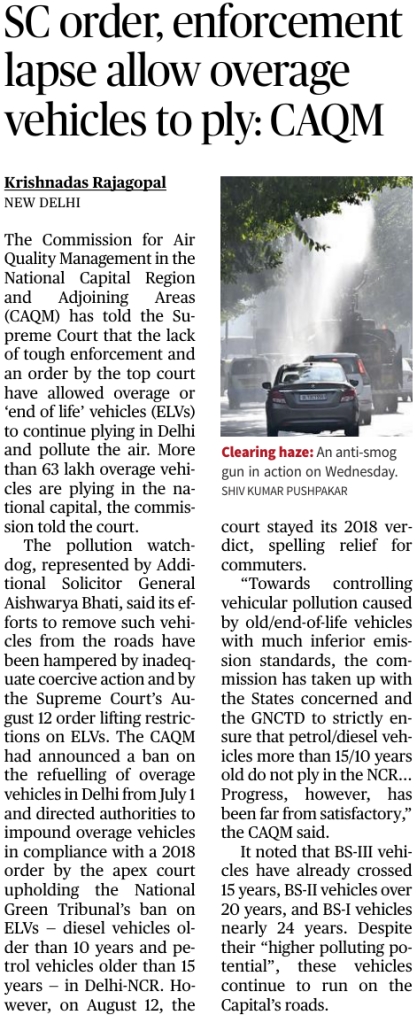
Context
The Commission for Air Quality Management (CAQM) told the Supreme Court that weak enforcement and a court order lifting restrictions have allowed end-of-life/overage vehicles to continue plying in Delhi-NCR, worsening vehicular pollution.
Key points
1. CAQM’s submission to Supreme Court
- CAQM, represented by Additional Solicitor General Aishwarya Bhati, informed the Supreme Court that enforcement gaps and the August 12 order lifting some restrictions impeded removal of overage vehicles.
- CAQM reported that over 63 lakh overage vehicles are plying in the national capital region.
2. Policy action announced by CAQM - CAQM had announced a ban on refuelling overage vehicles in Delhi from July 1 and directed authorities to impound such vehicles in line with a 2018 apex court verdict upholding NGT norms.
- The 2018 judgment supported the NGT’s ban on ELVs: diesel vehicles older than 10 years and petrol vehicles older than 15 years in Delhi-NCR.
3. Enforcement lapse and its impact - Enforcement failures (inadequate coercive action, poor on-ground implementation) meant many high-polluting vehicles continued to operate.
- Consequence: continued emissions from older vehicles with inferior emission standards, undermining air quality improvement efforts.
4. Vehicle fleet age and emission concerns - CAQM noted ageing fleet profile: BS-III vehicles have crossed 15 years, BS-II over 20 years, and BS-I nearly 24 years — indicating many vehicles predate modern emission norms.
- Older Bharat Stage (BS) vehicles have “higher polluting potential” and significantly contribute to ambient particulate and gaseous pollution.
5. Institutional and legal dimensions - Tension between judicial orders and on-ground enforcement: court directions can enable or constrain executive action depending on their scope.
- CAQM’s directions are binding, but effective implementation requires state cooperation (GNCTD and adjoining States) and adequate enforcement machinery.
6. Public health & administrative implications - Continued operation of ELVs raises public health risks (respiratory and cardiovascular).
- Administrative challenge: identifying, impounding, and providing legal/rehabilitative pathways for affected vehicle owners while ensuring compliance.
CAQM (Commission for Air Quality Management) - Statutory body established under the Commission for Air Quality Management in NCR and Adjoining Areas Act, 2021.
- Mandate: coordinate, monitor, and take actions to prevent & control air pollution in Delhi-NCR and adjoining areas; issue binding directions.
- Powers include restricting activities affecting air quality, conducting research, issuing enforceable orders, and coordinating with Delhi and neighbouring States.
GRAP (Graded Response Action Plan) - GRAP is a pre-emptive, staged emergency framework for Delhi-NCR (formulated after M.C. Mehta direction; notified 2017).
- Implemented by CAQM/MoEFCC and state authorities; activates progressively stricter measures as AQI worsens:
- Stage I (Poor): basic measures (dust management, vehicle PUC enforcement).
- Stage II (Very Poor): restrict diesel generators, hotspot controls.
- Stage III (Severe): curbs on specific vehicles, construction limits, remote schooling.
- Stage IV (Severe+): bans on heavy vehicle entry, school closures, shutdown of non-essential industry.
- Purpose: prevent escalation to hazardous AQI by time-bound, coordinated actions.
India gives tepid response to Russian push for Su-57, long-range drones and submarines
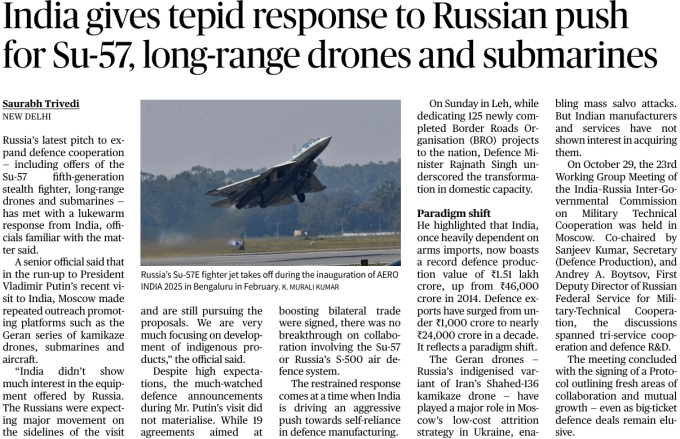
Context Russia offered deepened defence cooperation (Su-57 fighters, long-range drones, submarines) during recent outreach, but India’s response was lukewarm as New Delhi prioritises indigenous defence production and selective, capability-driven acquisitions.
Key points 1. Russia’s pitch
- Moscow proposed expanded defence ties including Su-57 fifth-generation fighters, long-range drones (Geran / kamikaze types) and submarines during high-level outreach.
- The proposals formed part of Russia’s efforts to deepen India-Russia military-technical cooperation.
2. India’s restrained response - Officials described India’s reply as lukewarm / tepid — no major deals or breakthrough announcements on Su-57, S-500 or similar high-end platforms.
- New Delhi emphasised domestic capability and circumspection in committing to major foreign systems.
3. Strategic/industrial rationale - India is pursuing self-reliance in defence manufacturing, focusing on indigenous development and capacity building.
- Defence Minister highlighted growth in domestic defence production and exports as evidence of a paradigm shift.
4. Defence production & export trends (as reported) - Defence production rose markedly (reported ~₹1.51 lakh crore vs ~₹46,000 crore in 2014).
- Defence exports increased from around ₹1,000 crore to nearly ₹24,000 crore in a decade — showing a shift from import dependence toward exports.
5. Operational and strategic considerations - India assesses acquisitions on capability fit, technology transfer, lifecycle costs and strategic implications.
- Concerns about platforms (e.g., stealth fighters, long-range drones, submarines) include integration, logistics, and operational doctrines.
6. Multilateral / diplomatic context - Working groups (India-Russia military-technical commissions) continue dialogue, but recent meetings produced limited concrete procurement outcomes.
- India balances relations with Russia while strengthening domestic industry and engaging other partners.
Note: India-Russia Inter-Governmental Commission on Military Technical Cooperation — forum where such proposals and working group outcomes are discussed and negotiated.
Illegal immigrants will be detected, deported: Shah Context During a Lok Sabha discussion on electoral reforms, the Union Home Minister stated that the government will “detect, delete, and deport” illegal immigrants from India, leading to a heated exchange and an Opposition walkout.
Key Points 1. Government’s Stand on Illegal Immigration - Home Minister asserted that illegal immigrants (infiltrators) will be identified and deported using constitutional provisions.
- Justified strict action by linking illegal migration to electoral roll contamination and national security risks.
- Emphasised the need to remove non-citizens’ names from voter lists.
2. Sharp Exchange in Parliament - Opposition, led by the Leader of Opposition (LoP), questioned the government's approach to electoral reforms, particularly the Special Intensive Revision (SIR) of electoral rolls announced by the Election Commission.
3. Debate on Electoral Reforms - Opposition raised concerns about:
- Transparency in electoral processes.
- Digital, machine-readable voter databases.
- CCTV access and clarity on electoral malpractice.
4. EC’s Role & Clarifications - The Home Minister referenced the Election Commission’s clarifications on alleged irregularities in Haryana elections.
- EC clarified that Election Commissioners enjoy immunity for decisions taken under the 2023 law and that no coercive action was taken.
5. Constitutional Angle: Citizenship & Voter Eligibility - Only Indian citizens are entitled to be enrolled as voters under Article 326 (adult suffrage).
- Including foreign nationals on electoral rolls violates electoral integrity.
- Illegal migration is usually addressed under:
- Foreigners Act, 1946
- Passport (Entry into India) Act, 1920
- Citizenship Act, 1955 (provisions for acquisition/loss of citizenship)
About Large Language Models (LLMs)
Syllabus: GS Paper 3 — Science & Technology; Artificial Intelligence and Emerging Technologies
Context: LLMs are advanced AI systems built to understand and generate human-like language. Their growing use in digital tools and industries raises questions about training processes, applications, and associated challenges.
Key Points - LLMs are AI programs designed to recognise, interpret, and generate text based on patterns learned from massive datasets.
- “Large” refers to data scale, as models are trained on thousands or millions of gigabytes of text.
- They use transformer neural networks, which excel at handling word sequences and capturing contextual patterns.
- Deep learning enables LLMs to analyse unstructured data and learn distinctions without human instructions.
- Quality of training data matters; curated datasets improve accuracy and reduce errors.
- LLMs undergo fine-tuning or prompt-tuning to specialise in specific tasks after base training.
- Common tasks include answering questions, summarising, translating, and writing content.
- Businesses use LLMs to enhance productivity, personalise services, and speed up product development.
- They power major GenAI tools like ChatGPT, Claude, Copilot, Gemini, and Meta AI.
- Many are now multimodal, processing images and other media, leading them to be called foundation models.
- Challenges include high computational needs, ethical concerns, and limitations in deeper contextual understanding.
Source: The Hindu
UN Environment Assembly Syllabus: GS Paper 3 — Environment;
Global Environmental Governance
Context: The seventh session of the
UN Environment Assembly (UNEA-7) is being held in Nairobi, Kenya, focusing on advancing collaborative global action to address environmental challenges.
Key Points About UN Environment Assembly - Highest-level global body for decision-making on environmental matters.
- Universal membership of all 193 UN Member States with participation from major groups and stakeholders.
- Meets every two years in Nairobi, Kenya, bringing together environment ministers.
- Established in 2012 as a key outcome of the Rio+20 Conference held in Brazil.
Functions of UNEA - Sets the global environmental agenda and frames policy responses to emerging challenges.
- Conducts policy review, dialogue, and exchange of best practices among nations.
- Provides strategic guidance for the future direction of the UN Environment Programme (UNEP).
- Fosters partnerships and mobilises resources for achieving environmental objectives.
- Structured with a President and 8 Vice Presidents, collectively forming the UNEA Bureau.
UNEA-7 (2025) Theme - “Advancing sustainable solutions for a resilient planet.”
Source: New Indian Express
Bluetongue Virus
Syllabus: GS Paper 3 — Health; Animal Diseases & Biosecurity
Context: Northern Ireland has reported more suspected cases of
Bluetongue Virus (BTV), raising concerns over livestock health, disease spread, and trade implications.
Key Points About Bluetongue Virus
- Causes bluetongue (BT), a severe haemorrhagic disease in animals.
- It is infectious but non-contagious, spreading only through vectors.
- Affects domestic ruminants—cattle, sheep, goats—and wild ruminants like deer, antelope, buffalo, camels.
- Sheep are most severely affected among domestic animals.
- Found in all continents except Antarctica.
Transmission - Mainly spread through bites of infected Culicoides midges, common on farms.
- Some strains can cross the placenta, infecting the fetus during pregnancy.
Human Risk - No transmission to humans; BTV does not infect people.
- Meat and dairy remain safe for consumption.
Clinical Signs (mainly in sheep) - High fever (40°C–42°C).
- Sometimes a bluish, swollen tongue, though not always present.
Impact - Leads to high morbidity and mortality in flocks and herds.
- Causes production losses such as reduced milk yield and affects trade.
Treatment & Prevention - No effective treatment currently exists.
- Vaccines available for certain strains; used in parts of Africa, Asia, and Europe.
Source: BBC
India International Science Festival
Syllabus: GS Paper 3 — Science & Technology; Scientific Events & Innovation Ecosystem
Context: The
11th India International Science Festival (IISF) is being organised in Panchkula, Haryana, showcasing India’s scientific achievements and promoting public engagement in science.
Key Points About India International Science Festival - Launched in 2015 to popularise science and promote scientific culture.
- Aims to connect citizens with scientific institutions nationally and globally.
- Encourages collaboration and interaction among scientists, innovators, and the public.
- Guided by the spirit of swadeshi, emphasising science for national wellbeing.
- Mission: To bridge traditional knowledge systems with modern scientific research.
Key Facts about IISF 2025 - Organised by the Ministry of Earth Sciences (MoES); coordinated by IITM Pune.
- Theme for 2025: “Vigyan Se Samruddhi: for Aatmanirbhar Bharat.”
- Features 150+ technical and thematic sessions across science, technology, and innovation.
Focus Areas of IISF 2025 - Science, Technology & Ecology of North-West India and the Himalayan region.
- Science for Society and Education.
- Atmanirbhar Bharat through Science & Technology.
- Integration of Traditional Knowledge with Modern Science.
Source: PIB
International Organization for Marine Aids to Navigation
Syllabus: GS Paper 3 — Infrastructure;
Maritime Transport & International Organizations
Context: India hosted the
3rd Session of the IALA Council in Mumbai, highlighting global cooperation in navigation safety and harmonised maritime systems.
Key Points About International Organization for Marine Aids to Navigation (IALA) - Established in 1957 as an NGO to improve marine navigation systems.
- Became an Intergovernmental Organization (IGO) in 2024 after a convention was ratified by 34 states.
- Works to harmonise global maritime navigation, enhance safety, and support environmental protection.
- Motto: Successful Voyages, Sustainable Planet.
- The IALA Council acts as the main decision-making body for marine aids to navigation.
Aims of IALA - Promote safe, economic, and efficient vessel movement through harmonised navigation aids.
- Support and share latest developments in maritime navigation.
- Strengthen international cooperation and assist member states.
- Enhance information exchange with user organizations and industry stakeholders.
Membership & Structure - Has 200 members: 80 national authorities and 60 commercial firms.
- India is a founding member, associated since 1957.
- Headquarters located in Saint-Germain-en-Laye, France.
Source: PIB

 Launch your Graphy