There are no items in your cart
Add More
Add More
| Item Details | Price | ||
|---|---|---|---|


| Index | ||
| S.No | Topic | Page No |
| Daily Hindu Analysis (YouTube) | ||
| 1. | Charting an agenda on the right to health | |
| 2. | Value of water: evaluating the pricelessness of clean, potable water | |
| 3. | Aditya-L1 joins global effort revealing why the 2024 solar storm behaved unusually | |
| 4. | INDIA bloc MPs seek to impeach Madras HC judge | |
5. | SURYAKIRAN-XIX: India-Nepal Army exercise concludes in Uttarakhand | |
| Daily Current Affairs (App) | ||
| 6. | 2nd WHO Global Summit on Traditional Medicine | |
| 7. | Dumping | |
8. | Senna spectabilis | |
9. | Saudi UNESCO Global Network of Learning Cities (GNLC) | |
MULTI-DISCIPLINARY SYLLABUS MAPPING (GS-I, GS-II, GS-III, GS-IV)
This topic spans all General Studies papers, making it extremely high leverage.
GS-I (Society)
GS-II (Governance, Social Justice)
GS-III (Economy, Development, Environment)
GS-IV (Ethics)
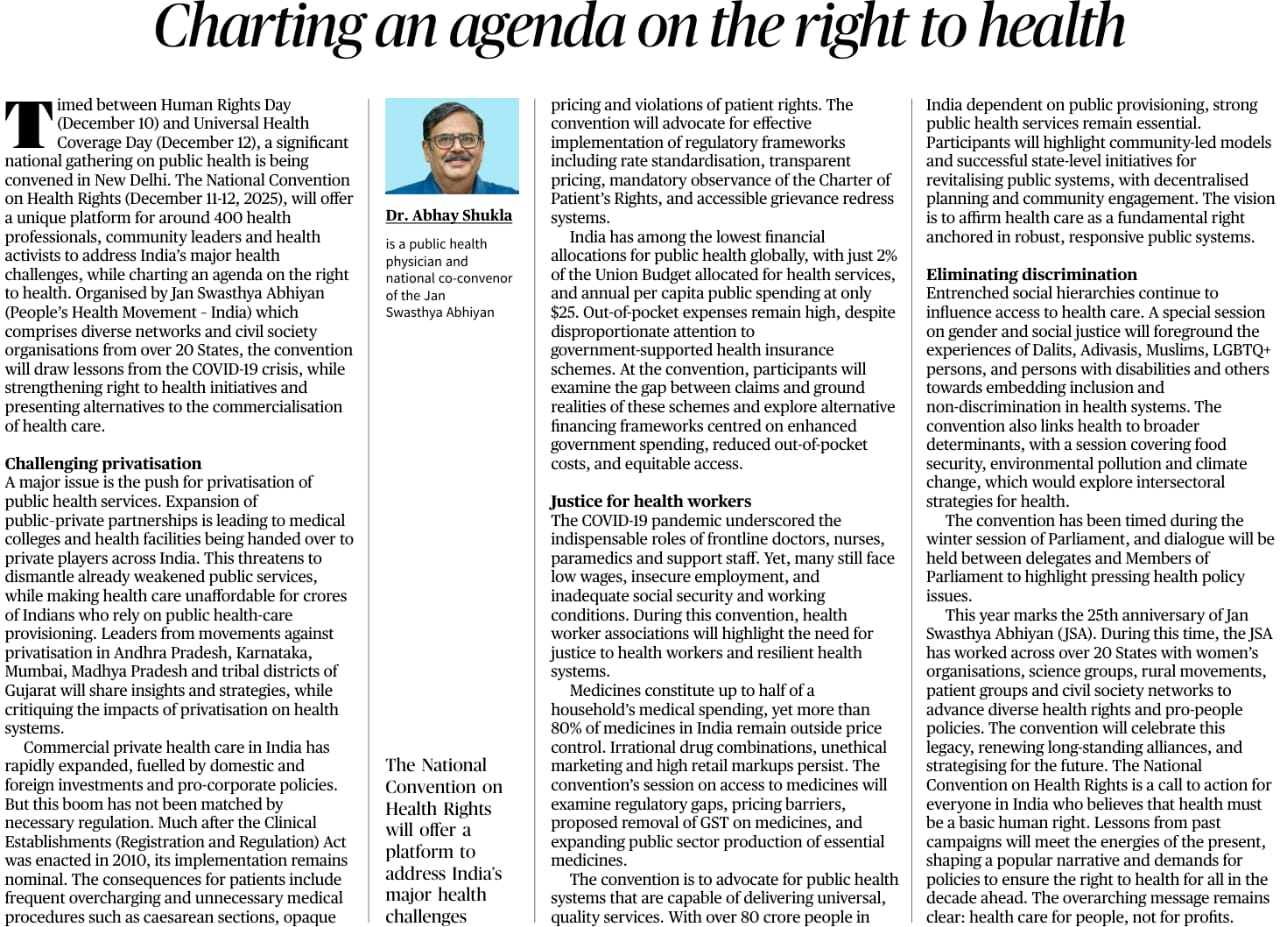
II. CHALLENGING PRIVATISATION OF HEALTH CARE
1. Rapid expansion of private sector
2. Consequences for public health
3. Regulatory failure
4. Concern articulated in the article
III. LOW PUBLIC HEALTH SPENDING & HIGH OUT-OF-POCKET EXPENDITURE
1. India’s low public investment
2. High OOP (Out-of-pocket expenditure)
3. Consequences
4. Structural issues
5. Article’s emphasis
IV. RIGHTS-BASED REGULATORY FRAMEWORKS
1. Need for enforceable patient rights
2. Health as a fundamental right
3. Regulatory gaps in private sector
V. JUSTICE FOR HEALTH WORKERS
1. COVID-19 lessons
2. Why worker justice is essential
VI. ACCESS TO MEDICINES: THE MOST EXPENSIVE COMPONENT OF HEALTHCARE
1. Medicines = 50% of household medical expenditure
2. Issues identified
3. Convention’s focus
VII. STRENGTHENING PUBLIC HEALTH SYSTEMS
1. Why public provisioning matters
2. Successful public health models highlighted
3. Vision
VIII. ELIMINATING SOCIAL DISCRIMINATION IN HEALTH
1. Persistent inequalities
2. Convention’s focus session
3. Social determinants
All these reinforce health inequities.
IX. INTER-ORGANISATIONAL COLLABORATION & POLICY DIALOGUE
1. Role of Jan Swasthya Abhiyan
2. Convention & Parliamentary engagement
X. VISION FOR THE NEXT DECADE
The overarching message: Health care must be recognised as a basic human right in India.
Future agenda includes:
UPSC MAINS QUESTION
“Growing privatisation of healthcare in India threatens equity and undermines the constitutional vision of the Right to Health.” Critically examine.
MULTI-DISCIPLINARY SYLLABUS MAPPING
⭐ GS-I (Geography & Society)
⭐ GS-II (Governance, Welfare, Policies & Social Justice)
⭐ GS-III (Economy, Environment, Infrastructure)
⭐ GS-IV (Ethics)
⭐ ESSAY (Major Theme)
 .
.(Structured exactly in line with the article’s themes + UPSC mains requirements)
I. CONTEXT & SIGNIFICANCE
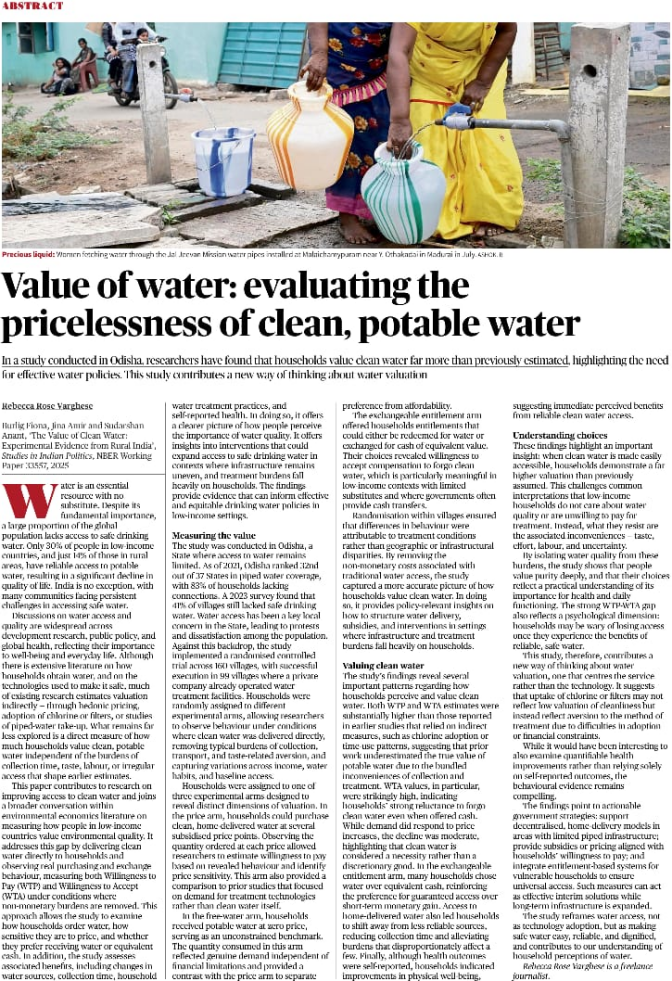
Clean water is indispensable for survival, health, and overall human well-being, yet substantial sections of India’s population lack access to safe drinking water. Despite technological and policy improvements, nearly 30% of rural households still rely on unsafe sources. The editorial is based on a rigorous experimental study conducted in Odisha which provides rare, empirical evidence of how households truly value clean water, challenging long-standing assumptions that low-income households are unwilling to pay for improved water quality.
The study's significance lies in its ability to reveal behavioural preferences that traditional valuation methods overlook. It highlights the mismatch between infrastructure development, service reliability, and actual household needs. The findings have deep implications for water policy, welfare models, and sustainable development, emphasising that the value of clean water extends far beyond monetary price—it shapes health outcomes, labour patterns, and dignity.
II. UNDERSTANDING EXISTING GAPS IN WATER VALUATION RESEARCH
1. Limits of traditional measurement methods
Previous research relies heavily on indirect measures such as chlorine uptake, filter adoption, price elasticity studies, or evaluations of riparian consumption patterns. These proxy indicators underestimate how households actually perceive water quality, because they fail to capture:
2. Consequence of methodological gaps
As a result, governments often undervalue the true benefits of improved water systems and continue investing in infrastructure that does not address reliability, treatment, or last-mile delivery. This gap in evidence limits the effectiveness of water policies and fails to capture the multidimensional benefits households associate with clean water.
3. Contribution highlighted in the article
The Odisha study directly measures how households value clean, potable water—separate from infrastructure or technology. This provides a more accurate basis for designing equitable and efficient drinking water policies in low-income contexts.
III. MEASURING THE VALUE OF WATER: THE ODISHA EXPERIMENT
1. Study Design
The study was conducted between 2021 and 2023 across 180 villages in Odisha, where severe access constraints to safe drinking water persist. While piped water connections exist on paper, the reliability of supply is extremely poor. Survey data showed that 83% of households lacked access to continuous piped water, and nearly half relied daily on distant or untreated sources.
2. Experimental methodology
Households were assigned redeemable entitlements (vouchers) that could be exchanged either for:
This design allows researchers to observe real-life behavioural choices, rather than hypothetical preferences. Households were placed in conditions mimicking their actual burden—travel distances, treatment practices, or irregular supply.
3. Unique contribution of the study
This experiment represents one of the clearest methods of quantifying water value independent of confounding factors such as:
It provides concrete evidence that can inform direct and equitable drinking water policies.
IV. KEY FINDINGS: HOUSEHOLDS VALUE CLEAN WATER HIGHLY
1. Strong preference for clean water
The study found that households overwhelmingly chose water entitlements over cash. This is particularly remarkable because low-income households usually prefer liquidity. Their willingness-to-pay (WTP) for clean water was substantially higher than estimates derived from earlier indirect studies.
2. Reasons behind preference
The findings show that households value:
3. Implications
This contradicts long-held assumptions that poor households care more about affordability than water quality. Instead, they value quality deeply but often lack reliable access to high-quality sources.
4. Immediate benefits visible to households
Improved water quality generates instant, perceivable benefits, strengthening consumer trust and willingness to switch when reliable supply is provided.
V. DIFFERENCES IN BEHAVIOUR & WHAT THEY REVEAL
1. Variations within villages
Randomisation revealed differences in behaviour largely attributed to variation in:
Rather than differences in intrinsic demand.
2. Revealing non-monetary burdens
The study highlights several hidden burdens associated with low-quality water access:
3. Why earlier studies understated true value
Previous methods focused narrowly on:
These failed to account for the combined physical, financial, emotional, and health burdens of poor water access.
VI. UNDERSTANDING CHOICES: THE PSYCHOLOGY AND REALITY OF WATER DEMAND
1. Clean water does not require persuasion—it requires access
The study suggests that households do not resist improved water due to mistrust or habit. Instead, they lack:
2. When access improves, behaviour changes instantly
Unlike technology adoption (e.g., filters or chlorine tablets), clean water is used immediately and willingly when reliable supply exists.
3. What households truly respond to
Households care less about:
And more about:
4. Policy misunderstanding corrected
The major misconception — that low-income households do not value water quality — is debunked.
VII. POLICY IMPLICATIONS: DESIGNING BETTER WATER SYSTEMS
1. Infrastructure must prioritise reliability over coverage claims
Piped systems on paper do not translate into usable systems unless:
2. Investing in quality water benefits entire communities
Benefits include:
3. Targeting interventions effectively
The study highlights interventions that are most impactful when infrastructure remains weak:
4. Integrating behavioural insights
Water policy must incorporate how households think, behave, and value water rather than assuming price dictates behaviour.
VIII. RETHINKING WATER GOVERNANCE
1. Moving beyond technology-centric paradigms
The editorial stresses that technology alone cannot solve water scarcity. The real challenge lies in:
2. Water as a public good, not a market commodity
The study supports public investment in water systems because returns are multidimensional, including:
3. Welfare-enhancing spending
Governments must expand spending not only to build systems but to:
IX. BROADER SOCIAL & ECONOMIC DETERMINANTS CONNECTED TO WATER
1. Health impacts
Unsafe water is linked to:
2. Food security
Water quality and availability affect:
3. Environmental and climate vulnerabilities
Water scarcity is exacerbated by:
X. VISION FOR THE FUTURE: RECOGNISING WATER’S TRUE VALUE
The overarching message is that water is far more valuable than policymakers have recognised. Its value cannot be captured through narrow economic metrics alone. Clean water contributes to dignity, well-being, productivity, gender equality, and long-term human development. The next decade must prioritise:
Water must be treated not merely as a utility but as a fundamental right essential for human flourishing.
UPSC MAINS QUESTION
Do you agree that water governance must move beyond technology-based solutions to focus on reliability, equity, and behavioural insights? Substantiate.
TWO MAINS QUESTIONS INTERLINKING BOTH THEMES (RIGHT TO HEALTH + CLEAN WATER)
1. “Safe drinking water is not merely a resource but an essential prerequisite for the Right to Health.” Analyse how improved water access can reinforce India’s public health goals and reduce systemic health inequities.
2. Evaluate how integrated policies on water quality, health workforce strengthening, and equitable public provisioning can contribute together to creating a resilient, rights-based health ecosystem in India.
GS Paper III (Science & Technology)
A. Space Technology & ISRO Missions
B. Science & Tech Developments & Applications
➡️ GS Paper I (Geography)
➡️ Prelims Syllabus
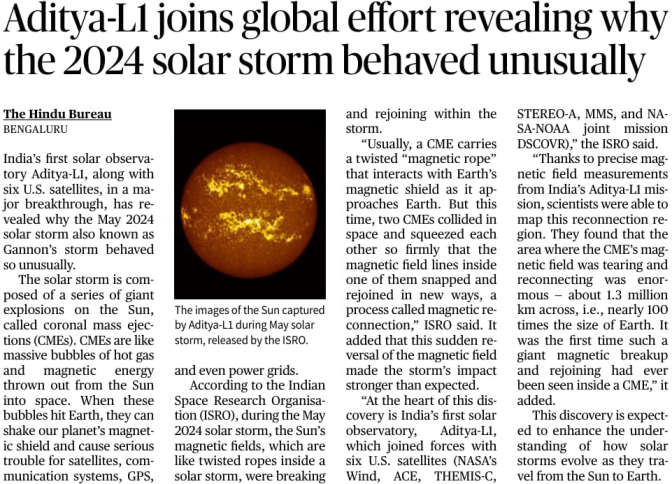
1. What is the article about?
The article explains how India’s solar observatory Aditya-L1, working with six U.S. satellites, solved the mystery behind why the May 2024 solar storm behaved in an unusually powerful way.
This marks a major scientific breakthrough in understanding solar storms and space weather.
2. What is a Solar Storm?
Coronal Mass Ejections (CMEs)
Why are they dangerous?
When CMEs hit Earth, they disturb our magnetic field, damaging:
Example: The 1989 Quebec blackout happened because a solar storm disrupted the power grid.
3. Why was the 2024 solar storm unusual?
Normal CME behaviour
Usually, a CME carries a twisted magnetic field (like a coiled rope).
As it approaches Earth, this interacts with Earth’s magnetic shield in predictable ways.
What happened in 2024? (The strange behaviour)
Why is this important?
Because this reconnection made the storm far stronger than expected.
Simple example:
Imagine two ropes twisted together. If they snap and rejoin in a new pattern, they can tighten suddenly and hit harder.
This is what happened with the magnetic fields of the CMEs.
4. What did Aditya-L1 discover?
Magnetic Reconnection Region Was Huge
Using precise magnetic readings, Aditya-L1 mapped the area where the magnetic fields broke and rejoined.
It was found to be:
This is the first time in the world such a giant reconnection region inside a CME has been observed.
5. Why is this discovery important?
A. Better Predictions of Solar Storms
Understanding CME collisions and reconnections helps us predict:
B. Protecting Technology on Earth
Solar storms can disrupt:
For example:
A strong storm can force airlines to avoid polar routes as radio signals get jammed.
C. Boosts Global Research Role of India
Aditya-L1 proves India is not just observing space but is leading discoveries in heliophysics (the study of the Sun).
6. How does Aditya-L1 work with other satellites?
India collaborated with six U.S. missions such as:
Together, they form a global network watching the Sun from different positions—like CCTV cameras covering different angles.
7. Why is this a milestone for ISRO?
First time India helped explain a global solar phenomenon
The discovery shows the scientific maturity of India’s first solar mission.
Helps India protect its own satellites
India relies on satellites for:
Aditya-L1 helps India prepare for space-weather emergencies.
8. Summary of Key Takeaways
UPSC PRELIMS QUESTION:
With reference to the objectives of Aditya–L1, consider the following statements:
1. To study the origin and acceleration of solar wind.
2. To understand the heating mechanism of the solar corona.
3. To observe solar flares and Coronal Mass Ejections (CMEs).
4. To study space-weather impact on Earth's magnetosphere from low Earth orbit.
Which of the statements given above are correct?
A. 1, 2, and 3 only
B. 1 and 4 only
C. 2, 3, and 4 only
D. 1, 2, 3, and 4
✅ Correct Answer: A
Explanation:
GS Paper II (Polity & Governance)
A. Structure, Organization & Functioning of the Judiciary
B. Separation of powers
C. Important Constitutional Articles
D. Judicial Accountability & Ethics
Prelims Syllabus
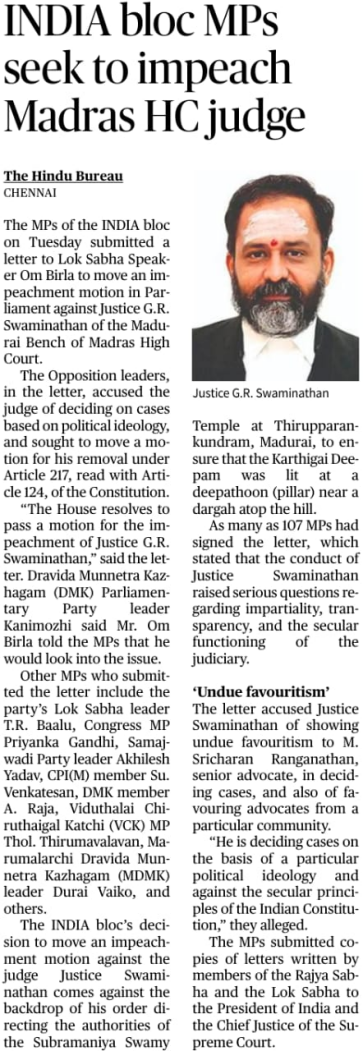
I. Background of the Tamil Nadu Deepam Row
To understand the impeachment demand, we must first know the recent controversy involving the judge and the Karthigai Deepam festival in Tamil Nadu.
1. What is Karthigai Deepam? (Basic Context)
2. What was the recent dispute?
Location Controversy
There was a dispute about where exactly the Deepam flame should be lit — on the traditional temple location or on a place associated with another religious shrine.
Community & Secular Concerns
3. What did Justice G.R. Swaminathan do? Why did it become controversial?
Justice Swaminathan reportedly passed an order related to the lighting of the Karthigai Deepam near a specific location at Thirupparankundram (Madurai), where both a temple and a dargah exist.
Opposition parties accused him of:
Example (Simplified):
If a judge interprets religious custom disputes in a way that seems to support one group repeatedly, opposition parties may allege bias even if the judge followed legal reasoning.
This is why MPs linked the Deepam row to allegations of partiality and violation of secular principles.
II. Why MPs Are Seeking Impeachment
The INDIA bloc MPs submitted a letter accusing the judge of:
1. Undue Favouritism
2. Deciding Cases Based on Political Ideology
They claim his judicial conduct reflected a political tilt, violating the expectation of neutrality and independence.
3. Violation of Constitutional Secularism
MPs argued that some of his decisions contradicted the secular character of the judiciary.
4. Loss of Public Confidence in Impartiality
For impeachment, the essential test is:
Has the judge’s behaviour undermined public trust?
Opposition MPs claim the Deepam-related order and other actions raise such concerns.
III. Constitutional Provisions for Impeachment of a High Court Judge
This is crucial for UPSC GS-II.
1. Relevant Articles of the Constitution
Article 217(1)(b)
Allows removal of a High Court judge in the same manner as a Supreme Court judge.
Article 124(4)
Defines the procedure for removal of judges of higher judiciary.
Article 124(5)
Allows Parliament to regulate the procedure through parliamentary law.
Thus, impeachment of a High Court judge uses the same “proved misbehaviour or incapacity” standard as Supreme Court judges.
2. Grounds for Removal
There are only two grounds, and they must be proved:
1. Proved misbehaviour
2. Proved incapacity
These are not defined in detail, but examples include:
3. The Removal Procedure (Step-by-Step in Simple Words)
This is important and scoring for UPSC answers.
Step 1: Notice of Motion
A removal notice must be signed by:
It is then submitted to the Speaker or Chairman.
Step 2: Admission of Motion
The Speaker/Chairman can:
Step 3: Formation of a Judicial Inquiry Committee
If accepted, a three-member committee is set up:
1. A Supreme Court judge
2. A Chief Justice of a High Court
3. An eminent jurist
They examine evidence and charges.
Step 4: Committee Report
Step 5: Parliamentary Approval
Both Houses must pass the motion with:
This is an extremely high bar (to protect judicial independence).
Step 6: President Orders Removal
If Parliament passes the motion, the President removes the judge.
4. Why Impeachment is Rare in India
Only one judge has ever been removed:
Many impeachment attempts fail because:
UPSC PRELIMS QUESTION:
With reference to the removal of a High Court Judge in India, consider the following statements:
1. A High Court Judge can be removed only on the grounds of “proved misbehaviour or incapacity.”
2. The procedure for removal of a High Court Judge is the same as that of a Supreme Court Judge.
3. The removal motion must be passed separately by both Houses of Parliament by a special majority.
4. The Constitution explicitly defines what constitutes “misbehaviour” for removal purposes.
Which of the statements given above are correct?
A. 1 and 2 only
B. 1, 2, and 3 only
C. 1, 3, and 4 only
D. 1, 2, 3, and 4
✅ Correct Answer: B
Explanation:
GS Paper II (International Relations)
Prelims Syllabus
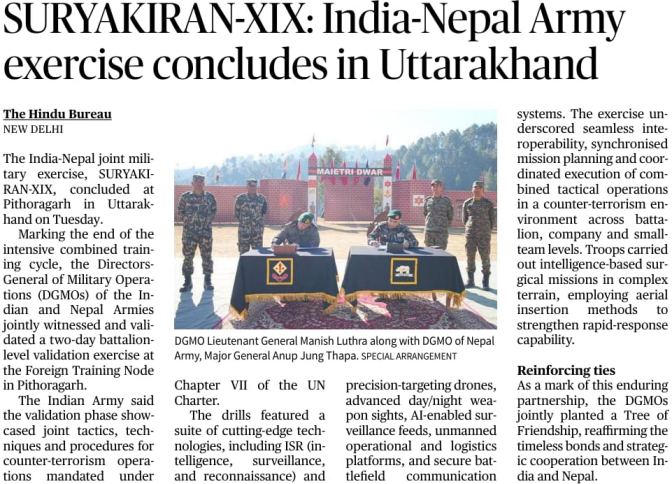
1. What is SURYAKIRAN-XIX?
SURYAKIRAN is a joint military exercise held every year between the Indian Army and the Nepal Army.
This year was the 19th edition (XIX = 19), and it took place in Pithoragarh, Uttarakhand.
The purpose is to train together, learn from each other, and strengthen military cooperation.
2. Who supervised the exercise?
The Directors-General of Military Operations (DGMOs) of both countries:
They observed the final training sessions and validated the outcomes of the exercise.
3. What was the main focus of the exercise?
A. Counter-terrorism operations
The soldiers practiced:
B. Joint tactics and techniques
This means both armies shared:
C. Operations as per the UN Charter
The drills followed guidelines under Chapter VII, which deals with:
4. What new technologies were used?
The exercise showcased modern military technologies, including:
These tools help armies respond faster and more safely.
5. Why is this exercise important?
A. Builds Interoperability
Interoperability means both armies can work together smoothly in real operations.
B. Strengthens Friendship
India and Nepal share:
The exercise deepens this partnership.
C. Enhances Security in the Himalayas
This region has:
Joint training improves cooperation for:
6. Symbolic Gesture: Tree of Friendship
At the end of the exercise, the DGMOs planted a Tree of Friendship, symbolising:
7. Final takeaway
SURYAKIRAN-XIX:
UPSC PRELIMS QUESTION:
SURYAKIRAN-XIX, recently in news, is a joint military exercise between:
A. India and Bhutan
B. India and Nepal
C. India and Sri Lanka
D. India and Bangladesh
✅ Answer: B
Syllabus: GS-II — Governance: Health policy and international cooperation.
Context
India has officially begun the countdown to host the 2nd WHO Global Summit on Traditional Medicine, signalling a major international push to mainstream traditional, complementary and integrative medicine within global health discussions.
Key points:
Source: PIB
Syllabus: GS-III — Economy: International Trade, WTO rules, Anti-dumping measures.
Context
The U.S. is considering new tariffs on Indian rice after American farmers alleged that India is dumping subsidised rice in the U.S. market, causing domestic price suppression.
Key points
Source: Indian Express
Syllabus: GS-III — Environment: Invasive species, biodiversity threats, ecosystem management.
Context
Tamil Nadu has launched one of India's largest invasive-species eradication missions to completely remove Senna spectabilis from all forest divisions by March 2026, due to its rapid spread and severe ecological impacts.
Key points
Source: New Indian Express
Syllabus: GS-II — International Organisations; Global Education Initiatives.
Context
UNESCO has added Riyadh, AlUla, and Riyadh Al-Khabra to the Global Network of Learning Cities (GNLC) in its 2025 update, expanding Saudi Arabia’s presence in the global lifelong-learning network.
Key points
Source: Times of India
 Launch your Graphy