There are no items in your cart
Add More
Add More
| Item Details | Price | ||
|---|---|---|---|




Index | ||
S.No | Topic | |
Daily Hindu Analysis | ||
1. | Fine-tune this signal to sharpen India’s AMR battle | |
2. | Natgrid’, the search engine of digital authoritarianism | |
3. | Top court says presence of strays in public institutions poses a ‘danger’ | |
4. | ISRO set to launch earth observation satellite on Jan. 12 | |
5. | Norms issued to compound minor drug violations | |
6. | Govt. pegs FY26 growth at 7.4% amid tariff concerns | |
| ||
Daily Current Affairs | ||
7. | SHINE Scheme | |
8. | Apparel Export Promotion Council (AEPC) | |
 Context
The author analyses the significance of the Prime Minister’s recent public warning on antimicrobial resistance (AMR) and argues that while political signalling has raised awareness, India now needs deeper surveillance, systemic reforms, and a One Health approach to effectively tackle the growing AMR crisis.
Detailed Analysis
Antimicrobial Resistance as a National Health Threat
AMR is described as one of India’s most serious emerging public health crises.
Data from the Indian Council of Medical Research shows antibiotics are becoming less effective against common infections such as pneumonia and urinary tract infections.
Irrational, indiscriminate, and self-medicated antibiotic use is identified as the single biggest driver of AMR in India.
Importance of Political Signalling and Public Awareness
The Prime Minister’s Mann Ki Baat address brought AMR into the public domain, moving it beyond hospitals and policy circles.
Past interventions like the National Action Plan on AMR and the ban on colistin as a growth promoter show that broad public and policy messaging can influence behaviour.
Public awareness is critical in determining whether AMR trends rise or stabilise in the future.
Limitations of Awareness-Only Approaches
The author cautions that awareness alone is insufficient at this advanced stage of India’s AMR trajectory.
AMR is compared to a “hydra-headed” challenge that requires coordinated, multi-sectoral solutions rather than isolated interventions.
Need for a One Health Approach
AMR is linked to the interconnected health of humans, animals, and the environment.
Solutions must integrate human medicine, veterinary practices, agriculture, and environmental regulation.
Recognition of this interdependence is essential for effective AMR containment.
Gaps in Surveillance and Data Representation
India’s AMR surveillance network remains heavily urban- and tertiary-care centric.
Non-urban, primary, and secondary healthcare settings are underrepresented, leading to skewed national estimates.
The National AMR Surveillance Network (NARS-Net) feeds data into the WHO’s GLASS system but currently covers limited sites across States and Union Territories.
Exclusion of Private Healthcare Sector
The author highlights expert recommendations to include private hospitals in AMR surveillance.
Since a large proportion of healthcare delivery in India occurs in the private sector, excluding it weakens the credibility of national AMR data.
Global and National Policy Alignment
The WHO Global Action Plan on AMR outlines five objectives, including awareness, surveillance, infection prevention, rational antimicrobial use, and investment in innovation.
India’s political messaging aligns with these goals, but expansion of surveillance and enforcement remains the most urgent need.
Suggestions by the Author
Expand AMR surveillance beyond urban tertiary hospitals to include non-urban, primary, and secondary care centres.
Integrate private hospitals into the national AMR surveillance framework.
Strengthen One Health coordination across human health, animal husbandry, agriculture, and environmental sectors.
Invest in monitoring, enforcement, diagnostics, vaccines, and new antimicrobial research.
Convert political signalling into sustained institutional action backed by funding and regulatory will.
UPSC Mains Practice Question
Antimicrobial resistance is not merely a medical problem but a governance and development challenge. Discuss in the context of India’s public health system and the need for a One Health approach. (250 words)
Context
The author examines the evolution of the National Intelligence Grid (NATGRID) from a counter-terror tool into a large-scale surveillance architecture, warning that its expansion, integration with population databases, and lack of oversight risk undermining constitutional freedoms and accountability.
Detailed Analysis
Origins in the Trauma of 26/11
The Mumbai terror attacks of 2008 exposed failures in intelligence coordination and data aggregation.
NATGRID emerged as a technological response to stitch together scattered data points across agencies to prevent future attacks.
It was conceived as a middleware platform enabling authorised agencies to query multiple databases for intelligence purposes.
Evolution into a ‘Crown Jewel’ of Surveillance
NATGRID allows searches across diverse datasets covering identity, travel, financial transactions, telecom records, and movement.
Though announced publicly in 2009, it became operational without a dedicated parliamentary statute, relying on executive approval.
Initial delays masked its scale, but recent reports show rapid expansion and increasing routine use.
Rapid Expansion and Policing Integration
NATGRID is no longer confined to central intelligence agencies; its access is being extended to police units across States.
Reports suggest tens of thousands of queries are processed monthly, indicating a shift from exceptional counter-terror use to everyday policing.
This normalisation of surveillance changes the balance between security and civil liberties.
Integration with the National Population Register
The reported linkage of NATGRID with the National Population Register marks a fundamental shift.
This enables population-wide mapping of identities, households, and relationships rather than tracking specific suspects.
The move is politically sensitive due to overlaps with debates around citizenship, NPR, and NRC.
Algorithmic Surveillance and ‘Inference at Scale’
The deployment of analytical tools such as entity resolution engines enables algorithmic inference about individuals.
Surveillance now shifts from direct evidence-based searches to pattern recognition and probabilistic suspicion.
Facial recognition, KYC databases, and driving licence records deepen the reach and permanence of digital monitoring.
Bias, Scale, and the Risk of Misidentification
Algorithms are not neutral; they replicate biases embedded in data related to caste, religion, geography, and socio-economic status.
For marginalised communities, false positives can lead to serious social and legal consequences.
The tyranny of scale means errors multiply rapidly without human or judicial checks.
Absence of Oversight and Course Correction
NATGRID operates without a clear statutory framework, independent regulator, or parliamentary oversight.
Courts have not conclusively adjudicated its legality in light of the right to privacy judgment.
Surveillance expansion is occurring alongside political rhetoric that frames accountability as a threat to national security.
Lessons from Past Intelligence Failures
The author argues that intelligence failures are often institutional rather than technological.
The reliance on surveillance tools diverts attention from reforms in training, coordination, and accountability.
Security without transparency risks repeating past failures while eroding democratic norms.
Suggestions by the Author
Enact a clear statutory framework governing NATGRID with defined purpose limitation.
Establish independent oversight through Parliament and judicial mechanisms.
Ensure transparency, auditability, and accountability for surveillance requests.
Separate counter-terror intelligence from routine policing to prevent mission creep.
Re-centre intelligence reform on institutional capacity rather than technological omniscience.
UPSC Mains Practice Question
Critically examine the implications of large-scale digital surveillance systems like NATGRID on internal security and constitutional freedoms in India. (250 words)
 Context
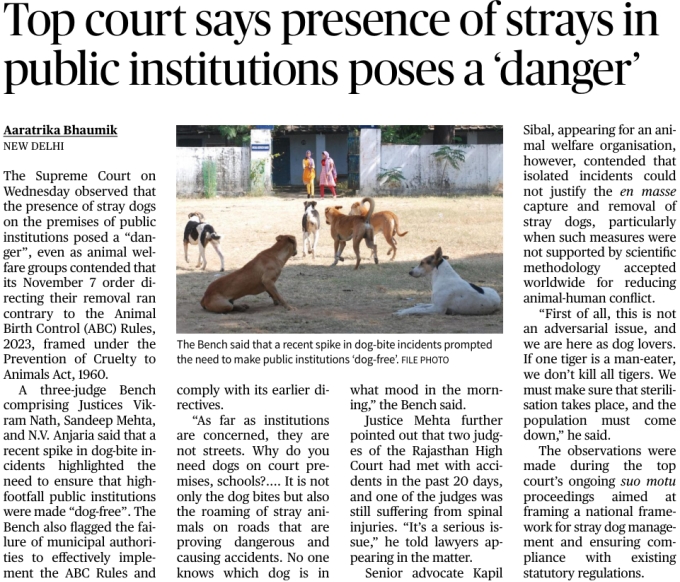
The Supreme Court observed that the presence of stray dogs in public institutions such as schools and courts poses a danger, especially in light of a recent spike in dog-bite incidents, and flagged lapses in implementation of existing rules by municipal authorities.
Key Points
Supreme Court’s Observation
The Court held that public institutions are not streets and must be kept dog-free to ensure safety.
It noted that roaming stray animals in high-footfall areas increase the risk of dog bites and accidents.
Trigger for Judicial Concern
A recent surge in dog-bite incidents, including injuries to members of the judiciary, prompted stricter scrutiny.
The Court emphasised that the risk is unpredictable as no one can assess the temperament of stray dogs.
Animal Birth Control (ABC) Rules, 2023
Animal welfare groups argued that mass removal of strays violates the ABC Rules, 2023, framed under the Prevention of Cruelty to Animals Act, 1960.
They stressed that sterilisation and population control, not culling or indiscriminate removal, is the globally accepted method.
Municipal Authorities Under Scrutiny
The Bench flagged the failure of municipal bodies to effectively implement ABC Rules.
Poor enforcement has led to unchecked stray populations and rising human-animal conflict.
Balancing Safety and Animal Welfare
The Court clarified that the issue is not adversarial and does not justify cruelty to animals.
However, public safety in institutions like schools, hospitals, and courts takes precedence.
Ongoing Suo Motu Proceedings
The observations were made during suo motu proceedings aimed at framing a national framework for stray dog management.
The focus is on ensuring compliance with statutory regulations while reducing human-animal conflict.
Supreme Court of India
Exercising its constitutional role, the Court is seeking a harmonised national approach to stray dog management.
It aims to reconcile public safety, municipal accountability, and animal welfare laws through judicial oversight.
UPSC Prelims Practice Question
Q.Consider the following statements regarding stray dog management in India:
1.The Animal Birth Control Rules are framed under the Prevention of Cruelty to Animals Act, 1960.
2.The Supreme Court has held that public institutions must be treated at par with public streets for the purpose of stray dog access.
Which of the statements given above is/are correct?
(a) 1 only
(b) 2 only
(c) Both 1 and 2
(d) Neither 1 nor 2
Answer: (a)
Explanation:
Statement 1 is correct: The Animal Birth Control Rules are framed under the Prevention of Cruelty to Animals Act, 1960.
Statement 2 is incorrect: The Supreme Court explicitly stated that public institutions are not streets and should be kept dog-free to ensure safety.
ISRO is scheduled to launch the PSLV-C62/EOS-N1 mission on January 12, 2026, marking its first launch of the year and a key step after a previous PSLV mission faced a technical glitch.
Key Points
Mission Overview
Mission name: PSLV-C62 / EOS-N1
Launch date and time: January 12, 2026 at 10:17 hrs IST
Launch site: First Launch Pad, Satish Dhawan Space Centre, Sriharikota, Andhra Pradesh
About EOS-N1 Satellite
EOS-N1 is an Earth Observation (earth imaging) satellite.
It is designed for strategic purposes, though detailed specifications have not been disclosed by ISRO.
Such satellites are typically used for surveillance, mapping, disaster management, and national security.
Launch Vehicle Significance
The mission will be carried out using the Polar Satellite Launch Vehicle (PSLV), ISRO’s trusted workhorse.
This will be the 105th launch from Sriharikota, highlighting India’s mature launch infrastructure.
Post-Glitch Comeback
The mission is significant as PSLV had faced a technical issue in its third stage during the PSLV-C61 / EOS-09 mission on May 18, 2025, leading to mission failure.
PSLV-C62 is therefore crucial to restore confidence in PSLV reliability.
Payloads from Startups and Academia
Along with EOS-N1, the mission will also carry payloads developed by Indian and foreign startups and academic institutions, supporting innovation and private participation in space.
Recent ISRO Context
ISRO recently achieved success by launching the U.S. BlueBird Block-2 satellite into Low Earth Orbit on December 24, 2025, using the LVM-3 launch vehicle, indicating operational momentum.
Q. PSLV-C62 / EOS-N1 mission is associated with:
(a) Human spaceflight programme
(b) Earth observation and strategic imaging
(c) Interplanetary exploration
(d) Satellite-based navigation system
Correct Answer: (b)
Explanation:
The PSLV-C62 / EOS-N1 mission involves the launch of EOS-N1, an Earth Observation satellite. Such satellites are primarily used for earth imaging, surveillance, resource mapping, disaster management, and strategic applications, and are not related to human spaceflight, navigation, or interplanetary missions.

The Central Drugs Standard Control Organisation (CDSCO) has issued guidelines and Standard Operating Procedures (SOPs) for compounding minor offences under the Drugs and Cosmetics (Compounding of Offences) Rules, 2025 to ease regulatory compliance.
Key Points
What is compounding of offences
A legal mechanism to settle minor violations by paying a monetary penalty instead of facing prosecution.
Applies only to notified, non-serious contraventions under the Drugs and Cosmetics framework.
Guidelines issued by CDSCO
SOPs issued for manufacturers, firms, and individuals to apply for compounding.
Applications can be submitted in physical form with advance copy via email as prescribed under Rule 4.
Applications are to be examined by the Compounding Authority.
Purpose of the move
Reduce unnecessary litigation and court burden.
Improve ease of doing business in the pharmaceutical and medical devices sector.
Ensure faster resolution of regulatory non-compliance while maintaining oversight.
Nature of violations covered
Limited to certain minor contraventions.
Serious violations affecting public health and safety are excluded from compounding.
Regulatory significance
Reflects a shift towards facilitative regulation rather than purely punitive enforcement.
Encourages voluntary compliance while preserving deterrence for major offences.
Central Drugs Standard Control Organisation (CDSCO)
National Regulatory Authority for drugs and medical devices in India.
Works under the Ministry of Health & Family Welfare.
Headed by the Drugs Controller General of India (DCGI).
Responsible for approval of new drugs, clinical trials, drug standards, import quality control, and coordination with State Drug Controllers.
UPSC Prelims Practice Question
Q.With reference to the Drugs and Cosmetics (Compounding of Offences) Rules, 2025, consider the following statements:
Compounding allows certain minor drug-related offences to be settled by payment of a monetary penalty without court proceedings.
All violations under the Drugs and Cosmetics Act are eligible for compounding under the 2025 Rules.
Which of the statements given above is/are correct?
(a) 1 only
(b) 2 only
(c) Both 1 and 2
(d) Neither 1 nor 2
Correct Answer: (a)
Explanation:
Statement 1 is correct as compounding permits settlement of specified minor violations through monetary penalty. Statement 2 is incorrect because serious offences impacting public health are excluded from compounding.
Context
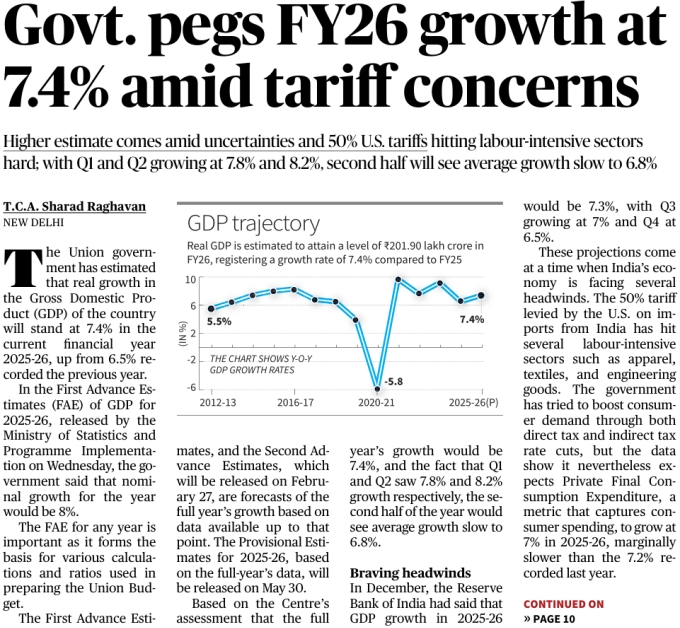
The Union government, through the First Advance Estimates (FAE) of GDP for 2025–26, has projected real GDP growth at 7.4%, amid global uncertainties and the impact of 50% U.S. tariffs on Indian exports.
Key Points
Overall GDP Growth Projection
Real GDP growth for FY26 estimated at 7.4%, higher than 6.5% in FY25.
Nominal GDP growth projected at 8%.
Real GDP expected to reach ₹201.90 lakh crore.
Quarter-wise Growth Trend
Q1: 7.8%
Q2: 8.2%
Q3: 7.0%
Q4: 6.5%
Growth expected to moderate in the second half with average growth at 6.8%.
External Headwinds
50% U.S. tariffs imposed on Indian imports.
Labour-intensive sectors such as apparel, textiles, and engineering goods are significantly affected.
Adds pressure on exports and manufacturing momentum.
Domestic Demand Scenario
Government attempted to boost demand via direct and indirect tax cuts.
Private Final Consumption Expenditure (PFCE) projected to grow at 7%, slightly lower than 7.2% in FY25, indicating cautious consumer spending.
Policy and Data Significance
First Advance Estimates form the base for Union Budget calculations.
Second Advance Estimates to be released on February 27.
Provisional Estimates based on full-year data to be released on May 30.
Economic Assessment
Growth outlook remains resilient despite trade shocks.
Slowing momentum in H2 reflects global trade uncertainty and weak external demand.
Ministry of Statistics and Programme Implementation (MoSPI)
Responsible for preparing and releasing GDP estimates including First Advance Estimates.
Provides the statistical foundation for fiscal planning and macroeconomic policy.
Syllabus: GS 2 – Governance | GS 3 – Quality Infrastructure
Context:
At the 79th Foundation Day of the Bureau of Indian Standards (BIS), Union Ministers launched the SHINE Scheme in New Delhi to promote quality awareness and safety standards through women-led community participation.
Key Points
What is SHINE Scheme
Objectives
Implementation Approach
Significance
Bureau of Indian Standards (BIS)
UPSC Prelims Practice Question
With reference to the SHINE Scheme, consider the following statements:
1. SHINE Scheme is an initiative of the Bureau of Indian Standards to promote standards awareness among women.
2. The Bureau of Indian Standards functions under the Ministry of Commerce and Industry.
Which of the statements given above is/are correct?
(a) 1 only
(b) 2 only
(c) Both 1 and 2
(d) Neither 1 nor 2
Correct Answer: (a)
Explanation:
Statement 1 is correct: SHINE is a BIS initiative focused on empowering women through quality and standards awareness.
Statement 2 is incorrect: BIS functions under the Ministry of Consumer Affairs, Food and Public Distribution, not the Ministry of Commerce and Industry.
Source: PIB
Syllabus: GS Paper 3 – Indian Economy | External Trade | Textile Sector
Context
A. Sakthivel has been appointed as the Chairman of the Apparel Export Promotion Council (AEPC) for his fifth term, highlighting continuity in leadership in India’s apparel export ecosystem.
Key Points
UPSC Prelims Practice MCQ
The Apparel Export Promotion Council (AEPC) functions under which of the following Ministries?
(a) Ministry of Commerce and Industry
(b) Ministry of Textiles
(c) Ministry of Micro, Small and Medium Enterprises
(d) Ministry of Labour and Employment
Correct Answer: (b) Ministry of Textiles
Explanation:
AEPC operates under the Ministry of Textiles, Government of India, and is the official body representing and promoting apparel exports from India.
 Launch your Graphy