Daily Current Affairs (CA ) for UPSC 7th Jan 2026


| Index |
| S.No | Topic |
|
| Daily Hindu Analysis (YouTube) |
| 1. | What are biomaterials and how do they work? |
|
| 2. | The right to disconnect in an ‘always-on’ economy |
|
| 3. | ISRO calls for proposals from Indian scientists to analyse data from Aditya-L1 |
|
| 4. | U.S. takeover of Greenland would mark end of NATO |
|
| 5. | Sufferers of poor AQI contribute to the problem too: SC on air pollution |
|
| 6. | Education Minister releases 55 volumes of literary works |
|
| 7. | EC says it has constitutional duty to bar foreigners from voter rolls |
|
| |
| Daily Current Affairs (App) |
| 8. | Justice Mission 2025 |
|
| 9. | Global Environment Facility |
|
| 10. | Lucknow To Get India’s First Urban Night Safari At Kukrail Forest Area |
|
| 11. | India has inaugurated the world’s second National Environmental Standard Laboratory (NESL) |
|
| 12. | Specialised Training Programme in Cancer Care for BIMSTEC Countries |
|
| 13. | Socotra Island |
|
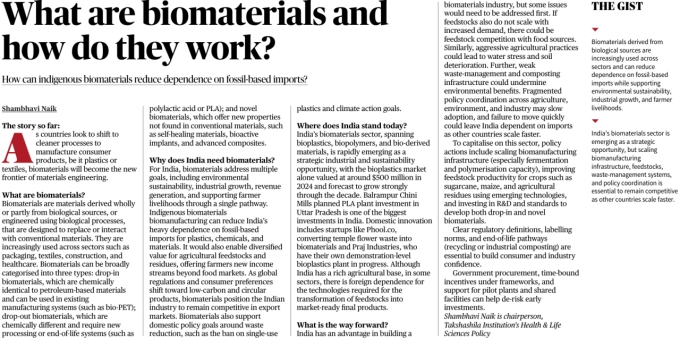
What are biomaterials and how do they work?
 Context
The article discusses the growing importance of biomaterials as countries, including India, shift towards cleaner manufacturing and reduced dependence on fossil-based materials. It examines how biomaterials work, why India needs them, where India currently stands, and the challenges ahead. Detailed AnalysisUnderstanding Biomaterials
Biomaterials are materials derived wholly or partly from biological sources or produced using biological processes.
They are designed either to replace conventional materials or interact with them across sectors such as packaging, textiles, construction, and healthcare. Types of Biomaterials
Biomaterials can be broadly classified into three categories:
- Drop-in biomaterials: Chemically identical to petroleum-based materials and usable in existing systems, such as bio-PET.
- Drop-out biomaterials: Chemically different and require new processing or end-of-life systems, such as polylactic acid (PLA).
- Novel biomaterials: Offer new properties like self-healing materials, bioactive implants, and advanced composites.
Why India Needs Biomaterials
Biomaterials address multiple national priorities simultaneously.
They reduce India’s dependence on fossil-based imports such as plastics and chemicals while supporting environmental sustainability, circular economy goals, and farmer livelihoods.
Agricultural residues and feedstocks can generate additional income streams for farmers beyond food markets. Economic and Strategic Relevance
With global markets moving towards low-carbon and circular products, biomaterials can help Indian industry remain competitive in exports.
They also support domestic policy goals like single-use plastic reduction and climate action. India’s Current Position
India’s biomaterials sector, covering bioplastics, biopolymers, and bio-derived materials, is emerging as a strategic opportunity.
The bioplastics market alone was valued at about $500 million in 2024 and is expected to grow strongly.
Examples include major PLA investments and startups converting temple flower waste and agricultural residues into biomaterials.
However, India still depends on foreign technologies for converting feedstocks into market-ready products. Challenges and Constraints
Scaling biomaterials faces structural hurdles.
Feedstock supply may compete with food sources if not carefully managed.
Aggressive agricultural practices could cause water stress and soil degradation.
Weak waste management and composting infrastructure can undermine environmental benefits.
Fragmented policy coordination across agriculture, environment, and industry may slow adoption. Suggestions by the Author
- Scale biomanufacturing infrastructure, especially fermentation and polymerisation capacity.
- Improve feedstock productivity using emerging technologies for crops like sugarcane and maize.
- Invest in R&D and standards to support both drop-in and novel biomaterials.
- Establish clear regulatory definitions, labelling norms, and end-of-life pathways such as recycling or industrial composting.
- Use government procurement, time-bound incentives, pilot plants, and shared facilities to de-risk early investments.
Conclusion
Biomaterials represent a significant opportunity for India to align industrial growth, environmental sustainability, and rural livelihoods. While the sector is promising, timely action on infrastructure, policy coordination, and technology development is essential to prevent India from remaining import-dependent as other countries scale faster. UPSC Mains Practice QuestionDiscuss the role of biomaterials in reducing India’s dependence on fossil-based imports. What challenges must India address to scale biomaterials sustainably?
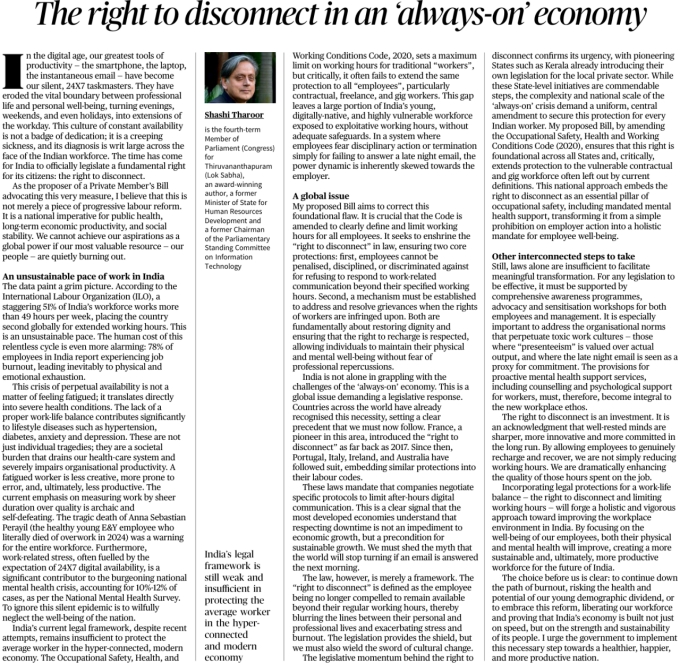
The right to disconnect in an ‘always-on’ economy
Context
The author discusses how constant digital connectivity has blurred the boundary between work and personal life in India, leading to overwork, burnout, and mental health stress. The article argues for legally recognising a “right to disconnect” as a necessary labour reform in the digital economy. Detailed AnalysisThe ‘always-on’ work culture
Digital tools like smartphones, laptops, and instant messaging have converted work into a 24×7 obligation. Evenings, weekends, and holidays increasingly resemble workdays. This culture is no longer a sign of dedication but a systemic problem eroding workers’ well-being. Scale of the problem in India
According to the International Labour Organization, 51% of India’s workforce works more than 49 hours a week, placing India among the most overworked countries globally. Surveys show high levels of job burnout, which directly translate into physical exhaustion, mental stress, and reduced productivity. Health and productivity consequences
Prolonged overwork contributes to lifestyle diseases such as hypertension, diabetes, anxiety, and depression. The National Mental Health Survey attributes 10–12% of mental health cases to work-related stress. Overworked employees are more error-prone, less creative, and ultimately less productive, undermining economic efficiency. Gaps in India’s legal framework
The Occupational Safety, Health and Working Conditions Code, 2020 fixes limits on working hours but largely applies to traditional workers. Contractual, freelance, and gig workers—who form a large share of the digitally connected workforce—remain inadequately protected. Employers retain disproportionate power, as failure to respond to late-night communication can invite penalties or termination. The right to disconnect as a global norm
Countries such as France, Portugal, Italy, Ireland, and Australia have legally recognised the right to disconnect. These laws restrict after-hours digital communication and affirm that respecting downtime is essential for sustainable economic growth, not an obstacle to it. What the proposed reform seeks
The author supports a Private Member’s Bill to amend labour codes so that:
- Employees cannot be penalised for refusing to respond outside working hours.
- Clear grievance redressal mechanisms exist when rights are violated.
- This would restore dignity, autonomy, and mental well-being at the workplace.
Beyond law: cultural and organisational change
Legislation alone is insufficient. The author stresses the need to dismantle toxic workplace norms such as presenteeism and the belief that late-night availability signals commitment. Awareness programmes, management sensitisation, and proactive mental health support must accompany legal reform.
Suggestions of the Author
- Amend the Occupational Safety, Health and Working Conditions Code, 2020 to explicitly include all categories of workers.
- Legally embed the right to disconnect as part of occupational safety and mental health protection.
- Introduce grievance redressal mechanisms for violations.
- Promote organisational culture change through awareness and training.
- Make counselling and psychological support integral to workplace policy.
Conclusion
The right to disconnect is not a luxury but a public health, productivity, and dignity issue. By protecting workers’ downtime, India can prevent burnout, improve long-term productivity, and harness its demographic dividend sustainably. Ignoring this reform risks normalising exhaustion and undermining both human and economic capital. UPSC Mains Practice QuestionDiscuss the relevance of recognising a ‘right to disconnect’ in India’s digital economy. Examine the legal and cultural challenges involved in its implementation.
ISRO calls for proposals from Indian scientists to analyse data from Aditya-L1
Context
ISRO has invited proposals from Indian scientists to analyse observational data from Aditya-L1, India’s first dedicated solar mission, on the second anniversary of the spacecraft reaching the Sun–Earth L1 point. Key PointsAbout the AnnouncementISRO released an Announcement of Opportunity (AO) for the first cycle of Aditya-L1 observations.
The call is open to Indian scientists and researchers working in India.
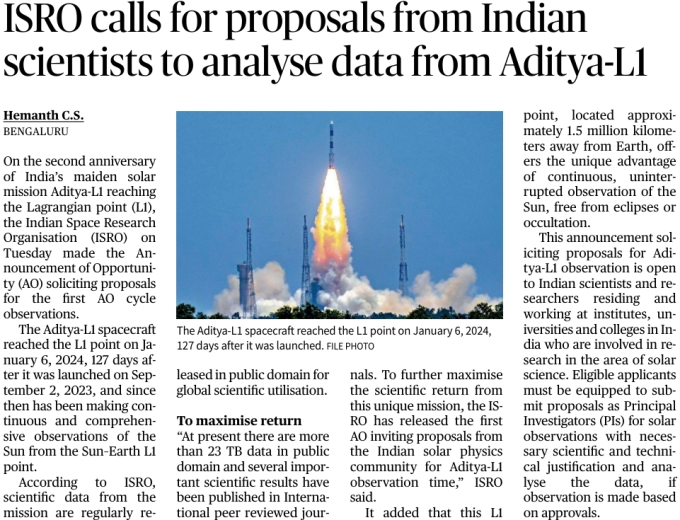
Aditya-L1 Mission StatusAditya-L1 reached the Sun–Earth L1 point on January 6, 2024, 127 days after launch.
The spacecraft is making continuous and uninterrupted observations of the Sun.
Importance of L1 PointThe L1 point is located about 1.5 million km from Earth.
It allows continuous solar observation without eclipses or occultation.
Scientific Data and OutputsISRO has already released over 23 TB of data in the public domain.
Several peer-reviewed scientific results have been published using Aditya-L1 data.
Eligibility and Research ScopeProposals must be submitted by Principal Investigators (PIs).
Applicants should have the scientific and technical capability to analyse solar data.
Observations will be approved based on scientific merit and justification.
Objective of the AO CycleTo maximise scientific return from India’s maiden solar mission.
To strengthen India’s solar physics research ecosystem.
Indian Space Research Organisation (ISRO)ISRO is India’s national space agency under the Department of Space.
It leads India’s space science missions, satellite launches, and applications.
Aditya-L1 is ISRO’s first mission dedicated exclusively to solar studies.
UPSC Prelims Practice QuestionConsider the following statements regarding Aditya-L1:1.The Sun–Earth L1 point allows continuous observation of the Sun without interruptions caused by eclipses.2.Aditya-L1 is India’s first interplanetary mission beyond Earth’s orbit.Which of the statements given above is/are correct? (a) 1 only
(b) 2 only
(c) Both 1 and 2
(d) Neither 1 nor 2Answer: (a)
U.S. takeover of Greenland would mark end of NATO ContextThe Danish Prime Minister warned that any U.S. takeover of Greenland would undermine the foundations of NATO, amid renewed remarks by U.S. President Donald Trump on asserting U.S. control over the Arctic island. Key PointsTrigger for the StatementRemarks followed U.S. military action in Venezuela and renewed comments by Donald Trump on Greenland.
Trump has repeatedly expressed interest in bringing Greenland under U.S. jurisdiction.
Denmark’s StandDanish Prime Minister Mette Frederiksen said a U.S. takeover would end the security order in place since World War II.
Denmark stressed that Greenland is part of the Danish Kingdom and, by extension, part of North Atlantic Treaty Organization.
Impact on NATOAny military action by the U.S. against a NATO member or its territory would violate alliance principles.
European leaders expressed solidarity with Denmark, warning of catastrophic consequences for NATO unity.
Greenland’s StatusGreenland is a semi-autonomous territory of Denmark, with control over domestic affairs.
Defence and foreign policy remain with Denmark.
Geopolitical SignificanceGreenland is strategically located in the Arctic, rich in minerals and critical for Arctic security.
Rising Arctic militarisation and resource competition increase its global importance.
Greenland (Additional Information)World’s largest non-continental island, located in the North Atlantic and Arctic Oceans.
Geographically part of North America, politically linked to Denmark.
Capital: Nuuk.
Climate: Polar, with extreme cold and ice cover.
Natural resources include coal, iron ore, rare minerals, gold, and platinum.
UPSC Prelims Practice QuestionQ.Consider the following statements regarding Greenland:1.Greenland is an autonomous territory within the Kingdom of Denmark.2.Greenland is geographically considered a part of the European continent.Which of the statements given above is/are correct? (a) 1 only
(b) 2 only
(c) Both 1 and 2
(d) Neither 1 nor 2Answer: (a)
Sufferers of poor AQI contribute to the problem too: SC on air pollution
Context
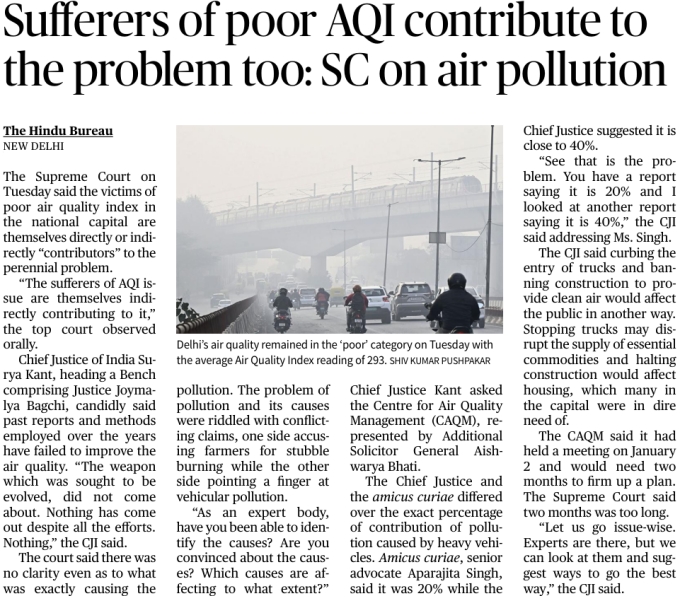
The Supreme Court observed that victims of poor air quality in Delhi also indirectly contribute to air pollution, while hearing matters related to persistent poor AQI and the effectiveness of regulatory measures. Key PointsSupreme Court’s ObservationThe Bench led by Supreme Court of India stated that sufferers of poor AQI are also contributors, directly or indirectly.
The Court noted that decades of reports and methods have failed to deliver tangible air quality improvement.
Debate on Sources of PollutionConflicting claims persist over major contributors, with some blaming vehicular emissions and others stubble burning.
The exact percentage contribution of heavy vehicles remains disputed, ranging between 20% and 40%.
Concerns on Policy Trade-offsMeasures like banning trucks or halting construction can disrupt essential commodity supply and housing needs.
The Court emphasised balancing clean air goals with public welfare and economic continuity.
Role of CAQMThe Court questioned the Commission for Air Quality Management on clarity regarding pollution sources.
CAQM informed the Court that it needs two months to finalise a comprehensive plan, which the Court termed excessive.
Need for Issue-wise ActionThe Supreme Court directed authorities to proceed issue-wise using expert inputs instead of delaying action.
Emphasis was laid on evidence-based, sector-specific interventions.
Air Quality Index (AQI) – Additional InformationWhat is AQILaunched in 2014 to simplify public understanding of air pollution.
Converts multiple pollutant concentrations into a single index value and colour code.
Pollutants CoveredPM2.5, PM10, Nitrogen Dioxide, Ozone, Carbon Monoxide, among others.
AQI CategoriesGood (0–50)
Satisfactory (50–100)
Moderately Polluted (100–200)
Poor (200–300)
Very Poor (300–400)
Severe (400–500)
Method of CalculationIndividual pollutants are assigned weights based on health impact.
The worst sub-index determines the overall AQI value and colour.
UPSC Prelims Practice QuestionQ.Consider the following statements regarding Air Quality Index (AQI):1.AQI converts data from multiple air pollutants into a single number and colour code.2.The overall AQI value is calculated by averaging the values of all monitored pollutants.Which of the statements given above is/are correct? (a) 1 only
(b) 2 only
(c) Both 1 and 2
(d) Neither 1 nor 2Answer: (a)
Education Minister releases 55 volumes of literary works
Context
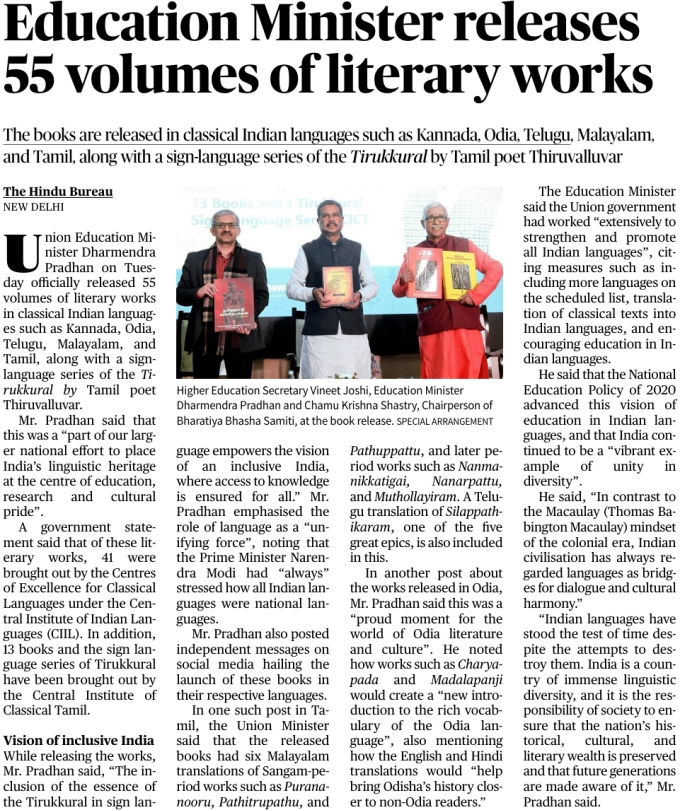
The Union Education Minister released 55 volumes of literary works in classical Indian languages, including a sign-language series of the Tirukkural, as part of efforts to promote India’s linguistic and cultural heritage. Key PointsRelease of Literary WorksUnion Education Minister Dharmendra Pradhan officially released 55 volumes of literary works.
The works are in classical Indian languages such as Kannada, Odia, Telugu, Malayalam, and Tamil.
Inclusion of Sign LanguageA sign-language series of the Tirukkural by Tamil poet Thiruvalluvar was also released.
This initiative aims to make classical knowledge accessible to persons with hearing disabilities.
Institutional ContributionOut of the 55 works, 41 volumes were brought out by Centres of Excellence for Classical Languages under the Central Institute of Indian Languages (CIIL).
13 books and the sign-language Tirukkural series were published by the Central Institute of Classical Tamil.
Content HighlightsMalayalam translations of Sangam-period works such as Purananooru, Pathirupathu, and Pathuppattu were included.
Telugu translation of Silappathikaram, one of the five great epics, was released.
Odia classical works like Charyapada and Madalapanji were part of the release.
Vision of Inclusive IndiaThe Minister emphasised language as a unifying force and a foundation for inclusive education.
The initiative aligns with the National Education Policy 2020, which promotes education and research in Indian languages.
The government reiterated its commitment to preserving India’s historical, cultural, and literary wealth for future generations.
EC says it has constitutional duty to bar foreigners from voter rolls ContextThe Election Commission of India defended the ongoing Special Intensive Revision (SIR) of electoral rolls before the Supreme Court, asserting its constitutional duty to ensure that no foreigner is included in voter lists. Key PointsElection Commission’s StandElection Commission of India stated it has both constitutional power and duty to bar foreigners from electoral rolls.
The EC rejected claims that SIR is a “parallel NRC”, calling such comparisons misleading rhetoric.
Special Intensive Revision (SIR)SIR involves verification and revision of electoral rolls to ensure accuracy.
It counts only eligible adults (18 years and above), unlike a citizenship register.
The exercise began in Bihar last year and has expanded to multiple States and Union Territories.
Distinction from NRCEC clarified that NRC covers all residents and citizens, while SIR is limited to voter eligibility.
Citizenship determination under SIR is incidental, only to exclude non-citizens from voting.
Supreme Court ProceedingsThe EC made submissions before the Supreme Court of India, led by the Chief Justice of India.
The Court examined whether the EC’s actions fall within its constitutional mandate.
Large-Scale Deletions in Uttar PradeshDraft electoral rolls in Uttar Pradesh showed 2.89 crore deletions, the highest in any State so far.
The EC maintained that deletions followed due process under election laws.
Constitutional BasisArticle 324 of the Constitution vests the EC with superintendence, direction, and control of elections.
Ensuring that only citizens are enrolled is intrinsic to free and fair elections.
Additional Information – Election Commission of IndiaA permanent constitutional body established under Article 324.
Responsible for conducting elections to Parliament, State Legislatures, and the offices of President and Vice-President.
Ensures electoral integrity, fairness, and adherence to constitutional principles.
UPSC Prelims Practice QuestionQ.Consider the following statements regarding the Special Intensive Revision (SIR) of electoral rolls:1.The SIR is conducted under the constitutional authority of the Election Commission of India.2.The SIR is equivalent to the National Register of Citizens as it determines citizenship of all residents.Which of the statements given above is/are correct? (a) 1 only
(b) 2 only
(c) Both 1 and 2
(d) Neither 1 nor 2Answer: (a)
Justice Mission 2025Syllabus: GS Paper 2 – International Relations (India and its neighbourhood / Global geopolitics) Context:
China conducted large-scale military drills named Justice Mission 2025 around Taiwan, escalating tensions amid cross-strait friction and recent U.S. arms sales to Taiwan. Key Points
- What it is:
Justice Mission 2025 is a large-scale inter-service military exercise conducted by China around Taiwan.
- Forces involved:
It includes coordinated deployment of Army, Navy, Air Force, missile and artillery units, reflecting joint warfare doctrine.
- Operational focus:
The drills emphasised sea–air combat readiness patrols, joint seizure of superiority, and blockade of key ports and strategic areas.
- Strategic objectives:
Aimed at testing joint combat capabilities and demonstrating all-dimensional deterrence beyond the island chain.
- Political signalling:
The exercise serves as a warning against Taiwan independence and external interference, especially from the United States.
- China–Taiwan position:
China claims Taiwan as part of its sovereign territory and has not ruled out the use of force for reunification.
- Triggering factors:
The drills followed U.S. arms sales to Taiwan exceeding USD 10 billion, heightening regional security concerns.
UPSC Prelims Practice QuestionJustice Mission 2025, recently seen in the news, is associated with:(a) Russia’s military drills near Ukraine
(b) China’s joint military exercise around Taiwan
(c) Japan–US naval exercise in the Pacific
(d) NATO military deployment in Eastern EuropeAnswer: (b)Explanation:
Justice Mission 2025 refers to China’s inter-service military drills conducted around Taiwan, involving army, navy, air force and missile units, aimed at deterrence and joint combat preparedness. Source: The Hindu BusinessLine
Global Environment FacilitySyllabus: GS Paper 3 – Environment and Ecology | International Environmental Institutions Context:
The Global Environment Facility approved US$52.8 million for four new UNEP-led environmental projects during its 70th Council meeting, strengthening multilateral funding for global environmental priorities. Key Points
- What it is:
The Global Environment Facility (GEF) is a multilateral environmental financing mechanism supporting developing countries and economies in transition.
- Established in:
1991, ahead of the 1992 Rio Earth Summit.
- Primary aim:
To support country-driven projects that deliver global environmental benefits while promoting sustainable development.
- Thematic focus areas:
Climate change, biodiversity, land degradation, oceans, chemicals, and pollution.
- Role as financial mechanism:
Serves as the designated financial mechanism for major multilateral environmental agreements.
- Conventions supported:
CBD, UNFCCC, UNCCD, Stockholm Convention, Minamata Convention, and BBNJ Agreement.
- Other support:
Also assists implementation of the Montreal Protocol.
- Key functions:
Provides grants and concessional finance, mobilises co-financing, supports capacity building, and funds climate transparency under the Paris Agreement.
- Governance structure:
Operates through the Assembly, Council, Secretariat, Scientific and Technical Advisory Panel (STAP), and Independent Evaluation Office (IEO).
- Significance:
Largest multilateral funder of biodiversity conservation with US$26+ billion in grants and US$153 billion in co-financing across 160+ countries.
UPSC Prelims Practice QuestionThe Global Environment Facility (GEF) serves as the financial mechanism for which of the following conventions?1. Convention on Biological Diversity2. United Nations Framework Convention on Climate Change3. Ramsar Convention on WetlandsSelect the correct answer using the code below:
(a) 1 and 2 only
(b) 2 and 3 only
(c) 1 and 3 only
(d) 1, 2 and 3Answer: (a)Explanation:
GEF is the financial mechanism for CBD and UNFCCC, but not for the Ramsar Convention. Source: UNEP
Lucknow To Get India’s First Urban Night Safari At Kukrail Forest AreaSyllabus: GS Paper 3 – Environment | Conservation and Eco-tourism Context:
Lucknow is set to introduce India’s first urban night safari at the Kukrail Forest Area, aiming to combine wildlife conservation awareness with sustainable city-based tourism. Key PointsWhat it is
- India’s first urban night safari, offering controlled nocturnal wildlife viewing within city limits.
- Focuses on education and conservation, not entertainment-driven wildlife display.
Location
- Situated in Lucknow, Uttar Pradesh.
- Developed along the Kukrail River on the northern outskirts of the city.
Objectives
- Promote urban eco-tourism and conservation awareness.
- Allow residents and students to observe nocturnal animal behaviour locally.
- Integrate conservation, education, and recreation sustainably.
Key Features
- Restricted safari routes with low-impact lighting to minimise disturbance.
- Upgradation of existing conservation facilities for crocodiles, gharials, and turtles.
- Eco-friendly infrastructure such as bamboo huts and nature trails.
- Guided educational programmes, including night ecology walks and school outreach.
Significance
- Urban conservation innovation: First Indian attempt to mainstream nocturnal wildlife education inside a city.
- Sustainable urban model: Demonstrates coexistence of biodiversity protection and urban leisure planning.
UPSC Prelims Practice QuestionWith reference to the proposed urban night safari at Kukrail Forest Area, consider the following statements:1. It will be India’s first urban night safari located within city limits.2. The project focuses on education and conservation using low-impact infrastructure.Which of the statements given above is/are correct?
(a) 1 only
(b) 2 only
(c) Both 1 and 2
(d) Neither 1 nor 2Answer: (c)Explanation:
Both statements are correct. The Kukrail project is India’s first urban night safari and is designed around conservation awareness with eco-friendly, low-impact features. Source: The Hindu
India has inaugurated the world’s second National Environmental Standard Laboratory (NESL)Syllabus: GS Paper 3 – Environment | Pollution control and environmental standards Context:
India has inaugurated the world’s second National Environmental Standard Laboratory (NESL) at CSIR–National Physical Laboratory, strengthening India’s capacity to set accurate and India-specific standards for air pollution monitoring. Key PointsWhat it is
- National Environmental Standard Laboratory (NESL) is an apex national facility for testing, calibration, and certification of air pollution monitoring equipment.
Location
- Established at CSIR–National Physical Laboratory.
Organisations involved
- Council of Scientific & Industrial Research (CSIR)
- CSIR–National Physical Laboratory (NPL)
Objectives
- Develop India-specific standards for air quality monitoring instruments.
- Support effective implementation of pollution control policies such as the National Clean Air Programme (NCAP).
Key Features
- Calibration and testing under Indian climatic conditions like high temperature, humidity, and dust load.
- Ensures accurate, traceable, and standardised environmental monitoring data.
- Supports domestic manufacturers, startups, MSMEs, and regulators.
Global Significance
- Only two countries globally – the UK and India – have such national-level environmental standard laboratories.
UPSC Prelims Practice QuestionConsider the following statements regarding the National Environmental Standard Laboratory (NESL):1. NESL is designed to calibrate and certify air pollution monitoring instruments under Indian climatic conditions.2. India is the only country in the world to have a National Environmental Standard Laboratory.Which of the statements given above is/are correct?
(a) 1 only
(b) 2 only
(c) Both 1 and 2
(d) Neither 1 nor 2Answer: (a)Explanation:
Statement 1 is correct: NESL focuses on testing and calibration under Indian environmental conditions.
Statement 2 is incorrect: The UK and India both have such national-level facilities. Source: PIB
Specialised Training Programme in Cancer Care for BIMSTEC CountriesSyllabus: GS Paper 2 – International Relations | Regional groupings and health cooperation Context:
The second phase of the Specialised Training Programme in Cancer Care for BIMSTEC countries was launched at Homi Bhabha Cancer Hospital and Research Centre, Visakhapatnam, highlighting India’s role in regional health capacity building in the Bay of Bengal region. Key PointsProgramme Launch
- The second phase was inaugurated by C. S. R. Ram, Joint Secretary (BIMSTEC & SAARC), Ministry of External Affairs.
- Conducted at the Homi Bhabha Cancer Hospital and Research Centre, Visakhapatnam.
Regional Participation
- Cancer-care professionals from BIMSTEC member countries including Bangladesh, Bhutan, Myanmar, Sri Lanka, Thailand, and Nepal are participating.
- Focus on addressing rising cancer incidence and unequal access to quality oncology care in the region.
Objectives
- Strengthen cancer diagnosis, treatment, and research capabilities.
- Build practical clinical skills and exposure to advanced oncology practices.
- Promote regional cooperation, collaborative research, and knowledge exchange.
Strategic Significance
- Enhances India’s health diplomacy and soft power in the Bay of Bengal region.
- Supports long-term improvement in patient outcomes across BIMSTEC countries.
Institutional Framework
- The initiative was announced at the 6th BIMSTEC Summit.
- Implemented by Tata Memorial Centre with support from the Ministry of External Affairs.
- The first edition (July–August 2025) trained 21 cancer-care professionals from Bangladesh, Bhutan, Myanmar, and Nepal.
About BIMSTEC
- BIMSTEC stands for Bay of Bengal Initiative for Multi-Sectoral Technical and Economic Cooperation.
Socotra IslandSyllabus: GS 1 – World Geography (Important Geographical Locations and Biodiversity) Context:
Hundreds of tourists were stranded on Socotra Island after flights were suspended due to clashes on mainland Yemen, bringing global attention to the island’s strategic isolation and ecological significance. Key Points:
- Location: Socotra Island is located in the Indian Ocean, about 340 km southeast of Yemen, and politically belongs to Yemen.
- Geographical setting: It is the largest island of a small archipelago extending east from the Horn of Africa, with an area of about 3,600 sq km.
- Associated islands: Samḥah, Darzah (al-Ikhwān or “the Brothers”), and ʿAbd al-Kūrī also form part of the Yemeni archipelago.
- Population and language: Around 70,000 people live on the island, speaking the Socotri language.
- Infrastructure: Apart from Hadibo, the main town, infrastructure on the island is minimal.
- Geological history: Socotra separated from the Arabian Peninsula about 80 million years ago, leading to long-term biological isolation.
- Biodiversity hotspot: Often called the “Galápagos of the Indian Ocean”, it has exceptionally high endemism.
- Endemic species: About 37% of plant species, 90% of reptiles, and 95% of land snails are found nowhere else on Earth.
- Global recognition: Declared a UNESCO World Heritage Site in 2008 for its outstanding biodiversity.
Q. Socotra Island is located in which of the following water bodies? (a) Red Sea
(b) Pacific Ocean
(c) Indian Ocean
(d) Mediterranean SeaAnswer: (c)Explanation:
Socotra Island is located in the Indian Ocean, about 340 km southeast of Yemen, near the Horn of Africa.

 Launch your Graphy