There are no items in your cart
Add More
Add More
| Item Details | Price | ||
|---|---|---|---|

Index | ||
S.No | Topic | |
Daily Hindu Analysis (YouTube) | ||
1. | The solution to the falling rupee lies in diplomacy | |
2. | Future of work: India’s youth under the new Codes | |
3. | EU, India to collaborate on ‘peaceful uses’ of nuclear energy under Euratom deal | |
4. | ‘Mother of all deals’: India and EU finalise FTA | |
5. | Acquire, auction assets of acid attackers to pay victims, says SC | |
6. | Place in electoral roll is a ‘qualified right’, poll body says in SC | |
| ||
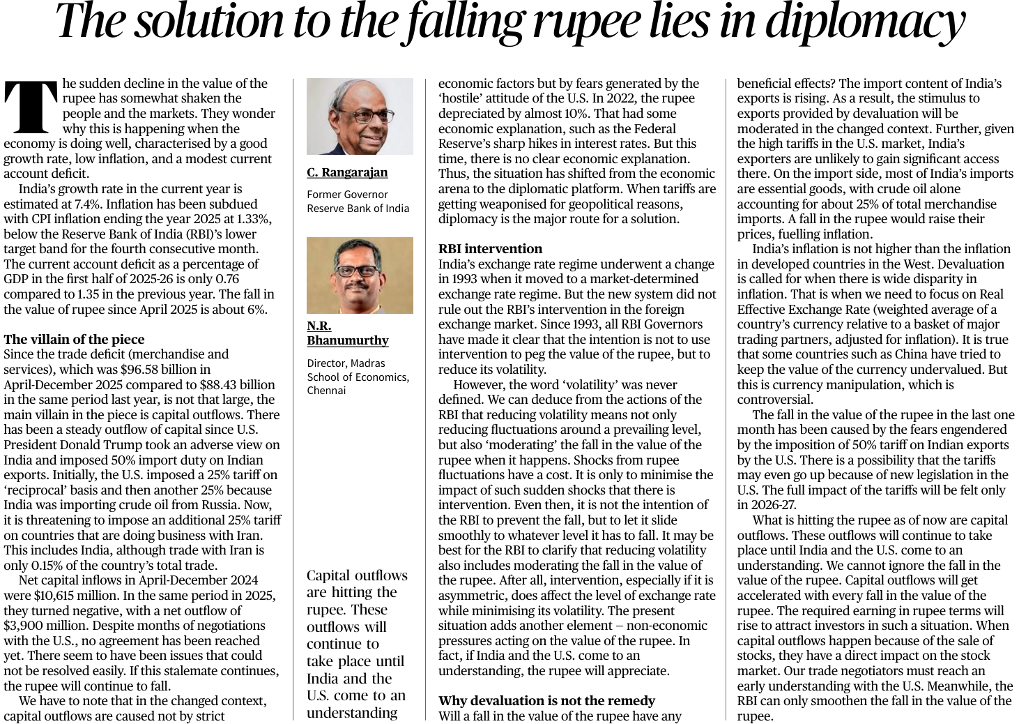
GS 3: Indian Economy – External Sector, Exchange Rate Management & Capital Flows Context
The article discusses the recent fall in the Indian rupee despite strong domestic macroeconomic fundamentals and argues that the primary reasons lie not in economics but in geopolitical and diplomatic factors, particularly India–U.S. trade tensions. Detailed Analysis1. Paradox of a Weak Rupee amid Strong FundamentalsThe author begins by highlighting a contradiction:India is witnessing robust economic growth (7.4%),Low inflation (CPI at 3.13%, below RBI’s lower tolerance band), andA modest current account deficit (0.76% of GDP in H1 2025–26).Despite these positives, the rupee has depreciated by about 6% since April 2025, creating concern in markets and among citizens.2. Identifying the Real Villain: Capital OutflowsThe article clearly states that the trade deficit is not the main cause of the rupee’s fall.Instead, the dominant factor is capital outflows, driven by:Deteriorating India–U.S. trade relations,The U.S. imposing 50% import tariffs on Indian exports (initially 25% reciprocal tariff + additional 25%),Threats of further tariffs linked to India’s crude oil imports from Russia and trade links with Iran.
Key data cited:
Net capital inflows of $10.6 billion (April–Dec 2024)Turned into net outflows of $3.9 billion (April–Dec 2025)This reversal has directly weakened the rupee.
3. Shift from Economics to DiplomacyThe author notes an important transition:Earlier rupee depreciation (e.g., in 2022) could be explained by economic factors like U.S. Federal Reserve rate hikes.The present depreciation lacks a clear economic explanation and is instead driven by non-economic pressures, especially geopolitical fears.Hence, the problem has shifted from the economic domain to the diplomatic arena, where trade tariffs are being used as geopolitical tools.
4. RBI Intervention: Role and LimitsThe article explains India’s exchange rate framework:Since 1993, India follows a market-determined exchange rate system.RBI intervention is aimed at reducing volatility, not pegging the rupee.Key insights:“Reducing volatility” also implies moderating sharp falls, not merely smoothing day-to-day fluctuations.RBI does not prevent depreciation but ensures it happens gradually, minimizing shock to markets.However, RBI intervention alone cannot reverse a diplomatically induced fall.
5. Why Devaluation Is Not a Remedy
The author strongly rejects competitive devaluation as a solution:
On exports:
India’s exports have high import content, limiting gains from depreciation.High U.S. tariffs further reduce export competitiveness.
On imports and inflation:
Nearly essential imports dominate India’s import basket.Crude oil alone accounts for about 25% of total merchandise imports.A weaker rupee raises import costs, fueling inflation.
On REER (Real Effective Exchange Rate):
Devaluation is justified only when domestic inflation is much higher than global inflation, which is not India’s case.Artificial undervaluation, as seen in some countries, amounts to currency manipulation, which is controversial.
6. Immediate Cause and Future Risks
The author attributes the recent sharp fall in the rupee to:Fears triggered by the 50% U.S. tariff on Indian exports.Possibility of further tariff escalation due to new U.S. legislation.The full economic impact is expected only in 2026–27, but capital outflows are already affecting:The rupee,Stock markets (through foreign portfolio investor exits),Required returns on Indian assets (higher rupee-denominated yields to attract investors).
Author’s SuggestionsDiplomatic Engagement with the U.S.
Early and effective trade negotiations are essential.Only a diplomatic understanding can halt capital outflows and restore confidence.
Limited Role for RBI
RBI should continue to smooth volatility, not defend a specific exchange rate.Monetary tools cannot resolve geopolitically driven currency pressures.
Avoid Over-reliance on DevaluationI
ndia should not view a weaker rupee as a growth strategy due to inflationary and structural constraints.
UPSC Mains Question“
The recent depreciation of the Indian rupee reflects non-economic pressures rather than macroeconomic weaknesses.” Discuss in the context of capital flows, trade diplomacy, and the role of the RBI.
GS 3: Indian Economy – Labour Reforms, Employment, Social Security
Context
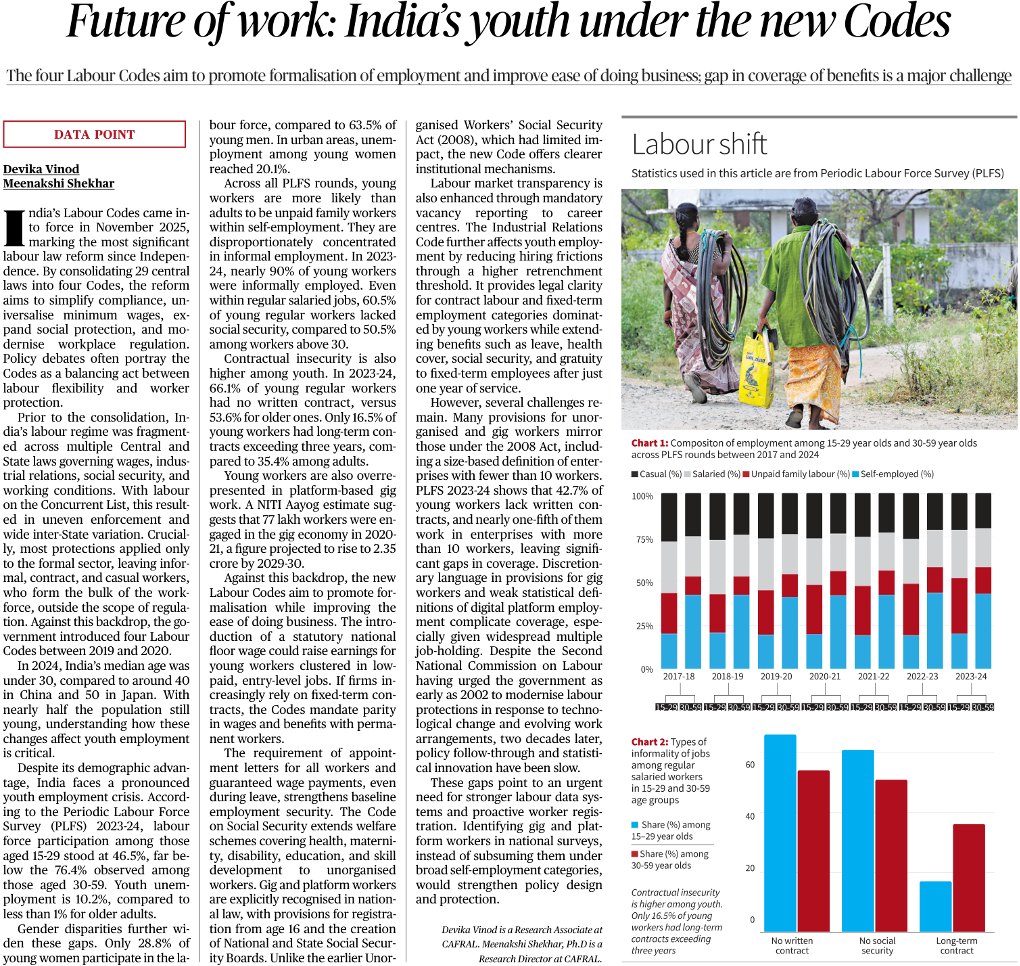
The article examines how India’s four new Labour Codes, implemented in November 2025, affect youth employment. It analyses whether these reforms can address India’s youth employment crisis marked by informality, contractual insecurity, and limited social security coverage, while balancing labour flexibility and worker protection.
Detailed Analysis
1. Background:
From Fragmented Laws to Unified Labour CodesIndia’s labour regulation earlier consisted of 29 Central laws and numerous State laws, leading to:Fragmented coverage,Uneven enforcement across States,Protection largely limited to the formal sector.Since labour is on the Concurrent List, this fragmentation left informal, contract, and casual workers—who form the bulk of the workforce—outside effective regulation. The four Labour Codes were introduced (2019–2020) to simplify compliance, universalise minimum wages, extend social protection, and modernise workplace regulation.
2. Demographic Imperative and Youth Employment CrisisIndia’s median age is below 30, making youth employment outcomes critical for economic growth.
However, PLFS 2023–24 highlights serious challenges:Labour force participation (15–29 years): 46.5%, far below 76.4% for ages 30–59.Youth unemployment: 10.2%, compared to <1% for older adults.Gender gap: Only 28.8% of young women participate in the labour force; urban female youth unemployment touches 20.1%.This demographic advantage risks becoming a demographic liability if quality employment is not generated.3. Informality: The Dominant Feature of Youth WorkThe article underlines that youth employment is overwhelmingly informal:In 2023–24, nearly 90% of young workers were informally employed.Even among regular salaried youth workers, 60.5% lacked social security, higher than among workers above 30.Youth are concentrated in family work and self-employment, often low-paying and insecure.This shows that formal job creation has not kept pace with the expanding youth labour force.
4. Contractual Insecurity and Gig Economy ExpansionYoung workers face disproportionate contractual insecurity:66.1% of young regular workers had no written contract (vs 53.6% among older workers).Only 16.5% had contracts exceeding three years.Youth are over-represented in platform-based gig work.A NITI Aayog estimate cited in the article suggests gig workers may increase from 77 lakh (2020–21) to 2.35 crore by 2029–30, making regulation urgent.
5. What the New Labour Codes Offer YouthThe Labour Codes aim to promote formalisation while improving ease of doing business:Statutory national floor wage may raise earnings for youth clustered in low-paid jobs.Parity in wages and benefits for fixed-term contract workers with permanent workers.Mandatory appointment letters and timely wage payments, including during leave.Code on Social Security extends benefits such as health, maternity, disability, education, and skill development to unorganised workers.Gig and platform workers are explicitly recognised in law, with provisions for registration and welfare boards.Industrial Relations Code reduces hiring frictions by raising retrenchment thresholds while improving clarity in contract and fixed-term employment.
6. Persistent Gaps and Implementation ChallengesDespite reforms, significant concerns remain:
Many provisions for unorganised and gig workers mirror the earlier Unorganised Workers’ Social Security Act, 2008, which had limited impact.Coverage exclusions remain due to size-based enterprise definitions (less than 10 workers).PLFS 2023–24 shows 42.7% of young workers lack written contracts, and nearly one-fifth work in larger enterprises but remain uncovered.
Discretionary language and weak statistical definitions of digital platform employment complicate identification and enforcement.Lack of robust labour data systems and proactive worker registration limits policy effectiveness. Suggestions of the AuthorsStrengthen Labour Data SystemsImprove statistical definitions and identify gig and platform workers explicitly in national surveys.Proactive Worker RegistrationMove beyond voluntary registration to ensure real coverage for informal and gig workers.
Close Coverage Gaps
Address size-based exclusions and discretionary provisions that dilute social security access.Policy Follow-throughEnsure effective implementation, learning from the limited impact of earlier social security legislation.
UPSC Mains Question
“Critically examine the impact of India’s new Labour Codes on youth employment in the context of informality, gig work, and social security coverage.” Source: The Hindu
EU, India to collaborate on ‘peaceful uses’ of nuclear energy under Euratom deal
GS 2: International Relations – India–EU Relations, Strategic Partnerships

GS 2: International Relations – India–EU Relations, Trade and Strategic Partnerships
Context
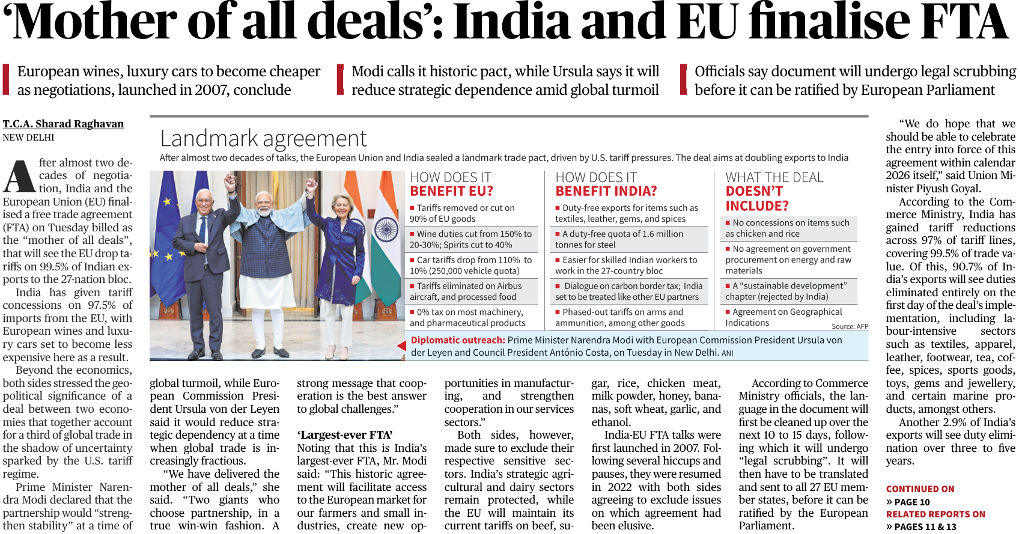
After nearly two decades of negotiations since 2007, India and the European Union have finalised a comprehensive Free Trade Agreement, termed historic by leaders on both sides amid global trade uncertainty.
Key Points
Landmark India–EU Trade Agreement
The FTA is described as India’s largest-ever trade deal.
It aims to deepen economic integration between two economies accounting for about one-third of global trade.
The agreement is driven partly by global trade disruptions and U.S. tariff pressures.
Market Access and Tariff Reductions
EU to remove or cut tariffs on 99.5% of Indian exports.
India to provide tariff concessions on 97.5% of imports from the EU.
Overall tariff reductions cover 97% of tariff lines and 99.5% of trade value.
How the Deal Benefits the EU
Tariffs removed or reduced on about 90% of EU goods.
Wine duties cut from 150% to 20–30%; spirits cut to 40%.
Car tariffs reduced from 110% to 10% under a quota of 250,000 vehicles.
Tariffs eliminated on Airbus aircraft, processed food, machinery, and pharmaceutical products.
How the Deal Benefits India
Duty-free exports for labour-intensive sectors such as textiles, leather, gems, jewellery, and spices.
Duty-free quota of 1.6 million tonnes for steel exports.
Improved mobility and access for skilled Indian professionals in the 27-country EU bloc.
Dialogue mechanism on carbon border tax, with India to be treated on par with other EU partners.
Phased tariff reduction on arms and ammunition.
Strategic and Geopolitical Significance
Leaders highlighted the deal’s role in reducing strategic dependence amid global turmoil.
It strengthens cooperation in manufacturing, services, and supply chains.
Seen as a signal supporting open trade and multilateralism.
What the Deal Does Not Include
No concessions on sensitive agricultural items such as chicken and rice.
No agreement on government procurement in energy and raw materials.
Sustainable development chapter excluded at India’s insistence.
Certain Geographical Indications remain unresolved.
Implementation and Ratification Process
The text will undergo legal scrubbing over the next 10–15 days.
It will be translated into EU languages and sent to all 27 EU member states.
Final ratification required by the European Parliament.
Targeted entry into force within calendar year 2026.
European Union
The EU is a 27-member political and economic union with a single market and common trade policy.
It negotiates trade agreements collectively on behalf of its member states.
The European Parliament plays a key role in ratifying international trade agreements.
Source: The Hindu
UPSC Prelims Practice Question
Question:
With reference to the India–EU Free Trade Agreement, consider the following statements:
1.The EU has agreed to eliminate or reduce tariffs on more than 99% of Indian exports by value.
2.India has provided tariff concessions on all agricultural products under the agreement.
3.The agreement requires ratification by the European Parliament before coming into force.
Which of the statements given above are correct?
A. 1 and 3 only
B. 1 and 2 only
C. 2 and 3 only
D. 1, 2 and 3
Answer: A
Explanation:
Statement 1 is correct as the EU will remove or cut tariffs on 99.5% of Indian exports by value.
Statement 2 is incorrect because sensitive agricultural items like chicken and rice are excluded.
Statement 3 is correct since ratification by the European Parliament is mandatory.
GS 2: Polity and Governance – Judiciary, Criminal Justice System, Victim Rights
Context
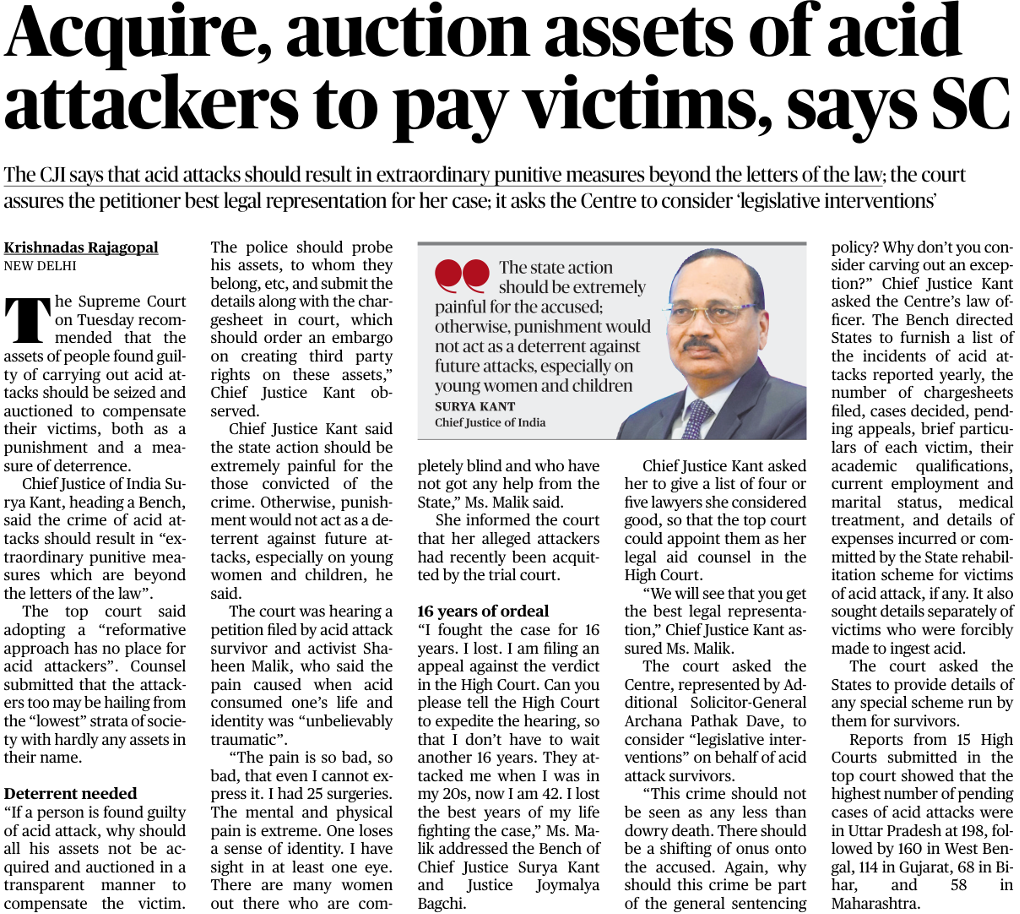
The Supreme Court recommended extraordinary punitive measures for acid attacks, including seizure and auction of convicts’ assets to compensate victims, and asked the Centre to consider legislative intervention.
Key Points
Supreme Court’s Observations on Acid Attacks
Acid attacks are heinous crimes requiring punitive measures beyond routine sentencing.
Reformative justice has no place in acid attack cases due to the gravity and lifelong impact of the crime.
Punishment must be severe enough to act as a strong deterrent, especially to protect women and children.
Seizure and Auction of Assets
The Court recommended that all assets of convicted acid attackers be seized and auctioned.
Proceeds should be used to compensate victims.
Police must investigate:
Nature and ownership of assets,
Beneficiaries,
Third-party interests.
Courts should place an embargo on creation of third-party rights over such assets.
Shift of Burden and Deterrence
The Court stated that acid attack crimes should be treated no less than dowry death.
Suggested a shift of onus onto the accused in such cases.
Emphasised that weak punishment fails to deter future attacks.
Victim-Centric Approach
The Court assured the petitioner best possible legal representation.
Directed that a list of competent lawyers be prepared for appointment as legal aid counsel.
Recognised the long-term physical, psychological, and social trauma faced by survivors.
Directions to Centre and States
The Centre was asked to consider legislative interventions specifically for acid attack cases.
States were directed to submit details on:
Number of acid attack incidents,
Chargesheets filed,
Cases decided and pending,
Victims’ educational background, employment, marital status,
Medical treatment and rehabilitation expenses,
Existing State rehabilitation schemes, if any.
Data on Acid Attack Cases
Reports from 15 High Courts show:
Highest pending cases in Uttar Pradesh: 198
Followed by West Bengal: 160
Gujarat: 114
Bihar: 68
Maharashtra: 58
Supreme Court of India
The Supreme Court is the apex judicial body entrusted with protecting fundamental rights and ensuring justice.
It exercises constitutional authority to issue directions, interpret laws, and recommend legislative reforms in cases of grave public importance.
Source: The Hindu
UPSC Prelims Practice Question
Question:
With reference to acid attack cases in India, consider the following statements:
1.Acid attacks are punishable under specific provisions of the Indian Penal Code.
2.The Supreme Court has recommended seizure and auction of convicts’ assets to compensate acid attack victims.
3.Acid attack cases are tried exclusively by special courts under a separate central law.
Which of the statements given above are correct?
A. 1 and 2 only
B. 1 and 3 only
C. 2 and 3 only
D. 1, 2 and 3
Answer: A
Explanation:
Statement 1 is correct as acid attacks are covered under IPC Sections 326A and 326B.
Statement 2 is correct as the Supreme Court recommended seizure and auction of assets of convicted attackers.
Statement 3 is incorrect because there is no separate central law mandating exclusive special courts for acid attack cases.
GS 2: Polity and Governance – Electoral Reforms, Constitutional Bodies, Representation of the People Act
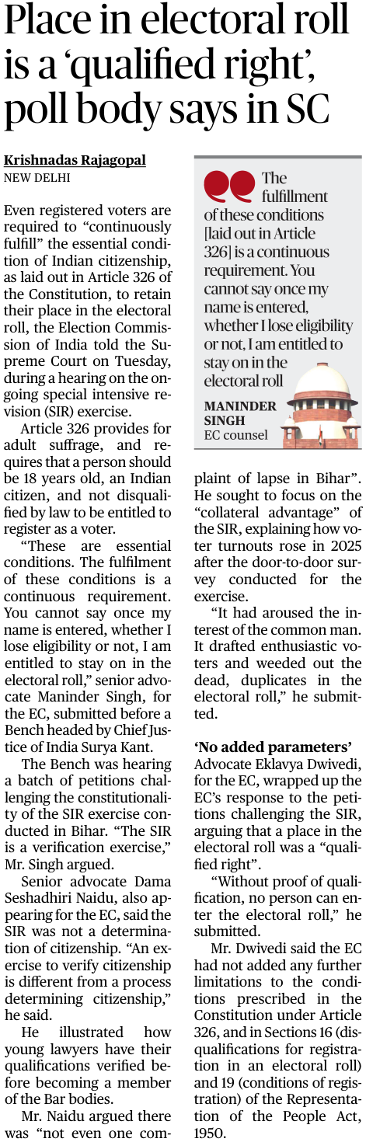
The Election Commission of India informed the Supreme Court that inclusion in the electoral roll is a qualified right subject to continuous fulfilment of conditions under Article 326, during hearings on petitions challenging the Special Intensive Revision exercise in Bihar.
Key Points
Constitutional Basis of Electoral Rights
Article 326 of the Constitution provides for adult suffrage.
Eligibility conditions include:
Minimum age of 18 years,
Indian citizenship,
Not being disqualified under law.
Fulfilment of these conditions is a continuous requirement, not a one-time entitlement.
Electoral Roll as a Qualified Right
The Election Commission argued that entry in the electoral roll is a qualified right, not an absolute right.
Mere inclusion of a name once does not guarantee permanent retention if eligibility is later lost.
Without proof of qualification, no person can remain on the electoral roll.
Special Intensive Revision (SIR) Exercise
The SIR is a verification exercise, not a determination of citizenship.
It is aimed at:
Removing duplicate entries,
Identifying ineligible voters,
Ensuring accuracy of electoral rolls.
The EC cited improved voter turnout in 2025 following a door-to-door survey conducted as part of SIR.
Arguments Against the Challenge
The EC clarified that SIR does not introduce new parameters beyond existing constitutional and statutory requirements.
Sections 16, 19, and related provisions of the Representation of the People Act, 1950 already prescribe:
Disqualifications for registration,
Conditions for registration in electoral rolls.
The EC maintained that the exercise is within its statutory mandate.
Judicial Proceedings
The matter is being heard by a Bench headed by the Chief Justice of India.
Petitions challenge the constitutionality and procedure of the SIR conducted in Bihar.
The Court is examining whether the exercise affects voting rights or violates constitutional safeguards.
Election Commission of India
The Election Commission is a constitutional body under Article 324 responsible for conducting free and fair elections.
It supervises preparation and revision of electoral rolls under the Representation of the People Act, 1950.
It has the authority to verify eligibility and ensure integrity of the electoral process.
Source: The Hindu

 Launch your Graphy