There are no items in your cart
Add More
Add More
| Item Details | Price | ||
|---|---|---|---|




| Index | ||
| S.No | Topic | |
| Daily Hindu Analysis | ||
| 1. | Presidential opinion versus the federal structure | |
| 2. | Will consider plea to revive NJAC, end Collegium system of judicial appointments: CJI | |
| 3. | IRDAI concerned over rising customer complaints: Chairman | |
| 4. | Cabinet approves ₹7,280 cr. scheme for rare earth magnets | |
| 5. | Govt. justifies move to impose ban on online money games | |
| 6. | Trade unions, farmers body protest against new labour codes | |
| 7. | SC asks if a ‘foreigner’ can be allowed to use Aadhaar to gain entry into poll roll | |
Context
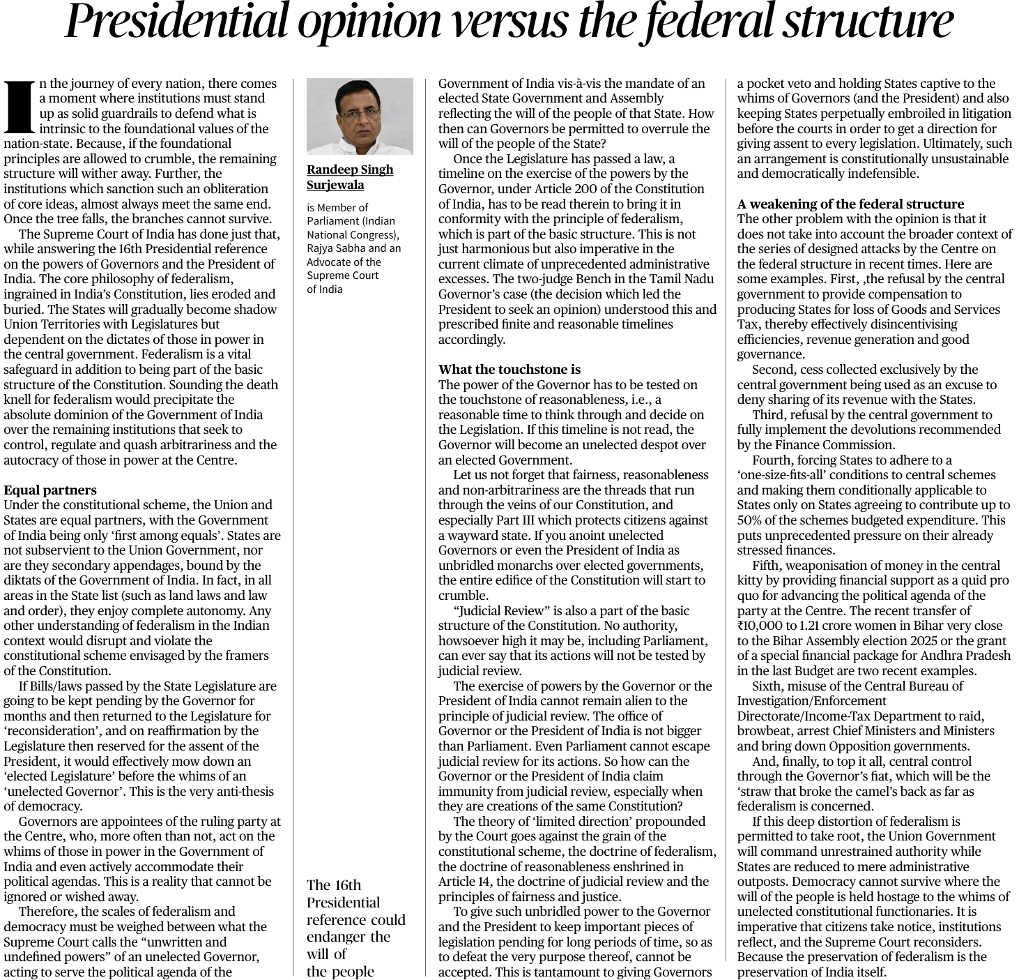
The article discusses concerns arising from the Supreme Court’s consideration of the 16th Presidential Reference on the powers of Governors and the President, and its potential impact on India’s federal structure and constitutional balance between the Centre and States.
Detailed Analysis
Federalism as a Basic Feature
Federalism is part of the basic structure of the Constitution, ensuring autonomy of States within their constitutional domain.
The Union and States are equal partners, with the Union acting as “first among equals,” not as a superior authority.
Role of Governor and President in Federal Scheme
Governors and the President are unelected constitutional authorities expected to act as neutral links between the Centre and States.
Their powers, especially regarding assent to Bills, must reflect the will of the elected State Legislature, not political preferences of the Centre.
Issue of Delays and Withholding Assent
Keeping State Bills pending indefinitely or returning them repeatedly for reconsideration undermines democracy.
Such actions effectively place an elected Legislature at the mercy of an unelected Governor, violating democratic principles.
Reasonableness as the Constitutional Touchstone
Exercise of gubernatorial powers must meet the test of reasonableness, fairness, and non-arbitrariness.
The Tamil Nadu Governor case highlighted the need for finite and reasonable timelines for granting or withholding assent.
Judicial Review as a Safeguard
Judicial review is also a basic feature of the Constitution.
No authority, including the Governor or President, is immune from judicial scrutiny when constitutional values are at stake.
Risks of the 16th Presidential Reference
The theory of “limited direction” suggested in the reference risks diluting federalism.
It may allow the Centre to exercise indirect control over State legislation, weakening State autonomy.
Broader Context of Federal Strain
The author cites recent examples indicating erosion of federalism:
GST compensation delays affecting States’ fiscal autonomy.
Centralisation of cess revenues without sharing with States.
Conditional central schemes imposing financial burdens on States.
Use of central investigative agencies against Opposition-ruled States.
Increasing use of Governors as instruments of central control.
Suggestions by the Author
Enforce strict timelines for Governors and the President in exercising assent-related powers.
Reaffirm that Governors act only on constitutional principles, not political considerations.
Strengthen judicial oversight to prevent misuse of discretionary powers.
Preserve the doctrine of federalism as envisioned by the Constitution’s framers.
UPSC Mains Practice Question
“Examine how the expanding discretionary role of Governors and the President can undermine India’s federal structure. Suggest constitutional safeguards to preserve cooperative federalism.”
Source: The Hindu
Context
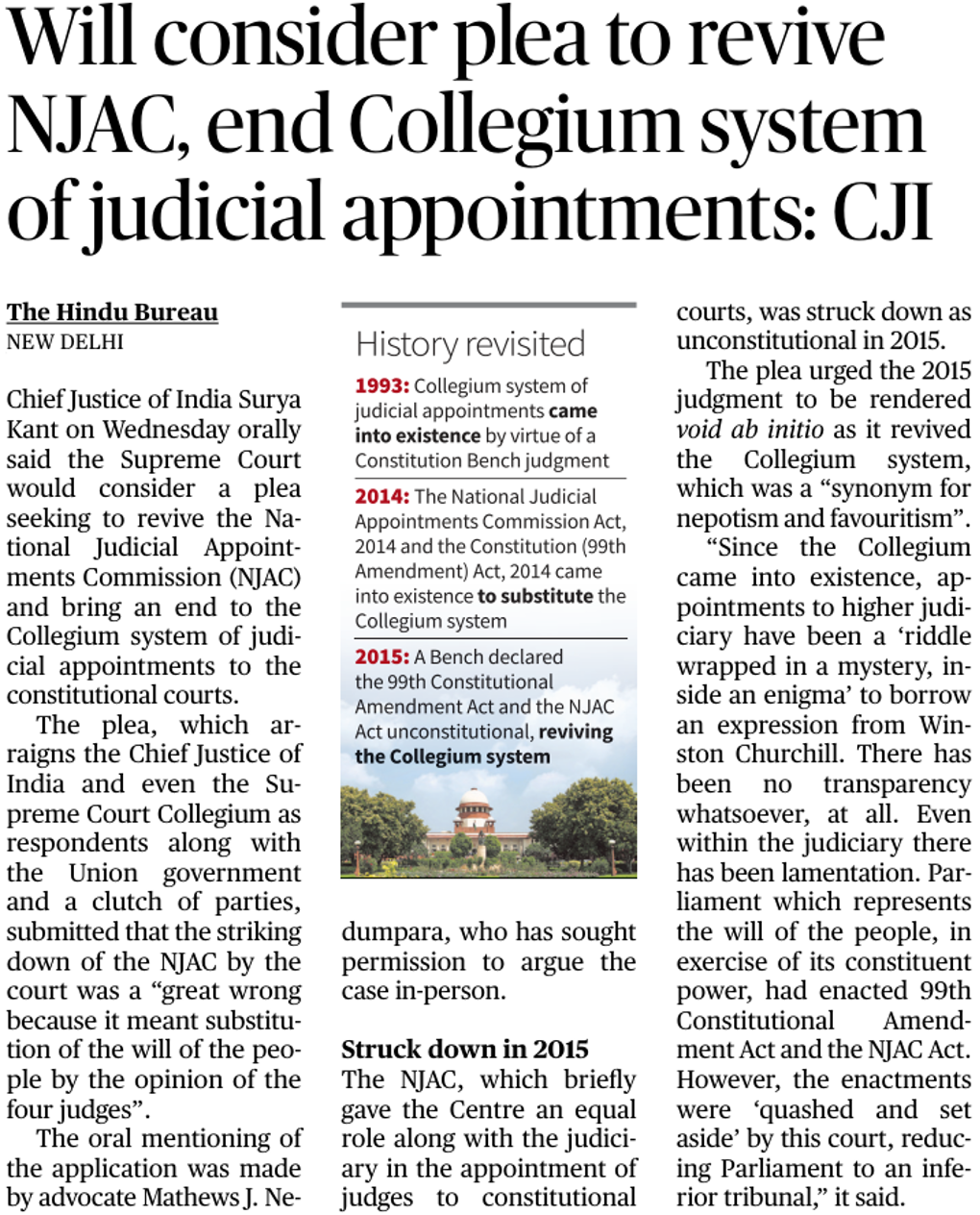
The article discusses concerns arising from the Supreme Court’s consideration of the 16th Presidential Reference on the powers of Governors and the President, and its potential impact on India’s federal structure and constitutional balance between the Centre and States.
Detailed Analysis
Federalism as a Basic Feature
Federalism is part of the basic structure of the Constitution, ensuring autonomy of States within their constitutional domain.
The Union and States are equal partners, with the Union acting as “first among equals,” not as a superior authority.
Role of Governor and President in Federal Scheme
Governors and the President are unelected constitutional authorities expected to act as neutral links between the Centre and States.
Their powers, especially regarding assent to Bills, must reflect the will of the elected State Legislature, not political preferences of the Centre.
Issue of Delays and Withholding Assent
Keeping State Bills pending indefinitely or returning them repeatedly for reconsideration undermines democracy.
Such actions effectively place an elected Legislature at the mercy of an unelected Governor, violating democratic principles.
Reasonableness as the Constitutional Touchstone
Exercise of gubernatorial powers must meet the test of reasonableness, fairness, and non-arbitrariness.
The Tamil Nadu Governor case highlighted the need for finite and reasonable timelines for granting or withholding assent.
Judicial Review as a Safeguard
Judicial review is also a basic feature of the Constitution.
No authority, including the Governor or President, is immune from judicial scrutiny when constitutional values are at stake.
Risks of the 16th Presidential Reference
The theory of “limited direction” suggested in the reference risks diluting federalism.
It may allow the Centre to exercise indirect control over State legislation, weakening State autonomy.
Broader Context of Federal Strain
The author cites recent examples indicating erosion of federalism:
GST compensation delays affecting States’ fiscal autonomy.
Centralisation of cess revenues without sharing with States.
Conditional central schemes imposing financial burdens on States.
Use of central investigative agencies against Opposition-ruled States.
Increasing use of Governors as instruments of central control.
Suggestions by the Author
Enforce strict timelines for Governors and the President in exercising assent-related powers.
Reaffirm that Governors act only on constitutional principles, not political considerations.
Strengthen judicial oversight to prevent misuse of discretionary powers.
Preserve the doctrine of federalism as envisioned by the Constitution’s framers.
UPSC Mains Practice Question
“Examine how the expanding discretionary role of Governors and the President can undermine India’s federal structure. Suggest constitutional safeguards to preserve cooperative federalism.”
Source: The Hindu
Context
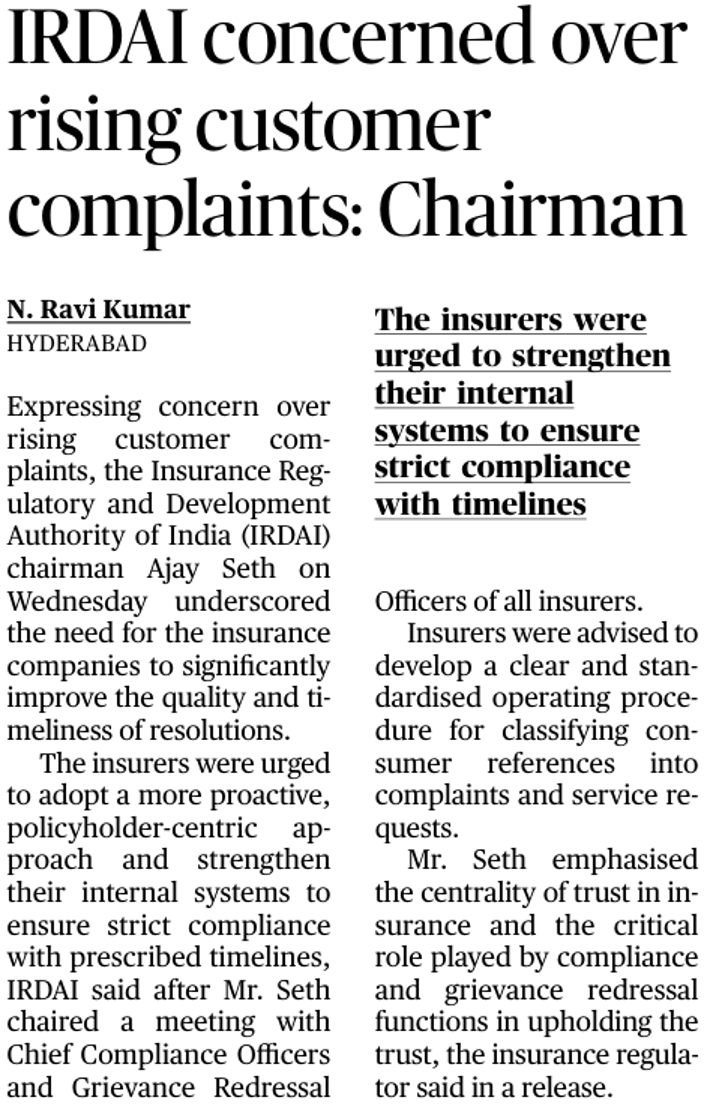
The Chairman of the Insurance Regulatory and Development Authority of India (IRDAI) expressed concern over the rising number of customer complaints and urged insurers to strengthen internal systems and ensure timely grievance redressal.
Key Points
Rising Customer Complaints
IRDAI flagged an increase in policyholder grievances across insurers.
Emphasis laid on improving quality and timeliness of complaint resolution.
Directions to Insurance Companies
Insurers urged to adopt a proactive, policyholder-centric approach.
Asked to strengthen internal compliance systems to meet prescribed timelines.
Advised to develop clear and standard operating procedures (SOPs) for classifying complaints and service requests.
Importance of Trust and Compliance
Trust identified as the backbone of the insurance sector.
Effective compliance and grievance redressal mechanisms seen as essential to sustain public confidence.
Insurance Regulatory and Development Authority of India (IRDAI)
Statutory body established under the IRDAI Act, 1999.
Functions under the Ministry of Finance, with headquarters at Hyderabad.
Mandate includes protecting policyholders’ interests, regulating insurers and intermediaries, approving products, ensuring solvency, and promoting insurance penetration, including in rural and vulnerable sections.
UPSC Prelims Practice Question
Q. Consider the following statements regarding the Insurance Regulatory and Development Authority of India (IRDAI):
1.IRDAI is a statutory body established under an Act of Parliament.
2.IRDAI is responsible for protecting policyholders’ interests and regulating insurance intermediaries.
Which of the statements given above is/are correct?
(a) 1 only
(b) 2 only
(c) Both 1 and 2
(d) Neither 1 nor 2
Correct Answer: (c)
Explanation:
Statement 1 is correct as IRDAI was established under the IRDAI Act, 1999.
Statement 2 is correct because IRDAI regulates insurers and intermediaries and safeguards policyholders’ interests.
GS 3: Indian Economy – Industry, Minerals, Supply Chains
Context
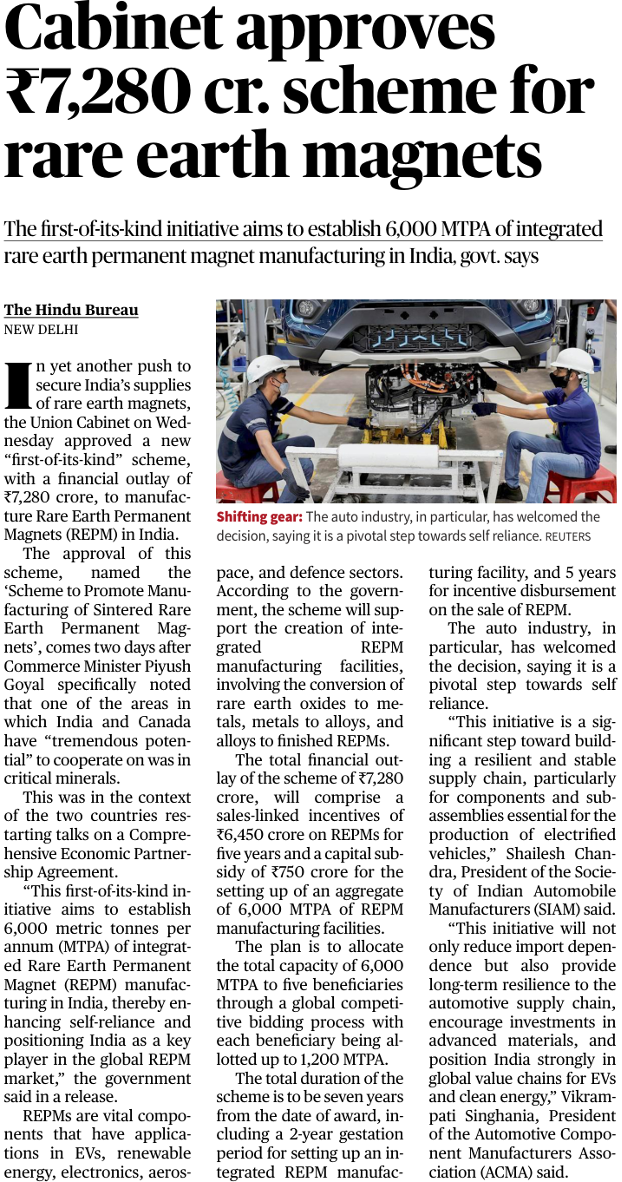
The Union Cabinet has approved a first-of-its-kind scheme with a financial outlay of ₹7,280 crore to promote domestic manufacturing of Rare Earth Permanent Magnets (REPM), aimed at reducing import dependence and strengthening strategic supply chains.
Key Points
About the Scheme
Named Scheme to Promote Manufacturing of Sintered Rare Earth Permanent Magnets.
Focuses on establishing 6,000 MTPA of integrated REPM manufacturing capacity in India.
Covers the entire value chain from rare earth oxides to finished magnets.
Financial Outlay and Incentives
Total outlay: ₹7,280 crore.
Sales-linked incentives: ₹6,450 crore over five years on sale of REPM.
Capital subsidy: ₹750 crore for setting up aggregate manufacturing capacity.
Manufacturing Capacity and Beneficiaries
Total capacity of 6,000 MTPA to be allocated through global competitive bidding.
Five beneficiaries, each eligible for up to 1,200 MTPA capacity.
Duration and Implementation
Total duration: 7 years from date of award.
Includes 2-year gestation period for setting up facilities.
Followed by 5 years of incentive disbursement based on sales.
Strategic Importance of REPM
REPM are critical for electric vehicles, renewable energy, electronics, aerospace, and defence sectors.
The scheme aims to enhance self-reliance and position India as a key global player in the REPM market.
Industry Response
Auto and component industries welcomed the move as a pivotal step towards resilient and stable supply chains.
Expected to boost EV manufacturing, advanced materials, and clean energy value chains.
Rare Earth Permanent Magnets (REPM)
Essential components used in EV motors, wind turbines, electronics, and precision defence equipment.
Currently dominated by a few global suppliers, making domestic capability a strategic necessity.
UPSC Prelims Practice Question
Q. Consider the following statements regarding the recently approved scheme for rare earth permanent magnets:
1.The scheme aims to establish 6,000 MTPA of integrated rare earth permanent magnet manufacturing capacity in India.
2.The scheme provides only capital subsidy support without any sales-linked incentives.
Which of the statements given above is/are correct?
(a) 1 only
(b) 2 only
(c) Both 1 and 2
(d) Neither 1 nor 2
Correct Answer: (a)
Explanation:
Statement 1 is correct as the scheme targets 6,000 MTPA of integrated REPM manufacturing capacity.
Statement 2 is incorrect because the scheme includes both sales-linked incentives and capital subsidy.
Government policies, fundamental rights, regulation of digital platforms
Context
The Union government has defended before the Supreme Court its move to regulate and impose a ban on online money gaming, citing risks to public order, economic security, and human lives. Key PointsGovernment’s StandOnline money gaming entities do not have an absolute right to trade under Article 19 when activities harm public interest.The Centre argued that such platforms pose serious risks to individuals, families, and national security. Legal BasisRight to trade or profession under Article 19 is subject to reasonable restrictions.The government justified the Promotion and Regulation of Online Gaming Act as a regulatory necessity. Public Safety and Social ConcernsOnline money games linked to addiction, financial distress, and fatalities, especially among young users.An estimated 45 crore people were negatively affected, with losses exceeding ₹2,000 crore. Economic and Security RisksIdentified systemic legal violations such as:Large-scale tax evasionMoney launderingCross-border illicit fund flowsPotential terror financing vulnerabilities Banking and Financial Red FlagsBanks detected money mule accounts connected to online money gaming websites.These platforms saw a surge in usage post-COVID, coinciding with increased fraud cases. Cybersecurity ThreatsGaming-related transactions overlap with cybercrime and online fraud.Risks include identity theft, data compromise, and exposure to malware such as spyware and viruses. Article 19 of the Constitution of IndiaGuarantees freedom to practise any profession or to carry on any occupation, trade, or business.This freedom is not absolute and can be restricted in the interest of public order, morality, and general welfare. UPSC Prelims Practice QuestionQ. Consider the following statements regarding the regulation of online money games in India:1.The right to trade under Article 19 is absolute and cannot be restricted by the State.2.The government has cited money laundering, cybercrime, and public safety concerns to justify regulation of online money gaming platforms.Which of the statements given above is/are correct?(a) 1 only
(b) 2 only
(c) Both 1 and 2
(d) Neither 1 nor 2Correct Answer: (b)Explanation:
Statement 1 is incorrect because Article 19 freedoms are subject to reasonable restrictions.
Statement 2 is correct as the government highlighted economic crimes, cyber risks, and public harm linked to online money games.
Context
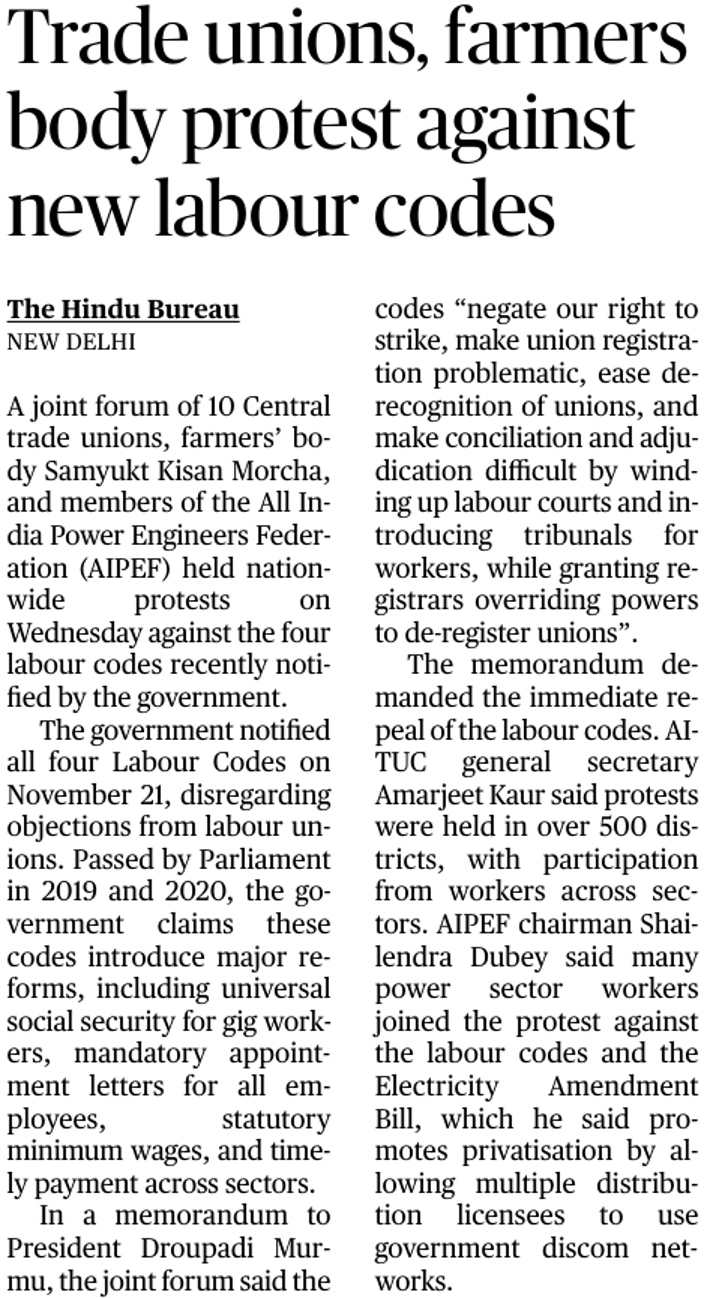
Trade unions and farmers’ organisations have launched nationwide protests against the four new Labour Codes notified by the Union government, alleging dilution of workers’ rights and bypassing stakeholder concerns.
Key Points
Background of Labour Codes
Parliament passed four Labour Codes during 2019–2020 to consolidate multiple labour laws.
The government formally notified all four codes on November 21, despite objections from trade unions.
Organisations Involved in Protests
Protests organised by a joint forum of 10 Central Trade Unions.
Participation by Samyukt Kisan Morcha and the All India Power Engineers Federation (AIPEF).
Demonstrations held in over 500 districts across sectors.
Government’s Stated Objectives
Introduce universal social security, including coverage for gig and platform workers.
Ensure statutory minimum wages and mandatory appointment letters for employees.
Promote timely wage payments and labour market flexibility.
Concerns Raised by Trade Unions
Labour Codes allegedly restrict the right to strike.
Make union registration and recognition more difficult.
Weaken conciliation mechanisms by winding up labour courts.
Introduce tribunals and grant registrars powers to deregister unions.
Power Sector and Farmers’ Concerns
Power sector workers protested the Electricity Amendment Bill, alleging promotion of privatisation.
Farmers’ groups expressed concern over indirect impacts on rural employment and allied sectors.
Demand of Protestors
Immediate repeal of the four Labour Codes.
Restoration of earlier labour law protections and consultative policymaking.
Additional Information
Four Labour Codes
Code on Wages, 2019
Industrial Relations Code, 2020
Code on Social Security, 2020
Occupational Safety, Health and Working Conditions Code, 2020
UPSC Prelims Practice Question
Q. Consider the following statements regarding the new Labour Codes in India:
1.The Labour Codes aim to consolidate multiple existing labour laws into four comprehensive codes.
2.The Industrial Relations Code expands the unconditional right to strike for workers.
Which of the statements given above is/are correct?
(a) 1 only
(b) 2 only
(c) Both 1 and 2
(d) Neither 1 nor 2
Correct Answer: (a)
Explanation:
Statement 1 is correct as the four Labour Codes consolidate numerous labour laws.
Statement 2 is incorrect because trade unions argue that the Industrial Relations Code restricts, rather than expands, the right to strike.
Context
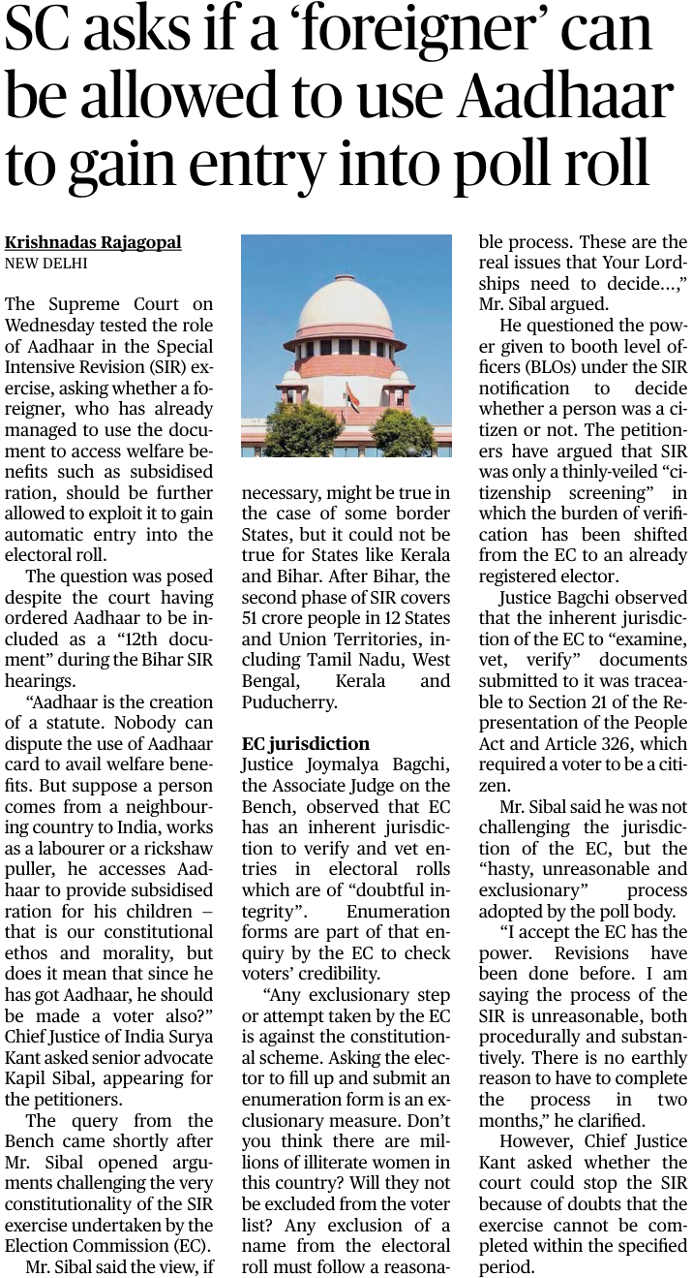
The Supreme Court is examining the Election Commission’s Special Intensive Revision (SIR) of electoral rolls and questioned whether possession of Aadhaar by a foreigner can be used to gain entry into the voter list.
Key Points
Role of Aadhaar
Aadhaar is a statutory identity document, primarily meant for welfare delivery.
The Court reiterated that Aadhaar does not confer citizenship and cannot by itself establish voter eligibility.
Constitutional Requirement for Voting
Article 326 mandates that only citizens of India can be enrolled as voters.
Entry into the electoral roll must be based on citizenship, not mere residence or possession of Aadhaar.
Special Intensive Revision (SIR)
SIR is being conducted by the Election Commission of India (ECI) to verify electoral rolls.
The second phase covers about 51 crore people across 12 States and Union Territories, including Kerala, Tamil Nadu, West Bengal, and Puducherry.
Jurisdiction of the Election Commission
The Court observed that the ECI has inherent powers to examine, verify, and vet electoral documents.
These powers flow from Section 21 of the Representation of the People Act, 1950
Concerns Raised by Petitioners
Petitioners argued that SIR acts as a citizenship screening exercise, shifting the burden of proof to voters.
Mandatory enumeration forms may lead to exclusion of vulnerable groups, such as migrants and illiterate voters.
Judicial Observations
Any exclusion from the voter list must follow a reasonable and constitutionally valid procedure.
The Court questioned the short timeline of completing the SIR within two months, calling it potentially unreasonable.
Election Commission of India
The ECI is a constitutional body under Article 324 responsible for preparing and revising electoral rolls.
It must balance electoral integrity with the constitutional principle of universal adult franchise.
UPSC Prelims Practice Question
Q. Consider the following statements regarding Aadhaar and electoral rolls:
1.Possession of Aadhaar by itself establishes Indian citizenship for inclusion in the electoral roll.
2.The Election Commission has statutory powers to verify and revise electoral rolls under the Representation of the People Act, 1950.
Which of the statements given above is/are correct?
(a) 1 only
(b) 2 only
(c) Both 1 and 2
(d) Neither 1 nor 2
Correct Answer: (b)
Explanation:
Statement 1 is incorrect because Aadhaar is only an identity document and does not confer citizenship.
Statement 2 is correct as the Election Commission derives powers to revise electoral rolls from the Representation of the People Act, 1950.
Source: The Hindu
 Launch your Graphy