There are no items in your cart
Add More
Add More
| Item Details | Price | ||
|---|---|---|---|



| Index | ||
| S.No | Topic | |
| Daily Hindu Analysis (YouTube) | ||
| 1. | Can India eliminate malaria by 2030? | |
| 2. | India–UAE ties — stability, substance, strategic union | |
| 3. | The issues surrounding Governors’ address | |
| 4. | The silicon curtain | |
| 5. | Nipah scare: RT-PCR tests done on bats at Kolkata zoo | |
| 6. | Shubhanshu Shukla, who flew to space, gets Ashok Chakra | |
| 7. | Nation honours 131 personalities with Padma awards | |
| 8. | Trade pacts bringing in jobs for youth: PM | |
| 9. | If judges lose credibility, nothing will be left of judiciary: Justice Bhuyan | |
GS Paper 2: Governance | Health | Government Policies and Interventions
Context
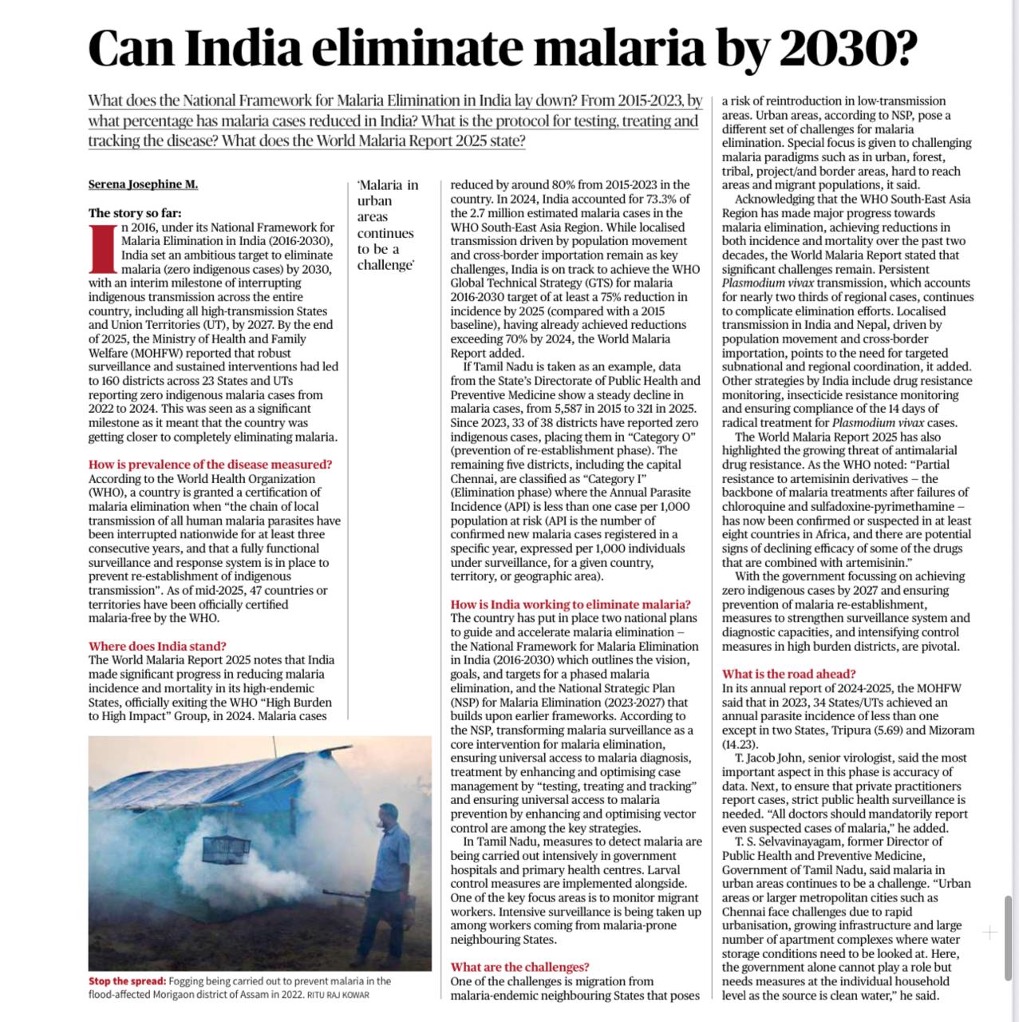
The article analyses India’s progress towards malaria elimination by 2030, examining national policy frameworks, reduction trends from 2015–2023, challenges such as migration and drug resistance, and insights from the World Malaria Report 2025.
Detailed Analysis
National Framework and Targets
India adopted the National Framework for Malaria Elimination (2016–2030).
Zero indigenous malaria cases by 2030 is the final target.
An interim milestone aims to interrupt indigenous transmission nationwide by 2027, including high-burden States and Union Territories.
How Malaria Elimination Is Measured
WHO certifies malaria elimination when local transmission is interrupted for three consecutive years with strong surveillance.
Disease burden is measured using Annual Parasite Incidence (API) — confirmed malaria cases per 1,000 population under surveillance.
Progress Achieved So Far
India reduced malaria cases by around 80% between 2015 and 2023.
In 2024, India accounted for 73.3% of estimated malaria cases in the WHO South-East Asia Region, yet showed steep internal decline.
India is on track to meet the WHO Global Technical Strategy (GTS) target of 75% reduction by 2025, having already crossed 70% reduction.
160 districts across 23 States and UTs reported zero indigenous malaria cases (2022–2024).
India exited the WHO’s “High Burden to High Impact” (HBHI) group in 2024.
State-Level and District Categorisation
Districts are classified as:
Category 0 – Prevention of re-establishment (zero indigenous cases)
Category I – Elimination phase (API < 1)
Example: Tamil Nadu shows steady decline from 5,587 cases (2015) to 321 cases (2025), with 33 of 38 districts in Category 0.
Policy Instruments and Strategies
India is guided by two key plans:
National Framework for Malaria Elimination (2016–2030)
National Strategic Plan for Malaria Elimination (2023–2027)
Core interventions include:
Test–Treat–Track strategy
Universal access to diagnostics and treatment
Strengthened vector control and larval management
Enhanced surveillance and case management
Urban Malaria and Special Risk Areas
Urban areas pose unique challenges due to:
Rapid urbanisation
Construction activity and water storage practices
High population density and migration
Special focus is required in urban, forest, tribal, border, project and migrant-dense regions.
Key Challenges Highlighted
Migration and cross-border transmission, especially from malaria-endemic neighbouring States and countries.
Plasmodium vivax dominance, accounting for nearly two-thirds of regional cases, complicating elimination due to relapse risk.
Rising drug resistance, including partial resistance to artemisinin derivatives globally.
Risk of re-introduction in low-transmission areas without sustained vigilance.
World Malaria Report 2025 Observations
Recognises India’s major progress in reducing both incidence and mortality.
Warns that drug resistance and declining efficacy of combination therapies threaten long-term gains.
Emphasises need for subnational and regional coordination.
What Lies Ahead
Government focus on zero indigenous cases by 2027 and preventing re-establishment thereafter.
Strengthening public health surveillance, including mandatory reporting by private practitioners.
Greater emphasis on data accuracy, urban malaria control, and household-level behaviour change, especially clean water storage.
Suggestions Emerging from the Article
Sustain high-quality surveillance even after elimination.
Target migrant populations and border districts through coordinated action.
Address drug and insecticide resistance proactively.
Strengthen urban malaria strategies alongside rural interventions.
UPSC Mains Practice Question
India has made significant progress in reducing malaria incidence but faces structural and epidemiological challenges in elimination. Critically examine India’s preparedness to achieve malaria elimination by 2030.
Context
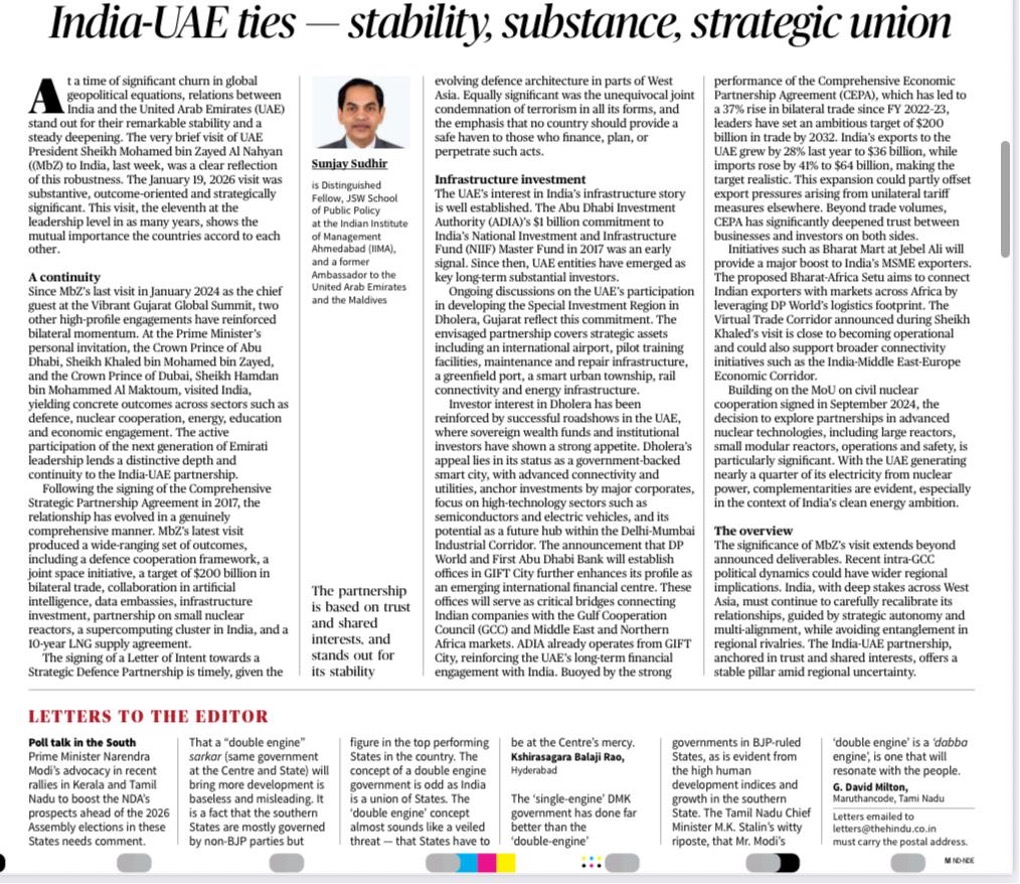
The article examines the deepening India–UAE strategic partnership in a volatile global geopolitical environment, highlighting continuity in leadership engagement, expanding economic and defence cooperation, and the partnership’s role as a stabilising force in West Asia.
Detailed Analysis
Strategic Stability in a Volatile World
Amid global geopolitical churn, India–UAE relations stand out for consistency and predictability.
The January 2026 visit of UAE President Sheikh Mohamed bin Zayed Al Nahyan reflects mutual trust and long-term alignment.
Repeated high-level exchanges show the relationship is institutionalised, not personality-driven.
From Transactional to Strategic Partnership
Since the Comprehensive Strategic Partnership Agreement (2017), ties have matured across defence, energy, education, technology, and trade.
Outcomes include defence cooperation frameworks, joint space initiatives, AI collaboration, semiconductor investment, and a $200 billion bilateral trade target.
Defence and Security Cooperation
The Letter of Intent on Strategic Defence Partnership signals deeper military collaboration.
Joint condemnation of terrorism and the principle that no country should shelter terror financiers or planners strengthens regional security norms.
Cooperation aligns with evolving defence architectures in West Asia.
Infrastructure and Investment Linkages
The UAE has emerged as a major long-term infrastructure investor in India.
ADIA’s $1 billion commitment to India’s National Investment and Infrastructure Fund (NIIF) reflects confidence in India’s growth story.
UAE participation in the Dholera Special Investment Region covers airports, logistics, greenfield townships, and urban infrastructure.
Economic Integration and CEPA Impact
The India–UAE CEPA has driven a 37% rise in bilateral trade in FY 2022–23.
Leaders have set a $200 billion trade target by 2032, with exports potentially reaching $100 billion.
CEPA has deepened trust between businesses and investors beyond trade volumes.
Connectivity and Global Value Chains
Initiatives like Bharat–Africa trade corridors leverage DP World’s logistics network.
The Virtual Trade Corridor announced during Sheikh Khaled’s visit enhances digital trade facilitation.
India–Middle East–Europe Economic Corridor strengthens India’s role in transcontinental connectivity.
Energy and Nuclear Cooperation
Civil nuclear cooperation agreement (September 2024) opens collaboration in advanced nuclear technologies, including SMRs.
Complementarity is evident as UAE generates nearly one-fourth of its electricity from nuclear power, aligning with clean energy goals.
Financial and Institutional Linkages
Establishment of DP World and First Abu Dhabi Bank offices in GIFT City enhances India’s role as an international financial hub.
GIFT City serves as a gateway connecting India with GCC, Africa, and Europe.
Geopolitical Significance
The partnership reflects India’s multi-alignment strategy, avoiding entanglement in regional rivalries.
It offers a model of pragmatic cooperation based on sovereignty, shared interests, and strategic autonomy.
India–UAE ties act as a pillar of regional stability amid West Asian uncertainties.
Suggestions Emerging from the Article
Deepen defence-industrial cooperation beyond agreements to joint production.
Expand CEPA utilisation among MSMEs and exporters.
Accelerate connectivity projects linking India with Africa and Europe via the UAE.
Institutionalise cooperation in clean energy and advanced technologies.
UPSC Mains Practice Question
India–UAE relations have evolved from transactional engagement to a comprehensive strategic partnership. Examine how this partnership contributes to India’s regional stability and strategic autonomy.
Source: The Hindu
GS Paper 2: Polity & Governance | Constitutional Bodies, Federalism
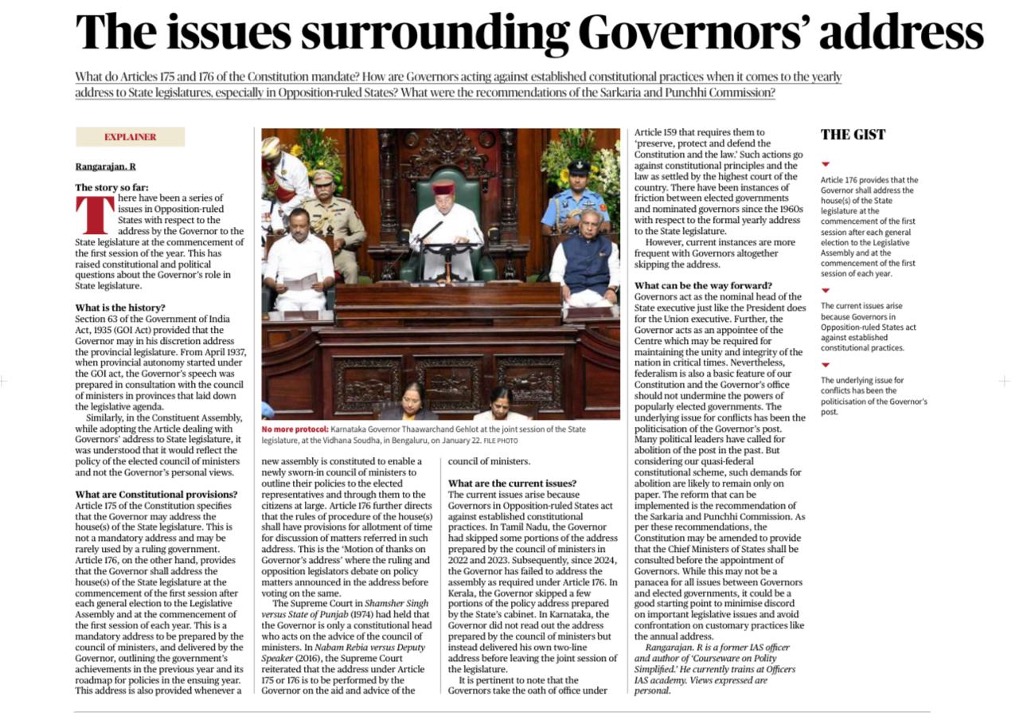
The article examines the growing constitutional and political controversies surrounding Governors’ addresses to State legislatures, especially in Opposition-ruled States, and questions deviations from established constitutional conventions under Articles 175 and 176.
Detailed Analysis
Historical Background of the Governor’s Address
The practice originates from Section 63 of the Government of India Act, 1935, where the Governor addressed the provincial legislature.
Even under colonial rule, the address reflected the policy of the council of ministers, not the personal views of the Governor.
The Constituent Assembly adopted this convention, reinforcing the Governor’s non-political and ceremonial role.
Constitutional Provisions Governing the Address
Article 175 empowers the Governor to address the State legislature but does not mandate it.
Article 176 mandates the Governor to address the House at:
The commencement of the first session after a general election, and
The first session of every year.
The address must be prepared by the Council of Ministers, outlining government policy and legislative agenda.
Rules of procedure require discussion on the address, often followed by a motion of thanks.
Judicial Interpretation of the Governor’s Role
In Shamsher Singh v. State of Punjab (1974), the Supreme Court held that the Governor is a constitutional head, bound by ministerial advice.
In Nabam Rebia v. Deputy Speaker (2016), the Court reiterated that constitutional functions under Articles 175 and 176 must be exercised on aid and advice of the Council of Ministers.
Governors cannot rewrite, omit, or refuse to read the address prepared by the elected government.
Current Controversies and Deviations
Recent instances in States like Tamil Nadu, Kerala, and Karnataka show Governors:
Skipping parts of the address,
Refusing to read the address,
Or delivering parallel remarks.
In some cases, Governors have avoided the address altogether, despite Article 176 being mandatory.
These actions contradict constitutional conventions and have intensified Centre-State friction.
Federalism and Democratic Concerns
Governors take an oath under Article 159 to preserve and defend the Constitution.
Deviations undermine:
The authority of elected State governments,
Legislative accountability,
Cooperative federalism.
The root cause is identified as the politicisation of the Governor’s office, particularly in Opposition-ruled States.
Recommendations of Constitutional Commissions
Sarkaria Commission and Punchhi Commission emphasised:
The Governor must act as a neutral constitutional umpire.
Governors should not interfere in day-to-day governance.
Respect for conventions like the annual address is essential.
Both commissions recommended consultation with the Chief Minister before appointing a Governor to reduce friction.
Suggestions Emerging from the Article
Reinforce constitutional conventions governing the Governor’s address.
Implement Sarkaria and Punchhi Commission recommendations.
Ensure Governors act strictly on ministerial advice under Articles 163 and 176.
De-politicise the office of the Governor to preserve federal balance.
UPSC Mains Practice Question
Discuss the constitutional position of the Governor’s address to the State Legislature. How do recent controversies challenge the principles of parliamentary democracy and federalism?
Source: The Hindu
The silicon curtain
Context
The article discusses the U.S.-led initiative “Pax Silica”, aimed at restructuring global semiconductor and AI supply chains into a closed-loop ecosystem, and analyses India’s strategic dilemma in navigating this emerging technology bloc amid U.S.–China rivalry.
Key Points
What is Pax Silica
Pax Silica is a U.S.-driven coalition to secure the full semiconductor and AI supply chain.
It brings together mineral suppliers, manufacturing hubs, logistics networks, and technology leaders.
Objective is to reduce dependence on China-dominated chip manufacturing ecosystems.
Members and Structure
Core signatories include Australia, Japan, South Korea, Singapore, Israel, UAE, Greece, Qatar, and the U.S.
Non-signatories include India, EU, Canada, Netherlands, Taiwan, and OECD countries.
Functions as a closed-loop ecosystem, prioritising trusted and aligned partners.
Strategic Shift by the U.S.
Marks a move from open globalisation to selective techno-economic alignment.
Focuses on countries willing to align with U.S. economic security protocols.
Seeks to insulate advanced AI and semiconductor development from Chinese influence.
China Factor
China is rapidly advancing domestic chip-making capacity.
Pax Silica aims to contain China’s dominance in AI, rare earths, and advanced manufacturing.
Reflects broader U.S.–China strategic competition in technology.
India’s Strategic Value
India offers:
A large and growing market.
A massive engineering and software talent pool.
Strength in design-to-delivery services for AI and semiconductors.
India’s democratic credentials and data-rich economy add to its attractiveness.
The Indian Paradox
India seeks to join U.S.-led security architectures while maintaining strategic autonomy.
Simultaneously easing restrictions on Chinese investments for industrial growth.
India’s approach is not decoupling but rebalancing between security and economic pragmatism.
Technology as the New Oil
Semiconductors and AI are described as the strategic resources of the 21st century.
Unlike oil, silicon ecosystems depend on global collaboration and innovation networks.
Excessive techno-nationalism risks fragmenting innovation.
Implications for India
Joining Pax Silica could:
Strengthen supply chain security.
Enhance access to advanced technology.
Staying out preserves:
Policy flexibility.
Economic ties with multiple global players.
India must decide whether Pax Silica becomes a bridge to shared prosperity or a rigid fortress.
Indo-Pacific Economic Framework (IPEF)
A U.S.-led initiative focusing on trade, supply chains, clean energy, and fair economy.
Pax Silica is viewed as a more technology-focused successor with sharper security orientation.
UPSC Prelims Practice Question
Q. Consider the following statements regarding “Pax Silica”:
It is a U.S.-led initiative aimed at securing semiconductor and AI supply chains through trusted partner countries.
India is a founding member of Pax Silica.
Which of the statements given above is/are correct?
(a) 1 only
(b) 2 only
(c) Both 1 and 2
(d) Neither 1 nor 2
Correct Answer: (a)
Explanation:
Statement 1 is correct as Pax Silica is a U.S.-driven closed-loop technology coalition.
Statement 2 is incorrect because India is not a founding member and currently holds observer status.
Source: The Hindu
GS Paper 3: Science & Technology | Health and Disease
Context
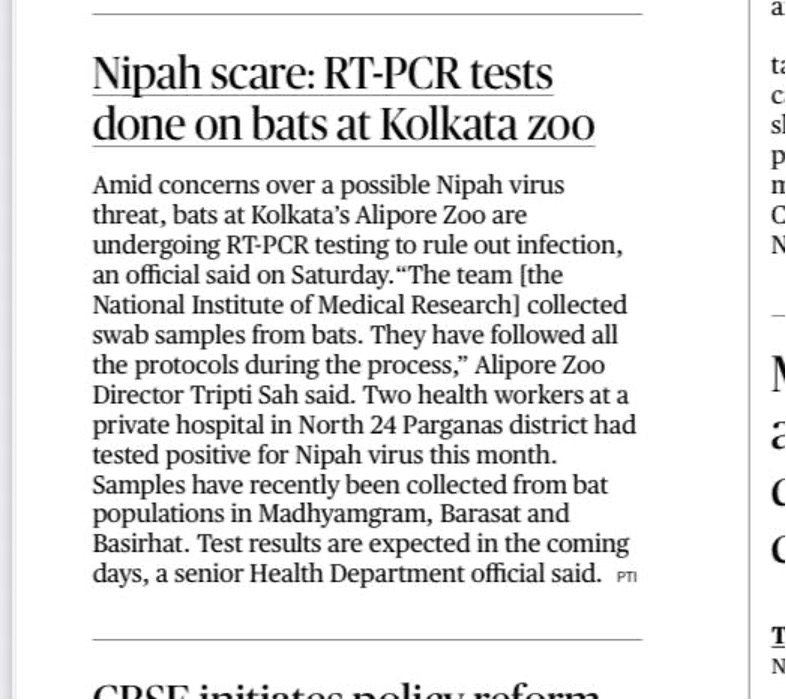
Following detection of Nipah virus cases in North 24 Parganas district, bats at Kolkata’s Alipore Zoo are undergoing RT-PCR testing to rule out infection, amid concerns of a possible zoonotic spillover.
Key Points
About Nipah Virus (NiV)
Zoonotic virus transmitted from animals to humans and sometimes human-to-human.
Caused by an RNA virus belonging to Paramyxoviridae family, genus Henipavirus.
Closely related to Hendra virus.
Natural Hosts and Transmission
Fruit bats (genus Pteropus) are the natural reservoir.
Virus present in bat urine, faeces, saliva, and birthing fluids.
Can spread through contaminated food, infected animals, or close contact with infected humans.
Affected Animals
Initially detected in pigs.
Other susceptible animals include dogs, cats, goats, horses, and sheep.
Clinical Features in Humans
Causes acute encephalitis.
Symptoms include fever, headache, drowsiness, disorientation, mental confusion, coma, and death in severe cases.
Fatality Rate
Case fatality rate ranges between 40% and 75%, making it one of the deadliest viral infections.
Diagnosis
Confirmed through RT-PCR testing of bodily fluids.
ELISA-based antibody detection is also used.
Prevention and Treatment
No approved vaccine available for humans or animals.
Prevention relies on surveillance, early detection, isolation, and infection control measures.
Additional Information
World Health Organization (WHO)
Nipah virus is listed by WHO as a priority disease due to its high fatality rate and epidemic potential.
UPSC Prelims Practice Question
Q. Consider the following statements regarding Nipah virus:
Fruit bats of the genus Pteropus are the natural reservoir of Nipah virus.
Nipah virus infection can be confirmed using RT-PCR testing.
Which of the statements given above is/are correct?
(a) 1 only
(b) 2 only
(c) Both 1 and 2
(d) Neither 1 nor 2
Correct Answer: (c)
Explanation:
Statement 1 is correct as fruit bats are the natural hosts of Nipah virus.
Statement 2 is correct because RT-PCR is a standard diagnostic method for Nipah infection.
Source: The Hindu
Context
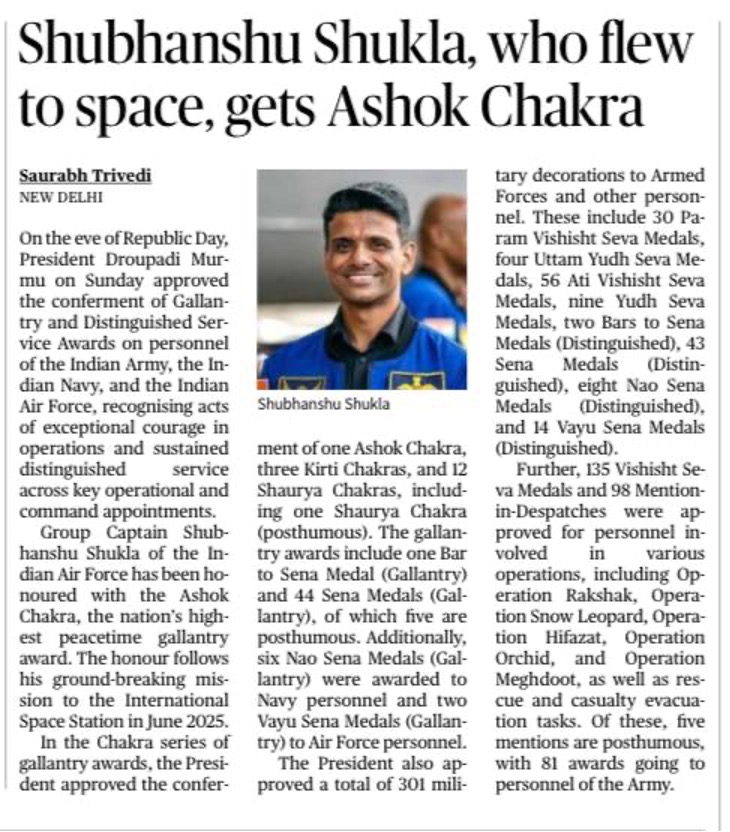
On the eve of Republic Day, the President of India approved Gallantry Awards, including the Ashok Chakra to Group Captain Shubhanshu Shukla of the Indian Air Force, recognising his exceptional courage and distinguished service, including his role as the first Indian to travel to the International Space Station (ISS) in June 2025.
Key Points
About the Awardee
Shubhanshu Shukla is a Group Captain in the Indian Air Force.
He became the first Indian to fly to the International Space Station in 2025.
His career reflects sustained distinguished service across key operational and command roles.
Ashok Chakra
Highest peacetime gallantry award of India.
Awarded for acts of exceptional courage, valour, or self-sacrifice outside the battlefield.
Can be awarded to military personnel as well as civilians.
Republic Day Gallantry Awards 2026
The President approved:
1 Ashok Chakra
3 Kirti Chakras
12 Shaurya Chakras
Additional awards included:
Bar to Sena Medal, Sena Medals, Nao Sena Medals, and Vayu Sena Medals.
Several awards were given posthumously for bravery in counter-insurgency, rescue, and evacuation operations.
Operational Contributions Highlighted
Personnel were recognised for roles in:
Operation Rakshak
Operation Snow Leopard
Operation Hifazat
Operation Orchid
Acts included counter-terror operations, disaster response, and casualty evacuation.
Additional Information
Gallantry Awards System in India
Gallantry awards are announced on Republic Day and Independence Day.
They honour bravery, courage, and sacrifice in both wartime and peacetime situations.
GS Paper 1: Indian Culture | Awards and Honours
Context
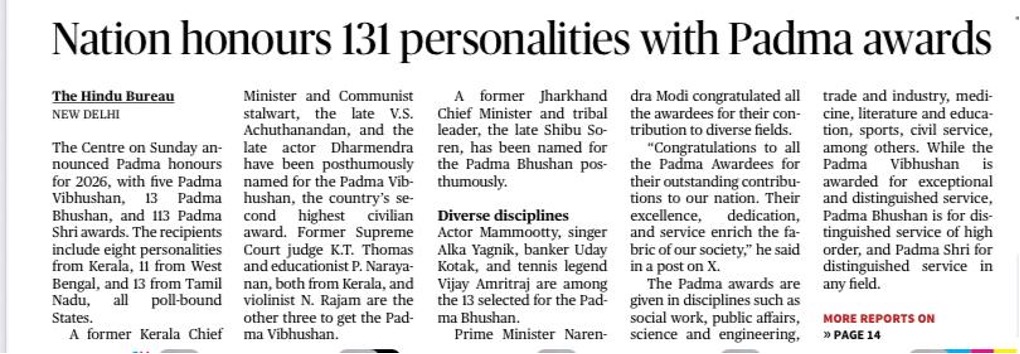
The Government of India announced the Padma Awards 2026 on the occasion of Republic Day, honouring 131 personalities from diverse fields for their distinguished and exceptional contributions to public life and national development.
Key Points
What are the Padma Awards
Instituted in 1954, Padma Awards are among India’s highest civilian honours.
Announced annually on 26 January (Republic Day).
Aim to recognise excellence and service to the nation across multiple domains.
Categories of Padma Awards
Padma Vibhushan: For exceptional and distinguished service.
Padma Bhushan: For distinguished service of a high order.
Padma Shri: For distinguished service.
Padma Vibhushan is the highest among the three.
Padma Awards 2026 – Key Highlights
Total awards announced: 131
5 Padma Vibhushan
13 Padma Bhushan
113 Padma Shri
Awardees include individuals from Kerala, West Bengal, Tamil Nadu, and other States.
Several awards were given posthumously.
Fields and Disciplines Covered
Awards span across art, social work, public affairs, science and engineering, trade and industry, medicine, literature and education, sports, and civil service.
Reflects recognition of both prominent achievers and grassroots contributors.
People’s Padma Initiative
Since 2014, focus on honouring “unsung heroes”.
In 2026, 30 individuals were recognised for grassroots and community-level contributions.
Eligibility and Nature
Open to all persons without distinction of race, occupation, position or gender.
The award is not a title and cannot be used as a prefix or suffix.
Normally not awarded posthumously, except in special cases.
Selection Process
Nominations examined by the Padma Awards Committee.
Committee is appointed annually by the Prime Minister and chaired by the Cabinet Secretary.
Members include the Home Secretary, Secretary to the President, and four to six eminent persons.
Final approval rests with the Prime Minister and the President of India.
Presentation and Limits
Awards are conferred by the President of India in March/April.
Recipients receive a Sanad and a medallion.
Maximum of 120 awards per year, excluding posthumous and foreign/OCI awardees.
UPSC Prelims Practice Question
Q. Consider the following statements regarding the Padma Awards:
Padma Vibhushan is the highest category among the Padma Awards.
Padma Awards can be used as honorific titles before a recipient’s name.
Which of the statements given above is/are correct?
(a) 1 only
(b) 2 only
(c) Both 1 and 2
(d) Neither 1 nor 2
Correct Answer: (a)
Explanation:
Statement 1 is correct as Padma Vibhushan is the highest Padma Award.
Statement 2 is incorrect because Padma Awards are not titles and cannot be used as prefixes or suffixes.
Source: The Hindu
Context
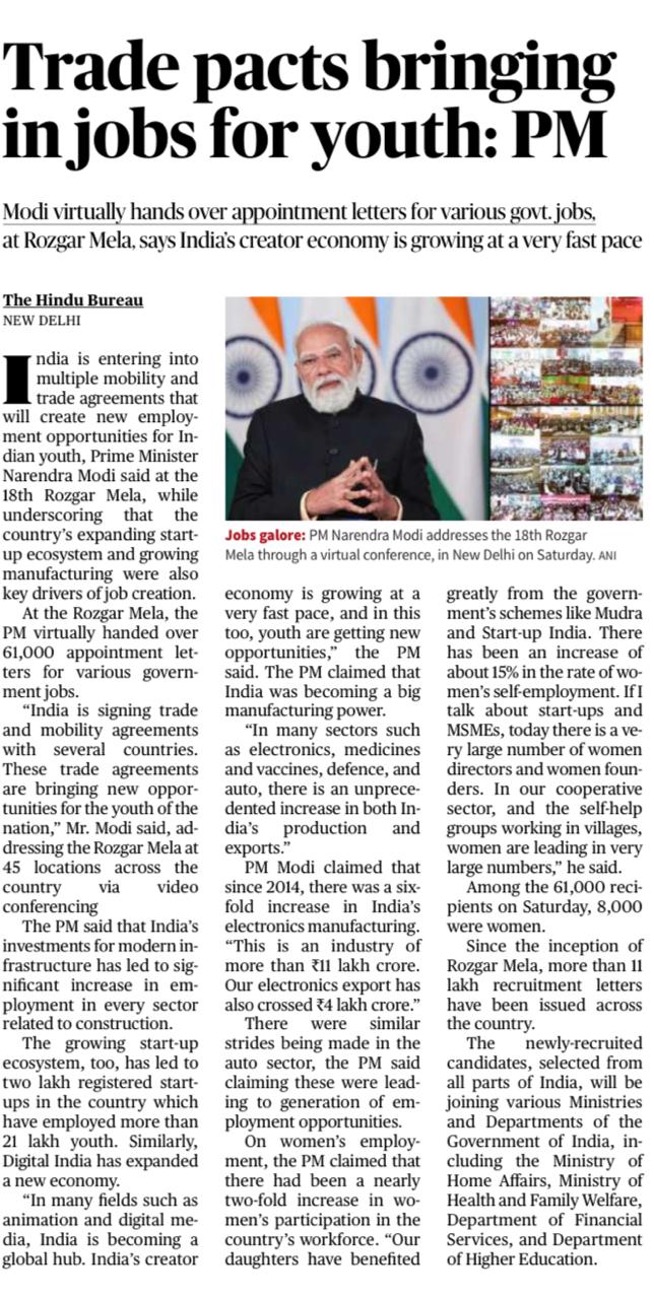
At the 18th Rozgar Mela, the Prime Minister highlighted that trade and mobility agreements, along with manufacturing and start-up growth, are generating large-scale employment opportunities for Indian youth.
Key Points
Rozgar Mela and Public Recruitment
PM virtually handed over 61,000 appointment letters for various government jobs.
Since inception, over 11 lakh recruitment letters have been issued nationwide.
New recruits will join Ministries including Home Affairs, Health, Finance, and Higher Education.
Trade and Mobility Agreements
India has signed multiple trade and mobility agreements with several countries.
These agreements are creating new employment avenues for youth across sectors.
They are strengthening exports, production, and global workforce mobility.
Manufacturing-Led Job Creation
Manufacturing, especially electronics, defence, automobiles, medicines, and vaccines, is a major job driver.
Electronics manufacturing has seen a six-fold increase since 2014.
Electronics exports have crossed ₹4 lakh crore, while the sector size exceeds ₹11 lakh crore.
Start-up and Digital Economy
India has over 2 lakh registered start-ups, employing more than 21 lakh youth.
Digital India has expanded opportunities in animation, digital media, and the creator economy.
India is emerging as a global hub for digital content creation.
Infrastructure Investment
Investments in modern infrastructure have boosted employment, especially in construction-related sectors.
Infrastructure expansion supports both direct and indirect job creation.
Women and Youth Employment
Women’s participation in the workforce has nearly doubled since 2014.
15% increase in women’s self-employment, supported by schemes like Mudra and Start-up India.
Out of 61,000 new recruits, 8,000 were women, reflecting inclusive growth.
UPSC Prelims Practice Question
Q. Consider the following statements regarding employment generation in India:
Trade and mobility agreements can contribute to job creation by expanding exports and workforce mobility.
Growth in electronics manufacturing has reduced India’s export earnings from the sector.
Which of the statements given above is/are correct?
(a) 1 only
(b) 2 only
(c) Both 1 and 2
(d) Neither 1 nor 2
Correct Answer: (a)
Explanation:
Statement 1 is correct as trade and mobility agreements expand production, exports, and employment opportunities.
Statement 2 is incorrect because electronics exports have significantly increased, crossing ₹4 lakh crore.
Source: The Hindu
Context
 Launch your Graphy