There are no items in your cart
Add More
Add More
| Item Details | Price | ||
|---|---|---|---|




S.No | Topic | Page No |
Daily Hindu Analysis | ||
1. | A dangerous march towards a Himalayan ecocide | |
2. | BRICS India summit needs a green and resilient agenda | |
3. | Centre paving way for bonded labour by scrapping MGNREGA, says Kharge | |
4. | Net FDI negative for fourth month in a row in Nov. 2025 | |
5. | ‘Sindoor’ formation by Air Force fighter jets to lead Republic Day flypast | |
| ||
Daily Current Affairs | ||
6. | National Legislative Index (NLI) | |
7. | Parbati Giri | |
8. | Spain joined Indo-Pacific Oceans Initiative (IPOI) | |
9. | ICE Cloud | |
10. | Kumbhalgarh Wildlife Sanctuary | |
GS 3: Environment & Ecology – Disaster Management, Climate Change, Sustainable Development
Context
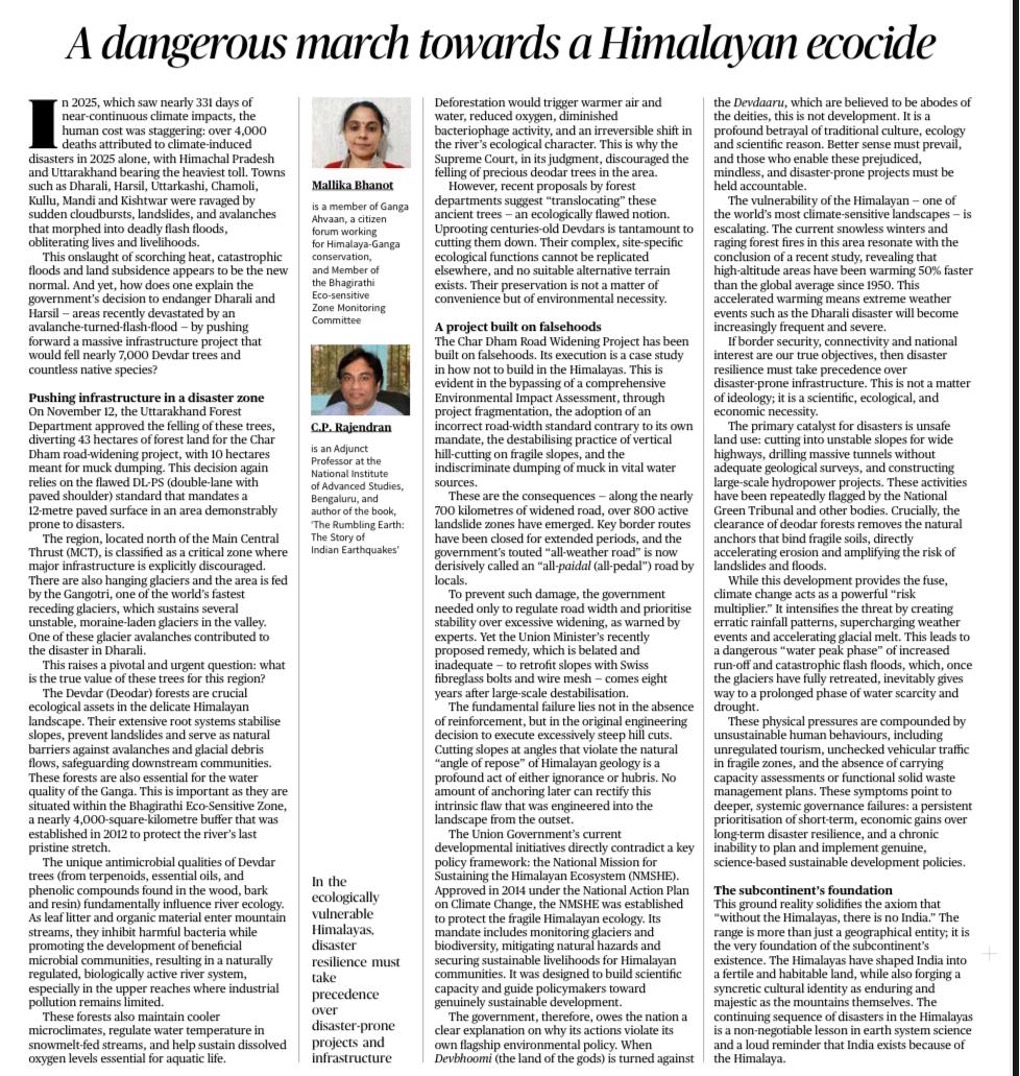
The article examines the growing pattern of large-scale infrastructure projects in the fragile Himalayan region, arguing that climate change combined with ecologically insensitive development is pushing the Himalayas towards an ecological collapse (ecocide), with disasters like Dharali as warning signals.
Detailed Analysis
1. Himalayas under escalating climate stress
The Himalayas are among the most climate-sensitive regions in the world.Extreme weather events such as cloudbursts, flash floods, landslides, and avalanches are increasing in frequency and intensity.Regions like Dharali, Harsil, Joshimath, Kullu, and Manali illustrate how climate change has become a constant risk multiplier.
2. Infrastructure expansion in disaster-prone zones
Despite clear vulnerability, governments continue to push massive road-widening and hydropower projects.
Example: Char Dham Road Widening Project, designed as an “all-weather road,” has involved:Widening roads beyond ecological limitsCutting steep mountain slopesDumping excavated debris into riversThese actions have destabilised slopes, triggered landslides, and worsened floods.
3. Forest destruction and ecological loss
Thousands of Deodar (Devdar) trees have been cut for infrastructure.Deodar forests play a crucial role in:Stabilising slopesRegulating water flowPreventing avalanches and landslidesMaintaining river water qualityThe Supreme Court has earlier recognised Devdar forests as ecologically irreplaceable, not merely timber resources.
4. River systems and water securityHimalayan forests regulate snowmelt-fed rivers, especially those feeding the Ganga.Deforestation leads to:Reduced oxygen levels in riversLoss of beneficial microbial lifeIncreased sedimentation and flood intensityThe degradation of catchment areas undermines long-term water security for millions downstream.
5. Governance and regulatory failures
Environmental safeguards are diluted through:Project fragmentation to avoid comprehensive impact assessmentsWeak Environmental Impact Assessments (EIAs)Disregard for National Green Tribunal ordersDisaster resilience is sacrificed for short-term connectivity and political optics.
6. Climate change as a force multiplier
Climate change intensifies existing vulnerabilities created by human activity.Accelerated glacial retreat and erratic rainfall amplify the destructive impact of roads, tunnels, and dams.Once glaciers retreat fully, the region risks a prolonged phase of water scarcity after a short period of excess flooding.
7. Unsustainable human pressures
Unregulated tourism, traffic congestion, lack of waste management, and absence of carrying-capacity assessments worsen ecological stress.The Himalayas are being treated as infrastructure corridors, not as living ecosystems.
8. Policy contradiction
India’s actions contradict the National Mission for Sustaining the Himalayan Ecosystem (NMSHE), which mandates:Glacier monitoringHazard mitigationScience-based developmentDevelopment projects are proceeding in violation of flagship environmental commitments.
Suggestions of the Author
Disaster resilience must take precedence over large infrastructure expansion.Strict enforcement of scientific, ecological, and slope-stability principles in road and dam construction.Protect old-growth forests, especially Devdar forests, as non-negotiable ecological assets.Shift from road-heavy development to context-sensitive connectivity solutions.Implement genuine carrying-capacity assessments for tourism and urban growth.Align Himalayan development strictly with climate adaptation and sustainability goals. UPSC Mains Practice Question
“Climate change acts as a force multiplier in the Himalayas, but unsustainable infrastructure development magnifies its destructive impact.”Critically examine with reference to recent Himalayan disasters.
GS 2: International Relations – Multilateral Groupings | GS 3: Environment & Climate Change
Context
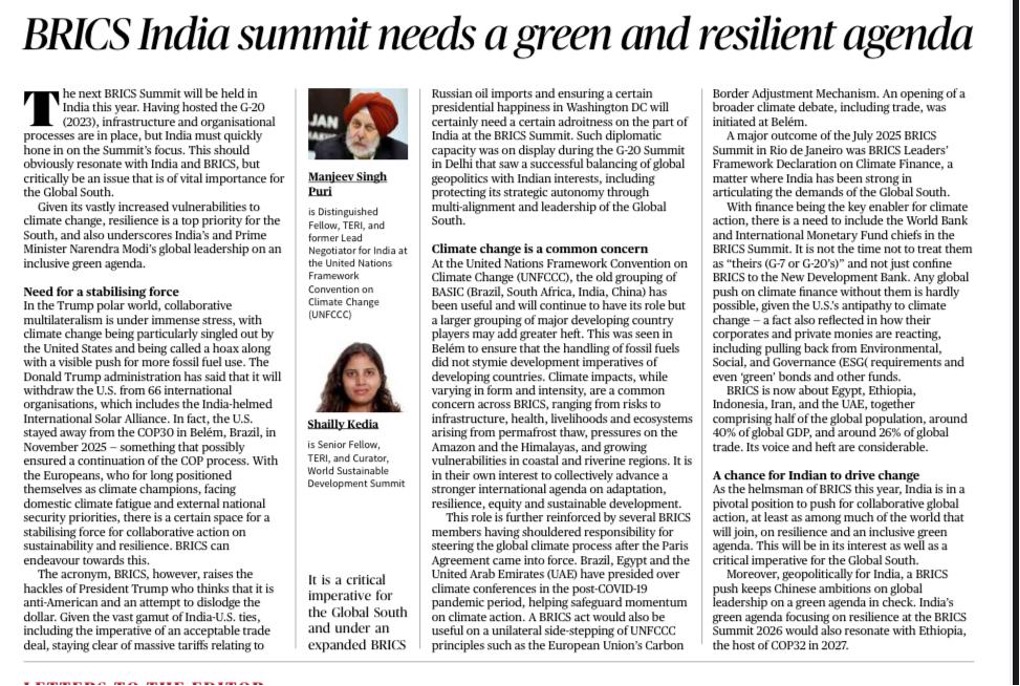
The article argues that as India prepares to host the upcoming BRICS Summit, it must use the platform to push a green, climate-resilient agenda, reflecting the growing climate vulnerabilities of the Global South and India’s emerging leadership role in global climate governance.
Detailed Analysis
1. Strategic importance of the BRICS Summit in India
The BRICS Summit comes at a time of global geopolitical fragmentation and weakening multilateralism.
India’s recent hosting of the G20 (2023) showcased its ability to balance geopolitical tensions while foregrounding development concerns of the Global South.
The BRICS Summit offers a similar opportunity, with climate resilience as a unifying agenda.
2. Climate change as a shared BRICS concern
Climate change is no longer a peripheral issue but a core developmental challenge for BRICS countries.
BRICS members include some of the world’s most climate-vulnerable regions, from the Himalayas and Amazon to coastal and riverine zones.
Climate impacts directly threaten infrastructure, livelihoods, food security, and ecosystems across the bloc.
3. Global climate governance under stress
Multilateral climate cooperation faces challenges due to:
Political polarisation in the U.S.
Retreat from global commitments
Fatigue among developed nations
This creates space for BRICS to act as a stabilising force in sustaining climate ambition.
4. India’s role as a bridge between Global South and Global North
India’s climate diplomacy emphasises equity, adaptation, and resilience, not just mitigation.
Through forums like the UNFCCC, G20, and International Solar Alliance, India has positioned itself as a credible leader of the Global South.
A green BRICS agenda would reinforce India’s commitment to multi-alignment and strategic autonomy.
5. Expansion of BRICS and increased global weight
With new members such as Egypt, Ethiopia, Iran, Indonesia, and the UAE, BRICS now represents:
Nearly half the world’s population
Around 40% of global GDP
A significant share of global emissions and trade
This scale gives BRICS the capacity to shape global climate outcomes.
6. Beyond mitigation: focus on resilience and adaptation
The article stresses that BRICS must prioritise:
Climate adaptation
Disaster resilience
Climate finance for developing countries
This aligns with the needs of countries facing extreme weather, floods, droughts, and sea-level rise.
7. Reforming global climate finance architecture
Existing institutions like the World Bank and IMF are inadequate for climate finance needs.
BRICS institutions, including the New Development Bank (NDB), must scale up climate-responsive lending.
Climate action cannot succeed without reforming global financial rules and investment flows.
8. Countering unilateral climate measures
The article flags concerns over instruments like the EU’s Carbon Border Adjustment Mechanism (CBAM).
Such measures risk becoming trade barriers against developing countries.
BRICS can provide a collective platform to address climate-trade linkages fairly.
Suggestions of the Author
India should anchor the BRICS Summit around climate resilience and sustainability.
Promote adaptation, equity, and development-friendly climate action.
Use BRICS to sustain momentum from COP processes, especially in the post-pandemic era.
Strengthen the role of BRICS institutions in climate finance.
Ensure that climate action supports, rather than constrains, development pathways of the Global South.
UPSC Mains Practice Question
“Discuss how BRICS can emerge as a stabilising force in global climate governance. Examine India’s role in advancing a green and resilient agenda through the BRICS platform.”
Source: The Hindu
GS 2: Polity & Governance | GS 3: Employment, Inclusive Growth
Context
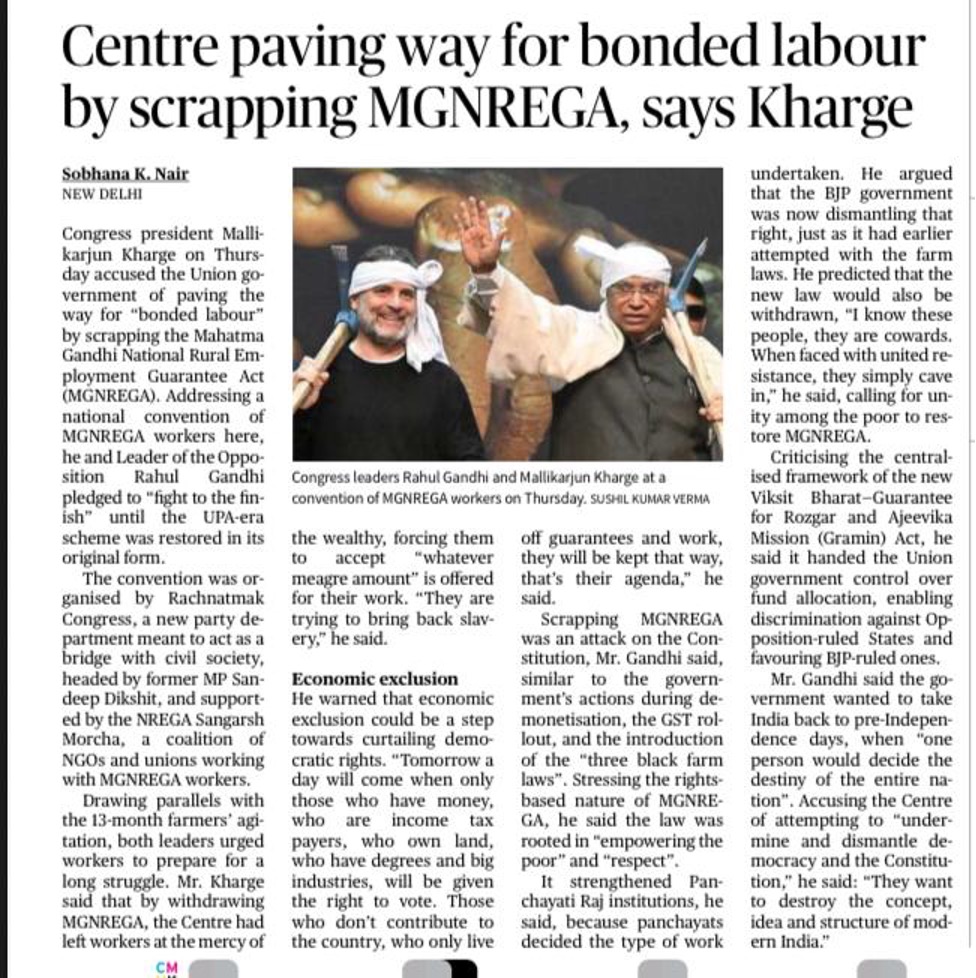
The news comes amid political criticism over reforms to MGNREGA, with concerns raised about dilution of employment guarantees, while the Centre highlights the enactment of the Viksit Bharat – Guarantee for Rozgar and Ajeevika Mission (Gramin) Act, 2025 to strengthen rural livelihoods.
Key PointsPolitical Criticism and Concerns
Opposition alleges that weakening MGNREGA may push rural workers towards bonded labour.Criticism centres on fears of reduced employment security and erosion of a rights-based framework.
Viksit Bharat – Guarantee for Rozgar and Ajeevika Mission (Gramin) Act, 2025
Received Presidential assent in 2025.Statutory wage employment guarantee increased from 100 to 125 days per year.Focuses on rural livelihoods, durable asset creation, convergence, and resilience-building.Employment Guarantee and RightsJusticiable right to work retained, addressing fears of dilution.
Procedural barriers that earlier weakened unemployment allowance have been removed.Time-bound grievance redressal mechanisms strengthened to improve accountability. Demand-Based Employment and PlanningEmployment demand continues to originate from workers, not authorities.Shift from reactive distress employment to advance participatory planning.Village-level planning ensures availability of work when demanded, not delayed.
Decentralisation and Federal Structure Gram Panchayats remain primary planning and implementing authorities.
Gram Sabhas retain approval powers over local development plans.Introduction of Viksit Gram Panchayat Plans for structured local planning.Coordination across levels without undermining local authority.
Consultation and Cooperative Federalism
Reform shaped through consultations with States and stakeholders.States treated as development partners, not merely implementing agencies.Reflects learning from past implementation challenges.
Fiscal Commitment and Equity
Central allocation increased from ₹86,000 crore to nearly ₹95,000 crore.Funding pattern:60:40 Centre–State for general States90:10 for Northeastern, Himalayan States and J&K Rule-based State-wise allocations ensure equity and transparency.Flexibility provided during natural disasters and extraordinary situations.
Correcting Structural Weaknesses
Earlier system suffered from episodic employment and weak enforceability.Issues such as duplication, ghost entries, and fragmented assets addressed.New framework integrates livelihood support with durable infrastructure creation.
Additional Information –
Mahatma Gandhi National Rural Employment Guarantee Act (MGNREGA)
Guarantees wage employment to rural households.Aims at livelihood security through public works and asset creation.Considered a cornerstone of rights-based social protection in rural India.
UPSC Prelims Practice Question
Q. Consider the following statements regarding the Viksit Bharat – Guarantee for Rozgar and Ajeevika Mission (Gramin) Act, 2025:
1.It increases the statutory annual employment guarantee beyond the earlier MGNREGA limit.2.It removes the role of Gram Panchayats in planning and implementation of rural works.
Which of the statements given above is correct?
(a) 1 only
(b) 2 onlyCorrect Answer:
(a)Explanation:
Statement 1 is correct as the Act raises guaranteed employment from 100 to 125 days.
Statement 2 is incorrect because Gram Panchayats continue as primary planning and implementing authorities. Source: The Hindu
GS 3: Indian Economy | External Sector
Context
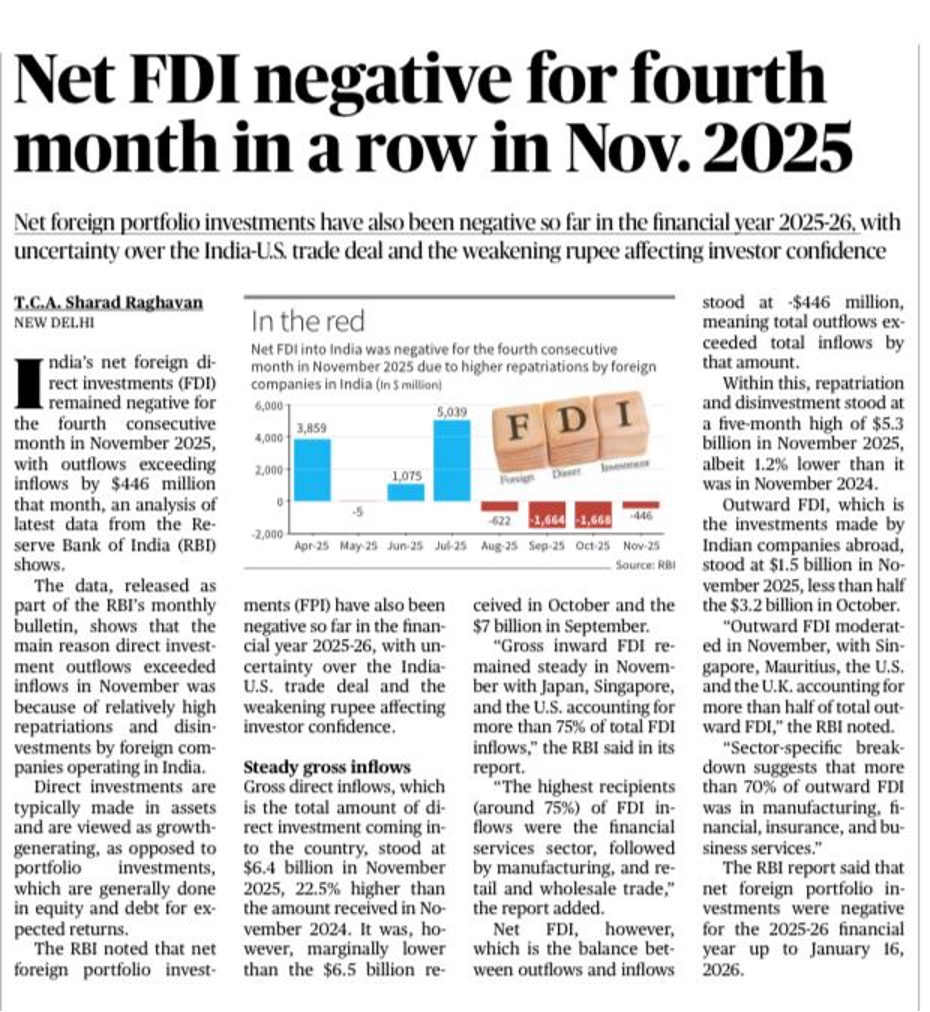
India’s net Foreign Direct Investment (FDI) remained negative for the fourth consecutive month in November 2025, as outward remittances and repatriation by foreign companies exceeded fresh inflows, according to RBI data.
Key Points
What does net FDI negative mean
Net FDI turns negative when outflows and repatriation exceed fresh FDI inflows.
Indicates pressure on external financing and investor sentiment.
November 2025 Trends
Net FDI remained negative for the fourth month in succession.
Main reason: Higher repatriation of profits and capital by foreign companies.
Fresh inflows were relatively muted, unable to offset outflows.
Role of Repatriation
Repatriation stood at a five-month high, crossing $5.3 billion in November.
This reflects foreign investors booking profits or exiting investments.
Gross FDI Inflows
Gross inflows were about $6.4 billion, higher than November 2024.
However, they were marginally lower than the previous month.
Major recipient sectors:
Financial services
Manufacturing
Wholesale and retail trade
Source Countries
Around 75% of total FDI inflows came from:
Japan
Singapore
United States
Outward FDI
Indian companies’ overseas investments stood at around $1.5 billion.
Manufacturing, financial services, and business services dominated outward FDI.
Foreign Portfolio Investment (FPI)
FPIs also remained negative during FY 2025–26.
Reasons include:
Uncertainty over India–U.S. trade relations
Weakening rupee
Global risk aversion
Macroeconomic Implications
Sustained negative net FDI can:
Pressure the balance of payments
Affect rupee stability
Reflect cautious global investor outlook
However, strong gross inflows suggest India remains structurally attractive.
Additional Information – Foreign Direct Investment (FDI)
FDI refers to long-term investments in productive assets.
Considered more stable than portfolio flows.
Regulated in India through sectoral caps and automatic/government routes.
UPSC Prelims Practice Question
Q. Consider the following statements regarding Foreign Direct Investment (FDI) in India:
1.Net FDI can turn negative if repatriation and outward investment exceed gross inflows.
2.Foreign Direct Investment is generally considered more volatile than Foreign Portfolio Investment.
Which of the statements given above is correct?
(a) 1 only
(b) 2 only
(c) Both 1 and 2
(d) Neither 1 nor 2
Correct Answer: (a)
Explanation:
Statement 1 is correct as net FDI reflects the balance between inflows and outflows.
Statement 2 is incorrect because FDI is usually more stable than FPI.
Source: The Hindu
GS 3: Defence & Security
Context
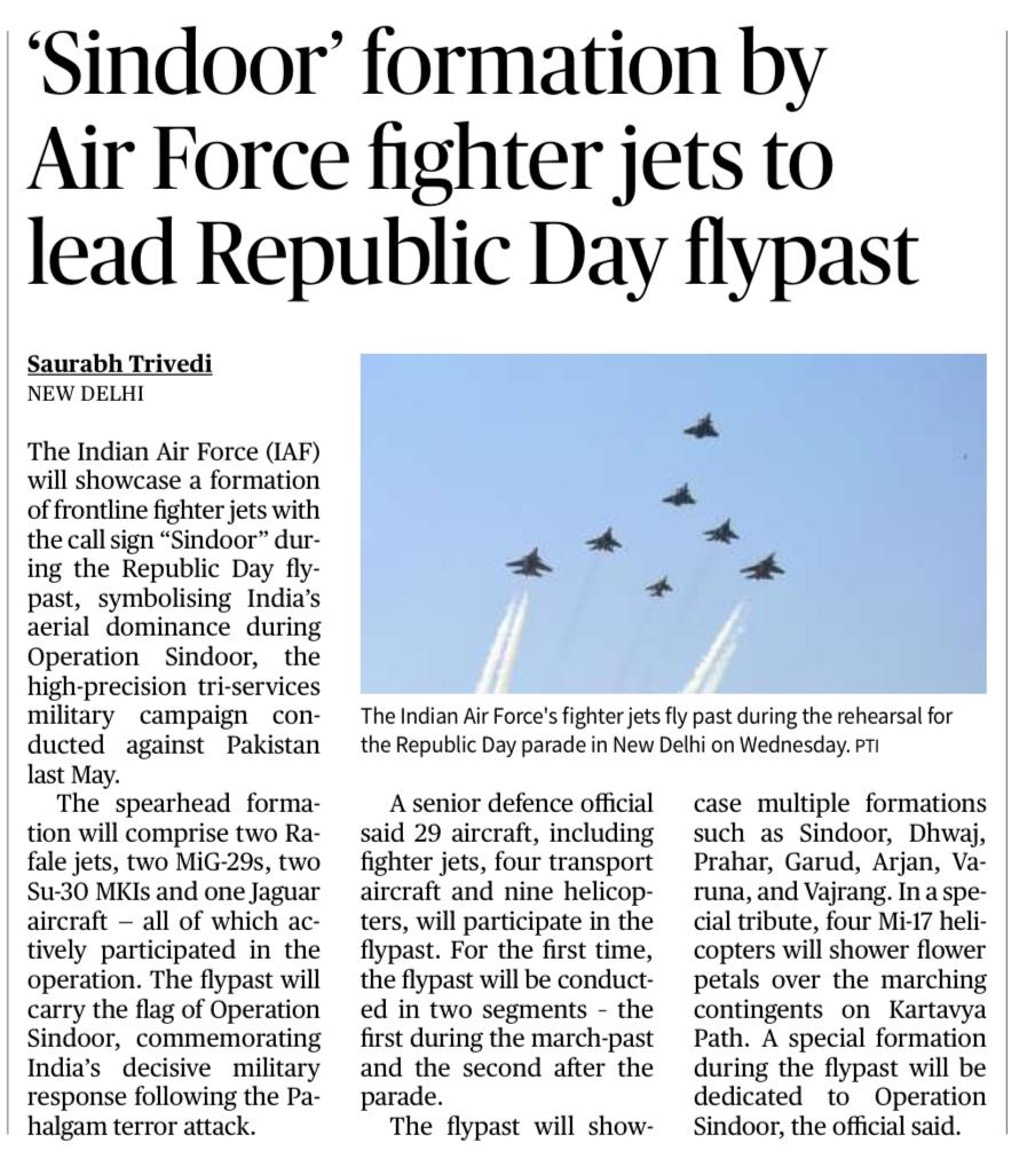
The Indian Air Force will lead the Republic Day flypast with a special fighter jet formation named ‘Sindoor’, commemorating Operation Sindoor, a high-precision tri-services military campaign conducted last year.
Key Points
What is the ‘Sindoor’ Formation
A frontline fighter jet formation with the call sign Sindoor.
Symbolises India’s aerial dominance and precision strike capability.
Dedicated to Operation Sindoor, launched after the Pahalgam terror attack.
Aircraft in the Lead Formation
2 Rafale fighter jets
2 MiG-29s
2 Su-30 MKIs
1 Jaguar aircraft
All aircraft actively participated in Operation Sindoor.
Republic Day Flypast Details
29 aircraft to participate in total.
Includes:
Fighter aircraft
Transport aircraft
Helicopters
Flypast conducted in two segments:
During the march-past
After the parade concludes
Special Aerial Tributes
Four Mi-17 helicopters will shower flower petals over marching contingents on Kartavya Path.
Dedicated aerial formations such as Sindoor, Dhwaj, Prahar, Garud, Arjan, Varuna, and Vajrang will be showcased.
Operational and Strategic Significance
Highlights tri-services integration and operational readiness.
Reinforces India’s capability for swift, precise, and decisive military response.
Serves as a message of deterrence and national resolve.
UPSC Prelims Practice Question
‘Operation Sindoor’, often seen in the news, is associated with:
(a) Humanitarian evacuation mission
(b) Tri-services military operation demonstrating precision strikes
(c) Naval anti-piracy exercise
(d) United Nations peacekeeping deployment
Correct Answer: (b)
Explanation:
Operation Sindoor was a high-precision tri-services military campaign, highlighted during the Republic Day flypast through the Sindoor fighter jet formation.
Source: The Hindu
GS 2: Polity and Governance | Constitutional Bodies ContextThe issue came into focus after the Karnataka Governor cut short his address to the State Legislature, following similar incidents involving Governors in Tamil Nadu and Kerala, raising questions about constitutional conventions governing the Governor’s Address.
Key PointsGovernor’s Address to the State Legislature
Governed by Article 176 of the Constitution.Mandates the Governor to address the Legislative Assembly:At the commencement of the first session after a general election, andAt the commencement of the first session of every year.In States with a Legislative Council, the address is delivered to both Houses assembled together.Time for discussion on the address is regulated by rules of procedure of the House.
Nature and Purpose of the Address
Informs the Legislature of the causes for its summons.Outlines the policies, priorities, and legislative agenda of the elected State government.Recaps achievements of the government in the previous year.Who Prepares the AddressThe address is not the personal opinion of the Governor.Prepared by the Council of Ministers of the State.Under Article 163, the Governor is bound to act on the aid and advice of the Council of Ministers.Therefore, the speech reflects the government’s viewpoint, not gubernatorial discretion.
Constitutional Position of the Governor
The Governor is the constitutional head of the State, not the executive authority.Any deviation from the approved text raises concerns regarding:Constitutional moralityFederal balanceDemocratic accountabilityParallels in Other DemocraciesUnited States: President delivers the State of the Union Address.United Kingdom: Monarch delivers the King’s/Queen’s Speech, marking the opening of Parliament.India’s system mirrors the British parliamentary tradition.
Constituent Assembly Perspective
Dr B. R. Ambedkar described the President (and by extension the Governor) as:Head of State, not head of the executive.A ceremonial authority acting as a constitutional seal for decisions of the elected government.
Why the Issue Matters
Repeated interruptions or alterations undermine:
Legislative supremacyResponsible government
Cooperative federalism
The address is a constitutional duty, not a discretionary function.
UPSC Prelims Practice Question
Q. Consider the following statements regarding the Governor’s Address to the State Legislature:
1.The Governor’s Address reflects the policies and programmes of the elected State government.
2.The Governor has discretionary power to modify or omit portions of the Address prepared by the Council of Ministers.Which of the statements given above is correct?
(a) 1 onlySource: The Hindu
Syllabus: GS Paper II – Polity & Governance
Topic: Parliament and State Legislatures, Legislative Reforms, Accountability
Context
At the 86th All India Presiding Officers Conference, Lok Sabha Speaker Om Birla announced the initiation of a National Legislative Index (NLI) to objectively assess and compare the performance of Parliament and State Legislatures.
Key Points
What is the National Legislative Index
• NLI is a proposed performance-evaluation framework.
• It aims to objectively measure legislative functioning using predefined indicators.
Objectives
• Promote healthy competition among legislatures.
• Improve efficiency, accountability, and quality of deliberation.
• Make legislatures people-centric and outcome-oriented.
Objective Performance Metrics
• Uses measurable indicators such as number of sittings and legislative output.
• Assesses committee work and utilisation of House time.
• Reduces scope for subjective or political evaluation.
Comparative Framework
• Enables comparison across Parliament and State Legislatures.
• Encourages best-practice sharing and institutional learning.
Accountability and Transparency
• Links legislative performance with public scrutiny.
• Encourages discipline, meaningful debate, and quality law-making.
Democratic Significance
• Discourages frequent disruptions in legislatures.
• Reinforces legislatures as core pillars of constitutional democracy.
Developmental Orientation
• Aligns legislative functioning with long-term national development goals.
• Shifts focus from procedures to outcomes and governance impact.
Lok Sabha
• Lok Sabha is the Lower House of Parliament of India.
• It plays a central role in law-making, financial control, and executive accountability.
• Initiatives like NLI aim to strengthen its institutional effectiveness.
UPSC Prelims Practice Question
The National Legislative Index (NLI), recently proposed, is primarily intended to:
(a) Rank political parties based on electoral performance
(b) Measure and compare the performance of Parliament and State Legislatures
(c) Evaluate judicial efficiency across States
(d) Monitor implementation of central laws by States
Correct Answer: (b)
Explanation:
The National Legislative Index is designed as an objective framework to assess and compare the functioning and performance of legislatures, including Parliament and State Assemblies.
Source: The Hindu
 Launch your Graphy