There are no items in your cart
Add More
Add More
| Item Details | Price | ||
|---|---|---|---|



| Index | ||
| S.No | Topic | |
| Daily Hindu Analysis (YouTube) | ||
| 1. | Judicial removal — tough law with a loophole | |
| 2. | Why AI infrastructure matters more | |
| 3. | Mozambican rights activist to get Indira Gandhi Peace Prize | |
| 4. | EC discretion is not unregulated power: SC | |
| 5. | Diverse team of experts to ‘define’ Aravalis | |
| 6. | Rupee sinks 68 paise to fresh low of ₹91.7/USD on persistent FPI outflow | |
| Daily Current Affairs (App) | ||
| 7. | Central Silk Board | |
| 8. | World Economic Forum (WEF) | |
| 9. | Lok Sabha to launch digital attendance system | |
| 10. | Punjab Police launches ‘Operation Parhar’ | |
| 11. | Abu Dhabi ranked world’s safest city for 10th consecutive year | |
| 12. | Internet Governance Internship & Capacity Building Scheme (IGICBS) | |
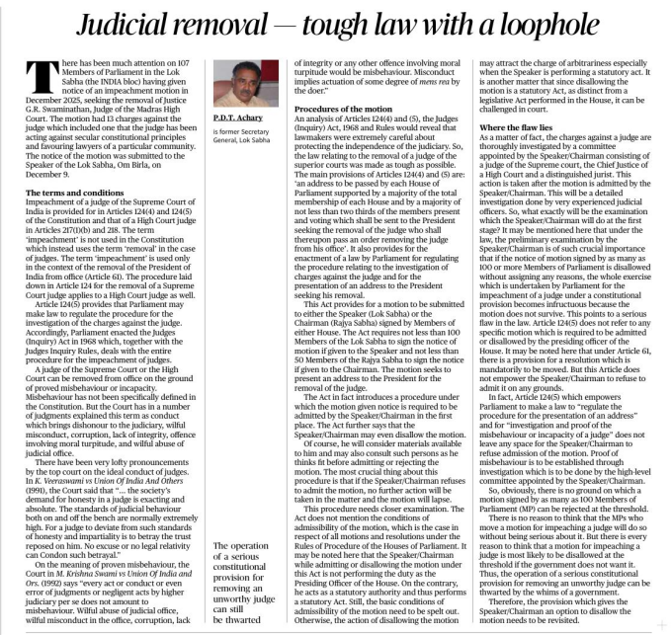
GS 2: Polity and Governance – Judiciary, Constitutional Provisions, Checks and Balances
Context
The author analyses India’s constitutional mechanism for the removal of judges in the backdrop of a recent impeachment notice against a High Court judge, and argues that despite being intentionally stringent, the law contains a serious procedural loophole that can defeat the purpose of judicial accountability.
Detailed Analysis
1. Constitutional Framework for Judicial Removal
Removal of a Supreme Court judge is provided under Articles 124(4) and 124(5); for High Court judges under Articles 217(1)(b) and 218.
The Constitution avoids the word impeachment and instead uses “removal” for judges.
A judge can be removed only on grounds of proved misbehaviour or incapacity.
2. Meaning of Misbehaviour
Misbehaviour is not explicitly defined in the Constitution.
Judicial interpretation has clarified it to include wilful misconduct, corruption, lack of integrity, moral turpitude, or abuse of office.
Errors of judgment or negligence alone do not amount to misbehaviour.
3. Statutory Procedure
Parliament enacted the Judges (Inquiry) Act, 1968 and related Rules.
A motion for removal requires signatures of 100 Lok Sabha MPs or 50 Rajya Sabha MPs.
If admitted, a three-member inquiry committee (Supreme Court judge, High Court Chief Justice, and a distinguished jurist) investigates the charges.
4. Role of the Presiding Officer
The motion is submitted to the Speaker of the Lok Sabha or Chairman of the Rajya Sabha.
The Presiding Officer has the power to admit or refuse the motion at the threshold.
This discretion is crucial and controversial.
5. The Core Loophole Highlighted
The law does not prescribe clear criteria for admitting or rejecting an impeachment motion.
Even a motion signed by the required number of MPs can be disallowed without reasons.
If disallowed, no inquiry committee is formed, rendering the constitutional mechanism ineffective.
6. Contrast with Removal of the President
Under Article 61, impeachment of the President is mandatory once a resolution is moved.
No similar obligation exists for the Speaker/Chairman in judicial removal cases.
This asymmetry creates an institutional imbalance.
7. Risk of Executive or Political Influence
Since Presiding Officers often belong to ruling parties, the discretion may be politically influenced.
A government unwilling to proceed can indirectly shield an errant judge.
Thus, a serious constitutional safeguard can be neutralised by executive convenience.
Suggestions of the Author
Article 124(5) should be revisited to clearly define conditions for admissibility of a motion.
The Speaker/Chairman’s discretion should be structured and reasoned, not absolute.
Admission of a motion meeting numerical requirements should be mandatory, followed by inquiry.
This would balance judicial independence with accountability.
UPSC Mains Practice Question
“India’s constitutional mechanism for removal of judges prioritises independence but inadequately ensures accountability.”
Critically examine in the light of the role of the Speaker/Chairman in admitting impeachment motions.
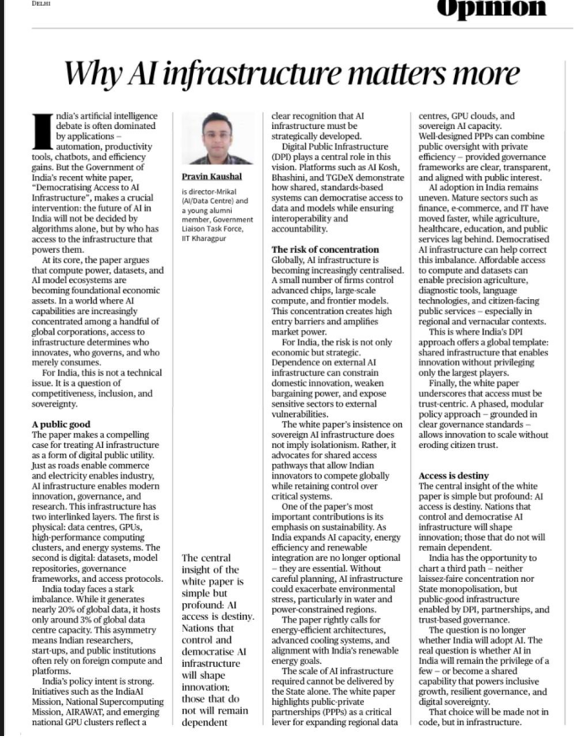
GS 3: Science & Technology – Artificial Intelligence, Digital Infrastructure, Economic Development
Context
The author argues that India’s AI future will be shaped not merely by applications and algorithms, but by who controls access to AI infrastructure such as compute power, datasets, and model ecosystems, as highlighted in the government’s white paper on democratising access to AI infrastructure.
Detailed Analysis
1. Shifting the AI Debate: From Applications to Infrastructure
India’s AI discourse often focuses on tools like chatbots and automation.
The author stresses that infrastructure ownership, not applications, will determine innovation, governance, and sovereignty.
AI infrastructure is emerging as a foundational economic asset, similar to roads or electricity.
2. AI Infrastructure as a Public Good
The article makes a case for treating AI infrastructure as digital public utility.
It has two layers:
Physical layer: data centres, GPUs, high-performance computing, energy systems.
Digital layer: datasets, model repositories, governance frameworks, access protocols.
Public access to these layers enables research, innovation, and inclusive growth.
3. India’s Structural Imbalance
India generates nearly 20% of global data but hosts only about 3% of global data centre capacity.
This forces Indian startups, researchers, and institutions to rely on foreign compute platforms, limiting autonomy.
The imbalance affects competitiveness and strategic control.
4. Role of Digital Public Infrastructure (DPI)
The author highlights India’s DPI approach as a strategic advantage.
Platforms such as AI Kosh, Bhashini, and TGDex show how standards-based systems can democratise access while ensuring interoperability and accountability.
DPI enables shared infrastructure without monopolisation.
5. Risk of Concentration and Strategic Dependence
Globally, AI infrastructure is increasingly concentrated among a few firms controlling advanced chips, compute, and frontier models.
This concentration raises entry barriers, amplifies market power, and creates strategic vulnerabilities.
For India, dependence on external AI infrastructure can weaken bargaining power and expose sensitive sectors.
6. Sustainability and Energy Concerns
AI infrastructure expansion has significant energy and environmental costs.
The author stresses the need for energy-efficient architectures, advanced cooling systems, and alignment with renewable energy goals.
Without planning, AI growth could worsen water and power stress in resource-constrained regions.
7. Public–Private Partnerships (PPPs)
The scale of AI infrastructure cannot be delivered by the State alone.
Well-designed PPPs can combine public oversight with private efficiency.
Clear governance frameworks are essential to ensure transparency and public interest alignment.
8. Access as Destiny
The central thesis is that access determines outcomes.
Countries that democratise AI infrastructure will shape innovation and governance.
Those that do not will remain dependent consumers of foreign technology.
Suggestions of the Author
Develop sovereign AI infrastructure without isolating from global collaboration.
Use DPI-led shared infrastructure models to prevent concentration.
Promote affordable access to compute and datasets for startups, academia, and public services.
Ensure AI infrastructure expansion is sustainable and energy-efficient.
Adopt a phased, modular, trust-centric policy framework grounded in transparency.
UPSC Mains Practice Question
“Democratising access to artificial intelligence infrastructure is critical for India’s technological sovereignty and inclusive growth.”
Discuss in the context of Digital Public Infrastructure and global concentration of AI capabilities.
Source: The Hindu

Mozambican rights activist to get Indira Gandhi Peace Prize. GS 2: International Relations – Peace, Humanitarianism, Global Recognition Context
Mozambican human rights activist Graca Machel has been selected for the Indira Gandhi Prize for Peace, Disarmament and Development for 2025, as announced by the Indira Gandhi Memorial Trust. Key PointsSelection and JuryDecision taken by an international jury chaired by Shivshankar Menon.Selection recognises path-breaking humanitarian work. Reasons for the AwardHonoured for contributions in education, health, nutrition, economic empowerment, and humanitarian action.Her work is rooted in self-determination and protection of vulnerable communities. Award DetailsAward includes a cash prize of ₹1 crore, a citation, and a trophy.Conferred by the Indira Gandhi Memorial Trust. Indira Gandhi Peace PrizeInstituted in 1986 in memory of Indira Gandhi.Also known as the Indira Gandhi Prize for Peace, Disarmament, and Development.Awarded annually to individuals or organisations without distinction of nationality, race, or religion.Recognises efforts towards international peace, disarmament, economic cooperation, development, scientific progress for human good, and expansion of freedom.Past recipients include: Mikhail Gorbachev, UNICEF, Jimmy Carter, UN & Kofi Annan, Angela Merkel, ISRO, Manmohan Singh, Sir David Attenborough, Pratham NGO, Indian Medical Association, Daniel Barenboim & Ali Abu Awwad. UPSC Prelims Practice QuestionQ. Consider the following statements regarding the Indira Gandhi Peace Prize:1.It is awarded annually to individuals or organisations irrespective of nationality.2.It was instituted in 1986 by the Government of India.Which of the statements given above is/are correct?(a) 1 only
(b) 2 only
(c) Both 1 and 2
(d) Neither 1 nor 2Correct Answer: (a)Explanation:
Statement 1 is correct as the award is open to all nationalities.
Statement 2 is incorrect because it was instituted by the Indira Gandhi Memorial Trust, not directly by the Government of India.
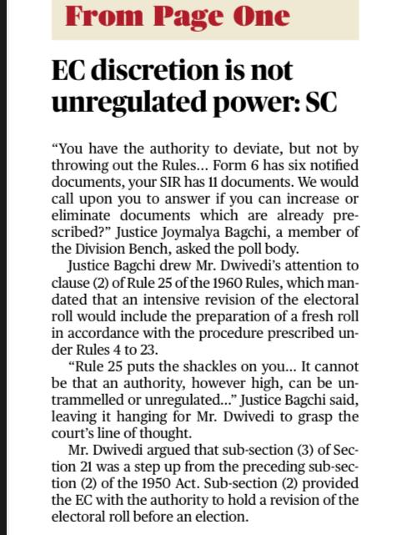
EC discretion is not unregulated power: SC
GS 3: Environment & Ecology – Environmental Protection, Mining, Biodiversity
ContextThe Supreme Court is examining the issue of defining the Aravalli range, as an unclear definition could strip large areas of environmental protection and expose them to unregulated mining. Key PointsIssue Before the CourtThe case concerns the definition of the Aravalli hills for environmental protection.An inadequate definition could lead to a regulatory vacuum. Intervention in the CaseSenior advocate Kapil Sibal questioned the feasibility of strictly defining mountain ranges.He argued that mountains like the Aravallis and Himalayas are geological strata, not rigid entities. Court’s Earlier FindingThe Court noted that only 1,048 out of 12,081 Aravalli hills in Rajasthan meet the 100-metre elevation threshold.Hills below this threshold risk being excluded from environmental safeguards. Environmental ConcernsExclusion from protection could expose lower Aravalli ranges to unregulated mining and ecological degradation.The Court acknowledged a significant regulatory lacuna in safeguarding the Aravallis. Judicial ApproachThe Court stayed its earlier judgment on defining the Aravallis.It expressed openness to expert views and non-adversarial inputs. Way ForwardThe Supreme Court indicated the need for a diverse team of experts.Expert inputs are required to ensure scientific, legal, and environmental balance in protection. Supreme Court of India’s stand:The Supreme Court plays a key role in environmental jurisprudence through judicial review.It has intervened in several cases to prevent ecological damage caused by mining and weak regulation.
Rupee sinks 68 paise to fresh low of ₹91.7/USD on persistent FPI outflow
GS 3: Indian Economy – External Sector, Exchange Rate, Capital Flows
ContextThe Indian rupee fell to a record low of around ₹91.7 per US dollar due to persistent foreign portfolio investor (FPI) outflows and heightened global geopolitical and financial uncertainties. Key PointsMovement of the RupeeThe rupee depreciated by 68 paise in a single session, marking its steepest fall in two months.It touched an intraday low of ₹91.65 per dollar. Primary Reason: FPI OutflowsForeign institutional investors have withdrawn over ₹30,000 crore from Indian equities.Persistent capital outflows increased demand for the US dollar, pressuring the rupee. Global and Geopolitical FactorsRising geopolitical risks, including uncertainty related to U.S. global actions, intensified risk aversion.Delays in international trade negotiations added to market nervousness. Role of RBIIntermittent RBI interventions were insufficient to offset the pace of depreciation.RBI Governor stated that a nation should not be judged solely by its exchange rate. Impact on CommoditiesGlobal uncertainty boosted safe-haven demand.Gold and silver prices surged sharply, reflecting investor risk aversion. Market ImplicationsA weaker rupee can raise import costs and contribute to imported inflation.Exporters may gain price competitiveness, but volatile currency movements affect overall stability. Reserve Bank of India’s Role:RBI manages currency volatility through market interventions and monetary tools.Exchange rate management aims at orderly movement, not a fixed target.RBI prioritises macroeconomic stability over defending specific currency levels. UPSC Prelims Practice QuestionPersistent depreciation of the Indian rupee is most directly associated with which of the following factors?(a) Increase in foreign portfolio investment inflows
(b) Decline in demand for US dollar assets
(c) Sustained foreign portfolio investor outflows
(d) Rise in domestic savings rate
Correct Answer: (c)Explanation:
Sustained FPI outflows increase demand for foreign currency, especially the US dollar, leading to depreciation of the rupee. Source: The Hindu
Central Silk Board
Syllabus: GS Paper III – Indian Economy
Topic: Agriculture Allied Activities, Sericulture, Institutional Support ContextRecently, the Government of India increased the financial approval limit of the Central Silk Board to ₹1 crore from ₹50 lakh by amending Rule 22 of the Central Silk Board Rules, 1955, aimed at improving administrative efficiency.
Key Points
Consider the following statements regarding the Central Silk Board:1. It is a statutory body functioning under the Ministry of Textiles.2. India is the largest producer of silk globally due to dominance in mulberry silk.Which of the statements given above is/are correct?
(a) 1 only
(b) 2 only
(c) Both 1 and 2
(d) Neither 1 nor 2Correct Answer: (a)Explanation:
Statement 1 is correct as the Central Silk Board is a statutory body under the Ministry of Textiles.
Statement 2 is incorrect because India is the second-largest, not the largest, producer of silk globally. Source: PIB
Syllabus: GS Paper II – International Relations
Topic: International Institutions, Global Platforms
Context
Union Minister Ashwini Vaishnaw recently clarified that while India engages with major global powers, the World Economic Forum (WEF) at Davos primarily serves as a platform for exchange of ideas, not for formal trade negotiations.
Key Points
Prelims Practice Question
Consider the following statements regarding the World Economic Forum (WEF):
1. It is a non-profit organisation that promotes public-private cooperation to address global challenges.
2. The WEF serves as a formal platform for binding trade negotiations between member countries.
Which of the statements given above is/are correct?
(a) 1 only
(b) 2 only
(c) Both 1 and 2
(d) Neither 1 nor 2
Correct Answer: (a)
Explanation:
Statement 1 is correct as WEF is a non-profit platform promoting public-private cooperation.
Statement 2 is incorrect because WEF is primarily a forum for dialogue and idea exchange, not formal trade negotiations.
Source: The Times of India
GS 2: Polity – Parliament, Parliamentary Procedures, E-Governance
Context
The Lok Sabha will introduce a digital attendance system from the Budget Session 2026 to ensure the actual physical presence of Members of Parliament inside the House and to improve accountability and productivity.
Key Points
What is the system
Announcement
Objectives
How it works
Key Features
Broader Parliamentary Reforms
UPSC Prelims Practice Question
Consider the following statements regarding the new digital attendance system in the Lok Sabha:
1. Attendance can be marked only from the designated seat inside the Lok Sabha chamber using biometric authentication.
2. MPs can mark attendance at any time during the day, even after the House is adjourned.
Which of the statements given above is/are correct?
(a) 1 only
(b) 2 only
(c) Both 1 and 2
(d) Neither 1 nor 2
Correct Answer: (a)
Explanation:
Statement 1 is correct as the system is seat-based and biometric, ensuring physical presence inside the House.
Statement 2 is incorrect because once the House is adjourned, the system is locked and attendance cannot be marked.
Source: Hindustan Times
GS 3: Internal Security – Organised Crime, Law and Order
Context
Punjab Police has launched Operation Parhar, a statewide coordinated crackdown to dismantle organised gangster networks and curb violent and organised crime across the State.
Key Points
Nature of the Operation
Operational Scale
Crimes Targeted
Identification of Criminal Networks
Ecosystem-Based Policing
Official Statement
Citizen Participation
Protection of Informants
UPSC Prelims Practice Question
‘Operation Parhar’, often seen in the news, is related to:
(a) Counter-insurgency operations
(b) Anti-gangster and organised crime crackdown
(c) Cybercrime surveillance programme
(d) Prison administration reforms
Correct Answer: (b)
Explanation:
Operation Parhar is a statewide anti-gangster operation launched by Punjab Police to dismantle organised crime networks and their support systems.
Source: The Hindu
GS 1: Society – Urbanisation, Quality of Life
Context
Abu Dhabi has topped the Numbeo Global Safety Index 2026, securing the world’s safest city rank for the tenth straight year, highlighting its strong public security framework and citizen-centric urban governance.
Key Points
Global Safety Ranking
About the Safety Index
Public Security Performance
Technology-Driven Policing
Preventive Policing Model
Public Trust and Urban Life
Global Benchmark
UPSC Prelims Practice Question
‘Numbeo Global Safety Index’, often seen in the news, is related to:
(a) Ranking cities based on military preparedness
(b) Measuring urban safety and crime perception
(c) Assessing disaster resilience of cities
(d) Evaluating economic competitiveness of urban centres
Correct Answer: (b)
Explanation:
The Numbeo Global Safety Index ranks cities based on crime perception, personal safety, and public confidence, making it a measure of urban safety.
Source: The Hindu
GS 2: Governance – Government Schemes, Digital Governance
Context
The National Internet Exchange of India (NIXI) has completed one year of the Internet Governance Internship & Capacity Building Scheme (IGICBS) and marked the milestone with a national-level event in New Delhi.
Key Points
What is IGICBS
Launch Timeline
Organisations Involved
Objectives
Key Features
Significance
 Launch your Graphy