There are no items in your cart
Add More
Add More
| Item Details | Price | ||
|---|---|---|---|


| Index | ||
| S.No | Topic | |
| Daily Hindu Analysis (YouTube) | ||
| 1. | The ‘Donroe doctrine’, a broken international order | |
| 2. | To compete with China, India may need China | |
| 3. | Activists urge SC to treat hate speech as a constitutional tort | |
| 4. | Trump slams U.K.’s move to hand over Chagos Islands | |
| 5. | In Dec., core sectors grew at 4-month high | |
| 6. | Governor altered policy address, says Kerala CM / T.N. Governor refuses to read customary address in Assembly | |
| Daily Current Affairs (App) | ||
| 7. | Gruha Lakshmi Digital Marketing | |
| 8. | India International Conference on Democracy and Election Management (IICDEM) 2026 | |
| 9. | Saltwater Crocodile | |
| 10. | Samakka-Saralamma Jatara | |
| 11. | Sukhatme National Award in Statistics | |
GS 2: International Relations – Global Order, Foreign Policy, Geopolitics
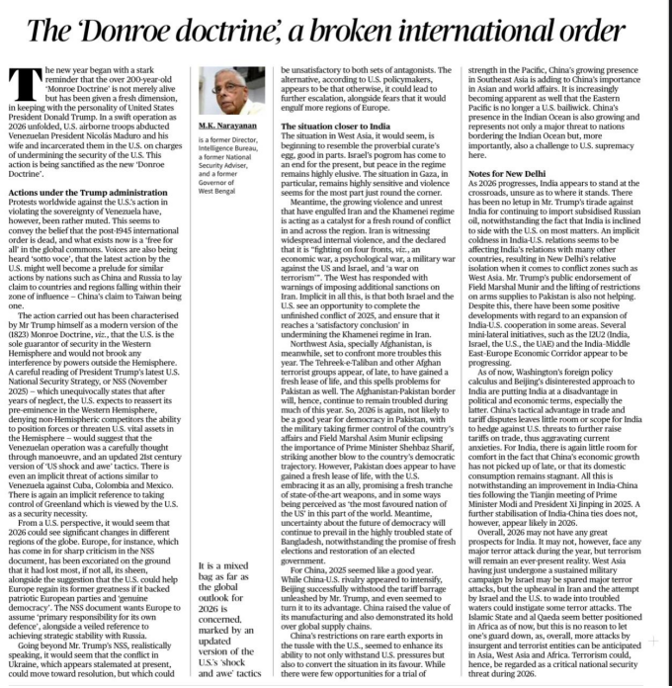
Context
The author examines how recent actions of the United States under Donald Trump signal a revival of coercive unilateralism, described as the “Donroe Doctrine”, and argues that these actions reflect the breakdown of the post-1945 international order. The article links U.S. behaviour to rising global instability and analyses its implications for Europe, West Asia, China, and particularly India.
Detailed Analysis
1. From Monroe Doctrine to ‘Donroe Doctrine’
The classical Monroe Doctrine (1823) asserted U.S. dominance in the Western Hemisphere.The author argues that recent U.S. actions represent a modernised, more aggressive version, marked by coercion and disregard for sovereignty.The abduction and incarceration of the Venezuelan President in a U.S. operation is cited as an example of this new doctrine.
2. Erosion of the Post-1945 International Order
Global protests against U.S. actions have been muted, signalling acceptance that the rules-based international order is weakening.The idea of global commons and collective security is giving way to a “free for all” power politics.The author warns this could legitimise similar actions by powers like China and Russia within their claimed spheres of influence.
3. Trump Administration’s Strategic PostureThe latest U.S. National Security Strategy stresses reasserting U.S. pre-eminence, especially in the Western Hemisphere.Europe is criticised for losing strategic autonomy and is being asked to take primary responsibility for its defence.Ukraine is viewed as a conflict that may either stagnate or dangerously escalate, drawing in more regions.
4. West Asia: Escalation and Instability
Gaza remains volatile with peace proving elusive.Iran is described as being under pressure on multiple fronts — economic, military, psychological, and ideological.Israel and the U.S. are seen as attempting to conclusively weaken the Iranian regime, risking regional destabilisation.Afghanistan and Pakistan are projected as zones of continued turbulence, undermining democratic prospects.
5. China’s Strategic Gains
Despite trade pressures, China has leveraged tariffs to strengthen manufacturing and supply chain dominance.Its growing influence in Southeast Asia, the Indian Ocean, and Eastern Pacific challenges U.S. supremacy.China’s economic resilience and export control strategies have enhanced its geopolitical leverage.
6. India at a Strategic Crossroads
India faces uncertainty due to U.S. pressure tactics, including tariff threats.While India aligns with the U.S. on many strategic issues, strained India-U.S. relations risk diplomatic isolation.Simultaneously, China’s economic advantages limit India’s strategic flexibility.Positive developments include multilateral initiatives like I2U2 and the
India-Middle East-Europe Economic Corridor, but these may not offset broader geopolitical pressures.
7. Security Outlook for 2026Terrorism remains a persistent threat, particularly in West Asia, Africa, and South Asia.While India may avoid major attacks, the regional instability around it continues to pose serious national security risks.
Suggestions of the AuthorIndia must avoid over-dependence on any single power and pursue strategic autonomy.New Delhi should strengthen diversified partnerships and multilateral platforms.A cautious approach is required in navigating U.S.–China rivalry while safeguarding economic and security interests.Diplomatic agility is essential in a world moving away from rule-based order to power-centric politics.
UPSC Mains Practice Question
The weakening of the rules-based international order has led to the resurgence of unilateralism in global politics.” In this context, examine the implications of the so-called ‘Donroe Doctrine’ for India’s foreign
GS 3: Indian Economy – Foreign Direct Investment (FDI), Trade, Global Supply Chains
Context
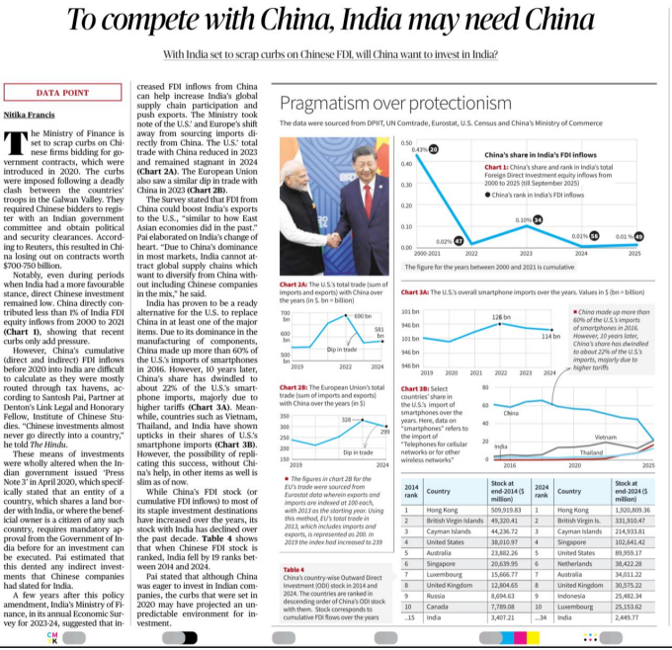
The article discusses India’s proposed move to ease restrictions on Chinese Foreign Direct Investment (FDI) imposed after 2020 and examines whether deeper economic engagement with China is necessary for India to enhance its manufacturing capacity, exports, and global supply chain integration, even while strategically competing with China. Detailed Analysis1. Background: Curbs on Chinese FDIIndia imposed restrictions on Chinese investments in 2020 following the Galwan Valley clash.Chinese firms were required to obtain government approval for investments and public contracts.These curbs significantly reduced China’s direct participation in Indian projects and investments. 2. Limited Role of Chinese FDI in IndiaEven before 2020, China accounted for less than 1% of India’s total FDI equity inflows.Much of Chinese investment entered India indirectly through tax havens, making actual figures hard to estimate.Post-2020 policy uncertainty further discouraged Chinese investors.
3. Global Supply Chains and China’s CentralityChina dominates global manufacturing and supply chains, especially in electronics and components.The author argues that India cannot realistically integrate into global supply chains while completely excluding China.East Asian economies earlier expanded exports by working within China-centric supply chains.
4. Lessons from the U.S. and EuropeThe U.S. and EU have reduced direct trade dependence on China, but complete decoupling has not occurred.Example:China’s share in U.S. smartphone imports fell from over 60% in 2016 to about 22%, but supply chains merely shifted partially to countries like Vietnam, Thailand, and India.This shift required Chinese components and know-how, highlighting interdependence rather than isolation.
5. India’s Manufacturing AmbitionsIndia aims to emerge as a China alternative in global manufacturing.However, success in electronics, machinery, and other sectors has relied on Chinese inputs, capital, and expertise.Replicating China’s manufacturing scale without Chinese participation remains difficult in the short to medium term.
6. Changing Policy SignalsIndia’s Ministry of Finance and DPIIT surveys suggest a rethinking of rigid restrictions.Increased Chinese FDI could help India:Boost exportsImprove supply chain participationEnhance manufacturing competitiveness
7. Pragmatism over ProtectionismThe core argument is that strategic competition does not require economic isolation.Controlled and selective Chinese investment may serve India’s economic interests better than blanket restrictions.
Suggestions of the Author
India should adopt a pragmatic, calibrated approach to Chinese FDI rather than rigid protectionism.Security concerns can be addressed through screening mechanisms, not outright exclusion.Leveraging Chinese capital and supply chains can accelerate India’s manufacturing and export growth.Economic engagement should complement, not undermine, India’s strategic autonomy.
UPSC Mains Practice Question
“India’s economic competition with China requires engagement rather than isolation.” Critically examine this statement in the context of India’s FDI policy and global supply chain integration. Source: The Hindu
GS 2: Polity and Governance – Fundamental Rights, Role of Judiciary Context
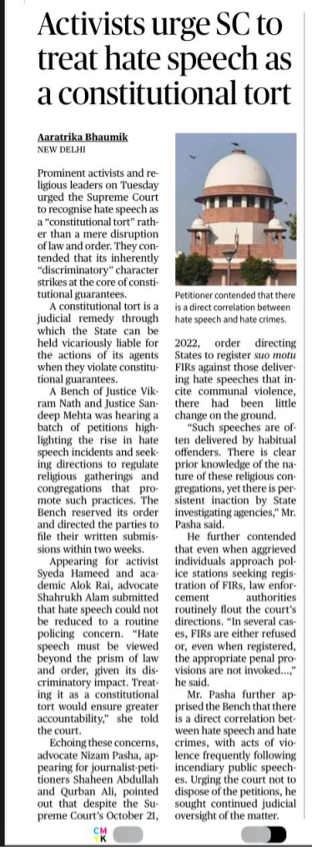
Prominent activists and religious leaders have urged the Supreme Court to recognise hate speech as a constitutional tort, arguing that existing law-and-order approaches have failed to curb its rising incidence and consequences. Key PointsDemand for Constitutional Tort FrameworkPetitioners argued that hate speech should be treated as a constitutional tort, not merely a public order issue.A constitutional tort allows the State to be held vicariously liable for violations of fundamental rights by its agents. Reasoning Behind the DemandHate speech is inherently discriminatory and directly violates constitutional guarantees such as equality and dignity.Treating it only as a policing issue undermines its constitutional impact. Judicial ProceedingsA Bench comprising Justice Vikram Nath and Justice Sandeep Mehta heard a batch of petitions.The court has reserved its order and directed parties to file written submissions within two weeks. Failure in Enforcement of Existing DirectionsDespite the Supreme Court’s October 21, 2022 directions to register suo motu FIRs in hate speech cases, enforcement has been weak.Law enforcement agencies often refuse to register FIRs or invoke inappropriate penal provisions. Habitual Nature of Hate SpeechPetitioners highlighted that such speeches are often delivered by habitual offenders.There is prior knowledge of such religious congregations, yet persistent inaction by investigating agencies continues. Link Between Hate Speech and ViolenceA direct correlation was highlighted between hate speech and hate crimes.Incendiary public speeches are often followed by acts of violence, threatening public order and social harmony. Need for Judicial OversightPetitioners urged the Court not to dispose of the matter and to ensure continued judicial monitoring to secure accountability and compliance. UPSC Prelims Practice QuestionQ. Consider the following statements regarding constitutional torts in India:1.A constitutional tort allows compensation against the State for violation of fundamental rights by its agents.2.Constitutional torts are explicitly defined and codified under the Indian Penal Code.Which of the statements given above is/are correct?(a) 1 only
(b) 2 only
(c) Both 1 and 2
(d) Neither 1 nor 2
Correct Answer: (a)Explanation:
Statement 1 is correct as constitutional torts are judicially evolved remedies to enforce fundamental rights.
Statement 2 is incorrect because constitutional torts are not codified in the IPC but developed through judicial interpretation. Source: The Hindu
GS 2: International Relations – Sovereignty, Strategic Interests, International Law
Context
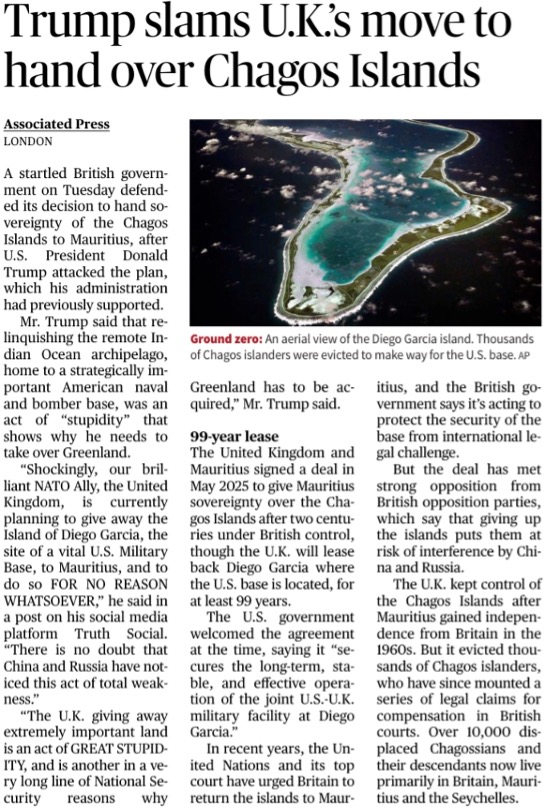
The issue is in news after U.S. President Donald Trump criticised the United Kingdom’s decision to hand over sovereignty of the Chagos Islands to Mauritius, calling it a threat to strategic security interests. Key PointsBackground of the Chagos Islands IssueThe Chagos Islands are a remote archipelago in the Indian Ocean.The U.K. retained control of the islands even after Mauritius gained independence in the 1960s.Thousands of native Chagossians were forcibly evicted to make way for a U.S. military base. Diego Garcia and Strategic ImportanceDiego Garcia, part of the Chagos Islands, hosts a critical U.S. military base.The base supports U.S. naval and bomber operations and is central to Indo-Pacific security. U.K.–Mauritius AgreementIn May 2025, the U.K. and Mauritius signed an agreement to transfer sovereignty of the Chagos Islands to MauritiusThe U.K. will lease back Diego Garcia for at least 99 years, ensuring continued U.S. military presence.The U.S. earlier supported the deal, citing long-term operational stability. Trump’s ObjectionsTrump termed the move an act of strategic weakness.He warned that relinquishing control could benefit China and Russia.He argued that the decision undermines NATO security interests.
International Legal Dimension
The United Nations and its top court have urged the U.K. to return the islands to Mauritius.The U.K. government argues the agreement protects the base from future legal challenges.
Domestic Opposition in the U.K.
British opposition parties argue the handover risks foreign interference.Concerns have been raised about weakening Western strategic control in the Indian Ocean.
Human Rights Aspect
Over 10,000 displaced Chagossians and their descendants live in the U.K., Mauritius, and Seychelles.They have pursued compensation and resettlement claims in British courts. United Nations’s Stand:The UN has consistently supported Mauritius’ sovereignty claim over the Chagos Islands.UN bodies have emphasised decolonisation and self-determination of displaced islanders. UPSC Prelims Practice QuestionQ. Consider the following statements regarding the Chagos Islands:1.Diego Garcia hosts a major U.S. military base leased from the United Kingdom.2.The United Nations has supported the United Kingdom’s continued sovereignty over the Chagos Islands.Which of the statements given above is/are correct?(a) 1 only
(b) 2 onlyCorrect Answer:
(a)Explanation:Statement 1 is correct as Diego Garcia hosts a key U.S. military base.
Statement 2 is incorrect because the United Nations has supported Mauritius’ claim, not the U.K.’s. Source: The Hindu
GS 3: Indian Economy – Industrial Growth, Infrastructure
Context
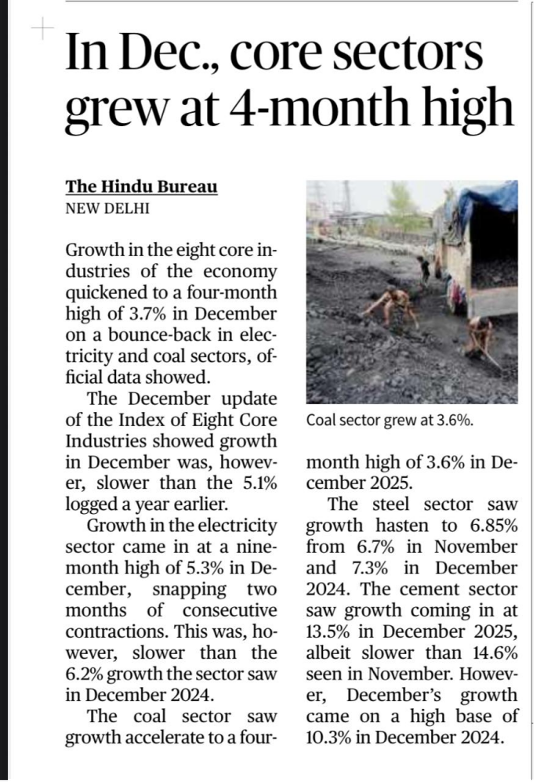
The Index of Eight Core Industries showed a four-month high growth of 3.7% in December, driven mainly by a rebound in electricity and coal output, according to official data.
Key Points
Overall Core Sector Performance
Growth of 3.7% in December, marking a four-month high.
However, growth remained lower than 5.1% recorded in December of the previous year.
Electricity Sector
Electricity output grew 5.3%, a nine-month high.
This reversed two consecutive months of contraction.
Growth was still slower than 6.2% seen in December last year.
Coal Sector
Coal production rose 3.6%, the highest in four months.
The rebound in coal supported electricity generation.
Steel Sector
Steel output growth improved to 6.85%.
This was higher than 6.7% in November, but lower than 7.3% in December 2024.
Cement Sector
Cement production expanded by 13.5% in December.
Growth moderated compared to 14.6% in November.
Expansion came on a high base of 10.3% in December last year.
Base Effect Impact
Slower year-on-year growth in some sectors is attributed to a high base effect from December 2024.
Index of Eight Core Industries
It comprises coal, crude oil, natural gas, refinery products, fertilizers, steel, cement, and electricity.
These sectors together have a weight of about 40% in the Index of Industrial Production (IIP).
It is a key indicator of overall industrial and infrastructure activity.
UPSC Prelims Practice Question
Q. Consider the following statements regarding the Index of Eight Core Industries:
1.It includes sectors such as coal, steel, cement, and electricity.
2.It has a weight of more than 60% in the Index of Industrial Production.
Which of the statements given above is/are correct?
(a) 1 only
(b) 2 only
(c) Both 1 and 2
(d) Neither 1 nor 2
Correct Answer: (a)
Explanation:
Statement 1 is correct as coal, steel, cement, and electricity are part of the core industries.
Statement 2 is incorrect because the core industries have a weight of about 40%, not over 60%, in the IIP.
Source: The Hindu
GS 2: Polity and Governance – Governor–State Relations, Constitutional Conventions
Context
The issue is in news after constitutional confrontations in Kerala and Tamil Nadu, where Governors allegedly altered or refused to read the customary policy address, triggering debates on constitutional propriety and the limits of gubernatorial discretion.
Key Points
Role of Governor’s Address
The Governor’s address to the Legislature is a constitutional requirement under Articles 175 and 176.It reflects the policies and priorities of the elected State government, not the personal views of the Governor.
Kerala: Alleged Alteration of Policy Address
Kerala Chief Minister Pinarayi Vijayan alleged that Governor Rajendra Vishwanath Arlekar made changes to the Cabinet-approved speech.
The CM asserted that only the Cabinet-ratified version has constitutional validity.The government maintained that omissions and additions by the Governor violate legislative precedent and constitutional convention.
Cabinet Supremacy
The policy address must be approved by the Council of Ministers.Any unilateral alteration by the Governor undermines collective responsibility of the executive.
Tamil Nadu: Refusal to Read Address
Tamil Nadu Governor R. N. Ravi declined to read the customary address prepared by the State government.The Governor exited the Assembly, leading to the House adopting the
Cabinet-approved text as the official address. Assembly’s ResponseThe Tamil Nadu Assembly recorded only the approved address and passed a resolution taking note of the Governor’s refusal.The Speaker urged adherence to constitutional procedure and convention.
Recurring Federal Friction
Both incidents highlight frequent tensions between elected governments and Governors.Critics argue that Governors are acting beyond their constitutional role as nominal heads. Constitutional ConcernSuch actions raise concerns about the erosion of parliamentary democracy at the State level.The issue reiterates the need to respect federal principles and democratic mandates. Supreme Court of India
The Supreme Court has consistently held that the Governor must act on the aid and advice of the Council of Ministers, except in limited discretionary areas.Constitutional conventions are integral to the smooth functioning of the federal system.
Syllabus: GS Paper II – Governance
Topic: Women Empowerment, Government Initiatives, Digital Inclusion Context
The Government of Karnataka has launched Gruha Lakshmi Digital Marketing, a state-supported digital portal aimed at promoting products made by women entrepreneurs and enhancing their economic independence and market access through technology. Key Points
Consider the following statements regarding “Gruha Lakshmi Digital Marketing”:
1. It is a government-supported digital marketplace to promote products made by women entrepreneurs in Karnataka.
2. The initiative is implemented by the Ministry of Women and Child Development at the national level.Which of the statements given above is/are correct?
(a) 1 only
(b) 2 only
(c) Both 1 and 2
(d) Neither 1 nor 2
Correct Answer: (a)Explanation:
Statement 1 is correct as the portal is a state-backed e-commerce platform for women entrepreneurs in Karnataka.
Statement 2 is incorrect since the initiative is implemented by the Government of Karnataka, not by a central ministry.
Source: The Hindu
Syllabus: GS Paper II – Polity
Topic: Election Commission of India, Electoral Reforms, Democratic Governance ContextThe Election Commission of India is hosting the first-ever India International Conference on Democracy and Election Management (IICDEM) 2026 to showcase India’s experience in conducting large-scale democratic elections and to promote global cooperation in election management.
Key Points
Consider the following statements regarding IICDEM 2026:
1. It is organised by the Election Commission of India through its training arm IIIDEM.2. The conference includes the launch of ECINET, a digital platform for election-related services.Which of the statements given above is/are correct?
(a) 1 only
(b) 2 only
(c) Both 1 and 2
(d) Neither 1 nor 2Correct Answer: (c)Explanation:
Statement 1 is correct as IICDEM 2026 is organised by IIIDEM under the aegis of ECI.
Statement 2 is correct since ECINET is scheduled to be launched during the conference. Source: PIB
Saltwater Crocodile
Syllabus: GS Paper III – Environment & Ecology
Topic: Wildlife Conservation, Biodiversity
Context
A pilot drone-based survey conducted by the Odisha State Forest and Environment Department has reported an increase in the population of saltwater crocodiles in the state, indicating successful conservation and habitat protection measures.
Key Points
Features of Saltwater Crocodile
Prelims Practice Question
Consider the following statements about the Saltwater Crocodile:
1. It is the largest living reptile and inhabits both freshwater and saltwater ecosystems.
2. In India, its natural population is mainly concentrated in Odisha, West Bengal, and the Andaman and Nicobar Islands.
Which of the statements given above is/are correct?
(a) 1 only
(b) 2 only
(c) Both 1 and 2
(d) Neither 1 nor 2
Correct Answer: (c)
Explanation:
Statement 1 is correct as the saltwater crocodile is the largest living reptile and thrives in freshwater as well as marine-influenced habitats.
Statement 2 is correct since its Indian distribution is largely limited to Odisha, West Bengal, and Andaman & Nicobar Islands.
Source: The Hindu
Samakka-Saralamma Jatara
Syllabus: GS Paper I – History & Culture
Topic: Indian Culture – Tribal Culture and Festivals
Context
Recently, Telangana began preparations for the biennial Samakka-Saralamma Jatara, one of the world’s largest indigenous spiritual gatherings, reflecting the rich tribal heritage and resistance traditions of the region.
Key Points
Sukhatme National Award in Statistics
Syllabus: GS Paper II – Governance
Topic: Government Institutions, Capacity Building, Official Statistics
Context
Recently, nominations were invited online for the Sukhatme National Award in Statistics – 2026 through the National Awards Portal, highlighting India’s emphasis on strengthening official statistics and statistical research.
Key Points
Prelims Practice Question
Consider the following statements regarding the Sukhatme National Award in Statistics:
1. It is awarded in alternate years to Indian statisticians for lifetime contributions to the field of statistics.
2. The award is presented annually on National Mathematics Day.
Which of the statements given above is/are correct?
(a) 1 only
(b) 2 only
(c) Both 1 and 2
(d) Neither 1 nor 2
Correct Answer: (a)
Explanation:
Statement 1 is correct as the award is given in alternate years for lifetime achievements in statistics.
Statement 2 is incorrect since the award is presented on Statistics Day (29 June), not on National Mathematics Day.
Source: PIB
 Launch your Graphy