There are no items in your cart
Add More
Add More
| Item Details | Price | ||
|---|---|---|---|


| S.No | Topic | |
| Daily Hindu Analysis (YouTube) | ||
| 1. | In a changing world, it is ‘small tables, big dividends’ | |
| 2. | What is T.N.’s new hybrid pension model? | |
| 3. | Include digital currency link on BRICS agenda: RBI to govt. | |
| Daily Current Affairs (App) | ||
| 4. | UN Biodiversity Beyond National Jurisdiction (BBNJ) Treaty | |
| 5. | 80 years of the United Nations Economic and Social Council (ECOSOC) | |
| 6. | Delhi to launch unified emergency helpline 112 | |
| 7. | Chips to Start-Up Programme | |
Syllabus: GS Paper 2 – International Relations | India’s Foreign Policy Context
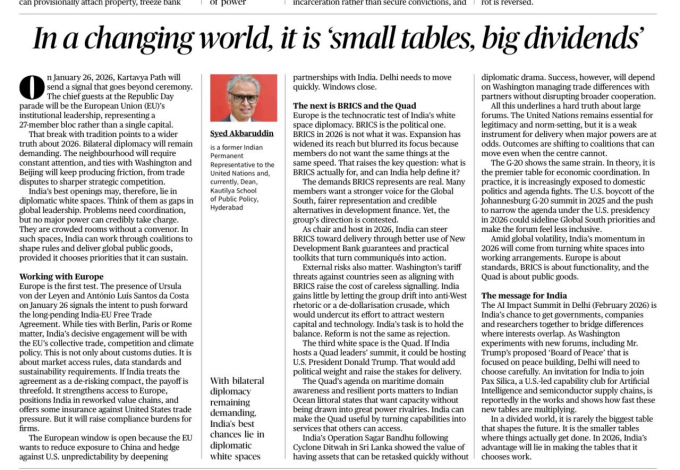
The author argues that in a fragmented and volatile global order, India’s diplomatic effectiveness in 2026 will depend less on large multilateral forums and more on focused, issue-based coalitions where outcomes are achievable and sustainable.
Detailed Analysis
The changing global diplomatic landscapeThe article begins with India’s Republic Day 2026 symbolism, where the chief guests are leaders of the European Union, not a single country.This reflects a broader shift: no single power can credibly lead global problem-solving, while bilateral diplomacy alone is insufficient.Major powers are locked in rivalry, producing friction in trade, technology, and security.
Limits of large multilateral forums
Global platforms like the United Nations remain vital for legitimacy and norm-setting but are weak in delivery when major powers disagree.The G20, theoretically the premier forum for economic coordination, is increasingly constrained by domestic politics and geopolitical agendas.The U.S. boycott of the Johannesburg G20 summit in 2025 and attempts to narrow its agenda highlight these limitations. India’s ‘diplomatic white spaces’The author introduces the idea of “diplomatic white spaces”—gaps where leadership is absent but coordination is needed.These spaces allow India to work through coalitions of the willing, shaping rules and delivering public goods without claiming hegemonic leadership.Success depends on choosing priorities that India can sustain diplomatically, politically, and economically. Working with EuropeEurope is identified as India’s first major test in 2026.Engagement is shifting from bilateral ties with individual states to collective engagement with the EU on:Trade and market accessData standards and sustainability rulesClimate and competition policyThe pending India–EU Free Trade Agreement is central, offering India supply-chain diversification and partial insulation from U.S. trade pressures, albeit with higher compliance costs.
BRICS: political ambition vs delivery
BRICSis described as India’s political stress test.Expansion has increased BRICS’ reach but diluted its focus due to divergent member priorities.Member demands include:Stronger Global South representationFairer development financeCredible alternatives to Western-led institutionsAs chair in 2026, India can steer BRICS towards practical delivery, especially through better use of New Development Bank guarantees, while avoiding anti-West rhetoric that could deter investment. The Quad as a functional platformThe Quadrilateral Security Dialogue is presented as India’s most promising functional coalition.Unlike BRICS, the Quad focuses on:Maritime domain awarenessDisaster resiliencePublic goods in the Indo-PacificHosting a Quad summit could elevate its delivery capacity while avoiding entanglement in great-power rivalry.India’s Operation Sagar Bandhu during Cyclone Asna in Sri Lanka is cited as an example of how flexible capabilities can translate into regional trust. The role of the United StatesThe author cautions against careless signalling on de-dollarisation or anti-West rhetoric, which could undermine India’s access to capital and technology.Reform and rejection of the existing order are not the same; India must balance autonomy with attraction for Western investment.New initiatives, such as a proposed U.S.-led AI and semiconductor capability club, indicate how rapidly new “tables” are emerging. Author’s SuggestionsIndia should prioritise small, outcome-oriented forums over large, consensus-heavy institutions.Diplomatic success lies in functional cooperation, not symbolic leadership.India must choose engagements that align with its capacity, credibility, and long-term interests, especially in technology, standards, and public goods.
UPSC Mains Practice Question“
In an era of fragmented multilateralism, middle powers like India can derive greater strategic gains from small, issue-based coalitions than from large global forums.”Discuss with reference to India’s engagement with the EU, BRICS, and the Quad.
 Syllabus:
 GS Paper 2 – Governance | Welfare Schemes | Social Justice
Context
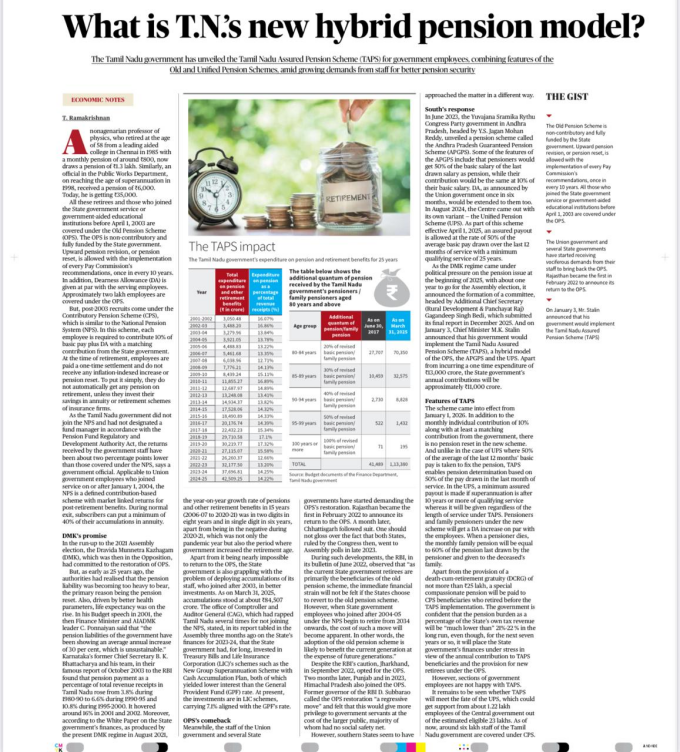
The article examines the Tamil Nadu Assured Pension Scheme (TAPS) introduced by the Tamil Nadu government, a hybrid pension model combining elements of the Old Pension Scheme (OPS) and the Unified/National Pension System (UPS/NPS), against the backdrop of long-standing employee demands for pension security and fiscal sustainability concerns.
Detailed Analysis Background: India’s pension transitionGovernment employees who joined service before April 1, 2003 are covered under the Old Pension Scheme (OPS).OPS provides a defined benefit pension, fully funded by the State, with pension equal to 50% of last drawn basic pay plus DA, and periodic revisions.Employees joining after April 1, 2003 are covered under the Contributory Pension Scheme / National Pension System (CPS/NPS).NPS is a defined contribution scheme, where employees contribute 10% of basic pay plus DA, matched by the government, with returns linked to market performance and no guaranteed pension. The problem identifiedRetirees under NPS face income uncertainty, as pension depends on accumulated corpus and annuity returns.At the same time, States fear that a return to OPS would cause unsustainable fiscal pressure, given rising life expectancy and pension liabilities.This tension has led to political and administrative debates across States, with some States reverting to OPS despite warnings from fiscal institutions.
(TAPS)Tamil Nadu adopted a middle path by introducing TAPS, a hybrid pension framework.The scheme seeks to balance employee security with fiscal prudence, rather than fully reverting to OPS.
Who is covered
TAPS applies to government employees who joined service on or after April 1, 2003, currently under CPS/NPS.Employees who retired before the implementation of TAPS continue under the earlier applicable system.
Key features of TAPS
Employees will continue to contribute 10% of basic pay plus DA, with a matching government contribution.Unlike OPS, there is no pension reset or periodic revision.Pension is calculated based on average of the last 12 months’ basic pay.
Assured pension component
Employees with 10 years or more of qualifying service are eligible for an assured minimum pension.The assured pension is 50% of the average basic pay of the last 12 months, subject to minimum qualifying service.For those with less than 10 years of service, pension will be proportionately lower.
Family pension and death benefits
Family pension under TAPS is fixed at 50% of the pension drawn by the deceased employee.In addition, a death-cum-retirement gratuity (DCRG) up to ₹25 lakh is provided.
Comparison with OPS and NPS
OPS provides a fully guaranteed, inflation-adjusted pension, but with heavy long-term fiscal burden.NPS provides no assured pension, exposing retirees to market risks.TAPS introduces partial assurance, offering security without fully shifting the burden to the State exchequer. Fiscal implications
The Tamil Nadu government estimates an additional one-time expenditure of around ₹13,000 crore.Annual government contributions under TAPS are projected at around ₹11,000 crore.The government argues that these costs are lower than the long-term liabilities of OPS, making TAPS fiscally manageable.
Political and administrative
context
Several States such as Rajasthan, Chhattisgarh, and Jharkhand have reverted to OPS, despite warnings from the RBI.Tamil Nadu chose a cautious and incremental reform, aiming to avoid future fiscal stress while responding to employee concerns.However, many employee unions remain dissatisfied, arguing that TAPS does not fully match OPS benefits.
Author’s Suggestions / Inferences
Pension reform should focus on inter-generational equity, ensuring current benefits do not compromise future fiscal stability.Hybrid models like TAPS may offer a template for other States, provided transparency and long-term actuarial assessment are ensured.A uniform national framework balancing assurance and sustainability may be preferable to fragmented State-level solutions.
UPSC Mains Practice Question
“Hybrid pension models attempt to reconcile employee welfare with fiscal sustainability.”Discuss this statement in the context of the Tamil Nadu Assured Pension Scheme (TAPS). Source: The Hindu
.Syllabus:
GS Paper 3 – Indian Economy | Banking | Digital Payments
Context
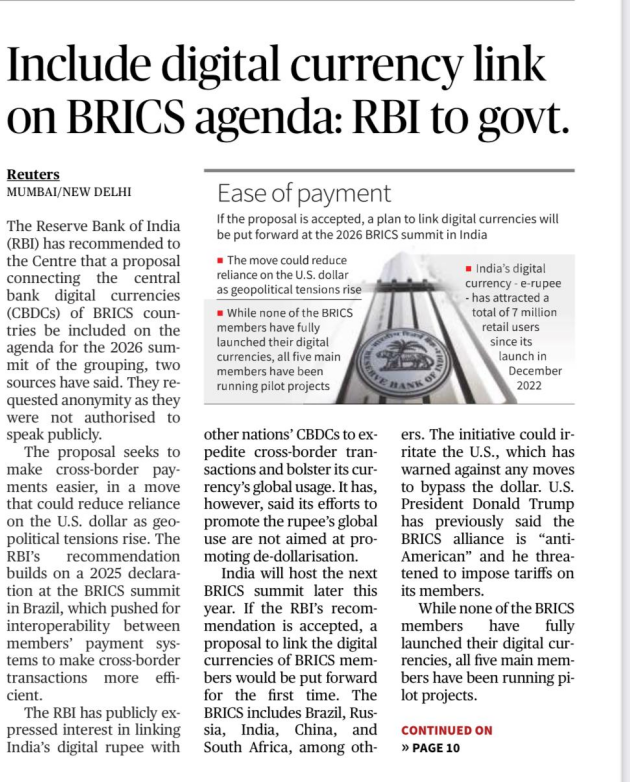
The Reserve Bank of India (RBI) has suggested that a proposal to link central bank digital currencies (CBDCs) of BRICS countries be included on the agenda of the 2026 BRICS Summit, which will be hosted by India, to ease cross-border payments.
Key Points RBI’s recommendation
The proposal seeks to connect CBDCs of BRICS members to improve cross-border payment efficiency.The recommendation builds on a 2025 BRICS declaration that called for interoperability among members’ payment systems.The move aims at reducing transaction costs and settlement time.
Objective of the proposal
To make cross-border payments faster, cheaper, and more efficient.To reduce excessive reliance on correspondent banking systems.To increase the global usage of local currencies, including the Indian rupee.
Geopolitical dimension
The proposal could lower dependence on the US dollar amid rising geopolitical tensions.RBI clarified that India’s efforts are not aimed at de-dollarisation, but at payment efficiency.The idea may face resistance, particularly from the United States, which has cautioned against bypassing the dollar.
Status of CBDCs in BRICS
None of the BRICS members have fully launched CBDCs yet.All five major BRICS countries are currently running pilot projects.This proposal would be the first attempt to formally link BRICS digital currencies. India’s digital currency experienceIndia’s digital rupee (e₹) was launched in December 2022.It has attracted around 7 million retail users so far.India has publicly expressed interest in linking the e₹ with other countries’ CBDCs. BRICS groupingBRICS includes Brazil, Russia, India, China, and South Africa, along with newly admitted members.India is set to host the 2026 BRICS Summit, providing an opportunity to shape the agenda. Additional InformationRBI is the issuing authority for India’s Central Bank Digital Currency (CBDC).It views CBDCs as a tool for payment innovation, financial stability, and cross-border settlement efficiency. UPSC Prelims Practice QuestionQ. Consider the following statements regarding CBDCs and BRICS:1.The RBI has proposed linking CBDCs of BRICS countries to facilitate cross-border payments.2.All BRICS countries have fully launched their respective digital currencies.Which of the statements given above is/are correct?(a) 1 only
(b) 2 onlyCorrect Answer: (a)
Explanation:
Statement 1 is correct as RBI has recommended linking BRICS CBDCs for cross-border payments.
Statement 2 is incorrect because BRICS members are still in pilot stages and have not fully launched CBDCs. Source: The Hindu
Syllabus: GS Paper 3 – Environment | Biodiversity | International Environmental Agreements
Context
The UN Biodiversity Beyond National Jurisdiction (BBNJ) Treaty, also called the High Seas Treaty, has entered into force after securing the required 60 ratifications, establishing the first legally binding global framework to conserve biodiversity in international waters. Key PointsWhat is the BBNJ Treaty
Consider the following statements regarding the BBNJ
Treaty:1. It is a legally binding agreement adopted under the United Nations Convention on the Law of the Sea.
2. It allows countries to claim sovereign rights over marine genetic resources in the high seas.Which of the statements given above is/are correct?
(a) 1 only
(b) 2 only
(c) Both 1 and 2
(d) Neither 1 nor 2
Correct Answer: (a)Explanation:
Statement 1 is correct as the BBNJ Treaty operates under UNCLOS.
Statement 2 is incorrect because the treaty explicitly prohibits sovereignty claims over high-seas biological resources. Source: DD News
GS Paper 2 – International Relations | International Organisations Context
The United Nations Economic and Social Council (ECOSOC) will commemorate its 80th anniversary on 23 January 2026, marking eight decades of coordinating global action on economic, social, and sustainable development issues.
Key PointsWhat is ECOSOC
Syllabus: GS Paper 2 – Governance | Internal Security | Public Service Delivery
Context
Delhi is set to overhaul its emergency response mechanism with the launch of the single emergency helpline number 112, aligning the city with the national emergency response framework announced by the Centre. Key PointsAlignment with national emergency framework
Consider the following statements regarding India’s emergency helpline number 112:
1. It integrates police, fire, and medical emergency services under a single access point.2. Emergency assistance through 112 can be accessed only via voice calls.Which of the statements given above is/are correct?
(a) 1 only
(b) 2 only
(c) Both 1 and 2
(d) Neither 1 nor 2
Correct Answer: (a)Explanation:
Statement 1 is correct as 112 integrates multiple emergency services.
Statement 2 is incorrect because the system also supports SMS, mobile apps, panic buttons, and online platforms. Source: The Hindu
Syllabus:
GS Paper 3 – Science & Technology | Electronics | Indigenisation of Technology
Context
The Chips to Start-Up (C2S) Programme has shown tangible progress in building skilled manpower, providing semiconductor infrastructure access, and enabling hands-on chip design, supporting India’s long-term semiconductor ecosystem.
Key Points
Consider the following statements regarding the Chips to Start-Up Programme:
1. It was launched by the Ministry of Electronics and Information Technology to build semiconductor design capacity.2. The programme focuses only on theoretical training and does not support fabrication or prototype development.Which of the statements given above is/are correct?
Correct Answer: (a)Explanation:
Statement 1 is correct as the programme is a MeitY initiative for semiconductor capacity building.
Statement 2 is incorrect because the programme explicitly provides hands-on training, fabrication access, and prototype development. Source: PIB
 Launch your Graphy