There are no items in your cart
Add More
Add More
| Item Details | Price | ||
|---|---|---|---|

| Index | ||
| S.No | Topic | |
| Daily Hindu Analysis (YouTube) | ||
| 1. | A Bill that reimagines higher education regulation | |
| 2. | Why Article 6 is a powerful tool for India | |
| 3. | What do two PSLV mission failures in a row mean for ISRO? | |
| 4. | India to be invited to join U.S.-led initiative Pax Silica, says envoy | |
| 5. | Safety of victims paramount while considering bail in POCSO cases: SC | |
| 6. | DRDO carries out flight test of anti-tank guided missile | |
| 7. | Retail inflation at 3-month high of 1.33% in December | |
| Daily Current Affairs (App) | ||
| 8. | International Renewable Energy Agency | |
| 9. | International Court of Justice hearings on Rohingya genocide case against Myanmar | |
| 10. | Pradhan Mantri–Rashtriya Krishi Vikas Yojana | |
| 11. | National Youth Day (Yuva Diwas) 2026 | |
| 12. | District Mineral Foundations (DMFs) | |
| 13. | Bureau of Energy Efficiency | |



Context
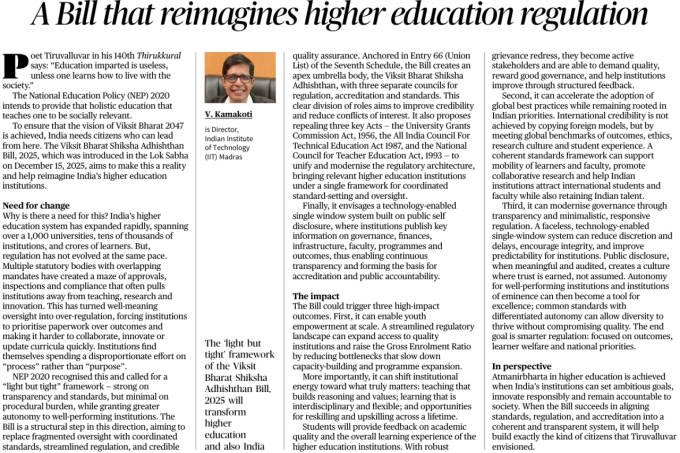
The article discusses the rationale, design, and potential impact of the Viksit Bharat Shiksha Adhisthan Bill, 2025, introduced in the Lok Sabha, which seeks to comprehensively reform India’s higher education regulatory architecture in line with NEP 2020 and the vision of Viksit Bharat 2047.
Detailed Analysis
Need for Change in Higher Education Regulation
India’s higher education system has expanded rapidly, with over 1,000 universities and crores of learners.Regulation has not kept pace, resulting in multiple statutory bodies with overlapping mandates.Excessive approvals, inspections, and compliance have led to over-regulation, diverting institutions from teaching, research, and innovation.Institutions focus on processes and paperwork rather than outcomes, curriculum renewal, and collaboration.
NEP 2020 and the “Light but Tight” Approach
NEP 2020 identified the problem of fragmented regulation and advocated a “light but tight” framework.This means strong standards and transparency, but minimal procedural burden.Greater autonomy is envisaged for well-performing institutions while ensuring accountability through outcomes.
Key Provisions of the Viksit Bharat Shiksha Adhisthan Bill, 2025
Anchored in Entry 66 of the Union List, ensuring uniform national standards.Creation of a single apex umbrella body, the Viksit Bharat Shiksha Adhisthan.Establishment of three distinct councils for regulation, accreditation, and standard-setting to avoid conflicts of interest.Repeal of legacy laws governing higher education regulation to unify and modernise the system.Introduction of a technology-enabled single-window system based on public self-disclosure by institutions. Transparency and Public Accountability
Institutions will publish key information on governance, finances, infrastructure, faculty, programmes, and outcomes.Public disclosure becomes the basis for accreditation and oversight rather than intrusive inspections.Transparency shifts regulation from assumption-based trust to earned trust through verifiable data.
Impact on Students and Institutions
Students become active stakeholders with access to information and grievance redress mechanisms.Student feedback strengthens academic quality and governance.Reduced regulatory bottlenecks can expand access and help raise the Gross Enrolment Ratio.Institutions can focus on teaching quality, interdisciplinary learning, and lifelong skilling. Global Standards with Indian Priorities
The Bill supports adoption of global best practices without blind replication of foreign models.A coherent standards framework enhances international credibility, mobility of learners and faculty, and collaborative research.Indian institutions can attract global talent while retaining domestic intellectual capital.
Governance Reform and Autonomy
Emphasis on faceless, technology-driven regulation reduces discretion and delays.Differentiated autonomy allows diversity among institutions while maintaining common standards.Autonomy becomes a tool for excellence rather than a privilege without accountability.
Suggestions of the Author
Align regulation, accreditation, and standards within a single coherent framework.Focus regulation on outcomes, learner welfare, and national priorities, not procedural compliance.Use transparency, public disclosure, and technology as the primary regulatory tools.Enable institutions of eminence and well-performing institutions to innovate responsibly.
UPSC Mains Practice Question
Discuss how the Viksit Bharat Shiksha Adhisthan Bill, 2025 seeks to balance autonomy, accountability, and quality assurance in India’s higher education system.
Context
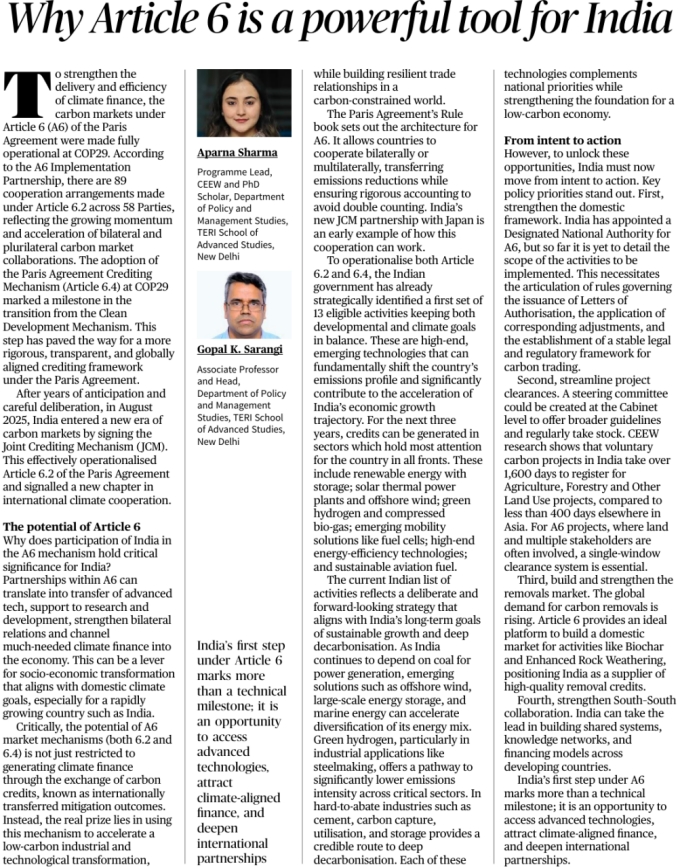
The article analyses the operationalisation of Article 6 of the Paris Agreement after COP29 and explains how India can strategically use carbon markets to access technology, finance, and partnerships while accelerating its low-carbon development pathway.
Detailed Analysis
Understanding Article 6 of the Paris Agreement
Article 6 provides a framework for international cooperation on emission reductions.It allows countries to transfer mitigation outcomes while avoiding double counting.The Paris Rulebook finalised the architecture for Article 6, enabling bilateral, plurilateral, and multilateral carbon market mechanisms.
Operationalisation of Article 6 at COP29
Article 6 mechanisms were made fully operational at COP29.Around 89 cooperation arrangements across 58 countries have already emerged.The transition from the Clean Development Mechanism to Article 6.4 crediting mechanism marked a shift to a more transparent and globally aligned framework.
India’s First Step: Joint Crediting Mechanism with Japan
India operationalised Article 6.2 by signing a Joint Crediting Mechanism (JCM) with Japan in August 2025.This demonstrated how bilateral cooperation can work under Article 6.It opened a new chapter in climate diplomacy and technology collaboration.
Why Article 6 Matters for India
Article 6 partnerships can enable transfer of advanced clean technologies.It can unlock climate finance and support research and development.It strengthens bilateral relations while supporting India’s domestic climate goals.It aligns with India’s need for a development-centric decarbonisation pathway.
Beyond Carbon Credits: Structural Transformation
The true value of Article 6 lies beyond carbon credit trading.It can accelerate low-carbon industrial and technological transformation.It supports resilient trade relationships in a carbon-constrained global economy.
Priority Sectors Identified by India
India has identified 13 eligible activities under Article 6.Key sectors include renewable energy with storage, offshore wind, solar thermal power, green hydrogen, bio-CNG, fuel cells, and energy-efficiency technologies.Emerging mobility solutions and sustainable aviation fuel are also included.
Hard-to-Abate Sectors and Deep Decarbonisation
Green hydrogen offers a pathway to reduce emissions in steelmaking and heavy industry.Carbon capture, utilisation, and storage is critical for cement and other emission-intensive sectors.Offshore wind and marine energy can diversify India’s energy mix and reduce coal dependence. Carbon Markets and India’s Growth Strategy
India’s Article 6 strategy balances economic growth with emission reductions.It supports sustainable growth while improving energy security.The approach reflects a forward-looking alignment with India’s long-term decarbonisation goals.
Suggestions of the AuthorStrengthening Domestic Framework
Clearly define the scope of activities under Article 6.Establish rules for issuing Letters of Authorisation and corresponding adjustments.Create a stable legal and regulatory framework for carbon trading.
Streamlining Project Clearances
Reduce approval delays through a single-window clearance system.Evidence shows Indian carbon projects face significantly longer registration timelines compared to other regions.
Building a Robust Removals Market
Use Article 6 to develop a domestic market for carbon removals.Promote activities like biochar and enhanced rock weathering.Position India as a supplier of high-quality carbon removal credits.Strengthening South-South CooperationIndia should lead collaboration among developing countries.Build shared systems, knowledge networks, and innovative financing models.
UPSC Mains Practice Question
Discuss how Article 6 of the Paris Agreement can support India’s climate goals while enabling economic growth and technological transformation.
Context
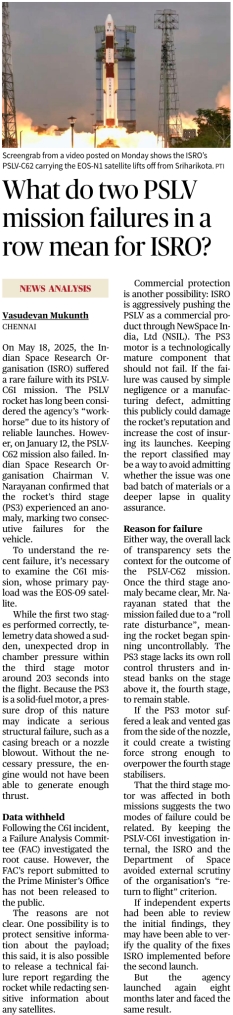
India’s Polar Satellite Launch Vehicle (PSLV), long regarded as ISRO’s most reliable launch system, suffered two consecutive mission failures — PSLV-C61 in May 2025 and PSLV-C62 in January 2026 — raising concerns about reliability, quality assurance, and transparency in India’s space programme.
Key Points
Background of the Failures
PSLV-C61 (May 2025) failed during flight while carrying the EOS-09 satellite.
PSLV-C62 (January 2026) also failed, with ISRO confirming an anomaly in the third stage (PS3).
These back-to-back failures are unprecedented for the PSLV, ISRO’s traditional “workhorse”.
Technical Cause Highlighted
Telemetry data showed a sudden pressure drop in the PS3 motor around 203 seconds into flight.
As PS3 is a solid-fuel motor, such a pressure loss may indicate:
Structural failure
Nozzle damage
Casing breach
Insufficient thrust prevented proper mission progression.
Roll Rate Disturbance
ISRO attributed the C62 failure to a roll rate disturbance.
PS3 lacks independent roll-control thrusters and depends on the fourth stage for stability.
A lateral gas leak from PS3 could generate twisting forces overpowering stabilisers.
Repetition of Failure Modes
Similarities between C61 and C62 suggest systemic or related defects rather than isolated incidents.
This raises concerns about manufacturing quality, material integrity, or inspection processes.
Transparency and Withheld Data
After PSLV-C61, a Failure Analysis Committee investigated the issue.
The report submitted to the PMO was not made public.
Lack of disclosure limits external scrutiny and independent verification of corrective measures.
Quality Assurance Concerns
Repeated failure points to a possible lapse in quality assurance rather than design philosophy.
The PS3 motor is considered a mature technology, expected to have minimal failure risk.
Commercial and Strategic Implications
ISRO is aggressively marketing PSLV via NewSpace India Limited (NSIL) as a commercial launch vehicle.
Failures may:
Damage international confidence
Increase insurance premiums
Affect launch contracts and competitiveness
“Return to Flight” Concerns
ISRO relaunched PSLV after eight months without public validation of fixes.
Absence of independent review weakens confidence in the “return to flight” decision-making process.
UPSC Prelims Practice Question
With reference to the recent PSLV mission failures, consider the following statements:
1.The third stage of PSLV uses solid fuel and does not have independent roll-control thrusters.
2.Consecutive PSLV mission failures raise concerns primarily related to launch pad infrastructure rather than propulsion systems.
Which of the statements given above is/are correct?
(a) 1 only
(b) 2 only
(c) Both 1 and 2
(d) Neither 1 nor 2
Correct Answer: (a)
Explanation:
Statement 1 is correct because the PSLV’s third stage (PS3) is a solid-fuel motor without independent roll-control thrusters and depends on upper stages for stability.
Statement 2 is incorrect as the failures are linked to propulsion and quality assurance issues, not launch pad infrastructure.
Context
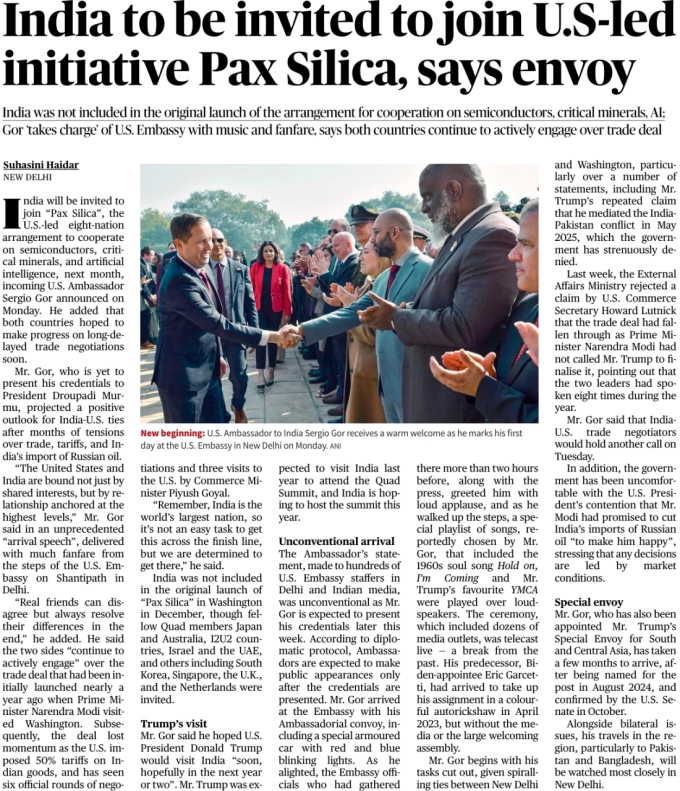
India is set to be invited to join “Pax Silica”, a U.S.-led initiative focused on cooperation in semiconductors, critical minerals, and artificial intelligence, signalling renewed momentum in India–U.S. strategic and economic engagement. Key PointsWhat is Pax SilicaPax Silica is a U.S.-led grouping of eight countries.Focus areas include semiconductors, critical minerals, and artificial intelligence.It aims to strengthen secure and resilient supply chains in strategic technologies. India’s InclusionIndia was not part of the original launch of Pax Silica in Washington.The U.S. Ambassador-designate confirmed that India will be invited to join next month.India’s growing role as a technology and manufacturing hub underpins the invitation. Strategic Significance for IndiaEnhances India’s access to advanced semiconductor ecosystems.Supports India’s push for strategic autonomy in critical technologies.Aligns with initiatives like Make in India and semiconductor mission. India–U.S. Relations ContextComes amid efforts to revive long-pending trade negotiations.Both sides continue engagement despite differences over tariffs and Russian oil imports.Reinforces India–U.S. cooperation beyond the Quad framework.Geopolitical DimensionPax Silica reflects U.S. efforts to build trusted technology coalitions.Participation helps India diversify partnerships in a fragmented global supply chain environment.Strengthens India’s position in the Indo-Pacific strategic architecture. UPSC Prelims Practice QuestionWith reference to the U.S.-led initiative Pax Silica, consider the following statements:1.Pax Silica focuses on cooperation in semiconductors, critical minerals, and artificial intelligence.2.India was a founding member of Pax Silica when it was launched in Washington.Which of the statements given above is/are correct?(a) 1 only
(b) 2 only
(c) Both 1 and 2
(d) Neither 1 nor 2
Correct Answer: (a)Explanation:
Statement 1 is correct as Pax Silica focuses on semiconductors, critical minerals, and AI cooperation.
Statement 2 is incorrect because India was not included in the original launch and is now set to be invited. Source: The Hindu
Safety of victims paramount while considering bail in POCSO cases: SC
ContextThe Supreme Court of India emphasized that victim safety and the sanctity of the trial are paramount when considering bail applications in POCSO cases involving children. This decision was made while adjudicating the bail granted to an accused in a 2024 gang rape case. Key PointsJudgment on Bail and Victim SafetySupreme Court’s Ruling: The court cancelled the bail granted to the accused by the Allahabad High Court in April 2025.Victim’s Safety: The Court stated that the safety of the victim is crucial, particularly in cases involving minors, where the accused’s influence could impact the trial process.Concerns Raised: The accused was accused of committing sexual assault on a 16-year-old minor, and there was concern about the accused's ability to influence witnesses and tamper with evidence.High Court’s Error: The High Court failed to take the victim’s safety and trial integrity into account when granting bail. Impact on the TrialMiscarriage of Justice: The Supreme Court described the decision of granting bail without considering these factors as a “miscarriage of justice.”Intimidation Concerns: The Court emphasized that the bail order had caused a real threat to the minor’s safety and could result in intimidation.Psychological Distress: A report from the Child Welfare Committee indicated that the victim was suffering from psychological distress due to the ongoing trial. Broader Implications of POCSO ActPOCSO Act (Protection of Children from Sexual Offences Act) addresses sexual offences against children, making it a comprehensive law against child sexual abuse.Emphasis on Children’s Safety: The law mandates a gender-neutral approach, ensuring both girls and boys are equally protected from sexual abuse and exploitation.Reporting of Offences: The Act ensures that non-reporting of child sexual abuse is itself a punishable offence. Additional Information: POCSO Act FeaturesGender-Neutral Nature: Both boys and girls are protected under the POCSO Act, and the crime is defined irrespective of gender.Explicit Definitions: The POCSO Act defines offences like sexual assault and child pornography clearly and prescribes enhanced punishments.Mandatory Reporting: Non-reporting of crimes against children is punishable, increasing transparency in cases involving child sexual abuse. UPSC Prelims Practice QuestionWhich of the following statements about the POCSO Act are correct?
1.It is a gender-neutral law that protects both girls and boys from sexual abuse.2.The law has no specific provisions for the reporting of child sexual abuse.3.The act only provides for punishment for the abuser and does not address the victim's psychological health.Select the correct answer using the code given below:(a) 1 only
(b) 1 and 2 only
(c) 1 and 3 only
(d) 1, 2, and 3Answer: (a)Explanation:
Statement 1 is correct because the POCSO Act is indeed gender-neutral.
Statement 2 is incorrect as the Act mandates reporting and penalizes non-reporting.
Statement 3 is incorrect because the Act does address the victim's welfare and includes provisions for their psychological recovery. Source: The Hindu
DRDO carries out flight test of anti-tank guided missile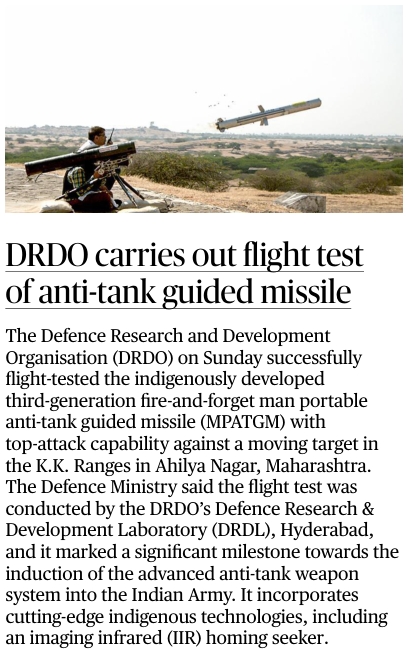
The Defence Research and Development Organisation (DRDO) successfully flight-tested an indigenously developed third-generation man-portable anti-tank guided missile (MPATGM) in Maharashtra, marking a key step towards strengthening India’s indigenous defence capability. Key PointsAbout the Missile TestMissile Type: Third-generation, fire-and-forget man-portable anti-tank guided missile.Capability: Successfully demonstrated top-attack mode against a moving target.Test Location: K.K. Ranges, Ahilya Nagar, Maharashtra.Conducted by: DRDO’s Defence Research & Development Laboratory (DRDL), Hyderabad. Technological FeaturesFire-and-forget system: No post-launch guidance required by the operator.Top-attack capability: Targets the weaker top armour of modern tanks.Imaging Infrared (IIR) Seeker: Ensures high accuracy and all-weather, day-night operation.Indigenous content: Incorporates cutting-edge, home-grown defence technologies. Strategic SignificanceBoost to Army capability: Enhances infantry’s ability to neutralise modern armoured threats.Induction readiness: Marks a milestone towards induction into the Indian Army.Atmanirbhar Bharat: Strengthens self-reliance in critical defence systems. Additional Information: Defence Research and Development Organisation (DRDO)DRDO is India’s premier defence R&D agency under the Ministry of Defence.It is responsible for developing advanced technologies and systems for the Armed Forces. UPSC Prelims Practice QuestionQuestion:With reference to the anti-tank guided missile recently tested by DRDO, consider the following statements:1.It is a third-generation fire-and-forget missile with top-attack capability.2.It uses an imaging infrared (IIR) homing seeker for target acquisition.Which of the statements given above is/are correct?
(a) 1 only
(b) 2 only
(c) Both 1 and 2
(d) Neither 1 nor 2
Answer: (c)Explanation:
The tested missile is a third-generation fire-and-forget MPATGM with top-attack capability and incorporates an imaging infrared (IIR) homing seeker, making both statements correct. Source: The Hindu
Retail inflation at 3-month high of 1.33% in December 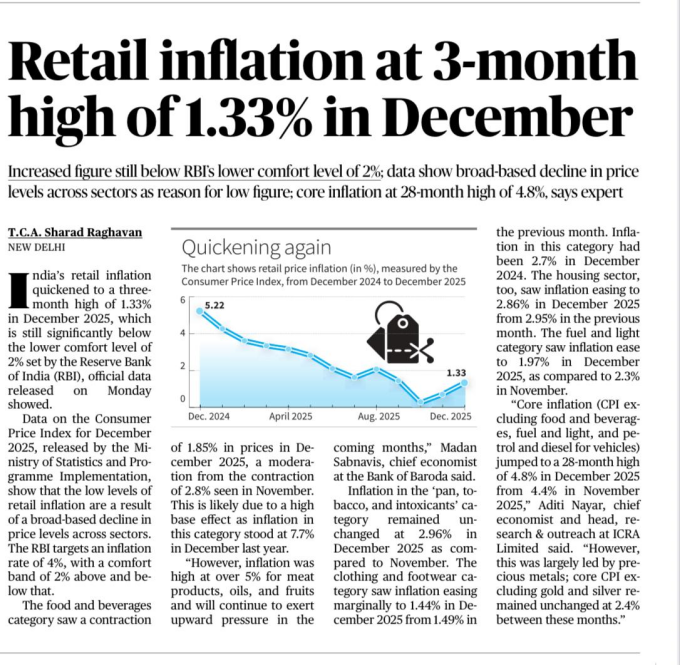
Context
India’s retail inflation, measured by the Consumer Price Index (CPI), rose to a three-month high of 1.33% in December 2025, though it remains below the RBI’s lower comfort level of 2%, indicating continued price stability. Key PointsOverall Inflation TrendRetail inflation (CPI): Increased to 1.33% in December 2025.RBI framework: Target inflation is 4%, with a tolerance band of 2%–6%.The current level remains well below the lower threshold, reflecting subdued price pressures. Reasons for Low InflationBroad-based decline in prices across multiple sectors.High base effect, especially in food prices, compared to December 2024 levels. Food and BeveragesPrices saw a contraction of 1.85% in December 2025.This followed a 2.8% contraction in November, largely due to base effects.However, meat products, oils, and fruits continued to show inflation above 5%, posing upward risks. Housing, Fuel, and LightHousing inflation: Eased to 2.86% from 2.95% in the previous month.Fuel and light inflation: Declined to 1.97% from 2.3% in November. Core InflationCore inflation (excluding food, beverages, fuel, and light): Rose to a 28-month high of 4.8%.The rise was mainly driven by precious metals prices.Core CPI excluding gold and silver remained unchanged at 2.4%. UPSC Prelims Practice QuestionWith reference to retail inflation in India, consider the following statements:1.Retail inflation is measured using the Consumer Price Index and is released by the Ministry of Statistics and Programme Implementation.2.The Reserve Bank of India targets CPI inflation at 4% with a tolerance band of ±2%.Which of the statements given above is/are correct?(a) 1 only
(b) 2 only
(c) Both 1 and 2
(d) Neither 1 nor 2
Answer: (c)Explanation:
Retail inflation in India is measured through the CPI released by MoSPI, and the RBI follows an inflation targeting framework of 4% with a tolerance band of ±2%, making both statements correct. Source: The Hindu
Syllabus: GS 3 – Environment and Ecology / Renewable Energy Context
India delivered its national statement at the 16th Assembly of the International Renewable Energy Agency (IRENA) held in Abu Dhabi, highlighting its commitment to global renewable energy cooperation.
Key PointsNature and purpose
1. India is a founding member of the International Renewable Energy Agency.2. The Council of IRENA is the supreme decision-making authority of the organisation.Which of the statements given above is/are correct?a) 1 only
b) 2 onlyThe Union Ministry of Agriculture has proposed to merge three ongoing schemes with the flagship Pradhan Mantri–Rashtriya Krishi Vikas Yojana (PM-RKVY) to improve convergence, efficiency, and outcomes in the agriculture sector.
Key PointsAbout PM-RKVY
1. PM-RKVY is a Centrally Sponsored Scheme implemented by State governments.2. Under PM-RKVY, Union Territories receive funding in a 90:10 Centre-State ratio.Which of the statements given above is/are correct?a) 1 only
b) 2 only Launch your Graphy