There are no items in your cart
Add More
Add More
| Item Details | Price | ||
|---|---|---|---|


| Index | ||
| S.No | Topic | |
| Daily Hindu Analysis | ||
| 1. | ISRO and the next big challenge | |
| 2. | GSDP share as criterion for central-State transfers | |
| 3. | UN body pegs India’s growth at 7.2% this fiscal | |
| 4. | Madhav Gadgil’s enduring legacy in the Nilgiris Biosphere Reserve | |
| Daily Current Affairs | ||
| 5. | PANKHUDI Portal | |
| 6. | Child marriage and India | |
| 7. | India–AI Impact Summit | |
| 8. | M-STrIPES | |
| 9. | Asha Van: Mobile Cancer Screening Unit Inaugurated in Gujarat | |
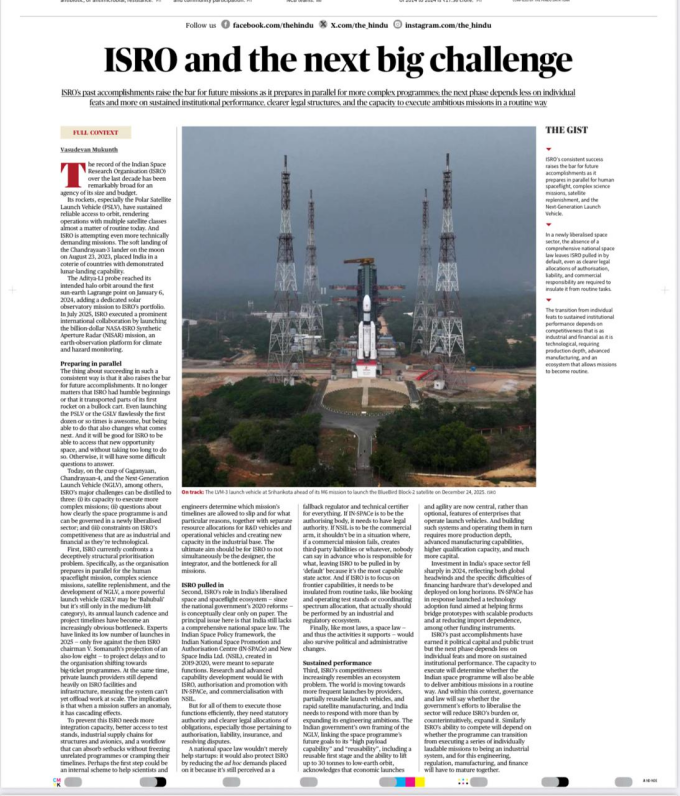
Context:
The author analyses how ISRO’s recent landmark successes have raised expectations and argues that India’s next phase in space exploration will depend less on one-off achievements and more on sustained institutional capacity, legal clarity, and routine execution of complex missions. From exceptional feats to higher expectations
ISRO’s success has created a new benchmark where excellence is expected, not celebrated as an exception. The next big challenge lies in transforming India’s space programme from a hero-driven model to a resilient, industrial, and legally grounded ecosystem capable of executing ambitious missions routinely and reliably.
UPSC Mains Practice Question
“India’s future space ambitions depend more on institutional and legal reforms than on technological breakthroughs.”
Discuss this statement in the context of ISRO’s evolving role and India’s space sector liberalisation.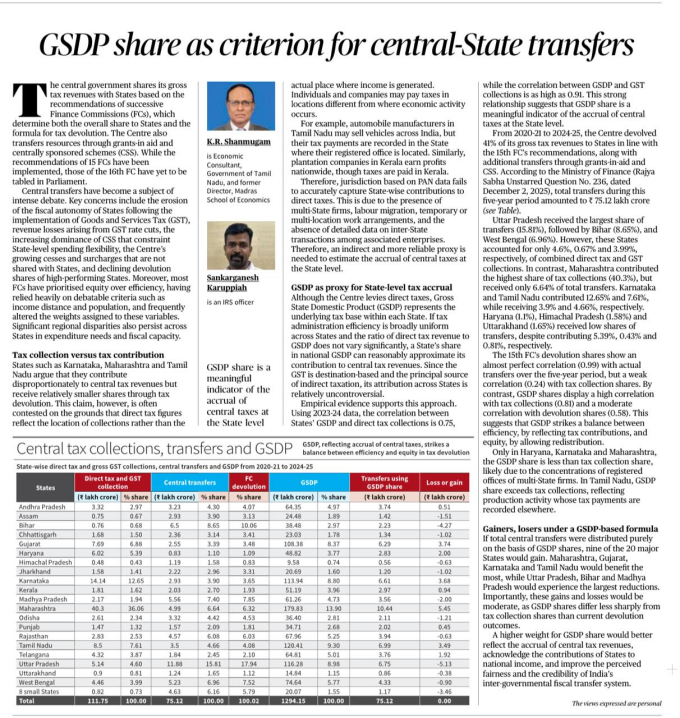
Context:
The author analyses how ISRO’s recent landmark successes have raised expectations and argues that India’s next phase in space exploration will depend less on one-off achievements and more on sustained institutional capacity, legal clarity, and routine execution of complex missions. From exceptional feats to higher expectations· Over the last decade, ISRO has achieved remarkable success despite limited budgets.
· Reliable PSLV launches, the Chandrayaan-3 soft landing, Aditya-L1 at the Sun–Earth L1 point, and the NISAR mission mark India’s growing space maturity.
· These accomplishments have shifted ISRO from proving capability to sustaining excellence.
Preparing in parallel for complex missions· ISRO is simultaneously working on Gaganyaan, Chandrayaan-4, Next Generation Launch Vehicle (NGLV), space station modules, and satellite replenishment.
· This “parallel preparation” creates strain on infrastructure, human resources, and launch cadence.
· Increasing launch frequency exposes structural bottlenecks rather than isolated technical failures.
Structural and institutional constraints· ISRO remains both designer, integrator, and operator, making it the default solution when missions face delays.
· Heavy dependence on ISRO-owned infrastructure limits scalability.
· Human spaceflight and advanced missions demand deeper redundancy, testing capacity, and supply-chain resilience.
Liberalisation and the missing legal backbone· Space sector reforms since 2020 aimed to separate roles among ISRO, IN-SPACe, and NSIL.
· However, the absence of a comprehensive national space law creates uncertainty around:
o Licensing and authorisation
o Liability and insurance
o Commercial responsibility and dispute resolution
o Without legal clarity, private players remain hesitant to invest at scale.
Transition to an industrial space ecosystem· Globally, space activities are moving towards industrial-scale, routine operations.
· India must enable industry to handle tasks like satellite manufacturing, spectrum-related services, and launch logistics.
· ISRO should increasingly focus on frontier research and innovation, not routine execution.
Sustained performance as the real challenge· The future challenge is not technological ambition but institutional endurance.
· Routine, repeatable missions require:
· Advanced manufacturing
· Skilled manpower
· Stable financing
· Predictable regulation
· Only then can ambitious missions become standard practice rather than exceptional events.
.UPSC Mains Practice Question“India’s future space ambitions depend more on institutional and legal reforms than on technological breakthroughs.”
Discuss this statement in the context of ISRO’s evolving role and India’s space sector liberalisation.
Context:
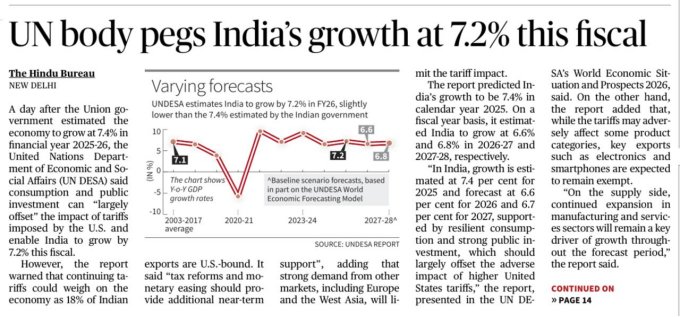
The United Nations Department of Economic and Social Affairs (UN DESA) has projected India’s economic growth at 7.2% in FY 2025–26, a day after the Government of India pegged growth at 7.4%, citing resilience in consumption and public investment.
Key Points
UN Growth Projection· India’s GDP growth is projected at 7.2% in FY26 by the UN Department of Economic and Social Affairs (UNDESA).
· Slightly lower than the Government of India’s estimate of 7.4%.
Drivers of Growth· Strong private consumption and public investment expected to offset the impact of external shocks.
· Continued expansion in manufacturing and services sectors identified as key growth engines.
Tariff-Related Concerns· UNDESA cautioned that prolonged U.S. tariffs could weigh on growth, as around 18% of India’s exports are U.S.-bound.
· However, demand from Europe and West Asia may provide partial cushioning.
Medium-Term Outlook· Growth projected at 6.6% in FY27 and 6.8% in FY28.
· Calendar year 2025 growth estimated at 7.4%.
UN Department of Economic and Social Affairs (UN DESA)· Established in 1948; Headquarters: New York.
· Part of the United Nations Secretariat, upholding the development pillar of the UN.
· Acts as the Secretariat for the Sustainable Development Goals (SDGs).
· Supports UN General Assembly and ECOSOC deliberations.
· Provides evidence-based policy advice and capacity-building to close the SDG financing gap.
· Formerly known as UN Department of International Economic and Social Affairs (DIESA); reorganised in 1997.
UPSC Prelims Practice Question
With reference to the UN Department of Economic and Social Affairs (UN DESA), consider the following statements:
1. UN DESA is part of the United Nations Secretariat and supports the work of ECOSOC.
2. UN DESA functions as the Secretariat for the Sustainable Development Goals.Which of the statements given above is/are correct?
(a) 1 only
(b) 2 onlyCorrect Answer: (c)
Context:
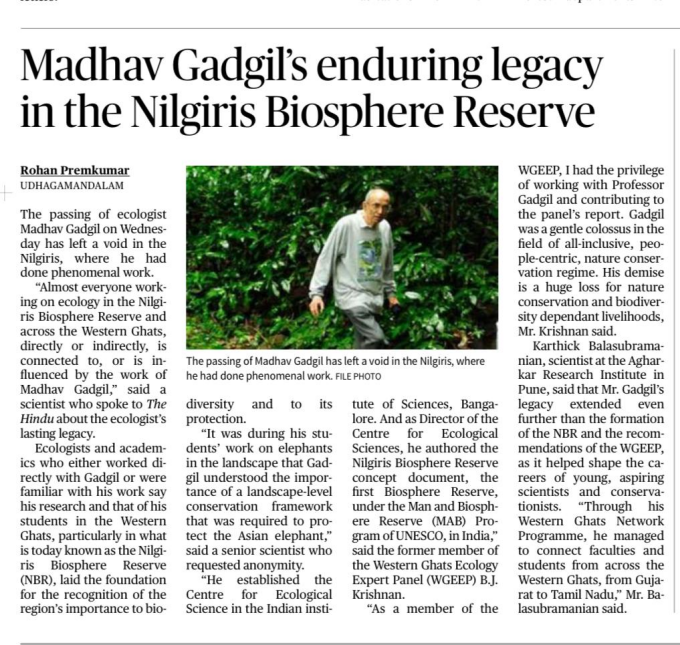
The passing of renowned ecologist Madhav Gadgil has drawn attention to his seminal contributions to ecology and conservation in the Nilgiris and the Western Ghats, particularly his role in shaping the Nilgiris Biosphere Reserve.Key Points
Contribution to Nilgiris Biosphere Reserve (NBR)·
Madhav Gadgil played a foundational role in conceptualising and authoring the Nilgiris Biosphere Reserve document.
An international programme aimed at promoting sustainable development through biosphere reserves.
Q. Consider the following statements regarding the Nilgiris Biosphere Reserve:1.It was the first Biosphere Reserve established in India under UNESCO’s Man and Biosphere Programme.2.Its conservation framework was based on landscape-level and people-centric approaches.Which of the statements given above is/are correct?
(a) 1 onlyAnswer: (c) Explanation:
Statement 1 is correct as the Nilgiris Biosphere Reserve was India’s first biosphere reserve under UNESCO’s MAB Programme.
Statement 2 is correct because Madhav Gadgil emphasised landscape-level and inclusive conservation approaches in the region.
Syllabus: GS Paper 2 – Government Policies and Interventions
Subject: Government Scheme
Context:
The Union Minister launched PANKHUDI, an integrated digital portal, to improve ease of living for women and children by streamlining CSR partnerships and stakeholder collaboration across social sectors.
Key Points:
What is PANKHUDI:
PANKHUDI is a single-window integrated digital platform designed to facilitate CSR and voluntary partnerships for women and child development with transparent monitoring. Nodal Ministry:
Ministry of Women and Child Development Objective:
To enhance coordination, transparency, and structured participation among government, NGOs, corporates, citizens, and NRIs for better service delivery. Unified CSR Interface:
Provides a common platform for individuals, NRIs, NGOs, corporates, and government agencies to participate in development initiatives. Priority Focus Areas:
Nutrition, health, Early Childhood Care and Education (ECCE), child welfare and protection, and women’s safety and empowerment. Support to Flagship Missions:
Strengthens implementation of Mission Saksham Anganwadi & Poshan 2.0, Mission Vatsalya, and Mission Shakti through digital workflows. Transparency and Accountability:
Enables online registration, proposal submission, approvals, and real-time tracking with non-cash contributions only for traceability.
Scale of Impact:
Supports infrastructure and services across 14+ lakh Anganwadi Centres, about 5,000 Child Care Institutions, 800 One Stop Centres, 500 Shakhi Niwas, and 400 Shakti Sadan.
UPSC Prelims Practice Question
Consider the following statements regarding the PANKHUDI portal:1. It is an integrated digital platform launched by the Ministry of Women and Child Development.2. It allows both cash and non-cash CSR contributions for women and child development programmes.Which of the statements given above is/are correct?
(a) 1 onlyAnswer: (a)Explanation:
Statement 1 is correct as PANKHUDI is launched by the Ministry of Women and Child Development.
Statement 2 is incorrect because the portal allows only non-cash contributions to ensure transparency and traceability. Source: DD News
Syllabus: GS 2 – Social Justice (Women and Child Issues)
Context
The Government of India has intensified efforts to end child marriage through the Bal Vivah Mukt Bharat (BVMB) campaign, targeting a 10% reduction by 2026 and complete elimination by 2030 in line with SDG 5.3. Key Points
Meaning of Child Marriage
Child marriage refers to any marital union where the female is below 18 years or the male is below 21 years of age.
Historical Evolution of Child Marriage Laws in India1. Social reform movements in the 19th century led by Raja Rammohan Roy, Ishwar Chandra Vidyasagar, and Jyotirao Phule highlighted the issue.
2. Age of Consent Act, 1891 was the first legal step to address early marriage.
3. Child Marriage Restraint Act (Sarda Act), 1929 fixed the minimum age at 14 for girls and 18 for boys.
4. Amendments in 1948 and 1978 raised the age to 18 for girls and 21 for boys.
5. Prohibition of Child Marriage Act (PCMA), 2006 shifted focus from restraint to prohibition, protection, and punishment.
Present Legal Framework
1. Prohibition of Child Marriage Act, 2006 declares child marriages voidable and void in cases involving force, trafficking, or deceit and provides for Child Marriage Prohibition Officers.
1. Reduce child marriage prevalence by 10% by 2026.
UPSC Prelims Practice Question
Consider the following legislations:1. Prohibition of Child Marriage Act, 20062. Protection of Children from Sexual Offences (POCSO) Act, 20123. Bharatiya Nyaya Sanhita, 2023Which of the above deal(s) with issues related to child marriage in India?
(a) 1 onlyAnswer: (c) Explanation:
The Prohibition of Child Marriage Act, 2006 directly addresses child marriage.
The POCSO Act, 2012 criminalises sexual activity with minors, including within child marriages.
The Bharatiya Nyaya Sanhita, 2023 treats sexual relations with a wife below 18 years as an offence, thereby addressing child marriage indirectly.
Syllabus: GS Paper 2 – International Relations / GS Paper 3 – Science and Technology
Subject: Artificial Intelligence and Global Governance
Context:
India has announced the India–AI Impact Summit 2026, scheduled for 19–20 February 2026 in New Delhi, marking the first-ever global AI summit hosted in the Global South.
Key Points:
What is the India–AI Impact Summit:
A high-level multilateral global forum on Artificial Intelligence, announced by the Prime Minister at the France AI Action Summit, focusing on responsible and inclusive AI. Global South Leadership:
First global AI summit hosted in a developing country, aiming to amplify Global South voices in global AI governance and norm-setting. Strategic Objective:
To promote development-oriented, inclusive, and human-centric AI, rather than dominance-driven or purely commercial AI models. Multilateral Continuity:
Builds upon existing global frameworks such as G20 AI Principles, UN resolutions, Global Partnership on AI (GPAI), African Declaration on AI, and the Hamburg Declaration on Responsible AI. Three Sutras Framework:· People: Emphasises human-centric, inclusive, ethical, and culturally sensitive AI.· Planet: Focuses on climate-aligned, sustainable AI with reduced energy and environmental footprint.· Progress: Promotes AI-led equitable growth in health, education, agriculture, governance, and public services. Outcome-Oriented Approach:
Moves beyond declarations to concrete deliverables, cooperative mechanisms, and implementation frameworks. Geopolitical Significance:
Addresses concerns such as job displacement, algorithmic bias, digital inequality, and energy-intensive AI models in a shifting global power order. UPSC Prelims Practice QuestionConsider the following statements regarding the India–AI Impact Summit:1. It will be the first global Artificial Intelligence summit hosted in the Global South.2. The summit focuses only on AI regulation and excludes developmental applications of AI.Which of the statements given above is/are correct?
(a) 1 only
(b) 2 only
(c) Both 1 and 2
(d) Neither 1 nor 2
Answer: (a)Explanation:
Statement 1 is correct as India–AI Impact Summit 2026 is the first global AI summit hosted in the Global South.
Statement 2 is incorrect because the summit explicitly focuses on development-oriented applications of AI across sectors like health, education, agriculture, and governance.
Source: The Hindu
Syllabus: GS 3 – Environment and Ecology (Biodiversity Conservation) Context
Consider the following statements regarding M-STrIPES:
1. It is a monitoring system launched by the National Tiger Conservation Authority for tiger conservation.
2. It relies only on satellite imagery and does not involve field-level data collection by forest staff.Which of the statements given above is correct?
a) 1 onlyAnswer: a Explanation:
Syllabus: GS Paper 2 – Governance, Social Justice and Health
Subject: Public Health and Preventive Healthcare
Context:
Gujarat Chief Minister Bhupendra Patel inaugurated Asha Van, a mobile cancer screening unit, in Gandhinagar to strengthen early detection of cancer, particularly in rural and underserved areas of the State.
Key Points:
What is Asha Van:
Asha Van is a mobile cancer screening and diagnostic unit designed to provide on-the-spot early detection services for multiple cancers. Advanced Diagnostic Facilities:
The unit is equipped with EVA-Pro diagnostics, a mammography unit, and teleconsultation facilities for expert medical advice. Range of Diseases Screened:
It can screen for lung, oral, blood, cervical, pancreatic, liver, breast, and prostate cancers, enabling early diagnosis and timely treatment. Focus on Rural and Underserved Areas:
The mobile unit can operate at any location, expanding access to specialised cancer screening beyond urban hospitals. Preventive Healthcare Approach:
Early detection through Asha Van aims to reduce cancer mortality, improve recovery outcomes, and promote preventive medicine. Alignment with National Health Vision:
The initiative supports the vision of Health and Wellness for All, with emphasis on community-based and outreach healthcare. Indian Red Cross Society:
The mobile unit has been handed over to the Indian Red Cross Society, Bhavnagar branch, for public service and statewide deployment. UPSC Prelims Practice QuestionConsider the following statements regarding Asha Van:1. Asha Van is a mobile unit designed for early detection of multiple types of cancer.2. The initiative is implemented through the Indian Red Cross Society for public health outreach.Which of the statements given above is/are correct?
(a) 1 only
(b) 2 only
(c) Both 1 and 2
(d) Neither 1 nor 2Answer: (c)Explanation:
Statement 1 is correct as Asha Van is a mobile cancer screening unit capable of detecting multiple cancers.
Statement 2 is correct as the unit has been handed over to the Indian Red Cross Society for public service. Source: The Hindu
 Launch your Graphy