Daily Current Affairs Analysis 31st Jan 2026



S.No | Topic | Page No |
Daily Hindu Analysis (YouTube) |
1. | Green steel can shape India’s climate goals trajectory |
|
2. | UGC equity rules flow from Article 15’s mandate to remedy historical injustice |
|
3. | Menstrual health in schools is integral to right to life: SC |
|
4. | UIDAI launches new Aadhaar app for secure age verification |
|
5. | High tap coverage under Jal Jeevan scheme, but lower usage, reliability |
|
6. | Stem cell therapy cannot be offered as a clinical service for autism: Supreme Court |
|
Green steel can shape India’s climate goals trajectory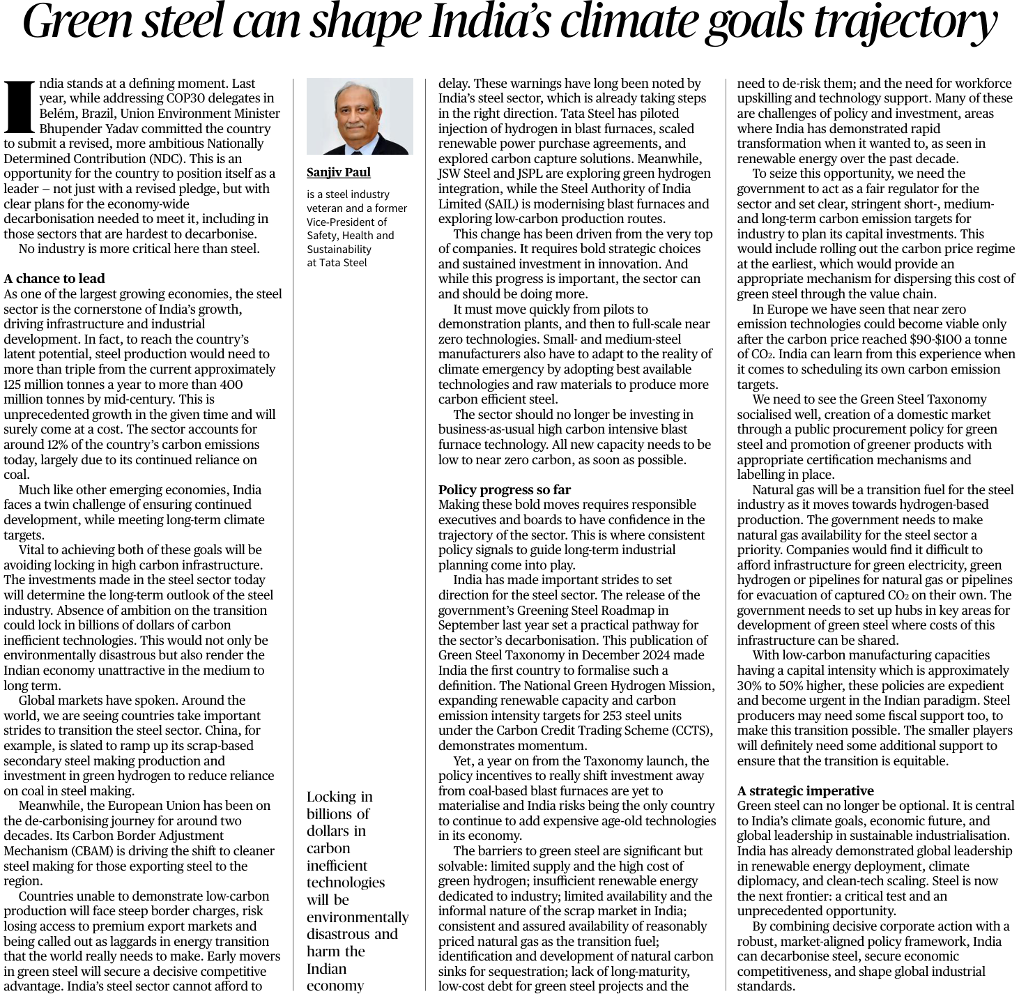
GS 3: Environment & Ecology – Climate Change, Industrial Policy, Sustainable Development
Context
The article discusses how India’s steel sector, one of the hardest-to-abate industries, is central to achieving the country’s revised and more ambitious climate commitments under its Nationally Determined Contribution (NDC), and how a transition to green steel can redefine India’s economic and climate trajectory.
Detailed Analysis
Steel sector at the core of India’s growth and emissions
Steel is the backbone of infrastructure and industrialisation in a fast-growing economy like India.
India’s steel production must rise from about 125 million tonnes to over 400 million tonnes by mid-century to meet development needs.
The sector contributes around 12% of India’s total carbon emissions, largely due to coal-based blast furnace technology.
Development–climate twin challenge
India must balance rapid economic growth with long-term decarbonisation goals.
Investments made today will determine whether India gets locked into high-carbon infrastructure or transitions to low-carbon pathways.
Lock-in of carbon-intensive technologies would be environmentally damaging and economically inefficient in the long run.
Global transition and competitive pressures
Major economies are already shifting:
China is expanding scrap-based secondary steel and green hydrogen use.
Countries unable to demonstrate low-carbon steel production risk losing access to premium export markets.
Early movers in green steel will gain long-term competitive advantage.
Technological pathways for green steel
Adoption of green hydrogen, renewable electricity, carbon capture, and energy-efficient processes is key.
Indian firms such as Tata Steel, JSW Steel, JSPL, and SAIL are piloting:
Hydrogen injection in blast furnaces
Renewable power purchase agreements
Low-carbon production routes
The sector must move quickly from pilot projects to full-scale deployment.
Need to avoid business-as-usual expansion
Continued investment in coal-based blast furnace technology will delay decarbonisation.
All new steel capacity must be low- or near-zero carbon as early as possible.
Small and medium steel producers also need access to best available technologies to remain viable.
Policy progress so far
Government initiatives include:
Greening Steel Roadmap
Green Steel Taxonomy (December 2024), making India the first country to formalise such a definition
National Green Hydrogen Mission
Carbon intensity targets for steel units under the Carbon Credit Trading Scheme (CCTS)
These steps provide direction but investment-shifting incentives remain insufficient.
Key barriers to green steel transition
High cost and limited supply of green hydrogen
Insufficient renewable energy dedicated to industry
Informal and fragmented scrap steel market
Lack of mature carbon markets and pricing signals
Capital-intensive nature of low-carbon steel, with 30–50% higher upfront costs
Role of the government
Act as a fair but firm regulator, providing:
Clear short-, medium-, and long-term emission targets
Early rollout of carbon pricing mechanisms
Promote green steel through:
Public procurement policies
Certification and labelling standards
Development of green steel hubs with shared infrastructure
Facilitate availability of natural gas as a transition fuel and pipelines for CO₂ transport.
Learning from global experience
In Europe, near-zero emission steel technologies became viable only after carbon prices reached $90–100 per tonne of CO₂.
India can draw lessons while designing context-specific carbon pricing and timelines.
Strategic and economic imperative
Green steel is not optional; it is essential for:
Meeting India’s climate goals
Ensuring long-term industrial competitiveness
Positioning India as a global leader in sustainable industrialisation
Steel is the next frontier after renewable energy in India’s climate leadership journey.
Suggestions of the Author
Accelerate the shift from pilots to commercial-scale green steel technologies.
Ensure strong, credible policy signals to guide private investment.
Socialise the Green Steel Taxonomy and create domestic demand through procurement.
Provide fiscal and technological support, especially to smaller producers, to ensure a just transition.
UPSC Mains Practice Question
“The steel sector is central to India’s development as well as its decarbonisation challenge.”
Discuss how the transition to green steel can help India achieve its climate commitments without compromising economic growth.
Source: The Hindu
UGC equity rules flow from Article 15’s mandate to remedy historical injustice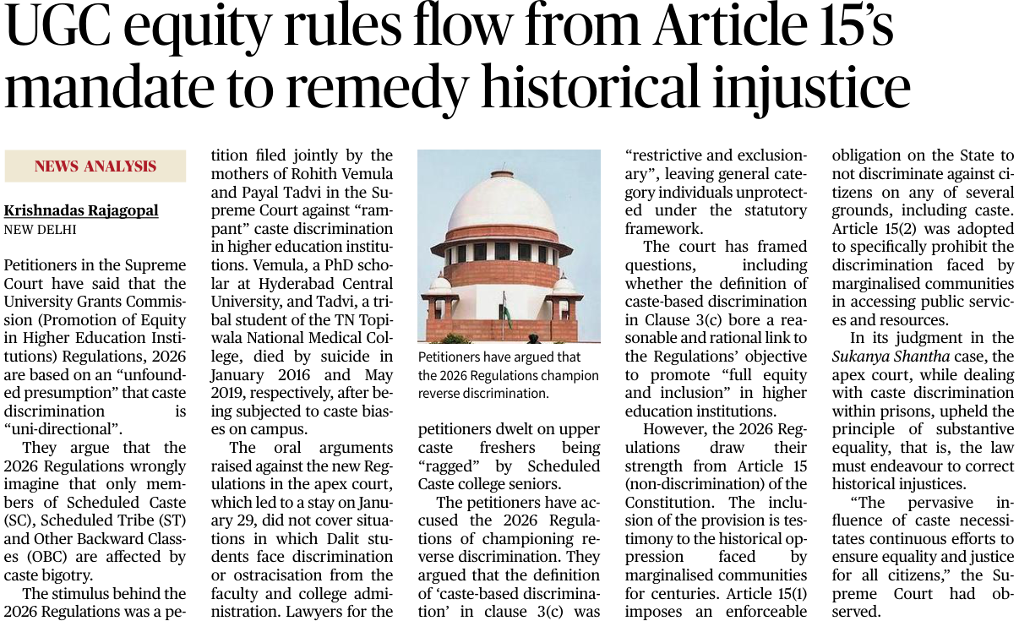
GS 2: Polity and Governance – Constitutional Provisions, Education, Social Justice
Context
The article analyses the constitutional basis of the UGC (Promotion of Equity in Higher Education Institutions) Regulations, 2026, which are under judicial scrutiny in the Supreme Court, focusing on whether they align with Article 15 and the idea of substantive equality.
Key Points
Background of the Case
Petitions were filed in the Supreme Court challenging the UGC Equity Regulations, 2026.
Petitioners argue that the regulations presume caste discrimination to be unidirectional, affecting only SC, ST, and OBC students.
The challenge arose in the context of caste discrimination cases linked to Rohith Vemula and Payal Tadvi, which highlighted systemic bias in higher education institutions.
What the UGC Equity Regulations, 2026 Provide
The regulations aim to promote full equity and inclusion in higher education institutions.
They define caste-based discrimination and mandate institutional mechanisms to prevent and redress it.
The objective is to address long-standing exclusion and unequal access faced by marginalised communities.
Petitioners’ Arguments
The regulations are claimed to be restrictive and exclusionary, allegedly leaving general category students unprotected.
Petitioners argue that discrimination can occur across caste lines, including against upper-caste students.
They allege that the definition of caste discrimination in Clause 3(c) promotes reverse discrimination.
Constitutional Basis: Article 15
Article 15(1) imposes an obligation on the State not to discriminate on grounds including caste.
Article 15(2) specifically prohibits discrimination in access to public places and resources.
The regulations draw legitimacy from Article 15, which recognises caste as a historical and structural source of inequality.
Substantive Equality vs Formal Equality
The article highlights that the Constitution adopts substantive equality, not mere formal equality.
Substantive equality allows the State to take corrective measures to remedy historical injustice.
Treating unequal groups equally would perpetuate injustice rather than remove it.
Supreme Court’s Jurisprudence
In the Sukanya Shantha case, the Supreme Court upheld the principle that laws must correct historical discrimination, not just prevent future discrimination.
The Court has consistently held that caste discrimination is systemic and pervasive, requiring targeted interventions.
Equality under the Constitution demands continuous efforts to protect marginalised communities.
Why the Regulations Are Constitutionally Defensible
The UGC regulations operationalise Article 15’s mandate by addressing real and documented caste-based exclusion.
They are designed to remedy institutional and structural discrimination, not individual grievances alone.
The claim of reverse discrimination ignores the asymmetry of power and privilege embedded in caste hierarchies.
Broader Implications for Higher Education
Universities are not caste-neutral spaces; social hierarchies often shape academic life.
Equity regulations are necessary to ensure dignity, access, and equal opportunity for all students.
Without such measures, constitutional promises of equality remain illusory.
UPSC Prelims Practice Question
Consider the following statements regarding Article 15 of the Indian Constitution:
1.Article 15 permits the State to take special measures to address historical discrimination based on caste.
2.Article 15 mandates only formal equality and does not support corrective or substantive equality measures.
Which of the statements given above is/are correct?
(a) 1 only
(b) 2 only
(c) Both 1 and 2
(d) Neither 1 nor 2
Correct Answer: (a)
Explanation:
Article 15 embodies the principle of substantive equality and empowers the State to take corrective measures to remedy historical caste-based injustice. Statement 2 is incorrect.
Source: The Hindu
Menstrual health in schools is integral to right to life: SC
GS 2: Polity and Governance – Fundamental Rights, Judiciary, Social Justice
Context
The Supreme Court has ruled that access to menstrual health and menstrual hygiene management (MHM) in schools is an essential part of the right to life and dignity under Article 21, responding to a writ petition highlighting gaps in MHM facilities across schools in India.
Key Points
Supreme Court’s Ruling
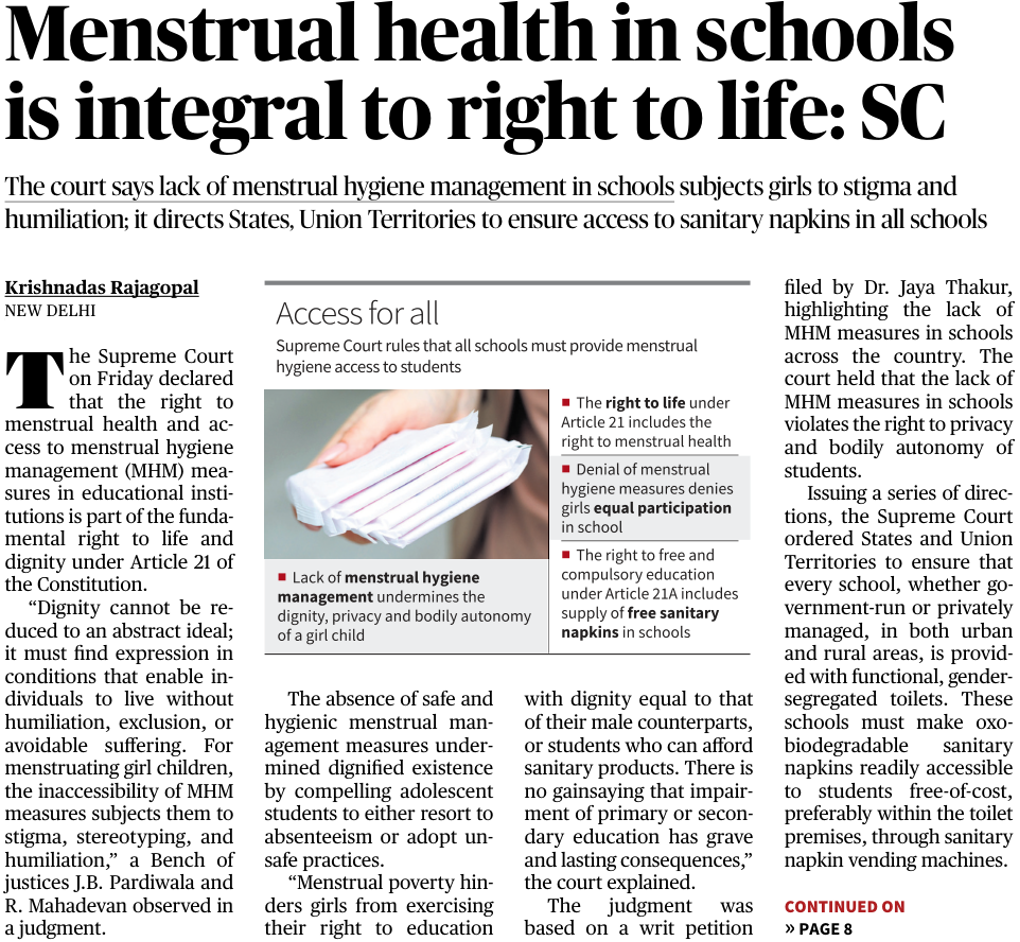
The Court held that menstrual health is an integral component of the right to life and dignity under Article 21.
Lack of menstrual hygiene facilities subjects girls to stigma, humiliation, exclusion, and avoidable suffering.
Denial of MHM measures violates privacy and bodily autonomy of girl students.
Impact of Inadequate MHM in Schools
Absence of safe and hygienic facilities forces girls to resort to unsafe practices or absenteeism.
Menstrual poverty restricts equal participation in education, undermining the right to education.
The Court noted that dignity cannot remain an abstract idea and must be reflected in real conditions of living.
Link with Equality and Education
Denial of menstrual hygiene denies girls equal participation in school life compared to boys or students who can afford sanitary products.
The right to free and compulsory education under Article 21A includes access to basic facilities necessary for attendance and participation.
Impairment of education due to lack of MHM has grave and lasting consequences.
Directions Issued by the Supreme Court
States and Union Territories must ensure all schools, government and private, provide MHM facilities.
Schools must have functional, gender-segregated toilets in both urban and rural areas.
Free sanitary napkins, preferably biodegradable, must be made easily accessible to students.
Napkins should be available within toilet premises, including through vending machines.
Constitutional and Rights-Based Framework
Article 21: Right to life includes dignity, privacy, bodily autonomy, and menstrual health.
Article 21A: Right to education requires enabling conditions for attendance and participation.
The judgment reinforces a gender-sensitive interpretation of fundamental rights.
Wider Social Significance
Recognises menstruation as a public health, education, and human rights issue, not merely a personal matter.
Addresses entrenched social stigma and stereotypes around menstruation.
Places accountability on the State to ensure substantive equality for girl children.
UPSC Prelims Practice Question
Consider the following statements regarding the Supreme Court’s ruling on menstrual health in schools:
1.The Supreme Court held that access to menstrual hygiene management in schools forms part of the right to life under Article 21.
2.The Court directed that only government-run schools are required to provide free sanitary napkins to students.
Which of the statements given above is/are correct?
(a) 1 only
(b) 2 only
(c) Both 1 and 2
(d) Neither 1 nor 2
Correct Answer: (a)
Explanation:
Statement 1 is correct as the Court explicitly linked menstrual health to Article 21. Statement 2 is incorrect because the directions apply to all schools, both government and private.
Source: The Hindu
UIDAI launches new Aadhaar app for secure age verification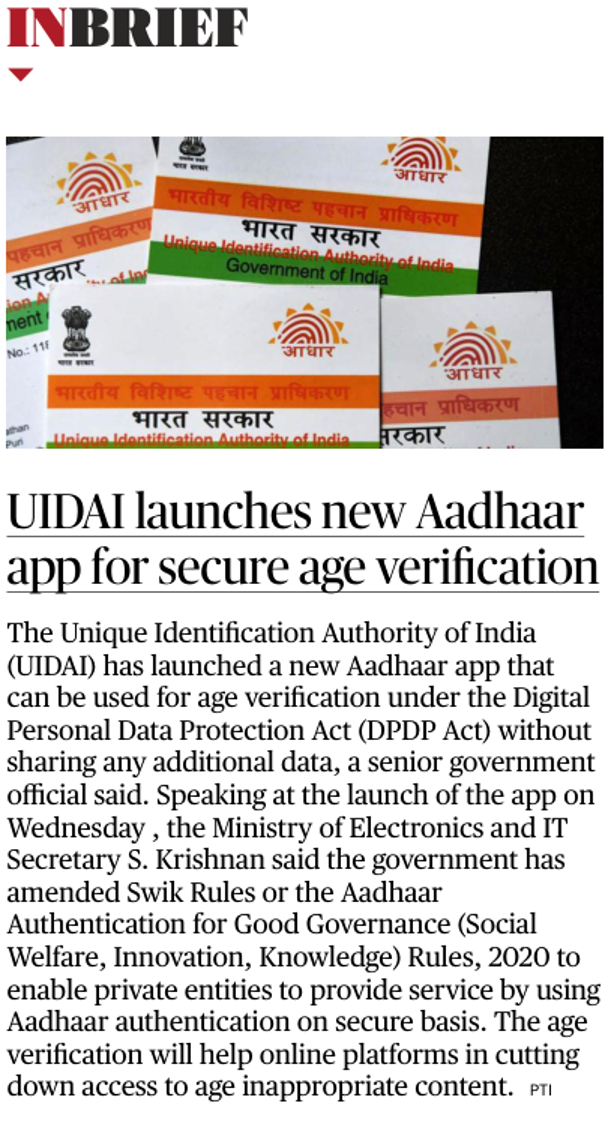
GS 2: Governance – E-governance, Data Protection, Digital Public Infrastructure
Context
The Unique Identification Authority of India has launched a new Aadhaar app to enable secure age verification under the Digital Personal Data Protection Act, without sharing additional personal data, to curb access to age-inappropriate online content.
Key Points
Background of the Initiative
UIDAI launched a new Aadhaar-based age verification app.
The app allows age verification without revealing full Aadhaar details or other personal data.
It aligns with the Digital Personal Data Protection (DPDP) Act framework.
Purpose of the New Aadhaar App
To enable privacy-preserving age verification.
To help online platforms restrict access to age-inappropriate content.
To strengthen trust-based digital authentication mechanisms.
Legal and Regulatory Changes
The government amended the Aadhaar Authentication for Good Governance (Social Welfare, Innovation, Knowledge) Rules, 2020.
Amendments allow private entities to use Aadhaar authentication on a secure and regulated basis.
Ensures Aadhaar use remains purpose-limited and consent-based.
Significance for Digital Governance
Balances data protection with ease of digital service delivery.
Supports India’s Digital Public Infrastructure (DPI) ecosystem.
Reduces risks of data misuse and excessive data sharing.
Benefits of Aadhaar-based Age Verification
Prevents minors from accessing age-restricted digital platforms.
Minimises collection of sensitive personal information.
Enhances compliance with child protection and data privacy norms.
Broader Policy Implications
Reinforces Aadhaar as a trusted digital identity platform.
Demonstrates convergence of DPDP Act and Aadhaar Act objectives.
Encourages responsible participation of private players in digital services.
Unique Identification Authority of India (UIDAI)
Statutory authority under the Aadhaar Act, 2016.
Functions under the Ministry of Electronics and Information Technology.
Responsible for Aadhaar enrolment, authentication, and lifecycle management.
Headed by a Chairperson, with Members and a CEO as Member-Secretary.
Issues 12-digit Aadhaar numbers based on minimal demographic and biometric data.
UPSC Prelims Practice Question
Q. Consider the following statements regarding the new Aadhaar age verification app:
1.It enables age verification without sharing additional personal data.
2.Its launch is aligned with amendments to the Aadhaar Authentication for Good Governance Rules, 2020.
3.It allows unrestricted use of Aadhaar authentication by private entities without consent.
Which of the statements given above are correct?
(a) 1 and 2 only
(b) 2 and 3 only
(c) 1 and 3 only
(d) 1, 2 and 3
Correct Answer: (a)
Explanation:
Statements 1 and 2 are correct. Statement 3 is incorrect because Aadhaar authentication by private entities remains regulated, consent-based, and purpose-specific.
Source: The Hindu
High tap coverage under Jal Jeevan scheme, but lower usage, reliability
GS 2: Governance – Social Sector Policies, Water Supply and Sanitation
Context
A periodic Functionality Assessment of Household Tap Connections (2024) commissioned by the Jal Shakti Ministry shows that while tap coverage under the Jal Jeevan Mission is very high, actual usage, regularity, and reliability of water supply remain lower.
Key Points
Jal Jeevan Mission Coverage
Nearly 98% of rural households now have tap connections under the Har Ghar Jal scheme.
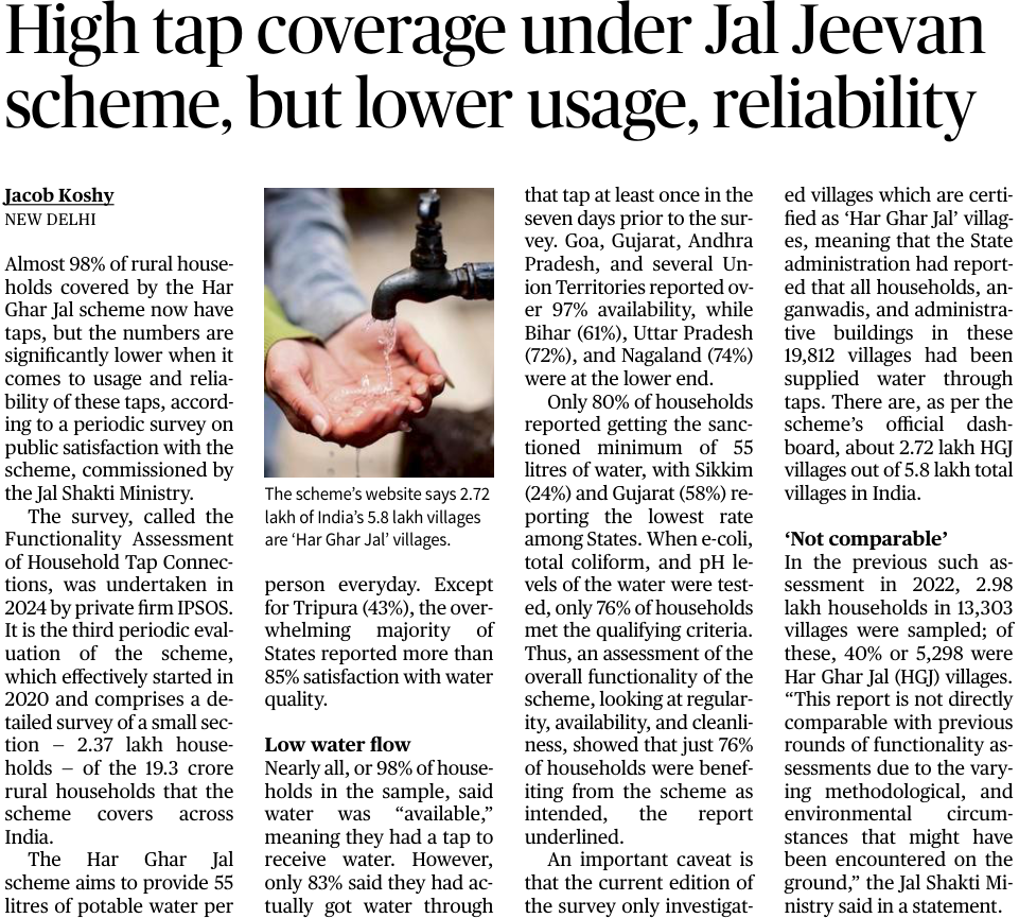
About 2.72 lakh villages out of 5.8 lakh villages are certified as Har Ghar Jal villages.
Certification implies taps in all households, anganwadis, and administrative buildings.
Usage Gap Despite High Coverage
Only 83% of households reported actually receiving water through taps.
Merely 80% of households received the sanctioned minimum of 55 litres per capita per day.
Significant variation across States in actual water supply.
Reliability and Regularity Issues
Water availability was defined as receiving water at least once in seven days prior to the survey.
States like Goa, Gujarat, Andhra Pradesh and some UTs reported over 97% availability.
Lower availability reported in Bihar (61%), Uttar Pradesh (72%) and Nagaland (74%).
Water Quality Concerns
Water quality parameters tested included E. coli, total coliform, and pH levels.
Only 76% of households met the prescribed quality standards.
Quality issues directly affect health outcomes and public confidence in tap water.
Overall Functionality Assessment
Considering regularity, availability, and cleanliness, only 76% of households benefited from the scheme as intended.
This highlights a gap between infrastructure creation and service delivery.
Methodology and Caveats
Survey conducted by IPSOS in 2024, covering 2.37 lakh households across India.
This was the third periodic assessment since the scheme’s rollout in 2020.
Findings are not strictly comparable with earlier surveys due to methodological and environmental variations.
Policy Implications
Focus must shift from tap installation to water flow assurance.
Greater emphasis needed on source sustainability, maintenance, and water quality monitoring.
State-specific interventions required to address regional disparities.
Jal Jeevan Mission
Launched in 2019 under the Ministry of Jal Shakti.
Objective is to provide 55 litres per capita per day of potable water to every rural household through functional household tap connections.
Emphasises water quality, source sustainability, and community participation.
UPSC Prelims Practice Question
Consider the following statements regarding the Jal Jeevan Mission:
1.The mission aims to provide 55 litres of potable water per capita per day to rural households.
2.Har Ghar Jal village certification guarantees daily water supply to all households.
3.Recent assessments show that tap coverage is higher than actual water usage.
Which of the statements given above are correct?
(a) 1 and 3 only
(b) 1 and 2 only
(c) 2 and 3 only
(d) 1, 2 and 3
Correct Answer: (a)
Explanation:
Statement 1 is correct. Statement 2 is incorrect because certification does not guarantee daily supply, only infrastructure coverage. Statement 3 is correct, as usage and reliability lag behind coverage.
Source: The Hindu
Stem cell therapy cannot be offered as a clinical service for autism: Supreme Court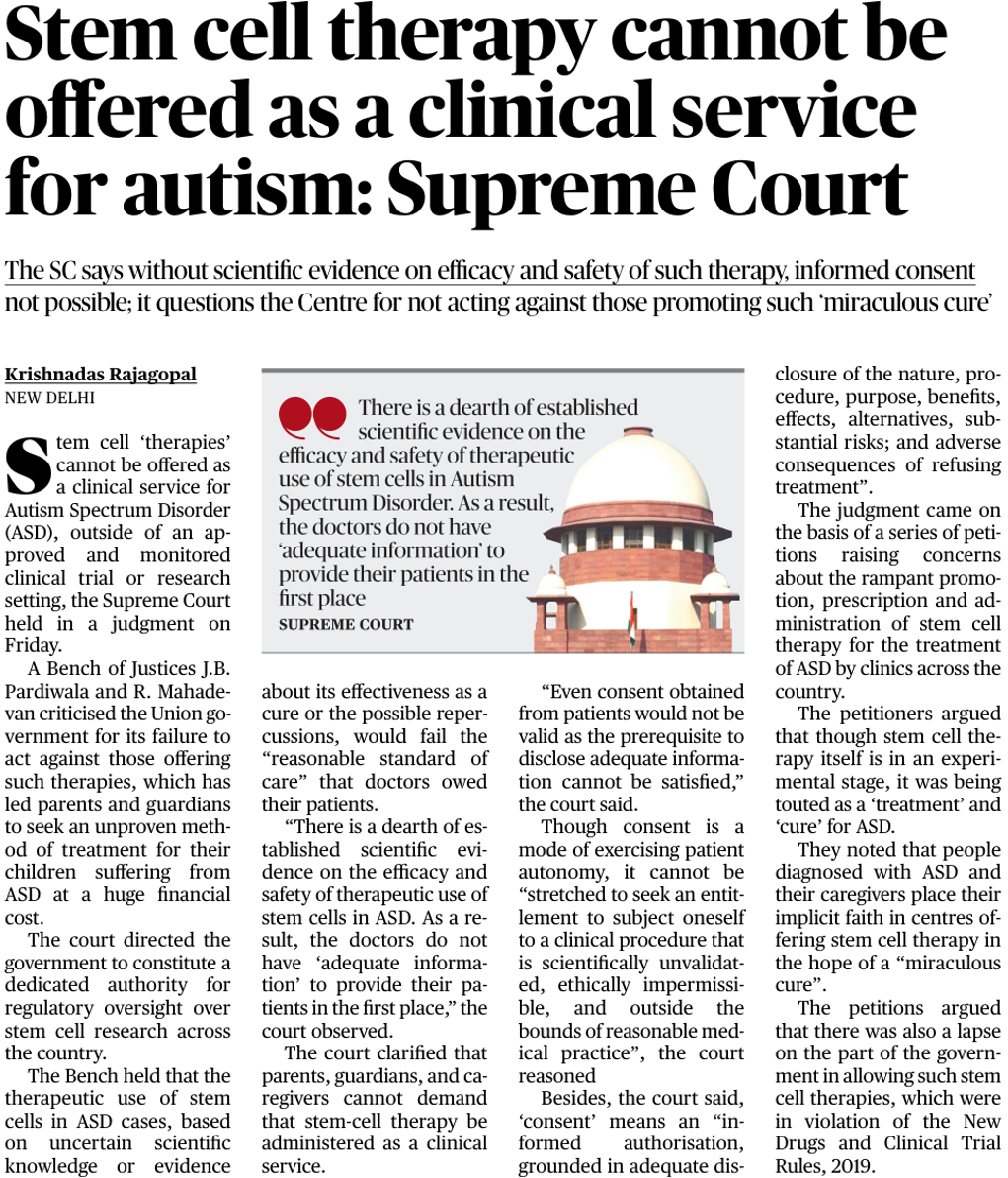
GS 2: Polity and Governance – Judiciary, Fundamental Rights, Health Governance
Context
The Supreme Court of India ruled that stem cell therapy cannot be offered as a clinical service for Autism Spectrum Disorder due to lack of established scientific evidence on efficacy and safety, raising concerns over patient rights and regulatory failure.
Key Points
Supreme Court Ruling
Stem cell therapy for Autism Spectrum Disorder cannot be provided as a clinical treatment outside approved and monitored clinical trials or research settings.
The court emphasised absence of credible scientific evidence supporting its safety and effectiveness in ASD.
Informed Consent and Medical Ethics
Informed consent is invalid when patients are not provided adequate, accurate, and evidence-based information.
Without proven efficacy and safety, doctors cannot meet the reasonable standard of care owed to patients.
Patient autonomy cannot justify exposure to scientifically unvalidated and ethically impermissible procedures.
Protection of Patients and Caregivers
Parents, guardians, and caregivers cannot demand stem cell therapy as a treatment for ASD based on uncertain or experimental claims.
The court noted that vulnerable families are often misled by promises of miraculous cures, leading to emotional distress and financial exploitation.
Government and Regulatory Lapses
The Union government was criticised for failing to act against clinics illegally promoting stem cell therapy as a cure for autism.
Such practices were found to be in violation of the New Drugs and Clinical Trials Rules, 2019.
Directions to the Government
The court directed the Centre to establish a dedicated regulatory authority for oversight of stem cell research and therapy in India.
Emphasis placed on strict enforcement against unauthorised prescription, promotion, or administration of unproven therapies.
Broader Constitutional and Legal Significance
The judgment reinforces the right to health and dignity under Article 21.
It underscores the principle that medical innovation must align with scientific rigor, ethical standards, and patient safety.

 Launch your Graphy