Daily Current Affairs 6 May 2026 | The Hindu Analysis for UPSC & APPSC
The Hindu News Analysis – 6th May, 2026
1. Silencing academia, weakening democratic space (GS-2, GS-1)
2. Cabinet approves four more judges for Supreme Court (GS-2)
3. Cabinet gives nod to make insult to Vande Mataram an offence
(GS-2, GS-1)
4. Govt. hikes sugarcane FRP by ₹10 per quintal (GS-3)
5. 30 banks integrated with UDGAM portal to help legal heirs trace funds (GS-3, GS-2)
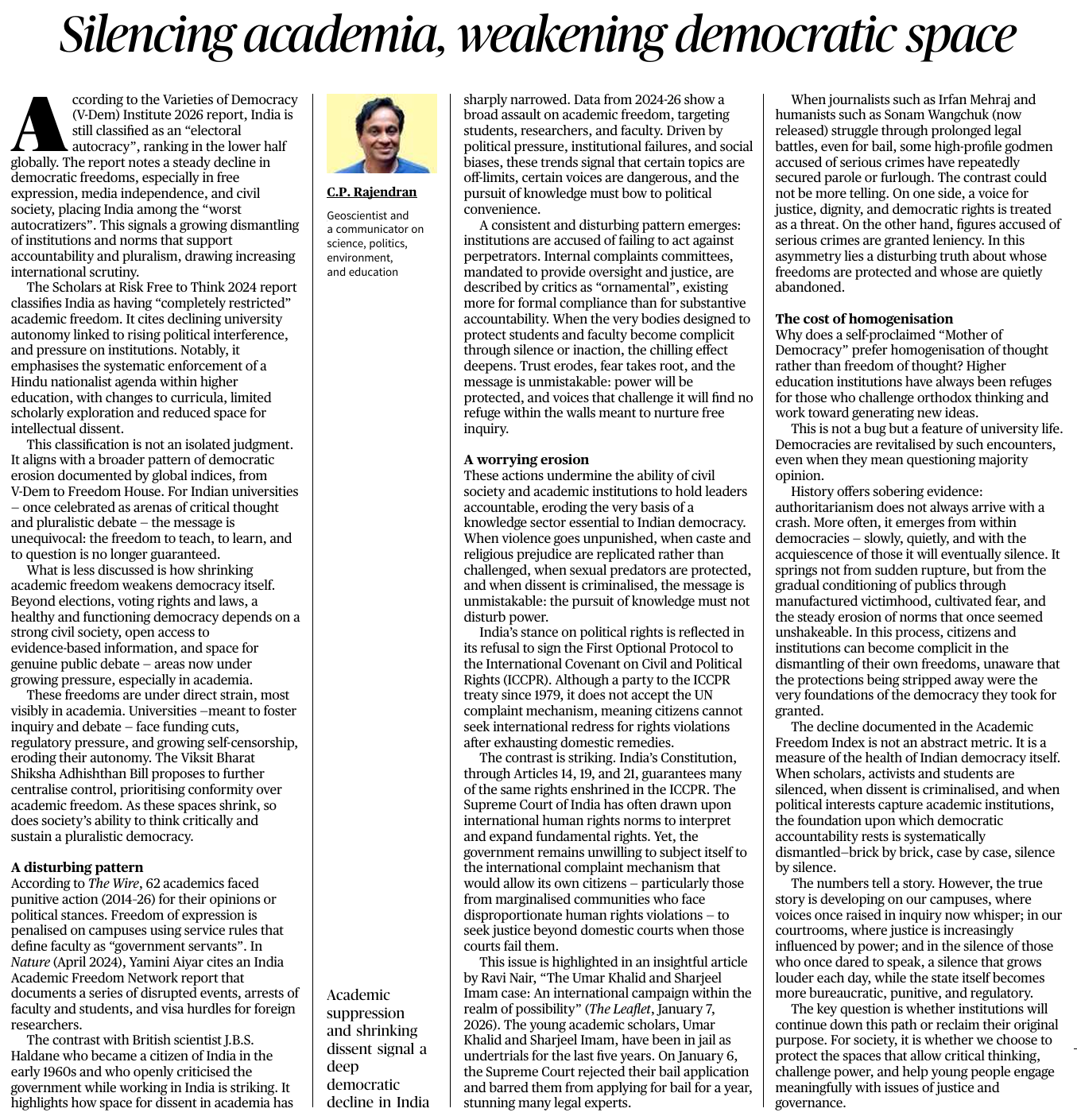
Silencing academia, weakening democratic space
GS Paper II
Issues relating to development and management of Social Sector/Services relating to Education
Pressure groups and informal associations and their role in the polity
Important aspects of governance, transparency and accountability
Fundamental Rights
GS Paper I
Role of women and social empowerment
Salient features of Indian society
Context
The article discusses the decline of academic freedom and democratic space in India, citing global indices such as the Varieties of Democracy (V-Dem) report and the
Academic Freedom Index. It argues that increasing political interference, institutional silence, restrictions on dissent, and shrinking autonomy of universities weaken democratic accountability and pluralism.
Detailed Analysis
Decline in Academic Freedom
The article highlights that India has been classified as an “electoral autocracy” by the V-Dem Institute and marked as having “completely restricted” academic freedom by the Scholars at Risk project.
Key concerns include:
- Political interference in universities
- Curriculum changes aligned with ideological agendas
- Reduced institutional autonomy
- Growing self-censorship among scholars and students
- Restrictions on critical inquiry and dissent
This indicates that universities are increasingly shifting from spaces of free inquiry to spaces of conformity.
Why Academic Freedom Matters in Democracy
Academic institutions are essential pillars of democracy because they:
Encourage critical thinking
- Promote evidence-based public debate
- Produce independent research and knowledge
- Hold power accountable through intellectual scrutiny
- Protect diversity of viewpoints
Institutional Failures and Chilling Effect
The article points to repeated institutional inaction in cases involving:
- Harassment complaints
- Violence on campuses
- Suppression of dissenting voices
Internal committees and oversight mechanisms are criticised for becoming symbolic rather than effective.
Consequences:
- Fear among students and faculty
- Loss of trust in institutions
- Self-censorship
- Decline in intellectual diversity
Such conditions create a “chilling effect,” where individuals avoid expressing opinions due to fear of punishment or exclusion.
Centralisation and Regulatory Pressure
The article critiques increasing centralisation in higher education governance.
For example:
- Funding cuts
- Expanding regulatory control
- Proposed policies that prioritise uniformity over autonomy
This may reduce the independence of universities and limit experimentation, innovation, and debate.
Democracy Beyond Elections
A major argument of the article is that democracy is not limited to elections alone.
Healthy democracy also requires:
- Civil liberties
- Independent institutions
- Free media
- Academic freedom
- Active civil society
When dissent is criminalised and critical voices are silenced, democratic accountability weakens even if elections continue.
International Human Rights Dimension
The article refers to India’s position regarding the:
International Covenant on Civil and Political Rights (ICCPR)
Although India is a party to the ICCPR, it has not accepted certain international complaint mechanisms that allow citizens to seek international remedies after exhausting domestic options.
The article argues that this reflects hesitation toward stronger international scrutiny on rights issues.
The Cost of Homogenisation
One of the central themes is the danger of promoting ideological uniformity in education.
Risks of homogenisation:
Decline in creativity and innovation
Suppression of minority viewpoints
Weakening of scientific temper
Reduced capacity for social reform
Erosion of pluralism
Universities historically thrive when multiple perspectives interact and challenge dominant ideas.
Significance
For Democracy
- Preserves accountability and transparency
- Enables informed public discourse
- Prevents concentration of power
For Education
- Encourages innovation and research
- Builds scientific temper
- Protects intellectual diversity
For Society
- Safeguards pluralism
- Promotes constitutional values
- Strengthens social trust and inclusion
Challenges
- Political polarisation in campuses
- Over-centralisation of education governance
- Weak institutional safeguards
- Fear of reprisals among academics
- Shrinking civil society space
- Balancing national interests with freedom of expression
Way Forward
Strengthen University Autonomy
- Ensure independence in appointments, curriculum, and research priorities
- Reduce excessive political and bureaucratic interference
Protect Freedom of Expression
- Encourage open debate and critical inquiry within constitutional limits
- Prevent misuse of laws against peaceful dissent
Promote Constitutional Values
- Encourage scientific temper, pluralism, and democratic citizenship in education
Support Research Ecosystem
- Increase public funding for higher education and independent research
- Facilitate global academic collaboration
Strengthen Civil Society
- Protect media, activists, scholars, and institutions that contribute to democratic accountability
Conclusion
The article argues that the weakening of academic freedom is not merely an educational issue but a democratic concern. Universities are vital spaces for dissent, innovation, and critical thinking. When these spaces shrink, democratic accountability and pluralism weaken. Protecting academic freedom therefore becomes essential for safeguarding constitutional democracy, institutional integrity, and an informed citizenry.
UPSC Mains question
Q. The weakening of institutions and shrinking space for dissent pose serious challenges to democratic governance. Examine.
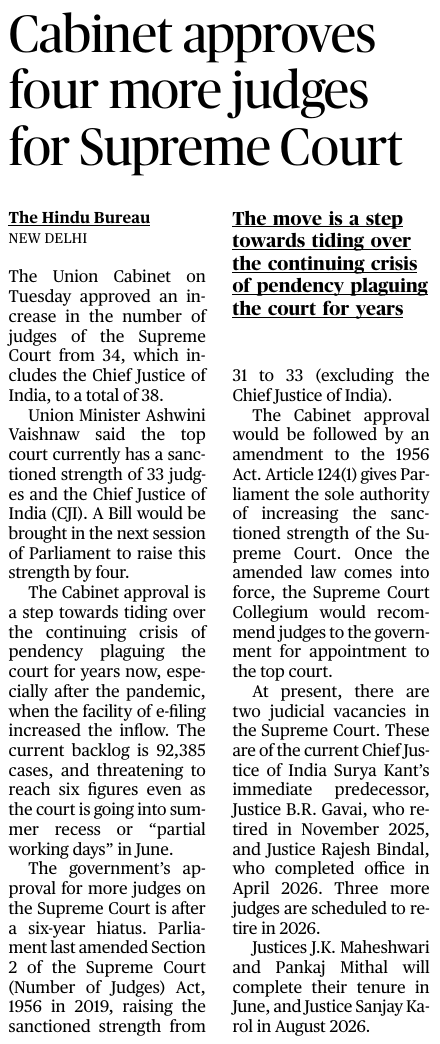
Cabinet approves four more judges for Supreme Court
GS Paper II
Judiciary
Separation of powers
Judicial reforms and pendency of cases
Context
The Union Cabinet approved increasing the sanctioned strength of Supreme Court judges from 34 to 38 to address rising pendency and improve judicial efficiency.
Prelims concepts
1. Constitutional Provisions
Article 124(1): This article grants Parliament the sole authority to prescribe and increase the strength of the Supreme Court judges.
Original vs. Current Strength: While the Constitution originally provided for a Chief Justice and seven other judges, it allowed Parliament to increase this number by law.
Role of the Collegium: Once the law to increase strength is in force, the Supreme Court Collegium recommends names to the government for appointment to the top court.
2. Legislative Framework
Supreme Court (Number of Judges) Act, 1956: This is the specific legislation amended by Parliament to change the sanctioned strength of the court.
Recent Amendments:
2019 Amendment: Increased the strength from 31 to 33 (excluding the CJI).
Proposed 2026 Change: The Union Cabinet has approved increasing the total strength from 34 to 38 (including the CJI).
3. Judicial Administration & Pendency
Current Backlog: The Supreme Court is facing a "crisis of pendency" with approximately 92,385 pending cases.
Impact of Technology: The introduction of e-filing facilities has increased the inflow of cases, contributing to the current backlog.
Cabinet gives nod to make insult to Vande Mataram an offence
GS Paper II
Fundamental Rights
Parliament and legislative process
Issues related to nationalism and constitutional values
GS Paper I
Modern Indian history and freedom movement
National symbols and cultural heritage
Context
The Union Cabinet approved a proposal to amend the Prevention of Insults to National Honour Act, 1971, to make insult or obstruction to the singing of Vande Mataram a punishable offence.
Prelims concepts
1. Legislative & Legal Framework
The Prevention of Insults to National Honour Act, 1971: This is the primary legislation that penalizes insults to the National Anthem (Jana Gana Mana), the National Flag, and the Constitution of India.
Proposed Amendment: The Union Cabinet has approved amending the 1971 Act to include "insult or obstruction to the singing" of the National Song, Vande Mataram, as a punishable offence.
Punishment: Under the existing 1971 Act, insults to national symbols are punishable by imprisonment for up to three years, a fine, or both.
Statutory Backing: Current Home Ministry guidelines regarding Vande Mataram are advisory; the proposed cabinet decision aims to give these rules statutory backing through legal amendment.
2. Historical Context of Vande Mataram
Author and Origin: The song was written by Bankim Chandra Chattopadhyay and published in his novel Anandmath in the early 1880s.
Imagery: It is characterized as a salutation to India imagined as a mother figure.
Role in National Movement:
In 1937, Congress leaders decided to use the first two stanzas of the song at their gatherings.
The song consists of six stanzas and takes a little over three minutes to perform in its entirety.
Post-Independence Status: The Constitution of the modern Republic of India accorded Vande Mataram the status of the National Song.
3. Protocol and Official Guidelines
Performance at Official Events: The Union Home Ministry has directed States to play the National Song at all official events.
Precedence: Guidelines suggest that when both are played at an event, the National Song should be given precedence before the National Anthem (Jana Gana Mana, composed by Rabindranath Tagore).
4. Comparison of National Symbols
Feature
National Anthem (Jana Gana Mana)
National Song (Vande Mataram)
Composer
Rabindranath Tagore
Bankim Chandra Chattopadhyay
Legal Protection
Protected under the 1971 Act
Proposed protection under the 1971 Act
Status
Primary National Anthem
Equal status as National Song
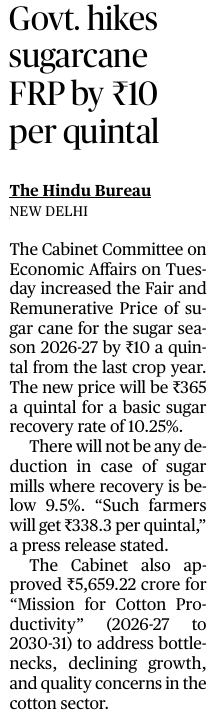
Govt. hikes sugarcane FRP by ₹10 per quintal
GS Paper III
Agriculture pricing and MSP/FRP
Farmer income and agricultural economics
Government policies and interventions in agriculture
Context
The Cabinet Committee on Economic Affairs increased the Fair and Remunerative Price (FRP) of sugarcane for the 2026-27 season by ₹10 per quintal, raising it to ₹365 per quintal at a basic recovery rate of 10.25%.
1. Fair and Remunerative Price (FRP)
Definition: FRP is the minimum price that sugar mills are legally bound to pay to sugarcane farmers.
Pricing Authority: It is announced by the Cabinet Committee on Economic Affairs (CCEA).
Determining Factors: The price is linked to a sugar recovery rate.
For the 2026-27 season, the FRP is set at ₹365 per quintal for a basic recovery rate of 10.25%.
Protection for Low Recovery: There is a "no deduction" rule for mills where recovery is below a certain threshold (9.5% in this instance), ensuring a minimum floor price (₹338.3 per quintal) for those farmers.
2. Institutional Mechanism
Cabinet Committee on Economic Affairs (CCEA): This is the top decision-making body for major economic policies, including the approval of agricultural prices and mission-mode projects.
Note for UPSC: While the CCEA approves the FRP, the Commission for Agricultural Costs and Prices (CACP) recommends it. Sugarcane is governed under the Sugarcane (Control) Order, 1966.
3. Mission for Cotton Productivity
Timeline: The mission is approved for the period 2026-27 to 2030-31.
Objectives: The mission aims to strengthen the cotton sector by addressing three primary areas:
Productivity Bottlenecks: Resolving physical or technical hurdles in farming.
Growth: Reversing declining growth trends in cotton production.
Quality: Improving the fiber quality of the cotton produced.

30 banks integrated with UDGAM portal to help legal heirs trace funds
GS Paper III:
Indian Economy and Banking
Financial Inclusion
Technology in Governance
GS Paper II:
Role of RBI and Regulatory Institutions
E-Governance and Citizen-Centric Administration
Context
The Reserve Bank of India (RBI) informed the Supreme Court that 30 banks have been integrated with the UDGAM portal to help legal heirs trace unclaimed deposits of deceased account holders. These banks account for nearly 90% of the funds held in the Depositors Education and Awareness Fund (DEAF).
Prelims concepts
1. UDGAM Portal
Full Form: Unclaimed Deposits – Gateway to Access Information.
Objective: To facilitate the identification and tracing of unclaimed deposits across multiple banks so that depositors or their legal heirs can find funds belonging to deceased account holders.
Nature of Platform: It is a centralized, interactive web portal developed by the Reserve Bank of India (RBI).
Scope & Limitation:
It currently integrates 30 banks, accounting for nearly 90% of funds held in the DEAF.
It is not a claims settlement mechanism; users must still approach the respective bank to settle the claim in accordance with applicable procedures.
Currently, it does not include deposits from post offices, provident funds, or insurance schemes.
2. Depositor Education and Awareness Fund (DEAF)
Establishment: A corpus set up by the RBI in 2014.
Purpose: To house unclaimed deposits from commercial and co-operative banks.
Mechanism: Funds lying in dormant or inoperative accounts for a specified period (typically 10 years or more) are transferred to this government-managed pool.
3. Key Institutions and Regulatory Bodies
Reserve Bank of India (RBI): The primary authority managing the DEAF and the developer of the UDGAM portal.
Securities and Exchange Board of India (SEBI): Involved in outlining steps to enable the return of unclaimed funds held in financial institutions beyond just traditional bank accounts.
Judiciary: The Supreme Court (specifically a three-judge Bench) plays a monitoring role via Public Interest Litigation (PIL) to ensure transparency in the return of unclaimed assets to citizens.





 Launch your Graphy