There are no items in your cart
Add More
Add More
| Item Details | Price | ||
|---|---|---|---|



| S.No | Topic | |
| Daily Hindu Analysis | ||
| 1. | Corruption and prior sanction, case of a divided house | |
| 2. | What happened to ISRO’s PSLV-C62 mission? | |
| 3. | Can data centres in orbit solve for AI models’ energy demand? | |
| 4. | India’s power distribution utilities post ₹2,701 cr. profit in FY 2024-25 | |
| 5. | India invited to join Gaza peace board | |
| 6. | Govt. is proud of Indian companies investing abroad: Commerce Minister | |
| 7. | Scientists find spaceflight affects immune genes, deforms brain | |
| 8. | Now, GBS outbreak claims 2 lives in M.P. | |
| 9. | Kakinada will be ‘Green Hydrogen Valley of India’: CM | |
| 10. | Kakinada will be ‘Green Hydrogen Valley of India’: CM | |
| Daily Current Affairs (App) | ||
| 11. | Irrawaddy Dolphin | |
| 12. | Sammakka-Saralamma Jatara | |
| 13. | Reserve Bank–Integrated Ombudsman Scheme, 2026 | |
| 14. | Dugongs | |
| 15. | Central Vigilance Commission (CVC) | |
Syllabus: GS Paper 2 – Polity | Governance | Accountability and Transparency
Context
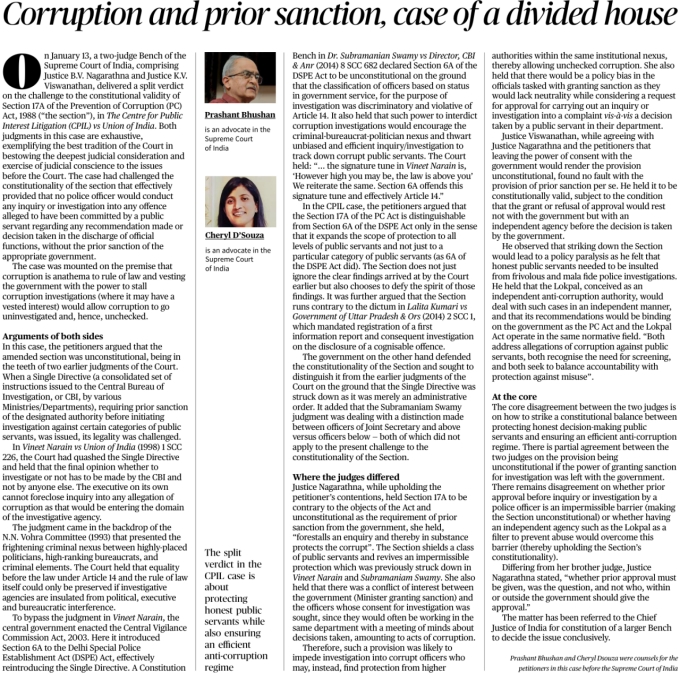
The article analyses a split verdict of the Supreme Court of India on the constitutional validity of Section 17A of the Prevention of Corruption Act, 1988, which mandates prior government sanction before initiating inquiry or investigation against public servants for acts done in official capacity. The author examines the tension between protecting honest decision-making and ensuring effective anti-corruption enforcement. Detailed Analysis
Background of the Case
A two-judge Bench of the Supreme Court of India delivered a split verdict in Centre for Public Interest Litigation (CPIL) vs Union of India.The challenge was to Section 17A of the PC Act, introduced through amendments, requiring prior sanction for investigation into corruption allegations against public servants.The concern was that such a requirement could stall or prevent corruption inquiries, especially where the government itself may have a vested interest. Arguments Against Prior SanctionThe petitioners argued that corruption is antithetical to the rule of law, and executive control over sanction allows corruption to remain unchecked.Reliance was placed on earlier judgments like Vineet Narain vs Union of India (1998), which held that the executive cannot block or control corruption investigations.The N.N. Vohra Committee (1993) findings on the politician–bureaucrat–criminal nexus were cited to stress the need for independent investigative agencies.Section 17A was argued to revive the “Single Directive”, earlier struck down for violating Article 14 (equality before law). Government’s DefenceThe Union defended Section 17A as a safeguard for honest officers, protecting them from frivolous or mala fide investigations.It argued that earlier judgments dealt with administrative instructions, whereas Section 17A is a statutory provision.The government claimed that the provision seeks to balance accountability with administrative efficiency. Where the Judges DifferedJustice B.V. Nagarathna held Section 17A to be unconstitutional, as it:Creates an impermissible barrier to inquiry.Protects a class of public servants and substantively shields corruption.Places investigative consent in the hands of the very authority whose decisions are under scrutiny, leading to conflict of interest.Justice K.V. Viswanathan, while agreeing that unchecked executive control is problematic, upheld Section 17A:He found no fault with prior sanction per se.He interpreted the provision to mean that approval should come from an independent authority, not necessarily the political executive.He emphasised that striking down the provision could lead to policy paralysis, discouraging honest decision-making. Role of Lokpal
Justice Viswanathan highlighted the Lokpal as an independent anti-corruption authority capable of filtering frivolous complaints.Since both the PC Act and Lokpal Act operate in the same normative field, Lokpal’s recommendations could ensure accountability without executive bias.
Author’s Suggestions
The solution lies not merely in striking down or upholding Section 17A, but in who grants the sanction.Prior approval, if retained, must be vested in an independent body rather than the political executive.This would preserve honest administrative decision-making while preventing the misuse of sanction as a shield for corruption.
UPSC Mains Practice Question
“Prior sanction for investigation into corruption cases raises a constitutional conflict between administrative efficiency and accountability.”Discuss in the context of Section 17A of the Prevention of Corruption Act and recent Supreme Court jurisprudence.
Context
The article examines the failure of ISRO’s PSLV-C62 mission shortly after launch, the nature of the technical anomaly during the third stage, and the institutional response of ISRO through a Failure Analysis Committee (FAC). It also raises concerns about transparency in releasing investigation reports to the public.
Detailed Analysis
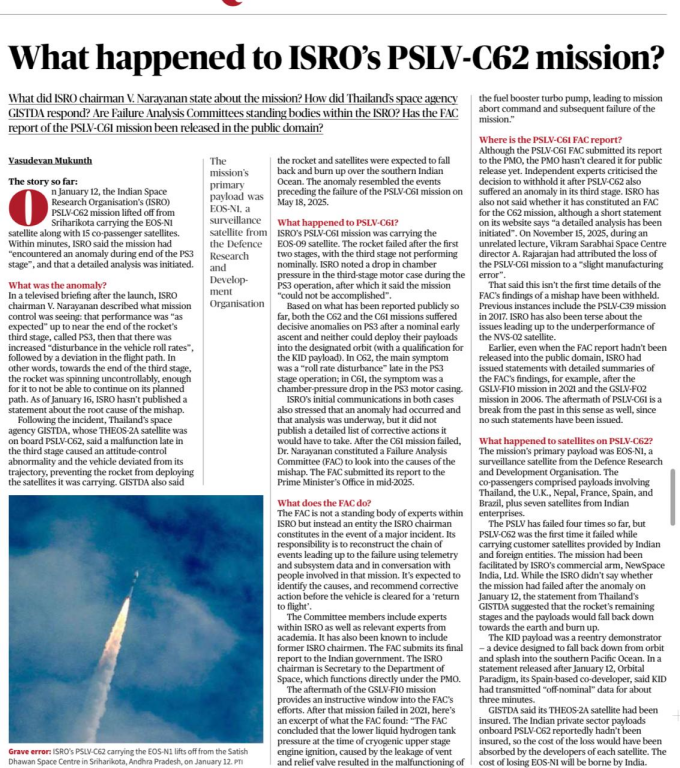
The Mission at a GlanceOn January 12, the Indian Space Research Organisation (ISRO) launched PSLV-C62 from Sriharikota.The mission carried EOS-N1, a surveillance satellite for the Defence Research and Development Organisation (DRDO), along with 15 co-passenger satellites.Within minutes, ISRO announced an anomaly at the end of the third stage (PS3) and initiated a detailed analysis.
Nature of the Anomaly
According to ISRO Chairman V. Narayanan, the rocket’s performance was normal until late in PS3, when:There was increased disturbance in vehicle roll rates.The launch vehicle deviated from its intended flight path.The rocket began spinning uncontrollably, making it impossible to continue the planned mission. Independent ObservationsThailand’s space agency GISTDA, whose THEOS-2A satellite was onboard, reported:A malfunction in late PS3 causing an attitude-control abnormality.Failure to deploy satellites due to deviation from trajectory.It was expected that the rocket and satellites would fall back and burn up over the southern Indian Ocean. Link with PSLV-C61 FailureThe anomaly resembled the earlier PSLV-C61 failure (May 18, 2025):In C61, ISRO reported a drop in chamber pressure in the PS3 motor case.Publicly available information suggests:Both C61 and C62 suffered decisive anomalies during PS3, despite nominal early ascent.Neither mission successfully deployed payloads into the intended orbit. Failure Analysis Committee (FAC)After the C61 failure, ISRO constituted an FAC, which:Is not a standing body but formed after major incidents.Reconstructs the failure sequence using telemetry and subsystem data.Recommends corrective actions before return-to-flight clearance.The C61 FAC report was submitted to the Prime Minister’s Office (PMO) in mid-2025. Transparency ConcernsThe FAC report for PSLV-C61 has not been released publicly.Independent experts criticised this opacity, especially since PSLV-C62 also failed.ISRO has only stated that a “detailed analysis has been initiated” for C62, without confirming whether a separate FAC has been constituted.
Past Practice vs Present Approach
Earlier, ISRO had released summarised FAC findings even when full reports were withheld:GSLV-F02 (2006)GSLV-F10 (2021)In contrast, after PSLV-C61 and C62, no such summaries have been made public, marking a departure from precedent. Impact on Payloads and Commercial ConfidenceThe primary payload EOS-N1 and co-passenger satellites from Thailand, the UK, Nepal, France, Spain, Brazil, and India were lost.Some payloads were insured (e.g., THEOS-2A), while others were not.The mission was facilitated by NewSpace India Ltd., and repeated failures raise concerns about India’s reliability as a commercial launch provider.
Author’s Suggestions / Implied Concerns
ISRO should restore its earlier practice of publicly sharing FAC summaries, especially after repeat failures.Greater transparency would:Strengthen institutional credibility.Reassure international customers and partners.Enable informed public and expert scrutiny of systemic issues.
UPSC Mains Practice Question“
Repeated launch failures test not only technological robustness but also institutional transparency.”Discuss in the context of recent PSLV mission failures and ISRO’s failure analysis mechanisms.
Syllabus: GS Paper 3 – Science and Technology | Emerging Technologies | Energy
Context
Rising energy demands of AI models have pushed Google to experiment with space-based datacentres under Project Suncatcher, while ISRO is reportedly studying similar technology, bringing the idea of orbital datacentres into focus.
Key Points
Why AI is driving energy demand
AI datacentres use dense GPU clusters for training and deploying large models.Generative AI growth has led to rapidly rising electricity consumption by datacentres.
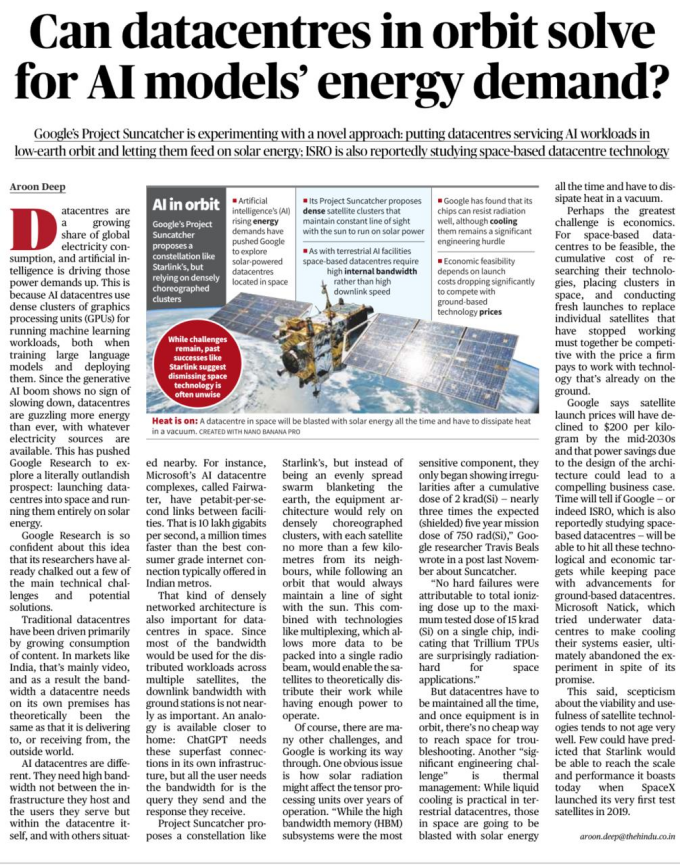
Concept of datacentres in orbitProject Suncatcher by Google proposes placing AI datacentres in Low Earth Orbit (LEO).Datacentres would run entirely on solar energy, avoiding terrestrial power constraints.
Technical architecture
Uses a constellation model similar to Starlink, but with densely choreographed clusters.Satellites maintain constant line of sight with the Sun to ensure uninterrupted power.Emphasis is on high internal bandwidth between satellites rather than fast Earth downlink. Advantages of space-based datacentres
Unlimited solar energy availability in space.Reduces dependence on terrestrial grids and fossil fuels.Could support energy-intensive AI workloads without stressing Earth-based infrastructure.
Key engineering challenges Thermal management: Heat dissipation in vacuum is difficult without convection.
Radiation exposure: Chips face ionising radiation affecting long-term reliability.
Maintenance constraints: No easy repair or replacement once in orbit. Economic feasibilityViability depends on significant reduction in launch costs.Google estimates launch costs may fall to around $200 per kg by the mid-2030s.Space-based systems must compete with cheaper and improving ground-based datacentres.
Lessons from past experiments Microsoft’s Project Natick (underwater datacentres) improved cooling but was discontinued.Starlink’s success shows scalability of satellite constellations, but economics differ for datacentres. India’s interestIndian Space Research Organisation is reportedly studying space-based datacentre technology.
Aligns with India’s push in space economy and advanced digital infrastructure. Additional Information – Google. Project Suncatcher explores AI infrastructure beyond Earth to manage future energy constraints.Focuses on integrating space engineering with AI computing needs.
UPSC Prelims Practice Question
Q. Consider the following statements regarding space-based datacentres:
1.They aim to use continuous solar energy availability in orbit to power AI workloads.
2.Thermal management is easier in space due to the absence of atmospheric resistance.
Which of the statements given above is/are correct?
(a) 1 onlyCorrect Answer: (a)
Explanation:
Statement 1 is correct as uninterrupted solar exposure is a key motivation for orbital datacentres.
Statement 2 is incorrect because heat dissipation is harder in vacuum, making thermal management a major challenge.
Syllabus:
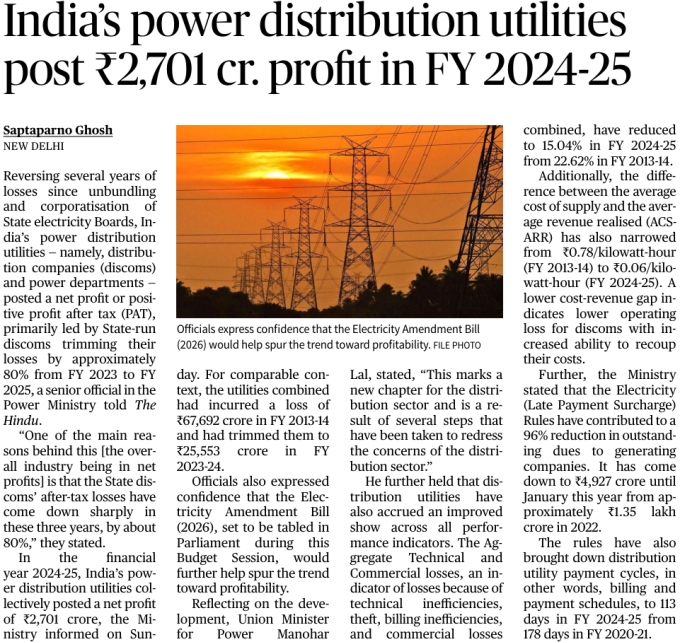
GS Paper 3 – Indian Economy | Infrastructure | Energy Sector ContextIndia’s power distribution utilities (discoms) reported a net profit of ₹2,701 crore in FY 2024-25, reversing years of losses, mainly due to sharp reduction in state-run discom losses and structural reforms in the power sector.
Key Points Overall financial turnaround
Power distribution utilities recorded profit after tax (PAT) of ₹2,701 crore in FY 2024-25.This marks a reversal from large losses incurred since unbundling and corporatisation of State Electricity Boards.
State-run discoms reduced losses by around 80% between FY 2023 and FY 2025. Comparison with past performance
Utilities had a combined loss of ₹67,692 crore in FY 2013-14.Losses were reduced to ₹25,553 crore in FY 2023-24, before turning profitable in FY 2024-25. Reduction in AT&C lossesAggregate Technical and Commercial (AT&C) losses declined to 15.04% in FY 2024-25.This is a significant improvement from 22.62% in FY 2013-14.Lower AT&C losses reflect better billing efficiency, reduced theft, and improved collection. Narrowing of cost–revenue gap
The gap between Average Cost of Supply (ACS) and Average Revenue Realised (ARR) reduced sharply.It declined from ₹0.78 per kWh in FY 2013-14 to ₹0.06 per kWh in FY 2024-25.A lower gap indicates improved cost recovery by discoms. Impact of regulatory and payment reformsElectricity (Late Payment Surcharge) Rules led to a 96% reduction in outstanding dues to generating companies.Outstanding dues fell to ₹4,927 crore by January 2026, from about ₹1.35 lakh crore in 2022.Distribution utility payment cycles reduced to 113 days in FY 2024-25, compared to 178 days in FY 2020-21. Policy outlookThe proposed Electricity Amendment Bill, 2026 is expected to further improve discom efficiency and financial health.Government expects continued improvement across operational and financial performance indicators. Additional Information – Ministry of PowerThe Ministry has attributed the turnaround to loss reduction, payment discipline, and regulatory reforms.It views the recent performance as a new phase for the distribution sector, moving towards long-term sustainability.
UPSC Prelims Practice QuestionQ. Consider the following statements regarding India’s power distribution utilities:
1.Aggregate Technical and Commercial (AT&C) losses have declined to nearly 15% in FY 2024-25.2.The gap between Average Cost of Supply and Average Revenue Realised has widened in recent years.
Which of the statements given above is/are correct?
(a) 1 only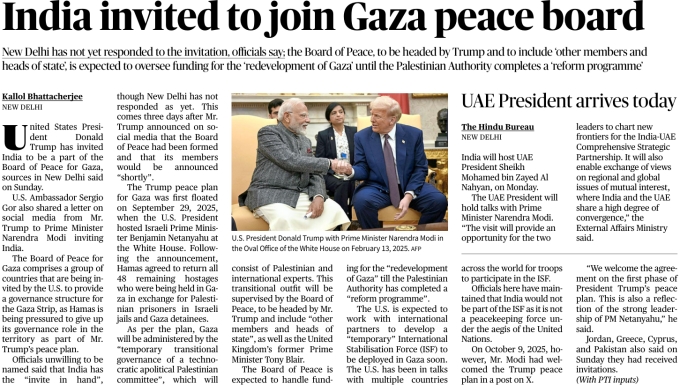
(a) 1 only
(b) 2 only
(c) Both 1 and 2
(d) Neither 1 nor 2Correct Answer: (a)Explanation:
Statement 1 is correct as the board is meant to supervise funding and redevelopment during a temporary phase.
Statement 2 is incorrect because India has not yet responded to the board invitation and has ruled out participation in the ISF.
Syllabus: GS Paper 3 – Indian Economy | External Sector | Foreign Investment
Context
The Commerce Minister highlighted the sharp rise in outward foreign direct investment (OFDI) by Indian companies, following the release of recent data showing strong growth in overseas investments during 2025.
Key Points
Rising outward investment
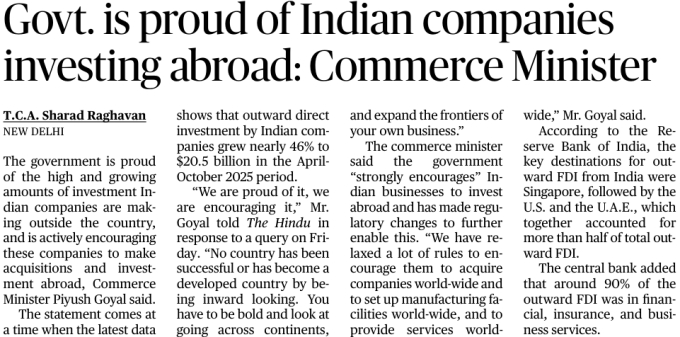
Outward direct investment by Indian companies grew nearly 46% to $20.5 billion during April–October 2025.
The government views this trend as a sign of India’s growing global economic footprint.
Government’s policy stance
Commerce Minister Piyush Goyal stated that the government is actively encouraging Indian companies to invest abroad.
The government has relaxed several regulatory norms to facilitate overseas acquisitions and expansion.
Indian firms are being encouraged to set up manufacturing facilities and service operations globally.
Strategic rationale
Overseas investments help Indian companies expand markets, access technology, and integrate into global value chains.
The Minister emphasised that economic success requires outward-looking policies, not inward isolation.
Key destinations for Indian OFDI
According to data from the Reserve Bank of India, major destinations for Indian outward FDI include:
Singapore
United States
United Arab Emirates
These three destinations together accounted for more than half of total outward FDI.
Sectoral composition
Nearly 90% of India’s outward FDI is concentrated in:
Financial services
Insurance
Business services
This reflects India’s growing strength in services-led global expansion.
Additional Information – Reserve Bank of India
The RBI tracks and regulates outward FDI under the Foreign Exchange Management Act (FEMA) framework.
Liberalised norms have made overseas investments simpler and faster for Indian companies.
UPSC Prelims Practice Question
Q. Consider the following statements regarding India’s outward foreign direct investment (OFDI):
1.Singapore, the United States, and the UAE together account for more than half of India’s outward FDI.
2.Manufacturing accounts for the largest share of India’s outward FDI.
Which of the statements given above is/are correct?
(a) 1 only
(b) 2 only
(c) Both 1 and 2
(d) Neither 1 nor 2
Correct Answer: (a)
Explanation:
Statement 1 is correct as these three destinations together account for over half of India’s OFDI.
Statement 2 is incorrect because financial, insurance, and business services dominate, not manufacturing.
Source: The Hindu
Syllabus: GS Paper 3 – Science and Technology | Space Technology | Human Health
Context
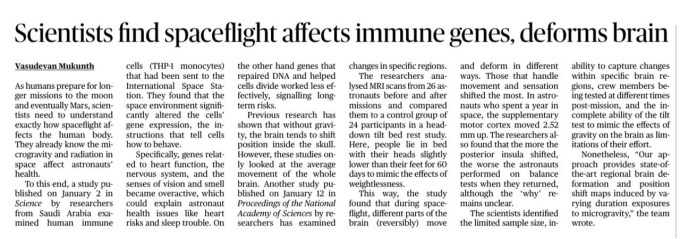
Recent scientific studies have highlighted how spaceflight and microgravity alter human immune gene expression and cause reversible structural changes in the brain, raising concerns for long-duration space missions to the Moon and Mars.
Key Points
Why the study matters
Long-duration space missions expose astronauts to microgravity and radiation.
Understanding biological effects is critical for crew health and mission safety.
Impact on immune genes
Researchers studied human immune cells (THP-1 monocytes) sent to the International Space Station.
Space conditions significantly altered gene expression in these cells.
Genes linked to heart function, nervous system, vision, and smell became overactive.
Genes involved in DNA repair and cell division showed reduced efficiency, signalling long-term health risks.
Brain structure changes
MRI scans of 26 astronauts before and after missions showed shifts in brain regions.
Movement- and sensation-related areas were most affected.
In astronauts who spent one year in space, the supplementary motor cortex shifted upward by about 2.52 mm.
Performance implications
Greater shifts in the posterior insula were associated with poorer balance performance after return to Earth.
Astronauts were tested at different times post-mission, showing temporary functional impacts.
Ground-based comparison
Astronaut data was compared with participants in head-down tilt bed rest for 60 days.
This Earth-based model simulates effects of weightlessness, confirming spaceflight-specific impacts.
Reversibility and limits
Brain changes were found to be largely reversible after return to Earth.
Researchers acknowledged small sample size as a limitation.
The precise biological mechanism behind these changes remains unclear.
UPSC Prelims Practice Question
Q. Consider the following statements regarding the effects of spaceflight on humans:
1.Spaceflight can alter immune gene expression and reduce efficiency of DNA repair mechanisms.
2.Structural changes observed in astronauts’ brains due to microgravity are completely permanent.
Which of the statements given above is/are correct?
(a) 1 only
(b) 2 only
(c) Both 1 and 2
(d) Neither 1 nor 2
Correct Answer: (a)
Explanation:
Statement 1 is correct as studies show altered immune gene activity and reduced DNA repair efficiency in space.
Statement 2 is incorrect because most brain changes observed were reversible after astronauts returned to Earth.
Source: The Hindu
Syllabus: GS Paper 2 – Governance | Health
GS Paper 3 – Science and Technology | Public Health
Context
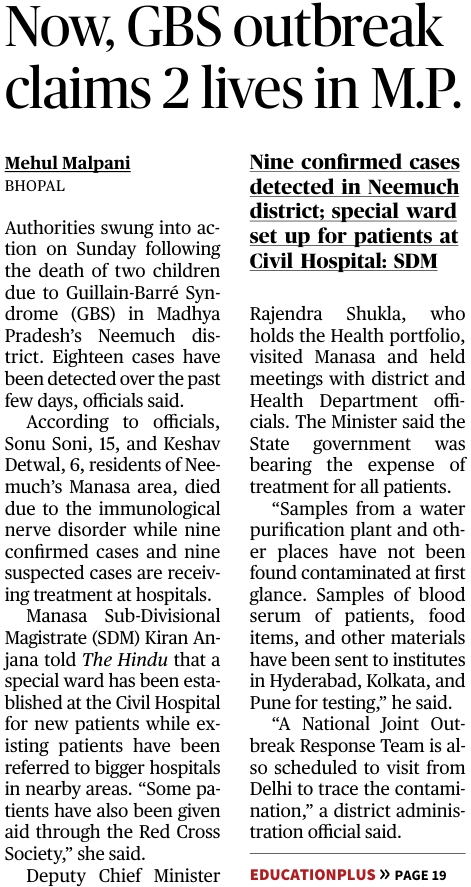
Two children died due to Guillain-Barré Syndrome (GBS) in Madhya Pradesh’s Neemuch district, prompting health authorities to set up special hospital wards and initiate investigations into possible causes.
Key Points
GBS outbreak in Madhya Pradesh
Two minors from Manasa area of Neemuch district died due to GBS.
18 cases were detected over a few days, including 9 confirmed and 9 suspected cases.
A special ward was established at the Civil Hospital, while serious cases were referred to larger hospitals.
Government response
The State Health Minister reviewed the situation with district officials.
The State government is bearing treatment costs for all patients.
A National Joint Outbreak Response Team from Delhi is scheduled to investigate the source of infection.
Samples of blood serum, food items, and water were sent to laboratories in Hyderabad, Kolkata, and Pune.
Initial investigation findings
No contamination detected initially in the water purification plant.
Further testing is underway to identify the triggering infection.
Nature of the disease
GBS is a serious autoimmune disorder affecting the peripheral nervous system.
It causes weakness, tingling, and numbness, which may progress to temporary paralysis lasting months.
Nerves controlling movement, pain, temperature, and touch are affected.
Who is affected
More common in adults and males, but can affect all age groups, including children.
Causes and risk factors
Exact cause is unknown, but GBS is often preceded by bacterial or viral infections.
According to the World Health Organization, infections trigger the immune system to mistakenly attack nerves.
Rarely, vaccination or surgery may slightly increase risk, but this risk is much lower than infection-related risk.
Treatment
There is no definitive cure, but early treatment improves outcomes.
Plasmapheresis is used to remove harmful antibodies from blood.
Supportive care is essential, including respiratory support in severe cases.
UPSC Prelims Practice Question
Q. Consider the following statements regarding Guillain-Barré Syndrome (GBS):
1.It is an autoimmune disorder affecting the peripheral nervous system.
2.The risk of developing GBS is higher after vaccination than after viral infections.
Which of the statements given above is/are correct?
(a) 1 only
(b) 2 only
(c) Both 1 and 2
(d) Neither 1 nor 2
Correct Answer: (a)
Explanation:
Statement 1 is correct as GBS is an autoimmune condition affecting peripheral nerves.
Statement 2 is incorrect because WHO states the risk from infections is higher than from vaccines.
Source: The Hindu

Syllabus: GS Paper 3 – Infrastructure | Energy | Renewable Energy
Context
The Andhra Pradesh government has announced Kakinada as the Green Hydrogen Valley of India following the foundation-laying for a large green hydrogen and green ammonia production complex, positioning the State as a clean energy hub.
Key Points
Announcement and vision
Andhra Pradesh Chief Minister N. Chandrababu Naidu declared Kakinada as the Green Hydrogen Valley of India.
The announcement was made during the bhumi puja for a major green energy project in the region.
Green hydrogen and ammonia complex
A ₹15,600-crore Green Hydrogen and Green Ammonia Production Complex is being set up.
The project is being developed by AM Green of the Greenko Group.
The complex will be spread over 495 acres in Kakinada.
It is projected to be the world’s largest green hydrogen and green ammonia facility.
Production targets
The first production target is 0.5 million metric tonnes of green ammonia by mid-2027.
The annual production capacity is planned to reach 1.5 million metric tonnes.
Technology and investment
AM Green will invest an additional ₹2,000 crore to deploy 2 GW of alkaline electrolyzers at the Kakinada facility.
The project relies on renewable energy-based electrolysis, reducing carbon emissions.
Export orientation
Green ammonia produced at Kakinada will be supplied mainly to Europe.
Germany is identified as a major importer.
An offtake agreement has been signed between AM Green and Uniper Global Commodities.
Strategic significance
The project supports India’s clean energy transition and export-led growth in green fuels.
It strengthens India–Europe energy cooperation and aligns with global decarbonisation goals.
UPSC Prelims Practice Question
Q. Consider the following statements regarding green hydrogen and green ammonia:
1.Green hydrogen is produced using renewable energy through the process of electrolysis.
2.Green ammonia is primarily used as a carbon-free fuel for electricity generation only.
Which of the statements given above is/are correct?
(a) 1 only
(b) 2 only
(c) Both 1 and 2
(d) Neither 1 nor 2
Correct Answer: (a)
Explanation:
Statement 1 is correct because green hydrogen uses renewable energy for electrolysis.
Statement 2 is incorrect as green ammonia is used not only for power generation but also in fertilisers, shipping fuel, and energy storage.
Source: The Hindu
Syllabus: GS Paper 3 – Science and Technology | Space Technology
Context
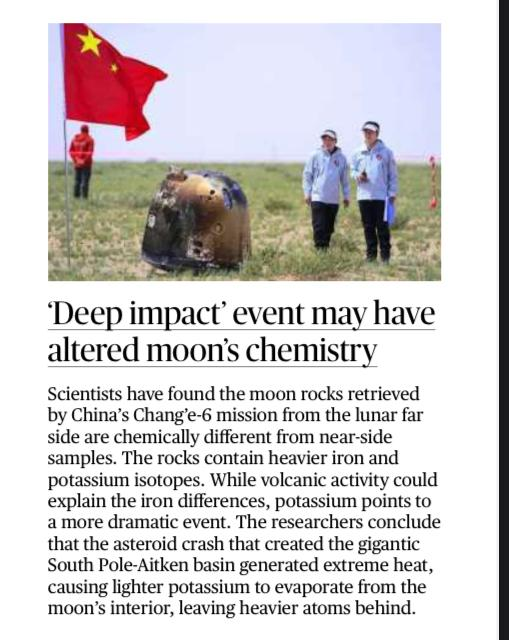
Scientists analysing lunar samples brought back by China’s Chang’e-6 mission found chemical differences between the Moon’s far side and near side, suggesting a massive asteroid impact altered the Moon’s internal chemistry.
Key Points
Mission and sample source
The samples were collected by Chang’e-6 from the far side of the Moon.
This is the first-ever sample return from the lunar far side.
Key chemical differences
Far-side rocks contain heavier iron and potassium isotopes compared to near-side samples.
These isotopic differences indicate distinct geological histories within the Moon.
Role of volcanic activity
Volcanism could explain iron isotope variations.
However, it cannot fully account for the observed potassium isotope differences.
Asteroid impact hypothesis
Scientists link the anomaly to a giant asteroid impact that formed the South Pole–Aitken Basin.
The impact likely generated extreme heat, causing lighter potassium isotopes to evaporate.
This left behind heavier potassium atoms, altering the Moon’s chemical composition.
Scientific significance
Provides evidence that large impact events can modify planetary interiors, not just surfaces.
Enhances understanding of the Moon’s formation and early evolution.
Offers insights relevant to planetary geology across the solar system.
Additional Information – China National Space Administration
CNSA’s Chang’e programme focuses on lunar exploration, sample return, and future crewed missions.
Chang’e-6 builds on earlier missions like Chang’e-5, which returned near-side lunar samples.
UPSC Prelims Practice Question
Q. Consider the following statements regarding the Moon’s South Pole–Aitken Basin:
1.It is one of the largest and oldest impact basins in the solar system.
2.It is located on the near side of the Moon facing the Earth.
Which of the statements given above is/are correct?
(a) 1 only
(b) 2 only
(c) Both 1 and 2
(d) Neither 1 nor 2
Correct Answer: (a)
Explanation:
Statement 1 is correct as the South Pole–Aitken Basin is among the largest and oldest impact basins.
Statement 2 is incorrect because it lies on the far side of the Moon, not the near side.
Source: The Hindu
Syllabus: GS Paper 3 – Environment | Biodiversity and Conservation
Context
The Union Ministry of Environment, Forest and Climate Change has launched the second nationwide range-wide estimation of riverine and estuarine dolphins under Project Dolphin, which for the first time includes the Irrawaddy dolphin in the Sundarbans and Odisha.
Key Points
Habitat and Distribution
Physical Features
Conservation Status
Government Initiative
Prelims Practice Question
Consider the following statements regarding the Irrawaddy dolphin:
1. It is a euryhaline species found in both freshwater and coastal environments.
2. In India, it is found only in the Ganga and Brahmaputra river systems.
Which of the statements given above is/are correct?
(a) 1 only
(b) 2 only
(c) Both 1 and 2
(d) Neither 1 nor 2
Correct Answer: (a)
Explanation:
Statement 1 is correct because the Irrawaddy dolphin can survive across a range of salinity levels.
Statement 2 is incorrect as in India it is mainly found in Chilika Lake and the Sundarbans, not the Ganga–Brahmaputra system.
Source: NIE
Syllabus: GS Paper 1 – Indian Culture | Art & Culture | Indian Society
Context
Telangana is preparing for the biennial Sammakka-Saralamma Jatara, regarded as one of the world’s largest indigenous spiritual gatherings, reflecting the deep-rooted tribal traditions and historical memory of resistance.
Key Points
Rituals and Practices
Significance
Syllabus: GS Paper 3 – Indian Economy | Banking and Financial Institutions
Context
The Reserve Bank of India (RBI) has unveiled the Reserve Bank–Integrated Ombudsman Scheme, 2026 to strengthen and streamline grievance redressal for customers of banks and other regulated financial entities.
Key Points
Coverage under the Scheme
Nature of Complaints
Compensation Provisions
Complaint Filing and Resolution Process
Prelims Practice Question
Consider the following statements regarding the Reserve Bank–Integrated Ombudsman Scheme, 2026:
1. The Scheme allows customers to directly approach the Ombudsman without first contacting the concerned bank or entity.
2. The RBI Ombudsman can award compensation for both financial and non-financial losses.
Which of the statements given above is/are correct?
(a) 1 only
(b) 2 only
(c) Both 1 and 2
(d) Neither 1 nor 2
Correct Answer: (b)
Explanation:
Statement 1 is incorrect because customers must first approach the concerned entity before going to the Ombudsman.
Statement 2 is correct as the Ombudsman can award compensation for financial as well as non-financial losses.
Source: DEVD
Syllabus: GS Paper 3 – Environment | Biodiversity | Conservation
Context
The Union government’s Expert Appraisal Committee under the Ministry of Environment, Forest and Climate Change (MoEFCC) has asked Tamil Nadu to revise the design of the proposed International Dugong Conservation Centre at Manora in Thanjavur district.
Key Points
What is a Dugong
Habitat and Distribution
Conservation Status
Key Characteristics
Cultural Significance
Prelims Practice Question
Consider the following statements regarding dugongs:
1. Dugongs are strictly marine mammals and do not enter freshwater habitats.
2. Dugongs are carnivorous and primarily feed on small marine organisms.
Which of the statements given above is/are correct?
(a) 1 only
(b) 2 only
(c) Both 1 and 2
(d) Neither 1 nor 2
Correct Answer: (a)
Explanation:
Statement 1 is correct as dugongs are strictly marine mammals.
Statement 2 is incorrect because dugongs are herbivorous and feed exclusively on seagrass.
Source: The Hindu
Syllabus: GS Paper 2 – Polity | Constitutional & Statutory Bodies | Governance
Context
Shri Praveen Vashista, IPS (Bihar cadre, 1991 batch), was appointed as a Vigilance Commissioner in the Central Vigilance Commission and took oath on 16 January 2026, bringing the CVC into focus.
Key Points
What is the CVC
Establishment
Historical Background
Composition and Appointment
Organisational Structure
Jurisdiction
Key Functions
Prelims Practice Question
Consider the following statements regarding the Central Vigilance Commission:
1. The Central Vigilance Commission was given statutory status by an Act of Parliament in 2003.
2. The CVC exercises superintendence over all investigations carried out by the CBI, including those unrelated to corruption.
Which of the statements given above is/are correct?
(a) 1 only
(b) 2 only
(c) Both 1 and 2
(d) Neither 1 nor 2
Correct Answer: (a)
Explanation:
Statement 1 is correct as the CVC became a statutory body under the Central Vigilance Commission Act, 2003.
Statement 2 is incorrect because the CVC’s superintendence over the CBI is limited to corruption-related cases under the Prevention of Corruption Act.
Source: The Times of India
 Launch your Graphy