There are no items in your cart
Add More
Add More
| Item Details | Price | ||
|---|---|---|---|

The Andhra Pradesh Public Service Commission (APPSC) Group 2 services offer a prestigious pathway into the state’s executive and non-executive machinery. With the 2026 cycle approaching, understanding the latest structural changes and subject weightage is essential for a focused preparation strategy.
This guide breaks down the three-stage selection process: Prelims (Screening Test), Mains, and the Computer Proficiency Test (CPT).
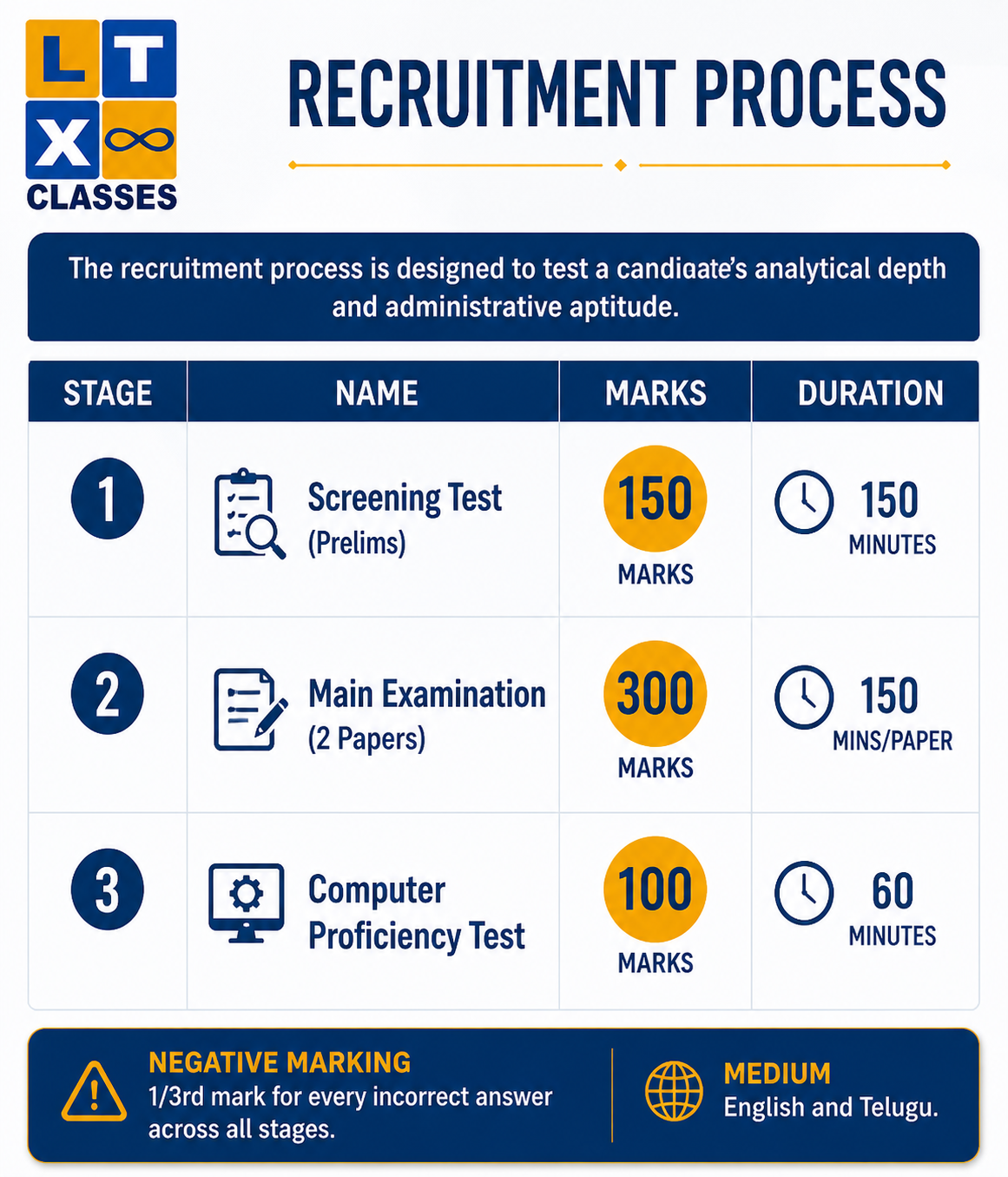
The recruitment process is designed to test a candidate's analytical depth and administrative aptitude.
Type: Objective (MCQs)
Negative Marking: 1/3rd mark for every incorrect answer across all stages.
Medium: English and Telugu.
The Prelims is a single paper consisting of 150 questions. It serves as a qualifying gate for the Mains.
1. Indian History (30 Marks)
Ancient History: Indus Valley Civilization; Vedic Age; Buddhism and Jainism; Mauryan Empire; Gupta Empire; Harshavardhana and his times.
Medieval History: The Chola Administration; Delhi Sultanate; Mughal Empire; Bhakti and Sufi Movements; Rise of Marathas; Advent of Europeans.
Modern History: 1857 Revolt and its impact; Rise and Consolidation of British Power in India; Social and Religious Reform Movements; Indian National Movement; Post-Independence Consolidation and Reorganization within the country.
2. Geography (30 Marks)
General and Physical Geography: Earth in our Solar System; Interior of the Earth; Major Landforms and their features; Climate: Structure and Composition of Atmosphere; Ocean Water: Tides, Waves, Currents; Drainage System.
Economic Geography of India and AP: Natural resources and their distribution; Agriculture and Agro-based activities; Distribution of major industries and major industrial regions. Transport, Communication, Tourism, and Trade.
Human Geography of India and AP: Human Development; Demographics; Urbanization and Migration; Racial, Tribal, Religious, and Linguistic groups.
3. Indian Society (30 Marks)
Structure of Indian Society: Family, Marriage, Kinship, Caste, Tribe, Ethnicity, Religion, and Women.
Social Issues: Casteism, Communalism and Regionalism, Crime against Women, Child Abuse and Child Labour, Youth Unrest and Agitation.
Welfare Mechanism: Public Policies and Welfare Programmes; Constitutional and Statutory Provisions for Scheduled Castes, Scheduled Tribes, Minorities, BCs, Women, Disabled, and Children.
4. Current Affairs (30 Marks)
Major Current Events and Issues pertaining to International, National, and the State of Andhra Pradesh.
5. Mental Ability (30 Marks)
Logical Reasoning: Statement and Assumptions, Statement and Argument, Statement and Conclusion, Statement and Courses of Action.
Mental Ability: Number Series, Letter Series, Odd Man Out, Coding-Decoding, Problems on Relations, Shapes and their Subsections.
Basic Numeracy: Number System, Order of Magnitude, Averages, Ratio and Proportion, Percentage, Simple and Compound Interest, Time and Work and Time and Distance. Data Analysis (Tables, Bar diagram, Line graph, Pie chart).
Total Marks: 300
Paper I (150 Marks)
Section A: Social and Cultural History of Andhra Pradesh (75 Marks)
Pre-historic Cultures: The Satavahanas, The Ikshvakus, The Vishnukundins, The Eastern Chalukyas of Vengi, Andhra Cholas — Society, Religion, Telugu Language, Art and Architecture.
Dynasties between 11th and 16th Centuries: Socio-Cultural and Religious conditions in Andhradesa between 11th to 16th Centuries A.D., Growth of Telugu Language and Literature, Art and Architecture.
Advent of Europeans: Rise and Consolidation of Company rule in Andhra; 1857 Revolt and its impact on Andhra; Establishment of British Rule; Socio-Cultural Awakening, Justice Party/Self Respect Movement; Nationalist Movement in Andhra between 1885 to 1947.
Origin and Growth of Andhra Movement: Role of Andhra Mahasabhas; Prominent Leaders; Events leading to the formation of Andhra State 1953; Role of Press and News Papers; Role of Library Movement and Folk Arts.
Events leading to the Formation of Andhra Pradesh State: Visalandhra Mahasabha; States Reorganization Commission and its Recommendations; Gentlemen’s Agreement; Important Social and Cultural Events between 1956 to 2014.
Section B: Indian Constitution (75 Marks)
Nature of Indian Constitution: Constitutional Development, Salient features, Preamble, Fundamental Rights, Directive Principles of State Policy and their relationship, Fundamental Duties, Amendment of the Constitution.
Structure and Functions of Indian Government: Legislative, Executive, and Judiciary.
Distribution of Powers: Legislative and Executive Powers between the Union and the States; Fundamental Provisions regarding the powers and functions of Constitutional Bodies.
Center-State Relations: Rajmannar Committee, Sarkaria Commission, Punchchi Commission; Role of NITI Aayog.
Decentralization: Community Development Programmes, 73rd and 74th Constitutional Amendments.
The CPT is qualifying in nature but mandatory for final selection. It assesses practical office automation skills.
Part A: Basics of Computers, Operating Systems (Windows/Linux), and Internet/Email.
Part B: Mastery of Office Suites (MS Word, Excel, and PowerPoint).
Qualifying Marks for CPT:
OCs: 40 Marks
BCs: 35 Marks
SC/ST/PH: 30 Marks
Strategic Tips for 2026 Aspirants
Focus on AP-Specific Content: In both Prelims and Mains, geography, history, and economy have significant weightage for Andhra Pradesh.
Practice Numeracy: With Mental Ability contributing 30 marks in Prelims, regular practice of Data Interpretation can be a scoring advantage.
Stay Updated: Since Science & Technology and Economy are dynamic, supplement your static notes with current developments from government reports and reliable news sources.
Note on Negative Marking: Be cautious with guesses; the 1/3rd penalty can significantly lower your score.
By aligning your preparation with this latest pattern, you can navigate the competitive landscape of the APPSC Group 2 2026 exam with confidence.
 Launch your Graphy