There are no items in your cart
Add More
Add More
| Item Details | Price | ||
|---|---|---|---|

The Civil Services Examination (CSE), conducted by the Union Public Service Commission (UPSC), is more than just an exam; it is a marathon of endurance, discipline, and intellectual depth. If you are eyeing a seat in the IAS, IPS, or IFS in 2027, the time to lay your foundation is now.
This guide breaks down th e essential pillars of the UPSC journey to help you navigate the 2027 cycle with precision.
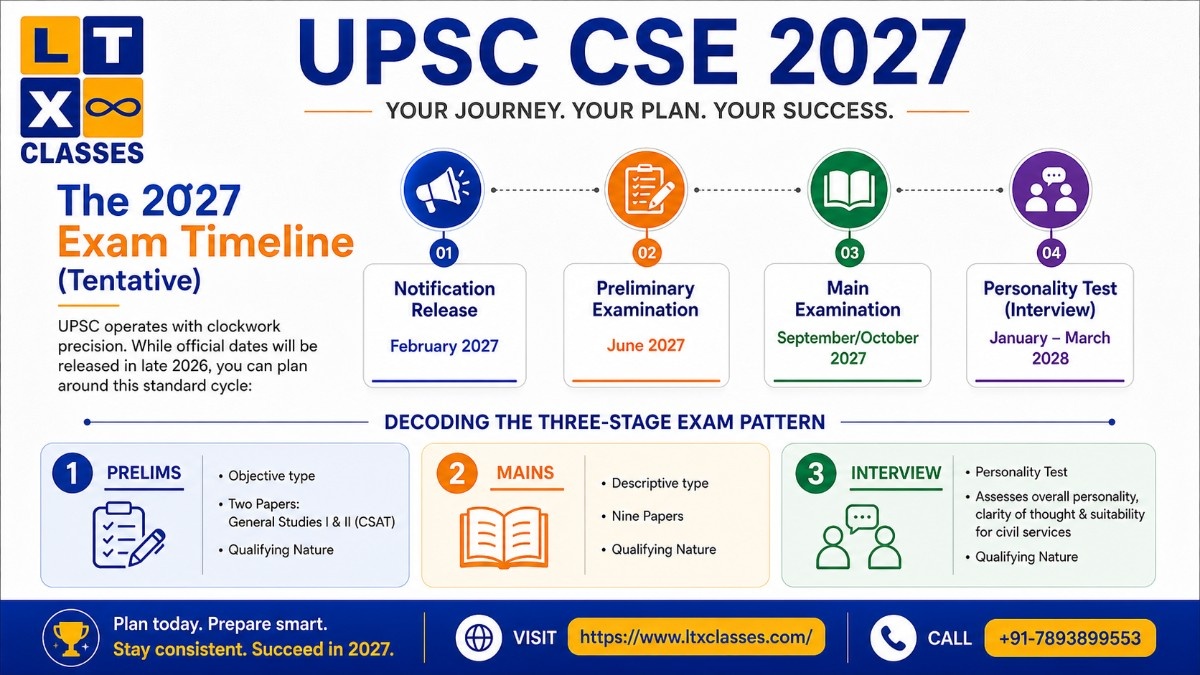
UPSC operates with clockwork precision. While official dates will be released in late 2026, you can plan around this standard cycle:
Decoding the Three-Stage Exam Pattern1. The Preliminary Examination (Objective)
The "filter" stage. It consists of two papers held on a single day.
General Studies (GS) Paper I: 100 questions (200 marks). This determines your cutoff for the Mains.
GS Paper II (CSAT): 80 questions (200 marks). This is qualifying; you only need 33% (66 marks) to pass.
2. The Main Examination (Descriptive)
The "rank-deciding" stage. It consists of 9 papers written over 5–7 days.
Qualifying Papers: Indian Language & English (300 marks each; marks not counted for merit).
Merit Papers (250 marks each): Essay, GS I, GS II, GS III, GS IV (Ethics), and two papers for your chosen Optional Subject.
3. The Personality Test (Interview)
A 275-mark conversation with a UPSC board to assess your personality, presence of mind, and suitability for a career in public service.
Syllabus Breakdown & Essential Resources
To succeed, you must move beyond rote learning and focus on conceptual clarity.Subject
Core Focus Areas
Recommended Sources
History
Ancient, Medieval, Modern, & Art/Culture
NCERTs (Class 6-12), Spectrum (Modern)
Polity
Constitution, Governance, & Panchayati Raj
Indian Polity by M. Laxmikanth
Economy
Macroeconomics, Budget, & Economic Survey
Indian Economy by Ramesh Singh or Nitin Singhania
Geography
Physical, Indian, & World Geography
NCERTs (Class 11 & 12), GC Leong
Environment
Biodiversity, Climate Change, & Laws
Shankar IAS Academy book
Ethics (GS IV)
Integrity, Case Studies, & Aptitude
Lexicon or G. Subba Rao
5-Step Strategy for 2027 Aspirants
1. Master the Syllabus FirstBefore buying books, print the official syllabus. It acts as your "North Star." If a news item doesn't relate to a syllabus keyword, don't waste time on it.
2. The NCERT Foundation
Spend the first 3-4 months reading NCERTs from Class 6 to 12. These books simplify complex concepts in Geography, History, and Science, ensuring you don't struggle with advanced textbooks later.
3. Integrated Current Affairs
UPSC no longer asks static questions in isolation.
Daily: Read The Hindu or The Indian Express.
Monthly: Follow a reliable magazine to consolidate news.
Linkage: If you read about a "Governor's Row" in the news, immediately revise the "Governor" chapter in your Polity book.
4. Choose Your Optional Wisely
The Optional subject accounts for 500 marks. Choose based on your interest and the availability of material, rather than just "scoring trends." Popular choices include Political Science, Sociology, Geography, and Anthropology.
5. Answer Writing & Mocks
Knowledge is useless in UPSC if you cannot express it within 150-250 words.
Mains: Start writing one answer daily for your mains preparation after you finish 25% of the syllabus.
Prelims: Solve Previous Year Questions (PYQs) to understand the "trap" options set by UPSC.
Pro-Tip for 2027
Consistency beats intensity. It is better to study for 6 hours every day for two years than to study 14 hours a day for two months and burn out.
"The IAS exam is not a test of your memory, but a test of your perspective on India and the world."
Start Your Journey with the Right Guidance
At LTX Classes, we support you through every stage of your preparation with structured learning and consistent mentorship. 📞 Call Us: +91 78938 99553
Address:
Plot No: 21, Sector – 3, MIG-1
MVP Colony, Near Gothisons
Visakhapatnam – 530017
 Launch your Graphy